Safety Protocols Implementation
Table of Contents
Safety protocols implementation is the systematic process of putting workplace safety policies, procedures, and preventive measures into practice. It ensures that safety requirements are not limited to written documents but are actively followed by employees, supervisors, contractors, and management. Effective implementation helps organizations identify hazards, control risks, prevent accidents, and create a safer working environment.
A successful safety program begins with identifying potential workplace hazards through inspections, risk assessments, and employee feedback. Once hazards are identified, organizations can establish appropriate controls, including safe operating procedures, personal protective equipment, training, emergency plans, equipment inspections, and workplace monitoring.
Safety protocols should also be communicated clearly to everyone involved in an organization’s operations. Employees need to understand their responsibilities, the risks associated with their work, and the procedures they must follow. Organizations such as the International Labour Organization (ILO) emphasize the importance of occupational safety and health systems in preventing workplace injuries and protecting workers.
Training is another essential element of implementation. Employees should receive appropriate instruction before performing hazardous tasks and should understand how to use equipment, recognize unsafe conditions, report incidents, and respond to emergencies. Regular refresher training can help reinforce safe practices and address changes in equipment, Safety Protocols Implementation processes, regulations, or workplace conditions.
Effective implementation also requires management commitment. Leaders should provide adequate resources, establish clear safety responsibilities, investigate incidents, and regularly evaluate whether safety procedures are working as intended. The Occupational Safety and Health Administration (OSHA) recommends a proactive approach to safety management that includes management leadership, worker participation, hazard identification, education, and continuous improvement.
Ultimately, safety protocols implementation is an ongoing process rather than a one-time activity. Organizations must regularly review procedures, monitor performance, learn from incidents and near misses, and make improvements when necessary. When safety becomes integrated into everyday operations, it can help reduce workplace risks while supporting productivity, employee confidence, regulatory compliance, and long-term operational reliability.
#SafetyCompliance
What Is Safety Protocols Implementation and Why Is It Important?
Safety protocols implementation is the process of putting an organization’s workplace safety policies, procedures, and preventive measures into practical use. It involves identifying hazards, assessing risks, establishing appropriate controls, training employees, Safety Protocols Implementation monitoring compliance, and continuously improving safety practices. The objective is to ensure that safety requirements become part of everyday operations rather than remaining only as written policies.
Effective implementation begins with understanding the specific risks associated with a workplace. These may include hazardous machinery, electrical systems, chemicals, working at height, manual handling, fire hazards, or other operational risks. Once hazards are identified, organizations can introduce appropriate control measures such as engineering controls, safe work procedures, personal protective equipment, warning systems, and emergency response plans.
Why Is Safety Protocols Implementation Important?
The primary importance of safety protocols implementation is preventing workplace injuries and incidents. Clearly defined and consistently applied Safety Protocols Implementation procedures help employees understand how to perform tasks safely and how to respond when unsafe conditions arise. The International Labour Organization (ILO) promotes occupational safety and health systems designed to prevent workplace accidents and protect workers.
Safety protocols also improve employee awareness and accountability. When workers receive appropriate training and understand their responsibilities, they are better positioned to identify hazards, report unsafe conditions, and follow established procedures. Employee involvement is an important part of effective safety management.
Another major benefit is improved regulatory compliance. Organizations must comply with occupational health and safety legislation, industry standards, Safety Protocols Implementation and applicable workplace requirements. A structured approach to safety implementation can help businesses demonstrate that reasonable measures are being taken to manage workplace risks. OSHA’s Recommended Practices for Safety and Health Programs highlights management leadership, worker participation, hazard identification, education, and continuous improvement as important components of effective safety programs.
Safety implementation can also contribute to operational efficiency. Preventing accidents, equipment damage, and work interruptions can reduce unexpected costs and downtime. Consistent procedures can also improve coordination between employees, supervisors, contractors, and management.
Ultimately, safety protocols implementation is an ongoing management process, not a one-time activity. Organizations should regularly review procedures, Safety Protocols Implementation conduct inspections, investigate incidents and near misses, provide refresher training, and update controls when workplace conditions change. By integrating safety into everyday decision-making, organizations can create a stronger safety culture while protecting employees, assets, and business operations.
#EmployeeSafety

How Can Organizations Identify Hazards and Establish Effective Safety Procedures?
Organizations can identify workplace hazards and establish effective safety procedures by using a systematic approach that combines hazard assessment, employee involvement, risk controls, training, and continuous monitoring. The goal is to identify potential sources of harm before an incident occurs and establish practical procedures that workers can consistently follow.
1. Conduct Regular Workplace Inspections
Regular inspections are an important starting point for hazard identification. Supervisors and safety professionals should examine work areas, machinery, tools, electrical systems, storage areas, emergency equipment, and working practices. Inspections should look for both obvious hazards and less visible risks, such as poor housekeeping, unsafe equipment conditions, inadequate ventilation, or unsuitable work practices.
2. Perform Risk Assessments
After identifying hazards, organizations should assess the likelihood and potential severity of the associated risks. This helps determine which hazards require Safety Protocols Implementation immediate attention and which controls should be implemented first. Risk assessments should be reviewed whenever equipment, processes, materials, or workplace conditions change.
The Occupational Safety and Health Administration (OSHA) recommends incorporating hazard identification and assessment into an effective safety and health management program.
3. Involve Employees
Employees are often among the best sources of information about workplace hazards because they directly perform operational tasks. Organizations should encourage workers to report unsafe conditions, near misses, and potential hazards without fear of retaliation. Safety Protocols Implementation Employee participation can help identify practical risks that may not be obvious during formal inspections.
4. Establish Appropriate Safety Controls
Once risks have been assessed, organizations should establish suitable control measures. The National Institute for Occupational Safety and Health (NIOSH) recommends using the hierarchy of controls, which prioritizes elimination and substitution before engineering controls, administrative controls, and personal protective equipment.
Safety procedures should clearly explain how tasks must be performed, what hazards workers may encounter, which controls must be used, and what actions should be taken during an emergency.
5. Provide Training and Communication
Written procedures are effective only when employees understand and follow them. Organizations should provide task-specific safety training and ensure workers understand equipment requirements, emergency procedures, reporting processes, and their individual responsibilities.
6. Monitor and Improve Procedures
Safety procedures should be reviewed regularly through inspections, audits,Safety Protocols Implementation incident investigations, and employee feedback. Near misses should also be analyzed because they can reveal weaknesses before a serious incident occurs.
Ultimately, effective hazard identification and safety procedure development should be treated as an ongoing improvement process. By identifying risks proactively, involving employees, applying appropriate controls, providing effective training, and regularly reviewing performance, organizations can create safer workplaces while improving operational reliability Safety Protocols Implementation and compliance.
#IndustrialSafety
What Role Does Employee Training Play in Implementing Safety Protocols?
Employee training is a fundamental part of implementing workplace safety protocols because it transforms written policies and procedures into practical, everyday safety practices. Even well-designed safety procedures cannot effectively protect employees if workers do not understand the hazards involved, know the required controls, or have the skills needed Safety Protocols Implementation to perform their tasks safely.
Building Safety Awareness
Training helps employees understand the risks associated with their jobs and recognize potentially unsafe conditions. Workers can learn how to identify hazards, use equipment correctly, follow safe work procedures, and report unsafe situations. Safety Protocols Implementation This awareness allows employees to take a more proactive role in preventing workplace incidents.
Developing Practical Skills
Safety training should go beyond theoretical information. Employees need practical instruction relevant to their specific responsibilities. Depending on the workplace, this may include machinery operation, personal protective equipment, chemical handling, Safety Protocols Implementation working at height, electrical safety, manual handling, fire response, or emergency procedures.
The Occupational Safety and Health Administration (OSHA) identifies education and training as important elements of an effective safety and health program. Training should help workers understand both the hazards they may encounter and the measures used to control those hazards.
Supporting Consistent Procedures
Organizations often have different teams, shifts, contractors, and supervisors working across the same operation. Consistent training helps ensure that everyone understands the organization’s safety expectations and follows Safety Protocols Implementation established procedures in a similar manner. This reduces confusion and helps create standardized working practices.
Improving Emergency Preparedness
Employee training is particularly important during emergencies because workers may need to respond quickly. Emergency training can cover evacuation procedures, emergency communication, fire response, first aid arrangements, alarm systems, and reporting Safety Protocols Implementation requirements. Regular drills can help employees become familiar with their responsibilities before an actual emergency occurs.
Encouraging Employee Participation
Training can also strengthen an organization’s safety culture. When employees understand why procedures exist, they are more likely to participate in hazard reporting, safety meetings, inspections, and improvement initiatives. The International Labour Organization (ILO) emphasizes the importance of effective occupational safety and health systems for protecting workers and preventing workplace harm.
Supporting Continuous Improvement
Safety training should not be considered a one-time activity. Refresher training, toolbox talks, competency assessments, and additional instruction Safety Protocols Implementation should be provided when procedures, equipment, regulations, or workplace conditions change.
Ultimately, employee training provides the knowledge and practical competence required to make safety protocols effective. By combining appropriate training with clear procedures, strong supervision, employee participation, and regular evaluation, organizations can develop a stronger safety culture and reduce preventable workplace risks.
#SafetyTraining
How Can Organizations Monitor Compliance and Improve Workplace Safety Practices?
Organizations can monitor safety compliance and improve workplace practices by establishing clear standards, regularly measuring performance, involving employees, and using findings from inspections and incidents to strengthen existing controls. Effective safety management is an ongoing process that requires organizations to identify weaknesses and take corrective action before they result in serious incidents.
1. Conduct Regular Safety Inspections
Routine workplace inspections help organizations determine whether employees are following established safety procedures. Supervisors and safety professionals can inspect equipment, work areas, personal protective equipment, emergency systems, housekeeping, and operating practices. Findings should be documented and assigned to responsible personnel for corrective action.
2. Perform Safety Audits
Safety audits provide a more structured evaluation of whether workplace policies and regulatory requirements are being followed. Audits can examine training records, inspection documentation, risk assessments, permits, maintenance records, and employee practices.
The Occupational Safety and Health Administration (OSHA) recommends regularly evaluating safety and health programs to identify opportunities for improvement.
3. Track Safety Performance Indicators
Organizations should establish measurable safety indicators to monitor performance. These may include reported hazards, near misses, inspection findings, corrective-action completion rates, training completion, equipment inspection results, and incident trends. Leading indicators can help identify potential problems before an injury or major incident occurs.
4. Encourage Hazard and Near-Miss Reporting
Employees should have accessible ways to report hazards, unsafe practices, and near misses. A strong reporting culture allows management to identify weaknesses that may not be discovered through formal inspections. Reports should be investigated objectively, with corrective actions focused on preventing recurrence rather than simply assigning blame.
5. Provide Corrective and Preventive Actions
Identifying a problem is only the first step. Organizations should determine the underlying cause, implement appropriate corrective measures, and verify that those measures are effective. The National Institute for Occupational Safety and Health (NIOSH) recommends prioritizing stronger controls, such as eliminating hazards or using engineering controls, rather than relying primarily on administrative measures or personal protective equipment.
6. Review and Update Safety Procedures
Workplace conditions change as organizations introduce new equipment, processes, materials, technologies, and working arrangements. Safety procedures should therefore be reviewed regularly and updated when necessary. Employees should receive appropriate training whenever significant changes are introduced.
7. Build a Culture of Continuous Improvement
Effective compliance monitoring should not be viewed simply as an administrative requirement. Management should use inspection results, audit findings, employee feedback, incident investigations, and performance data to continuously improve safety practices.
Ultimately, organizations can strengthen workplace safety by combining regular inspections, audits, performance monitoring, employee participation, corrective actions, and continuous improvement. This proactive approach helps organizations identify risks earlier, improve compliance, protect employees, and create a stronger and more sustainable workplace safety culture.
#RiskManagement
What Are the Benefits of Effective Safety Protocols Implementation for Employees, Operations, and Regulatory Compliance?
Effective safety protocols implementation provides organizations with a structured approach to identifying hazards, controlling risks, protecting employees, and maintaining safe working conditions. When safety procedures are properly implemented and consistently followed, the benefits extend beyond accident prevention. They can improve operational reliability, employee confidence, productivity, and compliance with applicable safety requirements.
Benefits for Employees
The primary benefit is improved protection for employees. Clearly defined safety procedures help workers understand workplace hazards and the controls required to manage them. Proper training, personal protective equipment, emergency procedures, and safe operating practices can reduce exposure to preventable risks.
Effective safety programs can also improve employee confidence and participation. When workers see that management takes safety seriously, they may be more willing to report hazards, near misses, and unsafe conditions. The International Labour Organization (ILO) recognizes effective occupational safety and health systems as an important means of protecting workers and preventing workplace harm.
Benefits for Operations
Safety protocols can contribute directly to operational efficiency. Workplace incidents can result in injuries, equipment damage, investigations, production delays, and unplanned costs. Preventing these events can help organizations maintain more consistent operations.
Standardized safety procedures also provide employees with clear instructions for performing tasks. This can reduce uncertainty, improve coordination between teams, and support more consistent work practices. Regular inspections and preventive maintenance can further help identify equipment problems before they lead to operational disruptions.
A strong safety management approach can also support continuous improvement. Organizations can use inspection findings, incident investigations, near-miss reports, and employee feedback to identify weaknesses and strengthen their processes.
Benefits for Regulatory Compliance
Effective safety protocols help organizations demonstrate that they are actively managing workplace risks and meeting applicable legal and regulatory requirements. Depending on the industry and location, organizations may need to maintain appropriate training records, risk assessments, inspections, emergency procedures, incident documentation, and other safety-related records.
OSHA’s Safety and Health Programs recommends management leadership, worker participation, hazard identification, education and training, and program evaluation as components of an effective workplace safety program.
Long-Term Organizational Benefits
Beyond immediate safety improvements, effective implementation can contribute to a stronger safety culture and improved organizational reputation. Consistent safety practices demonstrate that employee wellbeing and responsible operations are organizational priorities.
Ultimately, effective safety protocols implementation benefits employees by reducing workplace risks, operations by improving reliability and efficiency, and organizations by supporting regulatory compliance and continuous improvement. When safety is integrated into everyday decision-making rather than treated as a separate requirement, it becomes an important foundation for sustainable and responsible business performance.
#OccupationalSafety
Case Study of Safety Protocols Implementation
A practical approach to safety protocols implementation can be illustrated through a manufacturing company that identified recurring workplace hazards during routine operations. Although the company had written safety policies, management recognized that procedures were not being applied consistently across all departments. This created unnecessary risks for employees and could potentially affect productivity and regulatory compliance.
Identifying Workplace Hazards
The company began by conducting comprehensive workplace inspections and risk assessments. Supervisors, safety professionals, and employees reviewed machinery, workstations, electrical systems, material-handling activities, emergency equipment, and personal protective equipment requirements.
Employee participation was particularly valuable because workers were able to identify unsafe practices that were not always visible during formal inspections. Near-miss reports and previous incident records were also reviewed to identify recurring patterns.
Implementing Safety Procedures
Based on the findings, the company introduced updated procedures for high-risk activities. These included machine operation, equipment inspection, emergency response, material handling, and reporting unsafe conditions.
The organization also applied the NIOSH Hierarchy of Controls when selecting risk-control measures. Where possible, hazards were addressed through elimination, substitution, or engineering controls before relying on administrative measures and personal protective equipment.
Employee Training and Communication
The updated procedures were supported by employee training. Workers received task-specific instruction explaining the hazards associated with their responsibilities, required control measures, emergency procedures, and reporting expectations.
Supervisors also conducted regular safety meetings and toolbox discussions to reinforce key requirements. New employees and contractors were required to receive appropriate safety orientation before beginning work.
Monitoring Compliance
Implementation did not end after the new procedures were introduced. The company established routine inspections and periodic safety audits to determine whether procedures were being followed. Employees were encouraged to report hazards and near misses, while supervisors monitored corrective actions to ensure identified problems were resolved.
This approach is consistent with the principles described by OSHA’s Recommended Practices for Safety and Health Programs, which emphasize management leadership, worker participation, hazard identification, education and training, and program evaluation.
Results and Lessons Learned
Over time, the organization developed greater consistency in workplace safety practices. Employees became more involved in hazard reporting, supervisors gained better visibility into safety performance, and management was able to identify areas requiring additional controls or training.
The case demonstrates that effective safety protocols implementation requires more than creating written policies. Hazard identification, employee participation, appropriate controls, training, monitoring, and continuous improvement must work together.
The key lesson for organizations is that safety implementation should be treated as an ongoing management process. Regular evaluation and employee feedback allow procedures to evolve as workplace conditions, equipment, regulations, and operational requirements change. This approach can help organizations protect employees while supporting reliable operations and stronger safety performance.
#SafetyManagement
White Paper: Safety Protocols Implementation
Executive Summary
Safety protocols implementation is the process of converting workplace safety policies, procedures, and risk controls into consistent day-to-day practices. An effective approach requires more than creating written rules. Organizations must identify hazards, assess risks, establish appropriate controls, train employees, monitor compliance, and continuously improve their safety systems.
The International Labour Organization (ILO) describes occupational safety and health management as a systems-based process involving policy, organization, planning and implementation, evaluation, and action for improvement.
This white paper examines the key principles of safety protocols implementation and explains how organizations can create a practical framework that protects employees while supporting operational reliability and regulatory compliance.
1. Introduction
Every workplace contains potential hazards. These may involve machinery, chemicals, electrical systems, vehicles, working at height, manual handling, fire, environmental conditions, or specific industry-related activities. Without appropriate controls, these hazards can result in injuries, occupational illness, equipment damage, operational disruption, and financial losses.
Effective safety protocols provide employees with clear guidance on how work should be performed and how risks should be controlled. However, their effectiveness depends on implementation. A procedure that exists only in a safety manual does not provide meaningful protection unless employees understand it and apply it consistently.
The ILO emphasizes that hazard identification, risk assessment, and risk control are key principles in establishing a safe and healthy workplace.
2. Core Elements of Safety Protocols Implementation
A strong implementation strategy should integrate several connected elements.
Management Leadership
Senior management must demonstrate visible commitment to workplace safety by establishing objectives, allocating resources, defining responsibilities, and supporting corrective actions. Safety should be integrated into operational and business decisions rather than treated as a separate administrative function.
Hazard Identification and Risk Assessment
Organizations should systematically identify hazards through workplace inspections, job hazard analyses, employee feedback, incident investigations, and review of operational changes. Risks should then be evaluated according to factors such as potential severity, likelihood, and worker exposure.
OSHA’s hazard identification guidance recommends evaluating identified hazards, prioritizing risks, and establishing interim controls where necessary while permanent solutions are developed.
Hazard Prevention and Control
After risks are identified, organizations should select appropriate controls. The NIOSH Hierarchy of Controls establishes a preferred order: elimination, substitution, engineering controls, administrative controls, and personal protective equipment. Elimination and substitution are generally more effective because they reduce hazards with less dependence on individual behavior.
Education and Training
Employees need training that is relevant to their specific roles and workplace hazards. Training should cover safe work procedures, hazard recognition, control measures, equipment use, emergency response, and reporting requirements.
OSHA recommends training workers on hazard identification and controls and providing additional training when facilities, equipment, processes, materials, or work assignments change.
Worker Participation
Employees should be actively involved in identifying hazards, developing practical controls, reporting concerns, and evaluating safety procedures. Workers often have direct knowledge of operational risks that may not be apparent to management.
OSHA notes that meaningful worker participation can improve the identification of workplace hazards and contribute to better design, implementation, and evaluation of safety programs.
3. Implementing Safety Protocols in Practice
A practical implementation process can follow a continuous cycle:
Identify → Assess → Control → Train → Monitor → Improve
First, organizations identify workplace hazards and determine which risks require attention. Appropriate controls and procedures are then developed and communicated to employees. Workers receive the necessary training before performing relevant tasks.
Implementation should subsequently be monitored through workplace inspections, safety observations, audits, incident investigations, and employee feedback. Where deficiencies are identified, corrective actions should be assigned, completed, and verified.
OSHA recommends evaluating whether controls are operating effectively, confirming that work practices and PPE requirements are followed, and involving workers in evaluating controls.
4. Monitoring Compliance and Measuring Performance
Monitoring helps determine whether safety protocols are working in practice. Organizations can track both leading and lagging indicators.
Leading indicators may include training completion, safety inspections, hazard reports, near-miss reporting, preventive maintenance, and corrective-action completion. Lagging indicators may include injury rates, lost-time incidents, equipment damage, and other incident outcomes.
Using multiple indicators provides a broader picture of safety performance and can help organizations identify problems before they result in serious incidents.
OSHA provides tools for safety-program evaluation, audits, implementation checklists, and leading indicators.
5. Continuous Improvement
Safety protocols should evolve as workplace conditions change. New machinery, processes, materials, technologies, regulations, contractors, or organizational structures can introduce new risks.
The ILO-OSH 2001 guidelines promote continual improvement of occupational safety and health performance and encourage organizations to integrate safety management into broader management arrangements.
Incident and near-miss investigations should therefore focus not only on what happened but also on why existing controls failed or were insufficient. Lessons learned can then be incorporated into procedures, training, risk assessments, and future planning.
6. Benefits to Organizations
Effective safety protocols implementation provides several benefits. For employees, it can reduce exposure to workplace hazards and improve awareness of safe working practices. For operations, effective controls can help reduce incidents, equipment damage, downtime, and disruptions.
A systematic approach can also strengthen regulatory compliance by providing evidence that an organization has established processes for identifying and controlling workplace risks. The ILO notes that occupational safety and health management systems can be integrated into business planning and can support continual improvement.
Strong safety practices can additionally contribute to employee confidence, organizational reputation, and long-term operational resilience.
7. Key Challenges
Organizations may encounter several barriers when implementing safety protocols. These include inadequate management commitment, insufficient training, poor communication, outdated procedures, limited resources, inconsistent supervision, and weak employee participation.
Another challenge is treating compliance as a documentation exercise. Excessive focus on forms and records without verifying actual workplace conditions can create a gap between documented procedures and real-world practices.
Successful implementation therefore requires practical procedures, active leadership, employee involvement, effective communication, and regular evaluation.
8. Conclusion
Safety protocols implementation is an ongoing organizational process that connects policies with actual workplace behavior. Effective implementation requires management leadership, systematic hazard identification, appropriate risk controls, employee training, worker participation, compliance monitoring, and continuous improvement.
Organizations should view safety as an integral part of operational management rather than a standalone requirement. By establishing a structured system and regularly evaluating its effectiveness, businesses can strengthen workplace protection, improve operational reliability, and support compliance with applicable requirements.
Ultimately, the most effective safety protocol is one that employees understand, managers support, and the organization consistently applies, measures, and improves.
#WorkplaceSafety
Industry Application of Safety Protocols Implementation
Safety protocols implementation is essential across industries where employees, equipment, materials, and operational processes may be exposed to workplace hazards. While the specific procedures vary according to the nature of each industry, the fundamental objective remains the same: identify risks, establish effective controls, train employees, and ensure that safety requirements are consistently followed.
Manufacturing Industry
Manufacturing facilities use safety protocols to control risks associated with machinery, electrical systems, chemicals, material handling, and production processes. Organizations implement machine guarding, lockout/tagout procedures, personal protective equipment requirements, emergency response plans, and routine inspections. Effective implementation helps protect employees while reducing equipment damage and production interruptions.
Construction Industry
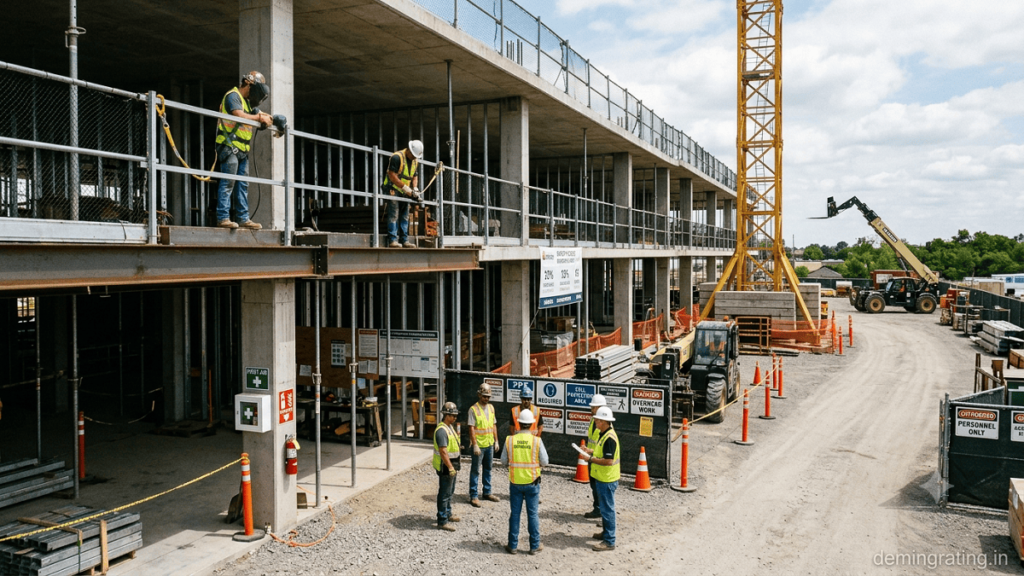
Construction sites involve constantly changing hazards, including working at height, excavation, heavy machinery, electrical systems, and falling objects. Safety protocols are implemented through site-specific risk assessments, permit systems, equipment inspections, toolbox talks, fall-protection measures, and worker training. The International Labour Organization (ILO) provides occupational safety and health information relevant to construction activities.
Oil and Gas Industry
Oil and gas operations require rigorous safety protocols because workers may encounter hazardous substances, high-pressure systems, fire and explosion risks, confined spaces, and complex lifting operations. Safety implementation can include permit-to-work systems, emergency response procedures, process safety controls, gas monitoring, equipment inspections, and competency-based training.
Healthcare Industry
Healthcare organizations implement safety protocols to protect patients, healthcare workers, and visitors. These include infection prevention, biological hazard controls, safe handling of medical equipment, chemical safety, emergency procedures, and appropriate personal protective equipment. The World Health Organization (WHO) provides guidance concerning occupational health and workplace risks in healthcare and other sectors.
Transportation and Logistics
Warehouses, ports, distribution centers, and transportation operations face hazards involving vehicles, forklifts, loading activities, manual handling, and stored materials. Safety protocols can include traffic-management systems, equipment inspections, loading procedures, pedestrian controls, and employee training.
Energy and Utilities
Power generation and utility operations require strict controls for electrical hazards, high-energy systems, working at height, confined spaces, and equipment maintenance. Organizations use procedures such as isolation and lockout/tagout, permit systems, inspections, emergency planning, and competency assessments to control these risks.
Across all these industries, successful safety implementation depends on management commitment, employee participation, hazard identification, appropriate risk controls, effective training, monitoring, and continuous improvement. OSHA’s Safety and Health Program Management Guidelines similarly emphasizes management leadership, worker participation, hazard identification, education and training, and program evaluation.
Ultimately, safety protocols must be adapted to the specific risks and regulatory requirements of each industry. When organizations integrate safety into everyday operations rather than treating it as a separate compliance activity, they can create safer workplaces while improving operational reliability, employee confidence, and long-term business performance.
#SafetyProtocols
Ask FAQs
What is Safety Protocols Implementation?
Safety Protocols Implementation is the process of putting workplace safety policies, procedures, risk controls, and preventive measures into practice to protect employees and maintain safe operations.
Why is Safety Protocols Implementation important?
It helps organizations identify and control workplace hazards, reduce accidents and injuries, improve employee awareness, support regulatory compliance, and maintain efficient operations.
How can organizations implement safety protocols effectively?
Organizations should conduct risk assessments, establish clear procedures, provide employee training, supply appropriate safety equipment, monitor compliance, investigate incidents, and regularly update safety measures.
What role does employee training play in safety implementation?
Training ensures employees understand workplace hazards, safety procedures, equipment requirements, emergency responses, and their individual responsibilities. Regular training also helps maintain competency when processes or workplace conditions change.
How can organizations measure the effectiveness of safety protocols?
Organizations can use workplace inspections, safety audits, incident and near-miss reports, training records, corrective-action tracking, employee feedback, and safety performance indicators to evaluate and continuously improve their safety programs.
Here’s a concise disclaimer suitable for your blog:
Disclaimer: This content is for general educational purposes only and does not replace applicable laws, regulations, industry standards, employer procedures, or professional safety guidance. Always follow the requirements relevant to your specific workplace and industry.