
Mukesh Kumar Singh
- Mukesh Kumar Singh
- Chapter 1 – The Beginning of a Quality-Driven Journey
- Chapter 2 – Understanding ISO 9001 and the Meaning of Quality
- Chapter 3 – Lean Thinking and the Power of Six Sigma
- Chapter 4 – Expanding Beyond Quality: Environment and Occupational Safety
- Chapter 5 – Information Security and the Modern Management System
- Chapter 6 – Laboratory Competence, Accreditation and Technical Confidence
- Chapter 7 – Continuous Learning Through Standards and Professional Development
- Chapter 8 – Building Professional Value Through Integrated Expertise
- Chapter 9 – From Certification to Organizational Excellence
- Chapter 10 – The Road Ahead: A Legacy of Quality, Learning and Continuous Improvement
- Take the Next Step Today

Chapter 1 – The Beginning of a Quality-Driven Journey
Every professional journey begins with a vision. Some journeys start with a business idea, some with a desire to acquire knowledge, and others with a commitment to create value through specialized expertise. The journey of Mukesh Kumar Singh, associated with 107/108 Mehta Chambers, Station Road, Vasai (West), District Palghar, Maharashtra – 401202, represents a professional path built around quality management, auditing, process improvement, training, and continuous learning.
The foundation of this journey can be connected with the philosophy of ISO 9001, one of the world’s most recognized quality-management standards. ISO 9001 provides organizations with a systematic framework for managing processes, understanding customer requirements, controlling operations, monitoring performance, addressing problems, and pursuing continual improvement. For a professional working in quality and management systems, understanding these principles can become the beginning of a much larger career.
Quality is not limited to inspecting a finished product. True quality begins much earlier, with planning, competence, resources, process control, communication, risk management, and customer understanding. This broader perspective creates opportunities for professionals who are willing to study how organizations actually function.
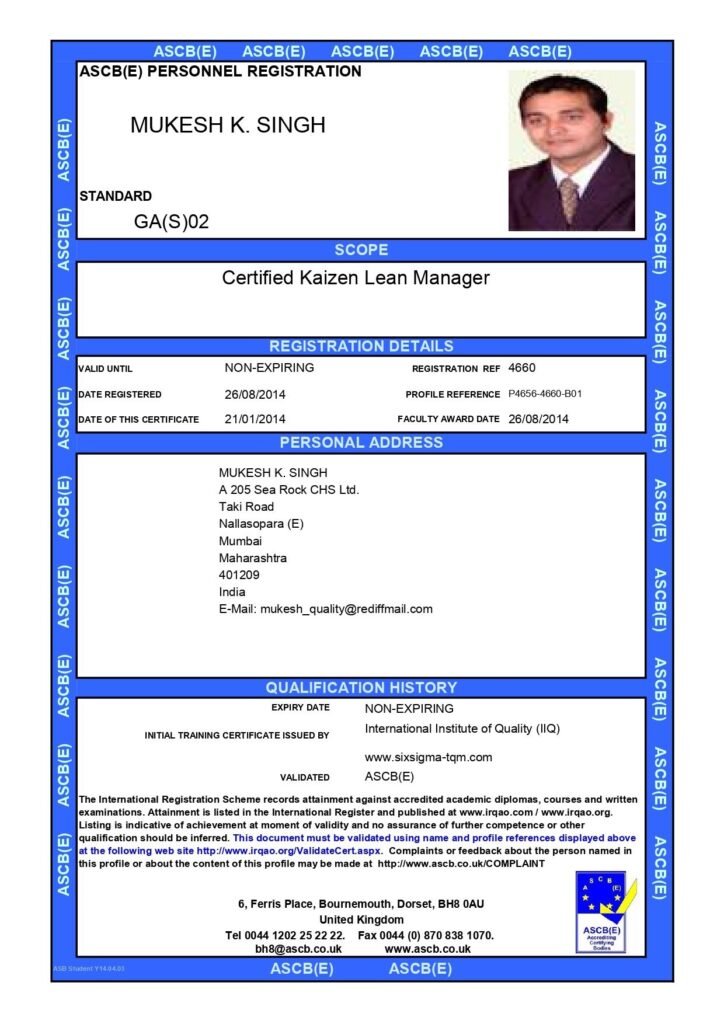
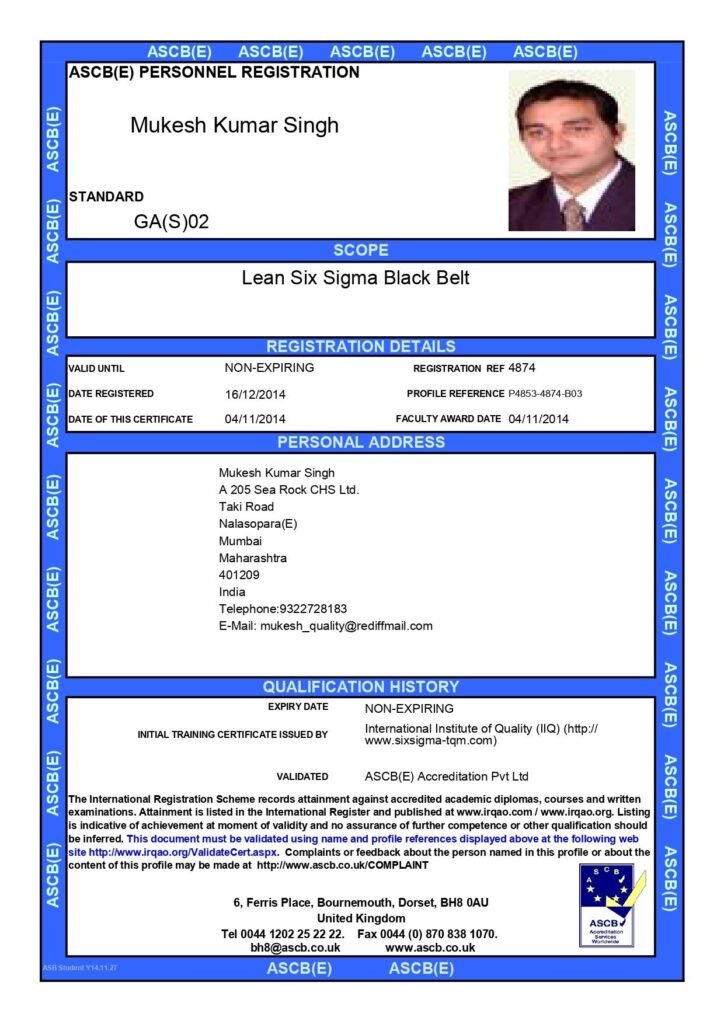
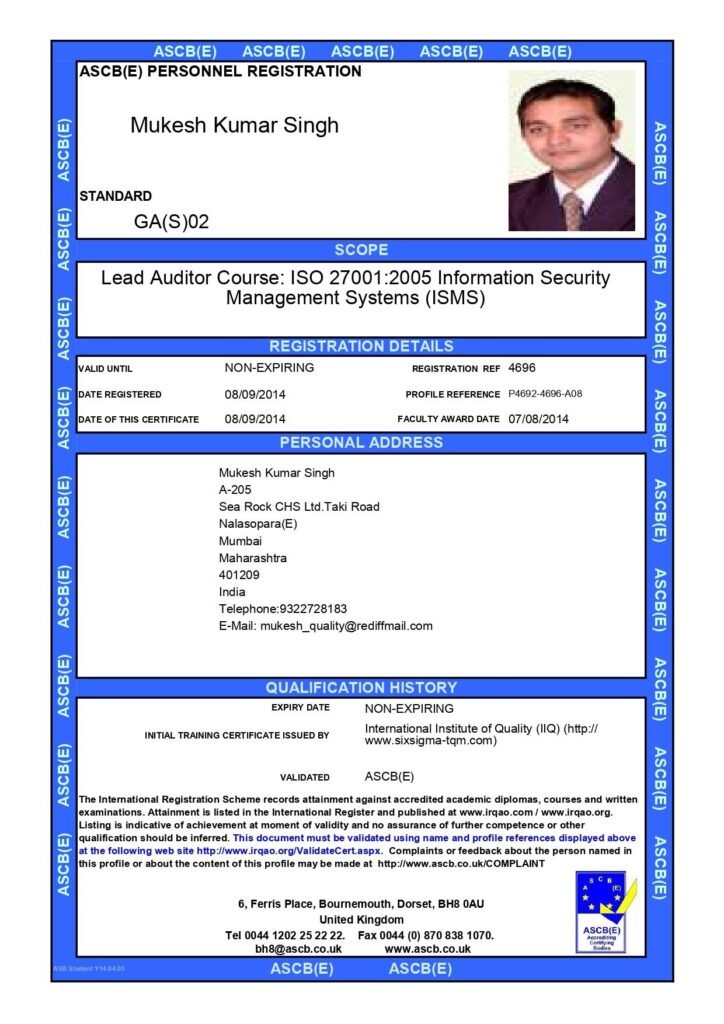
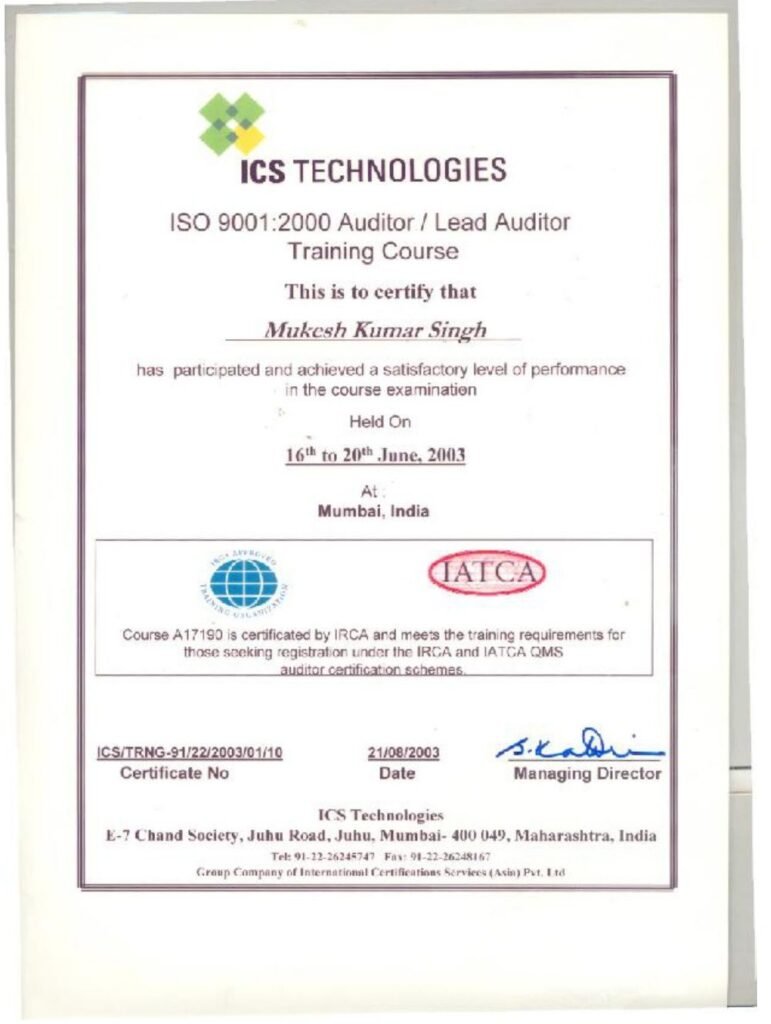
The professional development journey associated with Mukesh Kumar Singh gradually expanded across several important areas. These included Certified Kaizen Lean Manager, Lean Six Sigma Black Belt, Lead Auditor Course, Auditor/Lead Auditor Training Course, EMS Auditor Conversion Training Course, Information Security Management Systems Auditor/Lead Auditor Training Course, Laboratory Competence as per ISO/IEC 17025:2005 and aspects of Internal Audit, National Accreditation Board for Certification Bodies, Six Sigma Master Black Belt Training Course, ISO 9001:2015 Upgrade Training Course, ISO 45001:2018 Upgrade Training Course, and 5S Lead Auditor Training Course.
Each area added another dimension to the understanding of organizational performance.
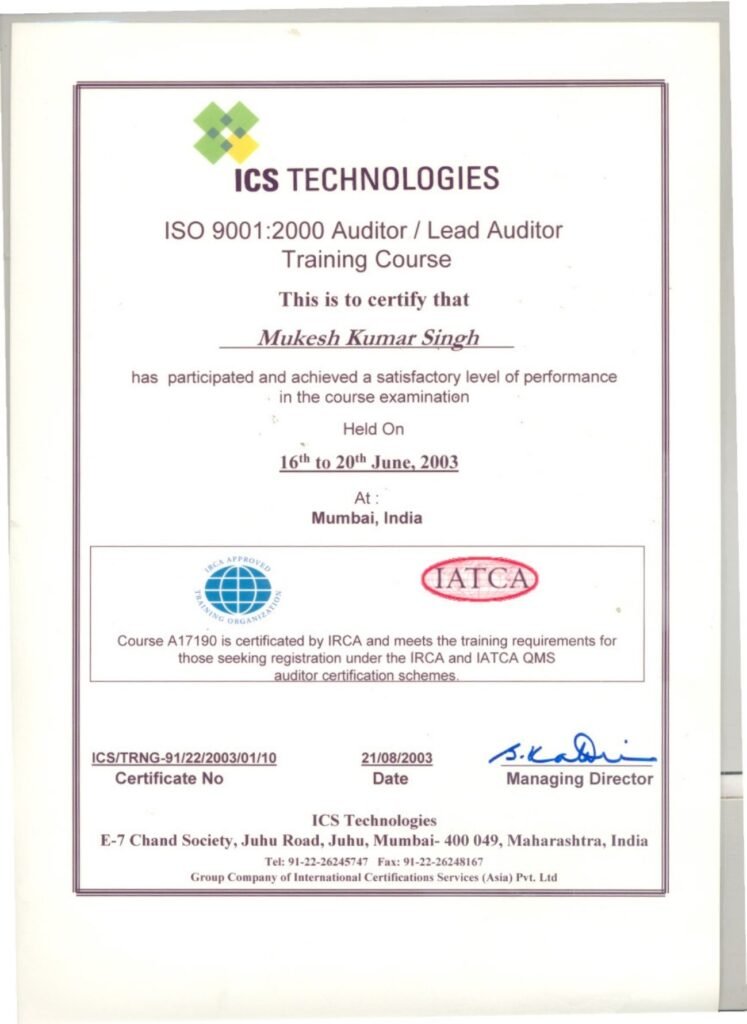
The early association with ISO 9001:2000 provided an important foundation. It encouraged systematic thinking about processes and quality objectives. As organizations evolved, the transition toward ISO 9001:2015 introduced stronger emphasis on organizational context, leadership, risks and opportunities, process-based thinking, performance evaluation, and continual improvement. Keeping pace with these changes became an essential part of professional development.
For Mukesh Kumar Singh, the journey was therefore not about treating certification as the final destination. Instead, certification and training could serve as a platform for acquiring deeper expertise.
The addition of Lean Six Sigma Black Belt knowledge strengthened the focus on process improvement. Lean thinking emphasizes the elimination of waste and activities that do not create value, while Six Sigma provides structured approaches for reducing variation and improving process performance. Together, they provide organizations with methods for achieving more consistent and efficient results.
The Certified Kaizen Lean Manager area added another important philosophy: continuous improvement through practical and sustained changes. Kaizen encourages people at different levels of an organization to identify opportunities for improvement and implement them step by step.
Auditing became another major part of the professional journey. Through Lead Auditor Course and Auditor/Lead Auditor Training Course, the focus expanded from understanding requirements to evaluating whether systems were actually implemented and effective.
An auditor must look beyond documents. Policies and procedures may explain how a process should work, but objective evidence must demonstrate what is actually happening. This requires observation, questioning, record review, process understanding, communication, and professional judgment.
The broader professional scope also included ISO 27001:2005 Information Security Management Systems, reflecting the increasing importance of information protection. Modern organizations depend heavily on information, digital systems, databases, communications, and technology. Understanding information-security management therefore became another valuable component of the quality professional’s knowledge.
Similarly, ISO/IEC 17025:2005 introduced the specialized field of laboratory competence. Laboratories must generate reliable and technically valid results, making competence, equipment, methods, records, measurement processes, and internal audits particularly important.
The journey also covered ISO 45001:2018, highlighting occupational health and safety, as well as ISO 50001:2011, which relates to energy management. These areas demonstrated that organizational excellence extends beyond product quality. A mature organization must consider employee safety, environmental responsibilities, resource efficiency, information security, customer expectations, and operational effectiveness.
Another important aspect was ISO 22163:2017, a sector-specific quality-management standard associated with the railway industry. Exposure to such specialized requirements illustrates how quality-management principles can be adapted to different industrial environments.
The collection of professional knowledge can therefore be seen as an interconnected system rather than a list of separate courses.
ISO 9001 establishes a foundation for quality.
Lean focuses on eliminating waste.
Six Sigma focuses on variation and structured improvement.
Auditing evaluates conformity and effectiveness.
ISO 27001 addresses information-security management.
ISO/IEC 17025 addresses laboratory competence.
ISO 45001 addresses occupational health and safety.
ISO 50001 addresses energy management.
5S supports workplace organization and discipline.
Accreditation-related knowledge strengthens understanding of conformity-assessment systems.
Together, these disciplines contribute to a broader vision of organizational excellence.
The real growth after the quality-management foundation was therefore professional rather than merely administrative. Knowledge expanded, technical understanding became broader, and the ability to look at organizations from different perspectives increased.
This journey demonstrates an important principle: quality certification can be the beginning of professional transformation rather than the end of it.
A certificate may establish that a particular learning milestone has been achieved, but continued training, practical application, auditing experience, process improvement, and knowledge sharing are what build lasting professional capability.
The story of Mukesh Kumar Singh begins with this philosophy—a commitment to understand quality, develop specialized knowledge, and continuously expand the ability to contribute to better systems and better organizational performance.
From the professional base at Vasai (West), this journey represents the beginning of a larger pursuit: transforming quality knowledge into practical capability and using continuous improvement as a foundation for long-term professional growth.
Quality provided the foundation. Learning expanded the vision. Continuous improvement became the direction.
#ISO9001
Chapter 2 – Understanding ISO 9001 and the Meaning of Quality

The journey toward professional excellence becomes meaningful when quality is understood not merely as a certificate, but as a systematic way of thinking and working. For Mukesh Kumar Singh, the foundation created through ISO 9001 provided an opportunity to explore the deeper relationship between quality, processes, customer expectations, management responsibility, and continual improvement.
ISO 9001 has become one of the most widely recognized frameworks for quality management. Its fundamental purpose is to help organizations consistently provide products and services that meet customer and applicable requirements while continually improving their processes and performance. For a quality professional, however, understanding ISO 9001 goes beyond knowing individual clauses. It requires understanding how the requirements can be translated into practical organizational activities.
The professional journey associated with Mukesh Kumar Singh included exposure to ISO 9001:2000 as well as ISO 9001:2015. These editions represent different stages in the development of quality-management thinking. The earlier approach established important foundations around documented procedures, quality objectives, responsibilities, process controls, records, corrective actions, and customer satisfaction. Over time, quality management evolved toward a more integrated approach based on organizational context, leadership, risk-based thinking, process management, and performance evaluation.
This evolution created an important lesson: quality systems must evolve with organizations.
A business cannot remain successful simply by maintaining the same procedures year after year. Markets change, technologies develop, customers become more demanding, competition increases, and risks become more complex. A quality-management system therefore needs to remain relevant to the organization’s current environment.
This is where the concept of continual improvement becomes important.
For Mukesh Kumar Singh, the professional development associated with ISO 9001 was not limited to understanding the standard itself. It developed a broader perspective about how organizations function. Every organization contains interconnected processes. Sales communicates with customers. Purchasing interacts with suppliers. Production depends on materials and resources. Quality evaluates performance. Human resources develops competence. Management establishes objectives and direction.
When one process performs poorly, other processes can also be affected.
For example, inaccurate customer requirements can create production problems. Poor purchasing controls can result in unsuitable materials. Inadequate employee training can increase errors. Weak inspection processes can allow defects to reach customers. Delayed corrective action can allow recurring problems to continue.
ISO 9001 encourages organizations to understand these relationships.
This process-based way of thinking became an important element of professional growth. Instead of viewing quality as the responsibility of one department, quality could be understood as a responsibility shared throughout the organization.
Another important lesson was the difference between documentation and effectiveness.
A company may have procedures, forms, policies, manuals, and records, but documentation alone does not guarantee quality. A procedure becomes valuable when employees understand it and follow it effectively. Records become valuable when they provide evidence for decisions and demonstrate process performance.
This distinction becomes particularly important during auditing.
The Lead Auditor Course and Auditor/Lead Auditor Training Course included in the professional scope helped strengthen the ability to evaluate management systems objectively. An auditor must collect evidence, understand processes, interview personnel, examine records, identify conformity or nonconformity, and evaluate whether the management system is functioning as intended.
A professional auditor does not approach an organization simply to find mistakes.
The objective is to evaluate the system against defined requirements using objective evidence.
This requires professional discipline. Personal opinions should not replace evidence. Assumptions should not replace verification. A finding should be supported by facts.
This evidence-based approach has value far beyond certification audits. It can also improve everyday management decision-making.
When managers learn to base decisions on evidence, they can identify trends, understand recurring problems, measure performance, and prioritize improvement activities. Quality management therefore contributes to better organizational decision-making.
The introduction of risk-based thinking also strengthened this perspective.
Organizations cannot eliminate every possible risk, but they can identify important risks, evaluate their potential effects, and establish appropriate controls. This encourages preventive thinking.
Prevention is one of the most powerful ideas in quality management.
It is better to prevent a defect than to discover it after delivery.
It is better to identify a supplier problem before production is affected.
It is better to train employees before errors occur.
It is better to identify process weaknesses before they become customer complaints.
This preventive approach connects ISO 9001 with Lean, Six Sigma, safety management, environmental management, and information security.
The professional journey later expanded into these disciplines, but ISO 9001 remained an important foundation because many management systems share common principles.
Leadership is another critical element.
A quality system cannot be sustained by the quality department alone. Senior management must establish direction, provide resources, communicate objectives, review performance, and support improvement.
When leadership treats quality as a business priority, employees are more likely to understand that quality is part of their everyday responsibilities.
Customer focus is equally important.
Organizations ultimately exist to provide value to customers and other relevant stakeholders. Understanding customer requirements, monitoring satisfaction, addressing complaints, and improving products or services are therefore central to sustainable success.
The ISO 9001 foundation consequently created a broader professional philosophy for Mukesh Kumar Singh: quality is a system, not an inspection activity.
Inspection may identify problems, but a strong management system seeks to understand why those problems occur and how they can be prevented.
This philosophy naturally led toward process improvement methodologies such as Lean and Six Sigma.
Lean would provide methods for identifying waste and improving flow. Six Sigma would provide analytical techniques for reducing variation and solving complex problems. Auditing would provide a structured method for evaluating system effectiveness.
Thus, ISO 9001 became more than one area of professional knowledge. It became a foundation from which other capabilities could develop.
The journey demonstrated that professional growth occurs when knowledge is connected.
Understanding the standard creates awareness.
Understanding processes creates practical insight.
Understanding auditing creates evaluation capability.
Understanding improvement methodologies creates the ability to make processes better.
The transition from ISO 9001:2000 toward ISO 9001:2015 further reinforced the importance of staying current. The ISO 9001:2015 Upgrade Training Course became part of the professional development pathway, supporting continued understanding of the changing quality-management environment.
This commitment to learning became one of the defining features of the journey.
The ultimate objective was not simply to know what ISO 9001 required, but to understand how quality principles could contribute to stronger organizations.
That understanding provided the platform for the next stage of professional development—exploring Lean, Kaizen, Six Sigma, and structured process improvement.
#QualityManagement
Chapter 3 – Lean Thinking and the Power of Six Sigma
The understanding of quality management created through ISO 9001 provided a strong foundation, but professional growth does not stop with maintaining a system. Once processes are established and controlled, the next question naturally arises: How can those processes be made more efficient, reliable, and effective?
For Mukesh Kumar Singh, this question opened the door to the world of Lean, Kaizen, and Six Sigma. The inclusion of Certified Kaizen Lean Manager, Lean Six Sigma Black Belt, and Six Sigma Master Black Belt Training Course within the professional development journey represented an important expansion from quality assurance toward process improvement and organizational excellence.
Lean thinking begins with a simple principle: organizations should create maximum value for customers while minimizing activities that consume resources without adding value. In everyday business operations, waste can appear in many forms. Employees may spend unnecessary time waiting for approvals, materials may move repeatedly between locations, information may be entered several times, excessive inventory may occupy valuable space, or processes may contain unnecessary steps.
Sometimes these inefficiencies become so familiar that employees stop noticing them.
Lean thinking encourages organizations to look at ordinary processes with fresh eyes.
Instead of accepting a process because it has always been done in a particular way, Lean asks whether every step is necessary. Does it create customer value? Does it reduce risk? Does it support another essential activity? Can it be simplified?
This philosophy connects naturally with ISO 9001.
ISO 9001 encourages organizations to establish controlled and effective processes. Lean encourages them to continuously examine those processes and eliminate unnecessary activities. The two approaches therefore can complement each other.
The Kaizen Lean Manager concept adds another important dimension: improvement should become a continuous organizational habit.
Kaizen is associated with incremental improvement. Rather than waiting for a major transformation project, organizations can encourage employees to identify small opportunities and make practical changes. A reduction in unnecessary movement, a better workplace arrangement, a simplified form, clearer identification, improved communication, or better scheduling can each contribute to performance.
When hundreds of small improvements accumulate over time, the overall effect can become significant.
This philosophy also changes the role of employees.
Instead of viewing improvement as the responsibility of senior management or a specialized quality department, Kaizen encourages people working directly with processes to contribute ideas. Employees often understand operational difficulties better than anyone because they experience those processes every day.
Creating a culture in which employees can identify and discuss problems can therefore become an important source of organizational learning.
Six Sigma brings a different but complementary perspective.
Where Lean concentrates strongly on waste and flow, Six Sigma emphasizes variation, measurement, root-cause analysis, and data-driven improvement. A process may appear to be working reasonably well, yet its results may vary considerably. Such variation can create defects, delays, customer complaints, rework, and additional costs.
The Lean Six Sigma Black Belt pathway provides structured methods for analyzing these problems.
A Black Belt approach generally encourages professionals to define the problem clearly, understand the current process, collect appropriate data, analyze causes, implement improvements, and verify whether the changes have produced the desired results.
The underlying message is powerful: decisions should be supported by evidence whenever reliable evidence can be obtained.
For example, if an organization believes that a particular machine is responsible for defects, it should not immediately replace the machine based only on assumptions. Data can be examined to determine when defects occur, whether they are concentrated around a particular machine, shift, product, material, operator, or process condition.
The real cause may be very different from the initial assumption.
This is where Six Sigma thinking becomes valuable.
Root-cause analysis encourages professionals to move beyond symptoms. Correcting a symptom may solve a problem temporarily, but identifying and addressing the underlying cause provides a stronger foundation for long-term improvement.
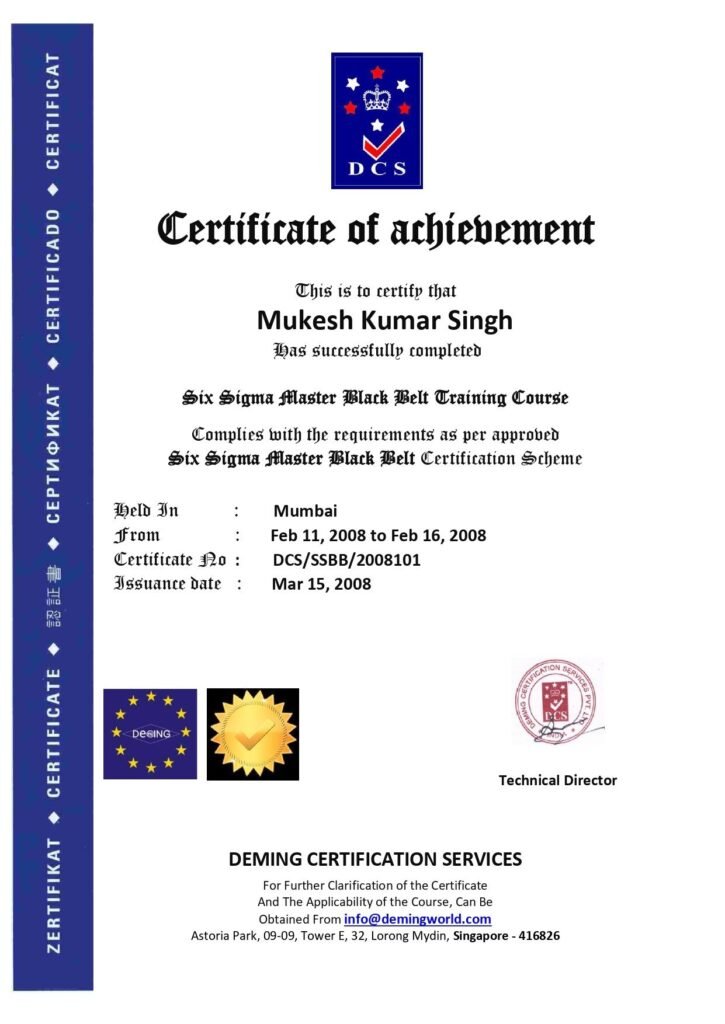
The professional journey toward Six Sigma Master Black Belt Training further extended this philosophy. Advanced Six Sigma knowledge can support not only individual improvement projects but also broader organizational capability development. A mature improvement environment requires people who can guide teams, select meaningful projects, understand performance data, and encourage disciplined problem solving.
This represents an important transition in professional growth.
A person who knows how to solve one problem has valuable technical capability.
A person who can teach others how to solve problems can create wider organizational value.
The combination of ISO 9001, Lean, and Six Sigma therefore created a powerful professional framework.
ISO 9001 provides process discipline.
Lean identifies waste and opportunities to improve flow.
Kaizen develops a culture of continuous improvement.
Six Sigma provides structured analytical problem solving.
Together, they encourage organizations to become more systematic in the way they improve.
This approach can influence many areas of business.
In manufacturing, it can support defect reduction and improved productivity.
In service organizations, it can reduce waiting times and improve customer experience.
In administrative departments, it can simplify approvals and reduce unnecessary paperwork.
In laboratories, it can improve process consistency and reliability.
In IT environments, it can help identify inefficient workflows.
In auditing, it can help professionals identify recurring problems and investigate their causes.
The broader professional value of Lean Six Sigma therefore lies in its adaptability.
It is not restricted to one industry.
The same basic improvement philosophy can be applied wherever processes exist.
Another important lesson is that improvement should be measurable.
An organization should know what problem it is trying to solve, how performance is currently measured, what improvement is expected, and whether the change actually produced better results.
This measurement-oriented mindset strengthens the quality-management system.
It also creates a bridge between management objectives and operational activities.
For Mukesh Kumar Singh, the development of Lean and Six Sigma expertise can therefore be viewed as a natural progression from the ISO 9001 foundation. Quality management established the importance of controlled processes; Lean and Six Sigma introduced stronger methods for improving those processes.
The journey was becoming broader and more practical.
Quality was no longer simply about ensuring that requirements were met.
It was increasingly about asking how processes could become faster, simpler, more reliable, less wasteful, and more capable of delivering consistent results.
This shift toward continuous improvement became an important milestone in the professional growth story.
It demonstrated that certification provides value when its principles are transformed into action—and that sustainable growth comes from the ongoing willingness to examine existing processes, learn from evidence, eliminate waste, reduce variation, and continuously search for better ways of working.
Quality establishes the standard. Lean removes unnecessary effort. Six Sigma reduces variation. Kaizen keeps improvement moving forward.
#SixSigma
Chapter 4 – Expanding Beyond Quality: Environment and Occupational Safety
The professional journey of Mukesh Kumar Singh continued to develop as the understanding of quality management expanded beyond product and service conformity. Modern organizations operate in environments where quality, safety, environmental responsibility, resource utilization, and legal compliance are closely connected. A company cannot achieve sustainable success by focusing on customer requirements alone. It must also consider its impact on employees, the environment, and the wider community.
This broader perspective became an important stage in the professional development journey through exposure to Environmental Management Systems (EMS) and Occupational Health and Safety Management Systems.
The EMS Auditor Conversion Training Course added environmental management to the existing quality-oriented knowledge base. Environmental management systems encourage organizations to understand how their activities, products, and services interact with the environment. They help organizations identify environmental aspects, determine significant impacts, understand applicable obligations, establish operational controls, monitor performance, and pursue continual improvement.
This approach changed the traditional idea of quality.
Quality is not only about whether a product satisfies a customer specification. It can also involve how responsibly that product is produced.
An organization may manufacture excellent products but still face challenges if it generates excessive waste, consumes resources inefficiently, or fails to control environmental risks. Therefore, environmental management becomes part of responsible organizational performance.
For a professional auditor, this creates a different set of questions.
What environmental aspects are associated with the organization’s activities?
Which aspects are significant?
What controls have been established?
Are employees aware of their responsibilities?
Are applicable environmental requirements being addressed?
Is environmental performance being monitored?
Are problems investigated and corrective actions implemented?
These questions encourage organizations to move from reactive environmental management toward preventive and systematic practices.
The same principle applies to occupational health and safety.
Every workplace contains hazards. Depending on the industry, these may involve machinery, electricity, chemicals, working at height, transportation, ergonomics, fire, noise, physical conditions, or other operational risks. A mature organization does not wait for an accident before addressing these hazards.
It identifies risks before they cause harm.
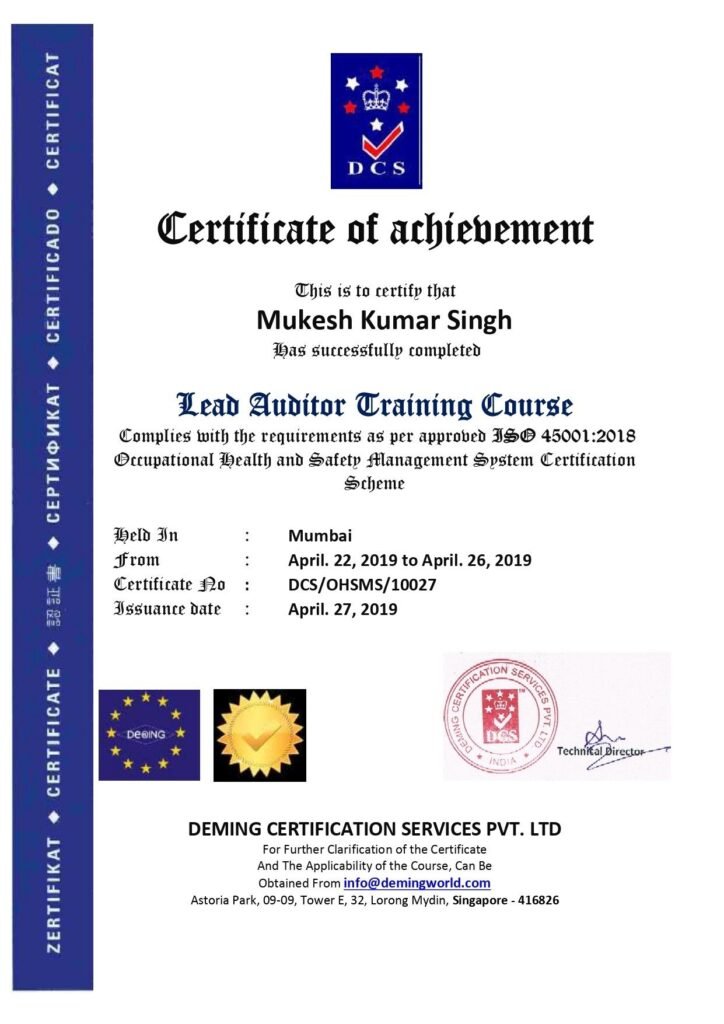
The inclusion of ISO 45001:2018 Upgrade Training Course represented an important expansion into this area. ISO 45001 provides a systematic framework for managing occupational health and safety risks and improving workplace safety performance.
One of the important lessons of modern safety management is that safety cannot be treated as the responsibility of one safety officer alone. Leadership, supervisors, workers, contractors, and other relevant personnel can all influence workplace safety.
Leadership commitment is particularly important.
Management must provide resources, establish objectives, support safe working practices, and ensure that safety considerations are incorporated into organizational decision-making.
Worker participation is equally valuable. Employees who work directly with equipment and processes often understand practical hazards that may not be obvious from documents alone. Encouraging workers to report hazards, suggest improvements, and participate in safety activities can strengthen the overall system.
This philosophy closely connects with Kaizen and Lean thinking.
Lean encourages employees to identify waste and inefficiency.
Kaizen encourages them to identify small improvements.
Safety management encourages them to identify hazards and unsafe conditions.
Together, these approaches can create a workplace culture in which employees actively look for opportunities to make processes better and safer.
Another important connection exists between quality and safety.
A poorly controlled process can create both quality problems and safety risks. For example, inadequate maintenance may result in defective products while also creating hazards for employees. Poor training may lead to production errors and unsafe work practices. Weak communication can result in incorrect product requirements as well as misunderstanding of safety instructions.
Integrated thinking therefore allows professionals to recognize relationships that may otherwise remain hidden.
The professional scope associated with Mukesh Kumar Singh included multiple management-system disciplines, and this multidisciplinary approach strengthened the ability to look at organizations from different perspectives.
Quality asks whether requirements are consistently achieved.
Environmental management asks how organizational activities affect the environment.
Occupational health and safety asks whether people are adequately protected from workplace risks.
Lean asks whether unnecessary activities and waste can be eliminated.
Six Sigma asks whether variation can be measured and reduced.
Although the objectives differ, all these approaches encourage systematic management and continual improvement.
This became an important element of professional growth.
Instead of seeing standards as isolated subjects, they could be viewed as different tools for improving organizational performance.
The development of knowledge around ISO 45001 also reinforced the importance of risk-based thinking. Organizations cannot eliminate every possible risk, but they can identify hazards, assess risks, establish controls, monitor effectiveness, and improve their systems.
This preventive philosophy is closely related to ISO 9001.
A quality organization seeks to prevent defects.
A safety-oriented organization seeks to prevent accidents.
An environmentally responsible organization seeks to prevent harmful impacts.
An information-security-oriented organization seeks to prevent security incidents.
The common principle is prevention through systematic management.
This perspective helped broaden the professional identity associated with Mukesh Kumar Singh. The focus was no longer limited to quality certification. It was developing into a wider understanding of organizational assurance and improvement.
The environmental and safety dimensions also highlighted the importance of continual learning. Standards and industry expectations evolve, and professionals must remain current. The ISO 45001:2018 Upgrade Training Course was therefore not simply another qualification; it represented the principle that existing knowledge must be updated as management systems develop.
The same philosophy applies to environmental auditing.
An auditor must understand not only the requirements but also how an organization actually operates. Effective auditing requires observation, interviews, records, evidence, process understanding, and professional judgment.
The result is a more complete approach to organizational assessment.
By expanding from ISO 9001 toward EMS and occupational health and safety, the professional journey became increasingly comprehensive. Quality remained a central foundation, but it was now connected with sustainability, employee protection, risk management, and continual improvement.
This broader perspective created a strong platform for the next stage of development: information security and the management of one of the most valuable assets of the modern organization—information itself.
Quality protects customer value. Environmental management protects environmental performance. Safety management protects people. Together, they contribute to responsible and sustainable organizational growth.
#LeanManagement
Chapter 5 – Information Security and the Modern Management System
As organizations became increasingly dependent on computers, databases, digital communication, and online business processes, the meaning of organizational quality began to change. Earlier, quality discussions often focused primarily on products, services, production processes, and customer satisfaction. With the growth of digital systems, another critical question emerged: How can organizations protect the information on which their operations depend?
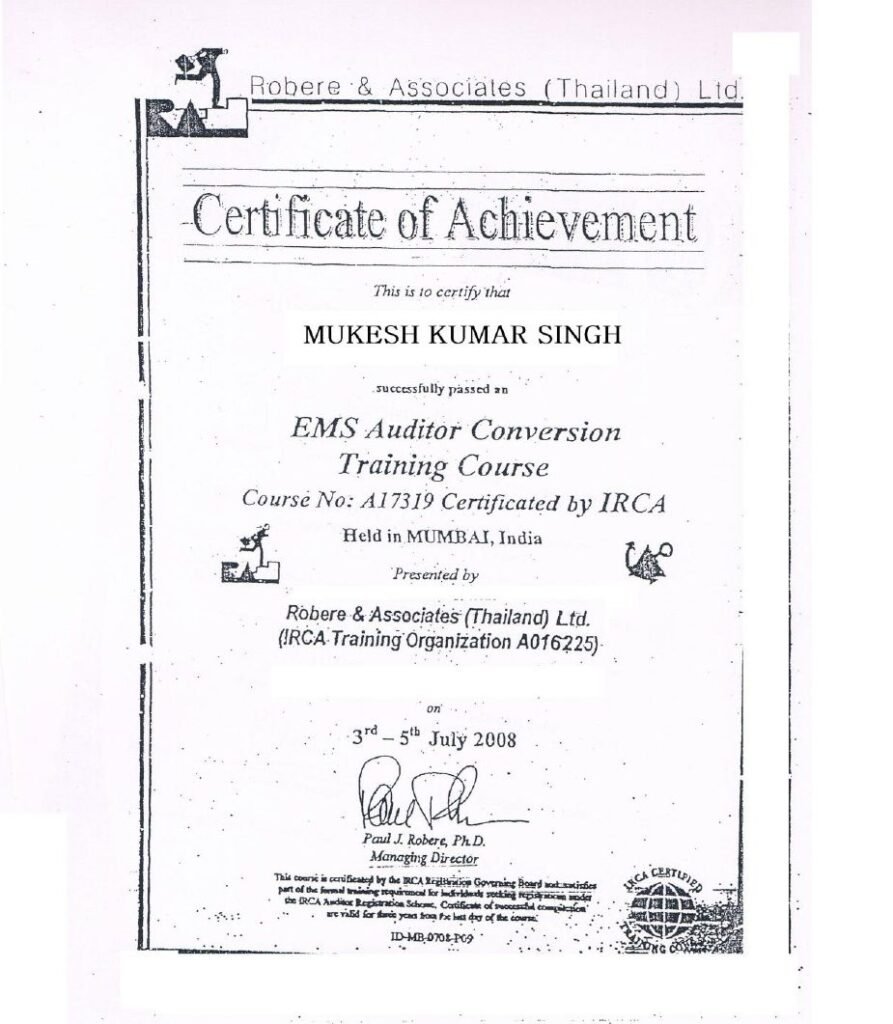
For Mukesh Kumar Singh, the inclusion of ISO 27001:2005 Information Security Management Systems (ISMS) and Information Security Management Systems Auditor/Lead Auditor Training Course represented an important expansion of professional knowledge. It connected the established principles of quality management and auditing with the rapidly developing field of information security.
Information has become one of the most valuable assets of modern organizations. Customer information, employee records, financial data, technical drawings, contracts, passwords, business plans, databases, intellectual property, and operational information can all have significant value. Loss, unauthorized access, alteration, or unavailability of such information can affect business continuity and customer confidence.
Information security therefore cannot be treated only as an IT department responsibility.
Technology provides important tools, but effective information security also requires management systems, defined responsibilities, risk assessment, employee awareness, controls, monitoring, incident response, and continual improvement.
This management-system perspective created a natural connection with ISO 9001.
Quality management asks organizations to establish controlled processes and continually improve them. Information security management applies similar thinking to the protection of information assets.
An organization first needs to understand what information it possesses and how that information is used. It then needs to identify potential risks and determine appropriate controls. Responsibilities must be assigned, employees must understand their roles, and performance must be monitored.
This is where auditor training becomes particularly valuable.
The ISMS Auditor/Lead Auditor Training Course developed the ability to examine information-security management from an assessment perspective. An auditor needs to determine whether appropriate processes have been established and whether they are actually implemented.
For example, an organization may have an information-security policy, but the existence of a policy alone does not guarantee security. Employees need to understand it. Access rights need to be appropriately controlled. Information needs to be handled according to defined requirements. Incidents need to be addressed. Backup and recovery arrangements need to be considered where applicable. Risks need to be evaluated and controls reviewed.
The auditor therefore looks for evidence.
This evidence-based approach is closely related to the auditing philosophy developed through ISO 9001.
The professional journey was consequently becoming more integrated. The principles of auditing, process management, risk evaluation, corrective action, and continual improvement could be applied across different standards.
The transition from quality management to information security also demonstrated the importance of risk-based thinking.
Every organization faces risks, but not every risk has the same probability or consequence. A systematic approach helps management identify important information-security risks and prioritize appropriate actions.
This principle is valuable because organizations have limited resources. They cannot necessarily address every theoretical threat at the same time. Risk assessment can help management focus attention on areas requiring greater protection.
Employee awareness is another important part of information security.
Even sophisticated technology can be undermined by poor human practices. Employees may accidentally share confidential information, use weak passwords, mishandle documents, or fail to report suspicious activity. Training and awareness therefore become essential components of an effective information-security culture.
This connects with the broader professional philosophy of Mukesh Kumar Singh.
Training is not simply the transfer of technical information. It is a mechanism for developing organizational competence.
The professional scope also included ISO 50001:2011, extending the management-system perspective into energy management. Energy performance can influence operating costs, resource efficiency, environmental impact, and organizational sustainability.
Energy management encourages organizations to understand where and how energy is consumed, establish objectives, monitor performance, and identify opportunities for improvement.
Once again, the same management principles appear.
Measure performance.
Understand risks and opportunities.
Establish controls.
Monitor results.
Take corrective action.
Improve continuously.
This common structure demonstrates why multidisciplinary quality knowledge can be valuable.
A professional does not need to treat every standard as completely separate. Instead, common management principles can be recognized while the specific technical requirements of each discipline are understood.
The inclusion of ISO 27001 and ISO 50001 therefore strengthened the professional ability to think in terms of integrated management systems.
An organization may need to protect its information while also maintaining product quality, employee safety, environmental performance, and energy efficiency. These objectives may sometimes compete for resources, but they can also support one another.
For example, improved process control can reduce errors and energy waste. Better information management can improve access to accurate quality records. Better employee training can strengthen both safety and information-security practices. Stronger internal audits can identify weaknesses across several management systems.
This interconnectedness became increasingly important as the professional journey expanded.
The knowledge associated with ISO 27001:2005 also highlighted how quickly organizational risks can evolve. Technologies, communication methods, digital platforms, and cyber threats continually change. Professionals must therefore continue updating their knowledge rather than relying permanently on what they learned at the beginning of their careers.
This principle of lifelong learning was already present in the ISO 9001 journey and became even more important in information security.
The professional growth story can therefore be seen as a gradual expansion of perspective.
ISO 9001 established the importance of quality and process control.
Lean and Six Sigma introduced systematic improvement.
Environmental and safety management expanded organizational responsibility.
Information security introduced protection of digital and information assets.
Energy management added resource-efficiency considerations.
Each new area increased the ability to view an organization as a complete system.
The journey was no longer about asking whether one department was performing correctly. It became about understanding how different processes interact and how management systems can collectively support organizational resilience.
For Mukesh Kumar Singh, this expansion represented another important milestone after the ISO 9001 foundation. The professional profile was becoming increasingly versatile, combining quality management, auditing, process improvement, risk-based thinking, information security, and resource management.
The lesson was clear: in the modern organization, quality cannot exist in isolation. It must work together with security, safety, sustainability, efficiency, and continual improvement.
This broader understanding prepared the foundation for another specialized area of professional development—laboratory competence, internal auditing, and accreditation, where quality management meets technical reliability and conformity assessment.
#LeadAuditor
Chapter 6 – Laboratory Competence, Accreditation and Technical Confidence
As the professional journey of Mukesh Kumar Singh continued to expand, the focus moved into an area where quality management meets technical competence: laboratory testing and calibration. Organizations in engineering, manufacturing, healthcare, construction, food, chemicals, infrastructure, and numerous other sectors often depend on laboratories for reliable measurements and test results. When important business or technical decisions depend on those results, confidence in laboratory competence becomes essential.
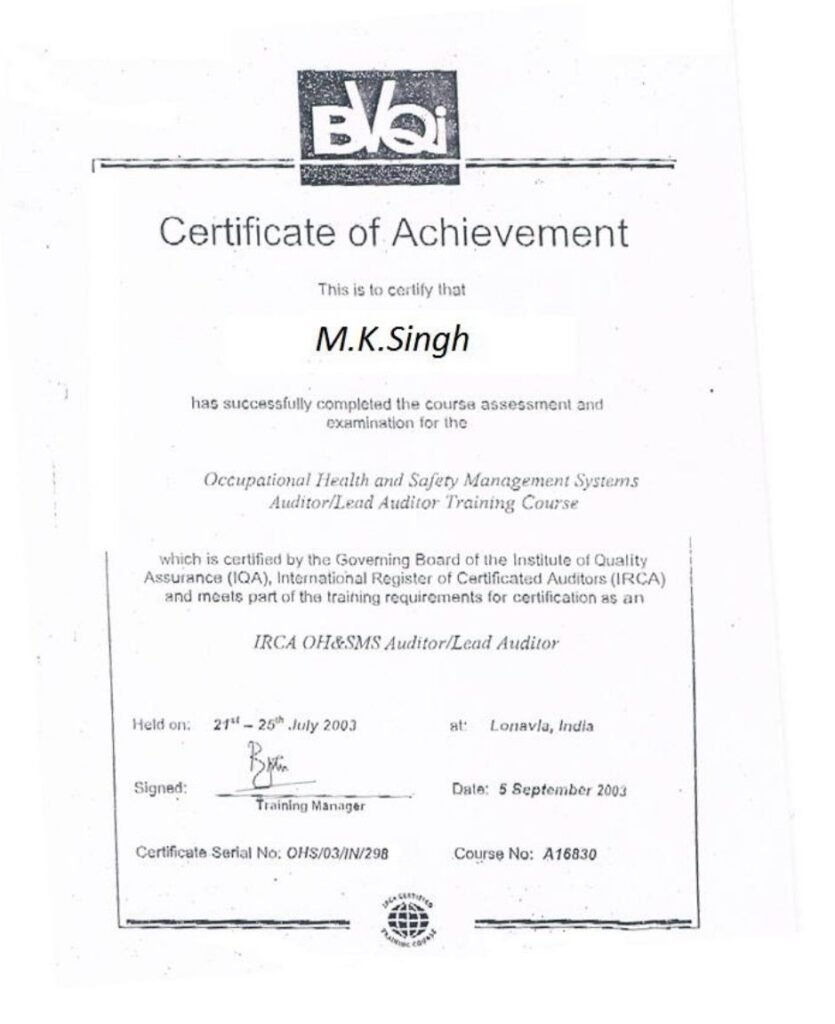
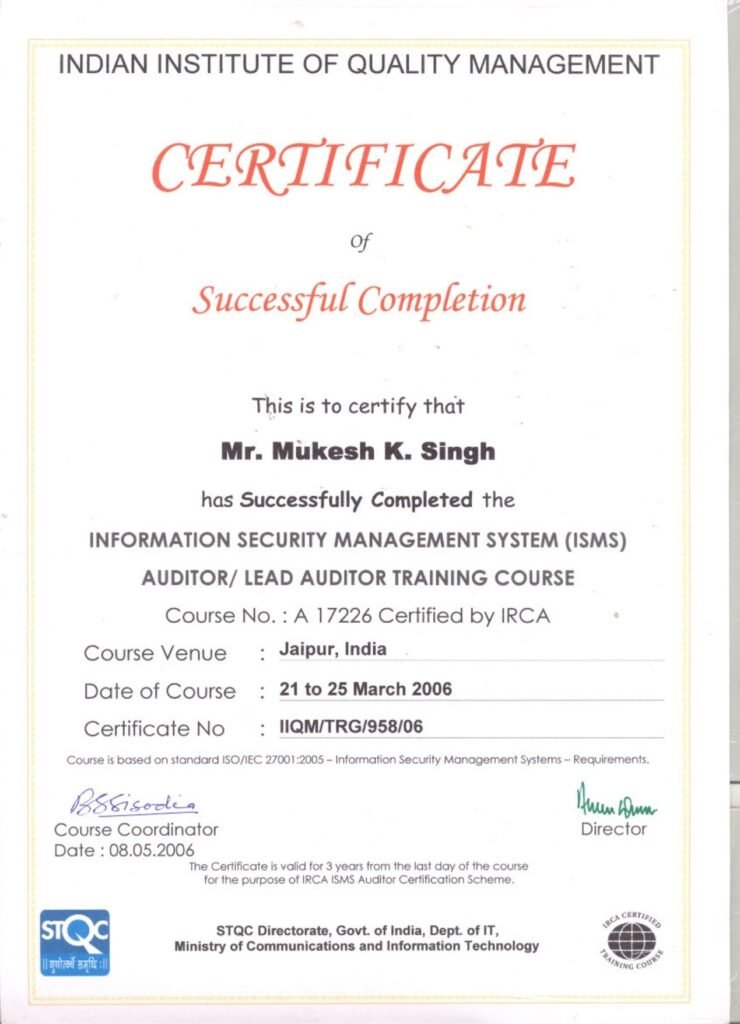
This was the significance of including Laboratory Competence as per ISO/IEC 17025:2005 and aspects of Internal Audit within the professional development scope.
ISO/IEC 17025 provides a framework for demonstrating the competence of laboratories performing testing and calibration activities. Unlike a general management-system approach, laboratory competence has a strong technical dimension. A laboratory must have appropriate personnel, suitable equipment, valid methods, controlled processes, reliable records, and appropriate conditions for carrying out its activities.
For a professional with a foundation in ISO 9001, studying laboratory competence provides an opportunity to understand how quality principles are applied in a technically specialized environment.
The fundamental objective remains similar: establish reliable processes, control risks, maintain competence, evaluate performance, and continually improve.
However, the evidence required in a laboratory environment can be highly technical.
Consider a testing laboratory that provides results used to determine whether a product meets a specification. If the testing method is unsuitable, the equipment is not properly maintained, personnel are not competent, or measurement conditions are poorly controlled, the resulting report may not provide the confidence required by the customer.
This demonstrates why competence is so important.
Quality cannot be separated from technical reliability.
A laboratory may have excellent documentation, but if its technical processes are not competent, the management system cannot achieve its intended purpose. Conversely, highly skilled technicians also need controlled processes to ensure consistency and traceability.
This relationship between technical competence and management controls became an important part of the professional perspective.
Internal auditing plays a significant role in this environment.
An internal audit provides an organization with an opportunity to examine its own processes systematically. Rather than waiting for an external assessment to identify weaknesses, the organization can use internal audits to discover gaps and improvement opportunities proactively.
For Mukesh Kumar Singh, knowledge of internal-audit principles created another connection between different professional disciplines.
The same basic audit philosophy can be applied across management systems: establish criteria, collect objective evidence, evaluate conformity, document findings, communicate results, and support corrective action.
However, each technical area requires appropriate subject knowledge.
An auditor assessing a laboratory cannot rely solely on general auditing skills. The auditor must understand the relevant laboratory processes sufficiently to evaluate whether activities are being performed competently and consistently.
This is where multidisciplinary professional education becomes valuable.
The quality-management foundation provides knowledge of processes and continual improvement.
Auditor training provides assessment methodology.
Technical laboratory knowledge provides an understanding of competence requirements.
Together, these areas create a stronger foundation for professional assessment.
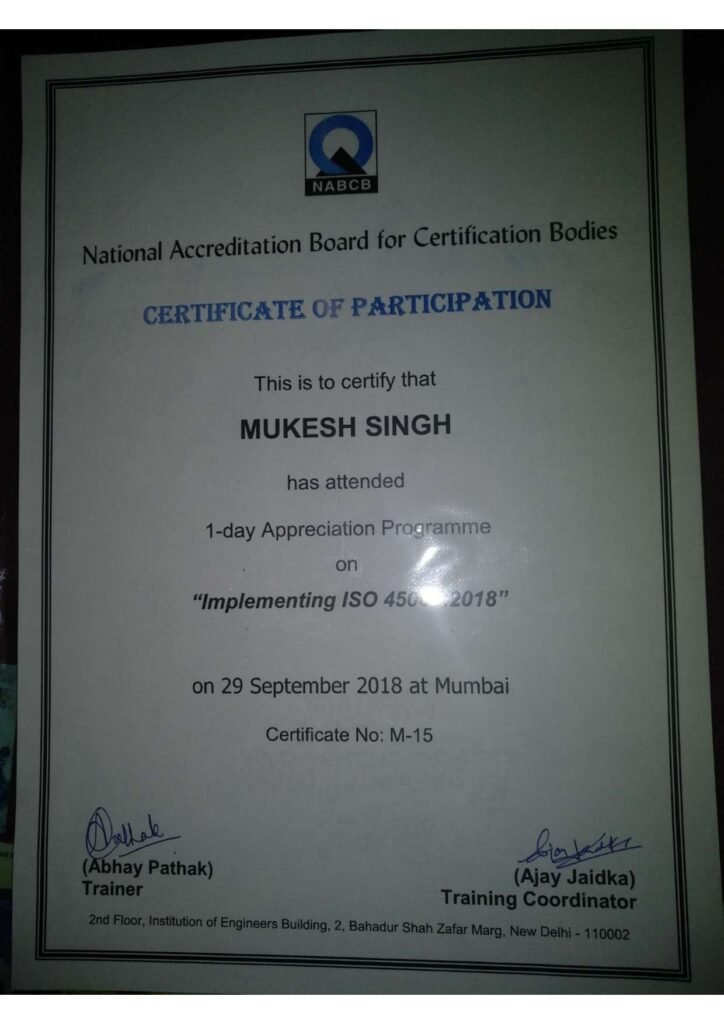
The journey also included exposure to the National Accreditation Board for Certification Bodies and related accreditation concepts. This added another important layer to understanding the wider conformity-assessment environment.
Certification and accreditation are part of an ecosystem designed to create confidence.
Organizations may seek certification to demonstrate conformity with specified requirements. Certification bodies conduct assessments. Accreditation provides a mechanism for recognizing the competence and impartiality of conformity-assessment bodies within applicable frameworks.
Understanding this structure helps professionals appreciate why competence, impartiality, consistency, objective evidence, and documented processes are so important.
The concept of accreditation also reinforces the importance of trust.
When an organization receives a test report, certificate, or conformity statement, users need confidence that the activity behind that document was performed by competent people using appropriate methods.
This is particularly important when technical decisions involve safety, product performance, regulatory requirements, or customer acceptance.
The professional development journey therefore moved beyond the simple question of whether a process was documented. It increasingly focused on whether the process was competent, reliable, controlled, and supported by evidence.
This represents an important evolution in quality thinking.
Quality systems are ultimately intended to create confidence.
Customers need confidence that products and services meet requirements.
Management needs confidence that processes are performing effectively.
Auditors need confidence that evidence is reliable.
Laboratory customers need confidence that test results are technically valid.
Accreditation systems need confidence in the competence of conformity-assessment activities.
These different forms of confidence are interconnected.
The experience of studying ISO/IEC 17025:2005 also strengthened an appreciation for measurement and evidence. In Six Sigma, data is essential for understanding variation. In laboratory work, measurement reliability is essential for trustworthy results. In auditing, objective evidence is essential for credible findings.
Thus, seemingly different disciplines share an important foundation: decisions should be supported by reliable evidence.
This philosophy can have a positive influence on organizational management.
Instead of relying entirely on assumptions or personal opinions, organizations can collect information, evaluate performance, analyze trends, and make decisions based on evidence.
The same approach applies to corrective action.
When a laboratory identifies a problem, the objective should not simply be to correct the immediate error. The organization should investigate why it occurred and determine whether similar problems could exist elsewhere.
This connects directly with Lean and Six Sigma root-cause analysis.
The professional journey therefore continued to become more integrated.
ISO 9001 provided the quality foundation.
Lean and Six Sigma provided improvement tools.
Auditor training provided assessment capability.
ISO/IEC 17025 provided technical laboratory competence.
Accreditation knowledge provided an understanding of conformity-assessment confidence.
Each new discipline strengthened the others.
The laboratory and accreditation stage also reinforced the importance of professional competence. Standards can provide frameworks, but competent people are required to interpret requirements, perform activities correctly, identify risks, and implement improvements.
This is why continuous professional education became such an important theme throughout the journey.
The knowledge associated with ISO/IEC 17025:2005 and accreditation did not stand alone. It became another part of a larger professional framework focused on quality, competence, evidence, assessment, and continual improvement.
For Mukesh Kumar Singh, this stage represented an important transition toward deeper technical understanding.
The journey had progressed from general quality management into specialized areas where precision, competence, and credibility were essential.
The lesson was significant: a strong management system creates structure, but technical competence and reliable evidence create confidence.
That understanding prepared the way for the next stage of professional growth—continued learning, standards upgrades, advanced improvement methodologies, and the development of a professional profile capable of adapting to changing organizational requirements.
#ContinuousImprovement
Chapter 7 – Continuous Learning Through Standards and Professional Development
Professional growth in the field of quality management does not end when a certificate is received. In fact, certification often marks the beginning of a longer journey. Standards evolve, industries change, technologies develop, and organizations face new risks and expectations. A professional who wants to remain relevant must therefore continue learning and updating knowledge.
For Mukesh Kumar Singh, continuous learning became an important part of the professional journey after establishing a foundation in ISO 9001, auditing, Lean, Six Sigma, information security, laboratory competence, environmental management, and occupational health and safety.
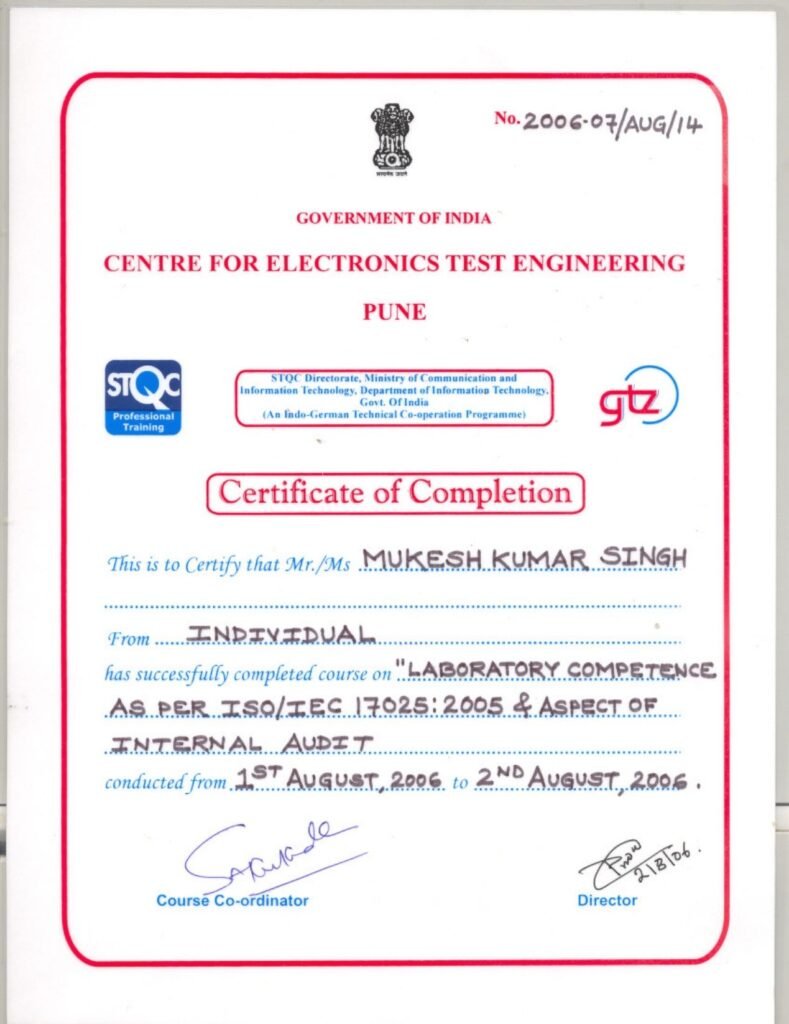
One of the important areas of development was the ISO 9001:2015 Upgrade Training Course. Moving from earlier versions of ISO 9001 toward the 2015 edition required professionals to understand changes in management-system philosophy and implementation.
The 2015 edition placed greater emphasis on organizational context, leadership, risks and opportunities, process-based thinking, performance evaluation, and continual improvement. These concepts encouraged organizations to look beyond procedures and documentation and consider how their management system supported actual business performance.
For a quality professional, understanding these developments is essential.
A standard is not static. Its requirements and interpretation can evolve as industries and business environments change. Organizations that fail to update their systems may find that their existing practices no longer adequately address current risks or expectations.
The same principle applied to occupational health and safety through the ISO 45001:2018 Upgrade Training Course.
Occupational health and safety management has increasingly moved toward proactive risk management. Instead of waiting for accidents or incidents to occur, organizations are encouraged to identify hazards, assess risks, establish controls, monitor performance, and continually improve safety practices.
The professional significance of this training was not limited to understanding a revised standard. It strengthened the broader ability to recognize how management systems evolve.
Quality, safety, environmental management, information security, and other disciplines may have different technical requirements, but they share several common management principles.
Leadership is important.
Competence is important.
Risk management is important.
Documented information is important.
Performance evaluation is important.
Corrective action is important.
Continual improvement is important.
Recognizing these common principles helps professionals understand integrated management systems more effectively.
Another significant area of professional development was 5S Lead Auditor Training.
5S is widely associated with workplace organization, but its importance extends beyond basic cleanliness. A properly organized workplace can improve visibility, reduce unnecessary movement, support efficient work, identify abnormalities, and establish stronger operational discipline.
The principles associated with 5S can be applied to offices, workshops, laboratories, warehouses, manufacturing facilities, and many other working environments.
For an auditor, the challenge is to evaluate whether 5S principles are actually implemented rather than simply displayed on posters.
A workplace may have labels and photographs showing an organized environment, but the auditor must determine whether the system is maintained consistently. Are unnecessary items removed? Are locations clearly defined? Are standards followed? Are employees involved? Is the condition sustained over time?
This again brings the discussion back to evidence.
The same evidence-based approach developed through ISO 9001 and auditing can be applied to 5S.
Continuous learning also became important in the area of Six Sigma Master Black Belt Training.
A Black Belt professional may lead improvement projects and apply analytical methods to specific problems. A Master Black Belt perspective can extend further toward mentoring, capability development, improvement-program deployment, project selection, and organizational transformation.
This distinction is important.
Solving a problem creates value.
Teaching others how to solve problems can create broader value.
Developing an organizational culture in which employees routinely identify and solve problems can create even greater long-term value.
This is why professional development increasingly became connected with knowledge sharing.
Training employees can help organizations reduce dependence on individual expertise. When knowledge is transferred effectively, more people can understand processes, identify risks, and participate in improvement activities.
The professional journey therefore increasingly reflected the concept of learning organizations.
A learning organization does not consider training an occasional activity. It encourages people to learn from audits, customer feedback, nonconformities, incidents, process data, improvement projects, and changing requirements.
Every problem becomes an opportunity to understand the system better.
Every audit becomes an opportunity to identify improvement opportunities.
Every training program becomes an opportunity to strengthen competence.
Every standard revision becomes an opportunity to review organizational practices.
This philosophy can have a significant impact on professional growth as well.
The more standards and methodologies a professional studies, the more connections become visible.
Lean can be connected with 5S.
Six Sigma can support corrective-action investigations.
ISO 9001 can provide the foundation for process management.
ISO 45001 can strengthen risk-based thinking.
ISO 27001 can extend risk management into information security.
ISO/IEC 17025 can demonstrate the importance of technical competence and reliable evidence.
ISO 50001 can encourage systematic management of energy performance.
ISO 22163 can introduce sector-specific quality requirements.
Rather than remaining separate subjects, these areas can become parts of one larger understanding of organizational performance.
This multidisciplinary approach also supports adaptability.
An organization may not face the same challenges every year. A manufacturing company may focus on productivity today, cybersecurity tomorrow, sustainability the following year, and supply-chain resilience later. A professional who understands several management disciplines can approach these changing challenges with a broader perspective.
For Mukesh Kumar Singh, the journey therefore represents more than the accumulation of professional training.
It represents an ongoing commitment to remain current.
Continuous learning became a professional responsibility.
The lessons gained from earlier certifications created a foundation for understanding new requirements. Each new course expanded the ability to interpret organizational problems from a different perspective.
This also demonstrates why professional development should be viewed as a cycle rather than a destination.
Learn → Apply → Audit → Identify gaps → Improve → Learn again.
This cycle mirrors the continual-improvement philosophy found across many management systems.
The professional journey after ISO 9001 certification consequently became a process of continuous renewal. Earlier knowledge was not discarded; it was expanded and updated.
The result was a progressively broader professional capability that combined quality management, auditing, process improvement, safety, information security, laboratory competence, environmental thinking, energy management, and workplace organization.
The most valuable outcome of this journey was therefore not simply knowledge of individual standards. It was the ability to remain adaptable in a changing professional environment.
Standards may change, technologies may change, and organizations may change—but the commitment to learning, evidence-based thinking, and continuous improvement remains the foundation of lasting professional growth.
#QualityAssurance
Chapter 8 – Building Professional Value Through Integrated Expertise
Professional growth becomes more meaningful when knowledge from different disciplines begins to work together. For Mukesh Kumar Singh, the journey after ISO 9001 certification was not simply about completing individual courses or collecting professional credentials. It gradually developed into a broader understanding of how different management systems, improvement methodologies, auditing practices, and organizational requirements could be connected.
The foundation remained quality management.
ISO 9001 provided a structured way to understand processes, customer requirements, responsibilities, controls, performance evaluation, corrective action, and continual improvement. Once this foundation was established, other disciplines could be understood in relation to it.
Lean and Six Sigma added another dimension.
While a management system provides structure, improvement methodologies help organizations examine how efficiently processes operate. Lean thinking focuses attention on waste, unnecessary activities, delays, excess movement, waiting, over-processing, and other forms of inefficiency. Six Sigma brings greater emphasis to variation, data, root causes, measurement, and structured problem solving.
Together, these approaches can transform the way professionals look at organizational performance.
A process is no longer viewed simply as a series of activities. It becomes something that can be measured, analyzed, controlled, improved, and continually reviewed.
This perspective can be particularly valuable for an auditor.
An effective auditor does not merely check whether a document exists. The auditor needs to understand what the organization is trying to achieve, how the process operates, what risks exist, what controls have been established, and whether evidence demonstrates that those controls are effective.
The training and experience associated with different standards helped strengthen this broader perspective.
Environmental management introduced another important consideration: the relationship between organizational activities and environmental impacts. Safety management introduced the importance of identifying hazards and controlling occupational risks. Information security introduced the need to protect information and manage security-related risks. Laboratory competence emphasized technical reliability and confidence in results.
Each discipline added another layer to the understanding of organizational assurance.
This created the possibility of viewing an organization as an interconnected system rather than a collection of independent departments.
For example, a manufacturing organization may have a quality problem caused by an inefficient process. That process may also generate unnecessary material waste. The same operation may involve an occupational safety hazard. Its production information may be stored digitally and therefore require appropriate information-security controls. Energy consumption may also be associated with the operation.
A narrow approach might address each issue separately.
An integrated approach asks a larger question:
How can the organization improve the entire process while managing quality, safety, environmental, information, energy, and operational risks together?
This broader way of thinking represents an important stage in professional development.
The inclusion of ISO 50001:2011 within the professional scope further strengthened awareness of energy management. Energy is an operational resource, and systematic attention to energy performance can encourage organizations to understand consumption patterns, establish objectives, monitor performance, and identify opportunities for improvement.
Similarly, exposure to ISO 22163:2017 introduced a sector-specific perspective associated with railway organizations and their quality-management requirements.
Sector-specific standards demonstrate an important principle: management systems must ultimately operate within real business and industry environments.
A generic understanding of quality is useful, but professionals also need to understand the particular risks, processes, customer expectations, regulatory considerations, and operational characteristics of different sectors.
This is where integrated professional knowledge creates value.
Mukesh Kumar Singh’s growing range of training and certification-related expertise could support a more flexible approach to professional assignments. Instead of looking at quality in isolation, different organizational issues could be examined through multiple perspectives.
The role of auditing also evolved in this journey.
An audit is not simply an examination intended to identify mistakes. Properly conducted, it can provide an organization with information about the effectiveness of its processes and the areas where improvement may be necessary.
Evidence becomes central to this process.
Records, observations, interviews, measurements, process outputs, documented information, and other objective evidence help an auditor form conclusions. Personal assumptions should not replace evidence.
This principle is particularly important when dealing with complex management systems.
Integrated expertise also strengthens communication.
A quality professional may need to communicate with senior management, engineers, laboratory personnel, production employees, IT teams, safety professionals, auditors, trainers, and other stakeholders. Each group may have different priorities and technical vocabulary.
Understanding several disciplines can make these conversations more productive.
It becomes easier to explain why a quality issue may also be a process issue, why a safety problem may indicate a weakness in risk management, or why an information-security incident may require changes in organizational controls.
Professional value therefore comes not only from technical knowledge but also from the ability to connect that knowledge with organizational objectives.
Training plays an important role in this process.
Courses such as Six Sigma Black Belt, Six Sigma Master Black Belt, Lead Auditor, 5S Lead Auditor, ISO 9001:2015 Upgrade, ISO 45001:2018 Upgrade, ISMS Auditor/Lead Auditor, and EMS Auditor Conversion represent different areas of capability.
Individually, each course addresses a particular subject.
Collectively, they can create a more comprehensive professional framework.
The same philosophy applies to laboratory competence and accreditation. Knowledge of ISO/IEC 17025:2005 encourages attention to technical competence, reliable processes, internal audits, evidence, and confidence in laboratory activities. Understanding accreditation concepts further highlights the importance of impartiality, competence, consistency, and conformity assessment.
The result is a professional journey built around one central idea: quality is interconnected with every important aspect of organizational performance.
This understanding can also influence leadership.
A professional with multidisciplinary knowledge can help encourage employees to see improvement as a shared responsibility. Quality is not only the responsibility of the quality department. Safety is not only the responsibility of the safety officer. Information security is not only the responsibility of the IT department.
Every employee contributes to the effectiveness of organizational processes.
This culture can create stronger ownership.
Employees who understand why procedures exist are more likely to participate meaningfully in improvement activities. Managers who understand process performance can make better-informed decisions. Auditors who understand organizational context can provide more useful observations.
Thus, the professional journey after ISO 9001 certification gradually developed from a focus on individual requirements toward a broader understanding of organizational excellence.
The most important achievement was not simply knowing more standards.
It was learning how to connect them.
Quality, productivity, safety, environmental responsibility, information security, energy performance, laboratory competence, workplace organization, and continual improvement can all contribute to one larger objective: creating organizations that are controlled, capable, resilient, and committed to improvement.
For Mukesh Kumar Singh, this integrated perspective represented another major stage of professional growth.
The journey had moved beyond certification itself.
It had become a journey toward professional versatility, organizational understanding, and the practical application of quality principles across different environments.
And with every new standard studied, every audit understood, and every improvement methodology explored, the foundation created by ISO 9001 continued to expand into a much larger vision of professional excellence.
#ManagementSystems
Chapter 9 – From Certification to Organizational Excellence
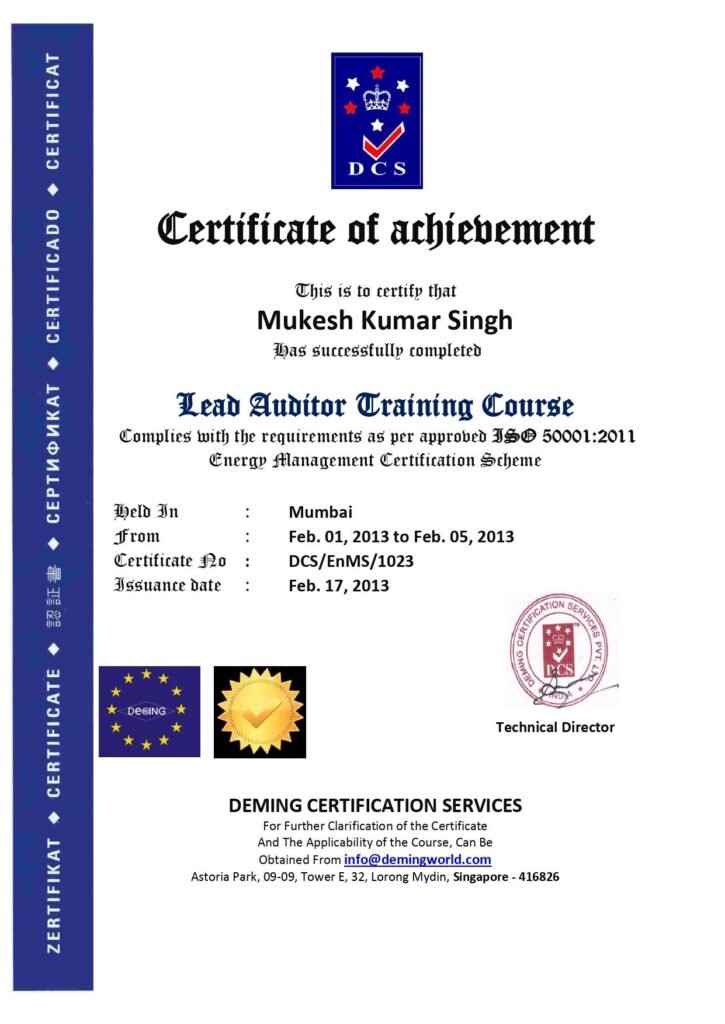
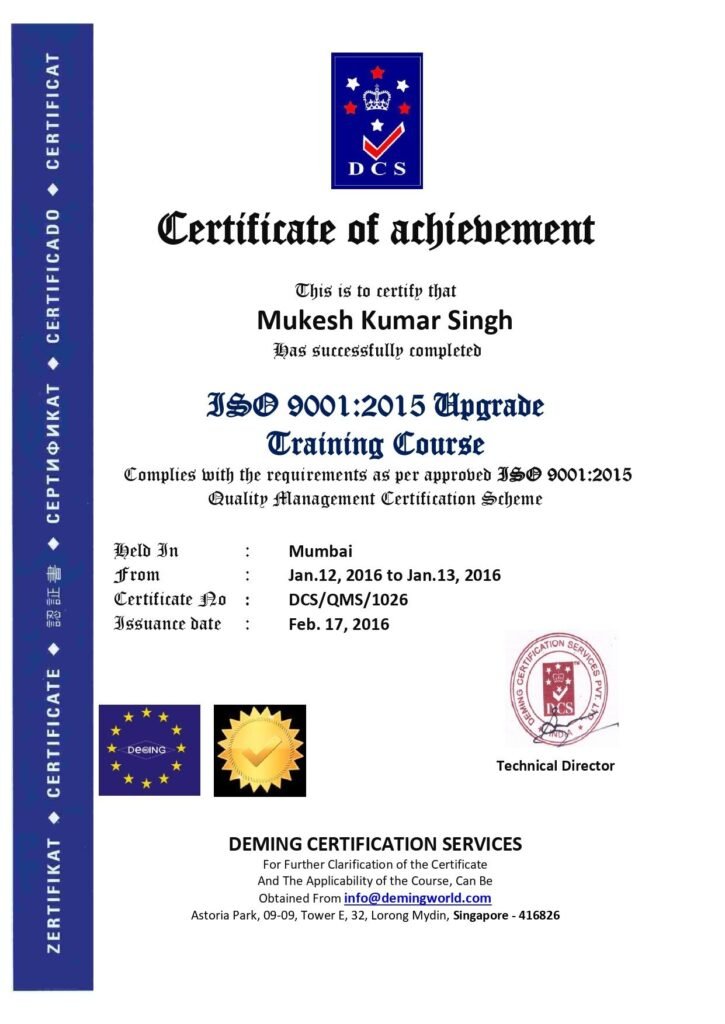
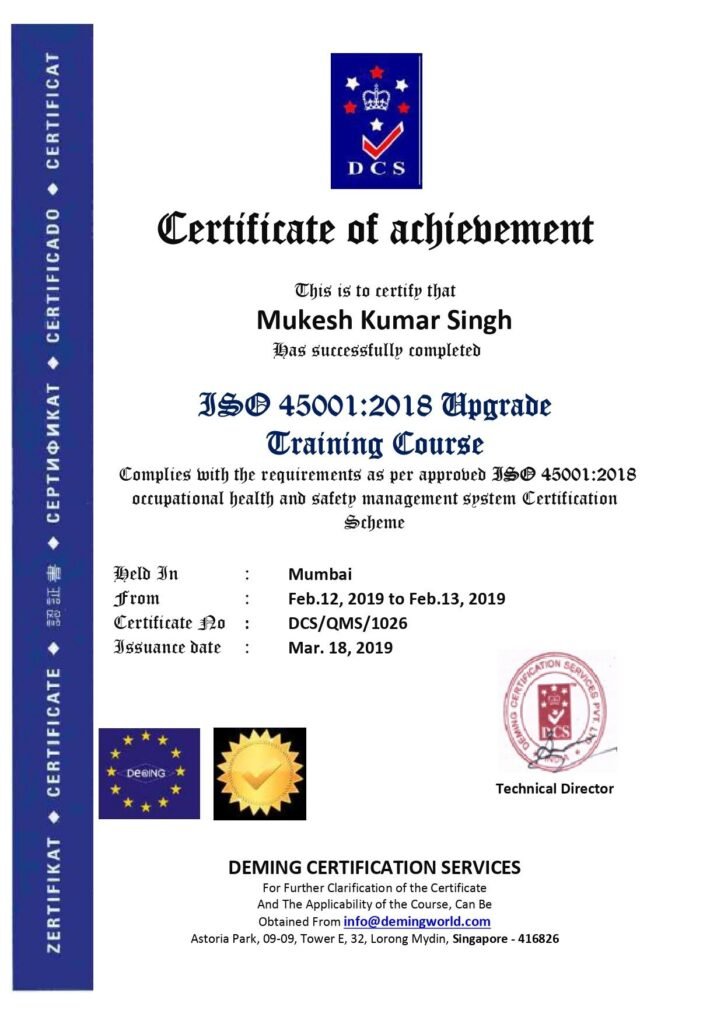
Certification can provide an organization or professional with a structured foundation, but the real value of certification is demonstrated through its application. For Mukesh Kumar Singh, the professional journey following ISO 9001 certification gradually moved beyond the boundaries of compliance and toward a broader vision of organizational excellence.
ISO 9001 introduced an important discipline: understanding processes systematically.
Instead of depending entirely on individual experience or informal methods, processes can be defined, responsibilities can be established, risks can be considered, performance can be evaluated, and improvements can be planned.
This approach creates a foundation on which other professional disciplines can be developed.
The subsequent exposure to Lean, Six Sigma, auditing, environmental management, occupational health and safety, information security, laboratory competence, energy management, 5S, accreditation, and sector-specific quality requirements strengthened this foundation.
The result was an increasingly integrated understanding of organizational performance.
One of the most important lessons from this journey is that compliance and excellence are not the same thing.
Compliance generally asks whether specified requirements have been addressed.
Excellence asks a broader question: how effectively is the organization using its systems to achieve sustainable performance?
A company may have procedures, records, certificates, and documented processes. However, the real strength of its management system is visible when employees understand their responsibilities, processes are consistently controlled, risks are managed, customers are considered, problems are investigated, and improvements are implemented.
This distinction makes auditing an important tool for organizational development.
Through auditing, organizations can obtain an independent and structured view of their processes. Audits can identify conformity as well as areas requiring attention. When audit findings are treated constructively, they can become inputs for improvement rather than merely observations to be closed.
The same philosophy applies to corrective action.
A weak corrective action may address only the immediate symptom.
A stronger approach attempts to understand the underlying cause.
Six Sigma and structured problem-solving concepts can support this way of thinking by encouraging professionals to define problems, collect information, analyze causes, implement solutions, and evaluate results.
This approach changes the organizational attitude toward mistakes.
Instead of asking only, “Who made the mistake?” the organization can ask, “Why did the system allow the mistake to occur, and what can be changed to prevent recurrence?”
That shift can have a powerful effect on organizational culture.
Lean thinking adds another dimension by encouraging organizations to identify activities that do not contribute sufficient value. Unnecessary movement, waiting, duplication, excess processing, inefficient workplace arrangements, and other forms of waste can affect productivity.
The principles associated with 5S can support this transformation at the workplace level.
An organized workplace makes abnormal conditions easier to identify. Clearly defined locations can reduce searching time. Standardized practices can improve consistency. Sustaining these conditions requires employee participation and management commitment.
Thus, seemingly simple workplace practices can become part of a larger culture of discipline and continual improvement.
The same principle applies to occupational health and safety.
ISO 45001:2018 emphasizes the importance of proactive thinking around hazards and risks. A mature safety culture does not depend solely on reacting after an accident. It encourages employees and management to identify hazards before they become incidents and to establish appropriate controls.
Environmental management follows a similar philosophy.
Organizations can consider environmental aspects and impacts, establish controls, monitor performance, and seek continual improvement. This creates a more systematic approach than responding only when an environmental issue occurs.
Information security presents another example.
Modern organizations depend heavily on information. Data may support operations, customer relationships, financial activities, communication, technical work, and decision-making. Understanding ISMS principles therefore broadens the concept of organizational risk beyond physical processes.
Information must also be protected through appropriate controls and awareness.
Laboratory competence introduces yet another important lesson: technical reliability matters.
Under ISO/IEC 17025:2005, attention to competence, processes, equipment, records, methods, and internal auditing supports confidence in laboratory activities. This demonstrates that quality is not simply about appearance or documentation. It is about whether the underlying process can consistently produce reliable outcomes.
Accreditation concepts reinforce the importance of competence, consistency, impartiality, and confidence in conformity assessment.
Energy management provides another opportunity for systematic improvement.
The inclusion of ISO 50001:2011 in the professional scope demonstrates that organizational performance can also be considered from the perspective of energy use and efficiency. Understanding how energy-related performance can be managed systematically adds another dimension to the overall management-system perspective.
The professional understanding of ISO 22163:2017 further demonstrates the importance of industry-specific requirements. Railway-related organizations operate within demanding operational environments where quality, reliability, traceability, process control, and customer requirements can have significant importance.
Together, these areas illustrate a fundamental principle:
Organizational excellence is created through connected systems, not isolated certificates.
This principle also influences leadership.
Leaders must establish direction, provide resources, encourage competence, evaluate performance, and support improvement. Employees must understand how their work contributes to organizational objectives. Auditors must provide objective information. Trainers must transfer knowledge effectively. Managers must convert information into decisions.
Everyone has a role.
For Mukesh Kumar Singh, the progression from ISO 9001 toward broader professional expertise can therefore be viewed as a transition from understanding a standard to understanding management systems as a whole.
The journey also highlights the importance of adaptability.
A professional working with management systems cannot rely permanently on knowledge gained many years earlier. Standards are revised, technologies change, customer expectations evolve, and new risks emerge. Continuous education is therefore essential.
The professional development reflected in areas such as ISO 9001:2015 upgrades, ISO 45001:2018 upgrades, Six Sigma Master Black Belt training, 5S Lead Auditor training, ISMS auditing, EMS conversion training, and laboratory competence demonstrates this continuing commitment to learning.
Ultimately, the value of certification is measured by what happens after certification.
If knowledge remains inside a certificate file, its organizational value is limited.
If that knowledge influences processes, strengthens employees, improves decision-making, supports audits, reduces variation, manages risks, and encourages continual improvement, its value becomes much greater.
The journey of Mukesh Kumar Singh therefore represents more than a sequence of professional qualifications.
It represents the gradual development of a quality-oriented mindset.
From quality management to process improvement, from auditing to risk management, and from individual standards to integrated systems, each stage contributed another part of the larger picture.
The destination is not a final certificate.
The destination is a culture in which learning and improvement become permanent.
That is the point at which certification evolves into organizational excellence.
#ProfessionalGrowth
Chapter 10 – The Road Ahead: A Legacy of Quality, Learning and Continuous Improvement
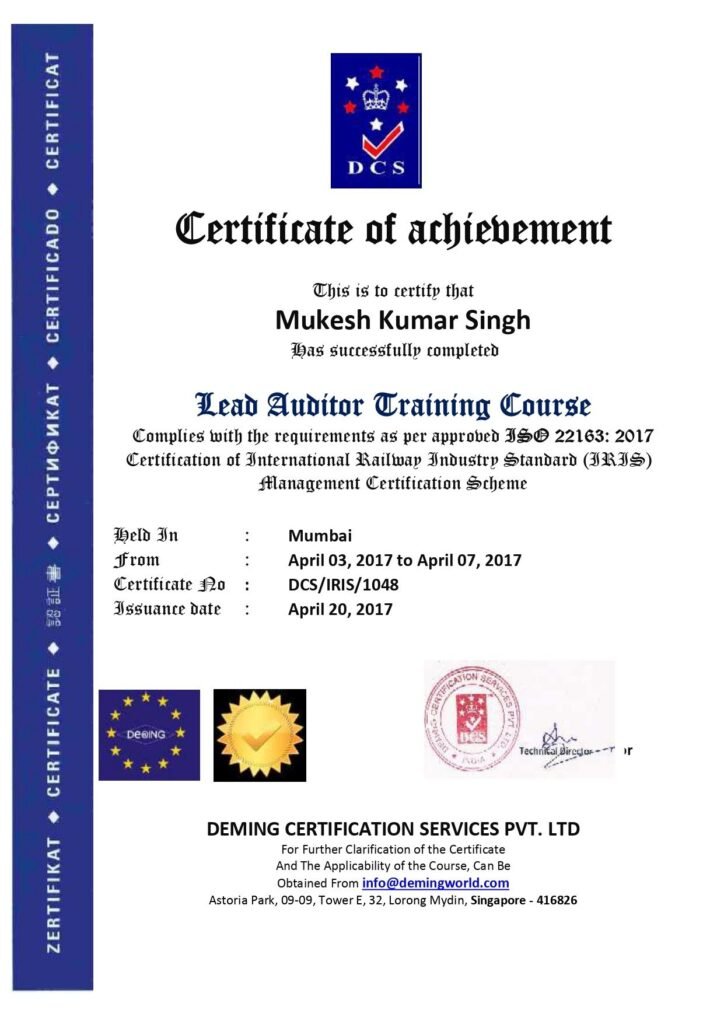
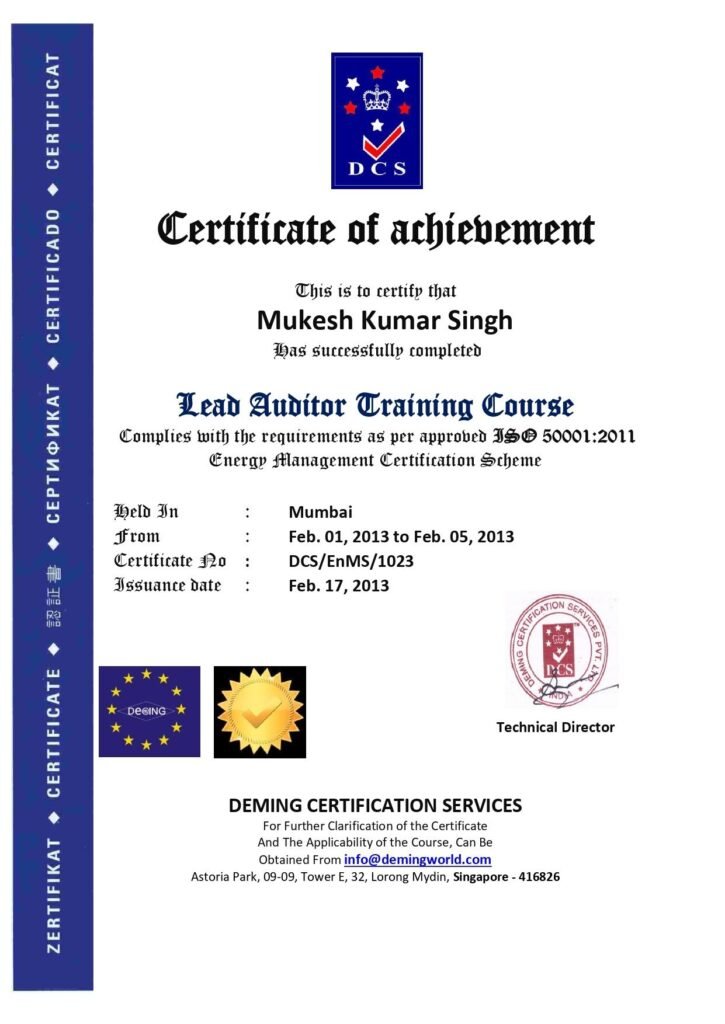
Every professional journey has a beginning, a period of development, and a vision for the future. For Mukesh Kumar Singh, the journey that developed around ISO 9001 certification represents much more than the achievement of an individual quality credential. It reflects a continuing commitment to professional learning, management-system knowledge, auditing, process improvement, and the practical application of quality principles.
The foundation of this journey was quality.
ISO 9001 created an understanding of structured processes, customer focus, documented information, responsibilities, performance evaluation, corrective action, risk-based thinking, and continual improvement. These principles became a platform for exploring wider areas of organizational management.
Over time, that platform expanded.
Lean and Six Sigma introduced structured approaches to process improvement and variation reduction. Kaizen encouraged continuous, incremental improvement. Black Belt and Master Black Belt training added greater depth to problem-solving and improvement leadership.
Auditing provided another important perspective.
An auditor must learn to examine processes objectively, collect appropriate evidence, understand requirements, communicate findings, and distinguish between conformity and opportunities for improvement. This discipline can strengthen analytical thinking and encourage decisions based on facts rather than assumptions.
The professional scope then extended into environmental management and occupational health and safety.
EMS Auditor Conversion Training encouraged understanding of environmental aspects, impacts, controls, and continual improvement. ISO 45001:2018 Upgrade Training strengthened awareness of occupational health and safety management and the importance of proactive risk control.
Information security added another modern dimension.
Through knowledge associated with ISO 27001:2005 Information Security Management Systems, the concept of organizational risk expanded beyond physical operations. Information is an important organizational asset, and protecting its confidentiality, integrity, and availability requires systematic thinking, appropriate controls, competence, and awareness.
Laboratory competence provided another valuable lesson.
ISO/IEC 17025:2005 emphasizes the relationship between technical competence, reliable processes, appropriate methods, records, equipment, internal auditing, and confidence in laboratory activities. This reinforces an important principle: quality must ultimately be demonstrated through reliable outcomes and objective evidence.
Accreditation concepts further strengthened the understanding of conformity assessment and professional confidence.
Similarly, ISO 50001:2011 introduced the importance of systematic energy management, while 5S Lead Auditor Training brought attention to workplace organization, standardization, discipline, and sustainability.
The inclusion of ISO 22163:2017 also broadened the professional perspective toward sector-specific quality requirements, particularly in environments where reliability, traceability, process control, and customer requirements are highly important.
When these areas are viewed together, a larger picture emerges.
Quality is not an isolated department.
Quality is connected with productivity.
Productivity is connected with process design.
Processes are connected with risks.
Risks are connected with safety, environment, information, energy, technology, and people.
People are connected with competence.
Competence is connected with training.
Training is connected with continual improvement.
This interconnected view represents one of the strongest outcomes of the professional journey.
The future therefore does not need to be viewed as a destination where learning stops. Instead, it can be viewed as another stage in the same improvement cycle.
Learn. Apply. Measure. Audit. Improve. Repeat.
This cycle is relevant to both organizations and professionals.
For organizations, it supports continual improvement of management systems and operational processes.
For professionals, it creates a mindset of lifelong learning.
As industries evolve, new technologies and new risks will continue to appear. Digital transformation, cybersecurity, automation, artificial intelligence, sustainability, energy efficiency, supply-chain resilience, and changing customer expectations are examples of areas that can influence future management systems.
A quality professional therefore needs more than knowledge of historical requirements.
Adaptability becomes essential.
The ability to understand new requirements, evaluate their organizational impact, communicate them effectively, and help translate them into practical processes can become an important professional capability.
This is also where training and knowledge transfer become increasingly valuable.
Knowledge has greater impact when it is shared.
A professional who understands quality principles can help others recognize the importance of process discipline. An auditor can encourage organizations to learn from findings. A trainer can help employees develop competence. An improvement specialist can guide teams toward structured problem-solving.
In this way, professional growth can gradually create organizational value beyond the individual.
The story of Mukesh Kumar Singh also demonstrates that certifications and training should not be viewed merely as additions to a résumé.
Their greater purpose is capability development.
A certificate may demonstrate that a particular learning milestone has been achieved, but practical value comes from understanding the subject and applying that knowledge responsibly.
The journey from ISO 9001 toward Lean Six Sigma, auditing, environmental management, occupational safety, information security, laboratory competence, accreditation, energy management, 5S, and sector-specific quality requirements demonstrates how one area of learning can lead naturally to another.
Each subject contributes a different perspective.
Together, they support a broader approach to organizational assurance and improvement.
The professional journey associated with the address at 107/108 Mehta Chambers, Station Road, Vasai (West), District Palghar, Maharashtra – 401202, can therefore be understood as a journey built around knowledge, discipline, quality, and continuous development.
Its most important achievement is not any single standard.
It is the mindset created through the combination of standards and improvement methodologies.
A quality-oriented mindset asks whether a process is effective.
An auditor asks whether evidence supports the conclusion.
A Six Sigma professional asks why variation exists.
A Lean professional asks where waste can be removed.
A safety professional asks what hazards can be prevented.
An environmental professional asks what impacts can be controlled.
An information-security professional asks what risks could compromise information.
A laboratory professional asks whether results can be trusted.
A management-system professional asks how all these elements can work together.
These questions form the foundation of sustainable improvement.
The road ahead will undoubtedly bring new standards, technologies, business models, and challenges. Yet the fundamental principles of disciplined management, objective evidence, competence, customer focus, risk awareness, and continual improvement will remain valuable.
The journey that began with ISO 9001 certification therefore becomes a story of evolution—from quality awareness to multidisciplinary expertise, from individual learning to integrated thinking, and from certification to a broader commitment to excellence.
The ultimate legacy of such a journey is not simply the number of courses completed or standards understood.
It is the ability to help create better processes, stronger systems, more capable people, and organizations that continually learn from experience.
Certification may mark a milestone, but continuous improvement creates the journey.
For Mukesh Kumar Singh, that journey continues—with quality as the foundation, learning as the engine, auditing as a source of insight, improvement as the objective, and professional excellence as the road ahead.
#OrganizationalExcellence
#ISO27001 #ISO45001 #ISO50001 #ISO17025 #Kaizen
Take the Next Step Today
Don’t wait to enhance your business’s quality and efficiency. Partner with Mayu Group India and experience the transformation that comes with expert consultancy and training. Contact us today to learn more about how we can help you achieve your business goals. Reach out via phone at +91-9322728183, visit our website at www.mayugroup.in, or email us at investor@mayugroup.in Let us be your guide on the journey to excellence and innovation.