
Indian Oil Corporation Limited Haldia Refiner
- Indian Oil Corporation Limited Haldia Refiner
- Chapter 1 – The Beginning of a National Industrial Vision
- Chapter 2 – Growth Through Technology and Expansion
- Chapter 3 – The Quality Journey and the Importance of ISO Certification
- Chapter 4 – The Human Story Behind Certification
- Chapter 5 – Energy Efficiency as a New Growth Philosophy
- Chapter 6 – Product Diversification and Value Creation
- Chapter 7 – Sustainability, Environment and Social Responsibility
- Chapter 8 – The Promoter, IndianOil and Institutional Strength
- Chapter 9 – Growth After Certification: From Compliance to Continuous Improvement
- Chapter 10 – The Future of Haldia Refinery: A Story Still Being Written
- Take the Next Step Today
Chapter 1 – The Beginning of a National Industrial Vision
The story of Indian Oil Corporation Limited’s Haldia Refinery is not merely the story of an industrial plant. It is the story of India’s determination to build energy security, strengthen domestic manufacturing and create an industrial foundation capable of supporting generations of economic development.
Haldia Refinery stands in West Bengal, near the confluence of the Haldi and Hooghly rivers. Its location gave it an important strategic advantage. The waterways provided access for crude and petroleum product movement, while its connectivity with eastern and northeastern markets allowed the refinery to become an important source of petroleum energy for a vast geographical region.
The refinery began operations in January 1975 with an original installed capacity of 2.5 million metric tonnes per annum. It was the fourth refinery of Indian Oil Corporation Limited. Its establishment represented a major step in the development of India’s petroleum infrastructure.
At the beginning, Haldia Refinery was designed primarily to process crude oil and produce essential petroleum fuels. But from the beginning there was a broader vision. The refinery was intended to become more than a production facility. It would become part of a national network through which energy could reach industries, transport systems, agriculture, households and communities.
The refinery’s development was gradual but continuous. Its original 2.5 MMTPA capacity was increased to 2.75 MMTPA in 1989. Through further debottlenecking, the refinery reached 3.6 MMTPA. In 1997, the addition of a second Crude Distillation Unit increased capacity to 4.6 MMTPA. Subsequent secondary processing facilities took the refinery to 6.0 MMTPA.
This progression established one of the most important characteristics of Haldia Refinery: its ability to evolve.
Industrial growth is rarely achieved through a single investment. It requires repeated improvements in technology, operating practices, maintenance, safety, human resources and quality. Haldia demonstrated this philosophy throughout its history.
The refinery also developed an important distinction within Indian refining. Along with fuel products, it became a producer of lube oil base stocks. This gave Haldia a diversified product profile and allowed it to serve industries requiring specialised petroleum derivatives.
The Lube Oil Block became one of the refinery’s important assets. Later, the catalytic iso-dewaxing technology enabled the production of superior Group II lube oil base stocks. Haldia eventually moved toward advanced Group III products as well.
The growth of the refinery was therefore simultaneously a story of quantity and quality.
More crude was processed, but the objective was not simply to increase volume. The refinery increasingly needed to produce cleaner fuels, specialised products and higher-value materials while controlling energy consumption and environmental impacts.
That challenge became more important as India’s economy expanded.
Every increase in industrial production created additional expectations from the energy sector. Customers demanded consistent quality. Regulators demanded compliance. Society demanded greater environmental responsibility. Employees demanded safe working conditions. Management demanded improved productivity.
The refinery had to respond to all of these requirements at the same time.
This is where management systems became increasingly important.
Quality management helped establish disciplined processes. Environmental management encouraged greater attention to emissions, waste and resource utilisation. Safety systems strengthened operational discipline. Energy management eventually became another essential pillar.
The journey toward ISO 50001:2018 was therefore not an isolated event. It was part of a much longer institutional evolution.
By 2020, Haldia Refinery had already travelled a remarkable distance from its original 2.5 MMTPA configuration. Its capacity had reached 8.0 MMTPA, following major expansion and modernisation programmes.
The refinery had grown physically, technologically and organisationally.
Yet the most important question was no longer simply, “How much can the refinery produce?”
The more important question became:
“How efficiently, safely and sustainably can the refinery produce it?”
That question would define the next phase of Haldia Refinery’s journey.
#HaldiaRefinery
Chapter 2 – Growth Through Technology and Expansion
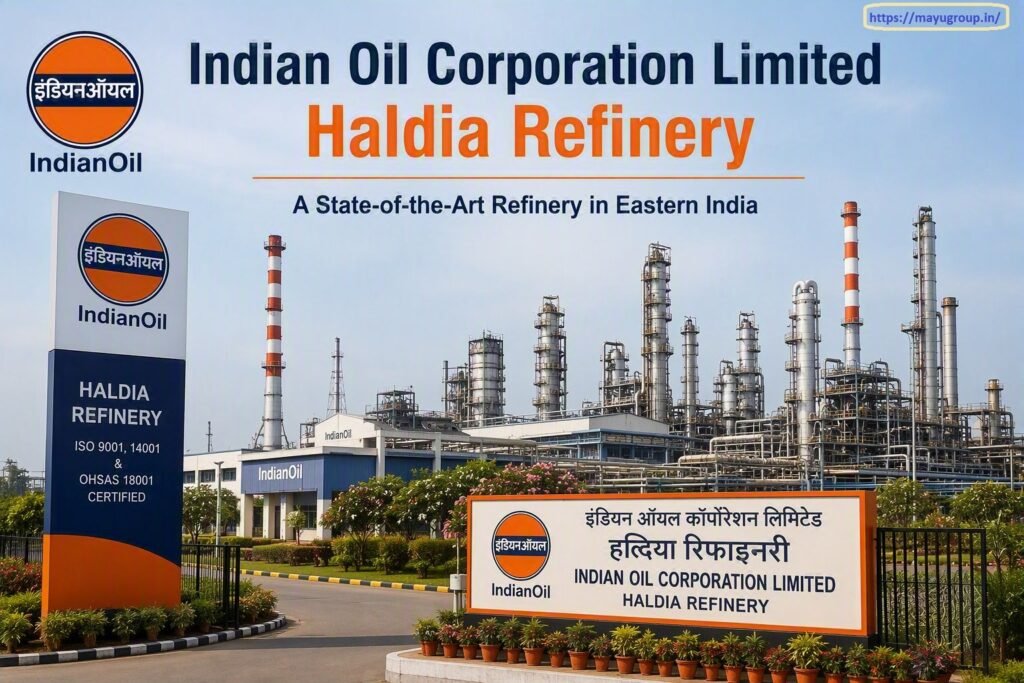
The growth of Haldia Refinery was achieved through a series of technological and capacity-enhancement projects. Each project addressed a particular industrial requirement, but together they transformed the refinery into a complex and versatile petroleum-processing facility.
One of the major milestones was the introduction of the second Crude Distillation Unit in 1997. The addition expanded the refinery’s processing capability and created a stronger foundation for future growth.
The next major stage involved secondary processing. Modern refineries cannot depend solely on atmospheric distillation. Crude oil contains different fractions, and higher-value products require sophisticated conversion and treatment technologies.
Haldia responded by developing secondary processing capabilities.
By 2010, the refinery’s capacity had expanded from 6.0 MMTPA to 7.5 MMTPA. A major component was the Once-Through Hydrocracker Unit, with a capacity of 1.7 MMTPA. The project also included a Hydrogen Generation Unit, Sulphur Recovery Unit, nitrogen facilities, effluent treatment and associated infrastructure.
The significance of the project went beyond capacity.
Hydrocracking improved the refinery’s ability to produce high-quality distillate products. IndianOil stated that the project was designed to improve distillate yield and produce Euro-IV quality diesel and other superior products.
This was an example of how environmental requirements and commercial objectives could move together.
Producing cleaner fuel was not simply a regulatory necessity. It was also an opportunity to modernise the refinery and improve its product value.
The refinery’s development continued.
Between 2019 and 2020, another major expansion increased capacity from 7.5 MMTPA to 8.0 MMTPA. The programme included revamping of crude distillation capacity and the implementation of a new Delayed Coking Unit and Coker Gas Oil Treater.
The Delayed Coking Unit represented another stage in refinery sophistication. It enabled the refinery to process heavier residual streams and convert lower-value material into more useful products.
Such technologies also introduced new challenges.
More equipment meant more energy requirements.
More process units meant more complex steam and electricity systems.
More production meant greater requirements for cooling, pumping, compression and heating.
Therefore, the growth of refinery capacity naturally created the need for better energy management.
A refinery is an energy-intensive industrial environment. Energy is consumed in furnaces, boilers, compressors, pumps, heaters, distillation columns, hydrogen systems and other process operations.
When energy efficiency improves even slightly across a large refinery, the cumulative impact can be substantial.
The management at Haldia increasingly understood that energy could not be treated simply as an unavoidable operating cost.
It had to be managed as a strategic resource.
This change in thinking was fundamental.
The old approach might have asked whether equipment was operating.
The new approach asked whether equipment was operating at optimum efficiency.
The old approach might have focused on production targets.
The new approach considered production, quality, safety, energy intensity and environmental performance together.
This philosophy became particularly relevant as the refinery moved toward ISO 50001:2018.
The standard provided a structured framework for establishing, implementing, maintaining and improving an Energy Management System.
For Haldia, certification could therefore be viewed as a continuation of its technological evolution.
Technology provided the physical capability.
Management systems provided the organisational discipline.
People provided the knowledge and commitment.
Together, these elements created the foundation for sustainable refinery growth.
The refinery’s success could no longer be measured only in tonnes of crude processed. It increasingly had to be evaluated in terms of the value created from every tonne of crude, every unit of energy, every hour of operation and every investment made in infrastructure.
This represented a major transformation in industrial thinking.
#IndianOil
Chapter 3 – The Quality Journey and the Importance of ISO Certification
Long before ISO 50001:2018 became part of the refinery’s management-system journey, IndianOil had already recognised the importance of quality assurance.
The Corporation’s Total Quality Management initiatives produced significant results. IndianOil’s historical annual reports record that its refineries, including Haldia, earned ISO 9001/9002 accreditation during the 1990s.
This historical fact is important because it shows that certification was not an artificial addition to Haldia Refinery’s operations.
Rather, certification reflected an organisational culture that had been developing for decades.
ISO 9001 and ISO 9002 placed emphasis on consistent processes, documentation, customer requirements, quality assurance and continual improvement.
Over time, these principles became embedded into industrial operations.
Employees learned that quality could not be inspected into a product at the end.
Quality had to be built into the process.
The same philosophy later became relevant to energy.
Energy efficiency cannot be created simply by conducting an annual energy audit. It has to become part of everyday decision-making.
An operator adjusting process parameters, an engineer selecting a pump, a maintenance team restoring equipment efficiency, a laboratory monitoring product quality, and a manager approving a capital project can all influence energy performance.
Therefore, energy management requires organisational participation.
This is one of the most important ideas behind ISO 50001.
The certification journey encouraged the refinery to look at energy as a system rather than as a collection of individual consumption points.
Furnaces could not be considered independently of crude throughput.
Steam consumption could not be considered independently of process integration.
Electricity consumption could not be considered independently of motors, pumps and compressors.
Hydrogen consumption could not be separated from product-quality requirements.
The management system encouraged a broader understanding.
It asked the organisation to identify significant energy uses, establish energy objectives, monitor performance, establish baselines and continuously improve energy performance.
This approach aligned naturally with the philosophy that had already developed through quality management.
A documented procedure was useful only if it produced better performance.
An audit was useful only if it identified opportunities for improvement.
A corrective action was useful only if it prevented recurrence.
A target was useful only if people understood it and acted upon it.
Certification therefore became more than a certificate displayed on an office wall.
It became an organisational discipline.
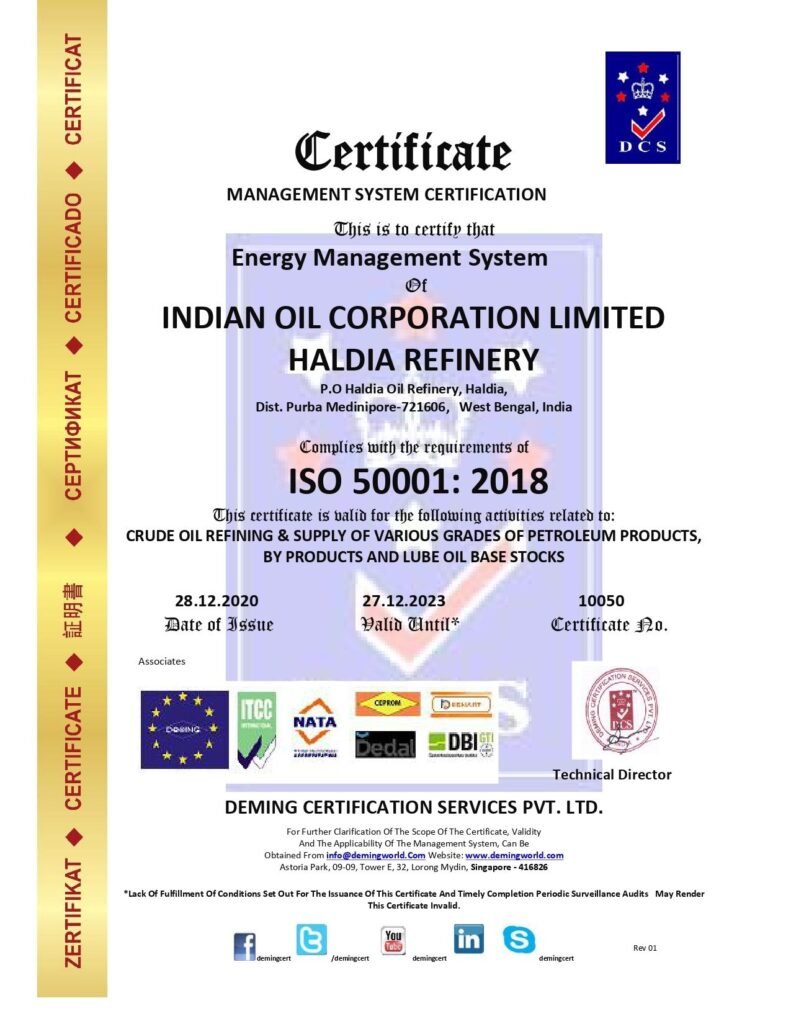
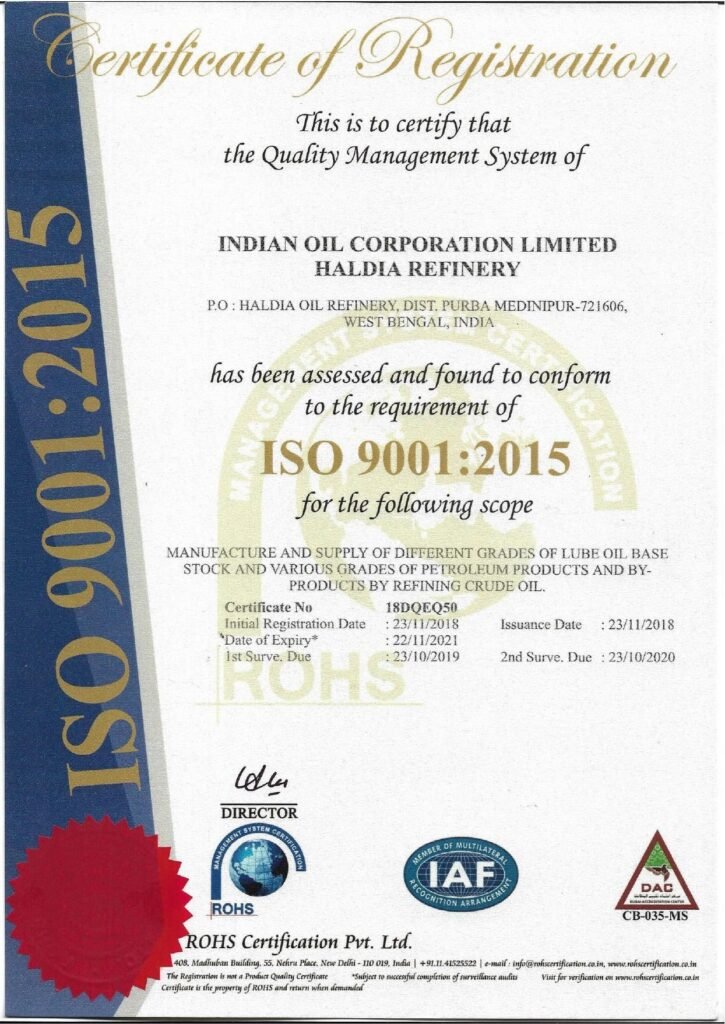
The 2020 ISO 50001:2018 certification details supplied for Haldia Refinery represent this stage of development.
The timing was significant.
In 2020, Haldia Refinery had reached 8.0 MMTPA capacity. At the same time, the refinery was dealing with increasingly complex processing requirements and modern fuel-quality expectations.
The certification consequently came at a point when energy management was becoming more important, not less.
The refinery had grown large enough that even small inefficiencies could create significant economic consequences.
A furnace operating slightly above optimum temperature could consume additional fuel.
A heat exchanger with fouling could increase heating requirements.
A steam leak could remain small in isolation but become significant across thousands of operating hours.
An inefficient motor could consume unnecessary electricity year after year.
A poorly controlled process could increase both energy consumption and product losses.
The Energy Management System brought these issues into a structured framework.
It encouraged measurement.
It encouraged analysis.
It encouraged responsibility.
It encouraged review.
Most importantly, it encouraged continual improvement.
The certification therefore formed a bridge between the refinery’s historical quality culture and its emerging sustainability culture.
ISO 9001 had helped reinforce the principle of doing things consistently and correctly.
ISO 50001 strengthened the principle of doing them with greater energy efficiency.
Together, these systems contributed to a more mature industrial organisation.
#ISO50001
Chapter 4 – The Human Story Behind Certification
Behind every certificate are people.
Machines do not establish management systems. People do.
At Haldia Refinery, thousands of decisions are made every day by employees, engineers, operators, maintenance specialists, laboratory personnel, safety professionals, managers and contractors.
A refinery operates continuously, and its complexity requires coordination.
The ISO 50001 journey therefore required more than technical documentation. It required awareness.
Employees needed to understand why energy mattered.
An operator needed to recognise that a small process deviation could increase fuel consumption.
A maintenance engineer needed to appreciate the relationship between equipment condition and energy efficiency.
An electrical engineer needed to consider energy performance when assessing motors and drives.
A process engineer needed to balance production, quality, safety and energy.
A manager needed to understand that an energy-efficiency investment could generate benefits over many years.
This created a culture of shared responsibility.
Training became an important part of the journey.
Employees could be introduced to concepts such as energy baselines, energy performance indicators, significant energy uses, operational controls and continual improvement.
But technical terminology alone could not create change.
The organisation had to connect energy management with everyday work.
For example, an operator could be encouraged to observe furnace performance.
A maintenance team could monitor steam traps and insulation.
An electrical team could analyse motor loading.
A process team could examine heat recovery.
A management team could review energy intensity alongside production results.
In this way, certification moved from the conference room to the plant floor.
The culture of safety also played an important role.
Refinery operations involve high temperatures, high pressures, flammable materials and complex equipment. Efficiency improvements could never compromise safety.
Therefore, the principle was not “save energy at any cost.”
The principle was:
Improve energy performance without compromising safety, product quality, reliability or environmental compliance.
This balance was critical.
One of the most valuable consequences of a structured management system is that it forces an organisation to examine interactions.
An energy-saving initiative that reduces steam consumption but creates operational instability is not necessarily an improvement.
A modification that reduces electricity consumption but increases equipment failure is not necessarily an improvement.
A production shortcut that increases output but reduces product quality is not sustainable.
True improvement requires a system-level view.
The employees of Haldia Refinery therefore became part of a larger transformation.
The refinery was not merely changing equipment.
It was changing habits.
The mindset gradually shifted from:
“Is the plant running?”
to:
“Is the plant running safely, reliably, efficiently and optimally?”
That is a much more demanding question.
It requires observation.
It requires data.
It requires communication.
It requires accountability.
It also requires leadership.
Management has to communicate objectives clearly, allocate resources, review performance and support corrective actions.
Employees have to believe that suggestions for improvement will be considered seriously.
Contractors need to understand operational expectations.
Suppliers need to appreciate equipment-efficiency requirements.
In this way, energy management becomes a shared organisational value.
The certification journey can therefore be understood as a human-development journey as much as a technical one.
A refinery may possess the world’s most advanced equipment, but without disciplined people it cannot achieve sustained performance.
Haldia’s long industrial history created a deep reservoir of experience.
Senior employees brought knowledge of traditional refinery operations.
Younger professionals brought new technological skills.
Engineers brought analytical capabilities.
Operators brought practical knowledge.
Managers connected technical improvements with business priorities.
Together, these groups created the human foundation for continual improvement.
The certification was consequently not the end of the journey.
It was a formal recognition of a management system and an invitation to continue improving it.
#EnergyManagement
Chapter 5 – Energy Efficiency as a New Growth Philosophy

The most important transformation associated with an energy-management system is conceptual.
A refinery traditionally views energy as one of the inputs required to manufacture petroleum products.
An advanced refinery begins to view energy itself as an area of performance.
This distinction is important.
If crude oil is a raw material, it is carefully measured.
If a petroleum product is sold, its quality is carefully measured.
If money is spent, it is accounted for.
Energy deserves the same discipline.
Haldia Refinery’s scale made this particularly relevant.
At 8.0 MMTPA, the refinery operates a complex network of process units and supporting systems.
Energy efficiency therefore has the potential to influence production cost, competitiveness, emissions and resource conservation.
The refinery’s energy-management approach could include attention to furnaces, steam generation, heat recovery, electrical consumption, compressors, pumps, cooling systems and process integration.
The basic principle is simple:
The less energy required to produce the same quantity and quality of product, the greater the efficiency.
But achieving that result is technically complex.
Refinery processes involve heat transfer, pressure changes, chemical reactions, separation and purification.
Distillation columns require heat.
Hydrogen plants require energy.
Hydroprocessing requires hydrogen and high operating temperatures and pressures.
Delayed coking requires controlled thermal conversion.
Lube oil processing requires specialised treatment.
Every process has its own energy profile.
The Energy Management System helped create a framework for understanding these relationships.
One useful concept is energy performance measurement.
Instead of looking only at total energy consumption, the organisation can consider consumption relative to production.
For example, energy intensity can be assessed against throughput or another appropriate operational parameter.
This creates a more meaningful picture.
If energy consumption rises because production rises, the increase may be expected.
If energy consumption rises while production remains unchanged, however, the situation requires investigation.
Similarly, if production remains constant but energy intensity declines, the refinery may have achieved an efficiency improvement.
This type of measurement transforms energy from an invisible operating cost into a visible performance indicator.
Data becomes central.
Meters, monitoring systems, laboratory information, process-control systems and maintenance records can all contribute to the understanding of performance.
The digital transformation of industrial operations further increases this potential.
Data can reveal trends that may not be visible during routine plant rounds.
A gradual increase in furnace fuel consumption can indicate fouling.
A change in compressor power can indicate deterioration.
Unexpected steam consumption can point to leaks or process changes.
A shift in electricity demand can identify equipment operating outside its optimum range.
These insights allow maintenance to become more predictive.
The result is a cycle:
Measure → Analyse → Identify → Improve → Verify → Standardise → Repeat.
This is the essence of continual improvement.
Energy efficiency also supports environmental objectives.
Reducing fuel consumption generally means reducing the amount of fuel that must be burned, which can contribute to lower greenhouse-gas emissions and other combustion-related impacts, subject to the specific process and fuel mix.
IndianOil has continued to emphasise energy efficiency and environmental performance across its refining operations. The Corporation states that its refineries pursue capacity augmentation, bottom upgrading and quality upgrading while also addressing environmental and safety requirements.
Haldia’s later projects demonstrate how this philosophy evolved.
The Wetgas Sulphuric Acid plant commissioned in 2022 was designed not only to meet sulphuric-acid demand but also to supply high-pressure steam to the refinery’s steam network, contributing to energy and emissions objectives.
This illustrates a broader principle:
Industrial waste or by-product streams can sometimes become resources.
Heat can be recovered.
Steam can be integrated.
Sulphur can be recovered.
Residual streams can be upgraded.
Low-value material can be converted into higher-value products.
Such approaches make the refinery more efficient and resilient.
Thus, the growth story after certification is not simply a story of “more production.”
It is a story of producing greater value from existing resources.
#EnergyEfficiency
Chapter 6 – Product Diversification and Value Creation
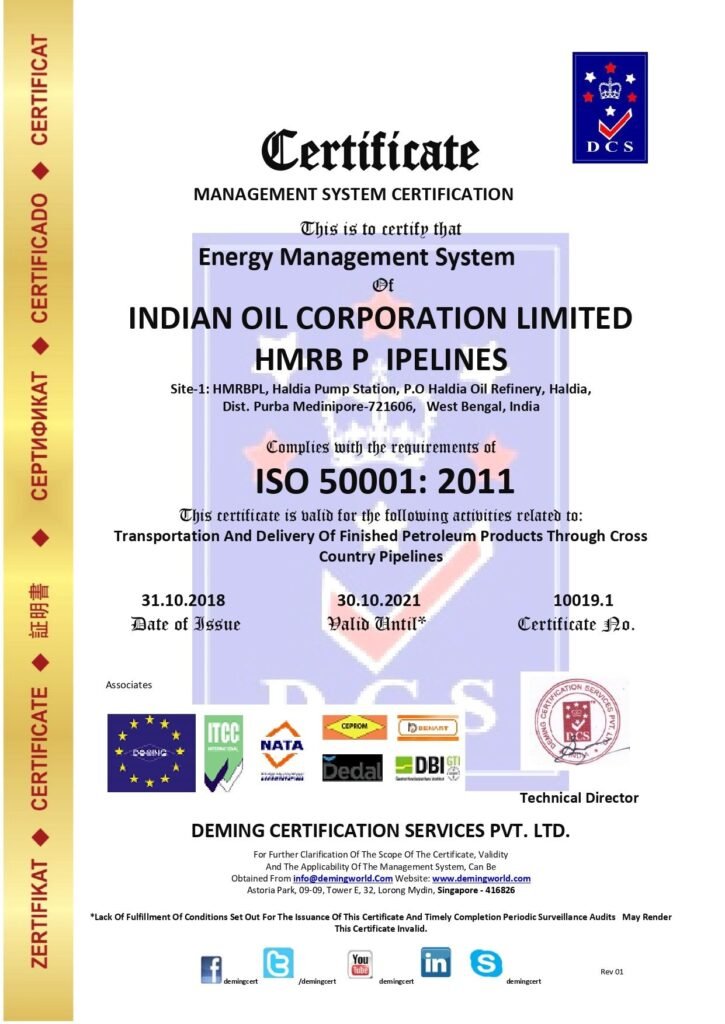
Haldia Refinery’s evolution cannot be understood only through its crude-processing capacity.
Its product portfolio is equally important.
The refinery produces a range of fuel products, including LPG, naphtha, motor spirit, superior kerosene oil, aviation turbine fuel, high-speed diesel and other petroleum products. It also produces lube oil base stocks and various residues and by-products.
This diversity gives the refinery an important economic advantage.
A refinery’s profitability depends not only on how much crude it processes but also on how effectively it converts crude into products that meet market requirements.
The Lube Oil Block became a particularly distinctive part of Haldia.
The refinery’s Catalytic Iso-Dewaxing Unit-I, commissioned in 2003, was described by IndianOil as the first of its kind in India for producing superior API Group II lube oil base stocks. These products offered lower pour points, very low sulphur content and higher viscosity index compared with conventional Group I base stocks.
This development was significant because lubricants are critical to modern industry.
Vehicles, machinery, manufacturing equipment and industrial systems all require lubricants.
Higher-quality base stocks can support higher-performance lubricant formulations.
Therefore, Haldia was not simply producing fuel.
It was producing specialised industrial inputs.
The refinery later expanded this capability further.
In 2024, Haldia commissioned Catalytic Iso-Dewaxing Unit-II, a 270 thousand tonnes per annum installation developed with an investment of approximately ₹1,019 crore, according to IndianOil. The unit supports production of Group III lube oil base stocks and specialty grades.
The significance of this project extends beyond Haldia.
It contributes to domestic production of advanced lube base stocks and can reduce dependence on imports.
This connects refinery modernisation with national industrial policy.
The concept of self-reliance becomes practical when domestic facilities can manufacture products that previously required substantial import dependence.
The refinery’s product diversification also demonstrates why energy management matters.
Producing more sophisticated products often requires more sophisticated processing.
Sophisticated processing requires energy.
Therefore, the commercial goal and energy-management goal must be integrated.
The challenge becomes:
How can the refinery increase value without proportionately increasing resource consumption?
That is where process optimisation becomes essential.
Better heat integration can reduce fuel requirements.
Improved equipment reliability can reduce losses.
Optimised operating conditions can improve product yields.
Better control can reduce off-specification production.
Advanced monitoring can identify deviations earlier.
These improvements can simultaneously benefit economics and sustainability.
The story therefore becomes one of value density rather than simply volume.
Instead of asking only how many tonnes can be processed, the refinery increasingly asks how much economic and strategic value can be created from those tonnes.
This is particularly important in a changing energy environment.
Fuel specifications have become progressively more demanding.
Customers expect better product quality.
Environmental standards have become stricter.
International shipping standards have influenced bunker fuel requirements.
Automotive technology has changed lubricant requirements.
Industrial users demand specialised products.
Haldia has responded by expanding and upgrading its product portfolio.
Its current profile includes API Group II and Group III lube oil base stocks, low-sulphur bunker fuel, sulphuric acid and other petroleum products.
This evolution demonstrates that certification and growth are not separate stories.
A management system creates discipline.
Technology creates capability.
Market demand creates direction.
Investment creates capacity.
Employees create execution.
Together, these elements transform an old refinery into a modern industrial asset.
#RefineryModernization
Chapter 7 – Sustainability, Environment and Social Responsibility
A refinery’s success in the modern era cannot be judged only by production and profitability.
Environmental responsibility has become an essential component of industrial performance.
Haldia Refinery’s location near the Hooghly and Haldi river systems makes environmental management particularly important.
The refinery’s operations involve crude oil, petroleum products, sulphur compounds, process chemicals, wastewater and combustion systems.
Consequently, environmental protection must be integrated into every stage of operation.
The development of sulphur-recovery facilities illustrates this philosophy.
IndianOil’s Haldia material notes that the refinery’s first Sulphur Recovery Unit was commissioned in 1994 and helped strengthen its environmental performance through sulphur recovery from refinery fuel gas.
Such technologies represent a fundamental principle of modern refining:
Pollutants should increasingly be treated as materials to be recovered, controlled or converted rather than simply released.
The same principle applies to wastewater.
Effluent treatment systems are essential in refinery operations.
Water must be treated before discharge or reuse, according to applicable requirements.
The objective is to reduce environmental impact while maximising resource efficiency.
Energy management contributes to this objective because energy consumption is closely connected with emissions.
When a refinery reduces unnecessary energy consumption, it can potentially reduce associated fuel use and emissions.
Therefore, ISO 50001 can support environmental performance indirectly as well as directly.
The refinery’s development of the Wetgas Sulphuric Acid plant is another example of integrated thinking. The plant was commissioned in 2022 with a capacity of 375 tonnes per day and is designed to supply 40 tonnes per hour of high-pressure steam to the refinery steam network. IndianOil identifies this contribution as supporting its Net Zero goals.
This demonstrates the evolution from conventional pollution control to resource optimisation.
A by-product can become a useful product.
A process stream can generate steam.
Steam can reduce the need for other energy sources.
An environmental project can therefore also become an efficiency project.
Sustainability also extends beyond the refinery boundary.
IndianOil’s Haldia Refinery has been associated with community development and social initiatives.
The refinery’s Golden Jubilee in 2024-25 included CSR initiatives such as “Drishti” and “Shakti” focused on eye and neurological care, along with cultural and community programmes.
Such initiatives reflect the broader role of a major industrial institution.
A refinery creates employment.
It supports contractors and service providers.
It contributes to local economic activity.
It supports transportation networks.
It supplies energy to industries and communities.
But a responsible industrial organisation also has to maintain trust with the surrounding community.
Trust is built through safe operations, environmental compliance, transparency, employment opportunities and community engagement.
This is why sustainable growth is different from simple expansion.
Expansion asks:
“How much larger can we become?”
Sustainable growth asks:
“How can we become stronger while protecting people, resources and the environment?”
That second question is increasingly central to the future of energy companies.
Haldia’s journey demonstrates how this philosophy has developed over decades.
From the original refinery of 1975 to an 8.0 MMTPA modern refinery, the organisation has repeatedly invested in technology, product quality, environmental performance and operational capability.
Certification reinforced this direction.
ISO 50001 brought energy performance into a structured management framework.
Quality systems reinforced product consistency.
Safety systems protected employees and assets.
Environmental systems addressed ecological responsibilities.
Together, these systems contributed to a more balanced definition of refinery success.
#IndustrialGrowth
Chapter 8 – The Promoter, IndianOil and Institutional Strength
The phrase “promoter growth” is more commonly used for privately promoted companies. Indian Oil Corporation Limited is different. It is a major public-sector energy company, and Haldia Refinery is one of its strategic refining assets.
Therefore, the growth story is best understood as the growth of IndianOil as the parent organisation and Haldia Refinery as a strategic operating asset.
IndianOil’s refining business has developed into one of the largest refining systems in India.
The Corporation states that its refining capacity is 70.25 MMTPA, representing approximately 31% of India’s national refining capacity, with additional expansion approved.
Haldia is part of that wider network.
The strength of the parent organisation provides access to capital, technology, research, procurement systems, technical expertise, marketing networks and organisational knowledge.
At the same time, Haldia contributes specialised capabilities to IndianOil.
Its lube oil base stock production is particularly distinctive.
It also serves eastern India through an extensive petroleum distribution network.
Haldia’s products move through pipelines, tank wagons, road tankers, ships and barges. IndianOil identifies several pipelines connected with the refinery, including the Haldia-Barauni Pipeline and other product pipelines.
This means the refinery is not an isolated industrial facility.
It is part of an integrated energy ecosystem.
Crude arrives.
It is processed.
Products are manufactured.
Products are stored.
They are transferred through pipelines, rail, road and marine transport.
Finally, they reach customers.
The efficiency of one part of this system affects the others.
If refinery production is efficient but product evacuation is inefficient, value can be lost.
If product quality is excellent but supply reliability is weak, customer confidence can suffer.
If energy consumption is reduced but maintenance reliability declines, the overall result may be negative.
The integrated IndianOil model helps address these relationships.
Research and development also contribute.
IndianOil’s technological experience across multiple refineries allows lessons from one location to influence another.
This creates an institutional learning system.
A successful energy-efficiency initiative at one refinery can provide a model for another.
A new process technology can be evaluated across multiple facilities.
A safety improvement can become a corporate standard.
A digital system can be scaled.
This is one of the advantages of being part of a large organisation.
Haldia’s growth therefore reflects both local capability and corporate support.
The refinery’s workforce has developed specialised knowledge through decades of operation.
IndianOil’s broader institutional resources provide additional strength.
Together, they support continuous modernisation.
The company’s larger transformation also mirrors the transformation of India’s energy sector.
India has moved from a period of petroleum scarcity and import dependence toward a large and sophisticated refining industry.
At the same time, the country is now preparing for an energy transition.
Traditional petroleum products remain important, but energy companies increasingly have to address low-carbon technologies, renewable energy, hydrogen, biofuels, efficiency and emissions reduction.
For Haldia, this creates both challenges and opportunities.
Its existing refinery assets remain strategically important.
But future competitiveness will depend increasingly on efficiency, flexibility and environmental performance.
The ISO 50001 philosophy is therefore likely to remain relevant even as technologies change.
The precise equipment may change.
The fuel mix may change.
The product mix may change.
But the principle of measuring energy, identifying inefficiency and continually improving performance will remain valuable.
#SustainableDevelopment
Chapter 9 – Growth After Certification: From Compliance to Continuous Improvement
Certification is often misunderstood as an endpoint.
In reality, it is a milestone.
The certificate may have an issue date and an expiry date, but the management philosophy behind it should continue.
For Haldia Refinery, the period around the 2020 ISO 50001:2018 certification coincided with a major phase in its physical development.
The refinery reached 8.0 MMTPA capacity in 2020 with the implementation of a new Delayed Coking Unit and Coker Gas Oil Treater.
This was important because certification and capacity expansion were occurring in the same broad period.
The refinery therefore faced a dual challenge:
increase capability while improving efficiency.
This is the essence of sustainable industrial growth.
The post-certification story should not be reduced to a claim that ISO certification alone caused increases in capacity or profitability. Industrial growth results from many factors, including investment, technology, market conditions, crude availability, product demand, operational performance, management decisions and workforce capability.
However, a strong energy-management system can help create the discipline needed to ensure that growth does not automatically translate into proportional increases in energy consumption.
This distinction is crucial.
Suppose a refinery increases production by 10%.
If energy consumption increases by 15%, the refinery has grown but may have become less energy-efficient.
If production increases by 10% while energy consumption increases by only 5%, energy intensity has improved.
If production increases while absolute energy consumption remains stable, the improvement is even more significant.
Thus, growth must be measured intelligently.
This is where Energy Performance Indicators become valuable.
They provide management with information about whether energy performance is improving.
The certification framework can also encourage regular internal audits.
Audits provide opportunities to identify weaknesses.
Management reviews provide opportunities to examine trends.
Corrective actions address problems.
Preventive thinking helps reduce recurrence.
Operational controls help ensure that improvements are maintained.
The result is a continuous cycle.
This cycle can be applied to equipment.
It can be applied to processes.
It can be applied to employee practices.
It can be applied to investment decisions.
For example, when a major equipment replacement is considered, the organisation can examine not only purchase price but also lifetime energy consumption.
A more efficient pump may cost more initially but generate lower operating costs.
A better heat exchanger may improve heat recovery.
Improved insulation may reduce heat loss.
A modern control system may optimise process conditions.
These decisions can have benefits over many years.
The refinery’s later development demonstrates the continuation of this philosophy.
The commissioning of advanced lube oil facilities in 2024 represents an investment in higher-value products and import substitution. IndianOil states that the new CIDW-II facility is expected to reduce dependence on imported lube oil base stocks and strengthen domestic production of Group III products.
This is a form of growth that combines technology, market value and national economic benefit.
The story therefore moves beyond certification.
ISO 50001 may have provided a framework for energy management, but the larger objective is organisational maturity.
A mature refinery does not wait for an auditor to identify an inefficiency.
It develops an internal culture in which employees look for opportunities continuously.
It does not treat energy conservation as a campaign.
It treats energy performance as part of normal operations.
It does not view sustainability as a separate department.
It integrates sustainability into engineering, operations, maintenance, procurement and investment.
That is the deeper legacy of certification.
#LubeOilInnovation
Chapter 10 – The Future of Haldia Refinery: A Story Still Being Written
The story of Haldia Refinery began in the 1970s, but it is far from finished.
The refinery’s journey from 2.5 MMTPA to 8.0 MMTPA demonstrates how a major industrial asset can continuously reinvent itself.
Its future will be shaped by forces that are different from those of 1975.
The energy market is changing.
Environmental expectations are increasing.
Customers want cleaner fuels and better-quality products.
Digital technologies are transforming industrial management.
Energy efficiency is becoming increasingly important.
The transition toward lower-carbon energy is accelerating.
Yet petroleum products will continue to play an important role in India’s economy for the foreseeable future.
This means refineries such as Haldia will have to perform two roles simultaneously.
They must remain reliable suppliers of petroleum products.
And they must become progressively more efficient, flexible and environmentally responsible.
The refinery’s experience provides a strong foundation for this future.
Its history demonstrates that it can absorb new technologies.
Its workforce has decades of operational experience.
Its location provides access to important transport networks.
Its product portfolio is diverse.
Its parent organisation has substantial technological and financial resources.
Its lube oil capabilities give it specialised market relevance.
Its management-system experience provides a framework for continual improvement.
The next stage may therefore involve even deeper integration of digital technology.
Data analytics can help identify abnormal energy consumption.
Artificial intelligence can support predictive maintenance.
Advanced process control can optimise operating conditions.
Digital twins can help engineers model equipment and processes.
Real-time dashboards can provide management with immediate visibility of energy performance.
These technologies can strengthen the philosophy behind ISO 50001.
At the same time, environmental priorities will become increasingly important.
The refinery can continue exploring opportunities for heat integration, energy recovery, water conservation, emissions reduction and process optimisation.
The objective is not merely to comply with standards.
The objective is to become more resilient.
Resilience means being able to respond to changing crude quality.
It means responding to changes in market demand.
It means managing price volatility.
It means maintaining reliable operations.
It means reducing exposure to energy waste.
It means developing new products.
It means preparing for a lower-carbon future.
The refinery’s journey also demonstrates the importance of people.
Technology can transform equipment, but people transform organisations.
The future workforce will need a combination of refinery expertise and digital capability.
Operators will increasingly work with data.
Engineers will combine traditional process knowledge with advanced analytics.
Maintenance professionals will use condition monitoring and predictive techniques.
Managers will evaluate projects using financial, energy and environmental indicators simultaneously.
This will create a new generation of refinery professionals.
The certification story therefore becomes a human story once again.
The certificate itself is a document.
The real achievement is the culture that supports it.
A certificate can expire.
A culture of improvement can continue.
This is perhaps the most important lesson from Haldia Refinery.
Its journey did not begin with ISO 50001.
The journey began with the decision to build a refinery capable of supporting India’s development.
It continued through capacity expansion, technology upgrades, product diversification, quality management and environmental improvement.
ISO 9001/9002 certification during the earlier quality-management era represented one important milestone.
ISO 50001:2018 represented another stage: the systematic management of energy performance.
Subsequent investments in specialised products, environmental facilities and advanced processing demonstrate that development continued beyond the certification period.
The story is therefore not one of a refinery that received a certificate and then grew.
It is the story of a refinery that had already developed a culture of continuous improvement and used management systems, technology and investment to strengthen that culture.
From its beginning in 1975 to its modern 8.0 MMTPA configuration, Haldia Refinery has repeatedly responded to the changing needs of India.
Its future will require the same spirit.
The next chapter will be written through efficiency.
The next chapter will be written through technology.
The next chapter will be written through safety.
The next chapter will be written through environmental responsibility.
The next chapter will be written through specialised products and innovation.
And, above all, the next chapter will be written by the people who operate, maintain, manage and continually improve the refinery.
Haldia Refinery is therefore more than an industrial installation.
It is a living example of India’s industrial transformation.
Its history demonstrates how infrastructure becomes capability, capability becomes productivity, productivity becomes economic value, and economic value becomes national development.
The story that began with crude oil entering a new refinery beside the rivers of West Bengal has evolved into a story of technology, quality, energy efficiency, sustainability and resilience.
And the story continues.
Conclusion
Indian Oil Corporation Limited’s Haldia Refinery represents a remarkable journey of industrial growth. Commissioned in 1975 with 2.5 MMTPA capacity, it developed through successive expansion programmes into an 8.0 MMTPA refinery with a diversified product portfolio and specialised lube oil capabilities.
Its quality-management journey and earlier ISO 9001/9002 accreditation established an important foundation of process discipline. The later ISO 50001:2018 certification in 2020, as specified in the supplied certification details, represented the evolution of that discipline toward systematic energy management.
The significance of this transition lies not in the certificate alone but in the philosophy it represents.
Measure performance.
Identify opportunities.
Improve efficiency.
Control processes.
Develop people.
Invest in technology.
Protect the environment.
Maintain quality.
And continue improving.
Haldia Refinery’s subsequent development—including advanced lube oil production and environmental-energy integration—illustrates how this philosophy can support long-term industrial competitiveness.
The refinery’s story ultimately reflects the larger story of IndianOil: an organisation that has evolved alongside India’s energy needs while continually expanding its technological capabilities.
For Haldia, the future will not simply be about refining more crude.
It will be about extracting greater value from every tonne of crude, every unit of energy, every asset and every employee’s expertise.
That is the true meaning of sustainable growth.
And that is why the story of Haldia Refinery remains unfinished.
#IndianEnergySector
#HaldiaRefineryGrowth #PetroleumRefining #IndianOilHaldia #EnergyIndustry #RefinerySustainability
Take the Next Step Today
Don’t wait to enhance your business’s quality and efficiency. Partner with Mayu Group India and experience the transformation that comes with expert consultancy and training. Contact us today to learn more about how we can help you achieve your business goals. Reach out via phone at +91-9322728183, visit our website at www.mayugroup.in, or email us at investor@mayugroup.in Let us be your guide on the journey to excellence and innovation.