
Bokaro Steel City Railway Station
- Bokaro Steel City Railway Station
- Chapter 1: The Beginning of a Railway City
- Chapter 2: The Need for Environmental Improvement
- Chapter 3: The ISO 14001:2015 Milestone
- Chapter 4: Cleanliness as a Daily Mission
- Chapter 5: Building a Greener Station Environment
- Chapter 6: Passenger Amenities and Public Experience
- Chapter 7: The Role of People and Management
- Chapter 8: Growth Through Better Systems
- Chapter 9: The Wider Significance for Bokaro
- Chapter 10: Looking Beyond Certification
- Take the Next Step Today
Chapter 1: The Beginning of a Railway City
Bokaro Steel City Railway Station occupies an important place in the social, economic, and industrial landscape of Bokaro, Jharkhand. More than a railway station, it serves as a gateway through which thousands of passengers enter, leave, and pass through the city. Its importance is closely connected with the growth of Bokaro as a major industrial centre and with the development of the surrounding region.
The story of Bokaro is strongly associated with industrial development. The establishment and expansion of the steel industry transformed the area into an important destination for workers, professionals, entrepreneurs, students, families, and visitors. As the city grew, railway connectivity became increasingly significant. Railways provided an efficient means of transporting people and supported the movement associated with industrial and commercial activity. In this changing environment, Bokaro Steel City Railway Station gradually became an essential part of the city’s identity.
A railway station is often the first public facility encountered by visitors arriving in a city. It creates an immediate impression of the place. A well-maintained station can communicate discipline, hospitality, efficiency, and civic responsibility, while poor sanitation and unclean surroundings can create an entirely different impression. For Bokaro, a city known for its industrial importance, maintaining a clean and organized railway environment was therefore an important public responsibility.
As passenger traffic increased, the responsibilities associated with station management also became more complex. A busy railway station generates considerable quantities of waste every day. Food packaging, paper, plastic materials, discarded bottles, organic waste, and other forms of refuse can accumulate rapidly if collection and disposal systems are not properly organized. In addition, passenger toilets, waiting areas, platforms, entrances, circulating spaces, and other public facilities require regular cleaning and maintenance.
These challenges made environmental management an important part of the station’s operations. Cleanliness could not be treated as a temporary activity undertaken only during special occasions. It needed to become a continuous process supported by planning, monitoring, responsible personnel, and public participation.
The objective associated with Bokaro Steel City Railway Station was clear: provide passengers with amenities in a clean and green environment while maintaining sanitation throughout the railway station premises. This objective connected passenger service with environmental responsibility. It recognized that the quality of a railway service is influenced not only by trains and schedules but also by the physical environment in which passengers spend their time.
A clean railway station provides several benefits. It creates a more pleasant experience for passengers and railway employees, supports better hygiene, improves the appearance of public spaces, and strengthens confidence in the organization responsible for maintaining the facility. Clean surroundings can also encourage passengers to behave more responsibly. When waste bins, sanitation facilities, and public areas are properly maintained, people are more likely to understand that cleanliness is a shared responsibility.
The concept of a green environment adds another important dimension. Environmental responsibility involves not only removing waste but also considering how resources are used and how everyday operations affect the surrounding environment. A railway station can contribute to environmental improvement through responsible housekeeping, waste management, conservation of resources, plantation and landscaping where appropriate, environmental awareness, and systematic monitoring.
This broader vision became increasingly relevant as organizations across India and around the world placed greater emphasis on environmental management. Public infrastructure facilities, including railway stations, have an important role in demonstrating that operational efficiency and environmental responsibility can exist together.
For Bokaro Steel City Railway Station, the pursuit of a formal Environmental Management System represented an important stage in this journey. Rather than depending entirely on informal practices, environmental activities could be approached through a structured system. Such a system encourages an organization to identify environmental aspects, understand potential impacts, establish responsibilities, implement appropriate controls, monitor performance, and pursue continual improvement.
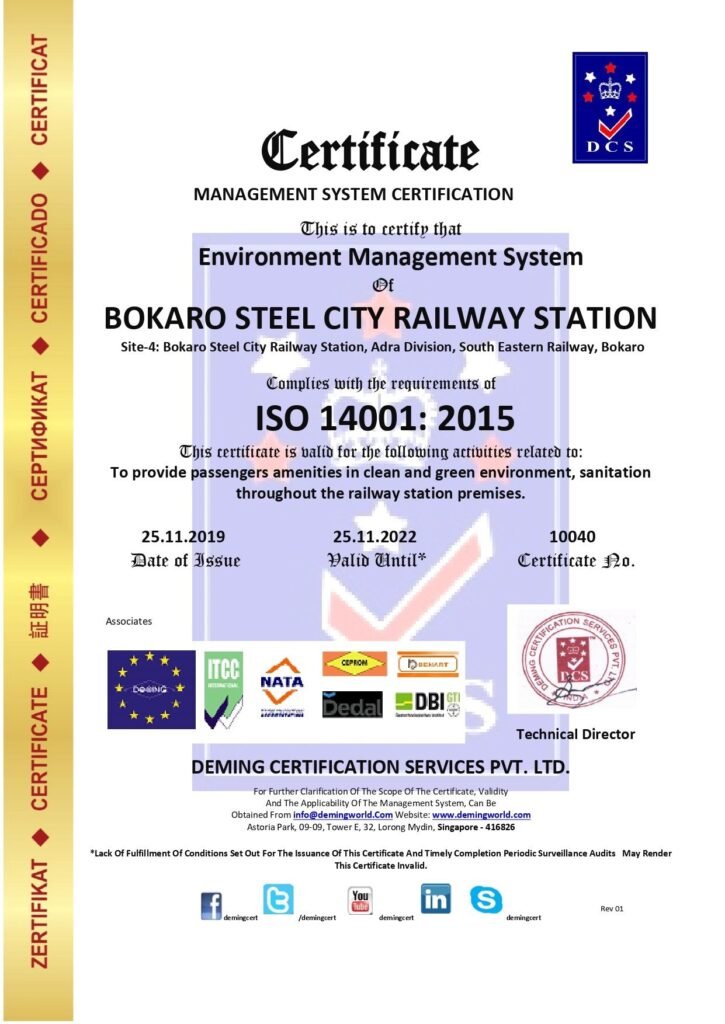
This approach ultimately led to the station’s ISO 14001:2015 certification in 2019. The certification became an important milestone in the station’s environmental-management journey. It provided formal recognition that the station had established an environmental management framework within the defined scope of its operations.
However, the importance of the certification goes beyond the certificate itself. An ISO management system becomes valuable when its principles are translated into everyday practices. The real measure of progress is found in the routine activities that passengers may see every day: clean platforms, maintained sanitation facilities, organized waste collection, cleaner surroundings, environmental awareness, and consistent housekeeping.
The journey of Bokaro Steel City Railway Station therefore represents more than the development of a physical railway facility. It represents the evolution of a public-service environment in which cleanliness, sanitation, passenger comfort, and environmental responsibility are treated as interconnected objectives.
As Bokaro continued to develop, the railway station had an opportunity to develop alongside it. The station could reflect the aspirations of a growing city by maintaining standards that support dignity, comfort, and environmental awareness. Its journey toward ISO 14001:2015 certification in 2019 marked a significant step in that direction.
The story begins, therefore, with a simple but powerful idea: a railway station should not merely move people from one destination to another; it should provide a clean, responsible, and welcoming environment throughout their journey. For Bokaro Steel City Railway Station, this principle formed the foundation for a new chapter of environmental management and continual improvement.
#BokaroSteelCityRailwayStation
Chapter 2: The Need for Environmental Improvement
The growth of Bokaro Steel City Railway Station brought with it an important responsibility: ensuring that increasing passenger movement did not compromise cleanliness, sanitation, or the quality of the surrounding environment. A railway station is a continuously active public facility. Unlike many buildings that operate during fixed hours, railway stations function throughout the day and night, serving passengers arriving and departing at different times. This continuous activity creates unique environmental and sanitation challenges.
For Bokaro Steel City Railway Station, maintaining a clean and green environment was therefore not simply a matter of appearance. It was an essential part of providing quality passenger amenities and responsible public service. The station’s environmental journey developed from the recognition that cleanliness had to be systematic, consistent, and capable of being monitored and improved.
One of the most visible challenges at any busy railway station is solid waste. Passengers may generate waste from food, beverages, newspapers, packaging materials, plastic bottles, tickets, and other personal items. When waste is not immediately collected, it can accumulate on platforms, near seating areas, around entrances, and in other high-traffic locations. Such accumulation affects the appearance of the station and can also create unhygienic conditions.
Food waste presents an additional challenge because it can attract insects and animals if not handled properly. Plastic and other non-biodegradable materials can remain in the environment for long periods. Effective housekeeping and responsible waste collection are therefore essential components of station management.
Sanitation is another critical area. Passenger toilets and other sanitation facilities are used by large numbers of people every day. Their condition can strongly influence the public perception of the railway station. Regular cleaning, proper maintenance, availability of essential facilities, and appropriate monitoring are necessary to maintain hygienic standards.
The need for environmental improvement also extends beyond the platforms. The station premises include circulation areas, entrances, waiting spaces, service areas, drainage systems, and surrounding locations. Each area has different maintenance requirements. A clean platform loses much of its value if other areas of the station remain neglected.
Recognizing these challenges encouraged a more organized approach to environmental management. Instead of considering individual cleaning activities separately, the station could view them as parts of a larger Environmental Management System. Such an approach makes it possible to understand how daily operations affect the environment and how those effects can be controlled.
The ISO 14001:2015 framework was particularly relevant to this objective. Environmental management under the standard emphasizes a systematic approach to identifying environmental aspects and managing their potential impacts. In the context of a railway station, this can involve activities such as waste handling, sanitation, housekeeping, resource use, environmental awareness, and compliance with applicable environmental requirements.
The objective was not to create a system that existed only on paper. The purpose was to develop practices that could function within normal station operations. Environmental responsibility needed to become part of everyday work. Cleaning personnel needed clear responsibilities. Supervisors needed to monitor activities. Environmental issues needed to be identified and addressed. Improvements needed to be encouraged rather than waiting for problems to become serious.
Another important consideration was the relationship between cleanliness and passenger behaviour. Railway passengers are not merely recipients of sanitation services; they are participants in the station environment. If passengers dispose of waste responsibly, use designated facilities, and avoid littering, the work of sanitation personnel becomes more effective. Public awareness is therefore an important component of environmental improvement.
A clean and green railway station can also influence the wider community. Railway stations are highly visible public spaces. Thousands of people pass through them, making them valuable locations for communicating messages about cleanliness and environmental responsibility. Good practices at the station can encourage passengers to carry similar habits into their homes, workplaces, and communities.
Environmental improvement can also contribute to employee satisfaction. Railway staff and sanitation workers spend significant portions of their working lives within the station environment. A cleaner workplace can support better morale and create a stronger sense of responsibility. When employees understand the environmental objectives of their organization, routine tasks such as cleaning, waste collection, inspection, and maintenance become connected to a larger purpose.
The green aspect of the initiative is equally significant. A clean station should ideally be surrounded by an environment that is visually pleasant and responsibly managed. Plantation, landscaping, proper maintenance of open spaces, reduction of unnecessary waste, and responsible resource use can contribute to a greener atmosphere.
For Bokaro Steel City Railway Station, these objectives were particularly meaningful because the station represents a major public gateway to an important industrial city. The condition of the station can influence the first impression visitors form of Bokaro. Maintaining high standards of sanitation and environmental management can therefore contribute to the city’s public image.
The decision to pursue ISO 14001:2015 certification in 2019 reflected this broader understanding of environmental responsibility. Certification provided a formal framework through which environmental objectives could be organized and managed. It encouraged the station to look beyond occasional cleaning drives and toward continual improvement.
Ultimately, the need for environmental improvement arose from a combination of practical and social responsibilities. The station had to manage waste, maintain sanitation, provide passenger amenities, protect its surroundings, and respond to the expectations of a growing and increasingly environmentally conscious public.
The journey toward certification demonstrated that these challenges could be addressed through a systematic approach. Environmental management became not merely an additional activity but an important element of station operations. The foundation was established for a cleaner, greener, and more organized railway environment—one in which passenger comfort and environmental responsibility could move forward together.
#ISO14001
Chapter 3: The ISO 14001:2015 Milestone
The year 2019 marked an important stage in the environmental journey of Bokaro Steel City Railway Station. During a period when cleanliness, sanitation, sustainability, and responsible public infrastructure were receiving increasing attention, the station achieved ISO 14001:2015 certification. This achievement provided formal recognition of an organized approach toward environmental management within the defined scope of station operations.
ISO 14001:2015 is an internationally recognized standard that provides a framework for establishing, implementing, maintaining, and continually improving an Environmental Management System, commonly known as an EMS. The purpose of such a system is to help an organization understand its environmental responsibilities and manage activities that may have an impact on the environment.
For a railway station, environmental management has a particularly broad meaning. A station is a busy public environment where large numbers of people interact with buildings, platforms, sanitation facilities, waste collection systems, water resources, transportation infrastructure, and surrounding areas. Managing this environment requires coordination and consistency.
The certification journey can therefore be understood as an organizational commitment to bringing greater structure to environmental responsibilities. Instead of treating cleanliness and sanitation as isolated activities, an Environmental Management System encourages them to become part of an integrated management process.
The scope associated with Bokaro Steel City Railway Station focused on providing passenger amenities in a clean and green environment and maintaining sanitation throughout the railway station premises. This objective placed the passenger at the centre of environmental improvement. A railway station is ultimately a public-service facility, and environmental management must contribute to a better experience for the people who use it.
Achieving certification requires an organization to examine its activities and understand the environmental aspects associated with them. At a railway station, these aspects can include solid waste generation, sanitation, housekeeping activities, resource consumption, wastewater, cleanliness of public areas, and the management of environmental responsibilities. Understanding these activities is an important first step toward controlling their impacts.
The ISO framework also encourages organizations to establish responsibilities and objectives. This is important in a station environment because environmental performance depends on many people performing their duties consistently. Cleaning teams, supervisory personnel, railway employees, contractors, and management all contribute to the effectiveness of environmental practices.
A certification is therefore not simply a statement that a facility is clean on the day of an inspection. It represents the existence of a management system designed to support consistent environmental performance. The objective is to establish processes that can be followed, monitored, reviewed, and improved.
One of the important principles associated with ISO 14001:2015 is continual improvement. Environmental management should not stop once a target has been achieved. Instead, organizations are encouraged to examine their performance, identify areas where improvement is possible, and take appropriate action.
For Bokaro Steel City Railway Station, this principle was particularly relevant because cleanliness is an ongoing requirement. A platform may be cleaned in the morning, but passenger activity can generate waste throughout the day. A sanitation facility may be maintained at one point in time but require repeated attention. Environmental management must therefore be continuous.
The certification also created an opportunity to strengthen environmental awareness. When environmental objectives are clearly established, employees can better understand why routine activities matter. Waste collection, cleaning, sanitation, inspection, and maintenance become part of a larger environmental responsibility rather than isolated duties.
Passenger participation is another important part of this process. Railway stations are shared public spaces, and maintaining them requires cooperation between service providers and users. Clean facilities can encourage responsible behaviour, while awareness messages and properly positioned waste facilities can help passengers understand their role in keeping the premises clean.
The 2019 certification was also significant from the perspective of public confidence. An internationally recognized environmental management standard provides an external framework for demonstrating organizational commitment. It can strengthen the perception that environmental concerns are being managed systematically.
For an important station in an industrial city such as Bokaro, this commitment carried additional significance. Industrial development and environmental responsibility must progress together. A modern city requires not only economic infrastructure but also public facilities that reflect awareness of environmental quality.
The certification was valid through 2022, making the period from 2019 to 2022 an important chapter in the station’s documented environmental-management journey. During this period, the principles associated with the Environmental Management System could support continued attention to sanitation, cleanliness, passenger amenities, waste management, and the creation of a greener environment.
However, the deeper value of ISO 14001:2015 lies in the practices it encourages rather than the physical certificate. A certificate can recognize a management system, but sustained improvement depends on people and processes. The effectiveness of environmental management is ultimately visible in everyday operations.
The story of the certification can therefore be viewed as a story of institutional development. Bokaro Steel City Railway Station moved toward a more structured understanding of environmental responsibility, connecting passenger service with cleanliness and sustainability.
The 2019 milestone became a foundation for the next stage of the station’s journey. It provided a framework through which environmental objectives could be organized and monitored, while creating an opportunity for employees and passengers to participate in maintaining a cleaner public environment.
In this sense, ISO 14001:2015 was not the conclusion of the station’s environmental journey. It was a milestone that represented a new way of thinking: environmental management should be systematic, passenger-focused, measurable, and continuously improved. That philosophy would become an important part of the station’s broader story of service, cleanliness, and responsible growth.
#EnvironmentalManagement
Chapter 4: Cleanliness as a Daily Mission
Cleanliness at a railway station is not a one-time achievement. It is a continuous responsibility that begins before the first passenger arrives and continues throughout the day as trains arrive, passengers depart, vendors operate, employees work, and thousands of people move through the premises. For Bokaro Steel City Railway Station, the commitment to providing passengers with a clean and green environment therefore required cleanliness to become part of everyday station management.
The ISO 14001:2015 Environmental Management System provided an organized framework for approaching this responsibility. Rather than treating cleaning as an isolated housekeeping function, the station’s environmental objectives connected cleanliness with sanitation, passenger amenities, waste management, environmental awareness, and continual improvement.
A railway platform can change rapidly within a short period. Passengers waiting for trains may consume food and beverages, use packaging materials, carry newspapers, or dispose of bottles and other waste. When a train arrives, passenger movement increases significantly. Within minutes, an area that was clean may require attention again. This reality makes regular housekeeping essential.
The first objective of an effective cleanliness system is therefore consistency. Cleaning schedules need to correspond with the operational requirements of the station. High-use areas require frequent attention, while other locations may follow appropriate periodic maintenance routines. The objective is to ensure that cleanliness is maintained as an ongoing process rather than restored only after conditions deteriorate.
Platforms are among the most visible areas of a railway station. Their condition influences the immediate impression passengers receive. Regular sweeping, collection of litter, removal of accumulated waste, and attention to corners and less visible areas can help maintain a cleaner environment.
Waiting areas also require careful attention. Passengers may spend considerable time waiting for trains, making the cleanliness of seating, floors, walls, entrances, and surrounding spaces important to their comfort. A well-maintained waiting environment can reduce the sense of disorder that often accompanies heavy passenger traffic.
Sanitation facilities require an even more disciplined approach. Toilets and wash areas are among the most frequently used facilities at a railway station. Their cleanliness can directly influence passenger satisfaction and perceptions of hygiene. Regular cleaning, appropriate maintenance, and monitoring are therefore essential.
Waste management is another major part of the cleanliness mission. The presence of waste bins alone is not enough. Waste must be collected regularly and handled responsibly. If collection is delayed, bins may overflow, creating an unpleasant appearance and potentially affecting hygiene. Timely removal helps keep passenger areas cleaner and supports the wider environmental-management objective.
Different types of waste may require different approaches to handling. Food waste, paper, plastic, and other materials have different environmental characteristics. Developing awareness of these differences can support more responsible waste management. It also creates opportunities for improving segregation and reducing the quantity of waste that remains unmanaged.
Cleanliness also includes the surroundings of the main passenger areas. Entrances, circulation spaces, stairways, foot-over bridges, service areas, and open spaces contribute to the overall condition of the station. A railway station cannot be considered truly clean if only the most visible platform areas receive attention.
Another important element is drainage and the prevention of stagnant water. Proper maintenance of drainage areas contributes to sanitation and helps maintain a healthier environment. Routine inspection can help identify blockages or other problems before they become larger issues.
The success of these activities depends heavily on the people responsible for implementing them. Sanitation workers perform physically demanding and essential duties. Supervisors provide coordination and monitoring, while station management provides direction and support. Their combined efforts make environmental objectives practical.
Employee awareness is therefore an important part of the Environmental Management System. Workers who understand the purpose behind their responsibilities are more likely to identify problems, report deficiencies, and take corrective action. Cleanliness becomes stronger when every individual understands that his or her contribution affects the entire station.
Passengers also play a significant role. A railway station is a shared public environment, and even the most efficient housekeeping system can be challenged by irresponsible disposal of waste. Passenger awareness can help reduce littering and encourage the proper use of sanitation and waste facilities.
Visible cleanliness can also influence behaviour. When passengers enter a well-maintained environment, they may be more inclined to preserve it. This creates a positive cycle in which good housekeeping encourages responsible public behaviour, which in turn makes it easier to maintain cleanliness.
The concept of a daily cleanliness mission also reflects the philosophy of continual improvement. Staff can observe recurring problems, identify their causes, and look for better ways of addressing them. If a particular area repeatedly becomes dirty, management can examine passenger movement, waste-bin placement, cleaning frequency, or other contributing factors.
This approach transforms cleaning from a purely reactive activity into a management process. Instead of asking only, “Has this area been cleaned?” the broader question becomes, “How can this area remain cleaner for longer?”
Such thinking is central to environmental management. It encourages the station to learn from daily operations and make practical improvements. Small changes can have meaningful effects when they are applied consistently across a busy facility.
For Bokaro Steel City Railway Station, cleanliness therefore became more than a visual standard. It represented passenger care, employee responsibility, environmental awareness, and public service. The objective was to create a station environment where sanitation and cleanliness were maintained throughout the premises as part of normal operations.
The journey following ISO 14001:2015 certification demonstrated the importance of this daily commitment. Certification provided a structured environmental framework, but the real achievement depended on the repeated actions of people working behind the scenes and the cooperation of passengers using the station.
Every clean platform, every properly maintained sanitation facility, every collected piece of waste, and every responsibly managed public area contributes to the larger environmental goal.
Ultimately, the cleanliness mission of Bokaro Steel City Railway Station can be summarized in one principle: cleanliness is not an event; it is a daily culture. When that culture becomes embedded in station operations, environmental management moves from policy to practice, creating a better experience for passengers and a healthier environment for everyone.
#CleanAndGreenStation
Chapter 5: Building a Greener Station Environment
The transformation of a railway station into a cleaner and greener public space requires more than regular sweeping and waste collection. It requires an understanding that every activity carried out within the station can have an environmental dimension. From the management of waste and sanitation to the use of water, maintenance of open areas, and awareness among passengers, environmental responsibility can become part of everyday railway operations.
For Bokaro Steel City Railway Station, the objective of providing passengers with amenities in a clean and green environment created a broader vision for station management. Cleanliness addressed the immediate physical condition of the premises, while the concept of a green environment encouraged attention to sustainability and responsible use of resources.
The ISO 14001:2015 certification achieved in 2019 provided a structured framework for pursuing these objectives. An Environmental Management System encourages an organization to identify environmental aspects associated with its activities, understand their potential impacts, establish appropriate controls, and seek continual improvement. For a busy railway station, this approach can bring together many activities that were previously viewed as separate functions.
One of the most important areas of environmental responsibility is waste management. Railway stations generate waste because of the large number of people using them every day. Food packaging, paper, plastic bottles, disposable materials, and other refuse can quickly accumulate. A greener station therefore requires systems for timely collection, appropriate handling, and responsible disposal of waste.
Waste segregation can also play an important role in environmental improvement. When different categories of waste are managed appropriately, recyclable materials may have a better chance of being recovered, while organic waste can potentially be handled separately. Even where complete segregation is difficult, encouraging responsible disposal creates greater environmental awareness among passengers and employees.
The use of waste bins is most effective when they are conveniently located, clearly identified, and regularly serviced. An overflowing bin can quickly become a source of litter, whereas a well-maintained waste collection point can encourage passengers to dispose of materials responsibly.
Water management is another important consideration for a railway station. Water is essential for sanitation, cleaning, passenger facilities, and other operational requirements. Responsible water use therefore contributes directly to environmental management. Preventing unnecessary wastage, identifying leaks, maintaining plumbing facilities, and encouraging efficient cleaning practices can support conservation.
Sanitation and environmental protection are closely connected. Clean toilets and wash areas require water and cleaning resources, but they also need proper maintenance to prevent unhygienic conditions. An effective environmental approach seeks to balance cleanliness with responsible resource use.
The physical surroundings of the railway station also contribute to the concept of a green environment. Wherever appropriate, maintained open spaces, plantation, landscaping, and greenery can improve the visual quality of the premises. Plants can make public areas more welcoming and help create a stronger connection between infrastructure and the natural environment.
Green surroundings are especially meaningful in an urban and industrial setting. Bokaro has developed as an important industrial city, and public spaces that incorporate greenery can contribute to a more pleasant urban environment. A railway station with clean pathways, maintained surroundings, and appropriate greenery can provide passengers with a more positive first impression of the city.
Environmental awareness is another essential part of building a greener station. Infrastructure alone cannot create sustainability. People need to understand why environmental practices matter. Notices, public messages, staff communication, and visible examples of responsible behaviour can encourage passengers to participate.
Employees are equally important in this process. A worker who notices a leaking tap, overflowing waste bin, damaged sanitation facility, or other environmental issue can contribute to improvement by reporting it promptly. Environmental management becomes more effective when employees are encouraged to identify problems rather than simply perform routine tasks.
The idea of continual improvement is particularly important. A greener station is not created overnight. Environmental performance can improve through a series of practical steps. A particular waste collection point may be relocated to improve accessibility. Cleaning schedules may be adjusted according to passenger movement. Maintenance practices may be reviewed to reduce unnecessary resource consumption. Awareness activities may be strengthened where littering remains a concern.
These small improvements can collectively create significant results.
The green transformation also has an important social dimension. Railway stations are public spaces used by people from different backgrounds and age groups. When passengers see environmental practices being followed consistently, they become more aware of the importance of cleanliness and responsible resource use. The station can therefore become a place where environmental values are demonstrated through everyday practice.
The role of management is to create conditions in which these practices can continue. Clear responsibilities, regular monitoring, communication, training, and corrective actions can help maintain environmental standards. An Environmental Management System provides a structure for bringing these elements together.
For Bokaro Steel City Railway Station, the environmental initiative therefore represented an evolution from conventional housekeeping toward a broader environmental philosophy. Cleanliness remained fundamental, but it was connected with sanitation, waste management, resource conservation, greenery, awareness, and continual improvement.
The achievement of ISO 14001:2015 certification in 2019 provided formal recognition of this environmental-management approach. However, the real value of the certification was reflected in the daily commitment to maintaining and improving the station environment.
A greener railway station is ultimately a combination of infrastructure, systems, people, and behaviour. It requires management commitment, dedicated employees, responsible passengers, and continuous attention to environmental performance.
The journey of Bokaro Steel City Railway Station demonstrates that environmental improvement can become an integral part of public service. By connecting passenger amenities with cleanliness and environmental responsibility, the station could work toward creating an atmosphere that was not only more hygienic but also more welcoming and environmentally conscious.
The vision is simple but powerful: a railway station should serve the movement of people while respecting the environment in which those people live and travel. Through systematic management, responsible practices, and continual improvement, Bokaro Steel City Railway Station’s clean and green vision became an important part of its journey toward better public service.
#IndianRailways
Chapter 6: Passenger Amenities and Public Experience
A railway station is ultimately a place built around people. Trains, platforms, ticketing facilities, waiting areas, sanitation services, entrances, and other infrastructure all exist to support passengers in reaching their destinations safely and comfortably. For Bokaro Steel City Railway Station, the commitment to environmental management was therefore closely connected with the quality of the passenger experience.
The scope associated with the station’s environmental initiative focused on providing passenger amenities in a clean and green environment and maintaining sanitation throughout the railway station premises. This objective placed passenger welfare at the heart of the Environmental Management System. The purpose of environmental improvement was not simply to satisfy a technical requirement but to create a better public environment.
Every passenger arrives at a railway station with different expectations. Some may be travelling for business, others for education, employment, family responsibilities, medical appointments, tourism, or personal reasons. Some passengers may spend only a few minutes at the station, while others may wait for extended periods. Regardless of the reason for travel, cleanliness and basic amenities influence the quality of their experience.
The first impression is particularly important. When passengers enter a railway station, they immediately notice the condition of platforms, entrances, floors, waiting spaces, toilets, and surrounding areas. A clean and organized environment can create a feeling of confidence and comfort. It suggests that the facility is managed carefully and that passenger welfare is taken seriously.
For Bokaro Steel City Railway Station, maintaining this impression required continuous effort. Passenger areas experience constant movement, and their condition can change quickly. Regular housekeeping and timely removal of waste are therefore essential. Cleanliness must be maintained not only during quiet periods but also during times of high passenger activity.
Waiting areas are particularly important because they are spaces where passengers spend time before boarding trains. Clean floors, seating areas, surrounding spaces, and sanitation facilities contribute to a more comfortable waiting experience. When public facilities are properly maintained, passengers can focus on their journey instead of being concerned about basic hygiene.
Sanitation facilities are perhaps one of the most significant elements of passenger comfort. Railway station toilets are used by large numbers of people every day, making regular cleaning and maintenance essential. Proper sanitation supports hygiene and contributes to the overall perception of station quality.
Cleanliness also needs to extend to less obvious areas. Stairways, foot-over bridges, entrances, circulation spaces, and other passenger movement areas can influence the overall experience. Passengers do not separate the station into individual management zones; they experience it as one environment. Consequently, maintaining a consistent standard throughout the premises is important.
Environmental management can also support passenger comfort indirectly. Proper waste collection reduces litter and unpleasant smells. Well-maintained surroundings create a more organized atmosphere. Greenery and appropriately maintained open spaces can make the station visually more pleasant.
Another important element is accessibility. A public railway station serves passengers with different needs and abilities. Clean and unobstructed pathways are valuable not only for general appearance but also for safe movement. Good housekeeping can help ensure that passenger routes remain usable and free from unnecessary obstacles.
The role of passengers in maintaining these standards cannot be ignored. Railway stations are shared spaces. The work of cleaning personnel can be undermined if passengers dispose of waste carelessly or misuse facilities. Environmental awareness therefore becomes a key part of the passenger experience.
A clean station can encourage responsible behaviour. When passengers see properly maintained waste facilities and clean surroundings, they receive a clear message that cleanliness matters. Public notices and awareness campaigns can reinforce this message by encouraging passengers to use waste bins, avoid littering, and maintain sanitation.
Employees also contribute significantly to the public experience. Their interaction with passengers, attention to cleanliness, and prompt response to problems can influence how people perceive the station. A culture of service develops when employees understand that even routine duties have a direct impact on passenger satisfaction.
The ISO 14001:2015 framework supports this wider approach because environmental performance is connected with organizational processes. When responsibilities are defined and environmental objectives are incorporated into operations, employees can work toward common goals. Monitoring and corrective actions can help identify areas where passenger experience can be improved.
The benefits of such a system can extend beyond immediate cleanliness. A well-maintained railway station can strengthen public confidence in the organization responsible for its operation. Passengers may associate a clean environment with better management, discipline, and attention to service quality.
For Bokaro, the importance of this relationship is especially significant because the railway station serves as a gateway to the city. Visitors arriving by train may form their first impression of Bokaro from the station itself. A clean, green, and orderly environment can therefore contribute positively to the city’s public image.
The environmental initiative also illustrates an important principle of modern public infrastructure: sustainability and passenger service should not be treated as competing priorities. In fact, they can reinforce one another. Efficient waste management creates cleaner passenger spaces. Responsible resource use supports long-term operational sustainability. Green surroundings improve the visual environment. Better sanitation supports public health and comfort.
The journey toward ISO 14001:2015 certification provided Bokaro Steel City Railway Station with an organized framework for connecting these objectives. The certification represented a formal milestone, but the larger goal remained continuous improvement in the quality of the passenger environment.
A successful railway station is therefore not measured only by the number of trains it serves. Its success is also reflected in how passengers feel when they enter its premises. Clean platforms, hygienic facilities, organized waste management, pleasant surroundings, and responsible environmental practices all contribute to a better journey.
For Bokaro Steel City Railway Station, the environmental journey can thus be understood as a passenger-service journey as well. The cleaner the environment, the more comfortable the passenger experience can become. The stronger the environmental culture, the more sustainable the improvement can be.
Ultimately, the central idea is simple: every passenger deserves a railway environment that is clean, hygienic, welcoming, and responsibly managed. By placing passenger amenities and environmental responsibility together, Bokaro Steel City Railway Station strengthened the connection between sustainable management and quality public service.
#RailwayCleanliness
Chapter 7: The Role of People and Management
The success of any environmental management system depends not only on policies, procedures, and certification but also on the people who implement them every day. At Bokaro Steel City Railway Station, the journey toward a cleaner, greener, and more hygienic environment required the combined efforts of management, railway employees, sanitation personnel, contractors, service providers, and passengers.
ISO 14001:2015 provided a structured framework for environmental management, but a framework can achieve results only when people understand their responsibilities and perform them consistently. The environmental objectives associated with the station therefore depended on creating awareness, assigning responsibilities, monitoring activities, and encouraging continual improvement.
Management plays a central role in establishing this culture. Leaders are responsible for communicating environmental objectives and ensuring that cleanliness and sanitation remain important operational priorities. When management demonstrates commitment, employees are more likely to recognize that environmental responsibility is a genuine organizational objective rather than simply a certification requirement.
At a railway station, management responsibilities can involve many different areas. Cleaning activities need to be organized, sanitation facilities need to be maintained, waste collection needs to be monitored, and environmental issues need to be identified and addressed. These activities require coordination because the station operates as a complex public facility with continuous passenger movement.
Supervisors form an important link between management and operational staff. They can monitor cleaning activities, inspect passenger areas, identify deficiencies, and ensure that corrective measures are taken. Regular observation is particularly important because station conditions can change rapidly during periods of high passenger movement.
Sanitation personnel are among the most important contributors to the station’s environmental performance. Their work is highly visible when facilities are clean but often unnoticed when everything is functioning properly. Sweeping platforms, cleaning public areas, maintaining toilets, collecting waste, and attending to sanitation requirements are repetitive but essential tasks.
The effectiveness of these activities depends upon adequate awareness and discipline. Employees need to understand the standards expected of them and the importance of following established procedures. Training and communication can help staff recognize environmental risks and understand how their work contributes to the overall objective.
A strong environmental culture also encourages employees to report problems. If a waste bin is overflowing, a sanitation facility requires attention, or a water leak is noticed, early reporting can help prevent a small issue from becoming a larger environmental or operational problem. Employees who feel responsible for the overall condition of the station can become active participants in improvement.
The role of contractors and service providers is also significant where cleaning, maintenance, waste handling, or other activities are carried out through external agencies. Their work affects the station’s environmental performance, making clear expectations and effective supervision important.
Communication is another essential element. Environmental objectives should be understandable to everyone involved. Staff members need to know why cleanliness matters, how waste should be handled, what procedures should be followed, and what action should be taken when an environmental issue is identified.
Passenger participation is equally important. A railway station is a shared public environment, and passengers influence its condition through their daily behaviour. Proper disposal of waste, responsible use of toilets and other facilities, and respect for public property can significantly support station cleanliness.
Environmental awareness among passengers can be encouraged through appropriate signage, public announcements, information displays, and visible examples of good practice. When passengers understand that cleanliness is a shared responsibility, they are more likely to participate.
The relationship between employees and passengers can create a positive cycle. Employees maintain the environment, while passengers help preserve it. A clean environment can encourage better passenger behaviour, and better passenger behaviour can reduce the pressure on housekeeping systems.
Management also needs to monitor environmental performance. Monitoring allows the organization to understand whether its objectives are being achieved and where further improvements may be required. Inspections, observations, records, feedback, and corrective actions can all contribute to this process.
The principle of continual improvement is especially relevant. Environmental management is never completely finished. Passenger volumes can change, operational conditions can vary, and new environmental challenges can emerge. A system that worked effectively in one period may require adjustment later.
For example, if a particular platform experiences repeated littering, management may examine whether waste bins are conveniently located or whether passenger awareness needs to be strengthened. If sanitation facilities require frequent corrective attention, the cleaning schedule or maintenance process may need review. If an environmental problem repeatedly occurs, its underlying cause should be examined rather than simply treating the immediate symptom.
This approach turns management into a process of learning. Each problem becomes an opportunity to improve the system.
Employee motivation is another factor that should not be overlooked. People are more likely to take pride in their work when they understand its importance. Recognition of good performance, constructive feedback, proper communication, and a respectful working environment can strengthen commitment to cleanliness and environmental objectives.
The 2019 ISO 14001:2015 certification can therefore be viewed as an organizational achievement as well as an environmental milestone. It reflected the ability to establish a systematic approach, but the continuing effectiveness of that approach depended on people.
For Bokaro Steel City Railway Station, the environmental journey demonstrates that infrastructure alone cannot create a clean and green station. Bins, cleaning equipment, sanitation facilities, landscaping, and management systems are important, but they require responsible people to operate and maintain them.
The station’s environmental culture is ultimately created through thousands of daily actions. A cleaner platform begins with a worker performing a task correctly. A hygienic toilet depends on regular maintenance. Proper waste management depends on both collection personnel and passengers. Continual improvement depends on supervisors noticing problems and management responding effectively.
The strongest environmental management systems are therefore those in which responsibility is shared. Management provides direction, employees implement procedures, supervisors monitor performance, service providers fulfill their duties, and passengers cooperate with the system.
The experience of Bokaro Steel City Railway Station illustrates an important lesson: certification can establish a framework, but people create results. The long-term success of environmental management depends upon developing a culture in which every person understands that maintaining a clean, green, and hygienic railway station is a shared responsibility.
Through cooperation, awareness, monitoring, and continual improvement, environmental management can become a permanent part of station culture rather than a temporary initiative. This human element forms one of the strongest foundations for the station’s continuing journey toward better passenger service and environmental responsibility.
#SustainableRailways
Chapter 8: Growth Through Better Systems
Growth is often measured through physical expansion, increasing passenger numbers, improved infrastructure, or greater operational capacity. However, for a public facility such as Bokaro Steel City Railway Station, growth also has another important meaning: the development of better systems, stronger processes, greater environmental awareness, and improved service quality.
The journey toward ISO 14001:2015 certification in 2019 represented an important step in this form of organizational growth. The certification introduced a structured Environmental Management System that encouraged the station to look at its activities from an environmental perspective. It provided a framework for understanding responsibilities, managing environmental aspects, monitoring performance, and pursuing continual improvement.
Before considering the impact of better systems, it is important to understand why systems matter. A busy railway station involves numerous activities occurring simultaneously. Passengers arrive and depart, trains are handled, platforms are cleaned, sanitation facilities are maintained, waste is collected, public areas are monitored, and operational requirements continue throughout the day. Without coordination, even hardworking employees may find it difficult to maintain consistent standards.
A management system creates structure within this complexity.
The ISO 14001:2015 approach encourages organizations to identify environmental aspects associated with their activities. For a railway station, these may include waste generation, sanitation, water use, housekeeping activities, maintenance operations, and the management of public areas. Understanding these aspects helps management identify where environmental controls and improvements are necessary.
This process can make environmental responsibility more systematic. Instead of responding only when a problem becomes visible, the organization can anticipate potential issues and establish appropriate procedures.
Waste management provides a useful example. In an unstructured system, waste may simply be removed when it becomes excessive. In a stronger system, waste generation, collection, handling, monitoring, and improvement can be considered together. Such an approach makes it easier to identify recurring problems and develop preventive measures.
The same principle applies to sanitation. Rather than simply cleaning facilities when they become visibly dirty, management can establish routines, assign responsibilities, monitor conditions, and identify areas requiring additional attention.
Better systems also improve accountability. When responsibilities are clearly established, employees understand who is expected to perform particular tasks and who is responsible for monitoring them. This reduces uncertainty and makes corrective action more effective.
Documentation and records can also support management decisions. Appropriate records can help identify patterns and recurring issues. For example, repeated problems in a particular area may indicate that the existing cleaning frequency, facility arrangement, or maintenance process needs to be reviewed.
The purpose of such documentation is not simply administrative. It can provide evidence for learning and improvement.
Training is another area where better systems contribute to growth. Employees need to understand environmental objectives and the procedures relevant to their work. Training can improve awareness of waste management, sanitation practices, resource conservation, emergency responses, and other environmental responsibilities.
When employees understand why a particular procedure exists, compliance can become more meaningful. Instead of following instructions mechanically, workers can recognize the environmental consequences of their actions.
Better systems can also strengthen communication. Environmental management requires information to move between management, supervisors, operational staff, service providers, and sometimes passengers. Clear communication helps ensure that environmental problems are reported promptly and that corrective actions are understood.
The station’s environmental performance can also benefit from a preventive approach. Preventive action focuses on reducing the likelihood of problems rather than waiting for them to occur. For example, ensuring that waste collection is timely can prevent overflowing bins. Regular inspection of sanitation facilities can identify maintenance needs before they become serious. Monitoring water facilities can help detect wastage or leakage.
This shift from reaction to prevention is one of the important ways in which an organization can mature.
Continual improvement is another central element of system-based growth. A management system should be reviewed periodically to determine whether it is achieving its objectives. When shortcomings are identified, corrective measures can be introduced. When successful practices are found, they can be strengthened or extended.
This creates a cycle of improvement: plan, implement, monitor, evaluate, correct, and improve.
For Bokaro Steel City Railway Station, such a cycle could support the long-term objective of maintaining a clean and green environment. The station’s environmental responsibilities would not depend solely on individual efforts but would be supported by processes that can continue even as personnel, passenger patterns, or operational circumstances change.
The system also creates a stronger foundation for public service. A clean station is important, but a station that can consistently maintain cleanliness is even more valuable. Consistency is one of the greatest benefits of good management systems.
The growth of an organization can therefore be seen in its ability to transform individual good practices into institutional practices. One employee may be exceptionally careful about cleanliness, but a strong management system ensures that the same standard is expected from the wider team.
This institutionalization of good practices can make environmental performance more stable.
The ISO 14001:2015 certification period from 2019 to 2022 represents an important chapter in this process. Certification provided recognition of the Environmental Management System within its defined scope, while the daily implementation of environmental practices provided the real substance behind that recognition.
For Bokaro Steel City Railway Station, growth through better systems was therefore not necessarily about building something dramatically new. It was about strengthening the way existing responsibilities were managed.
The station’s environmental journey shows that organizational improvement often begins with simple questions: What environmental impacts are created by our activities? Who is responsible for managing them? How can performance be monitored? What problems occur repeatedly? What can be done better? How can improvements be maintained over time?
When these questions become part of everyday management, a culture of continual improvement develops.
The broader lesson is important for public infrastructure. Modern railway stations must balance operational efficiency with passenger comfort and environmental responsibility. Better systems help bring these objectives together.
For Bokaro Steel City Railway Station, ISO 14001:2015 served as an important framework for this transformation. It connected environmental responsibility with organizational discipline, employee participation, monitoring, and continual improvement.
Ultimately, sustainable growth is not achieved through certification alone. It comes from converting standards into everyday habits and systems. A certificate may mark a milestone, but better processes create lasting value.
The journey of Bokaro Steel City Railway Station demonstrates this principle clearly: when an organization improves its systems, it improves its ability to serve people, protect the environment, and sustain progress over time.
#WasteManagement
Chapter 9: The Wider Significance for Bokaro
The story of Bokaro Steel City Railway Station cannot be separated from the story of Bokaro itself. The city has developed an important identity around industry, employment, education, commerce, and public infrastructure. In this environment, the railway station plays a significant role as a point of connection between Bokaro and other parts of the region and the country.
A railway station is more than a transportation facility. It is a public gateway. For many visitors, the station may be the first physical impression they receive of a city. For residents, it is a familiar part of everyday life and an important link to employment, education, business, family, and travel. Consequently, the condition of the railway station can influence the way people perceive the city.
The environmental journey of Bokaro Steel City Railway Station therefore has significance beyond the station’s immediate boundaries. The focus on cleanliness, sanitation, passenger amenities, and a green environment contributes to a wider vision of responsible urban development.
Bokaro’s industrial character makes environmental responsibility particularly meaningful. Industrial development brings economic opportunities and contributes to regional growth, but it also creates a broader need for awareness of environmental quality. Public institutions and infrastructure facilities have an important role in demonstrating that development and environmental responsibility can progress together.
The railway station represents this connection in a highly visible way. Thousands of passengers interact with the station environment, even if only for a short period. When they encounter clean platforms, maintained sanitation facilities, organized waste management, and pleasant surroundings, they experience a public facility that reflects attention to environmental quality.
The achievement of ISO 14001:2015 certification in 2019 provided a formal framework for this commitment. The certification recognized an Environmental Management System associated with the station’s defined scope of providing passenger amenities in a clean and green environment and maintaining sanitation throughout the railway station premises.
The importance of this achievement lies partly in the message it communicates. Environmental management is not limited to factories, offices, or specialized environmental organizations. Public transportation facilities can also adopt systematic approaches to environmental responsibility.
A railway station is particularly suitable for demonstrating environmental awareness because of its constant interaction with the public. Good environmental practices are visible to passengers and can influence behaviour. Proper waste facilities, clean surroundings, responsible sanitation practices, and environmental messaging can encourage people to think about their own responsibilities.
This creates the possibility of a wider social impact.
Passengers who learn to dispose of waste responsibly at a railway station may carry the same habit into other public places. Children travelling with their families may observe environmental practices and develop awareness from an early age. Workers may take pride in maintaining a public facility that represents their city. In this way, the station can become more than a place of transportation; it can become an example of civic responsibility.
The station’s environmental focus also contributes to the dignity of public spaces. Clean surroundings communicate respect for the people who use them. A passenger waiting for a train should be able to expect basic standards of sanitation and cleanliness regardless of the purpose of the journey.
This is especially important in a busy city where public facilities are shared by people from many backgrounds. A well-maintained railway station provides a common environment in which everyone benefits from better standards.
The green aspect of the station’s development adds another dimension. Urban areas can become dominated by buildings, roads, vehicles, and other infrastructure. Appropriate greenery and well-maintained open spaces can make public environments more visually comfortable. Where feasible, plantation and landscaping can contribute to the character of the station and reinforce the idea of environmental care.
Waste management is also important from a wider city perspective. Waste that is not properly handled within a railway station can affect surrounding areas. Responsible collection and disposal therefore help protect not only the station but also its neighbouring environment.
The station can also serve as an example of how environmental objectives can be incorporated into everyday operational management. Environmental responsibility does not necessarily require extraordinary measures. It can be built through routine practices: maintaining cleanliness, reducing unnecessary waste, monitoring facilities, conserving resources, maintaining greenery, and creating awareness.
The experience also illustrates the importance of institutional commitment. A public facility serves thousands of people, so environmental improvements can have a cumulative effect. Even small improvements become significant when they are repeated every day and experienced by large numbers of passengers.
For Bokaro, this is particularly relevant because the railway station is connected to the city’s identity as an important industrial and urban centre. A clean and responsibly managed station can contribute positively to the city’s reputation.
The certification period from 2019 to 2022 also forms part of a broader period in which environmental expectations were becoming increasingly important across public infrastructure. Cleanliness campaigns and sustainability initiatives created greater awareness among citizens about the quality of public spaces.
Within this wider environment, Bokaro Steel City Railway Station’s environmental-management initiative demonstrated that passenger service and environmental responsibility could be addressed together.
There is also an important lesson for future development. Environmental management should not be viewed as a temporary project associated with a particular certification period. The principles behind it—responsibility, monitoring, awareness, prevention, and continual improvement—remain relevant regardless of certification dates.
The end of a certificate’s validity does not mean that the underlying environmental responsibility should end. Instead, certification can be viewed as one milestone in a longer journey toward better systems and better public service.
The wider significance of Bokaro Steel City Railway Station therefore lies in its ability to connect local service with broader environmental values. The station serves passengers, but it also represents the city. Its cleanliness reflects the importance given to public spaces. Its sanitation standards reflect concern for passenger welfare. Its environmental practices reflect awareness of sustainability.
The story is ultimately about more than a railway station. It is about the relationship between infrastructure and community, between development and environmental responsibility, and between public service and civic pride.
Bokaro Steel City Railway Station demonstrates that a cleaner railway environment can contribute to a cleaner public culture. Through organized management, responsible employees, cooperative passengers, and continual attention to environmental quality, the station can remain an important example of how public infrastructure can evolve with the needs of society.
The wider lesson is clear: when a railway station improves its environmental standards, the benefit extends beyond its walls. It strengthens passenger confidence, supports the image of the city, encourages responsible public behaviour, and contributes to the broader idea of sustainable development.
#PassengerAmenities
Chapter 10: Looking Beyond Certification
The journey of Bokaro Steel City Railway Station toward environmental responsibility reached an important milestone with the achievement of ISO 14001:2015 certification in 2019. The certification, associated with the defined scope of providing passenger amenities in a clean and green environment and maintaining sanitation throughout the railway station premises, represented a significant organizational achievement. Its stated validity extended to 2022, marking an important period in the station’s environmental-management journey.
Yet the true meaning of environmental management goes beyond the period printed on a certificate. Certification can provide recognition, structure, and direction, but environmental responsibility must continue through everyday practices. The real success of an Environmental Management System is demonstrated by the ability of an organization to maintain good practices, identify new challenges, and continue improving over time.
For Bokaro Steel City Railway Station, looking beyond certification means treating environmental management as an ongoing responsibility. A railway station remains active every day, and environmental challenges do not stop when a certificate reaches its validity date. Passenger movement continues, waste continues to be generated, sanitation facilities continue to require maintenance, and public expectations continue to change.
This makes continual improvement an essential principle.
The station’s future environmental performance depends upon the ability to preserve the good practices established through systematic management while adapting to new requirements. Waste management methods can be reviewed and improved. Cleaning routines can be adjusted according to passenger movement. Sanitation facilities can be monitored more effectively. Environmental awareness can be strengthened among employees and passengers.
Such improvements do not necessarily require dramatic changes. Sometimes a small operational adjustment can make a meaningful difference. Better placement of waste bins, more effective monitoring of high-traffic areas, improved communication among cleaning teams, or stronger awareness messages can contribute to a cleaner station environment.
Technology can also support future environmental management. Modern monitoring and reporting systems can make it easier to identify recurring problems and track corrective actions. Digital communication can support employee coordination and passenger awareness. Where appropriate, improved equipment and resource-efficient technologies can contribute to more sustainable operations.
However, technology alone cannot guarantee environmental success. People remain central to the process. Employees must continue to understand their responsibilities, supervisors must monitor performance, and management must remain committed to environmental objectives. Passengers must also recognize their role in maintaining public spaces.
The future of a clean and green railway station therefore depends on a shared culture.
Employee development can play an important role in maintaining this culture. Regular awareness and training can help staff understand changing environmental expectations and reinforce established practices. Employees who are encouraged to identify problems and suggest improvements can become active contributors to environmental performance.
Passenger awareness is equally important. A railway station serves a diverse population, and not every passenger will automatically understand the environmental objectives of the facility. Clear communication can encourage people to use waste bins properly, avoid littering, respect sanitation facilities, and protect greenery.
A clean station can create a positive feedback cycle. When passengers see that facilities are well maintained, they may be more willing to preserve them. When employees see that passengers cooperate, maintaining standards becomes easier. Together, these behaviours can create a stronger culture of cleanliness.
Looking beyond certification also means recognizing that environmental performance is connected with passenger service. Cleanliness, sanitation, and environmental responsibility should not be considered separate from the basic purpose of a railway station. They are part of the overall quality of the passenger experience.
For a station such as Bokaro Steel City Railway Station, this relationship is particularly important because the facility serves as a gateway to the city. A clean and organized station can contribute to a positive impression among visitors while providing residents with a better public environment.
The station’s environmental journey can also provide lessons for other railway facilities. It demonstrates the value of approaching cleanliness systematically and connecting sanitation with environmental management. Other stations can learn from successful practices and adapt them to their own operational conditions.
The broader goal should be the development of railway stations that are not only efficient but also environmentally responsible. Such stations can combine good passenger facilities with cleanliness, sanitation, resource awareness, waste management, greenery, and continual improvement.
The principles established through ISO 14001:2015 can continue to provide useful guidance even beyond a particular certification period. The ideas of identifying environmental aspects, establishing responsibilities, monitoring performance, addressing deficiencies, and improving systems remain valuable for long-term management.
The future should therefore be viewed as a continuation rather than a conclusion.
Bokaro Steel City Railway Station’s environmental story began with the recognition that passenger service and environmental responsibility must work together. The 2019 certification provided a formal milestone, but the larger journey is measured by what happens every day: whether platforms remain clean, whether sanitation facilities are properly maintained, whether waste is responsibly managed, whether greenery is cared for, and whether employees and passengers continue to participate.
There is also an important connection between environmental improvement and organizational pride. Employees who work in a clean and well-managed station can develop a stronger sense of ownership. Passengers who experience a pleasant environment can develop greater confidence in the facility. The city itself benefits when one of its major public gateways is maintained responsibly.
The long-term vision can therefore be described through four simple principles: maintain, monitor, improve, and involve. Maintain the standards that have been established. Monitor environmental performance consistently. Improve systems whenever opportunities are identified. Involve employees, passengers, management, and the wider community.
This approach transforms certification from a final destination into a foundation for future progress.
The story of Bokaro Steel City Railway Station is ultimately a story of service and responsibility. Its environmental journey demonstrates that public infrastructure can evolve by combining operational needs with environmental awareness. The achievement of ISO 14001:2015 certification in 2019 marked an important chapter, while the period through 2022 represented a significant stage in the documented certification journey.
But the most important chapter is always the one that follows—the commitment to continue improving.
A railway station serves people in motion, but its environmental responsibilities remain firmly connected to the place in which it stands. By maintaining cleanliness, supporting sanitation, encouraging responsible waste management, protecting its surroundings, and building environmental awareness, Bokaro Steel City Railway Station can continue contributing to a better public environment.
The ultimate vision is not merely to have a certificate displayed on a wall. It is to have a culture visible throughout the station.
A truly successful environmental management journey is one in which cleanliness becomes habit, sustainability becomes responsibility, passenger comfort becomes a priority, and continual improvement becomes part of everyday work.
That is the lasting significance of the Bokaro Steel City Railway Station environmental journey: certification may mark a milestone, but responsible service creates the legacy.
#ContinualImprovement
#BokaroSteelCity #BokaroSteelCity #RailwayPassengerAmenities #SustainableRailways #GreenRailwayInitiative
Take the Next Step Today
Don’t wait to enhance your business’s quality and efficiency. Partner with Mayu Group India and experience the transformation that comes with expert consultancy and training. Contact us today to learn more about how we can help you achieve your business goals. Reach out via phone at +91-9322728183, visit our website at www.mayugroup.in, or email us at investor@mayugroup.in Let us be your guide on the journey to excellence and innovation.