
G.K.P. Printing & Packaging Limited
- G.K.P. Printing & Packaging Limited
- Chapter 1 – The Beginning of a Packaging Vision
- Chapter 2 – The Promoter’s Vision and the Making of a Quality-Driven Organization
- Chapter 3 – The Vapi Manufacturing Facility and the New Phase of Growth
- Chapter 4 – ISO 9001:2015 Certification: From a Certificate to a Culture of Quality
- Chapter 5 – Quality as a Business Culture
- Chapter 6 – From Certification to Market Confidence
- Chapter 7 – Growth Through Difficult Years
- Chapter 8 – Resilience, Recovery and Business Development
- Chapter 9 – The Promoter’s Continuing Responsibility and the Strengthening of the Organization
- Chapter 10 – The Road Ahead: Quality, Sustainability and the Future of G.K.P. Printing & Packaging Limited
- Take the Next Step Today

Chapter 1 – The Beginning of a Packaging Vision
Every successful manufacturing company begins with an idea. Sometimes that idea is born from a market opportunity, sometimes from years of experience, and sometimes from a simple observation that customers need something better, faster, or more reliable. The story of G.K.P. Printing & Packaging Limited is a story of such an entrepreneurial vision—one that developed around the essential but often overlooked world of packaging.
Packaging is an integral part of modern commerce. Almost every manufactured product requires some form of packaging before it reaches a customer. In industrial supply chains, the corrugated box is particularly important because it protects products during handling, transportation and storage. A well-designed box is expected to be strong, accurately manufactured, economical and suitable for the product it carries. For industries such as pharmaceuticals, food and beverages, engineering, consumer goods and other manufacturing sectors, packaging quality can directly influence operational efficiency and customer satisfaction.
G.K.P. Printing & Packaging Limited developed its business around this important requirement. The company has been associated with the corrugation and packaging business for many years, with publicly available company material tracing its roots to 1994. The present public limited company was incorporated in 2018, marking a new stage in its corporate journey. Its manufacturing facility at Vapi, Gujarat, subsequently became an important part of the company’s operations.
The company’s manufacturing location at Survey No. 397/1/P1, Plot No. 22, in Industrial Plot No. 31, Damaganga Industrial Park, Dungra, Vapi, Valsad, Gujarat – 396191, placed the business within an industrial environment well suited to packaging manufacturing. Vapi and the surrounding Valsad region have long been associated with industrial activity, providing access to customers, suppliers, transportation networks and a skilled workforce.
For a packaging manufacturer, location can play an important strategic role. Corrugated boxes are comparatively bulky products, and transportation costs can become significant when products travel long distances. Being situated within an industrial cluster allows a packaging company to remain relatively close to several potential customers. This proximity can support faster deliveries, better communication and more responsive customer service.
The company’s scope of work focuses on the manufacturing of corrugated boxes and other paper products. Although a corrugated box may appear simple to the final consumer, manufacturing it consistently requires coordination among several stages. Paper and board must be selected according to requirements. Materials must be processed correctly, dimensions must be maintained, printing and conversion must meet specifications, and finished products must be inspected and delivered according to customer schedules.
This meant that G.K.P. was not simply selling boxes. It was building a manufacturing relationship with customers whose own production processes depended upon the packaging supplier.
The promoter’s vision was therefore important. In the early stages of a manufacturing enterprise, the promoter often becomes the driving force behind investment, customer relationships, production development and organizational culture. A promoter must understand both the technical side of manufacturing and the commercial expectations of customers.
For G.K.P., the broader vision was connected with quality, reliability and customer satisfaction. Public company material around the period of its expansion described an objective of establishing a reputation for quality and reliability in the corrugation industry and emphasized customer satisfaction.
This philosophy became increasingly important as the company moved toward a more organized corporate structure. Growth brings opportunities, but it also brings complexity. A small operation can sometimes depend heavily on personal supervision. A growing manufacturing company, however, requires defined responsibilities, documented procedures, quality controls and measurable performance.
The establishment of the Vapi manufacturing unit was an important milestone in this transition. Publicly available company history records indicate that the Vapi facility became operational in December 2018. This was a significant development because it represented an investment in manufacturing capability at a time when the company was also entering a new corporate phase.
The timing was particularly important because 2019 became a landmark year for the company with its ISO 9001:2015 certification. The certification provided a formal structure around the company’s commitment to quality management.
Before reaching that milestone, however, the company had already developed an understanding of the packaging market. Certification did not create the company’s quality philosophy from nothing. Instead, it helped formalize and organize an approach that was already becoming increasingly important as the business expanded.
The journey from an entrepreneurial packaging business to a more structured manufacturing organization required patience. Machines and facilities could increase production capacity, but sustainable growth required something more: a culture in which employees understood that quality was everyone’s responsibility.
That culture would become one of the most important foundations of the company’s next phase.
The story of G.K.P. Printing & Packaging Limited therefore begins not with a certificate, but with a vision—to manufacture packaging products that customers could depend upon. The ISO 9001:2015 certification that followed in 2019 would become an important milestone in that journey, but the real story was the transformation taking place behind the certificate.
It was the story of a promoter seeking to build a stronger organization, a manufacturing facility preparing to serve industrial customers, and a company gradually moving toward a system in which quality, consistency and customer satisfaction could support long-term growth.
This was only the beginning. The next chapter would focus on the promoter’s vision and how that vision helped shape the company’s direction as it entered a new era of organized growth.
#GKPPritingPackaging
Chapter 2 – The Promoter’s Vision and the Making of a Quality-Driven Organization
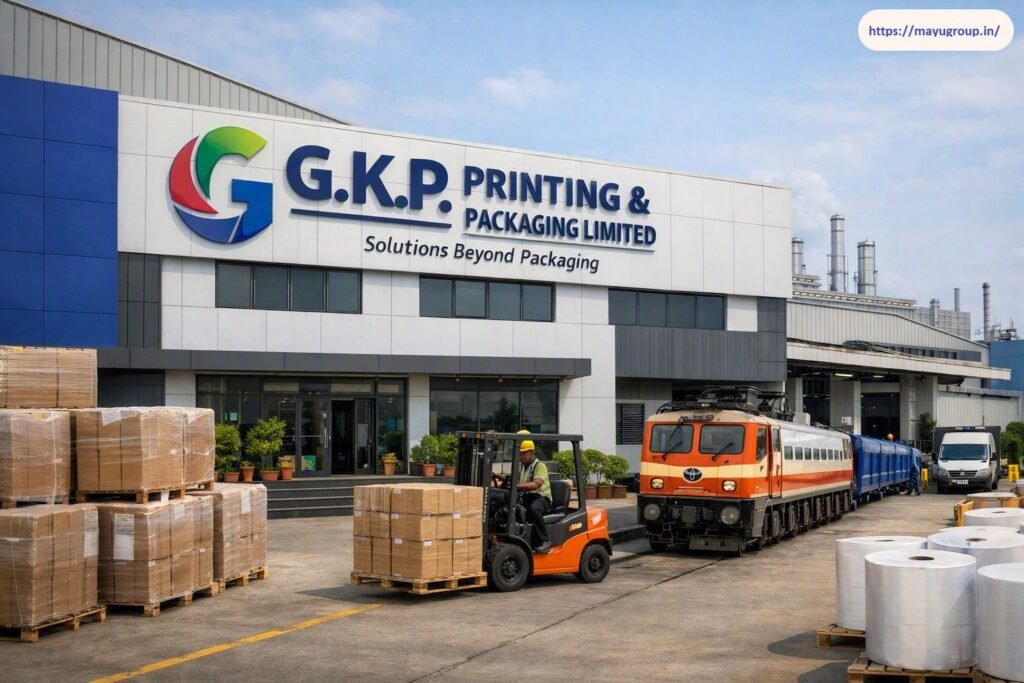
A manufacturing company’s growth is rarely determined by machinery alone. Machines can increase production capacity, but they cannot decide what quality means, how customers should be treated, or what standards an organization should follow. Those decisions come from leadership. In the story of G.K.P. Printing & Packaging Limited, the promoter’s vision became an important force in shaping the company’s direction.
The packaging industry is highly dependent on relationships. A customer does not purchase a corrugated box simply because it is made from paper. The customer purchases protection, consistency, convenience and confidence. A box must arrive when required, perform during transportation and storage, and meet the dimensions and specifications agreed upon between the customer and manufacturer. If packaging fails, the consequences can extend beyond the packaging supplier to the customer’s own production and distribution system.
Understanding this relationship between packaging quality and customer success is central to the promoter’s role.
For G.K.P., the objective was not merely to participate in the corrugated-box market but to establish a reputation for dependable quality and service. Public company material from the period around the company’s expansion emphasized quality, high standards, reliability and customer satisfaction. Such a philosophy provided the foundation for the company’s transition from an experience-based manufacturing operation toward a more structured organization.
The promoter’s vision can be understood through three interconnected ideas: quality, customer confidence and sustainable growth.
Quality was the first foundation.
In corrugated-box manufacturing, quality is not represented by a single measurement. It can involve the selection and condition of paper, board strength, dimensions, printing accuracy, cutting, folding, joint quality, appearance and the ability of the finished box to perform under practical conditions. Different customers may require different specifications, which means a manufacturer must be capable of understanding and reproducing those requirements consistently.
As the company’s customer base and production activities expanded, maintaining such consistency required more than individual supervision. It required systems.
The second foundation was customer confidence.
A successful packaging supplier becomes part of a customer’s supply chain. Customers need to know that their packaging will be available when promised and that products will conform to agreed specifications. For a manufacturer, this creates a responsibility that extends beyond the factory floor. Sales teams must understand customer requirements, production teams must translate those requirements into manufacturing instructions, quality personnel must verify conformity, and dispatch teams must ensure that finished products reach customers as planned.
The promoter’s vision therefore required different functions of the organization to work together.
The third foundation was sustainable growth.
Rapid expansion without systems can create instability. More customers mean more orders. More orders require greater production coordination. Greater production increases the need for maintenance, quality control, raw-material planning, employee training and inventory management. As an organization grows, the promoter’s responsibilities also become more complex.
This is where the establishment of a formal quality-management system became significant.
The company achieved ISO 9001:2015 certification in 2019, a milestone that came soon after the establishment of its Vapi manufacturing facility. ISO 9001 is based on a quality-management approach that emphasizes consistent processes, customer requirements, monitoring, corrective action and continual improvement.
For G.K.P., certification could therefore support the promoter’s broader objective of creating a company that was less dependent on informal methods and more dependent on repeatable processes.
A quality-management system also changes the way employees think about their work. Instead of asking only, “How many boxes did we produce today?” an organization begins asking broader questions: Were the boxes manufactured according to specification? Were customer requirements understood correctly? Were defects identified and addressed? Were problems analyzed so that they would not be repeated?
This shift from production alone to controlled production is one of the important characteristics of a mature manufacturing organization.
Leadership plays a central role in making this transformation successful. Certification may establish procedures, but management must ensure that those procedures are actually followed. Employees need training and communication. Responsibilities need to be clear. Records need to be maintained. Problems need to be reported rather than hidden. Corrective actions need to be taken seriously.
The promoter’s vision thus becomes embedded in organizational behavior.
The importance of this approach became even clearer as the company moved through changing market conditions. Packaging customers can be affected by fluctuations in raw-material prices, changing demand, transportation costs and broader economic conditions. A company with disciplined processes is better positioned to identify operational problems and respond to changing requirements.
The promoter’s journey can therefore be viewed as a transition from personal leadership to institutional leadership.
In the early phase of a business, the promoter may personally know major customers, suppliers and employees. As the organization expands, however, the promoter must create systems that allow the company to function effectively even when every decision cannot be made personally.
That is one of the deeper meanings of quality management.
The ISO 9001:2015 milestone in 2019 was therefore not simply an external recognition. It represented an important step toward institutionalizing the values that management wanted the company to embody.
For G.K.P. Printing & Packaging Limited, the promoter’s vision was ultimately about creating trust. Trust that products would meet requirements. Trust that orders would be handled professionally. Trust that quality would remain important even as production increased.
That trust became an asset in its own right.
As the company entered the next stage of its development, the challenge was to convert this vision into practical manufacturing systems. The Vapi facility provided the physical platform. The promoter’s leadership provided direction. ISO 9001:2015 provided a framework.
Together, these elements created the foundation for the company’s next chapter—a period in which quality management, manufacturing discipline and market confidence would become increasingly interconnected.
#ISO9001
Chapter 3 – The Vapi Manufacturing Facility and the New Phase of Growth
Growth in manufacturing becomes meaningful when a company’s vision is converted into physical capability. For G.K.P. Printing & Packaging Limited, the establishment and operation of its manufacturing facility at Dungra, Vapi, represented an important step in that transformation.
The company’s facility is located at Survey No. 397/1/P1, Plot No. 22, in Industrial Plot No. 31, Damaganga Industrial Park, Dungra, Vapi, Valsad, Gujarat – 396191. The location placed the company within an established industrial environment and provided a base from which it could develop its corrugated-box and paper-product manufacturing activities.
According to publicly available company history, the Vapi manufacturing unit became operational on December 27, 2018. This timing was significant. The facility became operational immediately before the company entered an important period of corporate development, including its 2019 ISO 9001:2015 certification.
A new manufacturing facility is more than a building containing machinery. It represents a commitment of capital, people, management attention and long-term expectations. For a packaging manufacturer, the factory must bring together raw materials, machinery, workers, production planning, quality inspection, storage and dispatch. Each element must function as part of a connected system.
Corrugated-box manufacturing begins with paper-based raw materials, but the final product must satisfy specific customer requirements. Different customers may require different dimensions, board combinations, printing designs and performance characteristics. Consequently, manufacturing flexibility becomes important.
The Vapi facility provided a platform from which the company could organize these activities on a more structured basis.
The surrounding industrial ecosystem also offered strategic advantages. Vapi is a significant industrial area in Gujarat, with manufacturing businesses operating across a variety of sectors. A packaging company located within such an environment can potentially benefit from proximity to industrial customers and supply-chain networks.
For G.K.P., this was particularly relevant because corrugated packaging is closely connected with manufacturing. Pharmaceutical companies, engineering businesses, consumer-product manufacturers, food-related enterprises and other industries require packaging to move finished products from factories to distributors and customers.
This means that a corrugated-box manufacturer must understand the needs of different industries. A pharmaceutical customer may have different packaging expectations from an engineering company. A consumer-goods manufacturer may require printed boxes designed for presentation as well as protection. An industrial customer may focus heavily on strength, dimensions and handling.
The ability to respond to such requirements is an important part of a packaging company’s competitiveness.
As G.K.P. expanded its manufacturing operations, the importance of process discipline naturally increased. When production is small, management can sometimes solve problems through direct supervision. As capacity increases, however, the organization needs systems that allow production to continue consistently.
This was one reason the timing of ISO 9001:2015 certification was important.
The company achieved certification in 2019, soon after the Vapi facility became operational. The certification provided a framework for defining and controlling processes. It encouraged the organization to consider how customer requirements were received, how production was controlled, how quality was checked and how problems were addressed.
The factory could therefore be viewed as the physical foundation of the company’s growth, while quality management became an organizational foundation.
Employees were central to this transformation. Machines can manufacture products, but people operate, maintain, inspect and improve manufacturing systems. A quality-driven organization therefore needs employees who understand the importance of following specifications and reporting deviations.
For a company producing corrugated boxes, even seemingly small deviations can create problems. Incorrect dimensions can affect product packing. Poor folding or joining can reduce box performance. Printing errors can affect customer branding. Inconsistent board quality can influence strength.
The solution is not simply to inspect finished goods at the end. Effective quality management seeks to build quality into the process itself.
This philosophy is closely connected with ISO 9001.
The certification encouraged a shift from a purely reactive approach—finding problems after production—to a more systematic approach involving planning, controls, documentation, monitoring and corrective action.
The Vapi facility therefore became more than a production location. It became part of the company’s effort to establish a repeatable manufacturing system.
The period around 2018 and 2019 also brought the company into a new phase of corporate identity. Publicly available records indicate that the present public limited company was incorporated in 2018, while the company’s manufacturing operations and subsequent public-market development created greater visibility.
With greater visibility came greater responsibility.
Customers, investors, suppliers, employees and other stakeholders expected the company to demonstrate professionalism. Quality certification helped communicate that the organization was prepared to operate according to a recognized quality-management framework.
Yet certification was only the beginning.
A certificate can demonstrate that a system has been assessed against a standard, but the real value of a management system emerges from its everyday implementation. Employees must follow procedures. Managers must monitor results. Customer complaints must be investigated. Processes must be improved. Records must be maintained.
For G.K.P., this meant that the challenge after establishing the Vapi facility was to convert capacity into dependable performance.
The company’s journey illustrates an important principle of industrial growth: infrastructure creates potential, but systems and people convert potential into performance.
The Vapi facility created the physical capacity. The promoter’s vision created direction. Employees created execution. Customers created market opportunity. ISO 9001:2015 created a framework for quality management.
Together, these elements positioned G.K.P. for the next stage of its journey.
The company was no longer simply looking at how much it could manufacture. It was increasingly concerned with how consistently it could manufacture, how effectively it could meet customer expectations and how systematically it could improve.
That change in thinking would become particularly important as the organization entered the post-certification period and faced the challenges and opportunities of a changing packaging market.
#QualityManagement
Chapter 4 – ISO 9001:2015 Certification: From a Certificate to a Culture of Quality
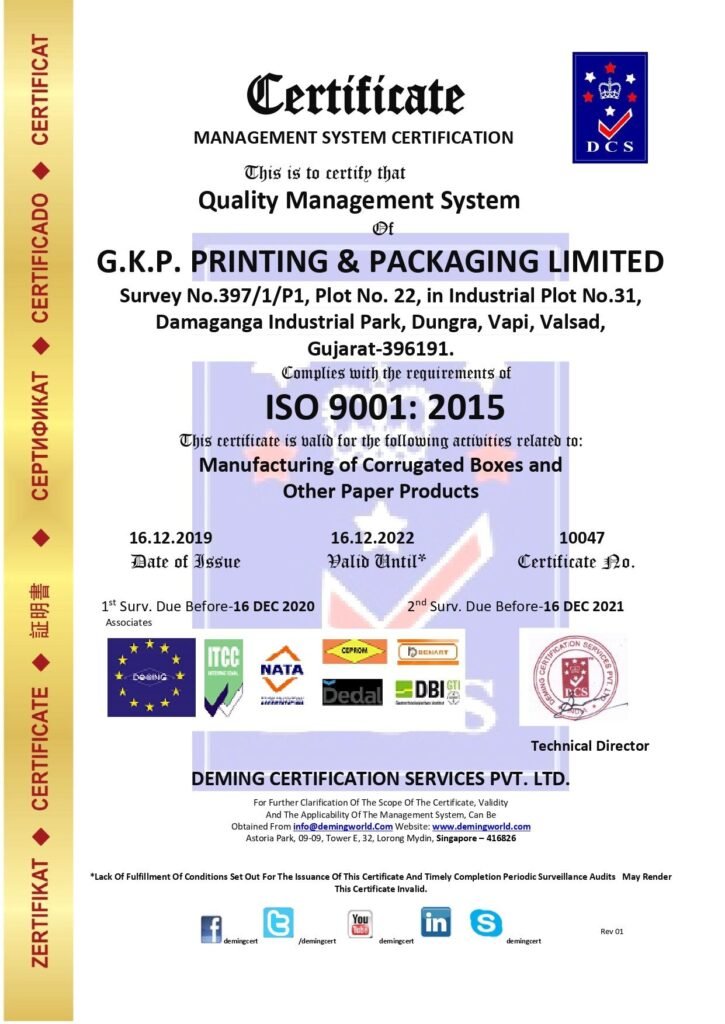
The year 2019 occupies a special place in the growth story of G.K.P. Printing & Packaging Limited. It was the year in which the company achieved ISO 9001:2015 certification, an important milestone in the development of its quality-management practices.
For a manufacturing company, receiving an ISO certificate can appear at first to be a simple administrative achievement. In reality, the significance of certification lies in the systems, discipline and organizational thinking behind it. A quality-management standard becomes valuable when its principles are incorporated into everyday operations.
For G.K.P., the timing of the certification was especially important. The company’s Vapi manufacturing facility had become operational in December 2018, and the organization was entering a period of expansion and greater corporate visibility. The ISO 9001:2015 certification provided a structured framework for managing this growth.
The basic philosophy behind ISO 9001 is straightforward: an organization should understand customer requirements, control its processes, evaluate performance, address problems and continually improve its management system.
In the corrugated-box industry, these principles have practical importance.
A customer may place an order for thousands of boxes with specific dimensions, board specifications, printing requirements and delivery schedules. The manufacturer must translate that order into a series of controlled activities. Raw materials must be available. Production instructions must be clear. Machinery must be properly operated. Quality checks must be performed. Finished goods must be protected and dispatched on time.
If any one of these stages fails, the final customer experience can be affected.
ISO 9001:2015 encouraged the organization to look at these activities as interconnected processes rather than isolated tasks.
This approach also changed the meaning of responsibility within the company. Quality could no longer be viewed only as the responsibility of a quality-control employee. Sales personnel had responsibility for correctly understanding customer requirements. Production employees had responsibility for following approved specifications. Maintenance personnel had responsibility for keeping equipment suitable for production. Supervisors had responsibility for monitoring processes. Management had responsibility for providing direction and resources.
In this way, certification could help transform quality from a department into a culture.
Documentation was another important aspect.
A growing manufacturing organization needs information that can be communicated consistently. Procedures, work instructions, inspection records and other quality-related documents can help reduce dependence on individual memory. When an employee changes, the process should not disappear with that person.
For G.K.P., the development of a documented management approach therefore had the potential to support continuity as the organization grew.
Another important principle was corrective action.
Manufacturing problems are inevitable. A machine may produce an incorrect dimension. A batch of raw material may not perform as expected. A customer may identify a packaging defect. A delivery may not meet expectations.
A mature organization does not simply correct the immediate problem and move on. It asks why the problem occurred and what can be done to prevent recurrence.
This is one of the most valuable lessons of quality management.
Suppose a customer receives boxes with inconsistent dimensions. Corrective action would not simply involve replacing the boxes. Management would also need to consider whether the problem arose from raw material variation, machine settings, measurement practices, operator instructions or another cause. Once the cause is identified, appropriate action can be taken.
Such thinking gradually builds organizational knowledge.
Customer feedback also becomes a source of improvement. Complaints are often viewed negatively, but a quality-driven organization can treat them as information. Every complaint can reveal a gap between customer expectations and actual performance.
The promoter’s vision of customer satisfaction could therefore be supported by the ISO framework.
Certification also contributed to external confidence. Customers often prefer suppliers that can demonstrate structured quality-management practices, particularly when the packaging supplied is part of a larger industrial process. An ISO 9001:2015 certificate does not guarantee that every individual product will be perfect, but it signals that the organization has established a recognized quality-management system.
For a growing company, that signal can be commercially meaningful.
The certification also encouraged management to think about continual improvement rather than one-time achievement. Quality is not something an organization completes once. Customer expectations change, machinery evolves, raw materials fluctuate, and markets become more competitive.
Consequently, a quality-management system must evolve as well.
The post-certification period was therefore a test of whether the principles introduced through the system would become part of the company’s everyday operations.
The true value of certification would not be measured by the appearance of the certificate itself. It would be measured through practical outcomes: fewer recurring defects, stronger process control, better understanding of customer requirements, more disciplined documentation, improved employee awareness and greater confidence among customers.
This distinction is important when evaluating the company’s subsequent growth.
It would be inaccurate to claim that ISO certification alone caused every improvement in G.K.P.’s business performance. Corporate growth depends upon many factors, including market demand, customer relationships, pricing, raw-material costs, production capacity, competition, financial management and broader economic conditions.
However, ISO 9001:2015 could provide a stronger management foundation from which those challenges could be addressed.
For G.K.P. Printing & Packaging Limited, 2019 therefore represented more than the acquisition of a quality certificate. It represented a change in organizational thinking.
The company was beginning to formalize its processes, strengthen its quality culture and prepare itself for the demands of a more structured manufacturing environment.
The certificate was the visible symbol.
The real transformation was taking place inside the organization—through procedures, people, accountability, customer focus and continual improvement.
That transformation would become increasingly important as G.K.P. moved beyond certification and confronted the practical challenges of competing, growing and maintaining customer confidence in the years that followed.
#CorrugatedPackaging
Chapter 5 – Quality as a Business Culture
After achieving ISO 9001:2015 certification in 2019, the next challenge for G.K.P. Printing & Packaging Limited was not simply to maintain a certificate. The greater challenge was to make quality a permanent part of the company’s culture.
A quality-management system becomes meaningful only when its principles are reflected in everyday decisions. In a manufacturing organization, this means that quality must be considered when raw materials are purchased, when customer orders are accepted, when production schedules are prepared, when machines are operated, when finished goods are inspected and when products are finally dispatched.
For G.K.P., whose core business involved the manufacturing of corrugated boxes and other paper products, this approach was particularly important. Packaging products are often manufactured according to precise customer specifications. A customer may require a particular size, board construction, printing design, strength or quantity. Even a relatively small deviation can create difficulties when the packaging is used on an automated production line or for transporting finished goods.
The ISO 9001:2015 framework encouraged the company to view these requirements systematically.
The first step in such a culture is understanding the customer.
A packaging order begins long before paper reaches a machine. It begins with communication. Customer requirements must be understood accurately and translated into manufacturing instructions. Questions about dimensions, material specifications, printing, quantities, delivery schedules and other requirements need to be clarified before production begins.
This creates a chain of responsibility.
The sales function communicates with the customer. Production interprets the requirements. Quality personnel verify conformity. Supervisors coordinate operations. Stores and procurement manage materials. Dispatch ensures that the correct finished products reach the customer.
Quality therefore becomes a shared responsibility.
This is one of the major differences between a traditional production-focused approach and a mature quality-management approach. In the traditional approach, the emphasis may be placed heavily on producing more units. In a quality-driven organization, the emphasis becomes producing the right product consistently.
For G.K.P., this distinction was important as the business developed its manufacturing capabilities.
Corrugated boxes may appear simple, but their production requires coordination among multiple stages. Paper and board must be handled correctly. Corrugation and conversion processes must be controlled. Printing, cutting, folding and joining must meet specifications. Finished boxes must be counted, stored and dispatched appropriately.
Each stage represents an opportunity either to preserve quality or introduce variation.
A strong quality culture attempts to prevent defects rather than relying entirely on final inspection. This means that employees must understand the consequences of errors and know how to identify abnormal conditions.
Employee awareness therefore becomes essential.
An ISO-based system can establish procedures, but employees bring those procedures to life. Training helps workers understand not only what they are expected to do, but why the requirement exists.
For example, accurate measurement is not merely a formality. It ensures that a box fits the customer’s product. Proper machine settings are not merely technical details. They influence the consistency of production. Correct handling of finished goods is not simply warehouse discipline. It protects the quality already achieved during manufacturing.
When employees understand these connections, quality becomes more meaningful.
Another important aspect of quality culture is communication.
If an employee notices a recurring problem but feels unable to report it, the organization loses an opportunity to improve. A mature quality environment encourages people to identify problems early. Management can then investigate the cause and implement corrective action.
This approach creates a learning organization.
A problem becomes information.
A customer complaint becomes feedback.
A production deviation becomes an opportunity to strengthen a process.
An internal inspection becomes an opportunity to identify weaknesses before they become larger problems.
Over time, these practices can contribute to operational stability.
The promoter and management team have an important role in sustaining this culture. Leadership must demonstrate that quality is genuinely important, rather than something required only for an audit. If production targets are always given priority over quality, employees will quickly understand the real organizational priorities.
Conversely, when management takes customer complaints seriously, supports corrective action and encourages employees to follow established processes, quality becomes part of the company’s identity.
This philosophy also has a commercial dimension.
A customer that receives consistent packaging is more likely to develop confidence in its supplier. Confidence can lead to repeat orders, stronger relationships and opportunities to supply additional products.
For a corrugated-box manufacturer, customer relationships can be especially valuable because packaging is often a recurring requirement. Manufacturing companies need boxes continuously, not just once. A supplier that consistently meets specifications and delivery expectations can become an important part of the customer’s supply chain.
Quality therefore contributes indirectly to business growth.
It can reduce waste, minimize rework, protect customer relationships and strengthen the company’s reputation.
At the same time, quality culture should not be confused with perfection. No manufacturing organization operates without challenges. Machines require maintenance, raw materials vary, orders change and unexpected problems occur.
The purpose of a quality-management system is to ensure that these challenges are handled systematically.
This is where continual improvement becomes important.
The organization must repeatedly ask: What happened? Why did it happen? What can we do differently? Did the corrective action work? Can the process be improved further?
These questions help prevent stagnation.
For G.K.P. Printing & Packaging Limited, the post-2019 period can therefore be understood as a period in which certification provided an opportunity to deepen the connection between quality and business performance.
The ISO 9001:2015 certificate was the formal recognition, but the lasting value lay in the habits developed around it.
Quality became connected with customer satisfaction.
Customer satisfaction became connected with trust.
Trust became connected with repeat business and reputation.
And reputation became one of the foundations upon which long-term growth could be built.
This was the deeper transformation following certification. G.K.P. was not simply manufacturing corrugated boxes; it was developing a management culture designed to make its manufacturing performance more consistent, measurable and responsive.
As the company entered the challenging years that followed, including the disruptions created by the COVID-19 pandemic and changes in industrial demand, this culture would face its most important test yet.
The question was no longer whether the company could obtain certification.
The question was whether the systems, people and values behind that certification could help the organization remain resilient when circumstances became difficult.
#PackagingIndustry
Chapter 6 – From Certification to Market Confidence
When G.K.P. Printing & Packaging Limited received its ISO 9001:2015 certification in 2019, the company entered a new stage of its business journey. The certification strengthened the formal quality-management structure of the organization, but its larger importance emerged through the company’s relationship with customers, suppliers, employees and the wider market.
In manufacturing, reputation is built gradually. A company may invest in modern equipment, establish a factory and obtain recognized certifications, but customers ultimately judge a supplier through everyday performance. Products must conform to specifications. Deliveries must be dependable. Communication must be clear. Problems must be resolved responsibly.
For G.K.P., the ISO certification became one element in building that confidence.
The company’s primary products—corrugated boxes and other paper products—serve an important function in industrial supply chains. Boxes protect goods during storage and transportation, but they can also carry printed information, branding and handling instructions. A packaging supplier therefore has responsibilities that extend beyond the production of paper-based products.
Consistency becomes particularly important for repeat customers.
Imagine a manufacturing customer that orders thousands of boxes every month. Its production planning, warehouse operations and distribution schedules may all depend on the availability of suitable packaging. If the boxes arrive late or fail to meet agreed specifications, the customer’s own operations can be affected.
This creates an important commercial relationship between quality and reliability.
ISO 9001:2015 helped G.K.P. establish a structured framework for managing such expectations. A quality-management system encourages organizations to identify customer requirements, establish appropriate processes, monitor performance and take corrective action when problems arise.
This structure can create confidence because it demonstrates that quality is not left entirely to individual judgment.
The company’s 2019 public presentation emphasized its focus on quality, reliability and customer satisfaction. These objectives were consistent with the principles of the quality-management system.
For the promoter and management, the certification could also serve as an important communication tool. When approaching customers, particularly industrial customers, being able to demonstrate a formal quality-management system can provide reassurance that the supplier takes process control seriously.
However, certification was not a substitute for performance.
The real test began after the certificate was issued.
Employees had to follow procedures consistently. Management had to monitor performance. Quality records had to remain meaningful. Customer complaints needed to be investigated. Corrective actions needed to address root causes. Internal processes had to be reviewed and improved.
This required discipline.
The company also had to manage another important relationship: its suppliers.
Corrugated-box manufacturing depends heavily on raw materials, particularly paper and paperboard. Changes in material availability, pricing or quality can affect manufacturing costs and finished-product performance. A quality-oriented company therefore needs to consider supplier performance as part of its broader quality system.
The connection between suppliers and customers can be understood as a chain.
A change in raw-material quality can influence production.
Production variation can influence finished-box quality.
Finished-box quality can influence customer satisfaction.
Customer satisfaction can influence repeat business.
Thus, quality management extends throughout the value chain.
The post-certification period also required G.K.P. to balance quality with commercial competitiveness. Customers expect quality, but they also expect competitive pricing. Manufacturers therefore need to control waste, reduce rework and use resources efficiently.
This is where a well-managed quality system can contribute to business performance.
If defects are reduced, material wastage may decline. If processes become more consistent, rework may decrease. If customer requirements are understood correctly at the beginning, costly production errors can be avoided. If maintenance is managed systematically, unexpected interruptions may potentially be reduced.
Quality management can therefore support both customer satisfaction and operational efficiency.
Yet the company operated in an environment where external conditions could change quickly.
The years following 2019 brought major economic uncertainty. The COVID-19 pandemic disrupted manufacturing, transportation and supply chains across India and the world. Industrial customers experienced changes in demand, while businesses faced difficulties related to workforce availability, logistics and raw materials.
For a packaging manufacturer, such disruptions could create significant operational challenges.
The company’s quality-management foundation could not eliminate those challenges, but it provided a framework for managing processes during uncertainty. Maintaining communication, documenting issues, monitoring operations and responding systematically became even more important.
The experience reinforced an important lesson: quality management is not only useful during stable periods. Its greatest value can emerge during difficult periods.
A company with disciplined processes can identify problems more clearly. Management can distinguish between isolated incidents and recurring issues. Corrective actions can be tracked. Responsibilities can be assigned. Decisions can be based on information rather than assumptions.
This is where certification becomes part of organizational resilience.
For G.K.P., the journey after 2019 was therefore not simply about gaining recognition in the marketplace. It was about converting the recognition associated with ISO 9001:2015 into practical customer confidence.
Every successful order could strengthen that confidence.
Every timely delivery could strengthen the relationship.
Every corrected defect could improve the system.
Every satisfied customer could contribute to the company’s reputation.
The promoter’s role remained important throughout this process. Leadership had to ensure that the company’s growth ambitions did not weaken its quality standards. As production and customer requirements changed, management had to maintain the balance between capacity, cost, quality and service.
This balance is at the heart of sustainable manufacturing.
The company’s journey demonstrates that market confidence is earned through repeated performance. Certification may open the door, but customer experience determines whether the relationship continues.
For G.K.P. Printing & Packaging Limited, the ISO 9001:2015 certification of 2019 therefore became an important bridge between its manufacturing capability and its market aspirations.
It strengthened the message that the company wanted to be known not simply as a supplier of corrugated boxes, but as a dependable manufacturing partner.
The years ahead would bring new opportunities as well as unexpected difficulties. Market conditions would change, customer demand would fluctuate and the company would have to manage the pressures of operating in a competitive manufacturing environment.
The real achievement would be maintaining the principles of quality while continuing to adapt.
That was the next stage of G.K.P.’s journey: transforming certification into confidence, confidence into relationships, and relationships into a foundation for long-term business development.
#ManufacturingExcellence
Chapter 7 – Growth Through Difficult Years
The period following G.K.P. Printing & Packaging Limited’s ISO 9001:2015 certification was not a period of uninterrupted expansion. Like many manufacturing companies, G.K.P. had to operate through changing economic conditions, supply-chain pressures and the unprecedented disruption caused by the COVID-19 pandemic.
This period became an important test of the company’s systems, leadership and resilience.
The ISO 9001:2015 certification had been achieved in 2019, at a time when the company was developing its manufacturing presence and strengthening its quality-management framework. Soon afterward, the business environment changed dramatically. The pandemic affected industrial production, transportation, workforce availability and customer demand across India.
For a company manufacturing corrugated boxes and other paper products, these disruptions could have a direct impact on operations. Packaging demand is closely connected to the activity of other industries. When factories reduce production, packaging requirements can change. When transportation is restricted, deliveries become more difficult. When raw-material supply is disrupted, manufacturing schedules can be affected.
The challenge for management was therefore to maintain continuity while responding to circumstances that could not easily be predicted.
G.K.P.’s Vapi unit remained an important part of its operational identity during this period. The company’s FY2020-21 annual report identifies the Vapi facility at Daman Ganga Industrial Park as one of its operating locations. The following year’s annual report similarly records the Vapi unit as part of the company’s operations.
These records illustrate that the company continued to maintain its manufacturing presence during a difficult economic period.
For the promoter and management, resilience required more than maintaining machinery. It required managing people.
A manufacturing organization depends upon its employees. During a public-health crisis, concerns about safety and workforce availability become particularly important. Employees need clear communication, appropriate precautions and confidence that management takes their wellbeing seriously.
G.K.P.’s published policies also demonstrate an organizational emphasis on providing a healthy and safe working environment for employees, contractors and visitors. The company’s health and safety policy refers to employee consultation, defined responsibilities, competent personnel and continual improvement of workplace safety systems.
This emphasis on people complements the company’s quality-management philosophy.
Quality cannot be maintained if employees do not have a safe and stable environment in which to perform their responsibilities. Likewise, business continuity becomes difficult when employee concerns are ignored.
The pandemic also highlighted the importance of communication with customers.
In uncertain conditions, customers need to know whether orders can be produced, whether deliveries can be made and whether schedules need to be adjusted. Honest communication can preserve relationships even when circumstances prevent a supplier from meeting an original plan.
For a packaging company, customer relationships are particularly valuable because packaging requirements are often recurring. G.K.P.’s own corporate profile emphasizes its objective of building long-term business partnerships through reliability, assured quality and an understanding of customer requirements.
The difficult years therefore provided an opportunity to put these principles into practice.
Another challenge was the management of raw materials and operating costs. Paper-based packaging manufacturing is sensitive to material availability and pricing. When supply chains become unstable, the cost of maintaining production can rise.
A quality-management system can help an organization respond by encouraging controlled processes, monitoring and corrective action. It cannot eliminate external cost pressures, but it can help management identify inefficiencies and avoid unnecessary waste.
This is where the connection between quality and financial performance becomes important.
A defective box represents more than a quality problem. It can mean wasted paper, machine time, labour and transportation. If the product has already reached the customer, the cost may become even greater because it can involve replacement, additional transportation and damage to customer confidence.
Reducing avoidable errors is therefore both a quality objective and a business objective.
The company also needed to remain responsive to changing customer requirements. G.K.P.’s product portfolio includes several types of corrugated packaging, including coloured, printed, customized and partitioned boxes. Its published product information indicates that these products serve applications across pharmaceutical, food, engineering, electronics, textile and other industries.
This diversity can provide opportunities during changing market conditions because demand does not necessarily move in the same direction across every industry.
The ability to customize products can also strengthen customer relationships. Different customers require different packaging solutions, and a manufacturer capable of adapting dimensions, designs and configurations can become more valuable to its customers.
The difficult years therefore demonstrated an important principle of business growth: resilience does not mean avoiding every problem. It means developing the ability to respond to problems without losing sight of long-term objectives.
For G.K.P., the promoter’s leadership remained important during this period. Management had to balance immediate operational concerns with the company’s longer-term ambitions. Decisions regarding production, employees, customers, suppliers and costs had to be made under conditions of uncertainty.
The ISO 9001:2015 framework provided a useful organizational foundation, but people remained responsible for making the system work.
This period also changed the meaning of growth.
Before a crisis, growth may be measured primarily by sales, production volume or customer acquisition. During a difficult period, simply maintaining operations can become an achievement. Preserving customer relationships, protecting employees, controlling quality and keeping the organization financially disciplined can create the foundation for future recovery.
G.K.P.’s later financial performance demonstrates why this distinction matters. The company experienced significant changes in revenue in subsequent years, showing that manufacturing growth can be uneven rather than linear. Yet the organization continued to operate and develop its business.
The lesson from this chapter is therefore not that certification guaranteed growth. It did not.
Rather, the experience demonstrates how a quality-management mindset can support resilience. Clear processes, customer focus, employee responsibility, corrective action and continual improvement can help a company navigate uncertainty.
The pandemic years tested G.K.P. in ways that no certification audit could predict.
They tested whether management could adapt.
They tested whether employees could maintain discipline.
They tested whether customer relationships were strong enough to survive disruption.
And they tested whether the company’s long-term vision could remain intact during a period of extraordinary uncertainty.
The answer was found not in a single event, but in continued operation and adaptation.
For G.K.P. Printing & Packaging Limited, the difficult years became an important chapter in the journey after ISO 9001:2015 certification. They demonstrated that the true value of quality management is not only visible when business conditions are favorable.
#CustomerSatisfaction
Chapter 8 – Resilience, Recovery and Business Development
The story of G.K.P. Printing & Packaging Limited after ISO 9001:2015 certification cannot be understood only through the idea of expansion. A more accurate description is a story of resilience, adjustment and recovery. The years following certification brought both opportunities and pressures, and the company’s performance reflected the changing conditions of the packaging and manufacturing environment.
G.K.P. entered this period with a clear business philosophy. The company describes itself as a provider of professional and customized packaging solutions, with a focus on quality and cost-effective product development. Its stated approach emphasizes long-term relationships with customers, reliability, assured quality and target-oriented manufacturing.
These principles became increasingly important as the company moved through changing market conditions.
The packaging industry is closely connected to the broader economy. When manufacturing activity increases, demand for boxes and other packaging products generally rises. When industrial production slows, packaging demand can decline. At the same time, manufacturers must manage raw-material prices, labour costs, transportation expenses and competitive pricing.
For G.K.P., sustainable development therefore required the ability to balance production, quality and cost.
One of the most important developments during the company’s post-certification journey was the expansion and diversification of its product capabilities. The company publicly lists coloured corrugated boxes, corrugated packaging boxes, corrugated paper boxes, customized corrugated boxes, partition boxes, white corrugated boxes and printed corrugated boxes among its offerings.
This range demonstrates an important business strategy: serving customers through different packaging requirements rather than depending on a single standardized product.
Customization can create additional value. A customer may require a box designed around a particular product, bottle, component or transportation requirement. A supplier capable of producing customized solutions can become more closely integrated into the customer’s operations.
For example, corrugated boxes with partitions can be useful for products that require separation and protection during transportation. Printed boxes can combine packaging with branding and product information. White corrugated boxes may be selected for specific appearance or material requirements.
The ability to provide these alternatives can strengthen the company’s position as a packaging partner.
This approach also connects directly with the quality-management philosophy established through ISO 9001:2015. Customization increases the importance of understanding specifications accurately and reproducing them consistently.
As product variety increases, process control becomes even more important.
The company’s published product information refers to machinery and manufacturing capabilities including rotary machines, partition cutters, board cutters, creasing machines and box-stitching equipment. These capabilities support the production of packaging solutions with different formats and specifications.
But equipment alone does not create competitiveness.
The real advantage comes when equipment, skilled people, process knowledge and quality controls operate together.
This is where the promoter’s role remains significant. Growth requires management to decide where the company should compete, what customers it should serve, how resources should be allocated and how quality should be protected.
The promoter’s vision of customer satisfaction therefore becomes a practical business strategy.
The company states that its long-term philosophy is to develop business partnerships rather than simply conduct individual transactions. It emphasizes interpersonal relationships, reliability, quality and understanding of client objectives.
Such relationships can be particularly valuable in packaging because customers often require regular supplies. Once a packaging supplier understands a customer’s specifications and production requirements, a stable relationship can develop.
However, maintaining these relationships requires consistent performance.
This is where the company’s quality-management journey becomes connected to business development.
ISO 9001:2015 created a framework for controlled processes. Product diversification created additional market opportunities. Customer relationships created recurring demand. Skilled employees and manufacturing equipment provided execution capability.
Together, these elements could support growth.
The financial record also illustrates the changing nature of the company’s journey. According to the company’s FY2021-22 annual report, net sales/income from operations increased from approximately ₹2,926.59 lakh in FY2020-21 to ₹5,339.78 lakh in FY2021-22, while profit after tax increased from approximately ₹77.64 lakh to ₹81.07 lakh.
The following year showed further movement. The company’s FY2022-23 annual report reported revenue from operations of approximately ₹5,607.08 lakh, compared with approximately ₹5,339.78 lakh in the previous year, representing growth of about 5.01%. The same report recorded profit after tax of approximately ₹85.90 lakh, compared with ₹81.07 lakh in FY2021-22.
These figures are significant because they demonstrate that the post-certification period included measurable business development. At the same time, they should not be interpreted as proof that ISO certification alone produced the financial growth. Revenue and profitability are influenced by many factors, including market demand, pricing, raw-material costs, production volumes, customer mix and broader economic conditions.
The more meaningful connection is that quality management can support the operational foundations upon which growth depends.
A company cannot easily build long-term customer relationships if its products are inconsistent. It cannot protect margins if avoidable waste and rework are high. It cannot expand efficiently if its processes are entirely dependent on individual employees.
Systems therefore become increasingly important as the organization grows.
G.K.P.’s health and safety policy also reflects this broader approach to organizational development. The company states its commitment to providing a healthy and safe working environment and emphasizes employee consultation, defined responsibilities, competent personnel and continual improvement.
This illustrates that organizational maturity extends beyond product quality.
A sustainable manufacturing company must consider employees, customers, suppliers, safety, operational efficiency and corporate responsibility together.
The recovery and development period also taught an important lesson about resilience. Growth cannot be measured only by the highest level of revenue achieved in a single year. A stronger measure is whether the organization can respond to changing circumstances and continue developing its capabilities.
For G.K.P., the journey included periods of expansion as well as pressure. The company’s ability to continue serving different industries and offering customized packaging solutions provided opportunities to respond to market changes.
The promoter’s role in this process was to maintain direction while adapting tactics.
A successful promoter does not simply insist that the company continue doing what worked in the past. Instead, leadership must recognize changing customer expectations and identify where the company can create additional value.
That is why the company’s movement toward customized packaging, diversified products and stronger process management is important.
The journey after ISO 9001:2015 certification was therefore not a simple story of “certificate followed by growth.” It was more nuanced.
Certification strengthened the quality framework.
The manufacturing facility created capacity.
Employees created operational capability.
Customer relationships created market opportunity.
Product diversification created additional avenues for business.
And management leadership connected these elements into a continuing strategy.
The result was an organization better positioned to respond to both opportunity and uncertainty.
As G.K.P. moved forward, the central challenge remained the same: how to preserve the values of quality, reliability and customer satisfaction while operating in a competitive and changing market.
The answer would depend upon the company’s ability to keep learning.
The story of G.K.P. Printing & Packaging Limited after ISO 9001:2015 certification cannot be understood only through the idea of expansion. A more accurate description is a story of resilience, adjustment and recovery. The years following certification brought both opportunities and pressures, and the company’s performance reflected the changing conditions of the packaging and manufacturing environment.
G.K.P. entered this period with a clear business philosophy. The company describes itself as a provider of professional and customized packaging solutions, with a focus on quality and cost-effective product development. Its stated approach emphasizes long-term relationships with customers, reliability, assured quality and target-oriented manufacturing.
These principles became increasingly important as the company moved through changing market conditions.
The packaging industry is closely connected to the broader economy. When manufacturing activity increases, demand for boxes and other packaging products generally rises. When industrial production slows, packaging demand can decline. At the same time, manufacturers must manage raw-material prices, labour costs, transportation expenses and competitive pricing.
For G.K.P., sustainable development therefore required the ability to balance production, quality and cost.
One of the most important developments during the company’s post-certification journey was the expansion and diversification of its product capabilities. The company publicly lists coloured corrugated boxes, corrugated packaging boxes, corrugated paper boxes, customized corrugated boxes, partition boxes, white corrugated boxes and printed corrugated boxes among its offerings.
This range demonstrates an important business strategy: serving customers through different packaging requirements rather than depending on a single standardized product.
Customization can create additional value. A customer may require a box designed around a particular product, bottle, component or transportation requirement. A supplier capable of producing customized solutions can become more closely integrated into the customer’s operations.
For example, corrugated boxes with partitions can be useful for products that require separation and protection during transportation. Printed boxes can combine packaging with branding and product information. White corrugated boxes may be selected for specific appearance or material requirements.
The ability to provide these alternatives can strengthen the company’s position as a packaging partner.
This approach also connects directly with the quality-management philosophy established through ISO 9001:2015. Customization increases the importance of understanding specifications accurately and reproducing them consistently.
As product variety increases, process control becomes even more important.
The company’s published product information refers to machinery and manufacturing capabilities including rotary machines, partition cutters, board cutters, creasing machines and box-stitching equipment. These capabilities support the production of packaging solutions with different formats and specifications.
But equipment alone does not create competitiveness.
The real advantage comes when equipment, skilled people, process knowledge and quality controls operate together.
This is where the promoter’s role remains significant. Growth requires management to decide where the company should compete, what customers it should serve, how resources should be allocated and how quality should be protected.
The promoter’s vision of customer satisfaction therefore becomes a practical business strategy.
The company states that its long-term philosophy is to develop business partnerships rather than simply conduct individual transactions. It emphasizes interpersonal relationships, reliability, quality and understanding of client objectives.
Such relationships can be particularly valuable in packaging because customers often require regular supplies. Once a packaging supplier understands a customer’s specifications and production requirements, a stable relationship can develop.
However, maintaining these relationships requires consistent performance.
This is where the company’s quality-management journey becomes connected to business development.
ISO 9001:2015 created a framework for controlled processes. Product diversification created additional market opportunities. Customer relationships created recurring demand. Skilled employees and manufacturing equipment provided execution capability.
Together, these elements could support growth.
The financial record also illustrates the changing nature of the company’s journey. According to the company’s FY2021-22 annual report, net sales/income from operations increased from approximately ₹2,926.59 lakh in FY2020-21 to ₹5,339.78 lakh in FY2021-22, while profit after tax increased from approximately ₹77.64 lakh to ₹81.07 lakh.
The following year showed further movement. The company’s FY2022-23 annual report reported revenue from operations of approximately ₹5,607.08 lakh, compared with approximately ₹5,339.78 lakh in the previous year, representing growth of about 5.01%. The same report recorded profit after tax of approximately ₹85.90 lakh, compared with ₹81.07 lakh in FY2021-22.
These figures are significant because they demonstrate that the post-certification period included measurable business development. At the same time, they should not be interpreted as proof that ISO certification alone produced the financial growth. Revenue and profitability are influenced by many factors, including market demand, pricing, raw-material costs, production volumes, customer mix and broader economic conditions.
The more meaningful connection is that quality management can support the operational foundations upon which growth depends.
A company cannot easily build long-term customer relationships if its products are inconsistent. It cannot protect margins if avoidable waste and rework are high. It cannot expand efficiently if its processes are entirely dependent on individual employees.
Systems therefore become increasingly important as the organization grows.
G.K.P.’s health and safety policy also reflects this broader approach to organizational development. The company states its commitment to providing a healthy and safe working environment and emphasizes employee consultation, defined responsibilities, competent personnel and continual improvement.
This illustrates that organizational maturity extends beyond product quality.
A sustainable manufacturing company must consider employees, customers, suppliers, safety, operational efficiency and corporate responsibility together.
The recovery and development period also taught an important lesson about resilience. Growth cannot be measured only by the highest level of revenue achieved in a single year. A stronger measure is whether the organization can respond to changing circumstances and continue developing its capabilities.
For G.K.P., the journey included periods of expansion as well as pressure. The company’s ability to continue serving different industries and offering customized packaging solutions provided opportunities to respond to market changes.
The promoter’s role in this process was to maintain direction while adapting tactics.
A successful promoter does not simply insist that the company continue doing what worked in the past. Instead, leadership must recognize changing customer expectations and identify where the company can create additional value.
That is why the company’s movement toward customized packaging, diversified products and stronger process management is important.
The journey after ISO 9001:2015 certification was therefore not a simple story of “certificate followed by growth.” It was more nuanced.
Certification strengthened the quality framework.
The manufacturing facility created capacity.
Employees created operational capability.
Customer relationships created market opportunity.
Product diversification created additional avenues for business.
And management leadership connected these elements into a continuing strategy.
The result was an organization better positioned to respond to both opportunity and uncertainty.
As G.K.P. moved forward, the central challenge remained the same: how to preserve the values of quality, reliability and customer satisfaction while operating in a competitive and changing market.
The answer would depend upon the company’s ability to keep learning.
And that ability—to learn from customers, employees, production challenges and market conditions—would become one of the most important characteristics of its continuing growth story.
#ContinualImprovement
Chapter 9 – The Promoter’s Continuing Responsibility and the Strengthening of the Organization
As G.K.P. Printing & Packaging Limited moved beyond the initial milestone of ISO 9001:2015 certification, the role of the promoter and management became increasingly important. Obtaining certification was a significant achievement, but maintaining a quality-driven organization over several years required continuous leadership, discipline and adaptation.
The promoter’s responsibility changed as the company developed.
In the early stages of a business, leadership is often closely connected with daily operations. The promoter may be involved directly in customers, suppliers, production decisions, employee matters and financial planning. As the organization grows, however, the promoter must gradually create systems that allow responsibilities to be distributed across the organization.
This transition from personal management to institutional management is an important stage in corporate growth.
For G.K.P., the development of the Vapi manufacturing facility and the implementation of ISO 9001:2015 created a foundation for this transition. The company needed processes that could operate consistently regardless of whether a particular decision was being made personally by the promoter or by another responsible manager.
A quality-management system contributes to this objective by defining responsibilities and establishing processes.
The promoter’s role therefore becomes less about controlling every individual activity and more about ensuring that the organization has the right structure to control those activities itself.
This requires leadership.
Management must communicate the company’s objectives clearly. Employees must understand what is expected from them. Quality standards must be maintained. Customer requirements must be respected. Financial resources must be managed carefully. Equipment must be maintained. Safety must remain a priority.
The promoter must also balance short-term and long-term objectives.
A manufacturing company can sometimes increase short-term sales by accepting orders at very low margins, reducing necessary maintenance or compromising on process discipline. Such decisions may provide immediate benefits but can create long-term risks.
Sustainable leadership requires a different perspective.
The promoter must ask whether a decision strengthens the organization for the future.
This philosophy is closely connected with the company’s stated emphasis on quality, reliability and long-term customer relationships. G.K.P.’s published corporate profile highlights its intention to develop business partnerships based on reliability, assured quality and understanding customer requirements. (gkpl.in)
Such a philosophy requires management consistency.
A customer relationship is not built through one successful order. It develops over repeated interactions. The customer expects the supplier to understand specifications, maintain quality and respond professionally when problems arise.
The promoter therefore has a strategic responsibility to protect the company’s reputation.
Reputation is an invisible business asset. It does not appear as a machine or building, but it can influence whether customers return, whether employees remain committed and whether suppliers are willing to work closely with the organization.
Quality certification can contribute to reputation, but reputation ultimately depends on performance.
This is why maintaining the principles behind ISO 9001:2015 is more important than simply displaying the certificate.
The company’s management system must remain active. Processes need to be reviewed. Customer feedback needs to be considered. Corrective actions need to be implemented. Employees need training. Risks need to be identified. Opportunities for improvement need to be evaluated.
The promoter’s role is to ensure that these activities remain meaningful rather than becoming routine paperwork.
This is particularly important as the business becomes more complex.
G.K.P.’s product range includes different forms of corrugated packaging, including printed, customized, partitioned and other corrugated boxes. (gkpl.in) Different products mean different production requirements. Different customers may also operate in different industries with different expectations.
Managing such diversity requires coordination.
A strong organization therefore depends upon communication between sales, production, quality, procurement, stores, maintenance, finance and dispatch.
The promoter’s leadership must encourage these functions to work toward common objectives rather than operate as separate departments.
Another responsibility is investment in people.
Machines can improve production, but skilled employees are required to operate them effectively. Training is particularly important in a quality-driven organization because employees need to understand specifications, procedures and the reasons behind quality controls.
The company’s published health and safety policy also emphasizes competent personnel, employee consultation, responsibilities and continual improvement.
This indicates that organizational development extends beyond manufacturing output.
Employee safety, employee participation and workplace discipline are all part of creating a sustainable organization.
The promoter must also respond to external changes.
The packaging industry does not operate in isolation. Changes in raw-material prices, customer demand, transportation costs, environmental expectations, technology and competition can influence business performance.
Leadership therefore requires continuous observation.
A promoter must be willing to ask difficult questions: Are existing products still competitive? Are customers asking for new solutions? Can waste be reduced? Can delivery performance improve? Is equipment being used efficiently? Are employees receiving appropriate training? Are quality problems recurring?
These questions lead directly to continual improvement.
The company’s financial history also demonstrates why leadership must remain adaptable. After strong revenue growth through FY2022-23, the company experienced a substantial decline in revenue during FY2023-24. Publicly available financial information reports revenue from operations of approximately ₹5,607 lakh in FY2022-23 and approximately ₹2,820 lakh in FY2023-24.
Such fluctuations demonstrate that manufacturing growth is rarely a straight upward line.
A promoter’s responsibility during a difficult period is therefore not simply to pursue expansion. It is to protect the organization’s core capabilities, manage costs, preserve customer relationships and prepare the company for recovery.
The subsequent improvement in FY2024-25 revenue to approximately ₹3,012 lakh, together with reported profit after tax of approximately ₹85 lakh, illustrates the possibility of recovery following a difficult year. (economictimes.indiatimes.com)
Again, these results cannot be attributed to a single factor. Business performance is influenced by many variables. Nevertheless, they illustrate why organizational resilience matters.
The promoter’s continuing responsibility is ultimately to ensure that the company can survive fluctuations while remaining focused on its long-term purpose.
For G.K.P., that purpose has remained closely connected with packaging, quality and customer service.
The company’s journey demonstrates that entrepreneurship does not end when a business becomes established. Instead, entrepreneurship changes form.
The early entrepreneur builds the business.
The growing promoter builds the organization.
The mature leader builds systems, people and capabilities that can continue creating value beyond individual decisions.
ISO 9001:2015 was an important part of that transition because it encouraged the organization to institutionalize quality.
The promoter’s continuing responsibility is to keep that institutionalization alive.
A certificate can expire.
A machine can become obsolete.
A market can change.
A customer can move to another supplier.
But a strong organizational culture can adapt.
That is perhaps the most important contribution leadership can make to long-term growth: creating a company that is capable of learning, adapting and improving even as circumstances change.
For G.K.P. Printing & Packaging Limited, the years after certification were therefore not simply about expanding production. They were about strengthening the organization behind the production.
The promoter’s vision had begun with packaging.
It had developed through manufacturing.
It had gained structure through quality management.
And it continued through leadership, people, customer relationships and the pursuit of sustainable growth.
#SustainablePackaging
Chapter 10 – The Road Ahead: Quality, Sustainability and the Future of G.K.P. Printing & Packaging Limited
The journey of G.K.P. Printing & Packaging Limited after its ISO 9001:2015 certification in 2019 is not simply a story about obtaining a quality certificate or increasing business activity. It is a story about transformation, resilience and the continuing search for a stronger foundation for growth.
The company’s journey began with packaging.
Its manufacturing activities focused on corrugated boxes and other paper products, serving customers that depended on reliable packaging for their own products and supply chains. Over time, the business developed manufacturing capabilities, established its Vapi facility and adopted a more structured quality-management approach.
The ISO 9001:2015 certification became an important milestone in that transformation.
But certification was never the destination.
The real destination is continual improvement.
For a manufacturing company, improvement can take many forms. It may mean reducing material waste, improving production efficiency, strengthening inspection systems, reducing customer complaints, improving delivery performance, developing employees or introducing new packaging solutions.
The challenge is to make improvement continuous rather than occasional.
This is particularly important in the packaging industry because customer expectations continue to evolve.
Customers increasingly expect packaging to be economical, reliable, visually attractive and environmentally responsible. They may also require greater customization and shorter delivery schedules.
A corrugated-box manufacturer must therefore remain responsive.
G.K.P.’s existing product range, which includes printed, customized, coloured and partitioned corrugated boxes, provides a foundation for responding to different packaging requirements.
The future opportunity lies in combining this product capability with stronger process management.
Technology will also influence the future of packaging manufacturing. Modern production systems can improve accuracy, productivity and consistency. Better production planning and data management can help manufacturers identify inefficiencies and make informed decisions.
For G.K.P., future competitiveness may therefore depend on how effectively people, technology and quality systems are combined.
However, technology alone will not determine success.
People will remain central.
A manufacturing company needs skilled operators, supervisors, quality personnel, maintenance teams, sales professionals and managers. Employees need training not only in operating equipment but also in understanding quality, safety and customer requirements.
The company’s published health and safety policy recognizes the importance of competent personnel, employee participation and continual improvement.
This approach can become increasingly important as the company develops.
A strong workforce creates organizational knowledge.
An employee who understands how a machine behaves, how a particular customer specification is interpreted or how a recurring defect can be prevented possesses knowledge that can improve the company’s performance.
The challenge for management is to capture and share that knowledge.
This is another reason systems matter.
A company that depends entirely on individual experience can become vulnerable when employees leave. A company that converts experience into documented processes, training and organizational knowledge becomes more resilient.
The promoter’s responsibility therefore continues into the future.
The promoter must encourage innovation while preserving discipline. New products must be evaluated. New customers must be understood. New machinery must be introduced carefully. Costs must be controlled. Quality must remain protected.
The balance between growth and stability will be particularly important.
G.K.P.’s financial history demonstrates that revenue growth can be uneven. The company reported revenue from operations of approximately ₹5,607 lakh in FY2022-23, followed by approximately ₹2,820 lakh in FY2023-24. In FY2024-25, reported revenue from operations increased to approximately ₹3,012 lakh, while profit after tax was reported at approximately ₹85 lakh. (goodreturns.in; Economic Times)
These changes illustrate an important truth: sustainable growth requires resilience as much as expansion.
The future cannot be built by assuming that every year will be stronger than the previous year. Markets fluctuate. Customer demand changes. Costs rise and fall. Competition increases.
A strong company is one that can respond to these changes without abandoning its fundamental principles.
For G.K.P., those principles include quality and customer satisfaction.
ISO 9001:2015 helped formalize these principles in 2019. The next stage is to keep the spirit of continual improvement alive regardless of the status of any particular certificate.
Quality should become part of the company’s identity rather than a requirement that exists only for certification.
The future of packaging also includes a growing focus on environmental responsibility.
Paper-based and corrugated packaging already has an important role in the movement toward recyclable packaging solutions, but manufacturers must continue to consider material efficiency, waste reduction and responsible resource use.
Reducing waste can provide both environmental and commercial benefits. Every reduction in avoidable material consumption can contribute to improved resource efficiency and potentially lower manufacturing costs.
This creates an opportunity for quality management and sustainability to work together.
Better processes can reduce defects.
Reduced defects can reduce waste.
Reduced waste can improve resource efficiency.
Improved efficiency can strengthen competitiveness.
Thus, the principles learned through quality management can support broader sustainability objectives.
Customer expectations will also remain a major driver of future development.
The company’s stated objective of building long-term business partnerships emphasizes understanding customer requirements and providing reliable quality.
This philosophy can help guide future growth.
Rather than competing only on price, a packaging company can compete through reliability, responsiveness, customization and service.
For G.K.P., the long-term opportunity is to become increasingly valuable to customers by understanding their packaging problems and providing dependable solutions.
The story that began with a manufacturing vision therefore continues.
The promoter’s original entrepreneurial ambition developed into a manufacturing operation.
The manufacturing operation developed a stronger quality-management framework.
The ISO 9001:2015 certification created formal recognition of that framework.
Customer relationships provided opportunities for growth.
Difficult economic conditions tested resilience.
And subsequent recovery demonstrated the importance of adaptation.
The future will bring another set of challenges.
Competition will continue.
Technology will evolve.
Customers will demand more.
Environmental expectations will increase.
Raw-material markets will remain unpredictable.
Employees will require new skills.
In such an environment, the company’s greatest strength may not be any single machine, product or certification. It may be its ability to learn and improve.
That is the lasting lesson of the G.K.P. journey.
Quality is not a destination. It is a continuous journey.
The ISO 9001:2015 certification of 2019 marked an important chapter, but the deeper achievement was the development of a mindset in which customer requirements, process discipline and continual improvement became central to the company’s development.
G.K.P. Printing & Packaging Limited’s story therefore remains unfinished.
Every new customer order creates another opportunity to demonstrate reliability.
Every manufacturing challenge creates an opportunity to improve.
Every employee creates an opportunity to strengthen organizational knowledge.
Every new market creates an opportunity to grow.
And every improvement made today can become the foundation for tomorrow.
The certificate issued in 2019 belongs to a particular moment in the company’s history. The values behind it—quality, responsibility, customer focus and continual improvement—can continue far beyond that period.
That is what gives the story its lasting significance.
The journey from packaging manufacturer to a more structured, quality-conscious organization was not completed in one year. It was built step by step, through leadership, investment, people, processes and perseverance.
And the next chapter of G.K.P.’s story will be written in the same way: one customer, one product, one improvement and one decision at a time.
#VapiGujarat
#GKPPrintingPackaging #CorrugatedBoxManufacturing #PackagingSolutions #IndustrialPackaging #QualityDrivenManufacturing
Take the Next Step Today
Don’t wait to enhance your business’s quality and efficiency. Partner with Mayu Group India and experience the transformation that comes with expert consultancy and training. Contact us today to learn more about how we can help you achieve your business goals. Reach out via phone at +91-9322728183, visit our website at www.mayugroup.in, or email us at investor@mayugroup.in Let us be your guide on the journey to excellence and innovation.