
Shree Kirshna Industries
- Shree Kirshna Industries
- Chapter 1 – The Beginning of a Manufacturing Vision
- Chapter 2 – The Decision to Choose ISO 9001:2015
- Chapter 3 – Building a Quality Culture
- Chapter 4 – The Promoter’s Transformation
- Chapter 5 – From Quality Certification to Customer Confidence
- Chapter 6 – Operational Discipline and Continuous Improvement
- Chapter 7 – Strengthening the Market and Building Sustainable Growth
- Chapter 8 – People, Technology and the Next Stage of Development
- Chapter 9 – Challenges, Learning and Resilience
- Chapter 10 – The Legacy of Certification and the Vision for the Future
- Take the Next Step Today

Chapter 1 – The Beginning of a Manufacturing Vision
Every successful industrial enterprise begins with a vision. Before there is a factory, there is an idea. Before there are machines, there is a decision to take a risk. Before customers place their confidence in a company, there is a promoter who believes that a business can be built through hard work, consistency and commitment.
The story of Shree Kirshna Industries, located at Plot No. 9, Survey No. 40, Siddharth Industrial Estate, Village Veoor, Nandore Road, Palghar (East), Maharashtra – 401104, can be understood as a story of entrepreneurial determination and gradual organizational development.
The company’s area of work is Steel Wire & Wire Ropes, a manufacturing field in which quality and consistency are fundamental to customer confidence. Steel wire and wire ropes are not merely ordinary industrial products. Depending on their application, customers may rely upon their strength, dimensional consistency, flexibility, construction and dependable performance. A manufacturing organization working in this field therefore has to understand that the quality of its product can influence the performance and reliability of the customer’s own operations.
For Shree Kirshna Industries, manufacturing was consequently more than the production of material. It was the creation of a relationship based on trust.
In the early stages of any manufacturing business, the promoter often plays several roles simultaneously. The promoter may be involved in purchasing raw materials, interacting with customers, supervising production, managing employees, solving operational problems and planning the next stage of business development. Such personal involvement can provide an organization with energy and flexibility during its formative years.
However, as the business develops, a new challenge emerges.
Growth creates complexity.
More orders require better planning. More production requires stronger process control. More employees require clearer responsibilities. More customers require better communication. More suppliers require systematic evaluation. More products and specifications require better documentation and inspection.
The company gradually reaches a point where individual experience alone is no longer sufficient.
It needs a system.
This realization is particularly important in manufacturing because consistency cannot depend entirely upon the memory or personal supervision of one individual. A process must be understood by the organization as a whole.
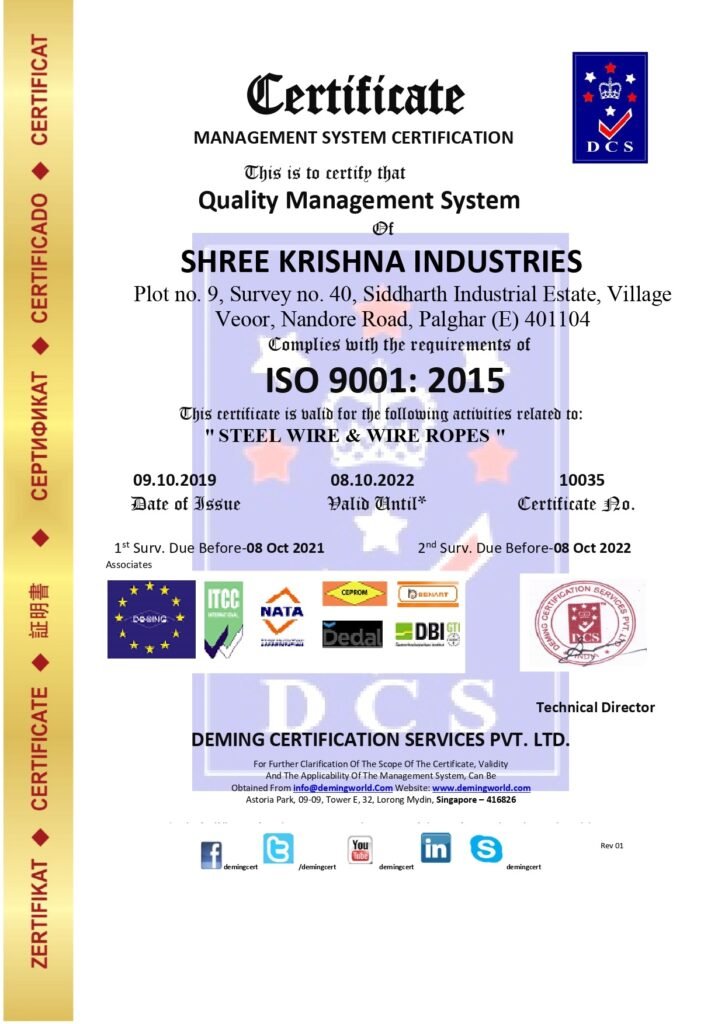
This was the environment in which Shree Kirshna Industries moved toward ISO 9001:2015 certification, with the certification stated in the company’s brief as being issued in 2019 and valid through 2022.
ISO 9001:2015 is an internationally recognized standard for quality management systems. It provides requirements for organizations to establish, implement, maintain and continually improve a quality-management system. ISO explains that the standard is intended to help organizations consistently provide products and services that meet customer and applicable requirements while enhancing customer satisfaction.
For Shree Kirshna Industries, therefore, the decision to pursue certification represented more than obtaining a formal document.
It represented a change in thinking.
The company had an opportunity to move from a system based largely on individual knowledge and experience toward one based on clearly defined processes, responsibilities, records, monitoring and continual improvement.
The transformation could be expressed in a simple sequence:
Understand the customer → Plan the work → Control the process → Inspect the result → Deliver reliably → Learn from feedback → Improve continuously.
This approach was especially relevant to the company’s manufacturing activities.
Quality begins long before a finished wire rope reaches a customer.
It begins with understanding what the customer requires.
It continues with selecting and controlling suitable inputs.
It involves production processes being carried out under appropriate conditions.
It requires inspection and measurement.
It includes correct identification, handling and dispatch.
And it continues even after delivery through customer feedback and complaint management.
Every stage is connected.
If one stage is weak, the final result can be affected.
ISO’s quality-management principles emphasize this process-oriented way of thinking. The principles include customer focus, leadership, engagement of people, process approach, improvement, evidence-based decision-making and relationship management.
For the promoter of Shree Kirshna Industries, this represented an important opportunity.
The objective was not to replace practical experience with documentation.
Instead, the objective was to combine experience with a disciplined system.
The employees who understood machinery and production processes possessed valuable knowledge. The ISO journey could help the organization capture that knowledge and establish methods that could be followed consistently.
This was essential for future growth.
A company that depends entirely upon one person’s presence can remain limited by that person’s capacity.
A company with defined systems can develop people, delegate responsibility and expand its operations more effectively.
The promoter’s role could therefore begin to evolve—from being the person who personally controlled every activity to becoming the person who established direction, developed people and strengthened the organization.
That transition is one of the most important stages in entrepreneurial growth.
The year 2019 consequently became an important milestone in the company’s journey.
The ISO 9001:2015 certification provided external recognition of the organization’s quality-management approach, but its greater significance was internal. It encouraged the company to think about quality as a responsibility shared across the organization.
Production was connected to quality.
Quality was connected to customer satisfaction.
Customer satisfaction was connected to business reputation.
Reputation was connected to future growth.
The company could therefore begin viewing quality not as a cost or administrative requirement but as an investment in its future.
The promoter’s vision could now extend beyond producing steel wire and wire ropes.
It could include creating a company known for disciplined manufacturing, dependable service and continuous improvement.
The certification was only the beginning of this journey.
A certificate can be issued on a particular date, but quality must be demonstrated every day.
The true challenge would be to convert the requirements of the management system into everyday habits.
Employees would need to understand their responsibilities.
Processes would need to be followed.
Records would need to provide useful information.
Problems would need to be investigated.
Customer feedback would need to be considered.
Management would need to review performance.
And improvement would need to become continuous.
ISO itself emphasizes that quality-management principles can help organizations establish processes, improve performance, strengthen customer satisfaction and build a culture of continual improvement.
This became the foundation for the next stage of Shree Kirshna Industries’ development.
The company had already demonstrated entrepreneurial courage by establishing and developing its manufacturing activity.
With ISO 9001:2015, it was taking another important step: building an organization in which quality could become systematic rather than dependent only upon individual effort.
The journey ahead would not simply be about producing more.
It would be about producing better, working smarter, developing people, strengthening customer relationships and creating systems capable of supporting sustainable growth.
The promoter’s vision was therefore entering a new phase.
The question was no longer only:
“How can we manufacture and sell our products?”
The more important question became:
“How can we build a company that customers can trust, employees can grow with, and management can develop for the future?”
That question marked the true beginning of the ISO journey at Shree Kirshna Industries.
And from that beginning would emerge a larger story—one of quality, discipline, customer confidence, organizational learning and industrial growth.
The certificate was the milestone.
The transformation was the journey.
And the future would depend upon how successfully the organization turned the principles of quality into everyday practice.
#ShreeKirshnaIndustries
Chapter 2 – The Decision to Choose ISO 9001:2015
The growth of a manufacturing organization is never achieved through production alone. A company may have capable workers, suitable machinery and a good product, but long-term success depends upon how consistently all these elements work together. As Shree Kirshna Industries developed its activities in the field of Steel Wire & Wire Ropes, the need for a more structured and systematic approach to quality became increasingly important.
The promoter understood that the future of the company could not depend entirely upon personal supervision and individual experience. As customer expectations increased and business activities became more complex, the organization needed processes that could be understood, followed and improved by everyone.
This was one of the important reasons behind the decision to pursue ISO 9001:2015 certification in 2019.
The decision was not simply about obtaining a certificate. It represented a management commitment to create a stronger foundation for the company’s future.
ISO 9001:2015 provides a framework for establishing and maintaining a quality-management system. It focuses on areas such as customer requirements, leadership, planning, operational control, performance evaluation and continual improvement. ISO explains that the standard can help organizations consistently provide products and services that meet customer and applicable requirements while enhancing customer satisfaction.
For Shree Kirshna Industries, these principles were directly relevant to its manufacturing activities.
The production of steel wire and wire ropes involves a chain of activities. Quality begins with understanding customer requirements and continues through material procurement, production, inspection, handling, packing and dispatch. If one stage is not properly controlled, the final product can be affected.
The company therefore began looking at its operations as a connected system rather than a collection of independent activities.
The basic philosophy could be summarized as:
Customer Requirement → Planning → Procurement → Production → Inspection → Packing → Dispatch → Customer Feedback → Improvement
This approach created greater clarity.
The purchase function could understand how its decisions influenced production.
Production personnel could understand how their work influenced inspection results.
The quality team could understand how inspection information could help production improve.
The dispatch team could recognize the importance of correct identification and delivery.
Management could see how all these activities ultimately influenced customer satisfaction.
This process-based approach is consistent with one of the fundamental quality-management principles identified by ISO. The process approach encourages organizations to manage activities as interconnected processes so that more consistent and predictable results can be achieved. (iso.org)
For the promoter, adopting this approach required a change in mindset.
In a growing organization, informal instructions can work for a while. People know one another, communication is quick and decisions can be made immediately. But informal systems become difficult to maintain when the organization becomes larger.
Suppose an experienced employee leaves.
If an important process exists only in that person’s knowledge, the organization can lose valuable information.
If the process is documented and understood, another trained employee can take responsibility.
This is one of the reasons structured systems are important for growing companies.
The ISO journey encouraged Shree Kirshna Industries to define responsibilities more clearly. Employees needed to know what was expected from them and how their work contributed to the organization’s objectives.
Documentation also became more meaningful.
Documents were not intended merely to create paperwork. Their purpose was to provide clarity and consistency.
Work instructions could help employees understand how activities were expected to be performed.
Inspection records could provide evidence of results.
Training records could demonstrate employee competence.
Supplier records could support purchasing decisions.
Customer feedback could provide information for improvement.
Non-conformity records could help the organization investigate problems.
Internal audits could reveal areas where processes required attention.
Management review could bring important information together for strategic decision-making.
The objective was to create a system in which information could support better decisions.
This was especially important for the promoter.
Entrepreneurs naturally rely on experience and intuition. Those qualities remain valuable even after an organization adopts ISO 9001. However, experience becomes more powerful when supported by reliable information.
Instead of relying only on personal judgment, management can ask:
What does the production data show?
What types of defects are recurring?
What are customers saying?
Which suppliers are performing reliably?
Where is rework occurring?
Which processes need improvement?
Are employees adequately trained?
Are resources sufficient?
These questions encourage evidence-based management.
ISO identifies evidence-based decision-making as one of its quality-management principles.
The certification process therefore helped the company move toward a more professional management culture.
Another important change was the treatment of customer complaints.
In a traditional business environment, a complaint may be seen simply as a problem to be solved quickly. A mature quality system treats the complaint as information.
A complaint can reveal a process weakness.
It can identify a communication gap.
It can show that a requirement was misunderstood.
It can reveal an issue with material, production, inspection or handling.
Most importantly, it can provide an opportunity to prevent recurrence.
This encouraged Shree Kirshna Industries to think beyond immediate correction.
The organization could ask:
What happened?
Then:
Why did it happen?
And finally:
What should we change so that it does not happen again?
This thinking is at the heart of continual improvement.
The promoter also recognized that certification could strengthen the company’s position when dealing with industrial customers.
A customer looking for a reliable supplier may want evidence that quality is managed systematically. ISO 9001 certification can provide an externally recognized indication that an organization operates a quality-management system.
For Shree Kirshna Industries, this created a stronger professional identity.
The company could approach the market not only as a manufacturer but as an organization committed to quality management.
That distinction could support customer confidence.
However, management understood that certification alone would not guarantee business growth.
The certificate could open a door, but actual performance would determine whether customers continued through it.
Therefore, the organization had to make the system part of everyday working.
The promoter’s responsibility was to provide leadership.
Employees had to participate.
Processes had to be followed.
Records had to be maintained.
Performance had to be reviewed.
Problems had to be addressed.
Improvements had to be implemented.
The decision to choose ISO 9001:2015 was therefore a decision to create discipline around the company’s existing manufacturing knowledge.
It was a decision to make quality systematic.
It was a decision to prepare the organization for growth.
Most importantly, it was a decision to think beyond the present.
Shree Kirshna Industries had already established its identity in the field of steel wire and wire ropes. The next challenge was to build an organization capable of meeting increasingly demanding customer expectations while maintaining consistency and efficiency.
The promoter understood that sustainable growth requires more than ambition.
It requires systems.
It requires people.
It requires customer trust.
It requires measurement.
It requires learning.
And it requires the willingness to improve continuously.
The ISO 9001:2015 certification journey represented the beginning of this structured approach.
The year 2019 consequently became an important milestone—not because a certificate was placed on a wall, but because the company began developing a stronger way of managing quality.
The decision had been made.
The next challenge was more important:
to transform the quality-management system from a formal requirement into a living culture throughout Shree Kirshna Industries.
That transformation would become the foundation of the company’s next stage of growth.
#ISO9001
Chapter 3 – Building a Quality Culture
Obtaining ISO 9001:2015 certification was an important milestone in the journey of Shree Kirshna Industries, but certification itself was not the final destination. The real challenge began after the certificate was received. The organization had to ensure that the principles of quality management became part of everyday working practices.
For a manufacturing company involved in Steel Wire & Wire Ropes, quality cannot be created at the final inspection stage alone. It must be built into every activity, beginning with customer requirements and continuing through procurement, production, inspection, packing and delivery.
This understanding gradually became an important part of the culture at Shree Kirshna Industries.
A quality culture begins with a simple idea: quality is everyone’s responsibility.
In many organizations, employees initially associate quality with the quality-control department. Production employees may believe that their responsibility is to manufacture, while inspectors are responsible for finding defects. Such an approach can create a gap between production and quality.
A mature quality culture removes that gap.
The production employee understands that preventing a defect is better than creating a defect and allowing inspection to discover it later. The supervisor understands that repeated rework is a sign that the process needs attention. The quality team understands that inspection results should provide useful information to production. Management understands that resources, training and leadership are essential for maintaining quality.
This approach is consistent with ISO’s quality-management principle of engagement of people, which recognizes that competent and engaged people are essential for an organization to create and deliver value.
For Shree Kirshna Industries, developing this culture required communication.
Employees had to understand why the organization was following documented processes. They needed to know that records were not being created merely for an auditor. Inspection was not simply an additional activity. Training was not merely a formality. Procedures were intended to make work more consistent and reduce avoidable problems.
Once employees understood the purpose behind the system, compliance could gradually become ownership.
This was particularly important on the shop floor.
Employees working directly with machinery often possess valuable practical knowledge. They know how equipment behaves during normal operation. They can recognize unusual conditions and identify changes that may not immediately appear in formal reports.
A good quality system does not ignore this knowledge.
Instead, it creates opportunities to use it.
Employees can identify recurring problems.
They can suggest improvements.
They can report abnormal conditions.
They can participate in corrective actions.
They can help management understand practical challenges.
In this way, quality management becomes a two-way process. Management provides direction and resources, while employees contribute experience and ideas.
The promoter’s leadership played an important role in this transformation.
The promoter had to demonstrate that quality was genuinely important to the organization. If management emphasized quality only during an audit, employees would quickly understand that certification was merely a formal requirement.
But when management consistently asked about customer satisfaction, process performance, defects, training and improvement, employees understood that quality was part of the company’s long-term direction.
Leadership therefore became more than giving instructions.
It meant setting an example.
It meant encouraging employees to report problems rather than hide them.
It meant treating mistakes as opportunities to learn when appropriate.
It meant providing resources for improvement.
It meant recognizing that prevention was more valuable than repeated correction.
This created an environment in which quality could develop naturally.
One of the most important changes was the organization’s attitude toward problems.
In a less mature system, a problem often creates blame.
Someone must be identified as responsible.
But blaming an individual does not necessarily eliminate the cause.
A stronger approach asks:
What happened?
Why did it happen?
Was the process clearly defined?
Was the employee trained?
Was the equipment suitable?
Was the material correct?
Was the requirement understood properly?
Could the problem happen again?
These questions shift attention from blame toward root-cause thinking.
The objective becomes prevention.
For example, if a product does not meet a requirement, simply correcting or replacing the product addresses the immediate issue. Investigating why the deviation occurred may reveal a weakness in the process. Correcting that weakness can prevent recurrence.
This is the essence of continual improvement.
ISO identifies improvement as one of its fundamental quality-management principles. Organizations that continuously improve are better positioned to maintain performance and respond to changing conditions.
For Shree Kirshna Industries, continual improvement could take many forms.
It could involve improving production methods.
It could involve reducing rework.
It could involve strengthening inspection practices.
It could involve improving supplier communication.
It could involve better training.
It could involve clearer work instructions.
It could involve improving customer communication.
Not every improvement needs to be large.
In fact, industrial improvement often comes from many small changes.
One unnecessary movement is removed.
One recurring mistake is prevented.
One inspection becomes more effective.
One employee learns a new skill.
One machine receives better preventive attention.
One customer requirement is communicated more clearly.
Each improvement may appear small in isolation.
Together, they can strengthen the organization.
The quality culture also influenced the way the company viewed customers.
A customer was no longer simply the person placing an order.
The customer became the ultimate judge of whether the company’s processes were successful.
A product could pass internal inspection, but if it failed to meet the customer’s actual requirement, the process had not truly succeeded.
Therefore, customer focus became central.
Customer requirements needed to be understood correctly.
Commitments needed to be communicated accurately.
Products needed to conform to agreed requirements.
Deliveries needed to be managed responsibly.
Feedback needed to be taken seriously.
Complaints needed to become opportunities for learning.
ISO places customer focus at the centre of quality management because the long-term success of an organization depends significantly on understanding and meeting customer needs and expectations.
This principle was especially valuable for Shree Kirshna Industries because industrial customers often expect reliability from their suppliers.
The company therefore had to build trust through repeated performance.
Every correct order strengthened confidence.
Every consistent product strengthened reputation.
Every properly handled problem demonstrated responsiveness.
Every improvement strengthened the organization.
Over time, these experiences could create long-term relationships.
The development of a quality culture also changed the role of the promoter.
As systems became stronger, the promoter did not need to personally control every activity.
Instead, the promoter could increasingly focus on leadership, strategy, customers, investment and future growth.
This was a significant transition.
The organization was becoming less dependent on individual supervision and more dependent on shared responsibility.
That was one of the most valuable outcomes of the ISO journey.
The company was not simply creating procedures.
It was creating organizational knowledge.
It was learning how to convert individual experience into repeatable processes.
It was learning how to use information for decisions.
It was learning how to turn customer feedback into improvement.
It was learning how to make employees participants in quality.
Most importantly, it was learning that certification is meaningful only when the system continues to operate after the audit is over.
The ISO 9001:2015 certificate represented an important achievement in 2019, but the quality culture created around it represented something much more valuable.
A certificate can demonstrate conformity at a point in time.
A quality culture demonstrates commitment every day.
For Shree Kirshna Industries, this distinction became a foundation for future development.
The company had entered a new stage of its journey.
It was no longer simply asking how much it could produce.
It was asking how consistently it could produce.
It was no longer simply asking how many customers it could acquire.
It was asking how many customers it could satisfy and retain.
It was no longer simply asking how problems could be corrected.
It was asking how problems could be prevented.
And it was no longer viewing employees merely as workers.
It was beginning to view them as participants in the company’s growth.
This was the beginning of a genuine quality culture.
And once that culture became embedded in the organization, ISO 9001:2015 became more than a certification.
It became a way of thinking, a way of working and a foundation for the company’s continuing growth.
#QualityManagement
Chapter 4 – The Promoter’s Transformation
The growth of a company is closely connected with the growth of its promoter. In the early years of a manufacturing business, the promoter is often involved in almost every important activity. Decisions about customers, suppliers, production, employees, finance and quality may all pass through the promoter. This personal involvement can be one of the greatest strengths of a young company because it allows quick decisions and close supervision.
However, as an organization grows, the same strength can become a limitation.
A company cannot depend forever on one person’s memory, experience and daily presence. Sustainable growth requires systems, capable employees and clearly defined responsibilities. The journey toward ISO 9001:2015 certification in 2019 provided Shree Kirshna Industries with an opportunity to make this important transition.
The promoter’s role gradually began to change—from direct operational control toward organized leadership.
This was not a sudden transformation. It was a gradual process of learning, delegation and trust.
The promoter had built the organization through personal effort and practical knowledge. Such experience was extremely valuable. The promoter understood customers, suppliers, manufacturing challenges and the realities of running an industrial business. But the next stage required that this knowledge be transferred into the organization.
ISO 9001:2015 provided a structured environment for doing so.
A quality-management system requires organizations to define processes, responsibilities, resources, monitoring activities and methods of improvement. Leadership is a central element of the standard. ISO’s quality-management principles identify leadership as one of the foundations of effective quality management.
For the promoter, leadership increasingly meant creating an environment where other people could perform their responsibilities effectively.
Instead of personally solving every problem, the promoter could ask:
Why did this problem occur?
Who is responsible for addressing it?
What process should be improved?
What resources are required?
How can the same problem be prevented in the future?
These questions encouraged a more systematic approach to management.
The transformation also changed the promoter’s relationship with employees.
In a small organization, instructions are often communicated verbally. A promoter can walk through the factory and explain something directly to a worker or supervisor. But as the organization expands, verbal communication alone becomes insufficient.
Responsibilities need to be defined.
Processes need to be documented.
Employees need training.
Performance needs to be monitored.
Communication needs to be consistent.
This does not mean that personal communication becomes unimportant. On the contrary, it remains valuable. But it needs to be supported by a reliable management system.
The promoter therefore began to see documentation differently.
Documents were not merely paperwork.
A documented process could help an employee understand what was expected.
A record could provide evidence of what had happened.
An inspection result could provide information for decision-making.
An internal-audit finding could identify a weakness.
A corrective-action record could demonstrate how a problem was addressed.
A management-review discussion could help determine future priorities.
This information gave the promoter greater visibility into the organization.
Instead of relying entirely on personal observation, management could use objective information to understand performance.
This represented a major change in leadership.
Entrepreneurship is often driven by instinct.
Quality management adds evidence.
The combination can be powerful.
The promoter’s experience could identify opportunities, while information from the management system could help evaluate those opportunities.
For example, before investing in a new capability, management could consider customer requirements, production capacity, existing performance, resource availability and potential risks.
Before changing a process, management could consider defect patterns, employee feedback and customer expectations.
Before selecting or continuing a supplier relationship, management could consider quality and delivery performance.
This approach helped the promoter become more strategic.
The focus gradually moved beyond today’s production schedule toward the organization’s future.
Questions became broader:
Where should the company go next?
How can customer relationships be strengthened?
Which capabilities need development?
What skills will employees require?
Where can productivity be improved?
How can quality costs be reduced?
Which new opportunities are suitable for the company?
What risks could affect future growth?
Such questions are the questions of a business leader rather than simply an operational supervisor.
The promoter’s transformation also required delegation.
Delegation can be difficult for entrepreneurs because the business is often closely connected to their personal identity. A promoter may believe that no one can perform a task as well as they can.
But growth requires another kind of confidence—the confidence to develop people.
Employees need opportunities to make decisions.
Supervisors need authority to manage processes.
Quality personnel need independence to report problems.
Production teams need the ability to identify and address operational issues.
When responsibility is delegated properly, the organization becomes stronger.
The promoter no longer has to be present at every decision.
Instead, the promoter establishes direction and ensures that the system supports the company’s objectives.
This does not reduce the promoter’s importance.
It increases it.
The promoter becomes responsible for building the organization rather than simply operating it.
That is a significant stage in entrepreneurial maturity.
The ISO journey also encouraged the promoter to view customer satisfaction as a strategic issue.
A customer complaint was no longer simply an operational inconvenience. It could be a signal about the organization’s reputation.
A repeat order could be an indicator of customer confidence.
A delivery problem could reveal a weakness in planning.
A recurring quality issue could indicate a process problem.
Customer feedback therefore became valuable management information.
ISO emphasizes customer focus as a fundamental quality-management principle because organizations depend on customers and must understand and meet their needs and expectations.
For Shree Kirshna Industries, this principle supported the promoter’s broader vision.
The goal was not merely to sell steel wire and wire ropes.
The goal was to develop relationships based on reliability.
A customer who trusts a supplier can become a long-term business partner.
Long-term relationships can provide stability.
Stability can support planning.
Planning can support investment.
Investment can support growth.
Growth can create new opportunities for employees and the organization.
The promoter therefore began to understand that quality and business growth were not separate subjects.
They were connected.
A poor-quality process could create rework and customer dissatisfaction.
A strong process could improve consistency and confidence.
A satisfied customer could create repeat business.
Repeat business could create the foundation for expansion.
The promoter’s leadership consequently became increasingly focused on building this positive cycle.
Another important change was the attitude toward mistakes.
A promoter operating through direct control may immediately intervene whenever something goes wrong.
A promoter leading through a management system instead asks whether the organization has learned from the incident.
The objective becomes organizational learning.
If a mistake occurs once and the organization learns from it, the experience can strengthen the company.
If the same mistake occurs repeatedly without analysis, it becomes a sign of management weakness.
This thinking encouraged Shree Kirshna Industries to focus on corrective action and continual improvement.
The promoter was therefore no longer simply the person responsible for solving problems.
The promoter was becoming the person responsible for ensuring that the organization learned from problems.
This was perhaps the most important transformation of all.
The company was developing systems that could survive beyond individual personalities.
Knowledge was being shared.
Responsibilities were becoming clearer.
Processes were becoming more structured.
Employees were becoming more involved.
Customers were becoming a greater source of feedback.
Management was becoming more evidence-based.
And the promoter was becoming more strategic.
The ISO 9001:2015 certification in 2019 was therefore an important milestone in the evolution of Shree Kirshna Industries.
Its value was not limited to the certificate itself.
It helped create a platform for leadership development.
The promoter’s original entrepreneurial vision remained the driving force, but it was now supported by a stronger organizational structure.
The journey from entrepreneur to strategic leader is one of the most important transitions in business.
For Shree Kirshna Industries, that transition created the possibility of building a company that could continue to grow without depending entirely on the promoter’s personal involvement in every activity.
The promoter’s greatest contribution was therefore no longer simply working harder.
It was building better systems, developing better people and creating a stronger organization.
That was the real transformation.
And it became one of the most important foundations for the company’s future growth.
#SteelWire
Chapter 5 – From Quality Certification to Customer Confidence
In manufacturing, a company’s reputation is built one order at a time. Customers may initially choose a supplier because of price, availability or convenience, but long-term relationships are usually created through consistent performance. For Shree Kirshna Industries, working in the field of Steel Wire & Wire Ropes, customer confidence became one of the most important outcomes of its journey toward ISO 9001:2015 certification.
The certification obtained in 2019 provided the company with an important professional milestone. It demonstrated that the organization had established a quality-management system based on the requirements of ISO 9001:2015. However, the promoter understood an important truth: a certificate can introduce a company to a customer, but only actual performance can create lasting trust.
ISO 9001 is designed to help organizations consistently provide products and services that meet customer and applicable requirements and to enhance customer satisfaction.
This principle became increasingly important as Shree Kirshna Industries developed its market relationships.
A customer purchasing steel wire or wire ropes is not simply purchasing a physical product. The customer is also purchasing confidence that the product will meet the agreed requirements and perform as expected in its intended application.
This makes consistency extremely important.
A customer may accept a supplier’s product once, but repeated business requires confidence that the same level of performance can be achieved again and again.
The ISO journey helped Shree Kirshna Industries strengthen the processes behind that consistency.
The company began viewing customer satisfaction as the result of many connected activities.
It begins with communication.
Before manufacturing starts, the organization must understand what the customer requires. Requirements relating to product specifications, quantities, dimensions, delivery expectations, packaging or other applicable conditions must be communicated correctly to the people responsible for fulfilling them.
If a requirement is misunderstood at the beginning, problems can appear later.
The production team may manufacture the wrong specification.
The inspection team may evaluate the wrong requirement.
The dispatch team may prepare the wrong material.
The customer may then receive something that does not meet expectations.
Therefore, effective communication became a critical part of the company’s quality culture.
The ISO framework encouraged a systematic approach to understanding customer requirements.
Instead of relying only on informal conversations, the organization could establish clearer methods for reviewing and communicating requirements.
This created greater confidence internally and externally.
Once requirements were understood, attention moved toward production.
The manufacturing process for steel wire and wire ropes requires control at different stages. The exact controls depend on the product and customer requirements, but the general principle remains the same: the process must be capable of producing consistent results.
This means that quality cannot be checked only after production is complete.
It must be considered throughout the process.
Employees need appropriate instructions.
Machines need to be maintained.
Measurements need to be reliable.
Materials need to be controlled.
Inspection needs to be systematic.
Finished products need to be correctly identified and handled.
When these activities work together, the possibility of delivering consistent products increases.
This consistency is what gradually builds customer confidence.
The company also began to recognize that customer complaints should not be treated simply as negative events.
A complaint can be uncomfortable for any organization.
However, it can also provide valuable information.
If a customer reports a problem, management can ask:
What happened?
When did it happen?
Which product or process was involved?
Why did the problem occur?
Was the requirement correctly understood?
Was the process followed?
Was the inspection effective?
Could the same issue affect other products?
What action is required?
And most importantly:
How can recurrence be prevented?
This approach changes the meaning of a complaint.
Instead of being viewed only as criticism, it becomes an opportunity for learning.
Such a culture can strengthen the organization because every problem has the potential to teach something about the process.
ISO’s quality-management principles include customer focus, evidence-based decision-making and improvement, all of which support this approach.
Customer feedback can therefore become part of a continuous improvement cycle.
Feedback leads to investigation.
Investigation leads to understanding.
Understanding leads to corrective action.
Corrective action leads to improvement.
Improvement strengthens customer confidence.
Customer confidence can then lead to repeat business.
This cycle can become a powerful driver of sustainable growth.
For Shree Kirshna Industries, the promoter’s relationship with customers also began to evolve.
In the early stages of a company, the promoter may personally handle most customer conversations. As the organization becomes more structured, customer relationships can be supported by processes and trained employees.
The promoter can continue to maintain important relationships while the organization develops a broader customer-service capability.
This is another advantage of a quality-management system.
The company becomes less dependent upon individual memory and more capable of delivering consistent service through defined responsibilities.
A customer should receive the same professional experience regardless of which employee handles the interaction.
That consistency strengthens the company’s image.
Reputation is created through repeated experiences.
One correct order is useful.
Many correct orders are better.
One quickly resolved problem demonstrates responsiveness.
Repeated responsible responses demonstrate reliability.
One satisfied customer is valuable.
A network of satisfied customers becomes a business asset.
This is how customer confidence can gradually translate into growth.
The ISO certificate also gave Shree Kirshna Industries an opportunity to present itself as a professionally managed organization.
For industrial buyers, evidence of a structured quality-management system can be an important consideration during supplier evaluation. Certification does not automatically guarantee product quality, but it provides evidence that the organization has implemented a recognized framework for managing quality.
The company could therefore communicate its commitment to quality more confidently.
The certificate became a symbol of the organization’s seriousness.
But management also understood that the symbol had to be supported by reality.
If the company displayed a certificate but ignored customer complaints, the certificate would lose its value.
If procedures existed but employees did not follow them, the system would become ineffective.
If inspections were performed only for audit purposes, quality would not improve.
If management ignored recurring problems, continual improvement would remain only a phrase.
Therefore, the company had to make quality visible through actions.
This required discipline.
Every order mattered.
Every inspection mattered.
Every customer communication mattered.
Every delivery mattered.
Every complaint mattered.
Every improvement mattered.
The promoter increasingly understood that customer confidence was not created by one major achievement. It was created through hundreds of small experiences.
The customer receives the correct product.
The delivery arrives as expected.
The company responds when information is requested.
A technical question receives attention.
A problem is investigated.
A corrective action is taken.
A future order receives the same commitment.
These experiences gradually create trust.
Trust is particularly valuable in industrial markets because customers often prefer dependable suppliers with whom they can develop long-term relationships rather than constantly searching for new sources.
For Shree Kirshna Industries, this created a potential growth cycle:
Quality → Confidence → Satisfaction → Repeat Business → Stronger Relationships → Business Growth.
The ISO 9001:2015 certification helped provide the foundation for this cycle, but management knew that it had to be maintained through continuous effort.
The certificate was therefore not the end of the quality journey.
It was a promise to continue improving.
The company had to keep monitoring performance.
It had to listen to customers.
It had to strengthen employees.
It had to improve processes.
It had to manage suppliers.
It had to respond to changing requirements.
And it had to maintain leadership commitment.
Customer confidence became one of the clearest signs that the quality system was producing real business value.
When customers trust a supplier, the relationship can move beyond individual transactions.
The supplier becomes part of the customer’s business network.
The customer can provide feedback, forecasts and new requirements.
The manufacturer can respond with greater understanding.
Both organizations can benefit from the relationship.
For Shree Kirshna Industries, this represented an important shift in identity.
The company was not simply trying to manufacture and sell steel wire and wire ropes.
It was building a reputation for dependable industrial service.
The promoter’s vision was therefore becoming broader.
Success meant more than production volume.
It meant earning customer confidence.
It meant creating repeat relationships.
It meant developing a reputation that could support future opportunities.
And it meant ensuring that the company’s quality system remained active long after the certificate was issued.
The lesson from this chapter is simple but powerful:
Certification can create credibility, but consistency creates trust.
For Shree Kirshna Industries, the ISO 9001:2015 journey provided a structured foundation for achieving that consistency.
The certificate represented recognition.
The processes represented discipline.
The employees represented capability.
The customers represented purpose.
And customer confidence became one of the most valuable foundations upon which the company’s future growth could be built.
#WireRopes
Chapter 6 – Operational Discipline and Continuous Improvement
The real strength of a quality-management system is revealed not when an auditor visits the organization, but when the factory is operating on an ordinary working day. Machines are running, employees are performing their duties, materials are moving through the production process, inspections are being carried out and customer orders are being prepared. It is in these everyday activities that quality becomes real.
For Shree Kirshna Industries, engaged in the manufacture of Steel Wire & Wire Ropes, the adoption of ISO 9001:2015 created an opportunity to strengthen operational discipline and develop a culture of continuous improvement.
The certification stated in the company’s brief was issued in 2019. But receiving the certificate was only the beginning. The more important task was to make the quality-management system an integral part of daily manufacturing.
A manufacturing organization is a chain of connected processes.
Raw material enters the organization.
It is received and checked.
Production begins.
Machines and processes convert the material into the required product.
Inspection verifies conformity.
Finished products are identified, handled and packed.
The goods are dispatched.
The customer receives the product and provides feedback.
Every stage can influence the next.
This is why the process approach is so important in ISO 9001. ISO explains that the process approach helps organizations manage activities as interconnected processes and achieve more consistent and predictable results.
For Shree Kirshna Industries, this approach encouraged employees to look beyond their individual tasks.
The purchasing function was connected to production quality.
Production was connected to inspection.
Inspection was connected to customer satisfaction.
Maintenance was connected to productivity.
Training was connected to employee competence.
Planning was connected to delivery performance.
Management was connected to all of them.
Once employees began seeing these connections, operational discipline became more meaningful.
A quality procedure was no longer simply an instruction.
It became part of a larger system.
One of the most important principles was prevention.
In a traditional manufacturing approach, a defect may be discovered at final inspection. The product is then reworked, corrected or rejected.
A quality-management approach tries to move quality controls earlier into the process.
The objective is not simply to detect defects.
It is to prevent them.
This change can have significant benefits.
If a defect is detected early, less material may be wasted.
If a process variation is identified before production continues, larger quantities of defective material can be avoided.
If an employee identifies an abnormal machine condition early, an equipment problem may be addressed before it affects production.
If a customer requirement is clarified before manufacturing begins, misunderstandings can be prevented.
Therefore, prevention can improve both quality and efficiency.
For the promoter of Shree Kirshna Industries, this represented an important management lesson.
Quality and productivity should not be viewed as competing objectives.
Poor quality can reduce productivity through rework, rejection, delays and customer complaints.
Better quality can support smoother production and stronger customer confidence.
The company therefore began looking at operational performance in a broader way.
The question was not merely:
How much did we produce?
It was also:
How much did we produce correctly, efficiently and consistently?
This change in thinking encouraged the use of monitoring and measurement.
Records can help management understand what is actually happening.
If a particular type of problem occurs repeatedly, records can reveal a pattern.
If a supplier’s performance changes, supplier records can provide evidence.
If customer complaints increase, complaint data can identify a warning signal.
If production performance improves after a process change, measurements can provide evidence of effectiveness.
This is why evidence-based decision-making is one of ISO’s quality-management principles.
The promoter could therefore make decisions based on a combination of experience and information.
Experience remained important.
But experience was increasingly supported by records and analysis.
Internal audits became another important element of operational discipline.
An internal audit is not simply an examination intended to find fault with employees.
When used properly, it is a management tool.
An audit can ask whether a defined process is being followed.
It can identify gaps.
It can reveal unnecessary activities.
It can identify risks.
It can show where employees need additional training.
It can provide opportunities for improvement.
The value of an audit therefore depends upon how the organization responds to its findings.
If an audit finding is treated as criticism, employees may become defensive.
If it is treated as an opportunity to strengthen the system, the organization can learn.
Shree Kirshna Industries could use this approach to develop a healthier relationship with audits.
The purpose became improvement rather than fear.
Another important area was corrective action.
Whenever a non-conformity or problem was identified, the organization could look beyond immediate correction.
For example, correcting a defective product addresses the immediate problem.
But management should also ask why the defect occurred.
Was the process unclear?
Was the employee properly trained?
Was the equipment functioning correctly?
Was the raw material suitable?
Was an inspection step missing?
Was the customer’s requirement misunderstood?
The answer can guide corrective action.
The organization can then determine whether the action was effective.
If the problem does not recur, the corrective action may have addressed the underlying cause.
If the problem continues, further investigation may be necessary.
This creates a learning cycle.
Problem → Investigation → Root Cause → Corrective Action → Verification → Improvement
Such a cycle strengthens organizational knowledge.
Employees learn from previous problems.
Management learns where processes are weak.
Future employees can benefit from documented experience.
The organization becomes less likely to repeat the same mistakes.
This is one of the most valuable long-term effects of a mature quality system.
Continuous improvement also does not always require major investment.
Industrial organizations often improve through small practical changes.
A work instruction becomes clearer.
An inspection point is moved to an earlier stage.
A machine-maintenance schedule becomes more disciplined.
A storage arrangement is improved.
A communication gap is eliminated.
An employee receives additional training.
A recurring customer complaint is prevented.
Each individual change may appear small.
Together, they can make a significant difference.
ISO identifies improvement as a fundamental quality-management principle and emphasizes the importance of continually improving organizational performance.
This philosophy gradually changes the organization’s attitude.
Instead of asking whether a process is good enough, employees begin asking:
Can it be made better?
That question encourages innovation.
It also creates employee involvement.
The people working closest to a process often know where improvements are possible. A good management system provides opportunities for them to communicate those ideas.
The promoter’s role is to listen, evaluate and support worthwhile improvements.
This creates ownership.
Employees begin to understand that quality is not something imposed by management.
It is something they help create.
Operational discipline also strengthened the company’s ability to manage growth.
As order volumes and customer expectations increase, informal methods become increasingly difficult to control.
Defined processes make expansion more manageable.
When responsibilities are clear, work can be delegated.
When records are maintained, information can be transferred.
When employees are trained, new responsibilities can be assigned.
When performance is measured, management can identify problems earlier.
When improvement is continuous, processes can evolve with business requirements.
This creates a foundation for sustainable growth.
For Shree Kirshna Industries, the ISO 9001:2015 journey therefore became an operational transformation.
The company was learning to manufacture through systems rather than relying solely on individual effort.
It was learning to prevent problems rather than merely correct them.
It was learning to use information rather than instinct alone.
It was learning to treat audits as improvement opportunities.
It was learning to convert complaints into organizational knowledge.
And it was learning that continuous improvement is not a one-time project.
It is a daily habit.
The promoter’s vision consequently became more ambitious.
The goal was no longer simply to keep production running.
The goal was to build a manufacturing organization capable of producing consistently, responding effectively to customers and improving its processes over time.
That is the true meaning of operational discipline.
It creates order without removing flexibility.
It creates consistency without preventing innovation.
It creates accountability without eliminating teamwork.
And most importantly, it creates a foundation upon which future growth can safely be built.
For Shree Kirshna Industries, the quality system was therefore becoming part of the company’s operating philosophy.
Every process could be reviewed.
Every problem could become a lesson.
Every employee could contribute.
Every customer interaction could provide information.
And every improvement could strengthen the organization.
The journey from certification to operational excellence was not completed in one day.
It was created through repeated actions.
One process at a time.
One improvement at a time.
One employee at a time.
One customer experience at a time.
That was the real operational value of ISO 9001:2015 for Shree Kirshna Industries—and it became an important foundation for the company’s continuing growth.
#ManufacturingExcellence
Chapter 7 – Strengthening the Market and Building Sustainable Growth
The implementation of ISO 9001:2015 brought an important change to Shree Kirshna Industries. The company was no longer looking at quality only as a manufacturing responsibility. Quality was becoming connected with customer relationships, market reputation, employee confidence and future business opportunities.
For an industrial organization manufacturing Steel Wire & Wire Ropes, this connection is particularly important. Customers require dependable products and reliable suppliers. They expect their requirements to be understood, orders to be handled professionally and products to be supplied with consistency. Over time, these expectations become the foundation of business relationships.
The ISO 9001:2015 certification received in 2019, and stated as valid through 2022, therefore became an important milestone in the company’s market-development journey.
The promoter understood that certification itself would not automatically create growth. Instead, it could provide a stronger platform from which the company could demonstrate its commitment to quality.
The difference was significant.
Before a customer develops confidence in a supplier, there are often many questions.
Can the supplier consistently meet requirements?
Can the supplier maintain product quality?
Can the supplier respond when an issue occurs?
Can the supplier handle repeat orders?
Can the supplier maintain records and traceability?
Can the supplier improve when expectations change?
A structured quality-management system could help the company answer these questions with greater confidence.
The company’s identity therefore began to evolve.
It was not simply a manufacturer located in an industrial estate at Plot No. 9, Survey No. 40, Siddharth Industrial Estate, Village Veoor, Nandore Road, Palghar (East), Maharashtra – 401104.
It was developing an identity as an organized manufacturing enterprise committed to systematic quality management.
That identity had value in the marketplace.
In industrial business, reputation is built slowly. A customer may initially place a small order. If the experience is positive, another order may follow. If performance remains consistent, the relationship can become stronger.
This creates a gradual cycle:
First Order → Satisfactory Performance → Confidence → Repeat Order → Stronger Relationship → Greater Opportunity.
Quality management supports every stage of this cycle.
Customer focus is one of the fundamental quality-management principles identified by ISO. The principle emphasizes understanding current and future customer needs and striving to meet customer requirements and expectations.
For Shree Kirshna Industries, customer focus meant that market growth could not be separated from product quality.
A larger order book without adequate process control could create problems.
More customers could mean more specifications.
More specifications could mean greater production complexity.
Greater complexity could increase the possibility of errors.
Therefore, growth itself needed to be managed.
This was an important lesson for the promoter.
The objective was not simply to acquire as many customers as possible.
The objective was to acquire customers that the organization could serve reliably while maintaining its quality standards.
This required careful planning.
Production capacity needed to be considered.
Raw-material availability needed attention.
Employees needed appropriate skills.
Inspection capability needed to support production.
Delivery commitments needed to be realistic.
The organization therefore began thinking about growth as a controlled process rather than uncontrolled expansion.
This approach helped protect the reputation that the company was building.
Another important factor was supplier relationships.
A manufacturer is dependent upon its supply chain. The quality of incoming materials can influence production performance and final-product conformity.
A structured supplier-management approach encourages organizations to evaluate suppliers based on their ability to meet requirements.
For Shree Kirshna Industries, this meant that purchasing could become more systematic.
Supplier performance could be considered through factors such as quality, delivery reliability, responsiveness and consistency.
Good supplier relationships could create stability.
Stable supplies could support production planning.
Better planning could support delivery performance.
Reliable deliveries could strengthen customer confidence.
Again, the individual elements were connected.
The company was gradually learning that business growth depends upon an entire network of relationships.
Employees, suppliers and customers all influence performance.
ISO’s quality-management principles include relationship management, recognizing the importance of managing relationships with relevant interested parties to optimize their impact on organizational performance.
This broader perspective helped the promoter develop a more strategic view of the business.
Growth was no longer measured only through sales.
It could also be measured through customer retention, process performance, employee capability, supplier reliability and organizational learning.
The company could ask deeper questions.
Are customers returning?
Are complaints decreasing?
Are processes becoming more efficient?
Are employees becoming more capable?
Are suppliers improving?
Are delivery commitments being achieved?
Are internal systems strong enough to support additional business?
These questions helped management distinguish between short-term expansion and sustainable growth.
The distinction is important.
Short-term growth can occur quickly.
Sustainable growth requires a strong foundation.
A company may obtain a large order, but if its processes cannot support the order, the opportunity can become a burden.
A company may acquire many customers, but if service quality declines, the reputation can suffer.
A company may increase production, but if rework and rejection increase, profitability can be affected.
Therefore, the promoter recognized that quality management was not an obstacle to growth.
It was an enabler of responsible growth.
The ISO system encouraged management to think about risks and opportunities.
Every business decision carries uncertainty.
New customers may create opportunities.
New products may create opportunities.
New markets may create opportunities.
At the same time, each may introduce new operational challenges.
A structured management system helps an organization consider these factors before making decisions.
This was particularly useful for a growing industrial company.
Instead of reacting to every new opportunity immediately, management could ask whether the organization had the necessary resources and capabilities.
This created greater discipline in decision-making.
The company could pursue growth while protecting its existing standards.
Another important change was the increasing importance of the company’s professional image.
Certification could become part of the company’s communication with customers and business partners.
The ISO 9001:2015 certificate demonstrated that the organization had implemented a recognized quality-management framework.
However, the promoter understood that the certificate was only the beginning.
The real message to customers was:
We are committed to managing quality systematically and improving our performance continuously.
That message became more powerful when supported by actual customer experiences.
If products were consistent, the message became credible.
If complaints were handled responsibly, the message became credible.
If employees demonstrated professionalism, the message became credible.
If processes continued improving, the message became credible.
Thus, the market value of certification came from the organization behind the certificate.
The company’s growth also created opportunities for employees.
As operations became more structured, employees could develop new responsibilities.
A worker could gain greater technical understanding.
A supervisor could develop management skills.
Quality personnel could gain experience in auditing and process improvement.
Administrative employees could become more familiar with systematic documentation.
This created a stronger internal organization.
Employee development, in turn, supported business growth.
The promoter increasingly recognized that a company’s future depends upon its people.
Machines can be purchased.
Buildings can be expanded.
Materials can be sourced.
But experienced and committed people are developed over time.
A quality culture therefore became an important competitive strength.
By strengthening employees, processes and customer relationships simultaneously, Shree Kirshna Industries was creating a more stable platform for the future.
The company’s ISO journey also encouraged a longer-term mindset.
The certificate had an issue date in 2019 and a stated validity through 2022. But the principles learned during that period were not intended to disappear when a certificate period ended.
The real objective was to create a continuing management philosophy.
Quality should continue.
Improvement should continue.
Customer focus should continue.
Employee development should continue.
Leadership should continue.
This was the difference between certification as an event and quality management as a culture.
For Shree Kirshna Industries, the years following certification therefore represented a period of organizational strengthening.
The company was developing the ability to look beyond immediate production and consider the wider business environment.
Its promoter was thinking more strategically.
Employees were becoming more involved.
Processes were becoming more disciplined.
Customers were becoming an important source of information.
Suppliers were becoming part of the quality network.
And the organization was becoming better prepared to handle opportunities.
The journey demonstrated an important principle of industrial entrepreneurship:
Growth is strongest when it is built on quality, trust and systems.
Shree Kirshna Industries had taken an important step in that direction.
The ISO 9001:2015 certification gave the organization a framework.
The promoter gave it vision.
Employees gave it effort.
Customers gave it feedback.
Continuous improvement gave it momentum.
Together, these elements created the possibility of sustainable business development.
The next challenge would be to ensure that this growth could be supported by stronger people, better technology, improved productivity and continued investment.
The company’s story was therefore moving into another important phase.
The foundation had been created.
#QualityCulture
Chapter 8 – People, Technology and the Next Stage of Development
The growth of an industrial organization is never achieved by systems alone. Procedures can create structure, machines can increase capacity and certification can strengthen credibility, but people remain at the centre of every successful manufacturing enterprise.
For Shree Kirshna Industries, the journey following its ISO 9001:2015 certification in 2019 created a stronger understanding of this connection. As the company continued its activities in Steel Wire & Wire Ropes, it became increasingly important to develop not only products and processes, but also the people responsible for operating those processes.
A quality-management system can only be effective when employees understand it.
An instruction has value when it is followed correctly.
A measurement has value when it is performed accurately.
A record has value when it reflects reality.
An improvement has value when employees are able to sustain it.
Therefore, employee competence became an important part of the company’s continuing development.
ISO 9001 places emphasis on competence, awareness and the involvement of people within the quality-management system. ISO’s quality-management principles also identify engagement of people as a fundamental principle of effective quality management.
For Shree Kirshna Industries, this meant recognizing that employees were not simply performing individual jobs. They were contributing directly to the company’s reputation.
A person involved in production could influence product quality.
A person responsible for inspection could influence customer confidence.
A person handling materials could influence product condition.
A person preparing documentation could influence communication.
A person dealing with customers could influence relationships.
Every role therefore mattered.
The promoter increasingly understood that employee development was an investment rather than an expense.
Training could improve competence.
Better competence could improve performance.
Improved performance could reduce errors.
Fewer errors could reduce rework.
Reduced rework could improve productivity.
Better productivity could support profitability.
And stronger profitability could provide resources for further development.
This created a positive cycle.
The organization also began recognizing the value of practical experience.
Employees who had spent years working with manufacturing processes possessed knowledge that could not always be found in a manual.
They understood machine behaviour.
They recognized unusual conditions.
They knew where production difficulties occurred.
They understood practical challenges.
The ISO-based approach provided an opportunity to capture and share this knowledge.
Experienced employees could guide newer employees.
Work instructions could help standardize important activities.
Training could reduce dependence on individual experience.
Records could preserve organizational knowledge.
As a result, the company could gradually become less dependent on one or two experienced individuals.
This was particularly valuable for the promoter.
A growing company needs people who can take responsibility.
The promoter could not personally supervise every activity forever.
Therefore, developing supervisors, operators, quality personnel and administrative staff became part of the larger growth strategy.
At the same time, technology was becoming increasingly important in manufacturing.
The steel wire and wire-rope industry requires appropriate equipment, process control and measurement capability. As customer expectations increase, manufacturers must continually evaluate whether their processes and resources are adequate.
Technology does not replace skilled people.
Instead, technology can enhance their capabilities.
A well-maintained machine can improve consistency.
Better measurement equipment can improve confidence in inspection results.
Improved production methods can reduce waste.
Digital records can make information easier to retrieve.
Modern communication systems can improve coordination.
Data can help management identify trends.
The promoter therefore began viewing technology as a tool for achieving business objectives rather than simply as a symbol of modernization.
The right investment was the investment that improved quality, productivity, safety, reliability or customer service.
This approach was particularly important because every investment carries a cost.
A growing company must decide carefully where resources should be allocated.
Should investment be made in machinery?
Training?
Inspection equipment?
Maintenance?
Information systems?
Infrastructure?
Employee development?
The answer depends upon business priorities and available resources.
ISO’s evidence-based approach to decision-making encourages organizations to use reliable information when making decisions.
For Shree Kirshna Industries, this philosophy supported more thoughtful investment decisions.
The company could examine where the greatest improvement opportunity existed and then determine how resources could be used effectively.
Technology also created opportunities for better information management.
A quality-management system generates information.
Inspection results provide information.
Customer complaints provide information.
Supplier evaluations provide information.
Internal audits provide information.
Production records provide information.
Maintenance records provide information.
The value of this information depends on how effectively management uses it.
When information is organized and reviewed, it can reveal trends.
For example, repeated defects may indicate a process weakness.
Repeated delays may indicate a planning problem.
Frequent equipment issues may indicate a maintenance requirement.
Repeated customer questions may indicate a communication gap.
These signals can guide improvement.
The company therefore continued developing a culture in which information was not merely recorded but used.
This represented an important change from traditional administrative thinking.
A record is not useful simply because it exists.
It becomes useful when someone learns something from it.
Management review was another important element in this process.
Management could review the performance of the quality-management system and consider whether objectives were being achieved.
The questions could be straightforward:
Are customers satisfied?
Are processes performing effectively?
Are problems recurring?
Are employees adequately trained?
Are suppliers meeting expectations?
Are resources sufficient?
What improvements are required?
What risks should be considered?
Such reviews helped connect day-to-day operations with long-term strategy.
For the promoter, this created a clearer picture of the organization.
Instead of focusing only on today’s production, management could look at the company’s overall direction.
This was especially important as the business matured.
A young business often focuses on survival.
A growing business focuses on stability.
A mature business begins focusing on sustainability and strategic development.
Shree Kirshna Industries was moving toward this third stage.
The promoter’s vision was becoming increasingly connected with building an organization that could continue developing over many years.
This required a balance between tradition and innovation.
The company could preserve the practical knowledge that had helped it grow while adopting more structured systems.
It could respect experienced employees while developing younger talent.
It could maintain established customer relationships while seeking new opportunities.
It could continue using proven processes while evaluating better methods.
This balance became one of the strengths of the organization’s development.
Another important area was preventive maintenance.
Manufacturing performance depends significantly on equipment reliability. Unexpected machine problems can interrupt production, create delays and potentially affect customer commitments.
A disciplined maintenance approach helps reduce avoidable interruptions.
Rather than waiting for equipment to fail, organizations can plan inspections and maintenance activities based on appropriate requirements.
This reflects the broader philosophy of prevention that runs throughout quality management.
The same thinking applies to people, materials and processes.
Prevent errors.
Prevent breakdowns.
Prevent misunderstandings.
Prevent recurrence.
Prevent avoidable delays.
Prevention is generally more efficient than repeated correction.
The promoter therefore increasingly viewed the company’s management system as a network of preventive controls.
Each control protected another part of the business.
Employee training protected process quality.
Supplier evaluation protected incoming material quality.
Inspection protected customer requirements.
Maintenance protected production continuity.
Customer feedback protected relationships.
Internal audits protected system effectiveness.
Continual improvement protected the future.
This integrated approach helped the company become more resilient.
Resilience is important because industrial businesses operate in changing environments.
Customer expectations change.
Market conditions change.
Costs change.
Technology changes.
Competitors change.
Employee expectations change.
A company that cannot adapt may struggle even if its existing processes are successful.
A quality-management system built around continual improvement can help an organization respond more systematically.
For Shree Kirshna Industries, the ISO journey therefore became a foundation for adaptation.
The company was learning not simply to maintain its existing performance but to prepare for future requirements.
People and technology became central to that preparation.
The promoter’s responsibility was to ensure that both developed together.
Technology needed skilled people.
People needed appropriate systems.
Systems needed leadership.
Leadership needed reliable information.
And all of them needed a clear focus on customers.
This created a powerful organizational cycle.
People → Process → Technology → Quality → Customer Satisfaction → Growth.
The cycle could then begin again at a higher level.
Better growth could create opportunities for more investment.
More investment could support better technology.
Better technology could improve processes.
Better processes could strengthen quality.
Better quality could increase customer confidence.
Customer confidence could support further growth.
For Shree Kirshna Industries, this represented the next stage of its development.
The ISO 9001:2015 certification had helped establish a structured quality foundation.
The next challenge was to ensure that the foundation supported continuous organizational development.
That meant investing in people.
It meant adopting appropriate technology.
It meant maintaining equipment.
It meant using information effectively.
It meant strengthening management review.
And it meant preparing the organization for future opportunities.
The promoter’s original entrepreneurial vision was therefore becoming more sophisticated.
The objective was no longer simply to build a manufacturing business.
It was to build an organization capable of learning, adapting and improving.
That is what transforms a company from a collection of activities into a sustainable enterprise.
For Shree Kirshna Industries, the journey was continuing.
The certificate had established a standard.
The people were giving it life.
The systems were giving it structure.
Technology was giving it new possibilities.
And the promoter’s vision was giving the organization direction.
The future would depend on how effectively all these elements continued to work together.
#ContinuousImprovement
Chapter 9 – Challenges, Learning and Resilience
Every growing business faces challenges. Certification, improved processes and customer confidence can strengthen an organization, but they do not eliminate uncertainty. Markets change, customer expectations evolve, costs fluctuate, employees change roles and manufacturing operations face unexpected difficulties.
For Shree Kirshna Industries, operating in the field of Steel Wire & Wire Ropes, the journey after achieving ISO 9001:2015 certification in 2019 was therefore not a straight line of uninterrupted success. It was a continuing process of learning, adjustment and improvement.
The most important difference was that the company now had a stronger framework for responding to challenges.
Before a formal quality-management system becomes established, a problem may be handled through immediate action. Someone identifies the issue, makes a decision and attempts to correct it. This can solve the immediate situation, but it does not always address the underlying cause.
ISO 9001 encouraged a different way of thinking.
When a problem occurred, the organization could ask not only, “How do we fix this?”, but also, “Why did this happen, and what can we do to prevent it from happening again?”
This change was important.
A problem could become a lesson.
A complaint could become information.
An audit finding could become an improvement opportunity.
A production difficulty could reveal a process weakness.
A supplier issue could lead to better supplier evaluation.
An employee error could identify a training requirement.
In this way, challenges could become part of organizational learning.
ISO’s quality-management principles emphasize improvement and evidence-based decision-making, supporting the idea that organizations should use information and experience to strengthen performance over time.
One of the challenges faced by any manufacturing organization is maintaining consistency while handling changing requirements.
Customers may request different specifications.
Order quantities may vary.
Delivery expectations may change.
New customers may have different expectations from existing customers.
The company therefore needs flexibility without losing control.
For Shree Kirshna Industries, this meant maintaining discipline while remaining responsive.
The quality-management system could not become so rigid that it prevented practical decision-making. At the same time, flexibility could not mean ignoring defined processes.
The solution was controlled flexibility.
Processes provided the framework.
Employees provided practical judgment.
Management provided direction.
Customer requirements provided the purpose.
This balance became an important part of organizational maturity.
Another challenge was maintaining employee awareness.
A new employee may understand the immediate requirements of a job but may not initially understand how that job affects the entire organization.
For example, an operator may focus on production output without realizing how a small deviation can create inspection problems.
A quality employee may identify a non-conformity without fully understanding the production pressure involved.
A dispatch employee may focus on sending material quickly without realizing the importance of correct identification and documentation.
Training and communication can connect these perspectives.
Employees begin to understand that every action influences another part of the business.
This creates teamwork.
Instead of departments working separately, they begin working as interconnected parts of one system.
For the promoter, this was an important leadership lesson.
A company becomes stronger when employees understand the purpose behind their responsibilities.
Another challenge was maintaining discipline during periods of high workload.
When production pressure increases, organizations may be tempted to take shortcuts.
Documentation may be postponed.
Inspection may become rushed.
Maintenance may be delayed.
Communication may become informal.
But these shortcuts can create larger problems later.
The promoter therefore had to reinforce an important message:
Pressure is not a reason to abandon quality.
In fact, pressure is when a strong quality system becomes most valuable.
Defined processes help employees know what to do.
Clear responsibilities reduce confusion.
Records help maintain information.
Inspection provides assurance.
Communication prevents misunderstandings.
Corrective action addresses problems.
A disciplined system provides stability when conditions become difficult.
This is one reason quality management can support organizational resilience.
Resilience means the ability to continue functioning and adapting when circumstances change.
For Shree Kirshna Industries, resilience depended on more than machines and buildings.
It depended on knowledge.
If one experienced employee was absent, could another employee perform the task?
If a supplier faced a problem, were alternatives available?
If customer requirements changed, could the organization adapt?
If a process produced an unexpected result, could the company investigate the cause?
If a complaint occurred, could management respond quickly?
These questions encouraged the company to reduce unnecessary dependence on individual people or informal methods.
Documented knowledge became valuable.
Training became valuable.
Supplier relationships became valuable.
Customer communication became valuable.
Management review became valuable.
Together, they increased organizational resilience.
Another important challenge was managing mistakes without creating a culture of fear.
If employees believe that reporting a problem will automatically result in punishment, they may hide information.
Hidden problems are dangerous.
A visible problem can be investigated.
A hidden problem can continue.
Therefore, the promoter had to encourage employees to communicate honestly.
The objective was not to ignore accountability.
Instead, accountability meant taking responsibility for solving problems and improving processes.
Employees needed to understand that reporting an issue early could protect the organization.
This encouraged transparency.
Transparency, in turn, strengthened trust.
The company’s internal-audit process could support this culture.
An audit could identify whether procedures were being followed and whether the system was effective.
The objective was not simply to produce a list of findings.
The real objective was to understand where improvement was required.
An effective audit asks difficult but useful questions.
Are processes actually being followed?
Are records accurate?
Are employees competent?
Are customer requirements clearly understood?
Are corrective actions effective?
Are recurring problems being addressed?
Are objectives being achieved?
These questions can reveal the difference between a system that exists on paper and a system that works in practice.
For Shree Kirshna Industries, this distinction was important.
The promoter wanted the ISO system to remain meaningful.
The company therefore needed to avoid the common danger of treating certification as a yearly documentation exercise.
Quality management had to remain part of everyday business.
This required continuous leadership attention.
Management had to review performance.
Employees had to remain involved.
Processes had to be updated when necessary.
Training had to continue.
Customer feedback had to be considered.
Improvement had to remain active.
Another lesson came from the relationship between quality and cost.
Poor quality can be expensive.
Defective products may require rework.
Rejected material may create waste.
Customer complaints may require additional resources.
Delivery problems may affect relationships.
Repeated process failures consume management time.
Therefore, preventing quality problems can also support financial performance.
The promoter increasingly understood that quality was not simply an expense.
It was an investment in efficiency and reputation.
This was especially important for a growing organization.
Every rupee saved through reduced waste or improved efficiency could potentially contribute to future development.
Every satisfied customer could potentially contribute to repeat business.
Every trained employee could strengthen the organization’s capability.
Every process improvement could increase productivity.
Thus, the quality system had both operational and strategic value.
The company’s challenges also strengthened the promoter personally.
Entrepreneurship requires resilience.
A promoter must make decisions even when information is incomplete.
There may be uncertainty about markets, customers, costs or operational requirements.
The quality-management system did not remove this uncertainty, but it provided a structured way to manage it.
The promoter could rely on data, customer feedback, employee input and process information when making decisions.
This created greater confidence.
The promoter was no longer relying only on instinct.
Experience and evidence could work together.
That combination became an important leadership strength.
The broader lesson from Shree Kirshna Industries’ journey was that growth does not mean the absence of problems.
Growth means becoming better at handling problems.
A mature organization does not expect everything to go perfectly.
Instead, it develops the ability to identify problems quickly, respond effectively and learn from them.
That is resilience.
For Shree Kirshna Industries, the ISO 9001:2015 journey helped create this resilience by strengthening systems, people and management practices.
The company learned that challenges could be converted into opportunities.
A customer complaint could improve a process.
An audit finding could strengthen documentation.
A production problem could improve training.
A supplier issue could improve purchasing controls.
An employee suggestion could improve productivity.
A difficult period could strengthen teamwork.
This mindset transformed the meaning of challenges.
They were no longer simply obstacles.
They were opportunities to become better.
By continuing to learn, adapt and improve, Shree Kirshna Industries could strengthen the foundation created during its ISO certification journey.
The promoter’s vision was therefore becoming increasingly focused on sustainability.
The objective was not to achieve temporary success.
It was to build an organization capable of surviving difficulties, adapting to change and continuing to serve customers effectively.
The journey had taught an important lesson:
Quality is not proven when everything goes right. Quality is demonstrated by how an organization responds when something goes wrong.
For Shree Kirshna Industries, every challenge became another opportunity to strengthen its processes, develop its people and reinforce customer confidence.
That resilience would become one of the most valuable assets supporting the company’s next chapter of growth.
#CustomerConfidence
Chapter 10 – The Legacy of Certification and the Vision for the Future
The journey of Shree Kirshna Industries from a developing manufacturing enterprise to an organization focused on systematic quality management is a story of determination, learning and continuous improvement. Working in the field of Steel Wire & Wire Ropes, the company understood that sustainable growth could not depend only on production capacity or market opportunities. It required trust, discipline, capable people and a clear vision for the future.
The achievement of ISO 9001:2015 certification in 2019, with the certification information provided as valid through 2022, became one of the important milestones in this journey.
But the true importance of certification was not the certificate itself.
Its importance was the transformation that took place around it.
A certificate can be displayed on a wall.
A quality culture must be displayed through action.
For Shree Kirshna Industries, the ISO journey encouraged the company to establish a more systematic approach to understanding customer requirements, controlling processes, monitoring performance and pursuing improvement. ISO describes ISO 9001 as a standard that helps organizations consistently provide products and services that meet customer and applicable requirements while enhancing customer satisfaction.
This philosophy became increasingly relevant to the company’s future.
The promoter’s vision also developed during this period.
In the early stages of a business, success can mean survival and stability.
Then success may mean increasing production and acquiring customers.
But as an organization matures, the meaning of success becomes broader.
It includes reputation.
It includes employee development.
It includes customer loyalty.
It includes process efficiency.
It includes responsible growth.
It includes the ability to adapt to change.
And it includes creating an organization that can continue beyond the direct involvement of one individual.
This was the deeper transformation at Shree Kirshna Industries.
The promoter was no longer simply building a manufacturing operation.
The promoter was building an institution.
An institution requires systems.
It requires people.
It requires values.
It requires knowledge.
And it requires a culture that can survive changing circumstances.
The ISO quality-management framework helped provide part of that foundation.
One of its most important contributions was the idea of continual improvement.
Improvement is never completed.
There is always a better way to communicate.
A better way to plan.
A better way to train.
A better way to inspect.
A better way to maintain equipment.
A better way to manage information.
A better way to respond to customers.
A better way to prevent problems.
ISO identifies improvement as one of its fundamental quality-management principles.
This principle created a mindset that could continue long after the original certification period.
The company could look at its past performance and ask what had been learned.
It could look at current performance and ask what needed attention.
It could look at future opportunities and ask what capabilities would be required.
This three-part view—past, present and future—could guide strategic development.
The past provided experience.
The present provided information.
The future provided direction.
For the promoter, this created a stronger foundation for decision-making.
The company could use customer feedback to understand market expectations.
It could use process information to identify operational opportunities.
It could use employee feedback to understand practical challenges.
It could use management review to connect these inputs with strategic priorities.
This is where quality management became closely connected with business management.
Quality was no longer a separate department.
It became part of the company’s overall thinking.
Production needed quality.
Sales needed customer focus.
Purchasing needed supplier control.
Maintenance needed reliability.
Human resources needed competence.
Management needed information.
Every function contributed to the final result.
This integrated perspective was one of the most important lessons from the company’s ISO journey.
Another important legacy was the development of employees.
People who worked within a structured system gained greater awareness of responsibilities and processes.
They learned that their individual performance influenced the organization as a whole.
A production employee could influence customer satisfaction.
A quality employee could influence process improvement.
A supervisor could influence team performance.
A manager could influence strategic direction.
When employees understand these connections, their work becomes more meaningful.
The promoter could therefore build a stronger organization by developing people rather than simply directing them.
This was essential for long-term growth.
No company can depend forever on the energy of its founder or promoter.
The real test of leadership is whether the organization becomes capable of performing well through a team.
The promoter’s legacy would therefore not be measured only by the size of the business.
It would also be measured by the people developed, systems established and values created.
Customer relationships formed another important part of this legacy.
Industrial customers value consistency.
When a manufacturer demonstrates reliability over time, the relationship can become stronger.
Trust can lead to repeat orders.
Repeat orders can create stability.
Stability can support investment.
Investment can improve capabilities.
Improved capabilities can create opportunities for new customers.
Thus, customer confidence can become a driver of sustainable growth.
For Shree Kirshna Industries, maintaining this confidence required continuous commitment.
Every order remained important.
Every specification mattered.
Every inspection mattered.
Every delivery mattered.
Every complaint required attention.
Every improvement contributed to reputation.
The company’s future growth would therefore depend upon maintaining the discipline created during its quality journey.
The next stage of development could include stronger technology, improved productivity, employee development, enhanced customer service and expansion into new opportunities appropriate to the company’s capabilities.
However, growth would need to remain controlled.
The company should grow in a way that protects quality.
More customers should not mean reduced attention.
More production should not mean weaker controls.
More products should not mean confusion.
More employees should not mean unclear responsibilities.
More opportunities should not mean abandoning discipline.
Instead, growth should strengthen the organization.
This is the central lesson of sustainable industrial development.
The company must expand its capacity while protecting its values.
The ISO experience provided Shree Kirshna Industries with an important framework for achieving that balance.
The certification period may have had a defined beginning and end, but the lessons learned from it could continue indefinitely.
The organization had learned the value of documented processes.
It had learned the importance of customer focus.
It had learned the importance of employee involvement.
It had learned to use evidence for decisions.
It had learned to investigate problems.
It had learned to seek continual improvement.
Most importantly, it had learned that quality is not a department.
Quality is the responsibility of the entire organization.
Looking back, the company’s journey can be understood as a series of connected stages.
First came entrepreneurial vision.
Then came manufacturing activity.
Growth created complexity.
Complexity created the need for systems.
The need for systems led to ISO 9001:2015 certification.
Certification encouraged greater process discipline.
Process discipline strengthened customer confidence.
Customer confidence supported business development.
Business development created the need for stronger people and technology.
Challenges created opportunities for learning.
Learning created resilience.
And resilience created the foundation for sustainable growth.
This was the larger story behind the certification.
The certificate was only one milestone.
The real achievement was the development of a more organized way of thinking and working.
For the promoter, the journey represented personal as well as professional growth.
The promoter learned to delegate.
The promoter learned to trust systems.
The promoter learned to use information.
The promoter learned that customer satisfaction and quality were connected directly to business success.
And the promoter learned that the strongest company is not necessarily the one that never faces problems.
It is the company that learns quickly and improves continuously.
The future of Shree Kirshna Industries would therefore depend upon carrying these lessons forward.
The company could continue strengthening its manufacturing capabilities.
It could develop employees.
It could improve technology.
It could deepen customer relationships.
It could explore appropriate market opportunities.
And it could continue developing a culture in which every employee understands the importance of quality.
The story of Shree Kirshna Industries is ultimately a story about transformation.
From individual effort to organizational systems.
From experience to documented knowledge.
From inspection to prevention.
From problems to learning.
From certification to culture.
From customer transactions to customer relationships.
And from business survival to sustainable growth.
The ISO 9001:2015 certification provided an important foundation for this transformation.
But the greatest legacy was not the certificate.
It was the mindset.
A mindset that says:
Understand the requirement.
Do the work correctly.
Measure the result.
Listen to the customer.
Learn from problems.
Develop people.
Improve continuously.
Grow responsibly.
That mindset can guide a company for many years.
For Shree Kirshna Industries, the journey that began around the 2019 certification milestone was therefore not simply a chapter in its history.
It became part of its identity.
The promoter’s vision, the employees’ commitment, the customers’ confidence and the organization’s quality-management practices together created a foundation for the future.
The journey continues because growth never truly ends.
There will always be new customers to serve, new challenges to overcome, new technologies to understand and new improvements to make.
And that is perhaps the greatest strength of the quality philosophy adopted by Shree Kirshna Industries:
The company does not have to be perfect to grow. It has to be willing to learn, improve and move forward.
That is the legacy of its quality journey.
And that is the foundation upon which the next chapter of Shree Kirshna Industries can be written.
#SustainableGrowth
#IndustrialGrowth #SteelWireManufacturing #WireRopeIndustry #ISO9001Certification #BusinessExcellence
Take the Next Step Today
Don’t wait to enhance your business’s quality and efficiency. Partner with Mayu Group India and experience the transformation that comes with expert consultancy and training. Contact us today to learn more about how we can help you achieve your business goals. Reach out via phone at +91-9322728183, visit our website at www.mayugroup.in, or email us at investor@mayugroup.in Let us be your guide on the journey to excellence and innovation.