
Kamal Kumar Sharma QMS Lead Auditor Course
- Kamal Kumar Sharma QMS Lead Auditor Course
- Chapter 1 — The Beginning
- Chapter 2 — The Decision to Build a Quality Management System
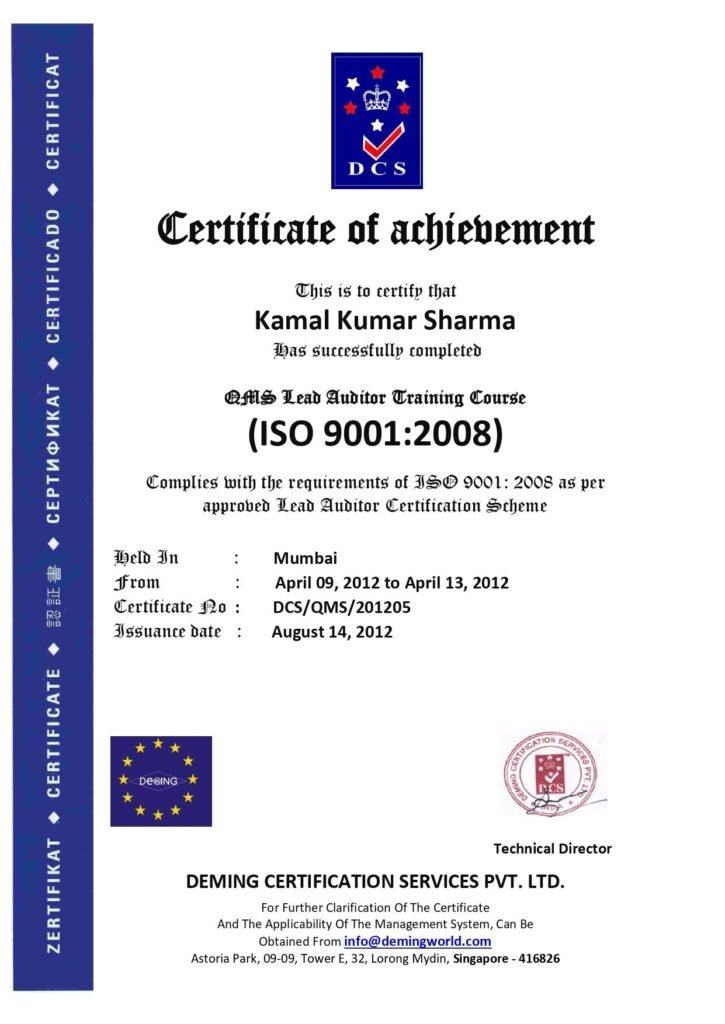
- Chapter 3 — The 2012 ISO 9001:2008 Certification Milestone
- Chapter 4 — From Certification to Quality Leadership
- Chapter 5 — Quality Management as a Foundation for Growth
- Chapter 6 — Challenges, Audits, and Continuous Improvement
- Chapter 7 — Leadership, Reputation, and Business Expansion
- Chapter 8 — Learning, Adaptation, and the Changing Business Environment
- Chapter 9 — The Value of the Journey and the Meaning of Certification
- Chapter 10 — The Legacy of Quality and the Road Ahead
- Take the Next Step Today

Chapter 1 — The Beginning
Mumbai has always been a city of ambition, enterprise, and transformation. Every day, thousands of businesses begin their journey with a simple objective: to provide something valuable to customers and build a reputation that can survive changing markets. For Kamal Kumar Sharma, this journey was closely connected with quality, discipline, and the desire to establish a professional system for the manufacturing and supply of herbal and homeopathy medicines and cosmetics.
The story of Kamal Kumar Sharma’s QMS Lead Auditor journey begins with an understanding that business growth cannot depend entirely on individual effort. As an organization becomes larger, processes become more complicated. More customers mean more expectations. More products mean greater responsibility. More employees require clearer roles. Suppliers need monitoring, documentation needs control, and customer complaints need to be handled systematically.
In such an environment, quality cannot be left to chance.
Kamal recognized this reality during the development of his professional activities. The products associated with the business were not ordinary commodities. Herbal medicines, homeopathy medicines, and cosmetics require customer confidence. People expect products to be manufactured consistently and supplied according to defined requirements. Even when a business has experienced people, informal methods can become difficult to control as operations expand.
The need for a structured Quality Management System therefore became increasingly important.
At the time, ISO 9001:2008 was widely recognized as an important international framework for quality management. It provided organizations with a systematic approach to processes, documentation, responsibilities, customer satisfaction, monitoring, corrective action, and continual improvement.
For Kamal, the idea of certification represented an opportunity to bring greater organization into the business.
The decision was not simply about obtaining a certificate. It was about understanding how an organization could operate through defined processes rather than depending entirely on personal supervision. The goal was to create consistency—to make sure that important activities were performed in a controlled and repeatable manner.
The journey began with awareness.
Employees and management needed to understand what a Quality Management System actually meant. Quality was not limited to checking a finished product. It started much earlier—with understanding customer requirements, selecting appropriate suppliers, controlling materials, managing production activities, maintaining records, monitoring processes, and responding when something did not go as planned.
This change in thinking was significant.
Previously, quality might have been considered primarily the responsibility of people involved in inspection. Under a management-system approach, however, everyone had a role.
A person purchasing materials affected quality.
A person maintaining production records affected quality.
A person handling customer communication affected quality.
A person responsible for storage and dispatch affected quality.
Management itself had the responsibility of creating an environment in which quality objectives could be achieved.
Kamal increasingly understood that this interconnected approach was essential for sustainable growth.
The preparation for ISO 9001:2008 certification required attention to documentation and operational practices. Procedures had to be established. Responsibilities had to be clarified. Records had to provide evidence that processes were being followed. Where gaps were identified, corrective actions were necessary.
This process was not always easy.
Introducing a formal system can initially feel uncomfortable to people who are accustomed to informal working methods. Employees may ask why additional records are required or why an established activity suddenly needs a documented procedure.
Kamal’s role was therefore important in explaining the purpose behind the changes.
Documentation was not intended to create unnecessary paperwork. It was intended to create clarity.
A procedure could explain how an activity should be performed. A record could demonstrate what had actually happened. An internal audit could identify whether the system was working. A corrective action could address the underlying cause of a problem.
Gradually, the organization began to see quality management not as an external burden but as a useful management tool.
The importance of leadership became clear as well. A Quality Management System cannot succeed merely because documents have been prepared. Management must demonstrate commitment through decisions, resources, training, monitoring, and continuous attention to customer requirements.
Kamal’s growing interest in quality management eventually extended beyond organizational certification. He began developing a deeper professional understanding of auditing and management-system principles. This interest would later become an important part of his QMS Lead Auditor journey.
The year 2012 became a significant milestone.
The organization achieved ISO 9001:2008 certification for the defined scope relating to the manufacturing and supply of herbal and homeopathy medicines and cosmetics. The certification represented formal recognition of the organization’s quality-management system at that time.
For Kamal, the achievement was a moment of satisfaction.
The certificate represented months of preparation, learning, implementation, and discipline. It also created a stronger professional image when dealing with customers and business associates.
But the most important lesson was that certification was not the destination.
A certificate can demonstrate that a management system has been assessed against a standard at a particular point in time. Long-term success depends on what an organization does afterward.
Kamal understood that the real test would come through continued implementation.
Would employees continue following procedures?
Would records remain accurate?
Would customer complaints be investigated?
Would management review performance?
Would corrective actions address root causes?
Would the organization continue improving?
These questions became more important than the certificate itself.
The beginning of this journey therefore established a philosophy that would influence the years ahead: quality must become part of the way an organization thinks and operates.
The 2012 ISO 9001:2008 certification was an important milestone, but it was only the opening chapter. It provided a foundation for learning, professional development, customer confidence, and future growth.
For Kamal Kumar Sharma, the journey from quality-system implementation toward QMS Lead Auditor knowledge would ultimately become a story about much more than certification.
It would become a story about leadership, responsibility, continuous learning, and the belief that a strong organization is built one controlled process at a time.
#QMSLeadAuditor
Chapter 2 — The Decision to Build a Quality Management System
The business operated within the manufacturing and supply of herbal and homeopathy medicines and cosmetics. Such an environment demanded consistency. Customers expected products to meet defined requirements, orders to be handled accurately, and supplies to be delivered with reliability. As the business developed, these expectations became increasingly important.
Kamal understood that growth brought responsibility.
When an organization is small, the promoter may personally know almost every activity taking place. Decisions can be made quickly, employees can receive instructions directly, and problems can sometimes be solved informally. However, as the number of activities, customers, suppliers, and employees increases, informal methods become increasingly difficult to control.
A system was required.
ISO 9001:2008 provided a framework for creating that system.
The first challenge was changing the mindset of the people involved. Quality could no longer be considered only the responsibility of someone checking the final product. It had to begin with customer requirements and continue through purchasing, production, inspection, storage, documentation, supply, and customer feedback.
Kamal began emphasizing this broader definition of quality.
A customer complaint, for example, was not merely an unpleasant event. It was information. It could reveal a weakness in a process, communication problem, documentation gap, supplier issue, or training requirement.
Similarly, an error in a record was not simply an administrative mistake. It could indicate that employees did not fully understand a procedure or that the process itself needed improvement.
This approach encouraged people to look beyond immediate problems and consider their causes.
One of the most important aspects of developing the Quality Management System was documentation.
Policies and procedures needed to explain how important activities were controlled. Responsibilities had to be clearly defined. Records had to be maintained as evidence of implementation.
Initially, some employees found the emphasis on documentation challenging. They were accustomed to completing activities based on experience and verbal instructions. The new system required a more disciplined approach.
Kamal worked to explain that documentation was not intended merely to satisfy an auditor.
It had a practical purpose.
If an employee was absent, another trained person could understand the required process. If a problem occurred, records could help determine what had happened. If a customer asked about an order, documented information could provide evidence. If management wanted to improve a process, historical records could provide useful information.
The Quality Management System gradually became a method of preserving organizational knowledge.
Another important area was supplier management.
The quality of finished products can be influenced by the quality and consistency of purchased materials and services. Therefore, suppliers needed appropriate evaluation and monitoring. Purchasing decisions could no longer be based entirely on price or familiarity.
This introduced a more systematic approach to procurement.
Production activities also required defined controls. Employees needed to understand their responsibilities, available instructions, relevant records, and the importance of maintaining consistent processes.
Training became another important consideration.
Kamal recognized that a procedure is useful only when the people responsible for implementing it understand what it means. Training therefore became connected with quality performance. Employees needed both technical knowledge and awareness of their responsibilities within the management system.
The organization also began paying greater attention to customer satisfaction.
Customer expectations were not limited to product characteristics. They included communication, delivery, reliability, responsiveness, and the organization’s ability to resolve problems.
A successful Quality Management System therefore had to connect internal processes with external expectations.
As implementation progressed, internal audits became increasingly valuable.
An internal audit provided an opportunity to examine whether processes were being followed and whether the management system was functioning effectively. The objective was not simply to find mistakes. It was to identify opportunities for improvement.
This experience would later become particularly valuable to Kamal’s professional development as he became more interested in QMS auditing and lead-auditor principles.
Management review also became an important part of the system.
Management needed information about performance, customer feedback, audit results, corrective actions, process performance, and opportunities for improvement. This created a structured opportunity to evaluate whether the organization was moving in the desired direction.
The journey required persistence.
There were days when implementation seemed difficult and days when progress was clearly visible. Every procedure created a new responsibility. Every record created a new source of evidence. Every audit finding created an opportunity to learn.
Slowly, however, the organization began to understand the value of the system.
The decision to pursue ISO 9001:2008 certification was therefore becoming more than a compliance exercise. It was becoming a business-development strategy.
A recognized quality-management framework could improve confidence among customers and business partners. It could help demonstrate that the organization was serious about systematic operations. Most importantly, it could provide management with a framework for controlling and improving the business.
As 2012 approached, the organization moved closer to its certification objective.
The preparation had created new habits: greater attention to records, clearer responsibilities, more disciplined processes, stronger customer focus, and greater awareness of continual improvement.
Kamal could see that the organization was changing.
The business was no longer relying solely on experience and personal supervision. It was developing a system capable of supporting future growth.
The decision to build the Quality Management System had therefore become one of the defining moments in the organization’s history.
It prepared the foundation for the next stage—the achievement of ISO 9001:2008 certification and the beginning of a new chapter in Kamal Kumar Sharma’s professional journey.
#ISO9001
Chapter 3 — The 2012 ISO 9001:2008 Certification Milestone
The year 2012 became a defining point in the journey of Kamal Kumar Sharma and the organization associated with the manufacturing and supply of herbal and homeopathy medicines and cosmetics.
The decision to establish a Quality Management System had already required commitment, learning, documentation, training, and changes in working methods. Now the organization was approaching the moment when its efforts would be formally assessed against the requirements of ISO 9001:2008.
For Kamal, certification was important because it represented the completion of a significant organizational transformation. The business had moved from informal control toward a more structured approach in which processes, responsibilities, records, monitoring, and improvement were connected.
The certification journey began with preparation.
Management needed to ensure that the documented Quality Management System reflected actual business activities. Procedures could not simply exist on paper. Employees had to understand them and demonstrate that they were being implemented.
This distinction was extremely important.
A Quality Management System is effective only when documented requirements are translated into practical action. If a procedure describes one method while employees follow another, the organization has a weakness regardless of how impressive the documentation appears.
Kamal therefore focused on implementation.
Employees were encouraged to understand why procedures existed and how their daily activities contributed to overall quality. Purchasing staff had responsibilities. Production personnel had responsibilities. People involved in inspection, storage, dispatch, administration, and customer communication all contributed to the effectiveness of the system.
The organization also had to demonstrate appropriate control over records.
Records provided evidence of what had happened. They could show that activities had been completed, checks had been performed, decisions had been made, and problems had been addressed.
This created a new level of accountability.
Employees gradually understood that good documentation was not about creating paperwork for its own sake. Proper records helped the organization remember, verify, analyze, and improve.
Internal audits were another important element of preparation.
Through internal auditing, the organization could examine its own processes before the external assessment. Findings could be identified and addressed. Employees could become familiar with the logic of audit questions and evidence-based evaluation.
For Kamal, this was especially valuable.
He began developing a deeper understanding of how auditors examine management systems. An effective auditor does not simply look for documents. An auditor looks for objective evidence and considers whether processes are effective and controlled.
This experience strengthened Kamal’s interest in the QMS Lead Auditor field.
As the certification assessment approached, management also recognized the importance of leadership.
A Quality Management System requires commitment from the top. Management must establish objectives, provide resources, communicate expectations, monitor performance, and support improvement.
The certification process therefore became an opportunity for management to demonstrate that quality was connected with business strategy.
Customer focus remained at the heart of the system.
The organization understood that customers ultimately determine whether a business is successful. Meeting requirements consistently, responding to concerns, and maintaining confidence were essential.
For a business associated with herbal and homeopathy medicines and cosmetics, customer trust was particularly significant. Product-related expectations could be closely connected with personal wellbeing, appearance, and confidence.
The organization therefore had to recognize the importance of disciplined operations.
When the assessment took place, the organization’s systems, procedures, records, and implementation were examined against the applicable ISO 9001:2008 requirements.
The process was not merely an inspection of finished products. It involved consideration of the management system and its various processes.
For Kamal and his team, the assessment represented an important learning experience.
Questions from auditors required employees to explain their activities. Records needed to support statements. Procedures needed to correspond with actual practices.
The experience demonstrated an important lesson: quality management is ultimately about evidence and effectiveness.
In 2012, the organization achieved ISO 9001:2008 certification for its defined scope of manufacturing and supply of herbal and homeopathy medicines and cosmetics.
The achievement brought a sense of pride.
The certificate provided external recognition that the organization’s quality-management system had been assessed against the applicable standard at that time.
For Kamal, however, the achievement was more meaningful than the certificate itself.
It represented the culmination of a learning process.
Employees had learned to work with greater discipline. Management had learned to evaluate processes systematically. Documentation had become more structured. Internal audits had created opportunities for improvement. Customer focus had become more visible.
The certification also strengthened the organization’s professional image.
In competitive markets, customers and business partners often seek evidence that an organization takes quality seriously. The ISO certification could therefore support confidence and provide an additional element of credibility.
But Kamal understood that certification was not a permanent guarantee.
The certificate was associated with a particular standard, scope, organization, and certification period. Maintaining certification required continued conformity and ongoing assessment.
This understanding prevented Kamal from treating the certificate as the final achievement.
Instead, he saw it as a starting point.
The organization now had a framework that could support future development. The challenge was to maintain the system, learn from audits, respond to changing requirements, and continue improving.
The 2012 milestone therefore marked a transition.
Before certification, the organization was preparing for a quality-management system.
After certification, it had to prove that the system could remain useful in real business conditions.
This was where the deeper value of the journey began.
The certificate created recognition, but the discipline created capability.
The experience gained during certification also encouraged Kamal to develop his professional knowledge further. His interest in auditing, management systems, and continual improvement became increasingly important.
The ISO 9001:2008 certification issued in 2012 would eventually expire and is not a current valid certification today. Nevertheless, its historical role in the organization’s journey remains important.
It represented a moment when quality management became formally embedded in the business story.
For Kamal Kumar Sharma, 2012 was therefore not simply the year a certificate was obtained.
#QualityManagementSystem
Chapter 4 — From Certification to Quality Leadership
The achievement of ISO 9001:2008 certification in 2012 gave Kamal Kumar Sharma an important foundation, but the real value of the journey became visible in the years that followed. Certification had introduced the organization to structured processes, documented information, internal auditing, corrective action, customer focus, and continual improvement. Now these principles had to become part of everyday management.
Kamal gradually realized that maintaining a quality system required a different kind of leadership.
A certificate could demonstrate that a system had been assessed at a particular time, but it could not manage the organization. People had to manage the processes. Employees had to understand their responsibilities. Management had to make decisions based on information and evidence.
This realization strengthened Kamal’s interest in Quality Management System auditing.
The role of a QMS Lead Auditor requires more than knowledge of individual procedures. An auditor must understand how different processes interact and how evidence can demonstrate whether a management system is effective.
Kamal began looking at organizations from a broader perspective.
For example, purchasing could not be viewed as an isolated activity. The quality of purchased materials could influence production. Production could influence inspection results. Inspection could influence product release. Product release could influence customer satisfaction. Customer complaints could then provide information that might require corrective action or process improvement.
Every process was connected.
This process-based thinking became one of the most important lessons from Kamal’s experience.
Instead of asking only whether a procedure existed, he learned to consider whether the process had a clear purpose, appropriate inputs, defined responsibilities, suitable controls, measurable results, and effective monitoring.
This approach changed the way he viewed audits.
An audit was not simply an exercise in checking documents against a list of requirements. It was an opportunity to understand how an organization actually worked.
Objective evidence became central to this approach.
If an employee said that a particular activity was performed, the auditor needed to understand what evidence supported that statement. If a procedure required monitoring, the relevant records could demonstrate whether monitoring had actually occurred.
This evidence-based approach helped distinguish assumptions from facts.
Kamal also recognized the importance of asking questions carefully.
A good auditor does not necessarily ask complicated questions. Instead, the auditor asks relevant questions that encourage people to explain their processes.
Questions such as “What happens after you receive this material?”, “Who is responsible for this activity?”, “How do you know the requirement has been met?”, and “What happens when the result is not satisfactory?” can reveal a great deal about process control.
This developing skill contributed to Kamal’s professional identity as a QMS Lead Auditor.
The experience also reinforced the importance of impartiality.
An auditor must be able to identify weaknesses without turning an audit into a personal criticism of employees. Findings should be based on evidence and applicable requirements.
This was particularly important because organizations can sometimes become defensive when weaknesses are identified.
Kamal learned that communication could determine whether an audit became a constructive learning experience or an uncomfortable confrontation.
When findings were explained clearly and objectively, employees were more likely to understand the reason for corrective action.
Corrective action itself became another area of learning.
A common mistake in quality management is to correct only the immediate symptom.
Suppose a record is incomplete. Simply completing that one record may solve the immediate problem, but it may not prevent recurrence. The organization needs to understand why the record was incomplete.
Was the employee insufficiently trained?
Was the procedure unclear?
Was the form difficult to use?
Was there insufficient supervision?
Was the process poorly designed?
Root-cause thinking helped the organization move from temporary correction toward lasting improvement.
Management review also became increasingly meaningful.
Instead of treating management review as a formal meeting held only because a standard required it, Kamal saw it as an opportunity for leadership to examine the health of the organization.
Customer feedback, audit findings, process performance, corrective actions, resource requirements, and improvement opportunities could all provide valuable information.
This approach linked quality management with business management.
The QMS was no longer a separate administrative system.
It became a source of information for management decisions.
The organization’s experience also demonstrated that employee involvement was essential.
A quality system designed entirely by management may look excellent on paper but fail during implementation if employees do not understand it.
Kamal therefore valued communication and awareness.
Employees needed to know not only what they were expected to do but also why their work mattered.
Someone responsible for maintaining records contributed to traceability.
Someone involved in purchasing contributed to input quality.
Someone handling customer communication contributed to customer satisfaction.
Someone conducting inspections contributed to product conformity.
Everyone had a role.
This understanding helped establish a stronger quality culture.
As Kamal continued developing his knowledge, he became increasingly aware that quality leadership was closely connected with business growth.
A company that controls its processes effectively is better positioned to manage expansion. When new employees join, documented processes can provide guidance. When new customers arrive, established controls can support consistency. When problems occur, records and analysis can help management respond.
The certification journey had therefore created capabilities that could extend beyond the original purpose of obtaining an ISO certificate.
Kamal’s professional growth followed a similar pattern.
The more he understood quality systems, the more he appreciated the importance of continual learning.
Standards evolve. Customer expectations change. Industries develop new challenges. Auditors need to remain knowledgeable and objective.
The journey from certification to quality leadership was therefore not a straight line. It was a continuing process of learning, application, evaluation, and improvement.
The 2012 ISO 9001:2008 certification had provided the foundation.
The subsequent experience provided deeper understanding.
For Kamal Kumar Sharma, the QMS Lead Auditor path represented the next stage of that development—a transition from simply participating in a certified quality system to understanding how management systems can be evaluated, improved, and connected with organizational performance.
#QualityManagement
Chapter 5 — Quality Management as a Foundation for Growth
After the ISO 9001:2008 certification milestone, Kamal Kumar Sharma began to see quality management from a broader business perspective. The organization was no longer simply preparing for an audit. It was operating within a framework that could influence customer relationships, employee responsibilities, supplier management, documentation, and future expansion.
The certification had created credibility, but credibility alone was not enough.
The real question was how the organization could use the discipline of quality management to support sustainable growth.
For a business involved in the manufacturing and supply of herbal and homeopathy medicines and cosmetics, consistency was especially important. Customers wanted confidence that products and services would meet defined expectations repeatedly, not only once.
Kamal therefore emphasized consistency as one of the foundations of growth.
A growing organization must be capable of delivering the same level of attention even when the number of customers increases. If every decision depends on one individual, expansion can become difficult. A structured management system can distribute responsibilities and create greater organizational stability.
This was one of the practical benefits of the QMS.
Procedures helped employees understand what needed to be done. Records created evidence. Defined responsibilities reduced confusion. Monitoring helped identify problems. Corrective actions created opportunities to prevent recurrence.
Together, these elements created a more organized working environment.
Customer relationships also benefited from the quality-focused approach.
A customer does not experience an ISO standard directly. The customer experiences the results: communication, product consistency, order handling, responsiveness, reliability, and problem resolution.
Kamal understood that these everyday experiences ultimately determine reputation.
If a customer received a product consistently and received timely responses to questions, confidence could increase. If a complaint was handled professionally and the underlying problem was addressed, the relationship could become stronger.
Quality management therefore became closely connected with customer satisfaction.
Another important area was supplier control.
As business activity increased, reliance on external suppliers could also increase. Materials and services received from suppliers could influence the organization’s ability to meet customer requirements.
Kamal’s quality-management perspective encouraged greater attention to supplier selection, evaluation, performance, and communication.
The objective was not simply to find the cheapest supplier.
The organization needed suppliers capable of meeting defined requirements consistently.
This approach could reduce disruptions and improve predictability.
Production and operational controls were equally important.
Growth can create pressure. More orders may mean faster production schedules, additional employees, more purchasing activity, and increased dispatch requirements. Without adequate controls, growth can expose weaknesses that were not visible when operations were smaller.
The QMS provided a framework for managing this complexity.
Employees could refer to established procedures. Responsibilities could be assigned. Records could help management monitor performance. Internal audits could reveal areas where controls needed strengthening.
Kamal began to understand that a quality system could function as organizational memory.
People may leave an organization, but documented processes and records can preserve important knowledge.
This becomes particularly valuable during growth.
When new employees join, they require training and awareness. A structured system can help explain how activities are performed and what responsibilities belong to each role.
Training therefore became an important part of organizational development.
Kamal believed that employees should not be trained merely to satisfy an audit requirement. Training should help people perform their work effectively.
An employee who understands the reason behind a procedure is more likely to follow it correctly.
This idea contributed to a stronger quality culture.
The organization also became more aware of the relationship between mistakes and improvement.
A mistake did not automatically mean that an employee had failed. Sometimes a mistake could indicate that the process itself needed improvement.
For example, if employees repeatedly entered incorrect information, management could ask whether the form was confusing. If records were frequently incomplete, perhaps the instructions needed clarification. If a process regularly experienced delays, perhaps resources or responsibilities needed to be reviewed.
This approach encouraged problem-solving rather than blame.
Corrective action became an opportunity to improve the system.
Kamal’s developing QMS Lead Auditor knowledge strengthened this way of thinking. As an auditor, he needed to distinguish between isolated incidents and systemic weaknesses.
A single error might require correction.
A repeated pattern could indicate a process problem.
Understanding this difference was essential for effective management.
The organization’s growth story therefore became connected with continual improvement.
Improvement did not always require major investment or dramatic transformation. Sometimes it meant clarifying a responsibility, improving a record, providing additional training, changing a sequence of activities, or improving communication.
Small improvements, when repeated consistently, could create significant long-term benefits.
The certification also influenced the organization’s professional image.
Having achieved ISO 9001:2008 certification in 2012, the organization could demonstrate that its quality-management system had been formally assessed against the applicable standard at that time.
This could provide additional confidence to customers and business partners.
However, Kamal remained aware that certification should never be used as a substitute for actual performance.
The certificate could open conversations.
Performance would determine whether those relationships continued.
This became an important principle in his professional philosophy.
Certification creates an opportunity; quality performance creates lasting value.
As the organization developed, Kamal’s role also evolved. His interest in auditing and quality systems became increasingly connected with business leadership.
He was learning to see quality from multiple perspectives: the customer’s perspective, the employee’s perspective, the management perspective, and the auditor’s perspective.
This broader understanding helped him appreciate the importance of balance.
A process had to be controlled, but it also had to be practical.
Documentation had to be sufficient, but not unnecessarily complicated.
Audits had to identify weaknesses, but they also had to encourage improvement.
Management had to set objectives, but employees needed the resources and competence to achieve them.
The QMS therefore became a bridge between operational discipline and business ambition.
Looking back, the 2012 certification represented more than an achievement in compliance. It helped establish a foundation on which the organization could develop greater consistency, professionalism, customer confidence, and management awareness.
The certificate itself would eventually expire, and it should not be presented today as a current certification. Yet the experience associated with it remained an important part of the organization’s historical journey.
For Kamal Kumar Sharma, the greatest value of the certification was the knowledge it created.
That knowledge could continue to influence decisions long after the certificate’s validity period ended.
And as the organization entered its next phase, one lesson became increasingly clear:
A business grows sustainably when quality grows with it.
#LeadAuditor
Chapter 6 — Challenges, Audits, and Continuous Improvement
Growth brought new opportunities to Kamal Kumar Sharma’s professional journey, but it also brought new challenges. The Quality Management System established around the ISO 9001:2008 certification had created structure and discipline, yet maintaining an effective system required continuous attention.
Kamal understood that quality management was not a one-time project.
A business changes every day. Employees change. Customers change. Suppliers change. Products develop. Market expectations evolve. Internal processes may become outdated. Even a procedure that worked effectively several years earlier may require review when circumstances change.
This made continuous improvement essential.
One of the most useful tools for identifying improvement opportunities was internal auditing. Through internal audits, the organization could examine whether established processes were being followed and whether they remained effective.
Kamal increasingly appreciated the difference between an audit and an inspection.
An inspection normally focuses on a particular product, activity, or result. An audit examines evidence against defined criteria and considers whether the system is functioning as intended.
This distinction became important in his development as a QMS Lead Auditor.
A professional auditor needs to remain objective.
The purpose is not to prove that employees are wrong. The purpose is to determine whether the management system conforms to applicable requirements and whether it is effectively implemented.
This required careful observation and disciplined questioning.
During an audit, an auditor might begin by reviewing a procedure. The next step could be to speak with the employee responsible for implementing it. Then the auditor might examine records to determine whether the activity had actually been performed as described.
This movement from document to practice to evidence created a complete picture.
Kamal learned that evidence was more powerful than assumptions.
If an employee explained that a process was controlled, the auditor needed appropriate evidence. If management claimed that customers were satisfied, the organization needed meaningful information to support that conclusion.
This approach encouraged greater transparency.
Audit findings also became learning opportunities.
Not every finding represented a major failure. Some findings could be relatively small gaps that, if ignored, might become more serious over time.
The important question was how the organization responded.
A strong corrective-action process did not simply close a finding quickly. It examined why the problem occurred and considered whether similar problems could exist elsewhere.
Root-cause analysis therefore became an important part of Kamal’s quality philosophy.
Consider a simple example.
Suppose an employee repeatedly failed to complete a required record. A superficial response might be to instruct the employee to complete the form correctly.
But a deeper investigation could ask several questions.
Was the employee properly trained?
Was the form easy to understand?
Was the procedure clear?
Was the employee given enough time?
Was responsibility clearly assigned?
Was there adequate supervision?
Was the record actually useful, or had it become unnecessary paperwork?
The answers could reveal that the problem was not simply an employee mistake.
Perhaps the process needed redesign.
This way of thinking encouraged improvement at the system level.
Kamal also recognized that management had to support corrective actions with appropriate resources. If a recurring problem required new equipment, additional training, revised documentation, or improved communication, management needed to consider those requirements seriously.
Quality could not be improved through instructions alone.
People needed resources and competence.
Training therefore remained an important part of the system.
As employees became more familiar with quality principles, they could recognize problems earlier. They could understand why records mattered and how their activities affected other processes.
This created a culture in which quality became everyone’s responsibility.
Customer feedback was another source of improvement.
Complaints could reveal weaknesses, but positive feedback could also provide useful information about what the organization was doing well.
Kamal encouraged the idea that customer satisfaction should not be measured only through the absence of complaints.
Organizations should seek to understand customer expectations and identify opportunities to improve service.
This customer-focused approach was especially relevant to a business operating in the herbal, homeopathy, and cosmetics sector, where trust and consistency can strongly influence customer relationships.
Supplier performance also required monitoring.
If purchased materials or services did not meet expectations, the organization could experience production problems, delays, or customer dissatisfaction.
A structured supplier-evaluation process could help management make better decisions.
These experiences strengthened Kamal’s understanding of risk and prevention, even though the terminology and requirements of later versions of ISO 9001 would evolve beyond ISO 9001:2008.
The broader principle remained valuable: organizations should not wait for problems to become serious before responding.
Prevention begins with awareness.
The QMS also encouraged management to examine performance through reviews and measurable information. Data could help identify trends that were difficult to see from individual incidents.
For example, repeated customer complaints might indicate a recurring weakness. Increasing audit findings might indicate inadequate training. Supplier problems might indicate the need for stronger evaluation.
Information transformed individual events into management knowledge.
Kamal’s professional development benefited from this experience.
The more he understood auditing, the more he realized that a lead auditor needs both technical knowledge and interpersonal skills.
An auditor must listen carefully.
An auditor must remain impartial.
An auditor must communicate findings clearly.
An auditor must understand evidence.
An auditor must avoid jumping to conclusions.
An auditor must also understand the business context sufficiently to evaluate whether processes are effective.
These qualities helped Kamal develop a mature approach to QMS auditing.
Challenges therefore became opportunities for professional growth.
Every audit could reveal something new. Every corrective action could teach something about process management. Every customer complaint could reveal an improvement opportunity. Every employee question could expose an area where communication needed strengthening.
This continuous cycle created momentum.
The organization learned that quality improvement did not require perfection.
Instead, it required commitment to identifying weaknesses, learning from them, correcting them, and preventing recurrence wherever practical.
The original ISO 9001:2008 certification issued in 2012 was an important historical milestone, but the deeper achievement was the quality culture developed through the experience.
Although that certification is now expired and should not be represented as current, the principles learned during the period remained relevant to Kamal’s professional journey.
The challenges after certification ultimately demonstrated one of the most important lessons of quality management:
A strong Quality Management System is not the system that never finds problems. It is the system that finds problems, learns from them, and becomes stronger because of them.
#ISO9001Auditor
Chapter 7 — Leadership, Reputation, and Business Expansion
As Kamal Kumar Sharma continued developing his understanding of Quality Management Systems, the relationship between quality and business growth became increasingly clear. The ISO 9001:2008 certification achieved in 2012 had introduced a structured way of managing processes, but its influence extended beyond procedures and records.
It affected how the organization presented itself to customers, how employees understood their responsibilities, and how management approached future opportunities.
Kamal began to recognize that reputation is built through repeated experiences.
A customer might first become interested because of a product, price, recommendation, or professional presentation. However, long-term trust usually depends on consistency. Orders need to be handled properly. Communication needs to be clear. Requirements need to be understood. Problems need to receive appropriate attention.
Quality management could support all of these areas.
For Kamal, this was an important transition in thinking.
Earlier, certification had been a goal. Later, quality became part of a larger business philosophy.
The organization could use its experience with quality systems to become more organized and professional. Instead of reacting to every problem independently, management could look for patterns and improve the processes responsible for those problems.
This approach helped create greater confidence within the organization itself.
Employees working in a structured environment could better understand what was expected of them. Clear responsibilities reduced uncertainty. Documented procedures provided guidance. Training helped employees develop competence.
Leadership played a central role in maintaining this environment.
Kamal understood that employees often take their cues from management. If management treats quality as important only during an audit, employees may do the same. If management demonstrates quality awareness throughout the year, employees are more likely to understand that quality is part of normal business operations.
Leadership therefore had to be visible.
Management needed to review performance, listen to employees, consider customer feedback, support corrective action, and provide resources where necessary.
This was not always easy.
Business growth creates pressure. Customers may demand faster delivery. New opportunities may require additional capacity. Employees may have competing priorities. Management may need to make difficult decisions involving cost, resources, and time.
In such circumstances, quality can sometimes appear to slow business down.
Kamal’s experience suggested the opposite.
Poor quality can create much greater costs through complaints, rework, delays, customer dissatisfaction, wasted materials, and loss of reputation.
A well-managed process can therefore protect the organization from avoidable problems.
This understanding strengthened the business case for quality.
As the organization’s professional image developed, certification experience could also support conversations with customers and business associates. The ISO 9001:2008 certificate issued in 2012 represented evidence that the organization’s management system had been assessed against the applicable standard at that time.
However, Kamal was careful to distinguish historical certification from current certification status.
The 2012 certification is now expired and should not be presented as a currently valid ISO certification.
What remained valuable was the experience and knowledge gained during the certification period.
That distinction became particularly important as Kamal’s professional reputation developed.
His identity as someone knowledgeable about QMS principles and auditing could not depend permanently on one historical certificate. It had to be supported by continuing learning, practical understanding, and professional conduct.
This encouraged him to deepen his knowledge of auditing.
A QMS Lead Auditor needs to understand both the requirements of a management-system standard and the practical realities of organizations.
An auditor entering a manufacturing environment needs to understand processes.
An auditor reviewing purchasing needs to understand supplier controls.
An auditor examining customer satisfaction needs to understand how feedback is collected and evaluated.
An auditor reviewing corrective action needs to understand whether the organization has addressed causes rather than merely symptoms.
This broad perspective helped Kamal connect quality with organizational performance.
The idea of business expansion also became more meaningful.
Growth should not simply mean more sales.
Sustainable growth means that an organization can increase its activities while maintaining control.
If customer numbers increase, customer-service processes must remain effective.
If production increases, operational controls must remain reliable.
If employees increase, training and responsibilities must remain clear.
If suppliers increase, evaluation and monitoring must remain effective.
If products increase, documentation and process controls must remain manageable.
Quality management provides a framework for considering these challenges.
Kamal therefore viewed the QMS as a foundation for scalability.
The organization could grow more confidently when processes were understood and controlled.
This perspective also influenced how he viewed organizational culture.
A strong culture is not created by posters or slogans. It develops through everyday behavior.
Employees need to see that management follows procedures.
They need to understand that problems can be reported without unnecessary fear.
They need to know that corrective action is intended to improve the system rather than simply assign blame.
They need to see that customer requirements are taken seriously.
When these behaviors become normal, quality becomes part of organizational identity.
Kamal’s leadership journey was therefore closely connected with culture.
His experience demonstrated that technical knowledge alone is not enough.
A person may understand ISO requirements perfectly but still struggle to create an effective quality culture.
Leadership requires communication, patience, consistency, and the ability to connect requirements with real business needs.
The journey also taught the importance of continual professional development.
Quality standards evolve. Industry expectations change. Customers become more informed. New approaches to risk, process management, digital records, and organizational performance emerge.
A professional who wants to remain effective must continue learning.
For Kamal, the QMS Lead Auditor path provided a way to continue that learning.
The knowledge gained from certification and auditing could be applied not only to a single organization but also to broader professional activities.
The story of growth was therefore becoming larger than the story of one certificate.
It was becoming a story about capability.
The 2012 certification helped establish credibility. The practical experience built understanding. The challenges developed resilience. Auditing strengthened analytical thinking. Leadership connected quality with business performance.
Together, these experiences created a professional foundation.
The central lesson of this chapter is simple:
Business growth becomes stronger when reputation, leadership, and quality management grow together.
For Kamal Kumar Sharma, the journey demonstrated that quality was not an obstacle to expansion. Properly understood and implemented, it could become one of the foundations that made responsible expansion possible.
#QualityLeadership
Chapter 8 — Learning, Adaptation, and the Changing Business Environment
The business environment never remains the same. Customer expectations change, competition increases, technology develops, employees move between organizations, and regulatory and industry expectations evolve. For Kamal Kumar Sharma, the experience gained through ISO 9001:2008 certification became increasingly valuable because it taught an important lesson: a quality system must be capable of adapting.
The organization associated with the manufacturing and supply of herbal and homeopathy medicines and cosmetics had already experienced the benefits of structured quality management. But maintaining that discipline required continuous learning.
Kamal understood that a procedure created several years earlier could not automatically remain effective forever.
Processes need to be reviewed.
Responsibilities may change.
New employees require training.
Suppliers may change.
Customer expectations may become more demanding.
Technology can alter how information is created and controlled.
Therefore, continual improvement must include adaptation.
One of the most important areas of adaptation was documentation.
In the early stages of quality-system implementation, documentation often consisted of traditional procedures, forms, registers, and records. As organizations become more technologically capable, many of these activities can increasingly be supported by digital systems.
However, technology alone does not create quality.
A digital record can be just as inaccurate as a paper record if the process behind it is poorly controlled.
Kamal’s experience encouraged him to focus on the principle behind documentation: information must be accurate, available, understandable, and appropriately controlled.
This principle was relevant to both traditional and modern working environments.
Training also had to evolve.
Employees joining an organization could not be expected to understand the Quality Management System simply because procedures existed. They needed appropriate induction, awareness, and role-specific training.
Kamal increasingly viewed training as an investment rather than an administrative expense.
A competent employee is better positioned to recognize problems, follow procedures, communicate effectively, and contribute to improvement.
The same principle applied to leadership development.
Managers needed to understand quality concepts sufficiently to make informed decisions. If management did not understand the importance of corrective action, process monitoring, or customer feedback, employees would struggle to maintain the system.
Quality awareness therefore had to exist at multiple levels.
The changing business environment also highlighted the importance of customer expectations.
Customers today often expect more information, faster communication, reliable delivery, consistent products, and professional complaint handling.
A quality system must respond to these expectations without becoming unnecessarily complicated.
Kamal’s approach was to return repeatedly to the fundamentals.
What does the customer require?
How does the organization know those requirements?
Which process delivers the requirement?
How is the process controlled?
How is performance monitored?
What happens when something goes wrong?
How can the organization improve?
These questions remained relevant regardless of technology or market conditions.
The QMS Lead Auditor perspective helped Kamal understand the value of asking such questions objectively.
An auditor should not assume that an organization is effective simply because it has impressive documentation. The auditor should examine actual evidence.
Similarly, an auditor should not assume that a process is ineffective simply because it is different from the auditor’s preferred method.
The important issue is whether the process meets applicable requirements and achieves its intended results.
This required professional judgment.
Kamal continued developing his ability to distinguish between a genuine system weakness and a difference in working style.
This was an important lesson in audit professionalism.
Another area of learning was the relationship between compliance and improvement.
Compliance is important, but an organization should not limit itself to doing only what is required.
A mature quality culture asks a further question:
“How can we do this better?”
This question creates the foundation for continual improvement.
Improvement could involve simplifying a process, reducing duplication, improving communication, strengthening supplier evaluation, increasing employee competence, or improving customer feedback.
Not every improvement needed to be expensive.
Sometimes the greatest improvements came from clarity.
A clearly written responsibility could prevent confusion.
A better-designed form could reduce errors.
A short training session could prevent repeated mistakes.
A regular review could identify a problem before it became serious.
These small changes could accumulate into meaningful improvements.
Kamal also learned the importance of resilience.
Every business experiences difficulties. A supplier may fail to deliver. A customer may complain. A process may produce an unexpected result. An employee may leave. A new competitor may enter the market.
The objective of a Quality Management System is not to guarantee that nothing will ever go wrong.
Instead, it should help the organization respond systematically when problems occur.
This perspective changed the meaning of failure.
A failure could become a source of information.
A complaint could reveal an unmet expectation.
An audit finding could reveal a weak control.
A delayed order could reveal a planning problem.
A repeated error could reveal inadequate training.
When organizations learn from such events, difficulties can become opportunities.
This was one of the strongest lessons Kamal carried from his quality-management experience.
The organization also needed to consider its long-term reputation.
A company may achieve short-term growth through aggressive sales, but sustainable growth requires trust.
Customers must believe that the organization will continue meeting expectations.
Employees must believe that management takes responsibilities seriously.
Business partners must believe that commitments will be honored.
Quality management can contribute to that trust by creating consistent processes and evidence-based decision-making.
The 2012 ISO 9001:2008 certification was therefore part of a larger story of organizational learning.
Although the certification is now expired and should not be presented as current, the historical experience remains useful. It established a framework through which Kamal could understand management systems, audits, process control, and continual improvement.
The changing environment also reinforced the importance of professional development.
A QMS Lead Auditor cannot stop learning after completing one course or participating in one certification project.
Standards change. Interpretations develop. Industry practices evolve. New technologies create new opportunities and risks.
Continuous learning is therefore part of professional responsibility.
Kamal’s journey illustrates this principle clearly.
The original certification created a foundation.
Practical experience developed understanding.
Auditing developed analytical skills.
Leadership developed perspective.
Continuous learning kept that knowledge relevant.
As the organization looked toward the future, the objective was no longer simply to preserve what had been achieved.
It was to build upon it.
The experience of ISO 9001:2008 became one chapter in a continuing story of quality, learning, adaptation, and growth.
The central lesson was powerful:
A successful quality system is not one that remains unchanged. It is one that changes intelligently while preserving its commitment to consistent quality and customer satisfaction.
#ContinualImprovement
Chapter 9 — The Value of the Journey and the Meaning of Certification
As Kamal Kumar Sharma looked back on the organization’s quality-management journey, he could see that the most important achievements were not represented by a single document or a single date. The 2012 ISO 9001:2008 certification was certainly an important milestone, but the real value was found in the knowledge, discipline, and professional experience developed along the way.
The organization had entered the certification journey with a practical objective: to establish a structured Quality Management System for its activities relating to the manufacturing and supply of herbal and homeopathy medicines and cosmetics.
Over time, however, the meaning of quality became broader.
Quality was no longer understood only as the conformity of a product. It became connected with customer requirements, process control, employee competence, supplier performance, documentation, management decisions, corrective action, and continual improvement.
This change in perspective was one of the greatest benefits of the journey.
Kamal began to understand that an organization can have excellent products but still experience business difficulties if its supporting processes are weak.
For example, poor communication can lead to incorrect customer expectations. Weak purchasing controls can create material problems. Inadequate training can cause repeated errors. Poor record control can make it difficult to understand what happened. Slow corrective action can allow problems to return.
Quality therefore exists throughout the organization.
This understanding became increasingly important as Kamal developed his knowledge as a QMS Lead Auditor.
A lead auditor must see the organization as a system of interconnected processes.
The auditor cannot evaluate one activity in complete isolation. Purchasing, production, inspection, customer communication, human resources, management review, and improvement activities can influence one another.
This systems perspective helped Kamal understand why quality management can support business performance.
An organization that knows its processes is better positioned to manage change.
An organization that measures performance can make better-informed decisions.
An organization that investigates problems can reduce recurrence.
An organization that listens to customers can identify opportunities.
An organization that trains employees can strengthen competence.
An organization that reviews its objectives can remain aligned with its business direction.
These principles became part of the professional lessons associated with Kamal’s journey.
The certification also demonstrated the importance of preparation.
Achieving certification required the organization to understand requirements, establish processes, implement them, maintain evidence, conduct internal audits, and respond to identified gaps.
The experience taught Kamal that preparation is not simply about preparing for an external auditor.
Preparation is about making sure the organization understands itself.
What are its processes?
Who is responsible?
What are the risks of failure?
What evidence demonstrates conformity?
How is performance measured?
How are problems addressed?
How does management know whether the system is effective?
These questions are relevant to management even without an external audit.
The journey also changed the way Kamal viewed audit findings.
A finding should not automatically be treated as a negative event.
If an audit identifies a weakness, the organization has received information that can help it improve.
The true value of a finding depends on the organization’s response.
If management ignores the issue, the audit provides little value.
If management corrects the immediate problem but does not examine the cause, the risk may remain.
If management investigates the root cause and strengthens the process, the organization becomes more resilient.
This perspective encouraged a culture of learning.
Kamal also recognized the importance of evidence.
In quality management, statements must be supported by appropriate information. A claim that a process is controlled is stronger when records demonstrate consistent implementation. A claim that customers are satisfied is stronger when supported by meaningful feedback and analysis.
Evidence creates confidence.
This principle became particularly relevant to the professional role of a lead auditor.
An auditor must remain objective and avoid personal assumptions.
The auditor should report what can be demonstrated against the applicable audit criteria.
Professional integrity is therefore essential.
The experience also reinforced the importance of communication.
A technically correct finding can still be poorly received if it is communicated in an unclear or disrespectful manner.
Kamal learned that effective auditors should be firm about requirements while remaining professional toward people.
The objective is improvement, not humiliation.
This approach can encourage employees to participate honestly in audits and report problems without unnecessary fear.
Another important lesson involved leadership.
A QMS cannot remain effective without management commitment.
Management must provide direction, resources, competence development, and support for improvement.
When leadership demonstrates that quality matters, employees are more likely to treat quality as part of normal work.
When leadership ignores the system, even excellent procedures can become ineffective.
The organization therefore needed to maintain a connection between business objectives and quality objectives.
Growth, customer satisfaction, operational efficiency, employee competence, and quality performance could not be considered completely separate.
They influenced one another.
The 2012 certification helped establish this understanding, but the passage of time also brought an important reality.
The ISO 9001:2008 certification issued in 2012 is now expired and is not a current valid certification.
This fact must be clearly distinguished from the historical story.
The certificate can be described as an achievement of that period, but it should not be used to imply current certification status.
Its historical value, however, remains.
It marked the point at which the organization formally demonstrated conformity with ISO 9001:2008 within its defined scope at that time.
For Kamal, the greatest legacy was the experience.
The certification journey created awareness.
Auditing created analytical ability.
Challenges created resilience.
Leadership created responsibility.
Customer focus created purpose.
Continual improvement created direction.
Together, these elements formed a professional philosophy.
The journey also demonstrated that certification should never be viewed as the final destination.
A certificate has a defined scope and validity period.
Quality culture is different.
It can continue through learning, leadership, process discipline, and commitment.
That distinction became one of the most important lessons of Kamal Kumar Sharma’s experience.
The organization could move into the future without depending solely on its historical certificate.
Instead, it could use the knowledge gained during the certification period as a foundation for future quality initiatives.
For Kamal, this meant continuing to develop his knowledge of management systems and auditing.
The QMS Lead Auditor journey became an extension of the original certification experience.
What began as a business requirement gradually became a professional discipline.
And what began as a certificate became a lesson in how organizations can create trust through consistency, evidence, responsibility, and continual improvement.
The story therefore leads naturally toward its final chapter.
The question was no longer simply what the organization achieved in 2012.
The greater question was what Kamal and the organization could learn from that achievement and carry forward into the future.
#CustomerSatisfaction
Chapter 10 — The Legacy of Quality and the Road Ahead
Every professional journey eventually reaches a point where the individual looks back and asks a simple question: what remains after the major milestones have passed?
For Kamal Kumar Sharma, the answer was not limited to a certificate, a date, or a formal recognition. The most important legacy of the journey was the understanding that quality is a continuous responsibility.
The story began with an organization connected with the manufacturing and supply of herbal and homeopathy medicines and cosmetics in Mumbai. The business environment required consistency, customer confidence, organized processes, and responsible management. These requirements created the motivation to establish a structured Quality Management System.
The ISO 9001:2008 certification achieved in 2012 became an important milestone in that development.
At the time, certification represented a significant achievement. It demonstrated that the organization’s defined quality-management system had been assessed against the requirements of ISO 9001:2008.
For Kamal, however, the certificate represented the beginning of a larger learning journey.
The organization had to learn how to maintain documented processes, manage records, evaluate suppliers, monitor performance, handle customer feedback, conduct internal audits, and implement corrective actions.
Every process created a lesson.
Every audit created an opportunity to learn.
Every challenge required leadership.
Every customer interaction demonstrated the importance of consistency.
These experiences gradually shaped Kamal’s understanding of quality management.
The journey also encouraged the development of QMS Lead Auditor knowledge.
Auditing required a disciplined approach to evidence, impartiality, communication, and process evaluation. Kamal learned that an effective auditor should not enter an organization simply looking for mistakes.
The auditor should seek understanding.
How does the organization operate?
What are the key processes?
What are the applicable requirements?
How are responsibilities assigned?
What evidence demonstrates conformity?
How does management monitor performance?
What happens when a process fails?
How does the organization improve?
These questions form the foundation of meaningful auditing.
The experience also showed that organizations are made up of people.
Procedures cannot implement themselves.
Records cannot explain themselves.
Policies cannot create culture by themselves.
Employees and leaders bring the system to life.
This is why leadership became such an important part of Kamal’s philosophy.
Management must demonstrate commitment through actions. Employees must understand why quality matters. Problems must be addressed constructively. Training must be treated as a means of strengthening competence.
When these principles are followed consistently, a quality system can become part of the organization’s identity.
The story of business growth also became closely connected with this philosophy.
Growth creates opportunities, but it also creates complexity.
More customers create more expectations.
More products create more controls.
More employees create more training needs.
More suppliers create more monitoring requirements.
More transactions create more records.
Without appropriate systems, growth can expose weaknesses.
With disciplined processes, growth can become more manageable.
Kamal therefore came to understand quality management as a foundation for sustainable development.
It did not guarantee commercial success.
No management standard can guarantee that.
However, a well-managed system can help an organization understand its processes, respond to problems, maintain consistency, and make better-informed decisions.
This can create an environment in which business growth has a stronger foundation.
The journey also taught an important lesson about reputation.
Reputation cannot be created permanently through one certificate.
A certificate may support credibility during its valid period, but customers ultimately judge organizations through their experiences.
They remember whether commitments were fulfilled.
They remember how complaints were handled.
They remember whether communication was professional.
They remember whether products and services were consistent.
Therefore, quality must be demonstrated repeatedly.
This is why the historical ISO 9001:2008 certification from 2012 should be understood accurately.
It is an achievement from that period, not a current certification.
The certification is now expired and should not be represented as valid today.
Nevertheless, its historical importance remains because it marked a significant point in the organization’s development and in Kamal’s professional journey.
The lessons learned during that period can continue to influence future quality initiatives.
Looking toward the future, the organization can build upon those lessons by continuing to strengthen process management, employee competence, customer focus, documentation, internal auditing, corrective action, and continual improvement.
The world of quality management also continues to evolve.
Organizations today operate in environments that may involve digital systems, changing customer expectations, supply-chain uncertainty, increased competition, and greater demand for transparency.
The fundamental principles of good management remain valuable, but their application must adapt.
Kamal’s experience provides an example of this adaptability.
The original journey began with ISO 9001:2008.
The professional learning continued through QMS auditing.
The next stages can involve further learning, stronger systems, improved processes, and new opportunities.
The important point is that quality should remain a living concept.
It should be visible in decisions.
It should be visible in processes.
It should be visible in employee behavior.
It should be visible in customer relationships.
It should be visible in management reviews and improvement activities.
It should also be visible when something goes wrong.
A mature quality culture does not pretend that problems never occur.
Instead, it creates an environment where problems can be identified, analyzed, corrected, and prevented where possible.
This is perhaps the strongest lesson from Kamal Kumar Sharma’s journey.
Quality is not perfection.
Quality is disciplined commitment.
It is the willingness to understand requirements, control processes, learn from evidence, listen to customers, develop people, and improve continuously.
The journey from certification to professional leadership therefore represents more than organizational history.
It represents personal development.
Kamal began with the practical challenge of establishing a quality system. He progressed through certification, implementation, auditing, leadership, and continual learning.
Each stage added another layer of understanding.
The certificate created recognition.
The system created discipline.
Audits created awareness.
Challenges created resilience.
Leadership created direction.
Continuous improvement created a path toward the future.
Today, the original 2012 ISO 9001:2008 certificate is expired. Yet the story does not end with expiration.
Instead, it demonstrates that the most valuable outcome of certification can be the knowledge and culture developed through the process.
For Kamal, the road ahead can therefore be viewed with confidence.
The future is not about repeating the past.
It is about learning from the past and applying those lessons to new circumstances.
The ultimate message of the entire journey can be expressed in one sentence:
A certificate may have a validity period, but a genuine commitment to quality can become a lifelong professional legacy.
The story of Kamal Kumar Sharma and his QMS Lead Auditor journey is therefore not simply a story about ISO 9001:2008 certification in 2012.
It is a story about transformation—from informal management toward structured processes, from certification toward understanding, from auditing toward leadership, and from one historical milestone toward a continuing commitment to quality.
The next chapter belongs to the future.
And that future will be built not merely on what was certified in 2012, but on what is learned, improved, and achieved in the years ahead.
#QualityCulture
#QMSAuditorTraining #LeadAuditorCourse #ISOAuditorTraining #AuditSkills #QualityProfessional
Take the Next Step Today
Don’t wait to enhance your business’s quality and efficiency. Partner with Mayu Group India and experience the transformation that comes with expert consultancy and training. Contact us today to learn more about how we can help you achieve your business goals. Reach out via phone at +91-9322728183, visit our website at www.mayugroup.in, or email us at investor@mayugroup.in Let us be your guide on the journey to excellence and innovation.