
Coach Care Centre Mumbai Central, Western Railway
- Coach Care Centre Mumbai Central, Western Railway
- Chapter 1 – The Beginning of a New Quality Journey
- Chapter 2 – Building a Culture of Quality Through ISO 9001
- Chapter 3 – The People Behind the Quality Transformation
- Chapter 4 – Quality at the Heart of Coaching Maintenance
- Chapter 5 – Integrating Quality, Safety and Environmental Responsibility
- Chapter 6 – From Certification to Continuous Improvement
- Chapter 7 – Strengthening Reliability and Operational Readiness
- Chapter 8 – Information, Technology and the Modern Maintenance Centre
- Chapter 9 – Building Institutional Confidence After ISO Certification
- Chapter 10 – The Continuing Journey Toward Excellence
- Take the Next Step Today
Chapter 1 – The Beginning of a New Quality Journey
Mumbai Central is more than a railway location. It is a place where movement, engineering, coordination and public service come together every day. Behind every train that arrives, departs or completes its journey is a complex network of people and processes working to ensure that coaches remain fit for service. Among these essential activities stands the Coach Care Centre Mumbai Central, Western Railway, operating under the Mechanical Department at the DRM Office, Mumbai Central, Mumbai – 400008.
The Centre’s defined scope covers all activities involved in coaching maintenance (Mechanical) for primary, secondary and terminating trains. This places the organization within an environment where reliability, discipline, technical competence and timely maintenance are fundamental requirements.
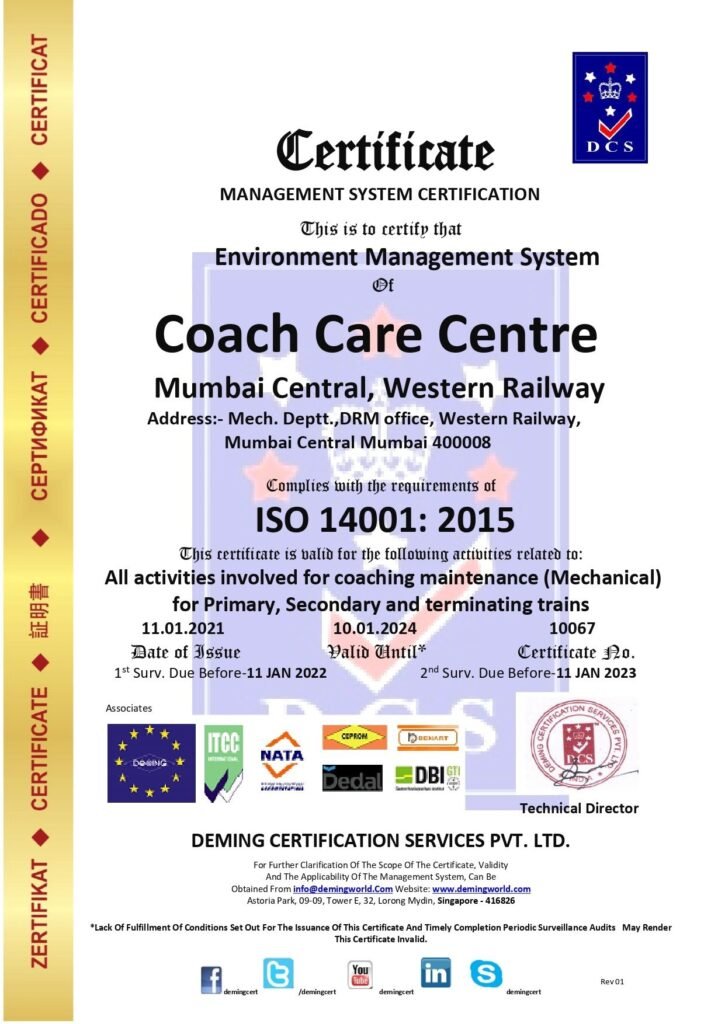
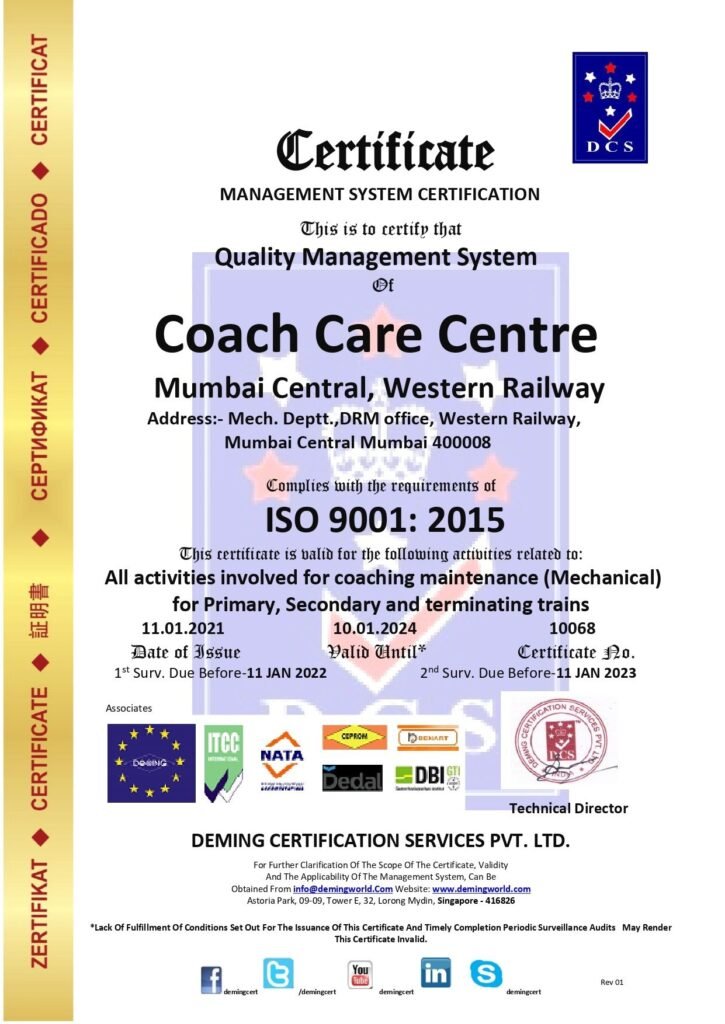
In January 2021, Coach Care Centre Mumbai Central entered an important phase in its management-system journey. Public certification records identify the Centre with ISO 9001:2015, along with ISO 14001:2015 and ISO 45001:2018, with the certificates issued on 11 January 2021 and validity listed through 10 January 2024. The same records also identify an ISO 27001:2018 certification issued on the same date.
For the Centre, ISO 9001:2015 represented more than the achievement of an international certificate. It introduced a structured way of looking at the activities that had already been at the heart of railway maintenance: planning, inspection, execution, verification, documentation, corrective action and continual improvement.
The importance of such a system becomes clearer when the nature of railway maintenance is considered.
A railway coach is not simply a vehicle. It is a combination of numerous mechanical systems and components that must function together. Maintenance personnel must work according to applicable railway instructions, technical requirements and established procedures. A single activity may involve inspection, identification of a defect, allocation of manpower, availability of tools and spares, execution of maintenance, inspection of the completed work and recording of the result.
Therefore, quality cannot be created at the end of the process.
Quality must be built into the process from the beginning.
This philosophy is central to ISO 9001.
The standard encourages organizations to understand their processes, establish responsibilities, control documented information, manage risks and opportunities, monitor performance and continually improve their systems. For a railway maintenance centre, these principles can become highly practical.
An inspection is not merely an inspection. It becomes a controlled activity with defined requirements.
A repair is not simply a mechanical intervention. It becomes part of a process that requires appropriate competence, resources and verification.
A maintenance record is not merely paperwork. It provides evidence of what was performed and can contribute to traceability and future decision-making.
A defect is not merely something to be corrected. It can become an opportunity to understand why the problem occurred and how recurrence may be prevented.
This change in perspective was important for the Centre’s quality journey.
The railway environment also demands coordination. Primary, secondary and terminating trains can present different maintenance requirements and operational constraints. Maintenance personnel must work within available time while ensuring that required activities are not compromised.
This creates a continuous balance between speed and discipline.
Trains operate according to schedules, but maintenance cannot become careless simply because time is limited. The objective is not merely to finish a task quickly. The objective is to complete it correctly, safely and in accordance with applicable requirements.
The ISO 9001 framework supports this philosophy by encouraging process consistency.
Another important part of the Centre’s certification journey was its integrated approach. Along with ISO 9001:2015, the certification records list ISO 14001:2015 for environmental management and ISO 45001:2018 for occupational health and safety. ISO 27001:2018 was also listed for information security.
Together, these standards created a broader management perspective.
Quality asks whether work meets requirements.
Safety asks whether people can perform that work without unacceptable risk.
Environmental management asks how maintenance activities affect the environment.
Information security asks how important information is protected and controlled.
These areas are interconnected.
A well-organized maintenance workplace can improve quality while also improving safety.
Proper storage of materials can reduce safety risks and prevent unnecessary waste.
Correct documentation can support quality while also protecting important information.
Employee training can strengthen technical competence, safety awareness and environmental responsibility at the same time.
This integrated approach helped establish a foundation for organizational maturity.
The certification milestone also reflected the importance of the people working at the Centre. A management system cannot maintain a railway coach. People do.
Technicians inspect.
Supervisors coordinate.
Engineers analyze.
Support personnel maintain records and resources.
Management provides direction.
Every role contributes to the final result.
The real purpose of ISO 9001 is therefore not to replace technical expertise but to provide a structured environment in which that expertise can be used consistently and effectively.
The Centre’s journey can be understood as a transition from individual experience toward organizational knowledge. Experienced railway employees possess enormous practical knowledge. A mature quality system helps capture, standardize and share that knowledge through procedures, training, records and continual improvement.
This becomes particularly important as railway technology develops.
The maintenance environment at Mumbai Central has continued to evolve. Publicly available records from 2024, for example, document the maintenance of a Vande Bharat trainset at Coach Care Centre Mumbai Central and describe technical issues and maintenance coordination following scheduled servicing.
Such developments demonstrate why quality management must remain dynamic.
New technology requires new knowledge.
New equipment requires appropriate procedures.
New defects require analysis.
New maintenance requirements require controlled implementation.
The certification obtained in 2021 can therefore be viewed as the beginning of a continuing journey rather than the conclusion of one.
The certificate provided formal recognition.
The management system provided structure.
The employees provided expertise.
And continual improvement provided direction.
For Coach Care Centre Mumbai Central, the story of quality begins with a simple but powerful principle:
Every coach maintained is connected to the confidence of the passenger who eventually travels in it.
The passenger may never see the maintenance team.
The passenger may never read an inspection record.
The passenger may never know how many technical decisions were made before the train departed.
But the passenger experiences the outcome.
That makes every maintenance activity meaningful.
The journey toward ISO 9001 certification was therefore not simply a journey toward compliance. It was a journey toward strengthening the culture of consistency, accountability, safety and improvement.
And from that point forward, every inspection, every maintenance activity, every corrective action and every lesson learned became part of a larger story—the story of a railway maintenance centre continuously working toward greater reliability and operational excellence.
#CoachCareCentre
Chapter 2 – Building a Culture of Quality Through ISO 9001
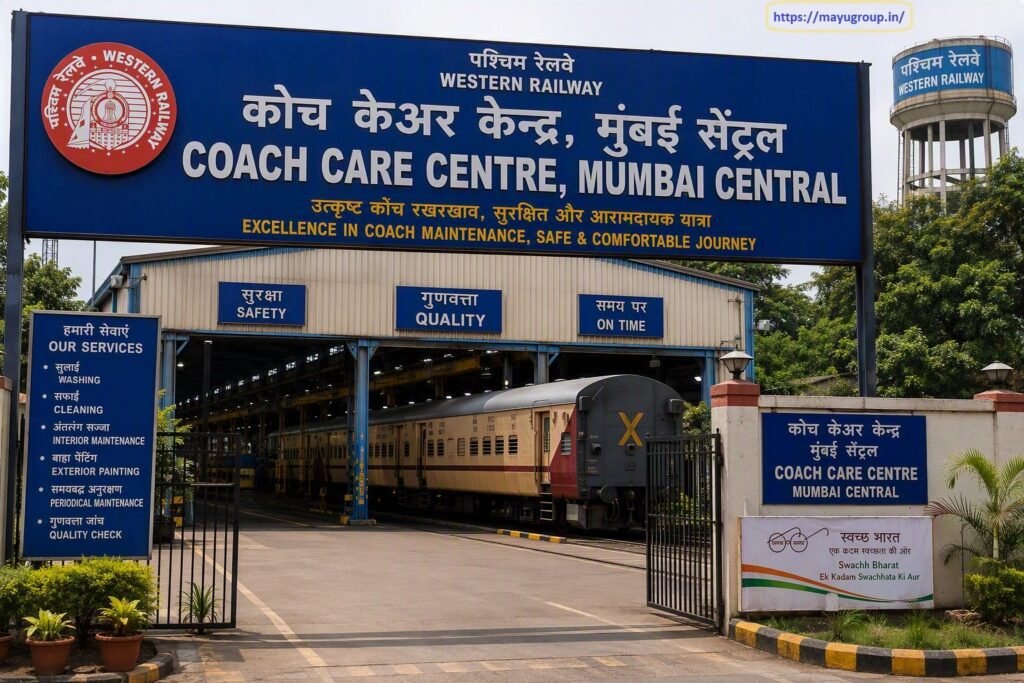
The achievement of ISO 9001:2015 certification marked an important stage in the development of Coach Care Centre Mumbai Central, Western Railway. However, the true significance of certification was not limited to obtaining a certificate. Its greater value lay in creating a structured culture in which quality became a responsibility shared across the organization.
For a railway coaching maintenance centre, quality is directly connected with reliability, safety, operational discipline and passenger confidence. Every train that enters a maintenance facility brings with it a responsibility. Mechanical systems must be examined carefully, defects must be identified, required maintenance must be performed and the completed work must be verified before the coach continues its operational journey.
ISO 9001 provided a framework for organizing these activities in a systematic manner.
The Centre’s certification records identify ISO 9001:2015 as part of its management-system certifications, with certification issued in January 2021 and validity listed through January 2024. The same certification framework also included ISO 14001:2015 and ISO 45001:2018, while ISO 27001:2018 was separately listed for information security.
The first major principle introduced through the quality-management approach was process thinking.
In any maintenance organization, numerous activities take place simultaneously. A coach may arrive for examination while another is undergoing repair. Materials may be required at one location while documentation is being completed at another. Supervisors must coordinate personnel, technicians must perform technical activities and records must be maintained throughout the process.
Without a systematic approach, such complexity can create inconsistencies.
ISO 9001 encourages the organization to understand how individual activities are connected.
An inspection provides information for maintenance planning.
Maintenance planning determines the required resources.
Resources enable technicians to perform the work.
Completed work requires verification.
Verification generates records.
Records provide information for future decisions.
Thus, every activity becomes part of a larger process.
This approach helped establish the understanding that quality is not something checked only at the end. Quality must be built into every stage of maintenance.
For the employees of Coach Care Centre Mumbai Central, this philosophy could be reflected in everyday work.
When a technician inspected a component, the objective was not simply to complete a checklist. The inspection needed to be meaningful.
When a defect was identified, it needed to be properly communicated.
When corrective maintenance was performed, the work needed to be completed using appropriate methods and resources.
When the repair was completed, verification became important.
When the activity was recorded, the record needed to be accurate and traceable.
Such discipline gradually strengthens organizational reliability.
Another important element was documented information.
Railway maintenance depends upon technical instructions, procedures, checklists, records, schedules and other forms of controlled information. If employees use outdated or incorrect information, the quality of work may be affected.
A controlled documentation system therefore provides an important foundation.
Employees should know where relevant information is available.
They should know which version is applicable.
Changes should be communicated appropriately.
Obsolete information should be controlled.
Records should be maintained as evidence of completed activities.
This may appear administrative, but in a maintenance environment documentation can have practical engineering value.
Suppose a recurring defect appears on a coach. Historical records can help the organization understand whether the problem has occurred previously. Maintenance history may provide clues about the frequency of the problem, previous corrective action and possible causes.
Therefore, documentation becomes part of organizational memory.
This is particularly valuable in large organizations where personnel change over time. Individual experience can be lost when employees transfer or retire, but controlled records and procedures help preserve institutional knowledge.
ISO 9001 also emphasizes competence.
A quality system cannot be stronger than the people who operate it. Railway maintenance requires technical knowledge, practical experience and awareness of applicable requirements.
Training therefore becomes an important component of quality.
New employees need orientation.
Existing employees require refresher training.
Technological changes may require specialized training.
Supervisors may require management-system awareness.
Personnel involved in inspections may need appropriate competency.
The objective is not simply to conduct training programs but to ensure that employees are capable of performing their assigned responsibilities effectively.
This people-centered approach can create a stronger quality culture.
Employees begin to understand not only what they are required to do, but also why the requirement matters.
A correctly completed maintenance activity protects the next stage of the process.
An accurately completed record supports traceability.
A reported abnormality provides an opportunity for prevention.
A suggestion for improvement can help strengthen the system.
This encourages employees to become participants in quality rather than simply followers of instructions.
Another important concept is risk-based thinking.
Railway maintenance naturally involves risks. Some are technical, some operational, some safety-related and some associated with information or environmental controls.
A mature organization does not wait for every problem to occur before taking action. It attempts to identify potential problems in advance and establish appropriate controls.
For example, recurring defects can be analyzed.
Maintenance activities can be reviewed for potential weaknesses.
Resources can be planned according to operational requirements.
Training needs can be identified before competency gaps create problems.
Documentation can be reviewed when procedures change.
This preventive approach supports reliability.
The Centre’s quality journey was also connected with the needs of its internal and external stakeholders.
The ultimate external customer is the railway passenger. Passengers expect their journey to be safe, dependable and comfortable. Internal railway departments also depend on effective coaching maintenance because the condition of coaches affects wider train operations.
Therefore, maintenance quality contributes to the reputation of the entire railway system.
A passenger may never know the name of the technician who inspected a coach. Nevertheless, that technician’s work contributes directly to the passenger’s experience.
This creates a strong sense of responsibility.
The ISO 9001 framework also encourages continual improvement.
Improvement does not always require major changes. It may begin with a simple observation.
A checklist can be clarified.
A handover process can be improved.
A recurring defect can be investigated.
A storage arrangement can be reorganized.
A training gap can be addressed.
A record can be simplified without losing necessary information.
Each improvement may appear small, but together they can produce significant organizational maturity.
The greatest achievement of certification occurs when employees stop viewing ISO 9001 as an external requirement and begin treating its principles as part of normal professional practice.
At that stage, quality becomes part of the Centre’s identity.
The certificate becomes evidence of a system.
The system becomes a way of working.
And the way of working becomes a culture.
For Coach Care Centre Mumbai Central, the adoption of ISO 9001:2015 therefore represented an important step toward a more systematic approach to coaching maintenance. It strengthened the connection between people, processes, records, resources and continual improvement.
The journey had begun with certification, but its real destination was much greater: a culture in which every maintenance activity was performed with consistency, responsibility and an understanding that quality ultimately serves the safety and confidence of the travelling public.
#MumbaiCentral
Chapter 3 – The People Behind the Quality Transformation
The success of any management system ultimately depends on people. Procedures, checklists, records, audits and standards can provide structure, but it is the workforce that turns these requirements into practical results. At Coach Care Centre Mumbai Central, Western Railway, the journey toward ISO 9001:2015 certification therefore became not only a story about processes but also a story about people—the employees, supervisors, engineers, technicians and support personnel whose daily efforts keep railway coaching maintenance moving forward.
The Centre operates under the Mechanical Department of Western Railway, with its scope covering activities involved in coaching maintenance for primary, secondary and terminating trains. Such responsibilities require coordination between different levels of personnel. Each person contributes to the final objective of maintaining coaches in an appropriate condition for their intended railway service.
When ISO 9001 was introduced into the Centre’s management framework, one of its most important messages was that quality is everyone’s responsibility.
Previously, an employee might have viewed quality as something primarily associated with inspection. The quality-management approach encouraged a broader understanding. Quality begins with planning, continues through execution and is confirmed through appropriate inspection and verification.
A technician working on a mechanical component has a direct influence on quality.
A supervisor coordinating maintenance activities also has a direct influence on quality.
An employee maintaining records contributes to quality.
A manager reviewing performance contributes to quality.
Even an employee reporting an abnormal condition contributes to quality because early reporting creates an opportunity to prevent a larger problem.
This change in mindset is essential in a railway maintenance environment.
Developing Competence
One of the fundamental principles of ISO 9001 is competence. Employees performing work that affects quality must possess appropriate knowledge, skills and experience.
Railway maintenance is highly dependent on technical competence. Mechanical systems require careful inspection and correct maintenance practices. Employees must understand applicable instructions and know how to use tools and equipment appropriately.
Training therefore becomes a continuous activity rather than a one-time event.
New employees may require induction into organizational procedures and workplace requirements. Experienced personnel may require refresher training. Changes in equipment or technology may require additional technical training. Employees involved in management-system activities may require awareness of quality, safety and environmental requirements.
The objective is not merely to conduct training programs. The real objective is to ensure that employees can apply what they have learned.
This creates an important connection between training and operational performance.
A trained employee is more likely to recognize an abnormal condition.
A competent technician is more likely to perform a maintenance activity consistently.
An informed supervisor is better positioned to identify process weaknesses.
An employee who understands the purpose of documentation is more likely to maintain accurate records.
In this way, competence strengthens the entire management system.
Experience as Organizational Knowledge
Railway organizations contain enormous amounts of practical knowledge. Experienced technicians often understand recurring defects, common maintenance challenges and practical solutions that may not be obvious to someone new to the job.
ISO 9001 provides a framework through which organizations can preserve and share organizational knowledge.
Instead of allowing valuable knowledge to remain only with individuals, organizations can incorporate lessons into procedures, training, records and improvement activities.
This becomes especially important when employees are transferred, promoted or retire.
A quality system helps ensure that learning remains within the organization.
For Coach Care Centre Mumbai Central, this approach was particularly valuable because maintenance requirements can evolve with railway technology.
Publicly available records from 2024 demonstrate that the Centre’s maintenance environment had expanded to include activities associated with Vande Bharat trainsets, including technical coordination and maintenance-related changes.
As technology develops, the knowledge required by maintenance personnel also changes.
The organization must therefore encourage learning.
Communication Across Shifts
Another major factor in maintenance quality is communication.
Railway maintenance does not necessarily stop when one employee’s shift ends. Work can continue across different shifts and teams. Information about defects, incomplete activities, special instructions and maintenance requirements therefore needs to be communicated effectively.
A strong handover process can prevent information from being lost.
Suppose a technician identifies an abnormality near the end of a shift. If that information is not communicated properly, the next team may not know about the issue. A controlled communication process reduces this risk.
ISO 9001 encourages organizations to determine appropriate internal communication arrangements.
In practice, this means that people should know what information needs to be communicated, to whom, when and through which appropriate channel.
Good communication creates continuity.
Employees and Safety
Quality cannot be separated from occupational safety.
The Centre’s certification framework also included ISO 45001:2018, reflecting the importance of occupational health and safety alongside quality management. Public certification records list ISO 45001:2018 together with ISO 9001:2015 and ISO 14001:2015 for the Centre.
Mechanical maintenance can involve numerous workplace hazards. Employees may work around railway coaches, mechanical equipment, tools, lifting arrangements and other potentially hazardous conditions.
A quality-oriented organization therefore understands that a job cannot be considered successful if it is completed by compromising employee safety.
Safety awareness becomes part of professional competence.
Employees should be encouraged to identify hazards, report unsafe conditions and follow established safety controls. Supervisors play an important role by reinforcing safe practices and responding appropriately to observations.
The objective is to create a culture in which employees do not remain silent when they see a potential hazard.
Employee Participation in Improvement
One of the strongest signs of a mature organization is employee participation.
People working directly on maintenance activities often see opportunities for improvement before anyone else does.
A technician may notice that a particular task takes unnecessarily long.
A supervisor may identify repeated delays.
An employee may notice that a particular form is confusing.
Another may identify a recurring defect.
These observations can become improvement opportunities.
The ISO 9001 philosophy encourages organizations to use information and evidence to improve processes. Employee suggestions can therefore become valuable inputs into continual improvement.
When employees see that their suggestions are taken seriously, they become more engaged.
Quality stops being something imposed from above.
It becomes something developed collectively.
Creating Professional Pride
The most important human outcome of certification may be professional pride.
Railway maintenance personnel often work behind the scenes. Passengers see trains and stations, but they rarely see the maintenance teams responsible for keeping coaches operational.
Yet every maintenance activity carries responsibility.
The technician checking a component may never meet the passenger who ultimately travels in that coach.
The employee completing a maintenance record may never know how the information is used later.
The supervisor verifying completed work may never receive personal recognition.
Nevertheless, each person contributes to the reliability of the railway system.
ISO 9001 helps make this responsibility visible.
It reminds the organization that quality is created by people performing their duties correctly and consistently.
A Stronger Team for the Future
The certification journey of Coach Care Centre Mumbai Central can therefore be viewed as a journey in human development as much as process development.
The management system provides the structure.
Training develops competence.
Communication creates continuity.
Employee participation generates improvement.
Safety awareness protects the workforce.
Experience creates organizational knowledge.
Together, these elements build a stronger team.
The certificate obtained in 2021 was an important milestone, but its lasting value depends upon the people who continue to apply the principles behind it. A management system becomes meaningful only when employees understand that every inspection, every maintenance activity, every record and every improvement contributes to a much larger objective.
That objective is reliability.
It is safety.
It is service.
And ultimately, it is the confidence of the travelling public.
For Coach Care Centre Mumbai Central, the people behind the process remain the most important part of the quality story. Standards can define requirements, but committed employees transform those requirements into everyday performance.
#WesternRailway
Chapter 4 – Quality at the Heart of Coaching Maintenance
The journey of Coach Care Centre Mumbai Central, Western Railway, toward ISO 9001:2015 certification was fundamentally a journey toward strengthening the way maintenance activities were planned, performed, checked and improved. In a railway environment, quality is not an abstract concept. It has a direct relationship with operational reliability, passenger confidence, employee safety and the overall effectiveness of railway services.
The Centre’s defined scope covers all activities involved in coaching maintenance (Mechanical) for primary, secondary and terminating trains. This broad scope places maintenance quality at the centre of its responsibilities. Every coach entering the maintenance system represents an asset that must be examined carefully, maintained appropriately and returned to service in accordance with applicable requirements.
ISO 9001 introduced a structured philosophy: quality should be built into the process rather than inspected only at the end.
This principle changed the way maintenance activities could be viewed.
A coach does not suddenly become “quality compliant” at the moment a final inspection is completed. Its condition is influenced by everything that happened before that inspection.
It begins with planning.
It continues with examination.
It involves identifying defects.
It requires appropriate tools, equipment, materials and competent personnel.
It includes the actual maintenance work.
It requires verification.
And it ends with appropriate documentation and release according to applicable railway requirements.
Every stage matters.
From Inspection to Prevention
One of the most important ideas associated with a mature quality system is prevention.
A reactive maintenance approach generally responds after a problem occurs. A stronger quality approach attempts to identify conditions that could result in problems before they become serious.
For example, if a particular type of defect repeatedly appears, simply repairing the defect each time may not be sufficient.
The organization needs to ask:
Why does the defect keep occurring?
Could the cause be related to a component?
Could it be associated with installation?
Could the maintenance method be improved?
Could operating conditions be contributing to the problem?
Could an inspection requirement be strengthened?
Could employee training address the issue?
These questions shift attention from correction to prevention.
This is where ISO 9001 becomes particularly useful. It encourages organizations to analyze problems systematically and implement corrective actions that address causes rather than merely treating symptoms.
The Importance of Standardized Processes
Railway maintenance involves numerous activities and numerous employees. If every person performs the same task differently, consistency can become difficult.
Standardized processes provide a common foundation.
A technician should know the applicable requirements.
A supervisor should understand how the activity is controlled.
Inspection personnel should know what needs to be verified.
Records should demonstrate what was completed.
This does not mean that professional judgment becomes unnecessary. Rather, standardization provides a framework within which professional judgment can be applied.
Standardization also makes training easier.
When a process is clearly defined, a new employee can learn the expected method more effectively. Experienced employees can identify deviations more easily. Supervisors can monitor performance against established requirements.
Over time, standardization reduces unnecessary variation.
Documentation as Evidence
In a maintenance organization, documentation is often viewed as administrative work. However, controlled records have substantial technical value.
A maintenance record can provide evidence that an activity was performed.
An inspection record can show what was observed.
A corrective-action record can demonstrate how a problem was addressed.
A training record can demonstrate employee competence development.
An audit record can show how the management system was evaluated.
Together, these records create organizational memory.
This is especially important when a recurring issue needs to be investigated.
Historical information may reveal patterns that cannot be identified from a single inspection.
Therefore, accurate documentation supports not only compliance but also engineering decision-making.
Quality and Reliability
The ultimate purpose of coaching maintenance is to support reliable railway operations.
When coaches are maintained systematically, the organization can improve its ability to identify defects and address maintenance requirements.
Reliability is built through many small activities.
A careful inspection.
A properly performed repair.
A correctly installed component.
A verified maintenance activity.
An accurately maintained record.
A timely corrective action.
Each activity may appear small when considered individually, but together they contribute to the larger performance of the railway system.
The ISO 9001 philosophy helps connect these activities.
Instead of seeing each maintenance task as an isolated event, employees can understand how their work contributes to the overall process.
Managing Nonconformities
No maintenance organization can expect every activity to be perfect at all times. Equipment can develop defects. Procedures can be misunderstood. Records can contain errors. Unexpected conditions can arise.
The maturity of an organization is therefore not demonstrated by claiming that problems never occur.
It is demonstrated by how effectively problems are managed.
ISO 9001 encourages organizations to control nonconforming outputs and take appropriate corrective action.
This creates an important learning cycle.
A problem is identified.
The immediate issue is controlled.
The cause is investigated.
Corrective action is determined.
The action is implemented.
Its effectiveness is evaluated.
The organization then learns from the experience.
This approach prevents the same problem from becoming a repeated cycle of temporary repairs.
Quality Under Operational Pressure
Railway maintenance often takes place under time constraints.
Trains operate according to schedules.
Maintenance windows may be limited.
Different departments may need to coordinate simultaneously.
Resources must be managed carefully.
These pressures can make disciplined processes even more important.
When time is limited, employees may be tempted to focus only on completing the immediate task.
A strong quality culture reminds them that speed cannot replace correctness.
A job completed quickly but incorrectly may create a larger problem later.
Therefore, quality management helps establish a balance between efficiency and conformity.
The objective is not simply to work faster.
The objective is to work effectively, consistently and correctly.
Coordination Across Maintenance Activities
The Centre’s scope covering primary, secondary and terminating trains means that its maintenance activities operate within different operational circumstances.
Each type of maintenance activity may involve different planning considerations.
The organization must understand what work is required, what resources are available and what verification is necessary.
This makes coordination critical.
A maintenance activity performed by one team may create information required by another.
A defect identified during one stage may require action during another.
A component requiring specialized attention may involve another workshop or technical facility.
Good communication and controlled records help maintain continuity.
Publicly available railway records from 2024 illustrate this evolving maintenance environment. Documents concerning Vande Bharat trainset maintenance at Mumbai Central describe coordination for scheduled maintenance and technical issues, demonstrating the increasing technical complexity of the Centre’s responsibilities.
Continual Improvement
Perhaps the most important quality principle is that there is always an opportunity to improve.
A mature organization does not ask only, “Did we complete the work?”
It also asks:
“What did we learn?”
Could the process be simpler?
Could an error be prevented?
Could inspection become more effective?
Could employees receive better training?
Could information be communicated more clearly?
Could maintenance planning be improved?
Could recurring defects be reduced?
These questions transform everyday work into a source of organizational learning.
Small improvements can eventually produce major benefits.
A better checklist may save time.
Better material organization may improve efficiency.
Clearer instructions may reduce errors.
Improved training may strengthen competence.
More effective root-cause analysis may prevent recurrence.
Thus, continual improvement becomes a habit rather than a special project.
A Culture Where Quality Becomes Natural
The greatest achievement of ISO 9001 is reached when quality no longer feels like an additional responsibility.
Employees begin to understand that quality is already part of their work.
The technician knows that careful workmanship matters.
The supervisor knows that verification matters.
The records personnel know that traceability matters.
Management knows that improvement matters.
Everyone understands that the final objective is not merely obtaining certification but maintaining a dependable system.
For Coach Care Centre Mumbai Central, the ISO 9001:2015 certification of 2021 therefore represented an important foundation for strengthening its quality culture. It created a framework in which maintenance activities could be approached through process control, competence, documentation, verification, corrective action and continual improvement.
The certificate itself was only the visible symbol.
The real achievement was the discipline behind it.
Every coach maintained represents a contribution to railway reliability.
Every defect identified represents an opportunity for prevention.
Every corrective action represents organizational learning.
Every trained employee represents stronger capability.
And every improvement contributes to a safer and more dependable railway service.
In this way, quality became more than a requirement. It became a professional commitment—one that connected the daily work of the Coach Care Centre with the larger responsibility of keeping India’s railway passengers moving with confidence.
#IndianRailways
Chapter 5 – Integrating Quality, Safety and Environmental Responsibility
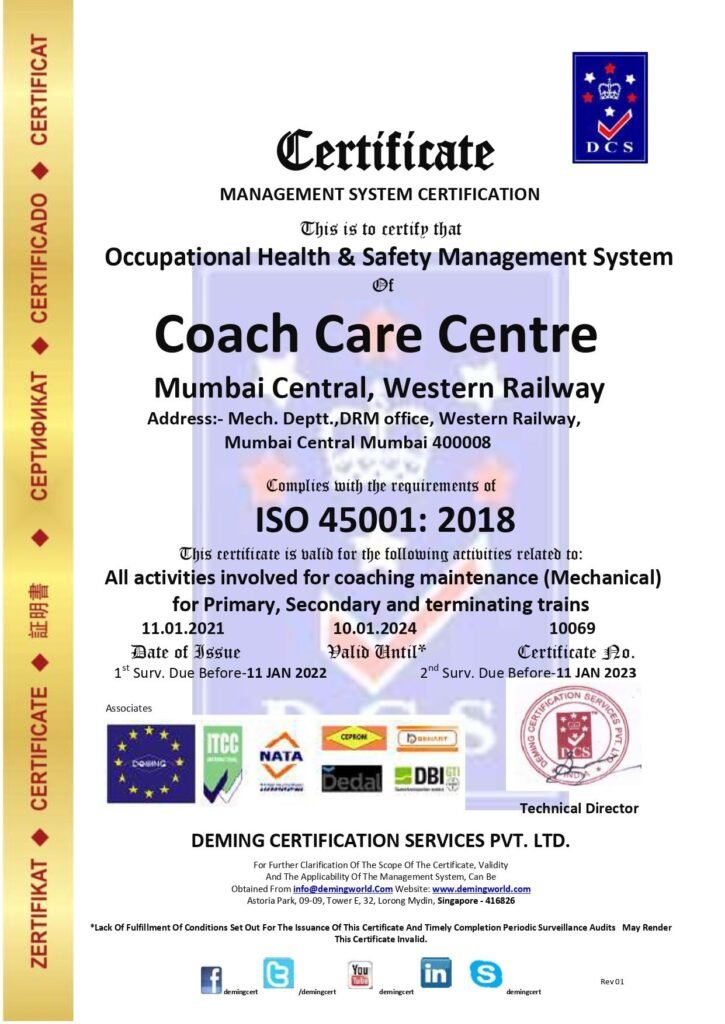
The journey of Coach Care Centre Mumbai Central, Western Railway, after achieving ISO 9001:2015 certification was not limited to improving the quality of mechanical maintenance. The Centre’s management framework also incorporated environmental management and occupational health and safety, creating a broader approach to operational excellence.
The certification records identify the Centre with ISO 14001:2015, ISO 9001:2015 and ISO 45001:2018, with certification issued in January 2021 and validity listed through January 2024. ISO 27001:2018 was also listed as part of the Centre’s certification framework.
This combination was significant because railway coaching maintenance involves more than technical performance. Every maintenance activity takes place within a workplace, uses resources and can create environmental impacts. Therefore, quality, safety and environmental responsibility must work together.
For the employees of Coach Care Centre Mumbai Central, this integrated approach meant understanding that a successful maintenance activity is not simply one in which a technical task has been completed. It is one in which the work has been performed correctly, safely and responsibly.
Quality and Safety – Two Sides of the Same Responsibility
Mechanical maintenance can involve a variety of workplace hazards. Employees may work around railway coaches, mechanical equipment, tools, lifting arrangements, components and other operational activities. Such an environment requires attention, discipline and adherence to established safety controls.
The introduction of ISO 45001:2018 alongside ISO 9001:2015 strengthened the connection between safety and quality.
A job cannot genuinely be called high-quality if it has been completed by unnecessarily exposing an employee to danger.
Similarly, an efficient maintenance process cannot be considered successful if it creates unsafe working conditions.
This philosophy encourages employees to think before beginning an activity.
What hazards are present?
What controls are required?
Are the necessary tools and equipment available?
Are employees competent to perform the work?
Are appropriate precautions being followed?
What should happen in an emergency?
These questions help create a preventive safety culture.
The purpose of such a culture is not to create fear. It is to create awareness.
Employees should feel comfortable reporting unsafe conditions. Supervisors should respond to those observations. Management should ensure that corrective actions are considered and implemented where appropriate.
Over time, this can transform safety from a set of instructions into a daily habit.
Environmental Responsibility in Maintenance
Mechanical maintenance also has an environmental dimension.
Maintenance activities can involve oils, lubricants, cleaning materials, metal components, packaging materials and other waste. Water and energy may also be consumed during various activities.
ISO 14001:2015 provides a structured framework for identifying and managing environmental aspects associated with organizational activities.
For the Coach Care Centre, environmental awareness can be reflected through everyday practices.
Waste should be appropriately handled.
Materials should be used responsibly.
Spills and leakages should be prevented and controlled.
Waste materials should be managed according to applicable requirements.
Energy consumption should be considered.
Employees should understand how their actions affect the surrounding environment.
These practices may appear small individually, but a maintenance centre operates continuously. Small improvements repeated every day can become meaningful over time.
Environmental management therefore becomes part of operational discipline.
The Integrated Management Approach
One of the major strengths of having several management standards is the possibility of integrating their requirements.
Instead of maintaining completely separate systems, an organization can establish common processes wherever practical.
For example, training can address quality, safety and environmental awareness together.
Internal audits can examine multiple management-system requirements.
Management reviews can consider quality performance, safety performance and environmental objectives.
Corrective-action systems can address issues across different areas.
Document control can support all management systems.
This integrated approach reduces duplication and encourages employees to see the organization as one connected system.
A technician does not think in separate categories while performing work.
The technician is simultaneously responsible for performing the job correctly, working safely and avoiding unnecessary environmental impact.
Integration reflects this reality.
Building Awareness Among Employees
The effectiveness of any environmental or safety system depends heavily on employee awareness.
A procedure may exist, but if employees do not understand its purpose, implementation may become weak.
Awareness can be developed through induction programs, toolbox discussions, refresher training, posters, instructions, safety meetings and practical demonstrations.
Employees can be encouraged to identify hazards and environmental concerns within their own work areas.
This creates a participative culture.
A technician who notices an oil leakage can report it.
A worker who observes an unsafe arrangement can bring it to the supervisor’s attention.
An employee who identifies unnecessary wastage can suggest a better method.
A supervisor who receives such information can initiate corrective action.
This creates a cycle of awareness and improvement.
Preventing Problems Before They Occur
The combined philosophy of ISO 9001, ISO 14001 and ISO 45001 places considerable importance on prevention.
Prevention is often more effective than correction.
If a workplace hazard is identified before an incident, preventive action can be taken.
If an environmental risk is identified before a spill occurs, controls can be strengthened.
If a quality problem is identified before a coach is released, corrective action can be taken.
This creates a common principle across the management systems:
Identify risks early. Control them systematically. Learn from experience.
Such thinking is especially valuable in railway maintenance because the consequences of an uncontrolled problem can extend beyond the immediate workplace.
Safety as Part of Professional Pride
There is also a human dimension to safety.
Employees who work in maintenance environments develop professional pride in their technical skills. A strong safety culture adds another dimension to that pride.
A professional does not simply complete a task.
A professional completes it correctly.
A professional follows appropriate safety controls.
A professional protects colleagues.
A professional reports hazards.
A professional maintains the workplace responsibly.
This understanding creates a culture in which safety becomes a sign of professionalism rather than an obstacle to productivity.
Environmental Responsibility and the Future
Environmental expectations are becoming increasingly important across industries. Railway organizations are also expected to use resources responsibly and manage environmental impacts effectively.
For a maintenance centre, this means that environmental responsibility should not be considered a separate project.
It should be integrated into routine operations.
Good housekeeping can reduce waste.
Controlled material storage can prevent contamination.
Efficient resource use can reduce unnecessary consumption.
Appropriate waste management can improve workplace organization.
Employee awareness can encourage responsible behavior.
Each improvement contributes to a more sustainable maintenance environment.
The Role of Leadership
Leadership is essential for integrating quality, safety and environmental responsibility.
Employees observe what management considers important.
If management regularly reviews quality performance, employees understand that quality matters.
If management responds seriously to safety concerns, employees are more willing to report hazards.
If environmental objectives are monitored, employees understand that environmental responsibility is genuine.
Therefore, leadership transforms written management-system requirements into organizational culture.
The certification framework gave Coach Care Centre Mumbai Central a formal structure, but its effectiveness depended upon continued implementation by employees and management.
A Stronger Foundation for Growth
The combination of ISO 9001, ISO 14001 and ISO 45001 created a broader foundation for the Centre’s development.
Quality supported reliability.
Safety supported employee protection.
Environmental management supported responsible operations.
Together, they contributed to sustainable organizational performance.
The Centre’s certification journey therefore demonstrated an important principle: operational excellence cannot be achieved by focusing on one dimension alone.
A maintenance organization must be technically capable, but it must also be safe.
It must be efficient, but it must also be environmentally responsible.
It must maintain records, but it must also protect important information.
It must solve today’s problems, but it must also learn from them to prevent tomorrow’s problems.
That integrated philosophy became an important part of the Centre’s development after ISO 9001 certification.
The certificate represented recognition, but the real transformation occurred through daily behavior.
Every correctly completed maintenance activity strengthened quality.
Every hazard identified strengthened safety.
Every responsible environmental practice strengthened sustainability.
Every lesson learned strengthened the organization.
And together, these actions created a stronger foundation for the continuing journey of Coach Care Centre Mumbai Central, Western Railway—toward reliability, responsibility and continual improvement.
#ISO9001
Chapter 6 – From Certification to Continuous Improvement
The achievement of ISO 9001:2015 certification in 2021 represented an important milestone in the journey of Coach Care Centre Mumbai Central, Western Railway. However, certification itself was never the final destination. The real value of a quality-management system emerges only when the principles of the standard become part of everyday operations and continue to guide the organization toward improvement.
For a railway coaching maintenance centre, this principle is especially important. Railway operations are constantly changing. Maintenance requirements evolve, technologies become more sophisticated, employee responsibilities change and operational expectations continue to increase. A system that remains unchanged cannot effectively support a changing organization.
Continuous improvement therefore became an important part of the Centre’s quality journey.
The fundamental question was no longer simply, “Are we following the procedure?”
It became:
“Is the procedure still effective, and how can the process be improved?”
The Meaning of Continual Improvement
ISO 9001 encourages organizations to continually improve the suitability, adequacy and effectiveness of their quality-management systems.
For Coach Care Centre Mumbai Central, improvement could take many forms.
A maintenance process might be reorganized.
An inspection checklist might be clarified.
A recurring defect might be investigated.
Employee training might be strengthened.
A communication process might be improved.
Maintenance records might be made easier to understand.
Material management might be reviewed.
Each of these changes can contribute to better performance.
Continuous improvement does not necessarily mean introducing expensive technology or completely redesigning a system. Often, the most valuable improvements come from understanding everyday problems and finding practical solutions.
A small improvement repeated across many maintenance activities can eventually produce a substantial organizational benefit.
Learning from Nonconformities
Every large maintenance operation can experience problems. Components may develop defects, records may contain errors, activities may not proceed exactly as planned and unexpected conditions may arise.
A mature quality system does not attempt to hide these problems.
Instead, it creates a mechanism for identifying, controlling and learning from them.
When a nonconformity occurs, the immediate issue must first be addressed. But a stronger response asks why the problem happened.
Was the procedure unclear?
Was the employee adequately trained?
Was the required material available?
Was the equipment suitable?
Was the inspection sufficient?
Was there a communication gap?
Was the underlying process itself weak?
Finding the root cause is important because correcting only the immediate symptom may allow the problem to return.
For example, repeatedly repairing the same type of defect without understanding its cause may consume resources without producing lasting improvement. Root-cause analysis changes the approach from repeated correction to prevention.
This is one of the most valuable contributions of ISO 9001 to maintenance operations.
Internal Audits as a Learning Tool
Internal audits are another important part of continual improvement.
An audit should not be viewed simply as an exercise designed to find mistakes. Its greater purpose is to determine whether the management system is functioning as intended.
Auditors can examine whether processes are being followed, whether records are maintained, whether employees understand their responsibilities and whether corrective actions have been effective.
A good audit can reveal both weaknesses and strengths.
A weakness provides an opportunity for corrective action.
A strength can become a good practice that may be shared across other activities.
This creates organizational learning.
For employees, audits can also improve awareness. When people understand why a particular process exists, they are more likely to appreciate its importance rather than treating it as unnecessary paperwork.
The audit process therefore becomes a mechanism for strengthening the organization’s culture.
Management Review and Leadership
Continuous improvement also requires leadership involvement.
Management review provides an opportunity to examine the performance of the management system and determine whether changes are required.
Questions may include:
Are quality objectives being achieved?
What recurring problems have been identified?
Are corrective actions effective?
Are employees receiving appropriate training?
Are resources sufficient?
Have operational risks changed?
Are customer or stakeholder expectations being addressed?
Are improvement opportunities being identified?
These questions connect daily maintenance activities with organizational decision-making.
Leadership is important because some improvements require resources or changes beyond the authority of individual employees.
An employee may identify a problem, but management may need to approve additional equipment, training, staffing or process changes.
Thus, improvement requires a connection between the maintenance floor and organizational leadership.
Employee Suggestions and Kaizen Thinking
Employees working directly with railway coaches often possess valuable practical knowledge.
They see problems that may not always be visible in management reports.
A technician may notice that a particular maintenance activity could be performed more efficiently.
A supervisor may observe a recurring coordination problem.
An experienced employee may identify a better way to organize tools or materials.
These observations can become improvement opportunities.
The concept of Kaizen, or continuous incremental improvement, fits naturally into this environment.
Instead of waiting for one large transformation, the organization can encourage employees to make small improvements regularly.
One improved checklist.
One better handover practice.
One clearer instruction.
One safer arrangement.
One improved storage method.
One better training module.
Over time, these changes can create a significant improvement in organizational maturity.
Preparing for Technological Change
The need for continuous improvement becomes even more important as railway technology develops.
Modern trainsets and railway systems can require increasingly sophisticated maintenance knowledge. Publicly available records from 2024 show maintenance-related activities at Mumbai Central involving a Vande Bharat trainset, including coordination for scheduled maintenance and technical changes.
Such developments demonstrate that maintenance organizations must continually develop their capabilities.
When new technology arrives, employees require appropriate knowledge.
When equipment changes, maintenance methods may need to change.
When technical instructions are revised, controlled documentation must be updated.
When new risks appear, controls may need to be strengthened.
A quality-management system helps provide a structured method for managing these changes.
Measuring Improvement
Another important element of continual improvement is measurement.
An organization cannot effectively manage improvement if it has no information about performance.
Appropriate monitoring can help identify trends and recurring issues.
For a maintenance centre, useful information may include maintenance findings, recurring defects, corrective actions, inspection results, training status, audit findings and other applicable operational indicators.
The objective is not to collect data simply for the sake of reporting.
Data should help answer practical questions.
Where are problems occurring?
Are they increasing or decreasing?
Are corrective actions working?
Which processes require attention?
Where should resources be focused?
Evidence-based decision-making allows management to move beyond assumptions.
From Reactive to Preventive Thinking
One of the greatest signs of maturity is the movement from reactive thinking toward preventive thinking.
Reactive thinking asks:
“What should we do now that the problem has happened?”
Preventive thinking asks:
“What can we do so that the problem does not happen again?”
The difference may appear simple, but it can transform an organization.
A recurring maintenance defect becomes an opportunity for root-cause analysis.
A repeated documentation error becomes an opportunity to improve training or simplify the process.
A repeated safety observation becomes an opportunity to strengthen controls.
A repeated environmental issue becomes an opportunity to improve workplace practices.
This approach turns problems into sources of knowledge.
Maintaining the Spirit of Certification
The certification records for Coach Care Centre Mumbai Central identify ISO 9001:2015 along with ISO 14001:2015 and ISO 45001:2018, with certification beginning in January 2021 and the listed validity extending into January 2024. ISO 27001:2018 was also included in the Centre’s certification framework.
But the spirit of certification goes beyond the validity period printed on a certificate.
The real objective is to establish a culture capable of sustaining improvement.
A certificate can demonstrate that a management system has been assessed against defined requirements.
Only the organization can keep that system alive.
This requires leadership commitment, employee participation, regular monitoring, effective corrective action and a willingness to learn.
The Road from Compliance to Excellence
The greatest transformation occurs when employees stop thinking:
“We are doing this because ISO requires it.”
and begin thinking:
“We are doing this because it improves the quality of our work.”
That is the point where compliance becomes culture.
At Coach Care Centre Mumbai Central, ISO 9001 provided a framework for creating this transition. It encouraged process thinking, evidence-based decisions, corrective action, employee competence and continual improvement.
The certification was therefore not an endpoint.
It was a foundation.
The Centre’s future strength would depend on its ability to learn from experience, respond to technological change, develop its workforce and continually improve its maintenance processes.
Every inspection could provide learning.
Every defect could provide information.
Every audit could identify an opportunity.
Every employee suggestion could contribute to improvement.
Every corrective action could make the system stronger.
In this way, the journey that began with ISO 9001 certification in 2021 could continue as a long-term journey of operational excellence.
The certificate marked recognition.
The management system created discipline.
The employees created performance.
And continual improvement created the path forward.
For Coach Care Centre Mumbai Central, this philosophy transformed quality from a certification requirement into a continuing commitment—one capable of supporting the Centre as railway technology, maintenance requirements and passenger expectations continued to evolve.
#QualityManagement
Chapter 7 – Strengthening Reliability and Operational Readiness
The journey of Coach Care Centre Mumbai Central, Western Railway, after ISO 9001:2015 certification was closely connected with one of the most important objectives of railway maintenance: reliability. A railway coach must be maintained in a condition suitable for its intended service, and achieving this requires much more than repairing defects after they appear. It requires planning, inspection, preventive maintenance, competent personnel, appropriate resources, verification and continual learning.
The Centre’s defined scope covers all activities involved in coaching maintenance (Mechanical) for primary, secondary and terminating trains. This broad responsibility places the maintenance organization within a demanding operational environment where time, coordination and technical accuracy must work together.
The ISO 9001 approach helped provide a structured framework for managing these requirements.
Reliability Begins with Preparation
A reliable maintenance activity begins before the technician starts working on a coach.
The organization needs to understand what maintenance is required, which personnel are needed, what tools and equipment are necessary and what materials may be required.
Good preparation reduces avoidable interruptions.
If the right material is unavailable, work may be delayed.
If the required equipment is not ready, the maintenance sequence may be affected.
If responsibilities are unclear, coordination may become difficult.
Therefore, planning becomes an important part of quality.
ISO 9001 encourages organizations to determine the processes needed to achieve intended results and to control those processes appropriately.
For Coach Care Centre Mumbai Central, this principle can be translated into practical maintenance discipline.
The objective is simple:
Prepare correctly so that work can be performed correctly.
Primary, Secondary and Terminating Maintenance
The Centre’s scope includes maintenance activities associated with primary, secondary and terminating trains. Each situation can present its own operational considerations.
Primary maintenance generally involves comprehensive attention to a rake as part of its designated maintenance cycle.
Secondary maintenance can involve examination and maintenance after a train has completed service elsewhere.
Terminating train maintenance requires attention within the available time before the train continues its operational cycle.
Although the specific activities can vary, the quality principles remain consistent.
Requirements must be understood.
Work must be planned.
Competent employees must perform the activity.
Results must be verified.
Records must be maintained.
Any abnormality must be appropriately addressed.
This consistency is essential because railway operations depend upon coordination.
Balancing Time and Quality
Railway maintenance frequently operates under time pressure.
Trains have schedules.
Coaches have operational commitments.
Maintenance windows can be limited.
Personnel may need to complete several activities within a defined period.
Such conditions can create pressure to prioritize speed.
However, speed without control can create quality risks.
A maintenance task completed incorrectly may create additional work later.
A missed inspection can result in an undetected defect.
An incomplete record can make future troubleshooting more difficult.
Therefore, an effective quality system helps create discipline under pressure.
The objective is not simply to complete work faster.
It is to complete the right work, correctly and safely, within the required operational framework.
This is where standardized processes become valuable.
They give employees a common reference point even when operational conditions become demanding.
The Importance of Coordination
Modern railway maintenance rarely involves only one individual or one department.
A coach may require activities involving different technical teams.
Some components may require specialized attention.
Materials may need to be obtained from another location.
Technical information may need to be communicated between facilities.
Maintenance findings may need to be reported to appropriate authorities.
Therefore, coordination becomes a major part of reliability.
A weakness in communication can create a weakness in maintenance.
If one team completes an activity but fails to communicate important information to the next team, continuity can be affected.
Controlled records, shift handovers and appropriate communication channels help reduce such risks.
Publicly available railway records from 2024 demonstrate the increasingly interconnected nature of maintenance activities at Mumbai Central. Records concerning a Vande Bharat trainset describe scheduled maintenance coordination involving Coach Care Centre Mumbai Central and Matunga workshop.
Such coordination reflects the evolving technical environment in which modern railway maintenance is performed.
Materials and Resources
Another essential element of operational readiness is resource availability.
A technically skilled employee cannot complete a maintenance activity effectively without the necessary tools, equipment and materials.
This makes resource planning part of quality management.
Materials should be appropriately identified and controlled.
Tools and equipment should be suitable for their intended purpose.
Where measurement equipment is used to support decisions, appropriate control and verification become important.
Storage arrangements should support accessibility while also protecting materials from damage or deterioration.
These activities may appear routine, but they influence the reliability of the entire maintenance process.
Poor material organization can create delays.
Incorrect identification can create quality risks.
Inadequate equipment can affect maintenance effectiveness.
Good resource management therefore contributes directly to operational readiness.
Preventive Thinking and Recurring Defects
Reliability is strengthened when organizations learn from recurring problems.
Suppose a particular defect appears repeatedly.
The immediate response may be to repair the affected component.
But the stronger question is:
Why does this defect continue to occur?
Root-cause analysis can examine whether the problem is associated with equipment, components, installation, maintenance methods, operating conditions, inspection practices or other factors.
Once the underlying cause is understood, corrective action can be considered.
This approach can help prevent repeated failures and reduce unnecessary maintenance effort.
It also creates organizational knowledge.
The next team encountering a similar issue has more information available.
Thus, every problem can become a learning opportunity.
Modernizing the Maintenance Environment
The maintenance environment at Mumbai Central has continued to evolve with railway technology.
Publicly available records from 2024 document maintenance-related activities involving a Vande Bharat trainset at the Coach Care Centre. One record discusses a technical change involving a pre-filter added to the hot-water boiler system in the pantry, while other records discuss scheduled maintenance and associated technical issues.
Such developments illustrate why maintenance organizations must continually develop their capabilities.
New trainsets can introduce new systems.
New systems require new technical knowledge.
New technical knowledge requires training.
New maintenance requirements require appropriate documentation.
Changes also need to be communicated and controlled.
A management system provides a structured way of managing these changes.
Reliability Through Competence
Employees remain at the centre of operational readiness.
A reliable process requires people who understand what they are doing.
Training should therefore be connected with actual maintenance responsibilities.
Employees need technical knowledge.
They also need awareness of quality procedures, safety requirements and relevant environmental controls.
Supervisors need the ability to coordinate activities and recognize potential process weaknesses.
Management needs to understand performance information and make appropriate decisions.
When competence is strengthened across these levels, organizational reliability becomes stronger.
Verification Before Completion
Another essential principle is verification.
A maintenance activity should not simply be considered complete because the work has been performed.
Where applicable, the result should be checked against the required criteria.
Verification creates confidence.
It also provides an opportunity to identify mistakes before the coach progresses to the next stage.
This reflects an important quality principle:
Do not assume that a process has succeeded—verify the result.
Verification also supports traceability because the organization can maintain appropriate records of completed activities.
Measuring Performance
Reliability can be improved more effectively when the organization understands its performance.
Appropriate records and indicators can help identify trends.
Management can examine recurring defects, maintenance findings, audit observations, corrective actions and other relevant information.
The purpose is not simply to produce statistics.
The purpose is to identify where attention is required.
If a particular problem appears repeatedly, resources can be directed toward understanding it.
If a process performs effectively, the organization can identify what makes it successful.
Evidence-based decision-making therefore supports continuous improvement.
A Foundation for Future Readiness
The certification journey provided Coach Care Centre Mumbai Central with a structured framework for strengthening reliability and operational readiness.
ISO 9001 supported process control.
ISO 45001 supported safe working practices.
ISO 14001 supported environmental responsibility.
ISO 27001 supported information-security considerations.
Together, these systems provided a broader foundation for managing a modern maintenance environment.
The real value, however, depended on implementation.
A certificate cannot inspect a coach.
A certificate cannot repair a component.
A certificate cannot coordinate a maintenance team.
People and processes perform those activities.
The management system provides the structure through which those activities can be controlled and improved.
For Coach Care Centre Mumbai Central, operational growth therefore means more than handling maintenance activities. It means continuously strengthening the ability to plan, execute, verify, learn and improve.
Every coach provides an opportunity to demonstrate quality.
Every maintenance cycle provides information.
Every defect provides a chance to learn.
Every employee provides a source of knowledge.
And every improvement contributes to reliability.
The ultimate objective remains clear: to support a railway system in which maintenance is performed with discipline, competence and responsibility.
That is the true connection between ISO 9001 certification and operational readiness.
The certificate marked an important milestone in 2021.
#RailwayMaintenance
Chapter 8 – Information, Technology and the Modern Maintenance Centre
The transformation of Coach Care Centre Mumbai Central, Western Railway, after ISO 9001:2015 certification was not limited to mechanical processes. As railway technology continued to develop, information became increasingly important to the way maintenance activities were planned, executed, monitored and improved. A modern coaching maintenance centre therefore needs to manage two closely connected resources: physical railway assets and reliable information about those assets.
The certification framework associated with Coach Care Centre Mumbai Central included ISO 9001:2015 for quality management and ISO 27001:2018 for information security, along with ISO 14001:2015 and ISO 45001:2018. Public certification records identify these certifications as being issued in January 2021, with the listed validity extending into January 2024.
This combination reflected an important understanding: quality management in a modern railway environment depends increasingly on accurate, controlled and accessible information.
Information as a Maintenance Resource
Every maintenance activity generates information.
An inspection produces findings.
A repair produces a maintenance record.
A defect produces information about the condition of the coach.
A corrective action produces evidence of how a problem was addressed.
Training produces information about employee competence.
Audits produce information about the effectiveness of processes.
Together, these records create a history of maintenance activity.
This information can be extremely valuable.
When a recurring problem is identified, previous records may help the organization understand whether the issue has occurred before.
When a component requires investigation, maintenance history may provide useful background.
When management reviews performance, records provide evidence for decision-making.
Thus, documentation is not simply an administrative requirement. It can become a technical and managerial resource.
ISO 9001 encourages organizations to maintain appropriate documented information and control it effectively. In the railway maintenance environment, this helps create consistency and traceability.
The Importance of Controlled Information
Railway maintenance depends on instructions, procedures, technical documents, checklists and other controlled information.
Imagine a situation in which two employees are working from different versions of an instruction. Even if both are technically competent, inconsistent information can create confusion.
A controlled documentation system helps prevent such situations.
Employees should know which information is applicable.
Changes should be reviewed and communicated.
Obsolete documents should be controlled.
Records should remain identifiable and retrievable.
These practices help maintain consistency.
The principle is simple:
The right person should receive the right information at the right time.
This principle becomes increasingly important as railway technology becomes more sophisticated.
The Role of ISO 27001
The inclusion of ISO 27001:2018 added another dimension to the Centre’s management framework.
Information security is not limited to computers or passwords. It involves protecting information from inappropriate access, alteration, loss or unavailability.
For a maintenance organization, information may exist in several forms.
Some information may be digital.
Some may exist in printed records.
Some may be communicated electronically.
Some may be stored within organizational systems.
Whatever the format, important information requires appropriate controls.
Employees therefore need awareness of information-security responsibilities.
Access to information should be appropriate to the employee’s role.
Important records should be protected.
Information should be handled carefully.
Unauthorized changes should be prevented where necessary.
This creates greater confidence in the information used for maintenance and management decisions.
Technology and Changing Railway Systems
The importance of information management becomes even clearer as railway technology develops.
Modern trainsets contain increasingly sophisticated systems, and their maintenance requires specialized knowledge.
Publicly available records from 2024 show that Coach Care Centre Mumbai Central was involved in maintenance activities associated with a Vande Bharat trainset. Records discuss scheduled maintenance, technical issues and coordination with Matunga workshop.
Such developments illustrate how the maintenance environment continues to change.
A modern maintenance organization must be prepared to learn.
When a new trainset enters service, employees may require additional technical knowledge.
When a new component is introduced, maintenance practices may need to be updated.
When a technical instruction changes, relevant documentation must be revised.
When a new defect is identified, information about the issue must be communicated appropriately.
Therefore, technology creates a continuous need for organizational learning.
Managing Change Systematically
Change can create both opportunities and risks.
A new technology may improve efficiency but also require new competencies.
A revised maintenance method may improve reliability but require new documentation.
A digital system may make information easier to retrieve but introduce new information-security considerations.
A quality-management system provides a structured approach to managing these changes.
Before implementing a significant change, the organization can consider several questions:
What exactly is changing?
Why is the change required?
Which processes will be affected?
Which employees need training?
What resources are required?
Which documents need revision?
What risks could arise?
How will the effectiveness of the change be evaluated?
This approach reduces the possibility of uncontrolled implementation.
It also reinforces the principle that improvement should be managed rather than improvised.
Digital Information and Decision-Making
As information becomes more accessible, organizations can increasingly use it to support evidence-based decisions.
Maintenance records can reveal recurring patterns.
Inspection findings can identify areas requiring attention.
Audit results can highlight process weaknesses.
Corrective-action records can show whether previous improvements have been effective.
Training records can identify competency requirements.
Management can use such information to determine priorities.
This does not mean that data replaces engineering judgment.
Instead, reliable information strengthens professional judgment.
An experienced maintenance professional may recognize a problem through observation, while historical information can provide evidence supporting that observation.
The combination of experience and evidence creates stronger decision-making.
Protecting Information While Improving Accessibility
There is an important balance between accessibility and security.
Maintenance information needs to be available to authorized employees when required. At the same time, inappropriate access or alteration must be prevented.
This is where information-security controls become important.
Employees need to understand their responsibilities.
Systems need appropriate access controls.
Important information should be protected against loss.
Records should be maintained in a reliable manner.
Information-security awareness should become part of organizational culture.
The objective is not to make information difficult to access.
The objective is to ensure that information is available to the right people while remaining appropriately protected.
Technology and Employee Skills
Technology is only useful when people know how to use it.
This makes employee development particularly important.
A maintenance professional of the future may require a combination of mechanical knowledge, digital awareness, information-management skills and problem-solving ability.
Training therefore needs to evolve alongside railway technology.
Employees may need to understand new equipment.
They may need to interpret digital records.
They may need to use new information systems.
They may need awareness of cybersecurity and information-security practices.
Supervisors may need stronger analytical capabilities.
Management may need to use data more effectively for planning and improvement.
The quality system can provide the framework for managing these competency requirements.
From Paper-Based Thinking to Knowledge-Based Maintenance
One of the most important long-term changes in maintenance is the movement toward knowledge-based decision-making.
Instead of relying only on memory, organizations can use documented evidence.
Instead of responding only to individual defects, they can examine patterns.
Instead of waiting for problems, they can analyze historical information to identify potential areas of concern.
This creates the foundation for more advanced maintenance approaches.
Predictive and condition-based approaches depend heavily on reliable information.
Although technology may change over time, the fundamental requirement remains the same:
Good decisions require good information.
A Modern Culture of Learning
The combination of ISO 9001 and ISO 27001 therefore supports more than compliance.
It supports a culture in which information is treated as an organizational asset.
A maintenance record becomes part of institutional knowledge.
An audit finding becomes a lesson.
A defect report becomes an opportunity for analysis.
A technical change becomes an opportunity for training.
An employee suggestion becomes a potential improvement.
This creates a learning organization.
The Centre’s development after certification can therefore be viewed as a movement toward greater integration between people, processes, technology and information.
Mechanical expertise remains fundamental.
But modern maintenance increasingly requires the ability to manage information effectively.
Looking Toward the Future
The railway environment will continue to evolve.
New trainsets will introduce new technologies.
Digital systems will become increasingly important.
Maintenance information will become more detailed.
Coordination between facilities will become more interconnected.
Information-security risks will continue to require attention.
In such an environment, the principles established through ISO 9001 remain highly relevant.
Processes must remain controlled.
Employees must remain competent.
Changes must be managed.
Information must remain reliable.
Problems must be analyzed.
Improvement must continue.
For Coach Care Centre Mumbai Central, the certification journey therefore provided a foundation for adapting to a changing maintenance environment.
The certificate represented a formal milestone.
The management system provided structure.
Technology provided new capabilities.
Information provided knowledge.
And employees provided the expertise required to convert all of these resources into effective maintenance.
The future of coaching maintenance will belong to organizations that can combine technical competence with disciplined processes, reliable information and continuous learning.
For Coach Care Centre Mumbai Central, that combination represents an important part of its continuing growth story.
#ISO45001
Chapter 9 – Building Institutional Confidence After ISO Certification
The journey of Coach Care Centre Mumbai Central, Western Railway, after ISO 9001:2015 certification was not simply about obtaining recognition from an external certification body. Its deeper significance lay in developing institutional confidence—a confidence that comes from having clearly defined processes, competent people, controlled information, documented evidence and a commitment to continual improvement.
For a railway coaching maintenance centre, institutional confidence is particularly important. The organization works within a large and interconnected railway system. Maintenance activities influence the availability and condition of coaches, the efficiency of train operations and, ultimately, the confidence of passengers.
The Centre’s certification framework included ISO 9001:2015, ISO 14001:2015 and ISO 45001:2018, with certification records showing issue in January 2021 and validity through January 2024. ISO 27001:2018 was also included in the listed certification framework.
These certifications created a structured foundation for quality, environmental management, occupational health and safety, and information security.
From Individual Responsibility to Organizational Responsibility
Before a formal management system becomes part of an organization, many activities can depend heavily upon individual experience.
An experienced technician knows what to inspect.
A supervisor knows how to coordinate the team.
An engineer understands technical problems.
A senior employee remembers previous maintenance issues.
Such experience is extremely valuable. However, an organization becomes stronger when important knowledge is not dependent upon only one person.
ISO 9001 encourages organizations to establish controlled processes so that responsibilities and methods become part of organizational knowledge.
This creates continuity.
If an experienced employee moves to another assignment, the organization should still be able to maintain the process.
If a new employee joins the team, there should be a structured way to understand responsibilities.
If a recurring problem occurs, there should be records that help identify previous experience.
This transformation—from individual knowledge to organizational knowledge—is one of the most important aspects of institutional growth.
Building Stakeholder Confidence
Coach Care Centre Mumbai Central operates within a network of stakeholders.
These include railway management, engineering authorities, operating departments, maintenance teams, workshops, suppliers, employees and, indirectly, passengers.
Each stakeholder has expectations.
Management expects effective processes.
Maintenance personnel require suitable resources.
Other railway departments depend on reliable maintenance coordination.
Passengers expect safe and dependable train services.
A quality-management system provides a structured way of demonstrating that these expectations are taken seriously.
ISO 9001 places emphasis on customer focus and meeting applicable requirements. In a railway environment, the concept of the customer extends beyond a conventional commercial relationship.
The passenger is the ultimate beneficiary of the service.
But internal railway departments also depend upon the output of the maintenance process.
Therefore, quality at the Coach Care Centre contributes to a much larger service chain.
Evidence Creates Confidence
One of the major strengths of a management system is evidence.
Instead of simply saying that an activity was performed, the organization can maintain appropriate records.
Instead of saying that employees were trained, training records can provide evidence.
Instead of saying that corrective action was taken, corrective-action records can demonstrate what was done.
Instead of claiming that the system is being monitored, audit and management-review records can demonstrate evaluation.
This evidence strengthens accountability.
It also supports future decision-making.
Suppose a technical problem appears on a coach.
Historical information can help the organization investigate.
What maintenance was previously performed?
What findings were recorded?
Was the issue previously identified?
What corrective action was taken?
Was the action effective?
Without reliable records, such questions can be difficult to answer.
With appropriate documentation, the organization can approach the problem systematically.
Managing Problems with Confidence
A mature organization does not measure success by the absence of problems.
Problems are inevitable in complex operations.
The real measure of maturity is how effectively problems are identified and managed.
A nonconformity should be controlled.
Its cause should be examined.
Corrective action should be determined.
Implementation should be monitored.
Effectiveness should be evaluated.
Lessons should be incorporated into future work where appropriate.
This process creates confidence because employees know that problems will not simply disappear into informal conversations.
They become part of a controlled improvement process.
This also encourages transparency.
When employees believe that reporting a problem will result in constructive action rather than unnecessary blame, they are more likely to report issues early.
Early reporting provides an opportunity for early intervention.
That can strengthen reliability.
The Role of Internal Audits
Internal audits are an important mechanism for institutional confidence.
An internal audit examines whether the management system is being implemented as intended.
The purpose is not merely to find faults.
Audits can identify areas of conformity, weaknesses, opportunities for improvement and areas where additional attention may be required.
For employees, audits can create greater awareness of responsibilities.
For supervisors, they provide feedback on process performance.
For management, they provide information that can support decision-making.
When audit findings are analyzed carefully, they become valuable sources of organizational learning.
A recurring audit finding may indicate that a process needs to be redesigned.
A positive practice identified in one area may be shared with another.
An isolated issue may be corrected before it becomes a larger problem.
Thus, auditing supports continual improvement.
Leadership and Institutional Confidence
Leadership plays a central role in creating confidence.
Employees observe what management considers important.
If management regularly reviews quality performance, employees understand that quality is a genuine organizational priority.
If safety concerns receive attention, employees understand that safety matters.
If environmental performance is monitored, employees recognize that environmental responsibility is real.
If employee suggestions are considered, employees become more willing to participate in improvement.
Leadership therefore transforms management-system requirements into workplace culture.
The certificate may demonstrate external assessment, but leadership determines whether the system remains effective.
Confidence Through Competence
Institutional confidence also depends upon employee competence.
A documented procedure has limited value if employees do not understand how to implement it.
Training and competency development therefore remain important.
Employees need technical knowledge appropriate to their responsibilities.
They need awareness of quality requirements.
They need safety awareness.
They need environmental awareness.
They increasingly need information-management and digital skills.
This becomes particularly important as railway technology evolves.
Publicly available records from 2024 show maintenance-related activities at Mumbai Central involving Vande Bharat trainsets, including technical coordination and scheduled maintenance activities.
Such developments demonstrate that the knowledge requirements of maintenance personnel continue to evolve.
A strong organization must therefore continue learning.
Preserving Knowledge for the Future
One of the most important forms of institutional growth is the ability to preserve knowledge.
Experienced employees develop practical understanding over many years.
A quality-management system can help convert this experience into procedures, training materials, maintenance records and improvement actions.
This creates organizational memory.
Future employees can learn from previous experience.
Supervisors can refer to historical records.
Management can examine previous corrective actions.
Engineers can analyze recurring trends.
In this way, the organization becomes stronger over time.
The Meaning of Certification
The ISO 9001:2015 certification achieved in 2021 can therefore be understood as a milestone in the Centre’s institutional development.
It demonstrated that the organization had established a formal quality-management framework.
But the true value of certification was created through implementation.
Processes had to be followed.
Employees had to be trained.
Records had to be maintained.
Audits had to be conducted.
Problems had to be addressed.
Management had to review performance.
Improvements had to continue.
Certification created the framework; organizational discipline created the results.
Growth Beyond Conventional Measures
For a railway maintenance centre, growth cannot always be measured in commercial terms.
There may be no conventional sales-growth story.
Instead, organizational growth can be reflected in capability.
Better processes.
Stronger technical competence.
Improved coordination.
More reliable records.
Greater safety awareness.
Better environmental practices.
Improved information management.
Stronger problem-solving capability.
These forms of growth are often invisible to passengers, but they are essential to railway operations.
The Centre’s development can therefore be viewed as a journey from operational experience toward institutional maturity.
A Culture of Confidence
Ultimately, institutional confidence develops when employees trust the system and management trusts the information produced by that system.
A technician knows what is expected.
A supervisor knows how work is controlled.
Management knows how performance is reviewed.
Records provide evidence.
Audits provide feedback.
Corrective actions provide learning.
Training provides competence.
Continual improvement provides direction.
Together, these elements create a resilient organization.
The Coach Care Centre’s certification journey therefore represented more than compliance with ISO requirements. It represented an opportunity to strengthen the organizational foundation behind railway coaching maintenance.
Every correctly maintained coach contributes to confidence.
Every accurately recorded maintenance activity contributes to traceability.
Every corrective action contributes to learning.
Every trained employee contributes to capability.
Every improvement contributes to institutional strength.
The real growth story of Coach Care Centre Mumbai Central is therefore not simply the story of receiving certificates in 2021. It is the story of building a system capable of learning, adapting and improving.
The certificate marked recognition.
The people created performance.
The processes created consistency.
The records created knowledge.
The audits created accountability.
And continual improvement created the pathway toward the future.
That is how certification can evolve into institutional confidence—and how institutional confidence can become a foundation for long-term operational excellence in railway coaching maintenance.
#ISO14001
Chapter 10 – The Continuing Journey Toward Excellence
The story of Coach Care Centre Mumbai Central, Western Railway, is ultimately a story of responsibility, transformation and continual improvement. Located within the Mechanical Department of Western Railway at the DRM Office, Mumbai Central, the Centre operates with the important scope of undertaking activities involved in coaching maintenance for primary, secondary and terminating trains.
The achievement of ISO 9001:2015 certification in 2021 represented an important milestone in this journey. Alongside ISO 9001:2015, the Centre’s certification framework included ISO 14001:2015 for environmental management, ISO 45001:2018 for occupational health and safety, and ISO 27001:2018 for information security. Public certification records identify the relevant certifications as being issued in January 2021, with the listed validity extending into January 2024.
But a certificate, by itself, is only a milestone.
The real story begins with what an organization does after certification.
From Certification to Culture
The most important achievement of an ISO 9001 journey occurs when quality becomes part of everyday culture.
Employees no longer think of quality as something that belongs only to auditors.
They understand that quality belongs to everyone.
The technician understands that workmanship matters.
The supervisor understands that process control matters.
The engineer understands that analysis and verification matter.
Management understands that resources and leadership matter.
The employee maintaining records understands that documentation matters.
This collective understanding creates a quality culture.
For Coach Care Centre Mumbai Central, such a culture provides a strong foundation for managing the complexities of railway coaching maintenance.
The Meaning of Continual Improvement
The final objective of ISO 9001 is not perfection in a single moment.
It is continual improvement.
Every maintenance cycle can provide information.
Every defect can provide learning.
Every audit can reveal an opportunity.
Every employee suggestion can lead to improvement.
Every corrective action can strengthen the process.
This creates a cycle:
Plan → Perform → Check → Improve.
The cycle may appear simple, but its consistent application can produce powerful results.
Planning establishes requirements.
Implementation converts plans into action.
Verification determines whether the expected result was achieved.
Improvement addresses weaknesses and identifies better ways of working.
The cycle then begins again.
Adapting to a Changing Railway Environment
Railway technology continues to develop.
Maintenance organizations therefore cannot remain static.
New trainsets may introduce new systems.
New equipment may require new skills.
New technical requirements may require updated procedures.
Digital information may become increasingly important.
Maintenance planning may become more data-driven.
Publicly available records from 2024 demonstrate that Coach Care Centre Mumbai Central has been involved in maintenance-related activities associated with Vande Bharat trainsets. Records describe scheduled maintenance and technical matters requiring coordination between Mumbai Central and other railway maintenance facilities.
Such developments demonstrate the importance of maintaining organizational flexibility.
A quality-management system must be capable of adapting to change.
The objective is not to preserve old methods simply because they have been used for many years.
The objective is to preserve what works while improving what can be made better.
Quality and Passenger Confidence
The final beneficiary of railway maintenance is the travelling public.
Passengers may never enter a maintenance facility.
They may never meet the engineers and technicians.
They may never see the inspection records.
Yet they experience the results of maintenance every time they travel.
A reliable coach contributes to confidence.
A well-maintained railway system contributes to dependable transportation.
A safe working culture contributes to safer operations.
A disciplined maintenance process contributes to service continuity.
Therefore, the work performed inside the Coach Care Centre has significance far beyond its physical boundaries.
Every maintenance employee is contributing to a much larger public-service mission.
Quality, Safety and Environment Together
The Centre’s integrated certification framework also demonstrates that modern operational excellence cannot be defined by quality alone.
ISO 9001 focuses on quality management.
ISO 14001 addresses environmental management.
ISO 45001 addresses occupational health and safety.
ISO 27001 addresses information security.
These areas increasingly overlap.
A well-organized workplace can improve both quality and safety.
Proper material management can support efficiency while reducing environmental risks.
Good documentation can support quality and information security.
Employee training can strengthen technical competence, safety awareness and environmental responsibility simultaneously.
This integrated approach provides a broader understanding of organizational excellence.
The People Who Make the System Work
Behind every certification is a workforce.
Management systems can define processes, but people implement them.
This makes employee development one of the most important investments an organization can make.
Employees must remain technically competent.
They must understand applicable procedures.
They must be aware of safety requirements.
They must recognize environmental responsibilities.
They must understand the importance of accurate records.
They must be willing to report problems.
They must participate in improvement.
A strong workforce is therefore not simply an operational resource. It is an organizational asset.
As technology changes, continuous learning becomes increasingly important.
Training must evolve.
Competencies must evolve.
Processes must evolve.
The organization must evolve with them.
Information as a Strategic Asset
The inclusion of ISO 27001:2018 in the certification framework also highlights the growing importance of information.
Modern maintenance depends increasingly on information.
Maintenance records provide history.
Inspection findings provide evidence.
Corrective-action records provide learning.
Training records provide competency information.
Audit records provide management feedback.
Technical documents provide instructions.
When information is accurate, controlled and available to authorized personnel, it strengthens decision-making.
When information is poorly controlled, organizational effectiveness can suffer.
Therefore, information management should be treated as part of operational excellence.
Leadership for the Next Generation
The future of Coach Care Centre Mumbai Central will depend heavily on leadership.
Leaders must provide direction.
They must ensure that resources are available.
They must encourage employee participation.
They must respond to problems constructively.
They must support training.
They must review performance.
Most importantly, they must demonstrate through their own behavior that quality is important.
Employees notice what leaders do.
If management treats corrective actions seriously, employees follow.
If management encourages reporting, employees become more transparent.
If management supports improvement ideas, employees become more engaged.
Leadership therefore shapes culture.
Turning Lessons into Legacy
Perhaps the greatest achievement of the Centre’s quality journey will be the knowledge it leaves for the future.
Every experienced technician has knowledge.
Every maintenance cycle generates lessons.
Every defect investigation creates information.
Every improvement adds organizational capability.
The challenge is to preserve this knowledge.
Procedures, training, documentation and controlled records can transform individual experience into institutional knowledge.
This ensures that organizational learning does not disappear when individuals move to other responsibilities.
In this way, quality management creates a legacy.
Future employees can learn from past experience.
Future supervisors can build upon previous improvements.
Future engineers can analyze historical information.
Future management can make better decisions using accumulated evidence.
The Road Ahead
The validity period listed in the certification records extended to January 2024. Regardless of the specific certification cycle, the principles behind ISO management systems remain relevant only when they are continuously maintained, reviewed and improved.
The true objective is therefore not to hold a certificate for a particular period.
The objective is to maintain the discipline represented by that certificate.
That means continuing to ask important questions:
Are our processes effective?
Are our employees competent?
Are our risks controlled?
Are our maintenance activities properly verified?
Are recurring problems being prevented?
Are we protecting the environment?
Are employees working safely?
Is important information appropriately protected?
Are we learning from experience?
Are we improving?
These questions keep the organization moving forward.
A Story That Does Not End
The story of Coach Care Centre Mumbai Central does not truly end with Chapter 10.
A railway maintenance centre is part of a living system.
Trains continue to operate.
Technology continues to develop.
Passenger expectations continue to evolve.
Maintenance requirements continue to change.
Therefore, the journey toward excellence must also continue.
The 2021 certification milestone provided a structured foundation.
ISO 9001 strengthened the focus on quality.
ISO 14001 reinforced environmental responsibility.
ISO 45001 strengthened occupational safety.
ISO 27001 highlighted information security.
Together, these management principles created a broader vision of organizational excellence.
The most important lesson is simple:
Certification is recognition of a system; continual improvement is the achievement of the organization.
For Coach Care Centre Mumbai Central, the real growth story lies in the ability to convert standards into daily discipline, daily discipline into reliable performance, and reliable performance into public confidence.
Every coach maintained represents responsibility.
Every employee represents capability.
Every record represents knowledge.
Every audit represents learning.
Every corrective action represents improvement.
Every innovation represents preparation for the future.
And every successful maintenance activity contributes to the larger mission of Western Railway.
The journey that began with quality certification therefore continues far beyond the certificate itself.
It is a journey of people, processes, technology and learning.
It is a journey from compliance toward excellence.
And above all, it is a continuing commitment to maintaining railway coaches with quality, safety, environmental responsibility, information discipline and professional integrity.
That is the enduring legacy of the quality journey at Coach Care Centre Mumbai Central, Western Railway.
#OperationalExcellence
#CoachMaintenance #RailwayCoachCare #MechanicalRailwayEngineering #TrainMaintenanceServices #RailwayAssetReliability
Take the Next Step Today
Don’t wait to enhance your business’s quality and efficiency. Partner with Mayu Group India and experience the transformation that comes with expert consultancy and training. Contact us today to learn more about how we can help you achieve your business goals. Reach out via phone at +91-9322728183, visit our website at www.mayugroup.in, or email us at investor@mayugroup.in Let us be your guide on the journey to excellence and innovation.