
Gautam Export Corporation
- Gautam Export Corporation
- Chapter 1 – The Beginning of a Vision
- Chapter 2 – The Decision to Pursue ISO 9001
- Chapter 3 – 2017: The Year of Certification
- Chapter 4 – Leadership, Systems and the Promoter’s Vision
- Chapter 5 – Transforming Processing and Packing
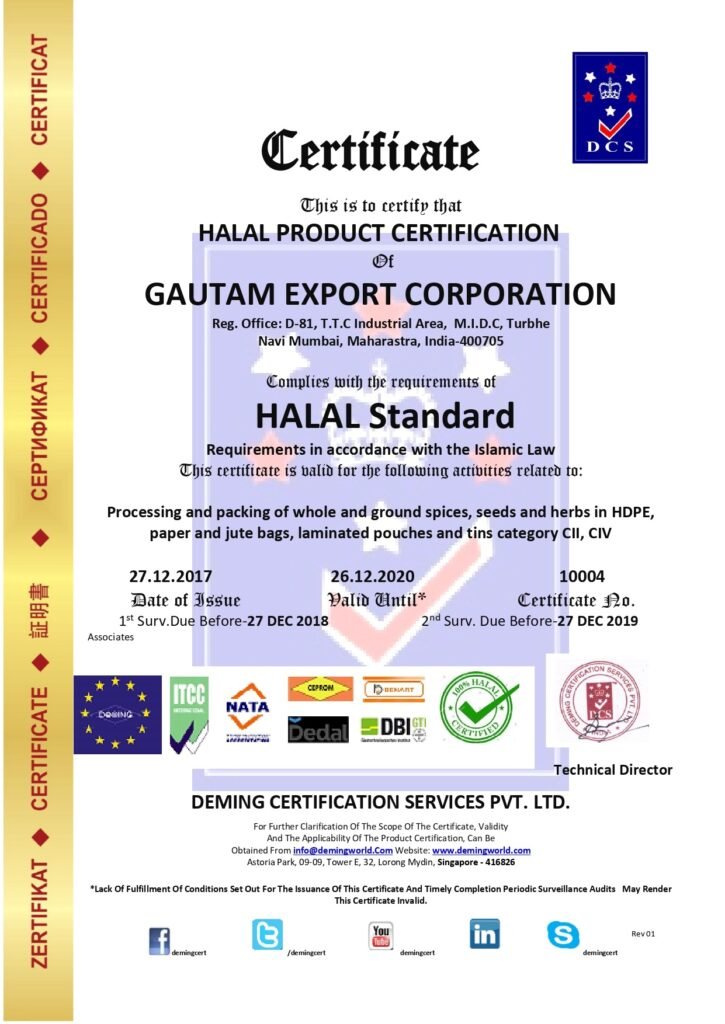
- Chapter 6 – HALAL Commitment and Market Confidence
- Chapter 7 – From Certification to Continuous Improvement
- Chapter 8 – The Human Story Behind the Growth
- Chapter 9 – Growth Through Trust and Professionalism
- Chapter 10 – The Legacy of Certification and the Road Ahead
- Take the Next Step Today

Chapter 1 – The Beginning of a Vision
Every successful organization begins with a vision. Sometimes that vision starts with a simple business idea, a product, a customer relationship or the determination of an entrepreneur to create something valuable. Over time, however, a small business can become a larger organization only when its people, processes and principles develop together. The journey of Gautam Export Corporation is an example of such a transformation.
Gautam Export Corporation is located at D-81, T.T.C. Industrial Area, M.I.D.C., Turbhe, Navi Mumbai, Maharashtra – 400705. The company operates in an industry that has a long and important connection with Indian agriculture and commerce: the processing and packing of spices, seeds and herbs. Its scope includes whole and ground spices, seeds and herbs packed in HDPE bags, paper and jute bags, laminated pouches and tins.
At first glance, spices, seeds and herbs may appear to be simple commodities. In reality, they require careful handling at every stage. The quality of a finished product depends upon many factors, including the selection of raw materials, processing practices, product identification, packaging, storage and delivery. A customer does not purchase only a product; the customer purchases consistency, reliability and confidence.
This understanding became increasingly important in the development of Gautam Export Corporation.
The promoter recognized that business growth could not depend forever on individual experience and personal supervision. As customer expectations increased and the organization became more ambitious, there was a need for a structured approach to quality and management. The company needed systems that could support its employees and allow the organization to maintain consistency even as its activities expanded.
This realization became one of the foundations of the company’s journey toward ISO 9001 certification.
The promoter’s vision was not limited to increasing sales. The broader objective was to establish Gautam Export Corporation as a dependable and professionally managed organization capable of meeting customer requirements consistently. This required a change in the way the company viewed its operations.
Every activity had to be understood as part of a larger process.
Procurement affected the quality of incoming materials. Incoming materials affected processing. Processing affected the finished product. The finished product depended upon appropriate packing. Packing influenced storage and transportation. Finally, every stage affected customer satisfaction.
Once management began looking at the organization in this connected way, quality was no longer considered the responsibility of a single department. It became a responsibility shared across the company.
The employee involved in purchasing had a role in quality because the materials selected could influence the finished product. The employee involved in processing had a role because consistency depended upon proper handling. The packing team had a role because the package protected the product and represented the company in the customer’s hands. The stores and dispatch teams also had important responsibilities because correct identification and handling were essential.
This change in thinking was significant.
The organization began moving from a largely experience-driven approach toward a process-oriented approach. Experience remained valuable, but it was increasingly supported by procedures, records and defined responsibilities.
The decision to pursue ISO 9001 therefore represented a natural progression in the company’s development. ISO 9001 is a quality-management-system standard intended to help organizations consistently provide products and services that meet customer and applicable requirements while supporting continual improvement. Its principles include customer focus, leadership, engagement of people, process approach, improvement, evidence-based decision-making and relationship management.
For Gautam Export Corporation, these principles provided a framework through which its existing experience could be organized and strengthened.
The preparation for certification required discipline. Employees had to understand their responsibilities. Processes had to be examined. Records had to be maintained. Management had to demonstrate commitment. The company had to look carefully at how work was actually being performed rather than relying only on assumptions.
This process also encouraged the organization to ask important questions.
Were incoming materials properly controlled?
Were products correctly identified?
Were processing activities performed consistently?
Was the correct packaging used?
Were finished products appropriately handled?
Were customer complaints recorded and investigated?
Were corrective actions implemented?
Could management demonstrate that important activities were being controlled?
These questions helped create a culture of accountability.
One of the most important lessons was that quality could not be created through final inspection alone. Quality had to be built into the process. Preventing a problem was generally more effective than discovering the same problem repeatedly after production.
The promoter therefore encouraged employees to view mistakes as opportunities for learning. If an error occurred, the objective was not simply to identify who was responsible. Management also needed to understand why the error occurred and what could be changed to prevent recurrence.
This approach gradually strengthened the organization.
The company’s packaging capabilities also reflected its effort to meet diverse customer requirements. HDPE bags, paper and jute bags, laminated pouches and tins each offered different characteristics and required appropriate handling. Managing several packaging formats demanded organization and clear communication.
The company’s association with HALAL requirements further reflected the importance of understanding customer and market expectations. Different customers and markets can have specific requirements, and a professional organization must be capable of understanding and controlling those requirements within its operations.
By the time Gautam Export Corporation approached ISO 9001 certification, the company had begun an important internal transformation. The organization was becoming more systematic, its responsibilities were becoming clearer, and employees were developing a greater understanding of quality.
The year 2017 would soon become a landmark in this journey.
When the ISO 9001 certification was issued, it represented formal recognition of the company’s quality-management efforts within its defined scope. For the promoter, however, the certificate was not the destination.
It was the beginning of a new phase.
The real challenge would be to maintain the system, develop employees, satisfy customers and continue improving after certification.
The story of Gautam Export Corporation was therefore entering a new chapter—a chapter in which quality, discipline and customer confidence would become increasingly connected with the company’s growth.
The foundation had been established.
The next step was to build upon it.
#GautamExportCorporation
Chapter 2 – The Decision to Pursue ISO 9001

The growth of Gautam Export Corporation brought with it a new realization: a successful business needs more than good products and commercial relationships. It needs a system capable of delivering consistent results. As the company developed its activities in the processing and packing of whole and ground spices, seeds and herbs, the promoter increasingly understood that quality had to become a structured part of everyday operations.
The company’s location in the T.T.C. Industrial Area, M.I.D.C., Turbhe, Navi Mumbai, placed it in an active industrial and commercial environment. From this base, Gautam Export Corporation had opportunities to serve customers with different expectations and packaging requirements. However, greater opportunity also meant greater responsibility.
A growing customer base can bring larger orders, more product varieties and tighter delivery expectations. Without proper systems, growth can create confusion. Materials may be incorrectly identified, production instructions may not be communicated properly, packaging requirements may be misunderstood, or customer complaints may not be systematically addressed.
The promoter wanted to avoid these risks.
The decision to pursue ISO 9001 therefore emerged from the desire to create a stronger foundation for the company’s future. ISO 9001 focuses on establishing a quality management system that helps organizations consistently meet customer and applicable requirements while pursuing continual improvement. For Gautam Export Corporation, this approach offered a practical framework for bringing greater discipline to its operations.
The first step was to understand that certification could not belong to one department alone. Quality was not simply the responsibility of a quality-control employee. It involved purchasing, stores, processing, packing, dispatch, administration, management and customer communication.
This understanding gradually changed the company’s internal approach.
The purchasing function, for example, was recognized as an important part of quality. The finished product could only be as reliable as the materials entering the organization. Spices, seeds and herbs are agricultural products and may naturally vary according to source, season and handling. The organization therefore needed appropriate attention to the selection, receipt and control of materials.
The processing stage presented another set of responsibilities. Whole spices and seeds had to be handled correctly, while ground products required careful identification and processing. When multiple products are handled within the same organization, clear identification and orderly processes become essential.
Packing was equally important.
Gautam Export Corporation’s scope included HDPE bags, paper and jute bags, laminated pouches and tins. Each packaging format served different customer requirements. The company needed to ensure that the appropriate product was packed in the appropriate packaging and that identification remained clear.
The promoter understood that a packaging error could affect the customer’s perception of the entire company. Therefore, packing could not be treated as a routine final activity. It had to be considered an important quality process.
The same principle applied to storage and dispatch. Once a product had been processed and packed, it still had to be protected, identified and dispatched correctly. A quality product could lose its value if it was damaged or incorrectly handled before reaching the customer.
The ISO 9001 journey encouraged the organization to look at all these activities as interconnected processes.
This was a major change in thinking.
Instead of asking only, “Did we produce the product?”, the company began asking, “Did we follow the right process from beginning to end?”
Documentation became an important part of this transformation.
Procedures and records helped establish consistency. They provided employees with guidance and gave management evidence about how activities were being performed. Documentation also helped preserve organizational knowledge so that processes did not depend entirely on the memory of one individual.
For some employees, this represented a significant change. In a traditional working environment, experienced employees may perform tasks correctly because they have learned them over many years. However, as an organization grows, relying entirely on personal experience can become difficult.
A documented system helps convert individual experience into organizational knowledge.
Training therefore became another important part of the certification journey. Employees needed to understand not only what they were expected to do but also why their responsibilities mattered.
A packing employee, for example, needed to understand that accurate packing protected customer satisfaction.
A store employee needed to understand that proper identification reduced the risk of material mix-ups.
A supervisor needed to understand that monitoring processes could prevent problems.
A quality representative needed to understand that auditing was intended to identify weaknesses and opportunities for improvement, rather than simply find faults.
This cultural shift helped create greater employee involvement.
The company also began to look at customer complaints differently. A complaint could be uncomfortable, but it could also provide valuable information.
If a customer reported a problem, management could investigate the cause, determine whether corrective action was required and consider whether the same issue might occur elsewhere.
This approach encouraged preventive thinking.
Instead of solving the same problem repeatedly, the company could search for its root cause and strengthen the process.
The promoter played a central role in maintaining this direction. Leadership was necessary because a quality-management system requires commitment from the top of the organization. Employees are more likely to take quality seriously when management demonstrates through its actions that quality is a business priority.
The promoter therefore viewed ISO 9001 not as an external requirement but as an internal opportunity.
The objective was to make the company more organized, more dependable and better prepared for future growth.
The certification process also encouraged the company to establish a clearer relationship between quality and business performance.
Better process control could reduce mistakes.
Better documentation could improve communication.
Better supplier management could support incoming-material quality.
Better customer feedback could strengthen relationships.
Better corrective action could reduce recurring problems.
These improvements could ultimately support business growth.
The decision to pursue ISO 9001 was therefore not simply a decision to obtain a certificate.
It was a decision to develop the organization.
For Gautam Export Corporation, this decision represented a turning point. The company was preparing to move from a business dependent primarily on experience and effort toward an organization supported by defined processes and a culture of continual improvement.
The year 2017 would soon provide formal recognition of this transformation.
But before the certificate could become a symbol of achievement, the organization first had to prove that it was ready to operate according to the principles it had chosen to adopt.
The journey had begun, and the promoter knew that the real measure of success would not be the certificate hanging on the wall.
It would be the confidence of the customer, the discipline of the employee and the consistency of the product leaving the company’s premises.
#ISO9001Certification
Chapter 3 – 2017: The Year of Certification
The year 2017 became a defining milestone in the journey of Gautam Export Corporation. After a period of preparation, process evaluation and organizational development, the company achieved ISO 9001 certification for its defined scope of work. The certification covered the processing and packing of whole and ground spices, seeds and herbs in HDPE, paper and jute bags, laminated pouches and tins. For the promoter and the employees, this achievement represented recognition of a commitment that had been developing over time.
The certificate was important, but its deeper significance was the transformation that had taken place within the organization.
Before certification, many business decisions in growing enterprises are naturally guided by experience. Experienced people know their products, suppliers, customers and processes. Their knowledge can be extremely valuable. However, when an organization begins to expand, personal knowledge alone is not always sufficient. More customers, more orders, more products and more packaging requirements create a need for clearly defined systems.
Gautam Export Corporation understood this challenge.
The ISO 9001 journey encouraged the organization to formalize its working practices and establish greater consistency. The objective was to make important processes understandable, repeatable and measurable.
The promoter regarded certification as a commitment to customers.
When a customer placed an order, the company wanted to provide confidence that the requirement would be understood, the appropriate product would be processed, the correct packaging would be used and the finished goods would be handled responsibly.
This required coordination across the organization.
Procurement had to understand material requirements.
Stores had to maintain proper identification and control.
Production had to follow appropriate processing practices.
Packing personnel had to understand product and packaging specifications.
Dispatch had to ensure that the correct finished goods reached the correct destination.
Management had to monitor the overall performance of the system.
Quality therefore became a shared responsibility.
One of the important changes after certification was the increased importance of documented information and records. Records could demonstrate that activities had been performed and could help management identify trends.
For example, if a recurring customer complaint appeared, management could examine available information and investigate the possible cause. If supplier performance became inconsistent, the company could review the relevant history. If a process repeatedly experienced problems, the organization could examine what was happening and consider corrective action.
This created greater organizational visibility.
The promoter could now look beyond individual events and begin to understand processes as a whole.
The concept of continual improvement also became more important. Certification did not mean that every process was perfect. Rather, it provided a structured approach for identifying opportunities to improve.
This distinction was essential.
A mature quality system does not claim that errors are impossible. Instead, it provides mechanisms for detecting errors, investigating causes and preventing recurrence wherever possible.
The employees gradually became part of this improvement culture.
A person working in packing could notice that a particular activity was creating unnecessary delay.
A store employee could identify an opportunity for better material organization.
A supervisor could recognize a training need.
A quality employee could identify a recurring nonconformity.
Management could then evaluate these observations and decide what action was appropriate.
Employee participation made the system more practical.
The company also recognized that quality had a direct relationship with customer satisfaction. In the spice, seed and herb business, customers expect consistency. They want the product they order, in the required quantity and packaging, delivered according to agreed requirements.
Gautam Export Corporation’s range of packaging options created both opportunity and responsibility. HDPE bags, paper and jute bags, laminated pouches and tins could serve different customer needs, but managing different formats required clear controls.
The company therefore paid greater attention to product identification, packaging requirements and handling.
The promoter also understood that certification could strengthen the company’s professional image in the market. A recognized quality-management certification could demonstrate that the organization had taken deliberate steps toward systematic management.
However, the promoter did not want the certificate to become merely a marketing statement.
The real objective was to make quality visible through performance.
Customers should experience professionalism through communication, product consistency, packaging, documentation and service.
Employees should experience quality through clearer responsibilities and processes.
Management should experience quality through better information and control.
This broader interpretation of certification gave the achievement greater meaning.
The year 2017 also marked a change in the promoter’s leadership responsibilities. As the organization became more system-oriented, management had to maintain the discipline that certification required.
This included monitoring performance, supporting employee awareness and ensuring that corrective actions were not ignored.
The promoter understood that certification could lose its value if employees followed procedures only during audits.
The organization therefore aimed to make the certified processes part of everyday work.
The correct process had to be followed whether an auditor was present or not.
This was perhaps the most important cultural objective.
Certification was also connected with the company’s HALAL-related product requirements. While ISO 9001 and HALAL certification address different requirements, both reflected the company’s awareness that customers may expect formal assurance in different areas. The organization therefore had to understand and respect applicable customer and market requirements.
As the year progressed, the ISO certificate became more than a document. It became a symbol of the company’s development.
For employees, it represented achievement.
For management, it represented responsibility.
For customers, it could provide additional confidence.
For the promoter, it represented the successful conversion of a vision into an organized management system.
But the promoter also understood that the real test had only begun.
Obtaining certification was one achievement.
Maintaining it was another.
Using the system to support growth was the larger objective.
The company now had to demonstrate that its processes could withstand the pressures of everyday business. Orders would continue to arrive. Customer requirements would change. Suppliers would present challenges. Employees would face new situations. Products and packaging requirements could evolve.
The quality system had to remain active through all these changes.
The certification of 2017 therefore opened a new chapter in the company’s history.
It marked the movement from preparation to implementation.
The organization had created a foundation.
Now it had to build upon that foundation.
The promoter’s vision was becoming clearer: Gautam Export Corporation would not measure success only by the number of orders received or products dispatched. It would measure success by its ability to consistently satisfy customers, strengthen its processes, develop its people and improve over time.
That philosophy would shape the company’s journey through the years that followed.
The certificate had been achieved.
The real journey of quality had begun.
#QualityManagement
Chapter 4 – Leadership, Systems and the Promoter’s Vision
The achievement of ISO 9001 certification in 2017 marked an important turning point for Gautam Export Corporation, but certification alone could not guarantee future success. The real challenge was to transform the principles of the quality-management system into everyday business practices. This required leadership, discipline and continuous involvement from the promoter and the management team.
For Gautam Export Corporation, leadership became increasingly connected with the company’s long-term vision.
The promoter understood that a quality-management system could not function effectively if it existed only within documents. Employees needed to understand why processes were being followed and how their individual responsibilities contributed to the company’s objectives. Quality had to become part of the organization’s culture.
This was especially important because the company’s operations involved several interconnected activities. Gautam Export Corporation was engaged in the processing and packing of whole and ground spices, seeds and herbs, using different packaging formats such as HDPE bags, paper and jute bags, laminated pouches and tins. Each stage had an influence on the next.
The promoter therefore encouraged employees to look at the organization as one connected system.
Procurement was connected to production.
Production was connected to packing.
Packing was connected to storage.
Storage was connected to dispatch.
Dispatch was connected to customer satisfaction.
Customer satisfaction was connected to the company’s reputation and future business.
This process-oriented approach helped employees understand that their work was not isolated.
A purchasing employee could affect product quality through the selection and control of incoming materials. A production employee could influence consistency through proper processing. A packing employee could protect the product and ensure that the required packaging was used. A store employee could help prevent mix-ups through proper identification and organization. A dispatch employee could influence the final customer experience.
Every person therefore became part of the quality chain.
The promoter’s leadership focused on developing this sense of responsibility.
One of the important changes was the growing use of defined procedures and records. In a developing business, employees often know how to perform their work because they have learned through experience. However, written procedures can help ensure that important knowledge is available to the organization as a whole.
This became particularly useful when new employees joined the company.
Instead of relying only on verbal instructions, the organization could provide greater clarity about responsibilities and expected practices. This helped create consistency and reduced dependence on individual memory.
Documentation also gave management greater visibility.
Records could show whether activities were being performed as expected. They could help identify recurring problems and support corrective actions. They could also provide evidence during audits and management reviews.
The promoter began to view records not simply as compliance requirements but as management information.
This was an important shift.
A record of a problem could reveal a trend.
A trend could reveal a weakness.
A weakness could lead to corrective action.
Corrective action could strengthen a process.
A stronger process could improve customer satisfaction.
This created a continuous cycle of learning.
The promoter also emphasized the importance of customer focus.
In a competitive market, a customer may have many choices. Price is important, but reliable service can become an equally valuable factor. A customer wants confidence that the supplier understands requirements and can deliver consistently.
Gautam Export Corporation therefore increasingly connected quality with customer relationships.
If a customer had a complaint, it was important to respond professionally.
If a requirement was unclear, it needed clarification.
If an error occurred, the company needed to understand its cause.
If a recurring issue appeared, management needed to consider whether the process itself should be improved.
This approach changed the meaning of customer complaints.
Rather than viewing a complaint simply as criticism, the organization could view it as information.
A complaint could identify a gap that internal processes had not detected.
This encouraged the company to develop a more constructive approach to problems.
The promoter also understood the importance of employee communication.
Employees are often the first people to notice operational difficulties. A person working directly with materials or packing may recognize a problem long before it becomes visible to senior management.
Creating an environment where employees can communicate these observations can therefore improve organizational performance.
The promoter’s role was to encourage this communication.
Employees were expected to follow procedures, but they were also encouraged to identify opportunities for improvement.
This balance was important.
A quality system should provide discipline without preventing practical thinking.
The company wanted employees to follow established processes while also remaining alert to situations where improvement might be necessary.
Training became another important part of leadership.
As processes became more structured, employees needed to understand the purpose behind them. Training helped communicate quality objectives, responsibilities and relevant procedures.
For example, employees involved in packing needed to understand the importance of correct product identification and packaging.
Employees handling materials needed to understand appropriate storage and control.
Supervisors needed to understand their responsibility for monitoring work.
Quality personnel needed to understand the importance of internal auditing and corrective action.
Management needed to understand that leadership involvement was essential to the effectiveness of the system.
This created a more informed workforce.
The promoter also recognized that quality management could support productivity.
At first, procedures and records might appear to add additional work. Over time, however, well-designed systems can reduce confusion and rework.
A clear instruction can prevent a mistake.
An organized store can reduce searching.
A defined responsibility can prevent duplication.
A documented customer requirement can reduce misunderstanding.
A systematic corrective action can prevent repeated failures.
Therefore, quality and efficiency could work together.
The company’s HALAL-related product requirements also reinforced the importance of maintaining customer and market expectations. Different markets can have different requirements, and a professional organization must be prepared to understand and control those requirements.
The promoter’s vision was gradually becoming more comprehensive.
The objective was no longer simply to process and pack spices, seeds and herbs.
The objective was to create a dependable organization capable of meeting customer requirements through controlled processes and responsible people.
This vision shaped the company’s growth after certification.
The promoter understood that a certificate could be obtained through preparation, but a quality culture had to be maintained through leadership.
That culture required commitment every day.
It required management to review performance.
It required employees to follow processes.
It required problems to be addressed.
It required customers to be heard.
It required improvements to be implemented.
Most importantly, it required everyone to understand that quality was not a department.
Quality was the responsibility of the entire organization.
This leadership philosophy became one of the strongest foundations of Gautam Export Corporation’s development after ISO 9001 certification.
The company was learning that sustainable growth is not achieved simply by increasing the quantity of business. It is achieved by increasing the organization’s ability to manage that business successfully.
The promoter’s vision was therefore becoming a practical management philosophy: grow the business, but grow the systems, people and quality culture at the same time.
That principle would guide Gautam Export Corporation into the next stage of its journey.
#ContinuousImprovement
Chapter 5 – Transforming Processing and Packing
The true value of a quality-management system becomes visible when it reaches the operational level. For Gautam Export Corporation, the processing and packing of whole and ground spices, seeds and herbs formed the core of its business activities. After achieving ISO 9001 certification in 2017, the company increasingly focused on making these operations more systematic, consistent and customer-oriented.
The organization understood that quality could not be created only at the final stage. It had to be developed throughout the entire process, beginning with the receipt of materials and continuing until the finished product was packed, stored and dispatched.
This approach brought greater attention to the first stage of operations: incoming materials.
Spices, seeds and herbs are agricultural products and can naturally vary in appearance, characteristics and quality. The company therefore recognized the importance of receiving appropriate materials and maintaining proper identification. Material handling, storage and documentation became important elements of the overall quality process.
The objective was simple: the right material had to enter the right process under controlled conditions.
This became especially important because Gautam Export Corporation handled both whole and ground products. Whole spices and seeds required appropriate handling and processing, while ground products required careful control to maintain consistency and correct product identity.
Product identification was therefore an important consideration.
In a processing environment where several products may be handled, confusion can create serious consequences. Clear identification and organized material movement help reduce the possibility of mix-ups.
The company also became more conscious of the importance of orderly working conditions.
Good housekeeping contributes to efficient operations and supports product protection. Employees were encouraged to maintain clean and organized working areas and to handle materials responsibly.
The objective was not simply to make the workplace appear orderly.
An organized workplace can make it easier to locate materials, identify products, follow instructions and prevent avoidable errors.
The processing stage itself became increasingly associated with consistency.
The promoter wanted customers to receive products that matched their requirements as closely as possible from one order to another. This meant that employees needed to follow defined processes rather than relying entirely on individual preferences.
Standardized working practices provided greater consistency.
If an employee changed, the process could continue.
If a supervisor changed, responsibilities remained defined.
If production volume increased, management had a clearer framework for maintaining control.
This was one of the important benefits of formal quality management.
The transformation continued into the packing operation.
Gautam Export Corporation’s scope included HDPE bags, paper and jute bags, laminated pouches and tins. The variety of packaging formats provided flexibility for different customers and products, but it also created a need for careful control.
The company needed to ensure that the correct product was placed in the correct packaging.
Packaging materials needed appropriate identification.
Customer requirements needed to be understood.
Finished packages needed to be handled carefully.
These activities were increasingly treated as quality-critical processes rather than routine tasks.
For the packing employee, this created a stronger sense of responsibility.
A package was not simply a container.
It was the customer’s first physical experience of the finished product.
A correctly packed product could strengthen confidence.
A damaged or incorrectly packed product could undermine it.
The promoter therefore encouraged employees to understand the connection between their work and customer satisfaction.
The company also recognized the relationship between packaging and product protection.
Different packaging materials provide different characteristics. HDPE bags, paper and jute bags, laminated pouches and tins each have their own handling requirements. Selecting and using the appropriate format therefore became part of meeting customer expectations.
Documentation supported this process.
Records helped demonstrate that activities had been performed according to established requirements. They also provided information that could be reviewed if a problem occurred.
Suppose a customer reported an issue with a packed product.
Management could investigate the relevant information, identify the possible cause and determine whether corrective action was necessary.
This was a major improvement in organizational capability.
Instead of relying entirely on memory, the company could use documented information to support investigation.
Corrective action also became increasingly important.
If an error occurred, the objective was not merely to correct the affected product. The organization also needed to consider whether the process could be changed to prevent recurrence.
This encouraged employees and management to think about root causes.
For example, if an incorrect packaging material was repeatedly selected, the company could examine whether identification, storage or communication needed improvement.
If a recurring processing issue appeared, management could examine training, instructions, equipment or supervision.
The objective was to solve the underlying problem.
This approach supported continual improvement.
The promoter also understood that productivity and quality should not be treated as opposing objectives.
A well-organized process can improve efficiency.
Clear instructions can reduce mistakes.
Proper material organization can reduce unnecessary movement.
Accurate documentation can reduce confusion.
Effective training can reduce rework.
Therefore, quality management could contribute to productivity rather than simply adding additional requirements.
Employees became an important source of improvement ideas.
Those working directly with processing and packing could often see operational difficulties before management became aware of them. Their observations could therefore contribute to improvements in workflow and control.
The promoter encouraged this participation.
The company was gradually developing a culture in which employees were expected not only to perform tasks but also to understand the reasons behind them.
This was especially important after ISO 9001 certification.
The certificate created an external recognition of the company’s management system, but the daily behavior of employees determined whether the system was actually effective.
The correct process had to be followed during ordinary working days, not just during audits.
This principle became increasingly important.
The organization also remained conscious of customer-specific requirements and its HALAL-related product commitments. Meeting such requirements depended upon controlled handling, clear communication and consistent processes.
By strengthening processing and packing practices, Gautam Export Corporation created a stronger foundation for growth.
The company could handle its operations with greater confidence.
Employees understood their responsibilities more clearly.
Management had greater visibility into processes.
Customers could receive more consistent products and service.
And the organization developed a stronger ability to identify and correct problems.
The transformation of processing and packing was therefore more than an operational improvement.
It represented a cultural change.
The company was learning to replace informal assumptions with controlled processes, individual dependence with shared responsibility, and reactive problem-solving with continual improvement.
This transformation strengthened the organization from the inside.
As Gautam Export Corporation looked toward future opportunities, the promoter knew that sustainable growth would depend on maintaining this discipline.
More customers would mean more responsibility.
More products would mean more complexity.
More packaging options would require stronger controls.
Greater market expectations would require better communication.
The company’s ISO 9001 journey had therefore begun to influence the very heart of its business.
The result was an organization increasingly prepared to deliver not only spices, seeds and herbs, but also the consistency, reliability and confidence that customers expected.
#FoodProcessing
Chapter 6 – HALAL Commitment and Market Confidence
As Gautam Export Corporation continued its development after achieving ISO 9001 certification in 2017, the company increasingly understood that quality was connected with more than production and packing. Customers in the food industry can have different requirements based on market, application, culture, religion and regulatory expectations. The company’s reference to the HALAL Standard therefore represented another important aspect of its commitment to meeting customer requirements.
For Gautam Export Corporation, the combination of a quality-management system and attention to HALAL-related requirements contributed to a broader philosophy of market confidence.
It is important to recognize that ISO 9001 and HALAL certification address different areas. ISO 9001 focuses on the organization’s quality-management system and its ability to consistently meet applicable requirements. HALAL requirements concern conformity with applicable halal principles and the requirements of the relevant certification scheme. Together, they can form part of a company’s wider approach to quality, compliance and customer assurance.
Gautam Export Corporation operated in the processing and packing of whole and ground spices, seeds and herbs. These products can reach customers with different expectations, and therefore the company needed to understand the importance of clearly defined requirements.
The promoter recognized that a professional food-processing organization must be able to answer a basic question:
What does the customer expect, and how can the organization consistently meet that expectation?
This question influenced the company’s development after ISO certification.
Customer requirements could relate to the product itself, its processing, packaging, quantity, identification, documentation or applicable standards. In some markets, HALAL status could also be an important consideration.
The company therefore increasingly viewed compliance as part of customer service.
The objective was not simply to possess certificates.
The objective was to create confidence.
When a customer evaluates a supplier, the customer wants to know whether the supplier can be trusted to deliver what has been agreed. A professional management system can support that confidence by providing defined processes, documented information and clear responsibilities.
For Gautam Export Corporation, ISO 9001 provided a framework for systematic quality management. Its HALAL-related commitment provided another dimension of assurance for applicable customers and markets.
The promoter understood that this combination could strengthen the company’s professional identity.
The company was not simply processing spices.
It was building a reputation for controlled operations.
This reputation was particularly important in a competitive food market.
Customers can often compare suppliers based on price, product availability and service. However, long-term relationships depend on reliability.
A customer who receives consistent products is more likely to develop confidence.
A customer who receives accurate documentation is more likely to view the supplier as professional.
A customer whose requirements are understood is more likely to continue the relationship.
Therefore, quality and compliance became connected with commercial growth.
The company’s packaging capabilities also supported this objective. Gautam Export Corporation could pack products in HDPE bags, paper and jute bags, laminated pouches and tins. This range allowed the organization to address different customer needs.
However, flexibility required control.
Each customer requirement had to be communicated accurately.
The correct product had to be associated with the correct packaging.
Product identification needed to remain clear.
Storage and handling needed to protect the finished goods.
Dispatch documentation needed to correspond with the order.
The promoter increasingly understood that every small detail could influence customer confidence.
The same principle applied to HALAL-related requirements.
Where customers required HALAL conformity, the organization needed to maintain appropriate controls within the applicable certification framework. This reinforced the broader principle that customer requirements must be understood before production and respected throughout the process.
The ISO 9001 quality-management system supported this approach by encouraging the organization to consider customer needs systematically.
Customer feedback also became increasingly valuable.
A customer question could reveal a new requirement.
A complaint could reveal a weakness.
A request for a particular packaging format could reveal a market opportunity.
A question about certification could reveal the importance of formal assurance.
The company could use this information to improve its processes and strengthen its market position.
This was a significant change in thinking.
Customer communication was no longer simply a sales activity.
It became an information channel.
The sales and customer-service functions could communicate market expectations to management and operations. Production and quality teams could then determine how those requirements should be controlled.
This created a connection between the market and the factory.
The promoter’s vision was to make Gautam Export Corporation increasingly responsive to customers without compromising process discipline.
This required balance.
The company had to remain flexible enough to meet customer requirements but organized enough to prevent uncontrolled changes.
The quality-management system helped create that balance.
Defined processes provided stability.
Customer focus provided flexibility.
Continuous improvement provided adaptation.
Together, these elements strengthened the organization.
The company’s location in Navi Mumbai also provided access to an important commercial and logistics environment. Such an environment could support broader market connections, but market access alone was not enough. The company needed to demonstrate that it could meet the expectations of customers beyond its immediate business network.
Certification and structured processes could contribute to this professional image.
For the promoter, the long-term goal was to build trust rather than simply pursue individual transactions.
Trust develops gradually.
It begins with a promise.
It grows when the promise is fulfilled.
It becomes stronger when the promise is fulfilled repeatedly.
This principle applied directly to the company’s relationship with customers.
If Gautam Export Corporation promised a particular product, it had to deliver that product.
If it agreed to a packaging requirement, it had to respect it.
If a customer required applicable certification or conformity, the company had to understand the requirement.
If a problem occurred, the company had to respond responsibly.
Such behavior strengthened relationships.
The HALAL commitment therefore became part of a larger story of professionalism.
It demonstrated that the company recognized the importance of market-specific expectations and customer confidence.
At the same time, ISO 9001 helped the organization establish a structured system through which requirements could be managed.
The two concepts were different, but they supported the same broader business objective: to become a reliable supplier capable of meeting customer expectations consistently.
As Gautam Export Corporation moved through the years following its 2017 certification, this approach helped shape its growth.
The promoter increasingly saw standards not as burdens but as tools.
A standard could create discipline.
A certification could provide confidence.
A customer requirement could create an opportunity.
A complaint could create a lesson.
An audit could identify a weakness.
An improvement could strengthen the business.
This mindset allowed the company to approach the market with greater confidence.
The story of HALAL commitment at Gautam Export Corporation was therefore not only about certification.
It was about understanding customers.
It was about respecting market expectations.
It was about building confidence.
And most importantly, it was about developing a professional organization capable of turning quality commitments into consistent business performance.
The promoter knew that the company’s future growth would depend on this trust.
The certificate could open a door.
But only reliable performance could keep that door open.
#SpicesAndHerbs
Chapter 7 – From Certification to Continuous Improvement
Achieving ISO 9001 certification in 2017 was a major milestone for Gautam Export Corporation, but the promoter understood an important principle: certification was not the end of the quality journey. It was the beginning of a more disciplined approach to continuous improvement.
A certificate can demonstrate that an organization has established a quality-management system at a particular point in time. The real strength of that system, however, depends on how effectively it is maintained and improved afterward. For Gautam Export Corporation, the period following certification became an opportunity to turn documented procedures and quality principles into everyday habits.
The company was engaged in processing and packing whole and ground spices, seeds and herbs. Its operations involved several packaging formats, including HDPE bags, paper and jute bags, laminated pouches and tins. Such activities required coordination, and coordination required effective processes.
The promoter therefore encouraged employees to think beyond the question, “Are we following the procedure?”
The more important question became, “Is the procedure helping us achieve the desired result?”
This distinction encouraged a culture of improvement.
A process could be followed correctly and still contain opportunities for improvement. Perhaps an activity could be performed more efficiently. Perhaps communication could be clearer. Perhaps a record could be simplified. Perhaps a recurring problem could be eliminated through better planning.
The company gradually learned to look at its processes with this mindset.
One of the important mechanisms supporting improvement was internal review and auditing. Internal audits could help management determine whether established processes were being followed and whether the quality-management system remained effective.
For employees, an audit was not intended simply as an inspection.
It was an opportunity to examine how work was being performed.
If a weakness was identified, the organization could investigate it.
If a nonconformity was found, corrective action could be considered.
If a process was working well, it could provide an example for other activities.
This created a cycle of organizational learning.
The promoter also encouraged employees to understand the difference between correction and corrective action.
Correction addresses an immediate problem.
Corrective action seeks to understand why the problem happened and prevent it from happening again.
This approach was particularly valuable in a food-processing and packing environment.
Suppose an incorrect packaging material was selected. The immediate correction might be to replace the material. But management could then ask why the incorrect material was selected.
Was the packaging stored incorrectly?
Was identification unclear?
Was the instruction misunderstood?
Was the employee insufficiently trained?
Was there a communication gap?
Was the process itself inadequate?
By asking these questions, the company could address the underlying cause rather than repeatedly correcting the same symptom.
This approach helped strengthen the organization’s processes over time.
Customer feedback was another important source of improvement.
Gautam Export Corporation understood that customers experience the final result of the company’s processes. A customer may notice an issue that internal personnel have overlooked.
Therefore, customer complaints and suggestions could provide valuable information.
The promoter encouraged the company to respond professionally to such feedback.
A complaint was not necessarily treated as a failure of an individual employee. It could be treated as information about the system.
This created a more constructive approach to problem-solving.
The organization could ask:
What happened?
What requirement was expected?
Where did the process fail?
What caused the failure?
What action should be taken?
How can recurrence be prevented?
This approach transformed customer feedback into a source of organizational learning.
Supplier relationships also became part of the improvement cycle.
The quality of incoming materials can influence the quality of finished products. Therefore, the company needed to pay attention to supplier performance and the consistency of materials received.
If recurring problems appeared, management could communicate with suppliers and evaluate whether changes were required.
This helped strengthen the connection between the organization and its supply chain.
The promoter increasingly understood that continuous improvement involved the entire business ecosystem.
Employees, suppliers, customers and management all contributed information that could help the company become stronger.
Training was another major element.
A quality system can become ineffective if employees do not understand it.
As the company evolved, employees needed to remain aware of relevant procedures and responsibilities. New employees required appropriate orientation, while existing employees could benefit from periodic training and awareness.
Training also helped create consistency.
When employees understand why a process exists, they are more likely to follow it correctly.
For example, a packing employee who understands the consequences of product identification errors is more likely to treat identification as an important quality activity.
Similarly, an employee responsible for storage who understands the importance of material control is more likely to maintain organized practices.
The promoter therefore regarded training as an investment rather than an expense.
An informed employee can prevent problems before they occur.
The company also began recognizing the relationship between continual improvement and efficiency.
Improvement did not always require major investment.
Sometimes a simple change could make a meaningful difference.
Better organization of materials could save time.
Clearer instructions could reduce mistakes.
Improved communication could prevent misunderstandings.
More effective planning could reduce delays.
A stronger record could help identify recurring problems.
A better training program could reduce rework.
These small improvements could accumulate and strengthen the organization.
This was particularly important for a growing company.
Growth can create additional pressure on systems. More customers can mean more orders. More orders can mean more production activity. More production can mean greater pressure on employees, materials, packing and dispatch.
If systems remain unchanged while business increases, quality can suffer.
Gautam Export Corporation therefore recognized that growth and improvement had to move together.
The promoter’s vision was to build an organization capable of handling increasing business without losing control over its processes.
This required discipline.
Employees needed to follow established practices.
Management needed to monitor performance.
Problems needed to be addressed promptly.
Customer feedback needed to be considered.
Opportunities for improvement needed to be acted upon.
Over time, these activities created a stronger organizational culture.
The company began to understand that continual improvement is not one large project undertaken once every few years.
It is a daily attitude.
Every employee can contribute.
Every process can be reviewed.
Every complaint can teach something.
Every audit can reveal an opportunity.
Every mistake can become a lesson.
Every successful improvement can become a new standard.
This philosophy became one of the lasting benefits of the ISO 9001 journey.
The certification had introduced structure.
The years that followed introduced learning.
The promoter’s leadership helped connect the two.
By continuing to focus on improvement, Gautam Export Corporation strengthened its ability to serve customers and manage growth.
The company was no longer simply asking how to maintain its certification.
It was asking a more important question:
How can we become better than we were yesterday?
That question became the foundation of the company’s continuing development.
And it demonstrated the deepest value of ISO 9001: not merely creating a quality system, but creating an organization capable of learning, adapting and improving continuously.
#HALALCertification
Chapter 8 – The Human Story Behind the Growth
Behind every quality certificate, production process and business achievement are people. Machines can support production, documents can define procedures and certifications can provide formal recognition, but it is people who ultimately make an organization successful. For Gautam Export Corporation, the journey following ISO 9001 certification was therefore not only a story of systems and processes. It was also a story of employees, leadership, teamwork and shared responsibility.
The company operated in the processing and packing of whole and ground spices, seeds and herbs, with products packed in HDPE bags, paper and jute bags, laminated pouches and tins. Such activities require coordination between different functions. The quality of the final product depends on many people performing their responsibilities correctly.
The promoter understood that the company’s quality-management system could succeed only when employees understood their role in it.
Before the development of a formal quality culture, employees in a growing business may naturally focus on completing their immediate tasks. A person working in stores concentrates on materials. A production employee focuses on processing. A packing employee focuses on packing. A dispatch employee focuses on sending finished goods.
ISO 9001 encouraged the company to look at these activities differently.
Each task was connected to the final customer.
The store employee was not simply handling material. That employee was helping protect product identity and process control.
The production employee was not simply processing spices or herbs. That employee was contributing to product consistency.
The packing employee was not simply filling bags or pouches. That employee was protecting the product and presenting it to the customer.
The dispatch employee was not simply moving goods. That employee was completing the customer’s order experience.
This understanding created a stronger sense of responsibility.
The promoter also recognized that employees are often the people closest to operational problems. They see difficulties that may not be immediately visible to senior management.
An employee may notice that materials are difficult to locate.
A supervisor may observe that a particular process is causing delays.
A packing employee may identify a recurring packaging issue.
A stores employee may notice a risk of material confusion.
A customer-service employee may recognize a repeated customer request.
If these observations are encouraged and communicated, they can become valuable sources of improvement.
The company therefore increasingly emphasized communication.
Employees were encouraged to report problems rather than hide them.
This was an important cultural change.
In some organizations, employees may hesitate to report mistakes because they fear criticism. However, hidden problems can become larger problems. An issue that is identified early can often be corrected more easily.
Gautam Export Corporation sought to encourage a more constructive approach.
When a problem occurred, the organization could ask what happened and why it happened.
This did not mean that responsibility disappeared. Employees were still expected to perform their duties properly. But management could also examine whether the process itself needed improvement.
This approach helped create a balance between accountability and learning.
Training played a major role in this transformation.
Employees needed to understand the company’s quality objectives, relevant procedures and their individual responsibilities. Training also helped communicate the importance of customer satisfaction.
For example, employees involved in packing could understand why correct product identification mattered.
Employees involved in processing could understand why consistency mattered.
Employees handling materials could understand why appropriate control and organization mattered.
Supervisors could understand their responsibility for monitoring activities and supporting employees.
Management could understand its role in maintaining the effectiveness of the quality system.
This shared understanding helped build a stronger workforce.
The promoter also recognized that employee development was connected with business growth.
A company cannot expand sustainably without capable people.
As responsibilities increase, employees need knowledge and confidence to handle them.
Training can provide part of that foundation.
Experience provides another part.
Together, training and experience can create a workforce capable of handling greater responsibility.
The promoter’s leadership therefore focused not only on processes but also on people.
This was particularly important after ISO 9001 certification.
There was a risk that employees could see certification as a management requirement rather than as a benefit to the organization. The promoter had to communicate that the quality system was intended to make work more organized and the company more reliable.
Gradually, the system became part of normal operations.
Employees learned that records were not simply forms to be completed.
They were evidence.
Employees learned that procedures were not simply instructions imposed by management.
They were tools for consistency.
Employees learned that audits were not simply inspections.
They were opportunities to identify weaknesses.
Employees learned that complaints were not simply criticism.
They could be sources of information.
This change in attitude was one of the most valuable outcomes of the company’s certification journey.
The human element was also important in maintaining morale.
Employees who understand the importance of their work are more likely to feel that their contribution matters.
A packing employee can recognize that every correctly packed unit represents the company.
A production employee can recognize that every properly processed product contributes to customer confidence.
A stores employee can recognize that organized material control protects the entire operation.
This creates a sense of ownership.
The promoter encouraged this ownership because the company’s reputation ultimately depended on the collective behavior of its people.
No single person could create customer satisfaction.
It required teamwork.
Procurement had to communicate with production.
Production had to communicate with packing.
Packing had to communicate with stores and dispatch.
Quality had to work with every function.
Management had to coordinate the overall system.
The stronger these relationships became, the more effectively the company could operate.
The company’s HALAL-related requirements also reinforced the importance of employee awareness. Where applicable requirements were relevant to products and customers, employees needed to understand their responsibilities and follow established controls.
This again demonstrated that certification and standards are ultimately implemented by people.
Documents cannot process products.
Certificates cannot inspect materials.
Procedures cannot communicate with customers.
People must perform these activities.
Therefore, employee commitment became one of the most important assets of Gautam Export Corporation.
The promoter’s role was to create an environment in which employees could understand expectations, develop their skills and contribute to improvement.
Over time, the organization became more than a collection of individual departments.
It became a team working toward a common objective.
That objective was simple but powerful:
Deliver consistent products, satisfy customers and improve continuously.
The company’s growth after ISO 9001 certification was therefore closely connected with the development of its people.
Systems created structure.
Leadership created direction.
Training created capability.
Communication created coordination.
Employee participation created improvement.
Together, these elements strengthened the organization.
The story of Gautam Export Corporation demonstrates that the most valuable part of a quality-management system may not be the documents or the certificate.
It may be the change in people’s thinking.
When employees begin to see quality as their responsibility, the organization becomes stronger.
When people understand that their work affects customers, they become more careful.
When employees feel able to report problems, the organization learns faster.
When teams cooperate, processes become more effective.
And when people grow with the organization, the organization becomes capable of sustainable growth.
This was the human foundation of Gautam Export Corporation’s journey after ISO 9001 certification.
#CustomerFocus
Chapter 9 – Growth Through Trust and Professionalism
The journey of Gautam Export Corporation after ISO 9001 certification in 2017 was not simply a journey of maintaining a quality-management system. It was a journey toward greater trust, professionalism and organizational capability. The promoter increasingly understood that sustainable business growth depends on the confidence a company creates among its customers, suppliers, employees and business partners.
Gautam Export Corporation operated in the processing and packing of whole and ground spices, seeds and herbs. Its product scope included different packaging formats such as HDPE bags, paper and jute bags, laminated pouches and tins. This flexibility created opportunities to serve different customer requirements, but it also required a disciplined approach to operations.
The promoter recognized that a company cannot build long-term growth simply by accepting more orders.
More orders mean more responsibility.
More customers mean more expectations.
More products mean greater operational complexity.
More packaging formats mean greater possibilities for error.
Therefore, growth must be supported by systems.
The ISO 9001 quality-management system helped the company create a structured foundation for this growth. Processes became clearer, responsibilities became more defined and records provided management with greater visibility.
This increased professionalism could influence customer confidence.
A customer wants to know that a supplier can understand requirements and deliver consistently. When a company demonstrates systematic processes, proper documentation and a willingness to address problems, it can strengthen the customer’s perception of reliability.
For Gautam Export Corporation, reliability became an important part of its business identity.
The promoter understood that trust develops over time.
A customer places an order.
The supplier understands the requirement.
The correct product is processed.
The product is packed appropriately.
The finished goods are identified correctly.
The shipment is prepared carefully.
The customer receives what was expected.
When this happens repeatedly, confidence grows.
Confidence can then lead to repeat orders, stronger relationships and new opportunities.
This cycle was an important part of the company’s growth philosophy.
The ISO 9001 certification could support this process by demonstrating that the company had established a formal quality-management framework. However, the promoter understood that certification alone could never replace actual performance.
A certificate can create an initial impression.
Performance creates lasting trust.
Therefore, the company focused on translating its quality system into everyday operations.
Customer requirements needed to be communicated clearly.
Production activities needed to be controlled.
Packaging needed to match expectations.
Records needed to be maintained.
Problems needed to be investigated.
Corrective actions needed to be completed.
Employees needed to remain aware of their responsibilities.
Management needed to monitor the system.
These activities collectively created professionalism.
The company’s range of packaging options was particularly significant.
HDPE bags could serve one type of requirement.
Paper and jute bags could address another.
Laminated pouches could provide a different presentation and handling format.
Tins could be suitable for other customer expectations.
This flexibility could become a competitive advantage because customers do not always require the same packaging.
However, flexibility without control can create risk.
The quality-management system helped the organization understand that customer-specific requirements had to be controlled throughout the process.
The correct product needed to be connected with the correct packaging.
Instructions needed to be communicated.
Finished goods needed to be identified.
Storage needed to be organized.
Dispatch needed to be accurate.
The promoter viewed these controls as part of customer service.
A customer does not see every internal process.
The customer sees the final result.
Therefore, every internal process must contribute toward a successful external experience.
This philosophy also influenced the company’s relationship with suppliers.
A reliable supplier relationship is important because incoming materials influence the final product.
Gautam Export Corporation increasingly understood that supplier evaluation and communication could contribute to quality.
If an incoming material did not meet expectations, the company could investigate the issue and communicate with the supplier.
If a supplier consistently performed well, the relationship could become stronger.
This created a more professional supply-chain approach.
Customer feedback was equally important.
The company learned that complaints could provide valuable information.
A complaint could reveal a product issue.
It could identify a packaging problem.
It could indicate a communication gap.
It could reveal an unmet expectation.
Rather than treating every complaint simply as a negative event, the company could examine what the complaint was teaching it.
This encouraged continual improvement.
The promoter’s approach was therefore increasingly based on learning.
The company did not need to pretend that problems never occurred.
Instead, it needed to demonstrate that when problems occurred, the organization could respond responsibly.
This was an important element of professionalism.
A mature organization is not defined by the absence of every mistake.
It is defined by how effectively it identifies, responds to and learns from mistakes.
This philosophy strengthened internal confidence as well.
Employees became more aware that their work mattered.
They could see the connection between their activities and customer satisfaction.
They could also understand that the company’s reputation depended on collective performance.
The promoter therefore treated employee development as part of business growth.
Training and awareness helped employees understand processes.
Clear responsibilities reduced confusion.
Communication improved coordination.
Internal audits provided opportunities to identify weaknesses.
Corrective actions helped strengthen processes.
These activities created organizational capability.
The company’s HALAL-related requirements also contributed to its professional approach to market expectations. Where applicable, customers could have specific requirements relating to halal conformity, and the company needed to understand and manage such expectations appropriately.
This reinforced a larger principle:
A growing organization must learn to serve different customers without losing control of its processes.
Gautam Export Corporation’s development after certification demonstrated this principle.
The promoter wanted the company to grow, but not at the cost of quality.
The objective was controlled growth.
Controlled growth means that when business increases, systems also improve.
When customer numbers increase, communication improves.
When product variety increases, identification becomes stronger.
When production increases, monitoring becomes more disciplined.
When employees increase, training becomes more important.
When markets expand, documentation and compliance become more important.
This approach helped connect growth with organizational maturity.
The company was not simply becoming larger.
It was becoming more capable.
That distinction is critical.
A company can increase its volume without becoming stronger.
But when an organization improves its processes, people and ability to manage complexity, growth becomes more sustainable.
The promoter’s vision gradually evolved around this concept.
Gautam Export Corporation would compete not only through products and prices but through reliability and professionalism.
This could create a stronger position in the market.
Customers could recognize the company as an organization that valued quality.
Employees could recognize the company as an organization with defined expectations.
Suppliers could recognize the company as a professional business partner.
Management could make decisions with greater information.
Together, these relationships created a foundation for continued development.
The ISO 9001 certification of 2017 therefore became part of a much larger story.
It provided the structure.
Leadership provided direction.
Employees provided execution.
Customers provided feedback.
Suppliers provided inputs.
Continuous improvement connected everything.
The result was an organization increasingly capable of turning trust into business relationships and business relationships into sustainable growth.
For Gautam Export Corporation, the real measure of success was not simply how many products were processed or packed.
It was whether customers could trust the company to perform consistently.
It was whether employees could perform their responsibilities confidently.
It was whether management could identify and correct weaknesses.
And it was whether the organization could continue improving as it grew.
That was the deeper meaning of professionalism.
And that professionalism became one of the most important outcomes of the company’s journey after ISO 9001 certification.
#OperationalExcellence
Chapter 10 – The Legacy of Certification and the Road Ahead
The journey of Gautam Export Corporation after ISO 9001 certification in 2017 represents more than the achievement of a formal quality-management certificate. It represents a period of organizational transformation in which the company strengthened its processes, developed greater awareness of customer expectations and established a foundation for continued improvement.
Located at D-81, T.T.C. Industrial Area, M.I.D.C., Turbhe, Navi Mumbai, Maharashtra, Gautam Export Corporation operates in the processing and packing of whole and ground spices, seeds and herbs. Its scope includes packaging in HDPE bags, paper and jute bags, laminated pouches and tins. The company also identifies HALAL Standard requirements within its product and certification context.
For the promoter, the journey toward ISO 9001 certification began with a vision of creating a more organized and dependable organization. The certificate issued in 2017 was an important milestone, but its greatest value came from the systems and culture developed around it.
The company learned that quality is not created at one particular stage.
It begins with understanding customer requirements.
It continues with appropriate procurement.
It moves through processing.
It continues through packing, storage and dispatch.
Finally, it reaches the customer.
Every stage matters.
This process-oriented way of thinking became one of the most important lessons of the certification journey.
The promoter also learned that sustainable growth requires systems capable of supporting increasing business activity. If a company grows without strengthening its processes, it can become difficult to maintain consistency. More customers can create more complexity. More products can create more opportunities for mistakes. More employees can create greater communication requirements.
Gautam Export Corporation therefore focused on developing its organizational capability alongside its business ambitions.
The quality-management system helped provide structure.
Procedures created consistency.
Records provided evidence.
Audits encouraged evaluation.
Corrective actions supported problem-solving.
Training developed employees.
Customer feedback created learning opportunities.
Management involvement provided direction.
Together, these elements created a stronger organization.
One of the most important outcomes was the development of a quality culture.
Quality became more than an inspection activity.
It became a shared responsibility.
Employees learned that their individual activities could influence the customer experience.
The procurement function could influence the quality of incoming materials.
Processing could influence product consistency.
Packing could influence product protection and presentation.
Storage could influence product condition.
Dispatch could influence delivery and customer satisfaction.
Management could influence the effectiveness of the entire system.
This understanding created a stronger sense of ownership.
The promoter also recognized that quality-management systems must evolve.
A system that remains unchanged while the business changes can eventually become ineffective.
Therefore, continual improvement became an important part of the company’s philosophy.
The company could learn from customer complaints.
It could learn from internal audits.
It could learn from supplier performance.
It could learn from employee observations.
It could learn from operational problems.
Every source of information could become an opportunity to improve.
This created a continuous cycle of organizational learning.
The HALAL-related requirements also reinforced the importance of respecting customer and market expectations. ISO 9001 and HALAL certification serve different purposes, but together they demonstrate the importance of systematic management and conformity with applicable requirements.
For customers who consider HALAL status important, confidence can be influenced by the organization’s ability to understand and control relevant requirements.
For all customers, confidence is strengthened when the company demonstrates consistency, professionalism and responsiveness.
The promoter therefore saw certification as part of the company’s reputation.
A certificate can provide recognition.
But reputation is created through repeated performance.
Every successful order contributes to reputation.
Every professional response to a complaint contributes to reputation.
Every improvement contributes to reputation.
Every employee who performs responsibly contributes to reputation.
Over time, these actions build trust.
The company’s journey also demonstrated the importance of people.
A quality-management system is ultimately operated by employees.
Documents cannot process spices.
Certificates cannot pack products.
Procedures cannot communicate with customers.
People perform these activities.
Therefore, employee awareness, training and commitment remain essential.
The promoter’s leadership helped establish this understanding.
Employees were encouraged to see quality as part of their daily responsibilities.
This created a stronger relationship between people and processes.
The organization became more capable of preserving knowledge through defined procedures and records rather than depending entirely on individual experience.
This was particularly valuable for future growth.
As employees change and responsibilities evolve, documented processes can help maintain continuity.
The company could therefore build an organization that was less dependent on individual memory and more supported by institutional knowledge.
The years from 2017 to 2020 became an important period in this development.
The certification period gave the organization an opportunity to apply the quality-management principles it had adopted and to demonstrate that the system could support its operations.
The end of a certification validity period should not be interpreted as the end of quality management.
The lessons learned during certification can continue to guide the organization.
The certificate may have a defined validity period, but the culture of quality can continue.
This is perhaps the most important legacy of the company’s ISO journey.
Gautam Export Corporation learned that quality is a long-term commitment.
It is not something achieved once.
It must be maintained.
It must be reviewed.
It must be improved.
It must be communicated.
And it must remain connected with customer expectations.
Looking toward the future, the company has the opportunity to build upon the foundation created during its certification journey.
The changing food and spice market may bring new customer requirements, new packaging expectations, new technologies and new competitive pressures.
The company’s ability to respond will depend on the strength of its systems and people.
The promoter’s original vision can therefore continue to evolve.
The future organization can be more process-oriented, more customer-focused and more responsive to market changes.
It can strengthen supplier relationships.
It can improve employee capabilities.
It can enhance documentation and traceability.
It can continue reviewing operational performance.
It can seek new markets while maintaining its commitment to quality.
Above all, it can continue to regard improvement as a permanent business philosophy.
The story of Gautam Export Corporation is therefore a story of transformation.
It began with entrepreneurial vision.
It developed through business experience.
It moved toward formal quality management.
It achieved ISO 9001 certification in 2017.
It applied the principles of systematic management through the certification period.
It strengthened employee awareness.
It developed greater customer focus.
It incorporated attention to HALAL-related requirements.
And it established a foundation for future growth.
The most valuable lesson is that certification is not the destination.
It is a platform from which an organization can grow.
The certificate represents recognition, but the real achievement lies in what the organization becomes because of the discipline behind that recognition.
For Gautam Export Corporation, that transformation can be summarized in a simple chain:
Vision created direction.
Quality created discipline.
Systems created consistency.
People created performance.
Customer trust created opportunity.
Continuous improvement created the foundation for growth.
The promoter’s journey therefore continues beyond the certificate.
The future belongs to an organization that can preserve its values while adapting to new opportunities.
Gautam Export Corporation’s experience demonstrates that sustainable growth is not merely about becoming bigger.
It is about becoming better.
Better organized.
Better prepared.
More responsive.
More consistent.
More professional.
And more capable of earning customer confidence year after year.
The ISO 9001 certification issued in 2017 will remain an important milestone in the company’s history. But its greatest legacy is the quality culture that developed around it.
That culture provides the foundation for the road ahead.
And the road ahead is one of continued learning, continued improvement and continued growth.
#SustainableBusinessGrowth
#SpiceIndustry #ExportQuality #FoodQualityManagement #CustomerSatisfaction #QualityDrivenGrowth
Take the Next Step Today
Don’t wait to enhance your business’s quality and efficiency. Partner with Mayu Group India and experience the transformation that comes with expert consultancy and training. Contact us today to learn more about how we can help you achieve your business goals. Reach out via phone at +91-9322728183, visit our website at www.mayugroup.in, or email us at investor@mayugroup.in Let us be your guide on the journey to excellence and innovation.