
Purulia Railway Station
- Purulia Railway Station
- Chapter 1: The Beginning of a Green Dream
- Chapter 2: The Road to ISO 14001:2015 Certification
- Chapter 3: The Promoter of Change and the Growth of Excellence
- Chapter 4: Growing Beyond Certification
- Chapter 5: People, Passengers, and a Culture of Responsibility
- Chapter 6: From Certification to Sustainable Growth
- Chapter 7: Challenges, Resilience, and Continuous Improvement
- Chapter 8: Community Partnership and the Green Identity of Purulia
- Chapter 9: Measuring Success and the Legacy of ISO 14001:2015
- Chapter 10: The Future Beyond 2022
- Take the Next Step Today

Chapter 1: The Beginning of a Green Dream
In the western part of West Bengal, surrounded by the beautiful hills, forests, and red soil of Purulia district, stands Purulia Railway Station. As an important station under the Adra Division of South Eastern Railway, it has served millions of passengers for decades, connecting small towns with major cities and bringing people closer to opportunities, education, business, and family. Every train that arrived carried hundreds of stories, and every departure marked the beginning of a new journey.
For many travelers, the station was more than a transport hub. It was the first impression of Purulia—a place where visitors experienced the warmth of the district and the discipline of Indian Railways. From the early morning tea vendors to the evening express trains, life at the station moved with remarkable energy. Porters hurried across platforms, ticket examiners welcomed passengers, and station staff worked tirelessly behind the scenes to ensure safe railway operations.
Despite its importance, the management understood that growing passenger traffic also brought growing environmental responsibilities. Plastic bottles accumulated after busy trains departed, waiting halls required continuous cleaning, water resources needed careful management, and maintaining hygiene across the station premises became increasingly challenging. The leadership realized that cleanliness was no longer simply a daily routine—it had become a strategic priority for sustainable development.
The official identity of the environmental project reflected this commitment.
Client Name: Purulia Railway Station
Address: Purulia Railway Station, Adra Division, South Eastern Railway, Purulia
Scope of Work: To provide passenger amenities in a clean and green environment while ensuring sanitation throughout the railway station premises.
This vision inspired the station administration to adopt an internationally recognized environmental management system: ISO 14001:2015.
The decision was not driven by the desire to display a certificate on an office wall. Instead, it represented a promise to passengers, employees, and the surrounding community that environmental protection would become part of everyday railway operations. The certification process officially began in 2019, with a validity period extending until 2022, symbolizing the station’s commitment to continual environmental improvement.
Leading this transformation was a dedicated team of railway professionals. The Station Superintendent believed that punctual trains and passenger comfort should always go hand in hand with cleanliness. Departmental officers coordinated operations, engineering staff improved infrastructure, and sanitation supervisors ensured that every platform remained hygienic throughout the day. Together, they created a culture where environmental responsibility belonged to everyone rather than a single department.
One of the first steps was conducting an environmental assessment of the station premises. The findings highlighted several opportunities for improvement. Waste bins were available but lacked proper segregation, excessive water consumption resulted from leaking taps, gardens required better maintenance, and awareness among passengers regarding responsible waste disposal remained limited.
Rather than viewing these as problems, the management treated them as opportunities for innovation.
Meetings were organized with housekeeping teams, vendors, maintenance staff, railway employees, and local stakeholders. Every participant contributed practical suggestions. Vendors recommended installing additional dustbins near food stalls, gardeners proposed planting native trees suitable for Purulia’s climate, and station staff suggested multilingual awareness announcements encouraging passengers to keep the station clean.
Gradually, a comprehensive environmental action plan emerged. The objectives were clear: improve sanitation, promote waste segregation, conserve water, increase greenery, reduce pollution, and educate both employees and passengers about environmental responsibility. These goals perfectly aligned with the principles of ISO 14001:2015, which emphasizes systematic planning, implementation, monitoring, and continual improvement of environmental performance.
Training became an essential part of the journey. Housekeeping staff learned scientific waste management practices, maintenance teams received guidance on resource conservation, and railway employees understood how their daily activities could positively influence the environment. Even small actions—switching off unused lights, repairing leaking pipelines, and separating recyclable waste—became meaningful contributions toward a larger mission.
Passengers soon began noticing visible changes. Freshly painted waste bins appeared across platforms, green plants decorated station entrances, waiting areas looked cleaner, and informative posters encouraged everyone to protect the environment. The station slowly transformed into a place where cleanliness and sustainability became part of the travel experience.
As the certification audit approached in 2019, excitement filled the administrative offices. Documents were carefully prepared, environmental records were updated, operational procedures were reviewed, and every department worked together with remarkable dedication. The atmosphere reflected teamwork rather than pressure, because the real achievement had already begun long before the auditors arrived—the people of Purulia Railway Station had embraced a shared vision of environmental excellence.
On the evening before the assessment, the setting sun illuminated the railway tracks with a golden glow. A gentle breeze moved through the newly planted trees near the station entrance as an express train arrived on Platform 1. Families stepped onto the platform, children smiled at the colorful gardens, and travelers walked through clean surroundings without realizing the extraordinary effort behind them.
At that moment, Purulia Railway Station was no longer just a railway station. It had become the beginning of a green dream—a journey toward sustainability, responsible management, and a future where every passenger could travel through a cleaner, healthier, and more environmentally friendly railway environment.
#PuruliaRailwayStation
Chapter 2: The Road to ISO 14001:2015 Certification
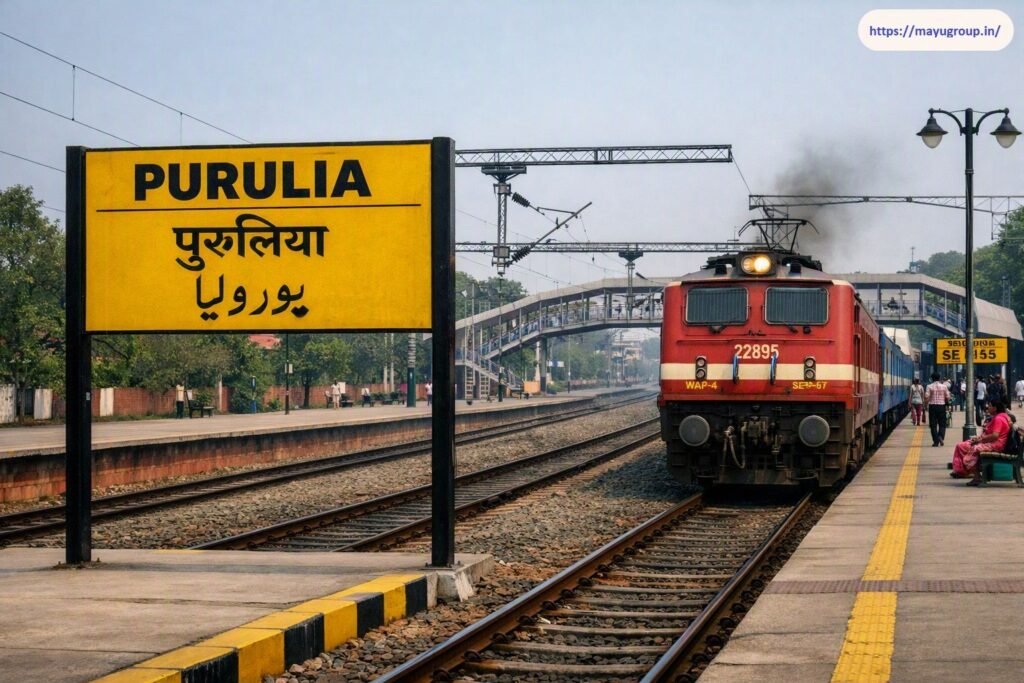
The year 2019 marked a turning point for Purulia Railway Station. After months of planning and discussions, the station officially began implementing the ISO 14001:2015 Environmental Management System. It was more than a certification project—it was a commitment to creating a railway station where passengers could enjoy modern amenities in a clean, green, and hygienic environment.
Every morning before sunrise, the station came alive with activity. The first passenger train arrived while housekeeping teams were already sweeping platforms and washing waiting areas. The station administration understood that cleanliness should never be temporary; it had to become a continuous process supported by proper planning, documentation, and teamwork.
The Divisional officers of the Adra Division, South Eastern Railway formed an Environmental Management Committee to supervise the implementation. The committee included station officials, engineering representatives, sanitation supervisors, electrical staff, and housekeeping contractors. Their common objective was simple: improve environmental performance while maintaining excellent passenger service.
The first challenge was understanding the environmental impact of daily railway operations. Every department prepared a detailed study of its activities. The housekeeping team measured the volume of waste generated each day. Engineering staff inspected water pipelines for leakages. Electrical technicians examined energy consumption in offices, platforms, and waiting halls. Gardeners surveyed the green spaces surrounding the station and identified areas suitable for plantation.
The findings revealed valuable opportunities for improvement. Thousands of plastic bottles and disposable food containers were discarded every week. Water was being wasted through damaged taps and overflowing storage points. Electricity consumption increased because lights often remained switched on in unused rooms. Instead of ignoring these issues, the management converted them into measurable environmental objectives.
A new waste management system was introduced across the station premises. Separate dustbins for wet waste and dry waste were installed on platforms, near ticket counters, waiting halls, and food stalls. Bright green and blue colors helped passengers identify the correct bins. Vendors received instructions to dispose of biodegradable and recyclable waste separately, making recycling more practical and efficient.
Awareness became the strongest tool for change. Colorful posters appeared throughout the station carrying messages such as “Keep Purulia Clean,” “Save Water,” and “Protect Our Environment.” Public announcement systems occasionally reminded passengers to use dustbins and avoid littering. School students visiting the station participated in cleanliness awareness campaigns, spreading environmental values beyond the railway premises.
Training sessions transformed the workplace culture. Housekeeping employees learned scientific cleaning methods, safe chemical handling, and proper waste segregation. Maintenance teams received guidance on preventing oil spills and reducing resource wastage. Even office staff participated in workshops about environmental documentation, emergency preparedness, and continual improvement—the core principles of ISO 14001:2015.
One inspiring initiative was the Green Platform Project. Instead of decorating the station with only ornamental plants, the gardening team selected native species that required less water and could survive Purulia’s warm climate. Flower beds near the entrance were redesigned, while trees were planted along boundary areas to improve shade and reduce dust pollution. Gradually, the station began looking fresher and more welcoming for travelers.
Water conservation also became a major priority. Leaking taps were repaired immediately, pipelines underwent routine inspections, and water usage was monitored every month. The management encouraged every employee to report wastage, proving that environmental protection depended on collective responsibility rather than individual authority.
As implementation progressed, documentation became equally important. Every cleaning schedule, waste collection record, maintenance activity, training program, and environmental inspection was carefully maintained. ISO 14001 required evidence that environmental practices were consistently followed, so accurate records became the backbone of the management system.
By the middle of 2019, remarkable improvements were already visible. Platforms remained cleaner for longer periods, waste segregation reduced litter, gardens flourished with healthy plants, and passengers frequently appreciated the improved station environment. Vendors noticed that cleaner surroundings attracted more customers, creating a positive relationship between environmental responsibility and business growth.
Finally, the day of the external certification audit arrived. Independent auditors visited every corner of the station. They inspected sanitation facilities, reviewed environmental records, interviewed employees, examined waste management practices, and observed passenger amenities. Instead of feeling nervous, the railway staff proudly demonstrated the systems they had developed together.
The auditors were particularly impressed by the participation of employees at every level. From station managers to sanitation workers, everyone understood the environmental policy and their role in achieving it. This shared awareness reflected the true spirit of ISO 14001:2015—not merely compliance, but organizational commitment.
Later that year, Purulia Railway Station successfully achieved ISO 14001:2015 Certification, valid from 2019 to 2022. The announcement filled the station with pride. Employees celebrated not because they had earned an international certificate, but because their daily efforts had created a healthier environment for thousands of passengers.
The certificate hanging inside the station office became a symbol of trust, discipline, and sustainable management. It reminded every railway employee that environmental excellence is not achieved in a single day—it is built through countless small actions performed with dedication.
Chapter 2 closed with a powerful realization: the certification was not the destination. It was the beginning of a much greater journey toward continuous improvement, community responsibility, and the vision of making Purulia Railway Station one of the cleanest and greenest stations under the South Eastern Railway.
#ISO14001
Chapter 3: The Promoter of Change and the Growth of Excellence
After receiving the ISO 14001:2015 Environmental Management System certification in 2019, a new chapter began for Purulia Railway Station. The certificate was not simply an achievement; it became the foundation for organizational growth, stronger public trust, and a culture of continuous improvement. Behind this success stood the true promoter of the project—the dedicated leadership of Adra Division, South Eastern Railway, along with the commitment of every railway employee who believed that environmental responsibility could transform public service.
Purulia Railway Station had always been an important transportation hub, but the management wanted it to become a model station where cleanliness, sustainability, and passenger comfort worked together. The promoter of this vision was not a private company but the collective administrative system of the railway division. Senior officers encouraged every department to think beyond routine maintenance and focus on long-term environmental excellence.
The station administration introduced a simple philosophy:
“Clean surroundings create happy passengers, and happy passengers create a stronger railway.”
This message was displayed during staff meetings and became the guiding principle for daily operations.
The months following certification brought remarkable organizational improvements. Instead of conducting occasional cleanliness drives, the station developed structured environmental programs with measurable targets. Every department received responsibilities based on the ISO framework. Housekeeping managed sanitation schedules, engineering monitored water systems, electrical teams reduced energy consumption, and administrative officers maintained environmental documentation.
One of the biggest changes was the introduction of performance monitoring. Weekly inspections were conducted across platforms, waiting halls, ticket counters, foot overbridges, toilets, and station entrances. Inspection reports highlighted strengths as well as areas requiring immediate improvement. Rather than criticizing employees, supervisors encouraged collaborative problem-solving.
The sanitation team became the heart of this transformation. Under disciplined leadership, cleaning operations were organized into shifts to ensure that every platform remained hygienic throughout the day. Modern cleaning equipment gradually replaced traditional methods, improving efficiency while reducing water usage. Employees began wearing protective safety gear, reflecting improved occupational health and environmental awareness.
Passengers soon noticed the difference. Travelers arriving from Howrah, Ranchi, and Tatanagar frequently appreciated the clean platforms and well-maintained waiting areas. Families felt more comfortable using passenger amenities, while elderly travelers benefited from cleaner toilets and safer walking spaces. Positive feedback collected through railway registers motivated employees to maintain even higher standards.
The station also strengthened its relationship with the local community. Schools, colleges, and voluntary organizations were invited to participate in environmental awareness campaigns. Students planted saplings within designated railway areas and learned about waste segregation and water conservation. These activities helped spread the message that protecting the environment was a shared responsibility extending beyond railway boundaries.
Financially, the environmental management system also contributed to operational growth. Better resource management reduced unnecessary expenditure on water leakage repairs, excessive electricity consumption, and inefficient waste handling. Although the primary objective was environmental protection, improved efficiency created indirect economic benefits for the station’s operations.
Another important initiative involved supporting railway vendors. Food stall operators received guidance on maintaining hygienic surroundings and disposing of waste responsibly. Dustbins were strategically placed near commercial areas, reducing litter around platforms. Vendors realized that cleaner business environments attracted more customers and improved the overall passenger experience.
Leadership within the Adra Division regularly reviewed environmental objectives through management meetings. Data regarding waste generation, cleaning performance, water usage, plantation activities, and passenger feedback was analyzed to identify opportunities for continual improvement. This systematic review reflected one of the strongest principles of ISO 14001:2015—continuous evaluation and corrective action.
The station’s green identity also began influencing its public image. Visitors often described Purulia Railway Station as organized, welcoming, and environmentally conscious. The beautifully maintained gardens near the entrance became popular photography spots for travelers waiting for trains. Seasonal flowers, shaded pathways, and clean surroundings created a pleasant atmosphere rarely associated with busy railway stations.
For the employees, the certification brought a sense of pride. Every cleaner, porter, technician, clerk, and station officer understood that they had contributed to an internationally recognized environmental achievement. The framed ISO certificate displayed inside the station office reminded everyone that excellence was built through teamwork rather than individual recognition.
By the end of the first year after certification, Purulia Railway Station had evolved into more than a transportation facility. It had become a symbol of responsible public infrastructure under the South Eastern Railway. Its growth was measured not only by passenger numbers but also by cleaner platforms, healthier surroundings, greener landscapes, efficient resource management, and stronger community engagement.
As trains continued to arrive and depart across the railway network, Purulia carried forward a powerful message: sustainable growth is possible when leadership, employees, and the public work together with a shared commitment to protecting the environment. The promoter’s vision had become a living reality, and the journey of excellence had only just begun.
#EnvironmentalManagement
Chapter 4: Growing Beyond Certification
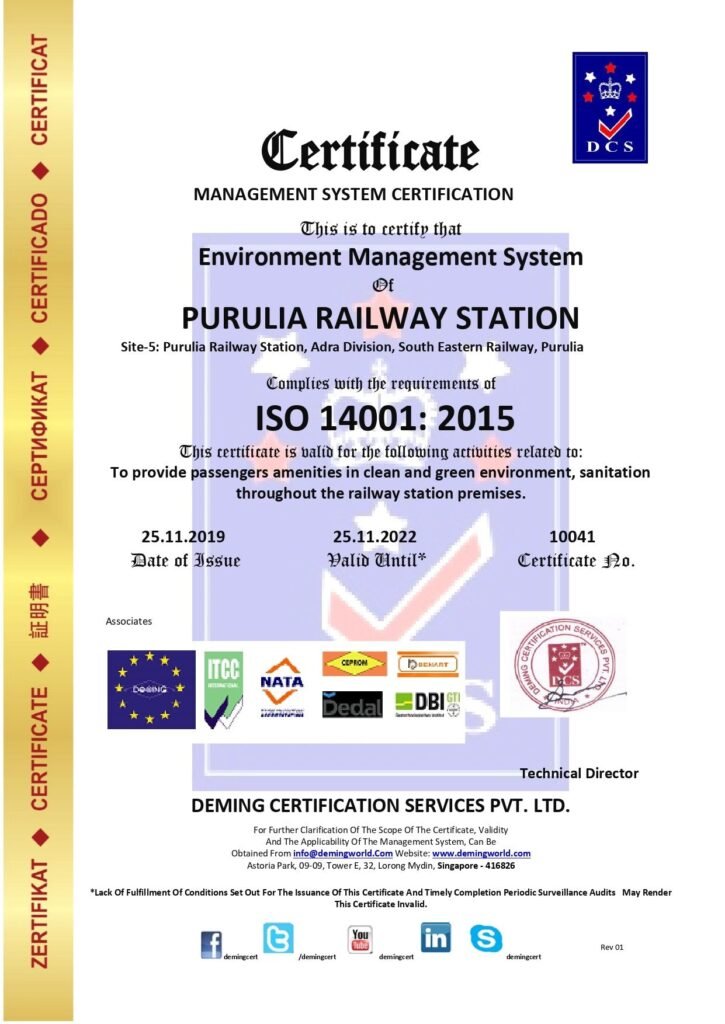
The celebration of achieving ISO 14001:2015 in 2019 lasted only a few days. Soon afterward, the management of Purulia Railway Station reminded every employee of an important truth: a certificate has value only when its principles are practiced every day. The environmental management system was valid until 2022, and maintaining its standards required dedication, discipline, and continuous improvement.
The station entered a new phase of growth. Instead of asking, “How do we earn certification?” the team began asking, “How do we become better than yesterday?” This shift in thinking transformed the culture of the entire railway station.
Each department prepared annual environmental improvement plans. Housekeeping teams strengthened sanitation schedules, engineering departments focused on preventive maintenance, and electrical staff searched for ways to reduce energy consumption. The station administration encouraged employees to suggest innovative ideas through monthly improvement meetings. Every suggestion, whether large or small, received careful attention.
One of the most visible changes was the expansion of green infrastructure. The entrance of the station was redesigned with flowering plants, decorative shrubs, and native trees suitable for the climate of Purulia. Gardeners selected species that required less water while providing shade and improving air quality. The once ordinary station entrance gradually became a welcoming green gateway for passengers arriving from different parts of India.
Water conservation also became a major success story. Earlier inspections had identified unnecessary water loss through leaking taps and damaged pipelines. After certification, a preventive maintenance system ensured that every reported leakage was repaired quickly. Water storage tanks were cleaned regularly, and station staff monitored daily consumption records to identify unusual usage patterns. These simple but effective measures reduced wastage and promoted responsible resource management.
Inside the station, passenger amenities received equal attention. Waiting halls became cleaner, seating areas were maintained more frequently, and toilet sanitation improved significantly through structured cleaning schedules. Special emphasis was placed on accessibility and hygiene, ensuring that elderly passengers, children, and persons with disabilities could use the facilities comfortably.
Technology also supported environmental progress. Conventional lighting in several areas was gradually replaced with energy-efficient LED systems, reducing electricity consumption while providing brighter illumination across platforms and corridors. Motion awareness among employees encouraged switching off unnecessary lights and electrical equipment whenever rooms were unoccupied. Small energy-saving habits collectively produced meaningful environmental benefits.
The station’s relationship with passengers became stronger through awareness campaigns. Colorful information boards encouraged travelers to use segregated waste bins, avoid littering, and help keep the station clean. Public announcements reminded everyone that environmental protection was a shared responsibility. Many passengers willingly participated, demonstrating that positive behavior often grows when people are provided with the right facilities.
Railway vendors became valuable partners in this journey. Food stalls adopted cleaner waste disposal practices, reusable containers were promoted wherever practical, and commercial areas were inspected regularly to maintain hygiene standards. Vendors discovered that cleaner surroundings improved customer confidence and contributed to a more pleasant travel experience.
Beyond daily operations, the management emphasized employee development. Regular training sessions refreshed staff knowledge about environmental policies, emergency preparedness, pollution prevention, and waste handling procedures. Newly recruited employees received orientation on the station’s environmental objectives, ensuring that the culture of sustainability continued across generations of railway workers.
The impact of these initiatives extended beyond the station premises. Local schools organized educational visits where students observed waste segregation systems and learned about environmental responsibility. Community organizations joined plantation drives during World Environment Day, strengthening the bond between Indian Railways and the citizens of Purulia. The station became a practical example of how public infrastructure could inspire environmental awareness within society.
Periodic internal audits measured the effectiveness of the environmental management system. Instead of treating audits as inspections to be feared, employees viewed them as opportunities to identify improvements. Corrective actions were implemented promptly, documentation remained updated, and environmental objectives were reviewed with transparency. This continuous evaluation reflected the true philosophy of ISO 14001:2015—continual improvement rather than temporary compliance.
By 2021, Purulia Railway Station had earned a reputation for maintaining a clean and green environment while providing reliable passenger amenities. Travelers often appreciated the well-maintained gardens, hygienic platforms, and organized waste management facilities. Railway officials from neighboring stations occasionally visited to observe the environmental practices implemented under the Adra Division, recognizing Purulia as a model for sustainable station management.
As the certification period approached its final year in 2022, the framed ISO certificate hanging inside the station office represented much more than an international standard. It symbolized the dedication of sanitation workers who cleaned before dawn, gardeners who nurtured every plant, engineers who prevented resource wastage, vendors who embraced cleanliness, and officers who believed that environmental excellence was essential to quality public service.
The journey beyond certification proved that real growth is measured not only by infrastructure or passenger numbers but also by the positive impact an organization creates for people and the environment. Purulia Railway Station had become a living example of sustainable progress—one platform, one tree, one clean corner, and one responsible action at a time.
#CleanAndGreenStation
Chapter 5: People, Passengers, and a Culture of Responsibility
The success of Purulia Railway Station’s environmental journey was never dependent on infrastructure alone. Behind every clean platform, properly maintained garden, hygienic waiting hall, and segregated waste bin stood a team of people who understood that sustainable development begins with responsibility.
After receiving ISO 14001:2015 certification in 2019, the station administration placed greater emphasis on developing a strong environmental culture among employees. The management understood that rules could create procedures, but only people could make those procedures successful. Therefore, the next stage of growth focused on employees, passengers, vendors, contractors, and the local community.
The sanitation workers became some of the most important contributors to this transformation. They arrived early in the morning, often before the first passengers entered the station, and began their daily responsibilities. Platforms were swept, waiting areas cleaned, toilets inspected, and waste collection points monitored. Their work was often unnoticed, but the management made an effort to recognize their contribution.
Regular training programs were introduced. Workers were taught how to handle different categories of waste, use cleaning materials safely, and maintain hygienic conditions without unnecessary consumption of water or chemicals. They were also encouraged to report damaged bins, leaking taps, blocked drains, or other environmental concerns immediately.
One of the most important changes was the development of a reporting culture. Previously, a minor leakage or overflowing dustbin might remain unnoticed until a routine inspection. Under the environmental management system, employees were encouraged to report problems as soon as they appeared. This simple approach helped the station move from reactive maintenance toward preventive action.
Passengers were equally important. A railway station is a public place, and no cleaning system can succeed if passengers continuously litter the premises. The administration therefore increased environmental awareness activities.
Posters were installed in visible locations. Announcements encouraged travelers to use designated dustbins. Messages promoted water conservation and discouraged careless disposal of plastic bottles and food packaging. The purpose was not to punish passengers but to make responsible behavior easier.
Gradually, passengers began responding positively. Parents encouraged children to throw wrappers into bins. Young travelers began using separate waste containers correctly. Regular commuters became familiar with the station’s cleanliness practices and often reminded others to maintain the same standards.
Railway vendors also became partners in the environmental initiative. Food and beverage stalls could generate considerable waste, especially during peak passenger hours. The station administration therefore worked with vendors to improve housekeeping around commercial areas. Waste was collected regularly, food-related litter was reduced, and vendors were encouraged to maintain clean surroundings.
This cooperation created an important business lesson. A clean environment was not an obstacle to commercial activity; it supported it. Passengers were more comfortable purchasing food and refreshments from stalls operating in clean surroundings. Vendors began to understand that environmental responsibility could improve customer confidence and contribute to a better business environment.
The station’s gardens provided another example of collective responsibility. Garden workers carefully maintained plants around the station entrance and other suitable areas. Trees and shrubs provided shade, reduced dust, and created a more pleasant atmosphere. Employees were encouraged to protect planted areas instead of treating them merely as decoration.
The green environment gradually became part of the station’s identity. Visitors arriving at Purulia saw greenery alongside railway infrastructure, creating a welcoming first impression. The initiative demonstrated that a busy railway station could combine transportation facilities with environmental consciousness.
The management also encouraged employees to conserve electricity. Lights and electrical equipment were switched off when not required, while energy-efficient lighting systems were introduced wherever practical. These actions appeared small individually, but their cumulative effect helped reduce unnecessary energy consumption.
Water conservation received similar attention. Leaking taps were repaired promptly, pipelines were inspected, and employees were encouraged to avoid unnecessary water usage during cleaning. The objective was not simply to reduce a monthly utility bill but to protect an increasingly valuable natural resource.
As these practices became routine, something more significant happened: employees began taking ownership of the environmental system.
They no longer considered ISO 14001:2015 to be the responsibility of senior officers or a particular environmental committee. A cleaner understood its importance. A technician understood it. A vendor understood it. A station clerk understood it. Even passengers gradually became part of the process.
This collective participation strengthened the organization.
The station administration periodically reviewed environmental performance and identified areas requiring additional attention. Corrective actions were recorded, responsibilities assigned, and improvements monitored. This systematic approach ensured that environmental initiatives did not disappear after a campaign ended.
By the time the station moved deeper into its certification period, the environmental management system had become part of everyday working life. Cleanliness was no longer treated as an occasional activity before important inspections. It had become a continuous standard.
The greatest achievement was therefore not a new garden, a new dustbin, or a successful audit. It was the change in mindset.
Purulia Railway Station demonstrated that organizational growth begins when people understand the purpose behind their work. The ISO 14001:2015 certification provided a framework, but employees and passengers gave that framework life.
Every clean platform represented discipline. Every repaired leak represented conservation. Every planted tree represented hope. Every correctly segregated waste item represented awareness.
The station was gradually becoming more than a place where trains stopped. It was becoming a community space where environmental responsibility could be seen, practiced, and shared.
And as the journey continued toward 2022, one principle remained clear: the strongest environmental management system is one that becomes part of the culture of the organization itself.
#IndianRailways
Chapter 6: From Certification to Sustainable Growth
The ISO 14001:2015 certification marked an important milestone in the journey of Purulia Railway Station, but the real test began after the certificate was received. Certification could demonstrate that an environmental management system had been established, but maintaining its effectiveness required continuous effort. During the following years, the station administration focused on converting environmental policies into long-term operational practices.
The leadership understood that sustainable growth could not be achieved through isolated cleanliness campaigns. Every activity had to become part of the station’s regular functioning. Cleaning schedules, waste collection, water conservation, energy management, landscaping, passenger amenities, and employee training were gradually brought together under a common environmental approach.
One of the most important areas of development was waste management. Railway stations generate different types of waste throughout the day, including food waste, paper, plastic bottles, packaging materials, and general refuse. With increasing passenger movement, the challenge was to ensure that waste did not accumulate on platforms or enter drains.
The station therefore strengthened its waste collection system. Dustbins were positioned at strategic locations, particularly near waiting areas, entrances, food stalls, and busy platform sections. Employees were encouraged to monitor these locations regularly so that overflowing bins could be addressed before they became a problem.
Waste segregation also became a priority. The purpose was to separate recyclable materials from biodegradable waste as close to the point of disposal as possible. Railway staff and vendors received instructions regarding proper segregation, while passengers were encouraged through signs and public announcements to use the appropriate containers.
The benefits extended beyond cleanliness. Better segregation made waste handling more organized and reduced the amount of recyclable material being unnecessarily mixed with general waste. It also created greater awareness among passengers about responsible consumption and disposal.
Water management was another important part of the station’s sustainable development. Railway stations require water for toilets, cleaning, drinking facilities, gardens, and other passenger amenities. Uncontrolled consumption could place pressure on available resources.
Maintenance teams therefore adopted a preventive approach. Leaking taps and damaged pipelines were identified and repaired. Water storage facilities were inspected periodically, and employees were reminded that even a small leak could result in considerable wastage over time.
The station’s green spaces received similar attention. Plantation was not considered merely an aesthetic exercise. Trees and plants helped create shade, improve the appearance of the station, and contribute to a healthier environment. Garden workers selected plants suitable for local conditions and maintained them through regular watering, pruning, and soil care.
The entrance gradually became one of the most attractive parts of the station. Greenery softened the appearance of concrete structures and railway infrastructure. Passengers waiting for trains could see plants and landscaped areas rather than an entirely built environment.
Energy conservation also became part of the station’s environmental objectives. Railway operations depend heavily on electricity for lighting, ventilation, communication systems, offices, and passenger facilities. The administration encouraged responsible energy use and gradually promoted energy-efficient lighting.
Employees were instructed to avoid unnecessary use of electrical equipment. Lights in vacant rooms were switched off, equipment was monitored, and maintenance teams ensured that electrical systems operated efficiently. These practices contributed to resource conservation while supporting the station’s broader environmental goals.
The improvement of passenger amenities remained central to the entire initiative. Environmental management was not treated separately from passenger service. A clean toilet, hygienic waiting room, functioning water facility, and well-maintained platform were all considered components of quality service.
This approach created a connection between environmental performance and passenger satisfaction. When travelers encountered clean and organized facilities, their experience of the station improved. A positive passenger experience also strengthened public confidence in the railway administration.
Training remained essential to sustaining these achievements. Employees participated in awareness programs covering environmental objectives, sanitation, emergency preparedness, waste management, resource conservation, and workplace safety. Refresher training helped ensure that new employees understood the same standards as experienced staff.
The management also recognized that contractors and vendors had to be included. Environmental performance could not be maintained if only permanent railway employees followed the system. Contractors responsible for cleaning and maintenance were therefore expected to follow station procedures and maintain appropriate records.
Regular inspections provided another layer of control. Supervisors visited different sections of the station and checked sanitation, waste disposal, water facilities, gardens, and general environmental conditions. Problems identified during inspections were recorded and addressed through corrective measures.
This systematic process helped create a culture of continual improvement. Instead of waiting for an external inspection, the station continuously evaluated its own performance.
The period following certification also strengthened the relationship between the railway station and the local community. Cleanliness and environmental awareness campaigns encouraged citizens to view the station as a shared public space. Schools, community groups, passengers, vendors, and railway employees could all contribute to maintaining its standards.
By this stage, the meaning of growth had changed.
Growth was no longer measured simply by the number of trains arriving or passengers served. It was also reflected in improved sanitation, reduced wastage, greener surroundings, better employee awareness, stronger public participation, and more organized environmental practices.
The ISO 14001:2015 system had provided the structure, but the people of Purulia Railway Station had provided the determination.
As the certification period moved toward 2022, the station stood as an example of how environmental responsibility could become integrated with everyday railway operations. The journey showed that sustainable development does not always require dramatic transformation. Sometimes it begins with a repaired tap, a correctly used dustbin, a planted tree, a switched-off light, or a cleaner platform.
Together, these small actions created something much larger: a culture of responsibility.
Purulia Railway Station had begun its environmental journey with a certificate. It was now continuing that journey with experience, discipline, and a growing belief that public infrastructure could serve both people and the planet.
#SustainableRailways
Chapter 7: Challenges, Resilience, and Continuous Improvement
The journey of Purulia Railway Station toward environmental excellence was not without challenges. Achieving ISO 14001:2015 certification in 2019 had created a strong foundation, but maintaining that standard in a busy railway environment required constant attention. Trains continued to arrive and depart, passenger numbers changed throughout the day, weather conditions affected sanitation, and operational priorities sometimes competed with environmental objectives.
The station administration soon learned that sustainable development was not a straight road. It was a continuous journey involving challenges, solutions, monitoring, and improvement.
One of the first major challenges was the unpredictable volume of waste. During normal days, the station’s cleaning teams could maintain platforms effectively. However, during festivals, holidays, weekends, and periods of heavy passenger movement, the amount of waste increased significantly.
Food packaging, plastic bottles, paper cups, and other disposable materials could accumulate quickly. The sanitation team therefore had to adapt its cleaning schedules according to passenger traffic. Instead of relying on fixed routines alone, supervisors increased monitoring during busy periods.
This flexible approach helped maintain cleanliness even when passenger numbers increased.
Another challenge was passenger behavior. Railway stations are public places used by people from different backgrounds, and not everyone followed environmental instructions. Some passengers still threw wrappers on the floor or placed waste in the wrong bins.
The management realized that changing behavior required patience. Rather than depending only on warnings, the station increased awareness through posters, announcements, signs, and direct communication. Employees politely encouraged passengers to use the correct bins and keep public spaces clean.
Over time, repeated awareness efforts began producing results.
Water conservation also presented operational difficulties. Railway facilities require significant amounts of water, particularly for sanitation and passenger amenities. During periods of high demand, controlling consumption became more difficult.
The maintenance team responded through regular inspections. Leaking taps, damaged pipes, and faulty fittings were identified and repaired. Employees were encouraged to report water wastage immediately. The objective was to create a preventive maintenance culture in which problems were corrected before they became major losses.
Seasonal weather presented another challenge. Purulia experiences hot and dry periods, making the maintenance of gardens and plantation areas more demanding. Plants required careful watering and attention, while dust could accumulate quickly around open railway areas.
The gardening team therefore focused on appropriate plant selection and efficient maintenance. Native and climate-suitable plants were preferred wherever possible. This reduced unnecessary dependence on water while ensuring that green spaces remained attractive.
Maintaining toilets and sanitation facilities was perhaps one of the most demanding responsibilities. These facilities are heavily used and require frequent cleaning. During peak hours, cleanliness could deteriorate rapidly.
To address this issue, cleaning schedules were reviewed and monitoring increased. Supervisors inspected facilities at regular intervals, while cleaning staff responded quickly when additional attention was required. The objective was to ensure that sanitation remained consistent throughout the day rather than only immediately after cleaning.
Employee awareness was another important challenge. Railway stations involve multiple departments, contractors, and shifts. Maintaining consistent environmental practices requires everyone to understand their responsibilities.
Training therefore became a continuing activity. Refresher sessions reminded employees about waste segregation, water conservation, energy efficiency, emergency procedures, and environmental objectives. New employees and contract workers were introduced to the station’s environmental procedures as part of their orientation.
The management also discovered that documentation was essential. ISO 14001:2015 was not simply about visible cleanliness; it required evidence that environmental processes were planned, implemented, monitored, and improved.
Records of inspections, training programs, waste management, maintenance activities, and corrective actions were therefore maintained carefully. Documentation helped the management understand trends and identify areas where additional improvement was necessary.
Internal audits played an important role in this process. Rather than waiting for an external assessment, the station conducted periodic reviews of its own environmental management system. Audit findings were discussed with responsible departments, and corrective measures were assigned.
This created a valuable cycle:
Identify → Correct → Monitor → Improve.
The approach encouraged employees to see problems as opportunities rather than failures.
Financial limitations could also affect environmental improvement. Not every proposed project could be implemented immediately. The administration therefore prioritized measures that offered practical environmental benefits without creating unnecessary expenditure.
Simple actions often produced impressive results. Repairing a leaking tap cost far less than replacing an entire water system. Switching off unnecessary lights required no major investment. Better placement of dustbins could improve cleanliness without extensive construction.
These experiences taught the station that environmental excellence depends as much on discipline as technology.
The COVID-19 period introduced additional difficulties for railway operations and sanitation. Health and hygiene requirements became even more important, while operational conditions changed significantly. Cleaning teams had to adapt to enhanced hygiene expectations and changing passenger movement.
The experience strengthened the station’s understanding of emergency preparedness. Environmental management and public health were closely connected, and the ability to respond quickly became an essential part of responsible station management.
Through every challenge, the station continued to improve.
Employees became more confident in identifying environmental risks. Supervisors became more systematic in monitoring performance. Passengers became increasingly familiar with cleanliness initiatives. Vendors became more conscious of their responsibilities. The entire station gradually developed greater resilience.
By 2022, the journey had demonstrated an important lesson: certification itself does not create excellence. People create excellence by maintaining standards when nobody is watching.
Purulia Railway Station’s environmental journey was therefore a story of resilience. Challenges did not weaken the system; they helped strengthen it. Each difficulty encouraged the organization to review its practices, improve its procedures, and develop better solutions.
The station had learned to look beyond the certificate and focus on the purpose behind it—providing passengers with a clean, green, safe, and hygienic environment while using natural resources responsibly.
The road was not always easy, but every challenge brought the station one step closer to becoming a stronger and more sustainable public institution.
#RailwayCleanliness
Chapter 8: Community Partnership and the Green Identity of Purulia
As Purulia Railway Station continued its environmental journey after receiving ISO 14001:2015 certification in 2019, the administration realized that long-term success could not depend on railway employees alone. A railway station belongs to the public. Thousands of passengers, vendors, local residents, students, and visitors use its facilities every day. Therefore, creating a clean and green station required cooperation from the entire community.
This realization led to a new phase in the station’s development: building a strong relationship between environmental management and public participation.
The station gradually developed an identity beyond being a place where trains arrived and departed. It became a public space where cleanliness, greenery, sanitation, and responsible behavior could be demonstrated every day.
One of the most visible initiatives was the promotion of environmental awareness among passengers. Posters and signboards were placed at strategic locations, reminding travelers to use dustbins, avoid unnecessary plastic, conserve water, and protect planted areas. Messages were designed to be simple and easy to understand because the station welcomed passengers from different educational and social backgrounds.
Public announcements also played an important role. During busy hours, passengers were reminded to maintain cleanliness and use designated waste collection facilities. These announcements transformed environmental awareness from a silent message on a wall into an active part of the passenger experience.
The station administration understood that awareness alone was not enough. Passengers needed convenient facilities if they were expected to behave responsibly. Therefore, waste bins were placed near locations where waste was most likely to be generated, particularly around food stalls, waiting areas, entrances, and busy sections of platforms.
This created a practical connection between awareness and action.
Local schools became another important partner. Teachers and students were invited to participate in cleanliness and plantation activities. For many students, visiting the railway station was an educational experience. They could observe how waste was collected, how public sanitation was maintained, and why environmental responsibility mattered in a busy public facility.
During plantation programs, students helped plant saplings in designated areas. Railway employees explained that trees were not simply decorations. They provided shade, helped improve the surroundings, and contributed to the visual identity of the station.
The sight of children planting trees also sent a powerful message to passengers. It showed that environmental protection was a responsibility shared across generations.
Community organizations and local volunteers also contributed to awareness programs. Cleanliness campaigns created opportunities for citizens to participate directly rather than simply expecting railway staff to maintain the premises.
This partnership changed perceptions.
Railway employees began to see members of the public as partners in environmental management. Passengers, in turn, became more aware that their behavior influenced the condition of the station.
Vendors played an especially important role. Food and beverage stalls were located in areas where waste could accumulate quickly. The station administration worked with vendors to promote better housekeeping and responsible waste disposal.
Vendors were encouraged to keep their immediate surroundings clean, use designated waste containers, and cooperate with cleaning teams. They gradually realized that a cleaner environment could improve the customer experience.
A passenger who saw a clean food stall, organized surroundings, and properly maintained platform was more likely to feel comfortable purchasing refreshments there.
Thus, environmental responsibility and commercial activity began supporting each other.
The green identity of the station also became increasingly important. The entrance and selected areas around the station were maintained with plants, shrubs, and trees. Gardeners worked carefully to keep these spaces healthy, especially during hot and dry weather.
The greenery created a visual contrast with railway infrastructure. Tracks, platforms, signals, buildings, and passenger facilities were complemented by natural elements.
For travelers arriving in Purulia, this created a welcoming first impression.
The environmental initiatives also strengthened the relationship between the station and the wider image of Purulia. The district is known for its natural beauty, landscapes, hills, forests, and cultural traditions. A cleaner and greener railway station therefore supported the broader identity of the region.
The station became a gateway not only to the district but also to its environmental character.
Behind these visible improvements was a structured management system. Environmental objectives were reviewed periodically, inspections were conducted, and corrective measures were introduced wherever necessary. Community participation therefore complemented, rather than replaced, formal environmental management.
The station’s ISO 14001:2015 journey demonstrated that a management standard becomes most effective when it influences everyday behavior.
A dustbin was useful only when people used it.
A garden was successful only when people protected it.
A clean toilet was meaningful only when sanitation standards were continuously maintained.
A water-saving system mattered only when employees and passengers avoided unnecessary wastage.
This understanding gradually created a culture of shared ownership.
The community partnership also had an indirect effect on employee motivation. When workers saw passengers appreciating clean facilities, they felt greater pride in their responsibilities. When students participated in plantation activities, gardeners felt that their work had educational as well as operational value.
Small interactions began producing larger changes.
A cleaner would remind a vendor to keep a waste container nearby. A vendor would request faster waste collection. A passenger would inform a staff member about a leaking tap. A student would return home and tell family members about waste segregation.
In this way, environmental awareness moved beyond the railway boundary.
By the end of the certification period, Purulia Railway Station had developed a recognizable green identity. Its achievements were not limited to formal compliance. The station had created a network of people who understood that public cleanliness was a shared responsibility.
The story of Purulia therefore became a story of partnership.
The railway provided leadership and systems. Employees provided dedication. Vendors provided cooperation. Students provided enthusiasm. Passengers provided participation. The community provided support.
Together, they created an environment in which sustainability could continue to grow.
The lesson was simple but powerful: a railway station becomes truly green not when it has the most plants or the newest equipment, but when the people who use and operate it believe that protecting the environment is their collective responsibility.
#WasteManagement
Chapter 9: Measuring Success and the Legacy of ISO 14001:2015
By the final years of the ISO 14001:2015 certification period, Purulia Railway Station had reached an important stage in its environmental journey. The certificate issued in 2019 and valid through 2022 had provided a formal framework for environmental management, but the real achievement was the transformation that took place within the station.
The administration had learned that success could not be measured only by the presence of a certificate. It had to be visible in daily operations, employee behavior, passenger experience, resource management, and the condition of the station premises.
Therefore, the station began looking at its progress through measurable indicators.
Cleanliness became one of the first areas of assessment. Supervisors regularly inspected platforms, waiting rooms, ticketing areas, toilets, entrances, stairways, and other passenger facilities. The purpose was to identify areas requiring attention and ensure that cleaning standards remained consistent.
The sanitation team developed greater discipline in maintaining schedules. Cleaning was not limited to the beginning or end of the day. Busy periods required additional attention because passenger movement could quickly change the condition of a platform.
This continuous monitoring produced an important change: cleanliness became a process rather than an event.
Waste management was another key indicator. The administration monitored collection practices and encouraged better segregation of recyclable and biodegradable materials. The availability of appropriately positioned bins reduced litter in frequently used areas.
Employees also became more conscious of the relationship between waste generation and environmental impact. Instead of simply collecting waste after it appeared, the station began emphasizing prevention and responsible disposal.
Water management provided another measure of improvement. Regular inspections helped identify leaks and unnecessary consumption. Employees were encouraged to report problems immediately, while maintenance teams worked to prevent recurring failures.
The objective was not merely to save water but to develop respect for a limited natural resource.
Energy efficiency was similarly monitored. Electrical staff examined lighting requirements and promoted the use of efficient lighting systems. Employees developed simple habits such as switching off lights and equipment when not required.
These actions demonstrated an important principle of environmental management: large improvements can emerge from many small decisions.
Greenery became another visible symbol of success. Plantation and landscaping initiatives improved the appearance of the station while creating a more pleasant environment for passengers. Garden maintenance became part of regular station management rather than an occasional beautification activity.
The station’s green spaces also created a sense of identity. A traveler entering a clean railway station surrounded by maintained greenery could immediately recognize that environmental care was part of the institution’s culture.
Employee participation was perhaps the most important measure of all.
Training records showed that staff members from different departments had been exposed to environmental management principles. Employees became increasingly capable of identifying environmental risks and suggesting corrective actions.
This was a significant change from the early stages of the journey, when environmental management had been a relatively new concept for some staff members.
The ISO system had encouraged people to think systematically.
Instead of asking only, “Is the station clean today?” employees began asking broader questions:
Is waste being managed correctly?
Are resources being used efficiently?
Could this process create environmental harm?
Can this activity be improved?
What preventive action can be taken?
These questions became part of the station’s working culture.
Passenger response also provided valuable evidence. Travelers increasingly appreciated clean platforms, improved sanitation, organized waste disposal, and greener surroundings. Positive feedback encouraged the administration to maintain its standards.
The station also benefited from stronger public awareness. Passengers were increasingly familiar with waste segregation and cleanliness campaigns. Vendors became more cooperative, while community organizations and students participated in environmental activities.
The combined effect strengthened the station’s public image.
However, the administration understood that environmental management was never complete. Every improvement created another opportunity for development. Waste reduction could be improved further. Water consumption could be monitored more carefully. Energy efficiency could be expanded. Green areas could be maintained more effectively.
This philosophy of continual improvement was one of the greatest lessons of ISO 14001:2015.
The certification period approaching 2022 therefore became a time of reflection. Railway officers looked back at the station’s condition before the environmental management system had been implemented.
The difference was substantial.
The station had moved from routine cleanliness toward structured sanitation management. Waste handling had become more organized. Employees had greater environmental awareness. Green spaces had expanded. Resource conservation had become an operational consideration. Community participation had increased.
Most importantly, the station had developed a system that could continue beyond the original certification period.
The certificate itself would eventually reach the end of its validity, but the knowledge gained during the certification journey would remain with the organization.
This became the true legacy of ISO 14001:2015.
A certificate can have an issue date and an expiry date. A culture of responsibility does not.
For Purulia Railway Station, the period from 2019 to 2022 therefore represented more than a three-year certification cycle. It represented a period of institutional learning.
Employees learned that environmental management required teamwork.
Managers learned that leadership had to be supported by measurable action.
Vendors learned that cleanliness could strengthen business and customer confidence.
Passengers learned that public spaces remained clean only when users contributed.
Students and community members learned that environmental protection could begin in everyday places.
The railway station became a practical demonstration of sustainable public service.
Its legacy was not based on claims of perfection. Rather, it was based on a willingness to recognize problems, implement solutions, monitor results, and continue improving.
As evening arrived at Purulia Railway Station, trains continued to move across the tracks. Passengers waited beneath the station lights, vendors served refreshments, railway employees completed their duties, and gardeners cared for the green spaces.
The station looked ordinary from a distance.
But behind the platforms was a remarkable story of organizational change.
A story in which an environmental management standard helped create discipline.
A story in which discipline created awareness.
Awareness created participation.
Participation created improvement.
And improvement created a lasting legacy.
Purulia Railway Station’s ISO 14001:2015 journey proved that environmental certification is most valuable when it changes the way an organization thinks and works. The greatest achievement was not the certificate received in 2019, but the environmental culture that continued to grow throughout the certification period and beyond.
The journey had begun with a commitment to provide passengers with amenities in a clean and green environment with sanitation throughout the railway station premises.
By 2022, that commitment had become part of the station’s identity.
And that identity would continue with every arriving train, every departing passenger, every maintained garden, every cleaned platform, and every employee who chose to protect the environment through one responsible action at a time.
#GreenRailwayInitiative
Chapter 10: The Future Beyond 2022
The story of Purulia Railway Station’s environmental transformation reached an important milestone in 2022, when the ISO 14001:2015 certification period came to an end. But for the people who had participated in the journey, 2022 did not represent an ending. It represented a new beginning.
The certificate issued in 2019 had provided a structured framework for environmental management. Over the following years, that framework had influenced sanitation, waste management, water conservation, energy efficiency, plantation, passenger awareness, employee training, and community participation.
The greatest achievement was that these practices had gradually become part of everyday thinking.
On an early morning in Purulia, the railway station continued its normal rhythm. A train arrived as passengers stepped onto the platform. Porters moved luggage, vendors prepared tea, railway employees checked facilities, and sanitation workers began their duties. From the outside, it looked like another ordinary day.
But the station had changed.
The experience gained through ISO 14001:2015 had created a stronger understanding of environmental responsibility. Employees no longer saw cleanliness as an isolated task performed by sanitation workers. They understood that every department influenced the environment.
The future vision was therefore built around one principle: continuous improvement.
The station administration recognized that environmental challenges would continue to evolve. Passenger traffic could increase. Waste generation could change. Water availability could become more important. Energy requirements could grow. Climate conditions could create new maintenance challenges.
The station needed to remain prepared.
Future environmental planning therefore focused on strengthening existing systems rather than simply introducing new projects. Waste segregation could be improved further. Recycling could be expanded. Water consumption could be monitored more accurately. Energy-efficient technology could be adopted progressively. Green areas could be protected and developed according to local environmental conditions.
Digital technology could also support future management. Electronic records, inspection systems, maintenance reporting, and data-based monitoring could help officers identify problems more quickly. Instead of depending entirely on manual observations, environmental performance could increasingly be supported by accurate information.
Passenger amenities would remain at the center of this development.
The purpose of environmental management was never simply to meet an international standard. It was to create a better experience for people using the railway station. Clean toilets, hygienic waiting areas, safe drinking-water facilities, organized platforms, effective waste collection, and attractive surroundings were all part of quality passenger service.
The future station would therefore need to balance environmental responsibility with passenger convenience.
The role of employees would remain equally important. New staff members would need to understand the environmental culture established during the certification period. Refresher training would help experienced employees maintain awareness. Leadership would continue to encourage suggestions from workers because those closest to daily operations often understand practical problems better than anyone else.
The story also offered an important lesson about recognition.
An ISO certificate should never become a destination. It should serve as evidence that an organization has established a systematic approach to improvement. Once the certification period ends, the responsibility does not disappear.
For Purulia Railway Station, the values behind the certification could continue regardless of the status of any particular certificate.
The station’s relationship with the community could become even stronger. Schools could continue participating in plantation and cleanliness campaigns. Local organizations could support awareness activities. Passengers could be encouraged to provide feedback on sanitation and environmental facilities.
The railway station could become a place where visitors learned that environmental responsibility was compatible with efficient public transportation.
The green identity of Purulia itself could also be reflected in the station. The district’s natural landscapes, forests, hills, and cultural heritage provide a strong foundation for environmental awareness. A railway station that welcomes visitors into such a region has an opportunity to communicate the importance of protecting its surroundings.
This created a larger vision.
Purulia Railway Station could represent not only a gateway to the district but also a gateway to environmental consciousness.
Every arriving passenger could encounter a simple message: travel responsibly, keep public spaces clean, save resources, and respect nature.
Every employee could carry the same message into daily work.
Every vendor could contribute through responsible commercial practices.
Every student participating in a plantation program could carry the lesson home.
In this way, the impact of the railway station could extend far beyond its physical boundaries.
Looking back at the journey from 2019 to 2022, the transformation was clear. The station had begun with an objective: to provide passengers with amenities in a clean and green environment while maintaining sanitation throughout the railway station premises.
That objective had gradually developed into a comprehensive environmental culture.
The journey had faced challenges—heavy passenger traffic, waste generation, water consumption, maintenance requirements, changing operational conditions, and the difficulty of changing public behavior. Yet every challenge created an opportunity to improve.
The most valuable lesson was that sustainability is built through consistency.
A single plantation drive cannot create a green station.
A single cleaning campaign cannot create permanent sanitation.
A single training program cannot create environmental awareness.
A single certificate cannot create sustainable development.
Real progress comes from repeating good practices every day.
That is what made the Purulia Railway Station story meaningful.
The certificate issued in 2019 became a milestone, but the people were the real promoters of change. Railway officers provided leadership. Employees provided dedication. Sanitation workers protected hygiene. Gardeners maintained greenery. Engineers conserved resources. Vendors cooperated. Passengers participated. Community members supported awareness activities.
Together, they created a culture that could continue beyond the certification period.
As another train departed from Purulia, the platform slowly became quiet. A cleaner collected the remaining waste, a gardener watered the plants, and an employee switched off unnecessary lights in an empty room.
These were ordinary actions.
Yet they represented the extraordinary journey of the station.
The future of Purulia Railway Station would not be defined by one certificate or one project. It would be defined by the willingness of its people to continue improving.
The story that began with ISO 14001:2015 had therefore reached its final chapter—but not its final page.
The railway tracks continued toward distant destinations.
And so did Purulia Railway Station.
Its journey forward was a journey toward cleaner platforms, greener surroundings, responsible resource use, improved passenger amenities, stronger community participation, and sustainable public service.
The final message of the journey was simple:
A certificate may mark an achievement, but a culture of environmental responsibility creates a legacy.
Purulia Railway Station had created that legacy.
And with every train that arrived, every passenger who departed, and every employee who performed one responsible action, the green journey continued.
#ContinualImprovement
#PuruliaHeritage #AdraDivision #SouthEasternRailway #GreenStationDevelopment #RailwayEnvironmentalSustainability
Take the Next Step Today
Don’t wait to enhance your business’s quality and efficiency. Partner with Mayu Group India and experience the transformation that comes with expert consultancy and training. Contact us today to learn more about how we can help you achieve your business goals. Reach out via phone at +91-9322728183, visit our website at www.mayugroup.in, or email us at investor@mayugroup.in Let us be your guide on the journey to excellence and innovation.