
Press Stampimg Industries
- Press Stampimg Industries
- Chapter 1 – The Beginning of a Quality Transformation
- Chapter 2 – Building a Culture Around Quality
- Chapter 3 – Entering the Railway Manufacturing Environment
- Chapter 4 – The 2021 Certification Milestone
- Chapter 5 – Turning Certification into Operational Strength
- Chapter 6 – People, Skills and the Human Side of Growth
- Chapter 7 – Expanding Capability Through Process Improvement
- Chapter 8 – Building Customer Confidence and Market Reputation
- Chapter 9 – Promoter’s Leadership and Vision for Sustainable Growth
- Chapter 10 – From Certification to a Future of Continuous Improvement
- Take the Next Step Today
Chapter 1 – The Beginning of a Quality Transformation
The story of Press Stamping Industries is a story of manufacturing, determination, quality consciousness and continuous growth. Located at 336/29 G.I.D.C. Industrial Estate, Makarpura, Vadodara, Gujarat, India, the organization developed its capabilities in an industrial environment where precision, reliability and timely delivery are essential to customer satisfaction.
The company’s principal activities included the manufacturing of sheet metal press components, fabrication components and machining works, while its capabilities also extended to the new build of parts for railway vehicles without design responsibility. These activities placed the organization in a technically demanding manufacturing environment where every component had to be produced according to defined customer requirements and controlled processes.
At the heart of the company’s development was its promoter and leadership team. From the early stages, the promoter understood that manufacturing success could not depend only on machines, manpower or production capacity. A sustainable business required a strong foundation of quality, discipline and customer confidence.
The manufacturing industry is highly competitive. Customers expect suppliers to provide products that meet specifications, maintain consistent quality and arrive within committed schedules. A single quality problem can result in rejection, rework, delayed deliveries and loss of customer confidence. For this reason, the leadership of Press Stamping Industries gradually began to recognize that quality had to become an integral part of the company’s overall business strategy.
The decision to strengthen the organization’s quality management system through ISO 9001 certification became an important turning point.
Before this transformation, manufacturing success could often be associated with practical experience and the technical knowledge of skilled workers. However, as the organization developed and customer expectations increased, the promoter realized that experience alone was not enough. Knowledge had to be converted into systems. Processes had to be defined. Responsibilities had to be clarified. Records had to be maintained. Problems had to be analyzed systematically.
ISO 9001 provided a structured framework for achieving this transformation.
The company began examining its activities from the customer’s perspective. Every order represented a commitment. Every drawing contained requirements. Every raw material had to be suitable for its intended application. Every manufacturing process had to be controlled. Every inspection had to provide meaningful evidence of conformity.
This encouraged the organization to develop greater discipline in areas such as customer requirement review, production planning, purchasing, material control, inspection, equipment maintenance, employee competence and corrective action.
One of the most significant changes was the company’s understanding of documentation.
Documents were no longer considered merely administrative paperwork. They became tools for ensuring consistency.
A controlled drawing helped ensure that production personnel were working to the correct revision.
An inspection record provided evidence that specified characteristics had been checked.
A training record demonstrated that employees had received appropriate instruction.
A maintenance record provided information about equipment condition.
A corrective-action record helped the company understand why a problem occurred and what could be done to prevent it from happening again.
This systematic approach became increasingly valuable as the organization expanded its manufacturing activities.
The promoter also encouraged employees to understand that quality was everyone’s responsibility.
The operator responsible for a press machine had a role in maintaining product conformity.
The fabrication worker had a responsibility to follow the specified process.
The machinist had to maintain dimensional accuracy.
The inspector had to verify requirements objectively.
The supervisor had to coordinate production and quality.
The stores team had to maintain appropriate material identification and control.
Management had to provide resources, direction and continual improvement.
In this way, quality gradually moved from being an activity performed at the end of production to becoming a responsibility present throughout the manufacturing process.
This change in thinking was particularly important as Press Stamping Industries began developing its position in railway-related manufacturing.
Railway vehicles require components manufactured with a high degree of consistency and control. A component that appears simple may nevertheless be part of a larger engineered system where dimensional accuracy, material suitability, fabrication quality and traceability can all be important.
The organization therefore understood that entering or strengthening its presence in railway manufacturing would require specialized systems and technical competence.
This realization eventually led to the company’s certification at Certification Level CL2 according to EN 15085-2:2020 for its defined scope.
The CL2 certification became another major milestone in the company’s development. It demonstrated the organization’s movement toward a more specialized quality framework for applicable railway vehicle and component manufacturing activities.
For the promoter, however, certification was never intended to be simply a certificate displayed on a wall.
The real objective was to build an organization capable of repeatedly meeting customer expectations.
This meant developing people, strengthening processes, controlling manufacturing activities and learning from mistakes.
The company began to see every production challenge as an opportunity to improve.
If a component required rework, the team needed to understand why.
If a customer raised an observation, the organization needed to investigate the underlying cause.
If a machine created repeated variation, its condition and process parameters needed to be reviewed.
If an employee lacked competence for a particular task, training had to be considered.
This approach created the foundation for continual improvement.
The certification journey also changed the way the promoter viewed business growth. Growth was no longer measured only through increased orders or production volumes. Organizational maturity became equally important.
Could the company handle more customers without losing quality?
Could it increase production while maintaining process control?
Could new employees be trained effectively?
Could customer requirements be communicated accurately to the shop floor?
Could problems be identified before they reached the customer?
These questions became increasingly important.
The company’s journey therefore entered a new phase.
The foundation had been established through manufacturing experience. ISO 9001 strengthened the organization’s management discipline. The railway certification journey added another layer of technical and organizational responsibility.
From the industrial surroundings of Makarpura, Vadodara, Press Stamping Industries began building an identity based not merely on producing components, but on producing them through controlled and reliable processes.
The promoter’s vision was becoming clearer: quality should not be something checked only after production; quality should be built into the way the company works.
This philosophy would become the foundation for the organization’s future growth.
The journey had begun with a commitment to improve.
The next stage would be to transform that commitment into a culture—one in which every employee, every process and every component contributed to the same objective:
consistent quality, customer confidence and sustainable industrial growth.
#PressStampingIndustries
Chapter 2 – Building a Culture Around Quality
The journey toward certification was not simply a matter of preparing documents and completing an audit. For Press Stamping Industries, it represented a gradual change in the way people understood manufacturing itself. The promoter and leadership team recognized that a quality management system would have little value if it remained confined to procedures, files and certificates. It had to become part of the daily working culture.
At 336/29 G.I.D.C. Industrial Estate, Makarpura, Vadodara, the organization operated in an environment where engineering work demanded coordination between people, machinery, materials and technical requirements. Sheet metal press components, fabrication components and machining works each involved different processes, yet all of them shared one fundamental requirement: the finished product had to meet the customer’s expectations.
The implementation of a structured quality management approach encouraged the company to examine every stage of its activities.
The first major change was greater clarity regarding customer requirements.
An order was no longer viewed simply as an instruction to manufacture a certain quantity of components. It became a commitment that required careful review. Drawings, specifications, material requirements, quantities, delivery schedules and inspection expectations had to be understood before production began.
This encouraged better communication between management, production and inspection teams.
When requirements were clearly understood at the beginning, the possibility of mistakes later in the process could be reduced. The promoter increasingly emphasized that prevention was more valuable than correction.
This philosophy became one of the strongest foundations of the company’s quality culture.
Production planning also became more systematic. Manufacturing activities had to be coordinated with available machinery, manpower, raw materials, tooling and inspection resources. Rather than allowing urgent requirements to control every decision, the organization began developing a more structured approach to scheduling and execution.
For a growing manufacturing company, this was an important transition.
As business increases, complexity increases with it. More customers can mean more drawings. More products can mean more tooling requirements. More production can mean greater pressure on machinery and inspection resources. Without a systematic approach, growth can create confusion.
The quality management system helped Press Stamping Industries create greater order within this complexity.
Another important area was document and drawing control.
In engineering manufacturing, working with the wrong drawing revision can create serious problems. A component may be manufactured accurately according to an outdated drawing and still fail to meet the current customer requirement.
The organization therefore developed greater awareness of controlling technical information.
The correct documents had to reach the appropriate people.
Changes had to be communicated.
Obsolete information had to be prevented from being unintentionally used.
This seemingly administrative activity had a direct effect on manufacturing quality.
The same principle applied to inspection records.
Inspection was gradually understood as more than an activity performed after production. It became a source of information about process performance.
When measurements were recorded consistently, the organization could identify trends and recurring problems.
If a dimension repeatedly moved toward an acceptance limit, it could indicate a process issue before an actual rejection occurred.
If defects appeared at a particular manufacturing stage, the process could be investigated.
This encouraged a more preventive mindset.
The promoter also placed importance on controlling nonconforming products.
Manufacturing processes are not perfect, and occasional deviations can occur. The important question is how the organization responds when they occur.
At Press Stamping Industries, the objective became to identify nonconforming components clearly, prevent unintended use or dispatch and investigate the reason for the problem.
The organization began asking deeper questions.
Was the material correct?
Was the machine properly set?
Was the tooling in suitable condition?
Was the operator adequately trained?
Was the specification understood correctly?
Was the inspection method appropriate?
Was there a gap in process control?
This approach transformed defects into learning opportunities.
Corrective action therefore became an important part of organizational improvement.
Instead of repeatedly solving the same problem, the company aimed to identify the root cause and implement actions capable of preventing recurrence.
This was especially valuable for the company’s future railway-related activities.
Railway manufacturing requires disciplined control because components can form part of larger systems where reliability and conformity are important. The company’s eventual Certification Level CL2 according to EN 15085-2:2020 reinforced the importance of maintaining appropriate competence, process control and documented evidence within its applicable scope.
The quality culture also changed the perception of employee responsibility.
Previously, quality might naturally have been associated most strongly with inspectors. Over time, the company began reinforcing a broader understanding.
The press operator was responsible for producing conforming components.
The machinist was responsible for maintaining dimensional requirements.
The fabrication worker was responsible for following the defined manufacturing method.
The supervisor was responsible for coordinating people, processes and production priorities.
The quality team was responsible for verification, monitoring and improvement.
Management was responsible for providing resources and direction.
Everyone became part of the quality chain.
This was an important cultural development.
The promoter understood that employees were more likely to follow a system when they understood its purpose. Therefore, the organization encouraged practical awareness rather than relying entirely on written instructions.
Employees began to recognize the connection between their work and the final customer.
A component manufactured correctly could move smoothly to the next process.
A component manufactured incorrectly could create rework, delay and additional cost.
A missing record could make traceability more difficult.
A poorly maintained machine could create repeated variation.
A clear instruction could prevent an error.
These connections helped make quality more meaningful.
Training became another important part of the transformation.
As processes became more structured, the organization needed people who understood their responsibilities. Employees were encouraged to develop technical competence and familiarity with relevant procedures.
For railway-related manufacturing, this emphasis on competence became particularly important. EN 15085-2 includes requirements concerning appropriate welding coordination, qualified personnel and inspection capabilities for applicable activities.
The company therefore began viewing employee development as an investment in manufacturing capability.
A trained employee could identify problems earlier.
A skilled operator could reduce process variation.
A knowledgeable supervisor could make better decisions.
A competent inspector could provide more reliable verification.
The benefits extended throughout the organization.
The promoter also began to understand that a quality culture could not be created through occasional instructions. It required consistency from management.
If management demanded quality but rewarded only production quantity, employees would naturally prioritize quantity.
If management emphasized both productivity and conformity, employees would understand that both mattered.
This balance became important as the company prepared for future growth.
The objective was not to produce fewer components in the name of quality.
The objective was to produce the right components efficiently and consistently.
This philosophy created the foundation for continual improvement.
The company began identifying opportunities to reduce rejection, minimize rework, improve machine utilization, strengthen inspection practices and improve delivery performance.
Each improvement contributed to the organization’s overall capability.
The promoter increasingly saw the quality management system as an investment in the future.
It could help the company manage larger orders.
It could support relationships with demanding industrial customers.
It could improve internal communication.
It could preserve organizational knowledge.
And it could provide a stronger foundation for specialized sectors such as railway manufacturing.
By the end of this stage, Press Stamping Industries had begun moving beyond the traditional concept of quality inspection.
Quality was becoming a management philosophy.
The company was learning that sustainable growth does not come simply from increasing production capacity. It comes from building systems capable of supporting that capacity.
The machines could manufacture.
The employees could operate.
The inspectors could verify.
But the management system connected everything together.
That connection became one of the company’s most valuable assets.
The journey toward railway-sector certification would demand an even greater level of discipline. Yet the foundation had already been established.
Press Stamping Industries had begun building something that could not be measured merely by the number of certificates displayed on its walls.
It was building a culture of quality—a culture in which customer requirements, process discipline, employee competence and continual improvement were becoming part of everyday business.
This cultural transformation would soon become a powerful driver of the company’s next phase of growth.
#ISO9001
Chapter 3 – Entering the Railway Manufacturing Environment
The development of Press Stamping Industries entered a new and significant phase when the organization began strengthening its capabilities for railway-related manufacturing. The company had already established experience in sheet metal press components, fabrication components and machining works, but the railway sector introduced a new level of responsibility, technical discipline and customer expectation.
For the promoter and leadership team, entering this environment was not simply about finding a new market. It was about preparing the organization to meet the expectations of an industry where consistency, reliability and controlled manufacturing processes are extremely important.
The company operated from 336/29 G.I.D.C. Industrial Estate, Makarpura, Vadodara, Gujarat, an industrial location surrounded by engineering and manufacturing activities. This environment provided access to technical skills, industrial infrastructure, suppliers and a workforce familiar with engineering production. Over time, Press Stamping Industries used this industrial foundation to strengthen its manufacturing capabilities.
The company’s work involved different forms of engineering production. Sheet metal components required accurate pressing and forming. Fabrication components required proper preparation, joining and finishing. Machining works required dimensional control, suitable tooling and careful inspection. Each process had its own challenges, but the company increasingly understood that all of them had to operate within one coordinated quality system.
The railway sector made this understanding even more important.
A railway vehicle is a complex engineered system. Numerous components manufactured by different organizations eventually come together to form a complete vehicle. A component that looks relatively small may nevertheless have an important function within the overall assembly.
This reality changed the way the company viewed its manufacturing responsibilities.
A component was no longer simply a piece of metal leaving the factory.
It was part of a larger engineering chain.
The promoter therefore encouraged employees to understand the importance of producing components according to approved customer requirements. Since the company’s defined railway scope involved new build of parts for railway vehicles without design responsibility, the organization needed to focus particularly on manufacturing according to the technical information and requirements supplied by its customers.
This required discipline from the beginning of every order.
Drawings had to be reviewed.
Specifications had to be understood.
Material requirements had to be considered.
Production processes had to be planned.
Inspection requirements had to be identified.
Any uncertainty needed to be clarified before manufacturing proceeded.
This approach helped reduce the possibility of misunderstandings between customer requirements and shop-floor activities.
The earlier ISO 9001 experience became extremely valuable at this stage.
The company already understood the importance of controlled documents, process planning, inspection records, corrective actions and employee competence. These practices provided a foundation for the more specialized requirements associated with railway manufacturing.
The promoter realized that a company could not simply claim railway manufacturing capability. It had to demonstrate that its processes, people and systems were capable of supporting that claim.
This led to greater attention toward technical competence.
Where specialized welding activities were involved, the organization needed to ensure that appropriate personnel, equipment and controls were available. Welding is not merely a joining activity; it is a manufacturing process that can directly affect the quality and performance of the finished component.
The EN 15085 series provides a framework for welding-related manufacturing of railway vehicles and components. Under EN 15085-2:2020, manufacturers are classified according to certification levels, with CL2 corresponding to a defined category of railway components and associated manufacturing requirements.
For Press Stamping Industries, achieving Certification Level CL2 represented an important recognition of the organization’s capabilities within its defined scope.
The certification journey required the company to look closely at its manufacturing organization.
Who was responsible for technical decisions?
Who controlled welding-related activities?
Who performed inspections?
Were personnel appropriately competent?
Were relevant procedures available?
Was equipment suitable?
Were records maintained?
Could the organization demonstrate that manufacturing activities were being performed under controlled conditions?
These questions encouraged the company to strengthen its internal structure.
The promoter began to see certification not as an external burden but as a framework that could make the organization stronger.
The company’s quality department became increasingly important in coordinating inspection and documentation.
Production supervisors became more conscious of process requirements.
Operators became more aware of the consequences of variation.
Stores personnel understood the importance of material identification and control.
Management became more involved in monitoring overall performance.
The organization was becoming more integrated.
Another important development was the company’s approach to traceability.
In engineering manufacturing, traceability provides confidence that relevant information can be connected with a particular product or production activity where required. Material identification, inspection records and production documentation can help establish a history of manufacturing.
For railway-related activities, this level of discipline becomes particularly valuable.
The promoter therefore encouraged the company to maintain appropriate records and establish clearer connections between production and quality information.
This also improved the organization’s ability to investigate problems.
If a component failed inspection, the company could ask when and where it was produced, which material was used, which process was followed and what inspection had been performed.
Such information could support root-cause analysis and corrective action.
The company also became more conscious of the importance of equipment condition.
Presses, fabrication equipment and machining equipment had to remain capable of producing the required results. Preventive maintenance became increasingly connected with quality assurance.
A machine breakdown could interrupt delivery.
A machine operating outside expected capability could create defective products.
Poor tooling condition could affect dimensions or surface quality.
Consequently, equipment maintenance was increasingly regarded as part of the overall manufacturing system.
Employee training became another major area of attention.
As the organization entered more demanding manufacturing activities, it could no longer rely solely on informal knowledge. Employees needed appropriate understanding of procedures, equipment and quality requirements.
The promoter encouraged employees to develop their technical capabilities and take greater ownership of their work.
The objective was to create a workforce that could recognize problems rather than simply wait for inspectors to identify them.
An operator who noticed unusual machine behavior could raise the issue.
A fabricator who identified a fit-up problem could stop and seek clarification.
An inspector who noticed a recurring defect could communicate the trend.
A supervisor could investigate process causes.
This created a preventive culture.
The railway certification journey also strengthened the company’s understanding of responsibility.
When manufacturing components for a railway application, every employee contributes to the final result.
Quality therefore became a collective responsibility.
The company continued to improve its internal systems, knowing that certification was only meaningful if the underlying processes remained effective.
The promoter’s vision gradually expanded.
The goal was not simply to manufacture more components.
The goal was to become a dependable manufacturing partner capable of meeting demanding industrial requirements.
This required a combination of people, machines, processes and management discipline.
The company’s EN 15085-2:2020 CL2 certification, with the supplied issue date of 2021, became an important milestone in that transformation.
It represented the movement of Press Stamping Industries toward a more specialized manufacturing identity.
The organization had begun its journey with practical engineering capability.
ISO 9001 helped introduce systematic quality management.
Railway-sector requirements encouraged further specialization.
Together, these developments created a stronger platform for growth.
The promoter could now look toward the future with greater confidence—not because every challenge had disappeared, but because the organization had developed systems for managing those challenges.
The railway market presented new opportunities, but it also demanded responsibility.
Press Stamping Industries was prepared to accept both.
The next stage of its journey would involve converting this newly established capability into operational strength, customer confidence and sustainable business growth.
The foundation had been created.
The certificate had become a milestone.
But the real test was still ahead:
Could the organization consistently transform its systems and technical capability into dependable performance for every customer, every component and every order?
The answer would be shaped by the company’s actions in the years that followed.
#ISO9001Certification
Chapter 4 – The 2021 Certification Milestone
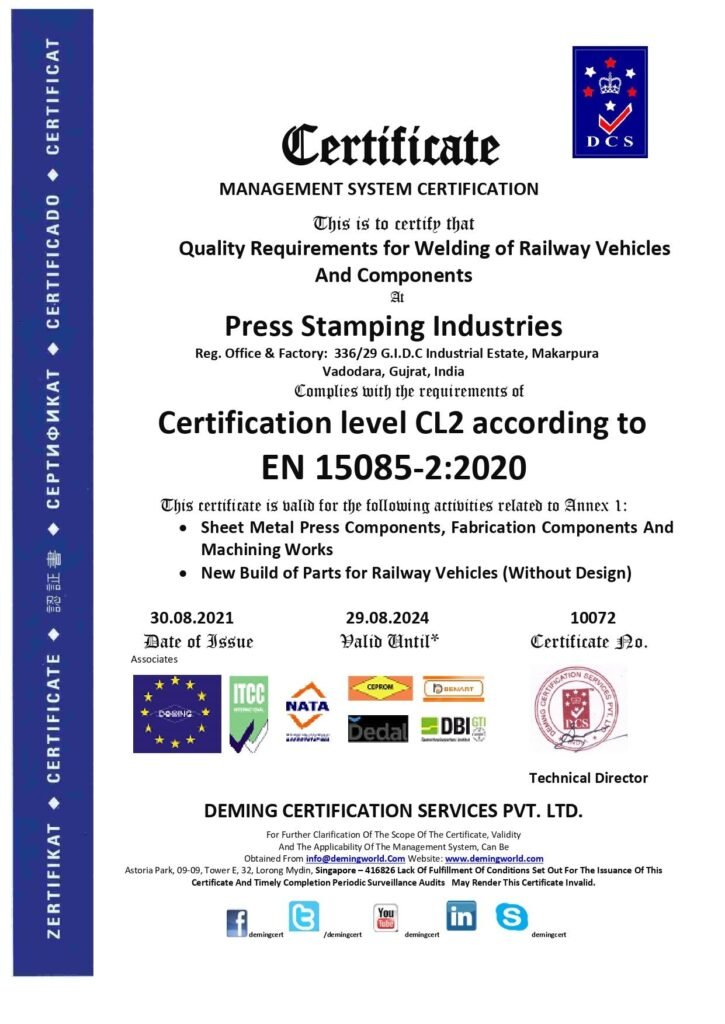
The year 2021 became one of the most important milestones in the growth journey of Press Stamping Industries. After years of developing manufacturing experience, strengthening its quality management approach and preparing its organization for more demanding industrial requirements, the company reached an important stage with its Certification Level CL2 according to EN 15085-2:2020.
For the promoter and leadership team, this achievement represented much more than the receipt of a certificate. It was recognition of the effort that had gone into developing a more disciplined manufacturing organization.
The company had already built its foundation around sheet metal press components, fabrication components and machining works. Its defined railway-related scope also included the new build of parts for railway vehicles without design responsibility. The certification journey encouraged the organization to bring these capabilities into a more structured framework.
The road toward certification required preparation.
Processes had to be understood.
Responsibilities had to be established.
Technical requirements had to be controlled.
Personnel competence had to be considered.
Equipment capability had to be reviewed.
Inspection and testing arrangements had to be organized.
Documentation and records had to demonstrate that the required controls were actually being implemented.
For employees, this period brought a greater awareness of the importance of their individual responsibilities.
A production operator learned that following the approved process was not merely an instruction from a supervisor. It was part of maintaining the organization’s manufacturing reliability.
An inspector understood that measurement records were not simply paperwork. They provided evidence that the component had been evaluated against defined requirements.
A supervisor recognized that production targets and quality targets had to move together.
The stores team became increasingly conscious of material identification and control.
Management had to ensure that resources, competence and infrastructure were available to support the defined activities.
The promoter played an important role in bringing these different responsibilities together.
The leadership communicated that certification should not create a temporary culture that disappeared after the audit. The objective was to establish practices that could continue throughout the life of the organization.
This was an important distinction.
Many organizations can prepare intensively for an assessment.
The greater challenge is maintaining the same level of discipline after the assessment is completed.
Press Stamping Industries therefore began treating certification as an ongoing commitment.
The company strengthened its internal monitoring activities.
Processes were reviewed.
Records were checked.
Corrective actions were followed up.
Employees were reminded of the importance of compliance.
Management reviewed areas where improvement was required.
This created a cycle of learning.
If an internal review identified a weakness, the organization could address it before it became a larger problem.
If a customer raised an observation, the company could investigate the root cause.
If production generated repeated rework, management could examine the process.
If a machine created variation, its condition and settings could be reviewed.
The certification framework therefore became part of the company’s problem-solving system.
The CL2 certification according to EN 15085-2:2020 was especially meaningful because it positioned the organization within a specialized railway manufacturing framework. EN 15085-2 establishes requirements for manufacturers involved in welding railway vehicles and components, with certification levels reflecting the relevance of the components and manufacturing activities within the applicable scope.
For Press Stamping Industries, this encouraged an even greater focus on technical competence and controlled manufacturing.
Where welding activities were applicable, appropriate attention had to be given to qualified personnel, welding coordination and inspection arrangements.
The company recognized that technical competence could not be assumed.
People performing specialized tasks needed appropriate knowledge and skills.
Processes needed to be defined.
Equipment needed to be suitable.
Inspection needed to be meaningful.
Documentation needed to provide evidence.
This created a stronger professional environment.
The promoter also recognized another important benefit of certification: customer confidence.
Industrial customers want to know that a supplier has the ability to consistently meet requirements.
A certificate cannot replace actual performance, but it can demonstrate that an organization has established a recognized management and technical framework within its declared scope.
For Press Stamping Industries, this created opportunities to communicate its capabilities more effectively to potential customers.
The company could demonstrate its commitment to quality.
It could explain its manufacturing scope.
It could demonstrate greater process discipline.
It could present itself as an organization prepared to work within controlled railway-sector requirements.
This was particularly valuable as the company sought sustainable business development.
Growth required more than increasing the number of orders.
It required the ability to manage those orders effectively.
The promoter therefore focused on strengthening the organization before pursuing uncontrolled expansion.
The company worked to improve production planning, inspection coordination, material management and employee competence.
This helped create a stronger foundation for handling future business.
Another important effect of certification was the development of organizational confidence.
Employees could see that the systems they had helped build were being formally recognized.
Management could see that the company’s manufacturing practices had reached a new stage of maturity.
Customers could see evidence of the organization’s commitment to controlled production.
The certificate became a symbol of collective effort.
However, the promoter repeatedly emphasized that the certificate itself was not the final objective.
The true objective was improvement.
A certificate has a validity period.
A quality culture should continue beyond that period.
The company therefore began thinking about what needed to happen after certification.
How could rejection be reduced?
How could productivity be improved?
How could employee skills be strengthened?
How could delivery reliability be increased?
How could customer relationships be developed?
How could manufacturing technology be improved?
How could the organization prepare for future railway-sector opportunities?
These questions became part of the company’s long-term thinking.
The promoter also understood that certification increased responsibility.
Once an organization presents itself as a certified manufacturer, customers expect the systems behind that certification to remain effective.
Therefore, maintaining competence became essential.
Maintaining equipment became essential.
Maintaining records became essential.
Maintaining process discipline became essential.
Continual improvement became essential.
The year 2021 thus marked both an achievement and a beginning.
It was the achievement of reaching a recognized certification milestone.
At the same time, it was the beginning of a new phase in which Press Stamping Industries had to demonstrate the practical value of that achievement through everyday performance.
From its manufacturing base in Makarpura, Vadodara, the company had taken another step toward becoming a more structured and technically capable organization.
The promoter’s vision was gradually becoming reality.
The organization was moving from experience-based manufacturing toward system-based manufacturing.
It was learning to combine traditional engineering skills with modern quality-management principles.
It was developing stronger awareness of customer requirements.
It was building greater confidence among employees.
It was creating a foundation for railway-related opportunities.
Most importantly, it was learning that sustainable growth depends on consistency.
A company can win an order through price.
It can attract a customer through capability.
But it earns long-term trust through reliable performance.
That understanding became central to the company’s development after certification.
The 2021 CL2 certification milestone therefore represented a turning point in the story of Press Stamping Industries.
The company had demonstrated its readiness for a more demanding manufacturing environment.
The next challenge was to convert certification into measurable operational strength—to improve productivity, reduce variation, strengthen customer relationships and create a business capable of sustainable growth.
The certificate had opened a new door.
Now the organization had to prove what it could accomplish after walking through it.
#EN15085
Chapter 5 – Turning Certification into Operational Strength
The achievement of certification in 2021 gave Press Stamping Industries a stronger platform, but the promoter understood an important truth: certification itself does not create business growth; the disciplined implementation of the systems behind certification does.
The real challenge began after the certificate was received.
The organization had to demonstrate that the principles of quality management could be converted into practical improvements across its manufacturing activities. At 336/29 G.I.D.C. Industrial Estate, Makarpura, Vadodara, Gujarat, the company continued its work in sheet metal press components, fabrication components and machining works while strengthening its capability for the new build of railway vehicle parts without design responsibility.
The leadership began focusing on one central objective—making the manufacturing process more reliable from beginning to end.
Production was no longer considered successful simply because components were completed. A successful process had to produce components that met requirements, were completed efficiently, were properly inspected and could be delivered according to customer expectations.
This change in thinking gradually influenced the entire organization.
One of the first areas receiving greater attention was rework and rejection.
In manufacturing, defective components create a hidden cost. A rejected component consumes material, machine time, manpower and inspection resources without creating corresponding customer value. Rework can also disturb production schedules and affect delivery commitments.
The promoter therefore encouraged the team to look beyond the immediate correction.
If a component was found outside specification, the question was not simply, “How can we repair it?”
The more important question became, “Why did this happen?”
The investigation could involve several possibilities.
Perhaps the machine setting was incorrect.
Perhaps the tooling required attention.
Perhaps the material characteristics were different from expectations.
Perhaps an operator had misunderstood an instruction.
Perhaps the drawing revision had not been communicated correctly.
Perhaps inspection had taken place too late in the process.
By examining these possibilities, the organization could work toward preventing similar problems.
This approach strengthened the company’s corrective-action culture.
The leadership also began paying greater attention to machine reliability.
Pressing, fabrication and machining activities depend heavily upon equipment capability. A machine that is poorly maintained can cause production interruptions or contribute to inconsistent results.
Preventive maintenance therefore became an increasingly important part of operational planning.
Instead of waiting for equipment to fail, the organization encouraged regular maintenance and monitoring.
This helped employees understand that maintenance was not merely an expense.
It was an investment in production continuity and product quality.
A well-maintained machine could support more consistent manufacturing.
A planned maintenance activity could prevent an unexpected breakdown.
A properly maintained tool could reduce dimensional variation.
A reliable machine could help production planning remain stable.
The same philosophy applied to measuring equipment.
Inspection decisions depend upon accurate and suitable measuring instruments. The organization therefore strengthened its attention toward calibration, verification and appropriate use of measuring equipment.
For the promoter, this represented an important shift from simply finding defects to controlling the conditions that could create defects.
Another area of operational improvement was material management.
The company worked with engineering materials that became part of finished components. Therefore, material identification, storage and movement needed appropriate controls.
The leadership understood that even a perfectly executed manufacturing process could not compensate for unsuitable or incorrectly identified material.
Supplier performance consequently became another part of the quality conversation.
Suppliers were not viewed merely as organizations from which material was purchased. They were considered contributors to the company’s overall manufacturing performance.
When incoming material met requirements consistently, production became more stable.
When supplier quality was inconsistent, the company’s own processes could be affected.
The company therefore developed greater awareness of supplier evaluation, incoming verification and communication of requirements.
This strengthened the broader supply chain.
Employee competence was another major focus.
As the company became more structured, it needed people who understood not only how to perform a task but also why the task had to be performed in a particular way.
The promoter encouraged training and knowledge sharing.
Experienced employees shared practical knowledge with newer workers.
Supervisors explained process requirements.
Quality personnel communicated common defects and their causes.
Employees became more familiar with inspection expectations.
This helped build organizational knowledge.
For railway-related manufacturing, technical competence was particularly significant. The company’s EN 15085-2:2020 CL2 certification required the organization to maintain appropriate capabilities within its defined scope. Where applicable welding activities were involved, suitable competence, coordination and inspection arrangements became important elements of the manufacturing system.
The promoter recognized that skilled people were one of the company’s strongest assets.
Machines could be purchased.
Buildings could be expanded.
Technology could be upgraded.
But experienced and competent people required time to develop.
Employee development therefore became part of the organization’s long-term growth strategy.
The company also began placing greater emphasis on production planning.
As customer requirements increased, it became important to coordinate machines, materials, manpower, tooling and inspection activities.
Unplanned production could result in bottlenecks.
Poor scheduling could create idle time.
Material shortages could stop production.
Inspection delays could hold up dispatch.
Better planning helped the organization make more effective use of its resources.
The quality management system provided a framework for connecting these activities.
Customer requirements influenced planning.
Planning influenced production.
Production influenced inspection.
Inspection influenced product release.
Product performance influenced customer satisfaction.
Customer feedback influenced improvement.
This created a continuous cycle.
The promoter began using this cycle to guide management decisions.
Instead of relying entirely on intuition, management increasingly looked at evidence.
What were the major causes of rejection?
Which processes required improvement?
Where were delivery delays occurring?
Which machines required greater attention?
Which employees needed additional training?
Which suppliers were performing consistently?
Which customer concerns were recurring?
These questions helped management identify priorities.
Another important change was the increasing use of internal audits and management review as tools for improvement.
Audits were not treated simply as exercises to prepare for external certification.
They became opportunities to identify weaknesses within the system.
If a procedure was unclear, it could be improved.
If a record was incomplete, the reason could be investigated.
If an employee required clarification, training could be provided.
If a process was producing repeated problems, corrective action could be initiated.
This approach helped create a more proactive organization.
The promoter also encouraged employees to suggest improvements.
A worker who operated a machine every day often understood practical problems that might not be visible to management.
A small modification to a fixture could save time.
A better arrangement of tools could improve productivity.
A clearer instruction could prevent mistakes.
A revised inspection sequence could identify defects earlier.
These small improvements gradually accumulated.
This became an important lesson in the company’s development:
large organizational improvements are often created through many small improvements implemented consistently.
The certification journey had therefore begun influencing not only quality documentation but also operational thinking.
The organization was learning to connect quality with productivity.
It was learning to connect maintenance with reliability.
It was learning to connect training with performance.
It was learning to connect customer feedback with improvement.
Most importantly, it was learning to connect every department with the final customer.
For the promoter, this was a significant transformation.
The company’s future could no longer depend solely on individual effort.
It needed systems capable of supporting growth.
Those systems had to remain effective even when order volumes increased, new employees joined, new products were introduced or customer expectations changed.
This was the foundation of sustainable growth.
Press Stamping Industries was gradually moving toward a more mature operating model—one where quality, productivity and customer satisfaction were not separate objectives but interconnected parts of the same business strategy.
The 2021 certification had provided recognition.
The work that followed was creating capability.
And as the company strengthened its processes, developed its people and improved its operations, it became increasingly prepared for the opportunities and challenges of the railway manufacturing market.
The promoter knew that the journey was far from complete.
Certification had opened the door.
Operational excellence would determine how far the organization could travel through it.
#RailwayManufacturing
Chapter 6 – People, Skills and the Human Side of Growth
Every manufacturing organization depends on machines, materials and processes, but behind all of them are people. Machines can perform operations, processes can provide structure and documents can define requirements, yet it is employees who ultimately make the system work. For Press Stamping Industries, the period following its quality and railway certification journey became not only a period of process improvement, but also a period of developing people.
At 336/29 G.I.D.C. Industrial Estate, Makarpura, Vadodara, Gujarat, the company operated in an environment where engineering manufacturing required practical skills and close coordination. Sheet metal pressing, fabrication, machining and railway-related component manufacturing each demanded employees who understood their responsibilities.
The promoter increasingly recognized that sustainable business growth could not be achieved simply by adding machines or accepting more orders. The organization also needed to develop the capabilities of the people operating those machines and managing those processes.
This understanding became particularly important after the company’s EN 15085-2:2020 Certification Level CL2 milestone.
Railway-related manufacturing introduced greater awareness of technical competence, controlled processes and responsibility. Where welding activities were applicable, suitable competence, welding coordination and inspection arrangements were important elements of the manufacturing framework. The organization therefore placed greater emphasis on ensuring that employees understood the requirements relevant to their responsibilities.
Training became an important part of this development.
For the promoter, training was not simply a formal activity conducted because a procedure required it. It was a way of strengthening the company’s future.
An employee who understood the manufacturing process could recognize abnormalities earlier.
An operator who understood the importance of machine settings could reduce unnecessary variation.
A fabricator who understood the significance of preparation and joining could improve consistency.
A machinist with strong measurement awareness could identify dimensional problems before they progressed.
An inspector with appropriate technical knowledge could provide more meaningful verification.
A supervisor who understood both production and quality requirements could make better decisions.
The organization therefore began encouraging a stronger learning culture.
Experienced employees became valuable sources of practical knowledge. Their experience could be shared with newer members of the team through on-the-job guidance and demonstrations. This helped prevent important operational knowledge from remaining limited to a few individuals.
The promoter understood that employee experience represented an organizational asset.
If an experienced worker knew how to identify a particular machine problem, that knowledge should become part of the company’s collective capability.
If an inspector understood a recurring quality issue, the lesson could be communicated to production.
If a supervisor discovered a better method of organizing work, the improvement could be evaluated and standardized where appropriate.
This approach helped transform individual experience into organizational learning.
Another important change was the company’s attitude toward responsibility.
Quality was increasingly viewed as a shared responsibility rather than something belonging exclusively to the inspection department.
The operator became the first person responsible for producing a conforming component.
The supervisor became responsible for ensuring that the process was properly organized.
The quality team provided verification and monitoring.
Maintenance supported equipment capability.
Stores supported material identification and availability.
Management provided resources and direction.
Each function became part of one connected system.
This understanding also encouraged employees to report problems earlier.
In a weak quality culture, workers may hesitate to report an abnormality because they fear blame. In a mature quality culture, reporting a problem early is considered a positive action because it creates an opportunity for prevention.
Press Stamping Industries gradually encouraged this type of thinking.
If a machine began behaving differently, the issue could be reported.
If a drawing appeared unclear, clarification could be requested.
If a component did not appear correct, it could be stopped for inspection.
If repeated defects were observed, the team could investigate the process.
This approach reduced the risk of allowing small problems to become larger ones.
The promoter also realized that employee motivation was closely connected with organizational growth.
People perform better when they understand that their contribution matters.
A production worker who knows that a component may ultimately become part of a railway vehicle can develop a stronger sense of responsibility toward quality.
The employee is no longer simply completing an assigned operation.
The employee is contributing to a larger engineering system.
This perspective helped strengthen professional pride.
The company’s railway-related activities also encouraged greater awareness of the importance of documentation and traceability. Employees learned that records could provide valuable evidence about what had happened during manufacturing.
An inspection record could demonstrate conformity.
A training record could demonstrate competence.
A process record could provide manufacturing information.
A corrective-action record could demonstrate learning.
Documentation therefore became part of the organization’s knowledge system.
The promoter also encouraged greater communication between departments.
Production could not operate independently of quality.
Quality could not operate independently of production.
Stores needed to understand production requirements.
Maintenance needed to understand equipment priorities.
Management needed information from every department to make informed decisions.
Regular communication helped reduce misunderstandings and created greater coordination.
As the company developed, leadership responsibilities also evolved.
In the early stages of a business, promoters often solve problems personally. As the organization grows, this approach becomes difficult to sustain. More employees, more orders and more processes require delegation.
The promoter therefore increasingly focused on developing supervisors and responsible personnel who could manage day-to-day activities.
This was an important step toward organizational maturity.
Instead of asking, “Who will solve this problem?”
The organization increasingly asked, “What system can prevent this problem from recurring?”
Instead of depending upon one experienced person, the company sought to develop processes that could be understood and followed by others.
Instead of treating training as a one-time event, management began viewing competence as something that required continuous development.
This shift strengthened the company’s ability to grow.
The human side of certification was therefore becoming clear.
Standards provide frameworks, but people give those frameworks life.
Procedures do not improve processes by themselves.
People improve processes by understanding and applying them.
Certificates do not manufacture components.
People do.
Machines do not identify every risk.
People observe, question and improve.
The promoter understood this increasingly well.
The company’s future therefore depended on building a workforce that was skilled, responsible and willing to participate in improvement.
The journey toward certification had created new expectations.
The period after certification was creating new capabilities.
Employees were becoming more technically aware.
Supervisors were becoming more accountable.
Quality personnel were becoming more involved in improvement.
Management was becoming more strategic.
Together, these developments created a stronger organization.
Press Stamping Industries was gradually building something more valuable than production capacity.
It was building human capability.
And as the company continued to strengthen its people, it became better prepared to manage increasing customer expectations, more complex manufacturing requirements and future opportunities within the railway and engineering sectors.
The promoter’s vision was becoming increasingly clear: sustainable growth would come not from machines alone, but from the combination of skilled people, controlled processes, reliable equipment and a culture of continual improvement.
That combination would become one of the most important foundations of the company’s future.
#SheetMetalComponents
Chapter 7 – Expanding Capability Through Process Improvement
As Press Stamping Industries moved forward after its certification milestone, the company began to understand that growth was not simply about producing more components. Sustainable growth required the organization to become better, more consistent and more capable with every production cycle.
The promoter’s attention increasingly moved toward process improvement.
At the company’s facility in 336/29 G.I.D.C. Industrial Estate, Makarpura, Vadodara, Gujarat, manufacturing activities covered sheet metal press components, fabrication components and machining works. The organization also operated within the defined scope associated with the new build of parts for railway vehicles without design responsibility.
Each of these activities contained opportunities for improvement.
A small production delay in one operation could affect another.
A material-handling problem could interrupt production.
An incorrect setup could create unnecessary rework.
A tooling issue could affect component consistency.
A delay in inspection could hold up the next stage.
The promoter therefore encouraged the team to look at manufacturing as one connected process rather than as a collection of independent activities.
This was an important change in thinking.
Previously, an employee might focus primarily on completing an assigned operation. With a stronger process approach, employees were encouraged to understand what happened before their operation and what would happen afterward.
A press component, for example, could pass through several stages before becoming a finished product. Material preparation, pressing, fabrication, machining, inspection and dispatch all had to work together.
If one stage failed, the entire chain could be affected.
Process improvement therefore began with identifying where problems were occurring.
The company became more attentive to recurring issues, customer observations, internal inspection findings and production difficulties. Instead of treating each problem as an isolated event, management looked for patterns.
If similar defects appeared repeatedly, the process required attention.
If the same type of delay occurred frequently, planning needed improvement.
If operators repeatedly required clarification, instructions could be made clearer.
If a particular tool created difficulties, its condition and suitability could be reviewed.
This approach supported the philosophy of continual improvement associated with a mature quality-management system.
The organization also recognized the importance of standardization.
When a process depends entirely upon individual working methods, results can vary. Standardized procedures and work instructions provide greater consistency by establishing an agreed method of performing important activities.
Standardization did not mean preventing employees from suggesting improvements.
Instead, it created a baseline from which improvements could be evaluated.
If a better method was identified, it could be reviewed, approved and incorporated into the process.
This allowed improvement to become part of the system rather than remaining dependent upon individual memory.
Tooling and fixtures also became important considerations.
In sheet metal pressing and fabrication, appropriate tooling and fixtures can contribute significantly to repeatability and productivity. The promoter encouraged greater attention toward the condition, suitability and organization of such manufacturing resources.
The objective was straightforward: make it easier for employees to produce the right component correctly the first time.
This philosophy connected quality with productivity.
Quality was not treated as an activity that happened after production.
Quality was increasingly built into production itself.
When a process was stable, inspection could confirm conformity more effectively.
When tooling was properly maintained, variation could be reduced.
When material was correctly identified, production interruptions could be minimized.
When employees understood the process, mistakes could be detected earlier.
When records were maintained properly, management could better understand what had happened.
The company also strengthened its awareness of traceability and controlled documentation, particularly in relation to railway-related manufacturing.
Within the supplied EN 15085-2:2020 CL2 certification framework, manufacturing organizations need appropriate control over relevant technical and quality activities. For welding-related work, requirements include suitable competence, coordination, inspection and controlled welding procedures within the applicable scope.
For Press Stamping Industries, this encouraged a disciplined approach to production information.
The right specification had to reach the right person.
The relevant revision had to be understood.
Inspection requirements had to be communicated.
Records had to provide useful evidence.
Nonconforming products had to be identified and controlled.
These practices reduced the possibility that an avoidable documentation problem would become a manufacturing problem.
Another important area was capacity utilization.
Growth often creates pressure on manufacturing resources. When demand increases, companies may be tempted to focus only on increasing output. However, uncontrolled expansion can create bottlenecks and reduce quality.
The promoter therefore viewed capacity development more carefully.
Could existing machines be utilized more efficiently?
Could production scheduling be improved?
Could unnecessary movement of material be reduced?
Could setup activities be organized better?
Could maintenance be planned around production requirements?
Could inspection be integrated more effectively into the workflow?
These questions helped the organization think about productivity strategically.
The company also recognized the value of measuring improvement.
Not every improvement could be expressed in a financial figure. Some improvements appeared through better coordination, fewer interruptions, faster problem identification, improved documentation or stronger employee confidence.
Together, these changes strengthened operational maturity.
Customer feedback also became an important source of improvement.
A customer comment was no longer viewed simply as criticism. It could represent information about how the company could improve its products or services.
When customers communicated expectations clearly, the organization could evaluate whether its processes were capable of meeting them consistently.
This helped strengthen customer-oriented thinking.
The promoter’s role was changing as well.
Instead of concentrating only on immediate production issues, leadership increasingly focused on the system supporting production.
The questions became more strategic:
How can the company improve reliability?
How can technical capability be strengthened?
How can employees be developed?
How can customer confidence be increased?
How can future railway-related opportunities be supported?
How can quality improvements be sustained?
These questions encouraged long-term thinking.
The result was an organization increasingly prepared to manage growth through controlled processes rather than through temporary effort.
Certification had provided a framework.
Employee development had provided capability.
Process improvement was now providing momentum.
Press Stamping Industries was learning that every improvement, however small, could contribute to a stronger organization.
A better process today could become a competitive advantage tomorrow.
A better inspection method could prevent a future customer complaint.
A better maintenance practice could protect production continuity.
A better training program could create a stronger workforce.
A better documentation system could support greater customer confidence.
Step by step, these improvements were building the company’s manufacturing strength.
The promoter understood that the most valuable growth was not necessarily the fastest growth.
It was growth that the organization could control, sustain and improve.
With this philosophy, Press Stamping Industries continued developing its capabilities and preparing itself for a future in which engineering quality, manufacturing discipline and customer confidence would become increasingly important to its success.
#FabricationComponents
Chapter 8 – Building Customer Confidence and Market Reputation
For Press Stamping Industries, the journey after quality certification was not limited to improving internal processes. Another important transformation took place outside the factory walls: the company began building a stronger reputation among customers, suppliers and business partners.
The promoter understood that in engineering manufacturing, reputation is created gradually.
A company can have modern equipment, experienced employees and ambitious plans, but customers ultimately judge an organization through its ability to deliver consistent quality, maintain commitments and respond responsibly when challenges arise.
This understanding became particularly important as Press Stamping Industries strengthened its involvement in activities connected with sheet metal press components, fabrication components, machining works and new build of parts for railway vehicles without design responsibility.
Railway-related manufacturing requires a disciplined approach because components may become part of larger assemblies where consistency, conformity and traceability matter. The company’s Certification Level CL2 according to EN 15085-2:2020, as recorded for the 2021–2024 certification period supplied for this story, became an important part of its professional identity.
The certification was not treated merely as a document to display.
The promoter recognized that its real value came from demonstrating that the organization had developed controlled processes and technical discipline appropriate to its certified scope.
This changed the way the company approached customer relationships.
Earlier, discussions with customers could focus mainly on price, delivery and product requirements. As the company’s quality maturity increased, conversations increasingly included process capability, inspection, documentation, quality controls and manufacturing responsibility.
This created a different level of confidence.
A customer looking for a manufacturing partner wants to know more than whether a component can be produced. The customer wants confidence that the supplier can reproduce the required quality consistently.
Press Stamping Industries worked toward providing that confidence through a systematic approach.
Production activities were increasingly supported by documented processes.
Inspection became an integral part of manufacturing.
Nonconformities were identified and addressed.
Employees were trained to understand their responsibilities.
Equipment and measuring resources received greater attention.
Records provided evidence of completed activities.
These practices helped create a more professional customer experience.
The promoter also understood that transparency is an important part of trust.
No manufacturing organization can guarantee that every production challenge will disappear. Machines require maintenance. Materials may sometimes create difficulties. Production schedules can change. Technical clarification may be required.
What distinguishes a mature organization is how it responds.
Instead of hiding problems, the developing culture at Press Stamping Industries encouraged earlier identification and responsible resolution.
When an issue was detected, the objective was to understand it, contain it where necessary, identify the cause and prevent recurrence.
This approach helped transform problems into learning opportunities.
Customer feedback became another source of organizational development.
A complaint or observation could reveal a weakness that internal teams had not previously recognized. Rather than treating feedback as a threat, management increasingly viewed it as information that could strengthen the system.
Over time, this mindset supported better communication between the customer and the company.
The organization also became more conscious of the importance of technical documentation.
For railway-related manufacturing, technical requirements cannot be treated casually. Drawings, specifications, revisions, inspection requirements and applicable production information must be properly understood and controlled within the organization’s responsibility.
Since the stated scope includes new build of railway vehicle parts without design responsibility, the company’s role is centered on manufacturing in accordance with customer-provided technical requirements rather than taking ownership of product design.
This distinction encouraged greater discipline in understanding customer inputs before production.
A clear requirement at the beginning could prevent confusion later.
The promoter gradually realized that customer confidence was built through hundreds of such small actions.
A correctly understood requirement.
A properly controlled production process.
A timely inspection.
A complete record.
A responsible response to a question.
A commitment respected.
A problem resolved professionally.
Each action contributed to the company’s reputation.
The same philosophy extended to suppliers.
Quality could not depend entirely upon internal operations. Materials, outsourced processes and purchased items could influence final product conformity.
Therefore, supplier evaluation and communication became increasingly relevant to the organization’s quality thinking.
The company sought greater consistency not only within its own facility but across the broader supply chain supporting production.
This was particularly useful as business requirements became more demanding.
Certification also gave the promoter a stronger platform for presenting the organization to prospective customers.
Instead of saying only that the company could manufacture components, the organization could demonstrate that its manufacturing activities were supported by a recognized quality-management approach and a railway welding-related certification framework appropriate to its defined scope.
Under EN 15085-2, certification levels distinguish the safety relevance of railway welded components; CL2 corresponds to a medium level of safety relevance within the classification system.
For Press Stamping Industries, this strengthened the company’s ability to communicate its commitment to controlled manufacturing.
However, the promoter did not want certification to create complacency.
A certificate could open a door, but performance would determine whether the relationship continued.
That principle became central to the company’s growth philosophy.
Every new customer represented an opportunity, but also a responsibility.
Every order had to be treated as a commitment.
Every production process had to support customer expectations.
Every employee had a role in protecting the company’s reputation.
This gradually created a stronger professional identity.
Press Stamping Industries was no longer viewed only through the products it manufactured. Its identity increasingly included the systems, discipline, people and values behind those products.
The promoter’s vision was becoming broader.
The objective was not simply to obtain certification and use it for marketing.
The objective was to build an organization that deserved customer confidence even when the certificate was not mentioned.
That distinction was significant.
Certification provided external recognition.
Consistent performance provided internal credibility.
Customer satisfaction provided market credibility.
Together, they formed the foundation of reputation.
As the company continued improving its processes, developing employees and strengthening technical capabilities, its market position became increasingly connected to quality and reliability.
The promoter had learned an important lesson from the company’s journey: business growth becomes stronger when customers believe not only in what a company produces, but also in the system behind the production.
For Press Stamping Industries, this belief became one of the strongest outcomes of its post-certification transformation.
The company had begun its journey by improving processes.
It was now turning those processes into customer confidence, professional reputation and a foundation for sustainable growth.
#QualityManagement
Chapter 9 – Promoter’s Leadership and Vision for Sustainable Growth
Behind every successful manufacturing organization is a leadership philosophy that determines how the company responds to opportunities, challenges and change. For Press Stamping Industries, the period following its quality certification became an important stage in the evolution of that philosophy.
The promoter had always understood the importance of production, customers and commercial performance. However, as the company developed its quality-management practices and strengthened its railway-related manufacturing capabilities, leadership itself began to change.
The promoter increasingly recognized that long-term growth could not depend on one individual making every decision.
A growing organization needs systems.
It needs competent people.
It needs clear responsibilities.
It needs reliable information.
And above all, it needs a culture in which employees understand that the success of the organization is also their responsibility.
This realization became one of the most important developments in the company’s journey.
In the earlier stages of business development, promoters often remain closely involved in day-to-day activities. Production problems, customer discussions, purchasing decisions, quality concerns and delivery commitments may all reach the promoter directly.
Such involvement can be valuable during the early years.
But as an organization grows, excessive dependence on one person can become a limitation.
The promoter of Press Stamping Industries began moving toward a more structured model of leadership.
Instead of personally solving every operational problem, greater attention was given to developing people who could identify problems, analyze them and take appropriate action within their responsibilities.
This created a more confident organization.
Employees became more comfortable raising concerns.
Supervisors became more responsible for process performance.
Quality personnel became more involved in prevention rather than simply detecting defects.
Production teams became more aware of the effect of their work on downstream operations.
The promoter’s role gradually became more strategic.
The question was no longer only, “How do we complete today’s production?”
It became, “What kind of organization do we need to build for tomorrow?”
That question influenced decisions about training, process control, equipment, documentation, customer relationships and technical capability.
The company’s defined scope—covering sheet metal press components, fabrication components, machining works and new build of parts for railway vehicles without design responsibility—required the organization to maintain discipline across multiple manufacturing activities.
The promoter therefore encouraged a balanced approach to growth.
Expansion could not come at the expense of quality.
Higher production could not justify uncontrolled processes.
New business opportunities could not be accepted without considering technical capability and resource requirements.
Growth had to be supported by the organization’s ability to deliver consistently.
This was especially relevant to the company’s railway-related activities.
The certification level CL2 according to EN 15085-2:2020, as supplied for the company’s 2021–2024 certification period, represented an important element of its railway manufacturing quality journey. The standard’s framework emphasizes appropriate competence, welding coordination, inspection and controlled manufacturing activities within the applicable certification scope.
For the promoter, such requirements were not simply technical obligations.
They represented an opportunity to build a more disciplined organization.
The promoter also understood that sustainable growth requires risk awareness.
Every manufacturing organization faces risks.
Material availability can affect production.
Equipment problems can affect schedules.
Skill gaps can affect quality.
Supplier performance can affect conformity.
Changes in customer requirements can affect planning.
Unexpected production problems can affect delivery.
A mature organization does not assume that these risks will never occur.
Instead, it prepares to identify and manage them.
This thinking became increasingly important at Press Stamping Industries.
Management began considering not only what could go right, but also what could go wrong and how the organization could respond.
This encouraged preventive thinking.
Maintenance was viewed as protection of production capability.
Training was viewed as protection of human capability.
Documentation was viewed as protection of organizational knowledge.
Inspection was viewed as protection of customer confidence.
Corrective action was viewed as protection against recurrence.
Such thinking helped connect individual activities to the company’s larger strategic objectives.
The promoter also placed increasing value on customer relationships.
In manufacturing, a customer relationship is built over time. It depends upon consistency, responsiveness and trust.
The company therefore aimed to become more than a supplier of components.
It sought to become a dependable manufacturing partner within the limits of its defined responsibilities.
That meant listening carefully to customer requirements, clarifying technical expectations, communicating responsibly and continuously improving internal performance.
The promoter’s vision also included strengthening the company’s internal culture.
Employees were encouraged to see quality not as the responsibility of one department but as a shared organizational value.
A machine operator could influence quality.
A supervisor could influence quality.
A store employee could influence traceability.
A purchaser could influence incoming material quality.
An inspector could influence customer confidence.
Management could influence the entire system.
This shared understanding made the organization more resilient.
The promoter also recognized that technology would continue changing manufacturing.
Future competitiveness would increasingly depend on efficient production planning, better information management, improved measurement, process monitoring and workforce development.
Therefore, the company needed to remain willing to learn.
The certification journey had already demonstrated that organizations must adapt when customer and industry expectations evolve.
The same principle would apply to future technologies and manufacturing practices.
Perhaps the most important leadership transformation was therefore a change in perspective.
The promoter began viewing the company not simply as a manufacturing business, but as an organization capable of learning.
Every audit could provide learning.
Every customer observation could provide learning.
Every nonconformity could provide learning.
Every successful improvement could provide learning.
Every trained employee could add knowledge to the organization.
This mindset created a foundation for sustainable development.
The promoter’s vision was not based solely on immediate commercial growth.
It was based on building a company with stronger systems, stronger people, stronger processes and stronger customer relationships.
The journey from certification to organizational maturity was not completed in a single year.
It was a continuous process.
But the direction had become clear.
Press Stamping Industries had moved from asking how to achieve certification to asking how to use quality principles as a permanent foundation for growth.
That was the real leadership achievement.
The certificate marked an important milestone.
The systems created around it became the lasting asset.
And the promoter’s evolving leadership ensured that those systems could continue supporting the company as it moved toward the future.
For Press Stamping Industries, sustainable growth was no longer simply a matter of increasing business.
It meant creating an organization capable of earning trust, developing capability, managing risk and improving continuously.
That vision became the bridge between the company’s achievements of the past and the opportunities waiting ahead.
#EngineeringExcellence
Chapter 10 – From Certification to a Future of Continuous Improvement
The journey of Press Stamping Industries after its quality certification was never meant to end with the issuance of a certificate. The certificate represented a milestone, but the real transformation was the change that took place within the organization.
At 336/29 G.I.D.C. Industrial Estate, Makarpura, Vadodara, Gujarat, the company had developed its identity around engineering manufacturing activities including sheet metal press components, fabrication components and machining works. Its defined scope also included the new build of parts for railway vehicles without design responsibility.
The certification journey brought a new level of discipline to these activities.
The supplied certification record identified Certification Level CL2 according to EN 15085-2:2020, with an issue date of 2021 and validity through 2024. The significance of this achievement was not limited to the certificate itself. It encouraged the company to strengthen its processes, competence, documentation, inspection practices and manufacturing controls within its defined scope.
For the promoter, this became a lesson in long-term business development.
A certificate can be obtained at a particular point in time.
A quality culture has to be maintained every day.
That distinction became central to the company’s future thinking.
As Press Stamping Industries continued its development, management understood that the manufacturing environment would continue to change. Customer expectations would evolve. Technical requirements would become more demanding. Competition would increase. New technologies would influence production. Skilled people would remain essential.
The company therefore needed to remain adaptable.
The promoter’s vision was increasingly based on continuous improvement rather than a one-time transformation.
The organization had already learned the importance of documented processes. The next challenge was ensuring that those processes remained useful as business conditions changed.
Procedures needed to be reviewed when necessary.
Employees needed continuing development.
Production methods needed evaluation.
Equipment and measuring resources needed attention.
Supplier performance needed monitoring.
Customer feedback needed to be converted into learning.
This created a cycle of improvement.
Plan. Implement. Check. Improve.
The principle was simple, but its impact could be significant when consistently applied.
The company also recognized that future competitiveness would depend on the ability to combine traditional engineering skills with modern management practices.
Manufacturing organizations increasingly benefit from better production planning, digital records, data-based decision-making, improved measurement systems and technology-supported process monitoring.
Press Stamping Industries had developed a foundation from which such improvements could be pursued.
Its quality journey had already created greater awareness of information, traceability and evidence.
The next stage could therefore focus on making information more accessible, improving coordination and reducing dependence on informal communication.
Digital transformation did not have to mean replacing everything that already worked.
It could begin with practical improvements.
Better document control.
Faster access to production information.
Improved record management.
More systematic monitoring of process performance.
Better communication between departments.
Stronger analysis of recurring problems.
Each improvement could contribute to greater organizational efficiency.
The human element would remain equally important.
Machines can support manufacturing, but people make decisions, interpret requirements, solve problems and improve processes.
The promoter therefore continued to view employee development as a strategic investment.
Training was not simply an administrative requirement.
It was a method of protecting organizational capability.
An experienced employee could share knowledge with a new employee.
A supervisor could help identify process weaknesses.
A quality professional could help production teams understand customer requirements.
A skilled operator could suggest a practical improvement.
When such knowledge was shared throughout the organization, the company became stronger than any individual employee.
This was one of the most valuable lessons of the post-certification period.
The company had moved from individual effort toward organizational capability.
The promoter also understood that customer trust would remain one of the company’s most important assets.
Customers do not build long-term relationships merely because a supplier holds a certificate.
They build relationships because the supplier demonstrates consistency.
For Press Stamping Industries, this meant continuing to focus on conformity, responsiveness, communication and dependable manufacturing performance.
The company wanted its reputation to be associated with disciplined engineering and responsible execution.
Its railway-related scope made this commitment particularly important.
EN 15085-2 establishes a framework for railway welding-related quality requirements and certification, with different certification levels reflecting the safety relevance of welded components. CL2 represents the medium safety-relevance category within that classification framework.
The company’s certification experience therefore reinforced the importance of maintaining competence and controlled processes rather than treating certification as a marketing label.
Looking back, the promoter could see how far the organization had travelled.
The transformation had started with quality awareness.
It had progressed through documentation and process control.
It had strengthened employee responsibility.
It had encouraged process improvement.
It had improved customer communication.
It had supported greater technical confidence.
And ultimately, it had helped create a stronger organizational foundation.
The journey also demonstrated that growth is not always visible through numbers.
Sometimes growth is visible in the way employees approach a problem.
It is visible when a defect is reported before it reaches the customer.
It is visible when documentation is maintained correctly.
It is visible when a customer requirement is understood clearly.
It is visible when management uses evidence to make decisions.
It is visible when employees take pride in producing work correctly.
These changes represent a different kind of business growth—the growth of organizational maturity.
For Press Stamping Industries, the certification period from 2021 to 2024 became an important chapter in that maturity.
It connected quality management with manufacturing discipline and connected manufacturing discipline with customer confidence.
The promoter’s role also evolved.
Instead of viewing certification as the destination, leadership increasingly saw it as the beginning of a larger journey.
The future would require learning, adaptation and continuous improvement.
The company would need to remain alert to changing customer expectations, new manufacturing technologies and evolving industry requirements.
But the foundation had already been established.
Press Stamping Industries had learned that quality is not something added at the end of production.
It is created through planning, people, processes, equipment, communication and leadership.
The company’s story after certification is therefore ultimately a story of transformation.
It is the story of a manufacturing organization becoming more systematic.
It is the story of employees becoming more quality-conscious.
It is the story of a promoter becoming more strategic.
It is the story of certification becoming a practical management tool rather than simply a framed document.
Most importantly, it is the story of a company preparing itself for sustainable growth.
The certificate may have had an issue date and a validity period, but the lessons created through the certification journey were not limited to those dates.
They became part of the organization’s experience.
As Press Stamping Industries looked toward the future, the objective remained clear: build better processes, develop better people, strengthen customer trust and improve continuously.
That philosophy would continue to guide the company beyond the certification period.
The journey had started with a commitment to quality.
It had developed into a culture of responsibility.
And it now stood as a foundation for the next chapter of Press Stamping Industries—a future shaped by engineering capability, disciplined manufacturing, customer confidence and the belief that every process can be improved.
#ContinuousImprovement
#PressStampingGrowth #RailwayComponentManufacturing #IndustrialQualityStandards #ManufacturingProcessControl #VadodaraEngineeringIndustry
Take the Next Step Today
Don’t wait to enhance your business’s quality and efficiency. Partner with Mayu Group India and experience the transformation that comes with expert consultancy and training. Contact us today to learn more about how we can help you achieve your business goals. Reach out via phone at +91-9322728183, visit our website at www.mayugroup.in, or email us at investor@mayugroup.in Let us be your guide on the journey to excellence and innovation.