Non-Destructive Testing (NDT)
Table of Contents
Non-Destructive Testing (NDT) is a group of inspection techniques used to evaluate the quality, integrity, and condition of materials, components, and structures without causing damage to the item being tested. NDT is widely used in industries where safety, reliability, and performance are critical, including manufacturing, aerospace, automotive, construction, oil and gas, power generation, and infrastructure.
The primary purpose of NDT is to identify defects or material discontinuities that could affect the performance or service life of a component. These may include cracks, corrosion, voids, inclusions, lack of fusion, porosity, Non-Destructive Testing and other imperfections. Because the inspected item remains usable after testing, NDT provides an efficient way to identify potential problems while minimizing material waste and production costs.
Why Is NDT Important?
Equipment and structural failures can result in significant financial losses, production downtime, environmental damage, or safety incidents. NDT helps organizations identify problems before they develop into serious failures. Non-Destructive Testing It can be applied during manufacturing to verify product quality and during service to monitor the condition of equipment and structures over time.
NDT also supports preventive maintenance. Regular inspections can reveal changes in material condition, allowing maintenance teams to plan repairs or replacements before a component reaches a critical level of deterioration. This approach can improve equipment reliability and extend operational service life.
Common NDT Methods
Several NDT methods are available, and the appropriate technique depends on the material, component, defect type, and inspection requirements. Common methods include Visual Testing (VT), Ultrasonic Testing (UT), Radiographic Testing (RT), Non-Destructive Testing Magnetic Particle Testing (MT), Liquid Penetrant Testing (PT), and Eddy Current Testing (ET).
Each method has different capabilities. For example, visual testing is useful for identifying surface conditions, while ultrasonic testing can locate certain internal discontinuities. Radiographic testing can provide an image of internal structures, whereas magnetic particle testing is primarily used for detecting surface and near-surface discontinuities in suitable ferromagnetic materials.
Conclusion
Non-Destructive Testing is an essential part of modern quality assurance, maintenance, and asset integrity programs. By detecting defects without damaging components, NDT allows organizations to maintain safety and reliability while reducing unnecessary replacement, rework, Non-Destructive Testing and downtime. Effective NDT programs depend on selecting the appropriate testing method, qualified personnel, suitable equipment, and properly controlled inspection procedures.
As technology continues to advance, digital imaging, automation, robotics, and data analysis are expanding the capabilities of NDT. Nevertheless, the fundamental objective remains the same: detecting potential problems early and helping ensure that materials,Non-Destructive Testing components, and structures remain safe and fit for their intended purpose.
External References
- American Society for Nondestructive Testing (ASNT)
- International Organization for Standardization (ISO)
- NIST – Nondestructive Evaluation
#PreventiveMaintenance
What Is Non-Destructive Testing (NDT) and Why Is It Important?
Non-Destructive Testing (NDT) refers to a group of inspection techniques used to examine materials, components, products, and structures without damaging or permanently altering them. NDT is widely used to identify defects, discontinuities, Non-Destructive Testing or changes in material condition while allowing the inspected item to remain in service or proceed to the next stage of production. It is an essential part of quality control, safety management, preventive maintenance, and asset integrity across industries such as manufacturing, aerospace, automotive, construction, oil and gas, power generation, and transportation.
How Does NDT Work?
Different NDT methods are designed to detect different types of defects. Common techniques include Visual Testing (VT), Ultrasonic Testing (UT), Non-Destructive Testing Radiographic Testing (RT), Magnetic Particle Testing (MT), Liquid Penetrant Testing (PT), and Eddy Current Testing (ET).
For example, visual testing can identify visible surface defects, while liquid penetrant testing can reveal certain surface-breaking discontinuities. Non-Destructive Testing Ultrasonic testing uses high-frequency sound waves to identify internal discontinuities, whereas radiographic testing uses X-rays or gamma radiation to produce images that can reveal internal features. Magnetic particle testing is commonly used to detect surface and near-surface discontinuities in suitable ferromagnetic materials.
Why Is NDT Important?
The primary importance of NDT is its ability to identify potentially dangerous defects without destroying valuable components. Detecting a crack, corrosion, weld defect, or material discontinuity at an early stage can prevent equipment failure, production interruptions, costly repairs, and safety incidents.
NDT is also valuable for preventive and predictive maintenance. Regular inspections can help organizations monitor the condition of equipment and structures over time and make maintenance decisions based on actual evidence. This can extend service life, reduce unexpected downtime, and improve the reliability of critical assets.
Another important benefit is cost efficiency. Instead of removing and destroying components simply to determine their condition, organizations can inspect them while preserving their usability. NDT can therefore reduce material waste and support more efficient quality assurance processes.
Conclusion
Non-Destructive Testing is a critical inspection approach for maintaining the quality, reliability, and safety of materials and assets. By detecting visible and hidden defects without damaging the inspected item, NDT helps organizations prevent failures, meet quality requirements, optimize maintenance, and protect people and equipment. Selecting the correct NDT method depends on factors such as material type, component geometry, expected defect, Non-Destructive Testing accessibility, and inspection requirements.
As industrial technology advances, NDT is increasingly incorporating digital imaging, automation, robotics, advanced sensors, Non-Destructive Testing and data analysis. These developments are making inspections more efficient and precise while strengthening NDT’s role in modern quality management and asset integrity programs.
External References
- American Society for Nondestructive Testing (ASNT)
- International Organization for Standardization (ISO)
- National Institute of Standards and Technology (NIST)
#AssetIntegrity

What Are the Most Common NDT Methods and Where Are They Used?
Non-Destructive Testing (NDT) includes several inspection methods, each designed to detect particular types of defects without damaging the material or component being examined. The most suitable method depends on factors such as material type, component thickness, Non-Destructive Testing defect location, accessibility, and inspection requirements. The following are among the most commonly used NDT methods across industrial applications.
1. Visual Testing (VT)
Visual Testing is one of the simplest and most widely used NDT methods. Inspectors examine surfaces directly or with tools such as magnifiers, cameras, borescopes, and videoscopes. VT can identify cracks, corrosion, dents, surface damage, poor weld appearance, Non-Destructive Testing and assembly problems.
Common applications: manufacturing, welding, construction, pipelines, bridges, pressure equipment, and general maintenance.
2. Ultrasonic Testing (UT)
Ultrasonic Testing uses high-frequency sound waves to detect internal discontinuities and measure material thickness. Non-Destructive Testing Changes in the sound waves can indicate defects such as cracks, voids, inclusions, and lack of fusion.
Common applications: weld inspection, pipelines, pressure vessels, aerospace components, forgings, and structural materials.
3. Radiographic Testing (RT)
Radiographic Testing uses X-rays or gamma radiation to produce an image of the internal structure of a component. Non-Destructive Testing It is particularly useful for detecting internal defects that cannot be identified through surface inspection.
Common applications: weld inspection, castings, pipelines, aerospace components, pressure vessels, and other critical manufactured parts.
4. Magnetic Particle Testing (MT)
Magnetic Particle Testing is used primarily on ferromagnetic materials. The component is magnetized, and magnetic particles are applied to its surface. Non-Destructive Testing Discontinuities can disturb the magnetic field and cause particles to accumulate around defect locations.
Common applications: steel welds, castings, forgings, shafts, gears, and other ferromagnetic components.
5. Liquid Penetrant Testing (PT)
Liquid Penetrant Testing detects surface-breaking defects. A visible or fluorescent penetrant is applied to a clean surface, allowed to enter discontinuities, and then removed. A developer helps reveal the trapped penetrant.
Common applications: aerospace parts, welds, castings, ceramics, Non-Destructive Testing and non-ferromagnetic components.
6. Eddy Current Testing (ET)
Eddy Current Testing uses electromagnetic induction to identify surface and near-surface discontinuities and changes in material properties. It is especially useful for conductive materials.
Common applications: aircraft components, heat exchanger tubes, tubing, electrical conductors, and manufactured metal parts.
Conclusion
Each NDT method has specific strengths and limitations. Visual testing is effective for surface examination, while ultrasonic and radiographic testing can provide information about internal conditions. Magnetic particle and liquid penetrant testing are particularly useful for detecting surface or near-surface defects, while eddy current testing is valuable for conductive materials. In critical applications, organizations may combine multiple NDT methods to obtain a more comprehensive assessment of component integrity.
External References
- American Society for Nondestructive Testing (ASNT)
- ISO 9712 – Non-Destructive Testing Personnel Qualification and Certification
- International Atomic Energy Agency (IAEA) – Non-Destructive Testing
#DefectDetection
How Does NDT Help Identify Defects Without Damaging the Inspected Product or Component?
Non-Destructive Testing (NDT) helps identify defects and material irregularities without cutting, breaking, drilling, or otherwise permanently damaging the inspected product or component. Instead of removing a sample for destructive testing, NDT techniques use physical principles such as sound waves, electromagnetic fields, radiation, visible light, Non-Destructive Testing and surface-sensitive chemicals to evaluate the condition of a material. This allows organizations to inspect valuable components while keeping them suitable for use.
How NDT Detects Hidden and Surface Defects
Different NDT methods interact with materials in different ways. Ultrasonic Testing (UT) sends high-frequency sound waves through a component. When the waves encounter a discontinuity or boundary inside the material, part of the energy is reflected. Inspectors can analyze these signals to identify and locate certain internal defects.
Radiographic Testing (RT) uses X-rays or gamma radiation to create an image of the internal structure of a component. Differences in material thickness or density can appear as variations in the resulting image, allowing inspectors to identify certain internal defects without opening the component.
For surface and near-surface defects, methods such as Liquid Penetrant Testing (PT) and Magnetic Particle Testing (MT) are particularly useful. PT allows a penetrant to enter surface-breaking discontinuities, while MT detects certain discontinuities by observing disturbances in a magnetic field. Both methods leave the component physically intact when properly performed.
Eddy Current Testing (ET) uses electromagnetic induction to detect certain surface and near-surface discontinuities in electrically conductive materials. Visual Testing (VT), meanwhile, allows inspectors to examine accessible surfaces directly or with optical equipment such as cameras and borescopes.
Why Non-Destructive Inspection Matters
Because NDT does not normally require destroying the inspected component, organizations can examine expensive or safety-critical equipment while preserving its usability. This is particularly valuable for aircraft components, pipelines, pressure vessels, welds, bridges, machinery, and other assets where replacement or destructive examination could be costly.
NDT can also support preventive maintenance by identifying developing defects before they become serious failures. Inspection results can help engineers determine whether a component can remain in service, requires monitoring, or needs repair or replacement.
Conclusion
NDT identifies defects by measuring how materials respond to controlled physical inputs rather than physically damaging them. Each technique has specific capabilities and limitations, so selecting the appropriate method depends on the material, component design, expected defect type, and inspection requirements. When properly selected and performed by qualified personnel, NDT provides valuable information about component integrity while preserving the inspected product for continued use.
External References
- American Society for Nondestructive Testing (ASNT)
- ISO 9712 – Non-Destructive Testing Personnel Qualification and Certification
- International Atomic Energy Agency (IAEA)
#IndustrialInspection
How Does NDT Support Product Safety, Quality Assurance, and Regulatory Compliance?
Non-Destructive Testing (NDT) is an important part of modern quality management because it allows organizations to evaluate the condition and integrity of materials, components, welds, and structures without damaging them. By detecting defects before they lead to failure, NDT supports product safety, improves quality assurance, and helps organizations demonstrate compliance with applicable standards, specifications, and regulatory requirements.
Supporting Product Safety
Safety is one of the primary reasons NDT is used in critical industries. Defects such as cracks, corrosion, voids, porosity, lack of fusion, and other discontinuities may weaken a component and increase the risk of failure. NDT methods such as ultrasonic testing, radiographic testing, magnetic particle testing, and liquid penetrant testing can help identify these conditions before a component is placed into service or while it is being maintained.
This is particularly important in industries such as aerospace, oil and gas, power generation, transportation, construction, and pressure equipment, where equipment failure can have serious consequences. Regular NDT inspections can also support preventive maintenance by identifying deterioration before it becomes a major safety issue.
Strengthening Quality Assurance
NDT provides manufacturers and inspection teams with objective information about material and component condition. During production, inspections can verify weld quality, casting integrity, material condition, and manufacturing consistency. Detecting defects early can reduce scrap, rework, warranty claims, and production delays.
Inspection results can also be documented and analyzed to identify recurring problems. This information helps organizations improve manufacturing processes and implement corrective or preventive actions. NDT can therefore contribute not only to final product inspection but also to continuous quality improvement.
Supporting Regulatory Compliance
Many industries operate under detailed codes, standards, specifications, and regulatory requirements that define how components should be manufactured, inspected, maintained, and documented. NDT helps organizations meet applicable inspection requirements and maintain records demonstrating that required examinations have been performed.
Personnel qualification is also important. Standards such as ISO 9712 establish requirements for the qualification and certification of personnel performing industrial NDT activities. Using appropriate procedures, qualified personnel, suitable equipment, and controlled inspection records helps improve the reliability and traceability of NDT results.
Conclusion
NDT supports safety, quality assurance, and regulatory compliance by providing a reliable way to identify material and manufacturing defects without destroying valuable components. When the appropriate testing method is selected and performed according to applicable procedures and standards, NDT helps organizations prevent failures, improve product reliability, reduce unnecessary costs, and demonstrate conformity with inspection requirements.
External References
- American Society for Nondestructive Testing (ASNT)
- ISO 9712 – Non-Destructive Testing Personnel Qualification and Certification
- International Organization for Standardization (ISO)
- International Atomic Energy Agency (IAEA) – Non-Destructive Testing
#QualityAssurance
What Are the Benefits of Using NDT for Maintenance, Reliability, and Risk Reduction?
Non-Destructive Testing (NDT) is an important tool for maintaining the safety, reliability, and performance of industrial equipment and infrastructure. Unlike destructive testing, NDT allows components to be examined without damaging or removing them from service unnecessarily. By identifying defects and changes in material condition at an early stage, organizations can make better maintenance decisions, reduce unexpected failures, and manage operational risks more effectively.
Supporting Preventive Maintenance
One of the major benefits of NDT is its ability to identify developing defects before they become serious problems. Techniques such as ultrasonic testing, radiographic testing, magnetic particle testing, liquid penetrant testing, and eddy current testing can detect different types of surface, subsurface, and internal discontinuities.
Regular NDT inspections can help maintenance teams monitor conditions such as corrosion, cracking, wall-thickness loss, weld deterioration, and material degradation. This information allows organizations to schedule repairs or replacements based on the actual condition of equipment rather than relying solely on fixed maintenance intervals.
Improving Equipment Reliability
Equipment reliability depends on identifying potential failure mechanisms before they interrupt operations. NDT provides information that can help engineers determine whether components remain suitable for continued service. Early detection of defects can prevent minor problems from developing into major equipment failures.
For industries such as oil and gas, power generation, aerospace, manufacturing, and transportation, improved reliability can reduce unplanned downtime and production interruptions. NDT can also help extend the useful service life of components by supporting condition-based maintenance and informed repair decisions.
Reducing Operational and Safety Risks
Undetected defects can create significant safety and financial risks. A structural crack, damaged weld, excessive corrosion, or internal discontinuity may eventually result in equipment failure. NDT helps reduce these risks by providing an opportunity to detect and assess potentially hazardous conditions before they lead to serious incidents.
NDT can also reduce unnecessary costs because components do not automatically need to be destroyed or replaced simply to determine their condition. Inspection results can support more targeted maintenance and better allocation of resources.
Conclusion
NDT provides significant benefits for maintenance, reliability, and risk reduction by enabling organizations to detect defects without damaging valuable components. It supports preventive and condition-based maintenance, reduces unexpected failures and downtime, and provides useful information for managing safety risks. When combined with appropriate inspection procedures, qualified personnel, accurate records, and other maintenance strategies, NDT becomes an essential part of an effective asset integrity and reliability program.
External References
- American Society for Nondestructive Testing (ASNT)
- International Organization for Standardization – ISO 55000 Asset Management
- International Atomic Energy Agency – Non-Destructive Testing
#QualityControl
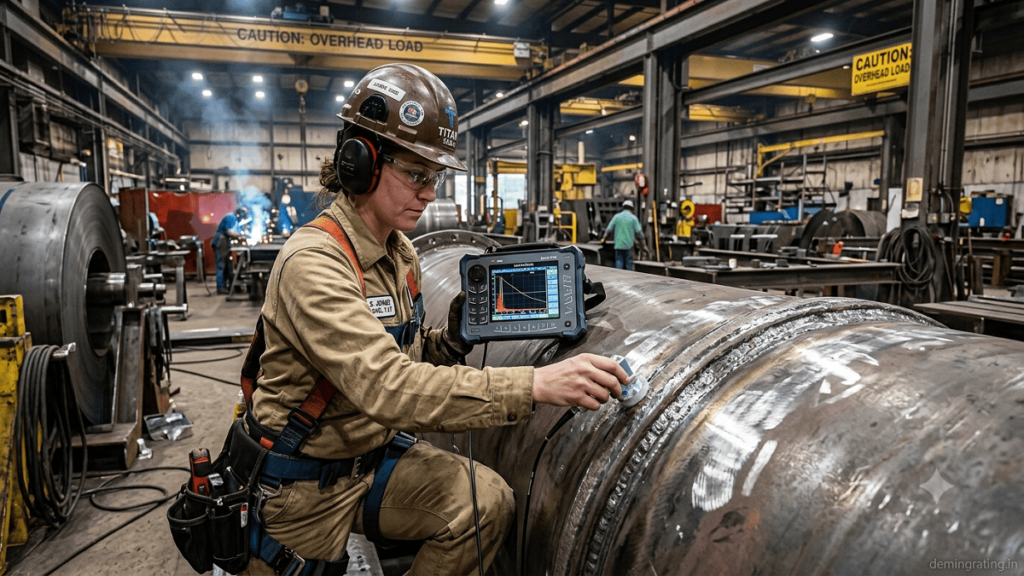
Case Study of Non-Destructive Testing (NDT): Detecting Pipeline Defects Before Failure
Non-Destructive Testing (NDT) plays a critical role in industries where equipment integrity and operational safety are essential. A practical example is the inspection of a steel pipeline used to transport industrial fluids. Because replacing or cutting open sections of an operating pipeline can be expensive and disruptive, NDT provides a way to assess its condition without causing permanent damage.
The Inspection Challenge
A pipeline operator was carrying out a scheduled integrity assessment after several years of service. Although there were no obvious signs of failure, the inspection team needed to determine whether corrosion, wall-thickness reduction, weld defects, or cracking had developed.
The main challenge was to identify potentially dangerous conditions while keeping the pipeline intact and minimizing operational disruption. Relying only on external visual inspection would not provide sufficient information about internal or subsurface conditions.
NDT Methods Used
The inspection program used several NDT techniques based on the characteristics of the pipeline and the defects being considered.
Visual Testing (VT) was first performed to identify visible corrosion, coating deterioration, dents, leaks, and other surface conditions. Areas showing potential concerns were then selected for more detailed examination.
Ultrasonic Testing (UT) was used to measure material thickness and investigate areas where corrosion or wall loss was suspected. Ultrasonic techniques can provide useful information about material thickness and certain internal discontinuities without cutting into the pipeline.
Magnetic Particle Testing (MT) was applied to suitable ferromagnetic components where surface and near-surface discontinuities were a concern, particularly around selected weld areas.
Where necessary, additional NDT techniques could be used to provide complementary information and improve confidence in the assessment.
Findings and Corrective Action
The inspection process identified areas requiring closer evaluation. Instead of replacing entire sections immediately, the operator could use documented inspection results to determine which locations required repair, continued monitoring, or additional testing.
The results also provided useful information for the pipeline’s maintenance planning. Areas affected by corrosion or other degradation could be prioritized according to their condition and operational importance.
Key Lessons
This case demonstrates how NDT can support asset integrity without destroying valuable equipment. Combining different inspection techniques provides a broader understanding of component condition than relying on a single method. Accurate inspection records also help organizations track deterioration over time and make informed maintenance decisions.
Conclusion
NDT is an effective approach for detecting potential defects while preserving the inspected component. In pipeline applications, techniques such as visual, ultrasonic, and magnetic particle testing can support condition assessment, maintenance planning, safety management, and risk reduction. The specific methods and acceptance criteria should always be selected according to the material, component design, applicable codes, operating conditions, and qualified inspection procedures.
External References
- American Society for Nondestructive Testing (ASNT)
- ISO 9712 – Non-Destructive Testing Personnel Qualification and Certification
- Pipeline and Hazardous Materials Safety Administration (PHMSA)
#NDTInspection
White Paper on Non-Destructive Testing (NDT)
Executive Summary
Non-Destructive Testing (NDT) is a collection of inspection techniques used to evaluate the integrity, quality, and condition of materials, components, and structures without causing damage to the inspected item. NDT is widely used in manufacturing, aerospace, automotive, construction, oil and gas, power generation, transportation, and other industries where equipment reliability and safety are critical.
The primary objective of NDT is to detect defects and material discontinuities before they result in product failure or operational problems. Common defects include cracks, corrosion, porosity, inclusions, voids, lack of fusion, and other imperfections that may affect structural integrity.
Role of NDT in Quality and Safety
NDT provides manufacturers and asset owners with valuable information about component condition without requiring destructive sampling. During manufacturing, inspection can verify the quality of welds, castings, forgings, composite materials, and finished components. During service, NDT can identify deterioration and help maintenance teams determine whether equipment remains suitable for continued operation.
This makes NDT particularly valuable for safety-critical assets. Detecting a defect at an early stage can help prevent equipment failure, reduce unplanned downtime, and minimize the risk of accidents or costly repairs.
Major NDT Methods
Different NDT methods are selected according to the material, component geometry, expected defect type, and inspection objectives. Visual Testing (VT) examines accessible surfaces for visible defects. Ultrasonic Testing (UT) uses high-frequency sound waves to detect certain internal discontinuities and measure material thickness.
Radiographic Testing (RT) uses X-rays or gamma radiation to produce images of internal structures. Magnetic Particle Testing (MT) detects surface and near-surface discontinuities in suitable ferromagnetic materials, while Liquid Penetrant Testing (PT) identifies surface-breaking defects. Eddy Current Testing (ET) uses electromagnetic induction to detect certain discontinuities and material changes in electrically conductive materials.
Benefits and Considerations
NDT can reduce material waste, support preventive maintenance, improve product reliability, and provide early warning of potential failures. Because components generally remain intact after inspection, organizations can examine expensive or critical assets without automatically replacing them.
However, no single NDT method can detect every type of defect. Inspection results can also be influenced by equipment, procedures, material properties, accessibility, and personnel competency. Therefore, selecting the appropriate technique and following applicable standards are essential for reliable results.
Conclusion
NDT is a critical element of modern quality assurance, asset integrity, and maintenance programs. By detecting defects without damaging components, it enables organizations to make informed decisions about product quality, safety, maintenance, and continued service. Combining appropriate NDT methods with qualified personnel, standardized procedures, accurate documentation, and applicable industry standards can provide a comprehensive approach to managing asset integrity and reducing operational risk.
External References
- American Society for Nondestructive Testing (ASNT)
- ISO 9712 – Non-Destructive Testing Personnel Qualification and Certification
- International Atomic Energy Agency (IAEA)
- National Institute of Standards and Technology (NIST)
#NDT
Industry Application of Non-Destructive Testing (NDT)
Non-Destructive Testing (NDT) is widely used across industries to evaluate the condition and integrity of materials, components, and structures without causing damage. It helps organizations detect defects, verify manufacturing quality, support preventive maintenance, and reduce the risk of unexpected failures. Different NDT methods are selected according to the material, component design, expected defect type, and inspection requirements.
Manufacturing Industry
In manufacturing, NDT is used to inspect raw materials, welds, castings, forgings, machined components, and finished products. Visual testing, ultrasonic testing, radiographic testing, magnetic particle testing, liquid penetrant testing, and eddy current testing can help identify cracks, porosity, inclusions, lack of fusion, and other discontinuities. Early detection allows manufacturers to correct process problems, reduce rework, and maintain consistent product quality.
Aerospace Industry
Aerospace manufacturers and maintenance organizations use NDT extensively because aircraft components must meet demanding safety and reliability requirements. Ultrasonic, eddy current, liquid penetrant, radiographic, and visual testing can be used to examine aircraft structures, engine components, fasteners, welds, and composite materials. NDT helps identify damage and material degradation while allowing valuable components to remain intact.
Oil and Gas Industry
Pipelines, storage tanks, pressure vessels, refineries, and offshore equipment are regularly exposed to corrosion, pressure, temperature changes, and mechanical stresses. NDT helps operators detect corrosion, cracks, weld discontinuities, and wall-thickness loss. Ultrasonic testing, radiographic testing, magnetic particle testing, liquid penetrant testing, and visual inspection are commonly selected according to the asset and inspection objective.
Power Generation
Power plants depend on NDT to assess critical equipment such as boilers, turbines, pressure vessels, piping, and welds. Inspection can identify defects caused by fatigue, corrosion, thermal stress, and prolonged service. Regular NDT supports maintenance planning and helps reduce the possibility of unexpected equipment failures and costly outages.
Automotive and Construction Industries
Automotive manufacturers use NDT to examine welds, engine components, castings, and other safety-related parts. In construction and infrastructure, NDT can help evaluate bridges, steel structures, pipelines, concrete-related components, and welded connections for deterioration or defects.
Conclusion
NDT has applications throughout the industrial lifecycle, from manufacturing and installation to maintenance and asset retirement. Its ability to identify potential defects without damaging components makes it an important tool for quality assurance, safety management, reliability, and maintenance planning. As digital inspection technologies, automation, advanced sensors, and data analysis continue to develop, NDT is becoming increasingly capable of supporting efficient and condition-based asset management.
External References
- American Society for Nondestructive Testing (ASNT)
- International Organization for Standardization (ISO)
- International Atomic Energy Agency (IAEA)
- National Institute of Standards and Technology (NIST)
#NonDestructiveTesting
Ask FAQs
What is Non-Destructive Testing (NDT)?
NDT is a group of inspection methods used to identify defects and assess material condition without damaging or permanently altering the inspected component.
What are the most common NDT methods?
Common methods include Visual Testing (VT), Ultrasonic Testing (UT), Radiographic Testing (RT), Magnetic Particle Testing (MT), Liquid Penetrant Testing (PT), and Eddy Current Testing (ET).
What types of defects can NDT detect?
Depending on the method, NDT can detect cracks, corrosion, porosity, voids, inclusions, weld defects, material thickness loss, and other surface, near-surface, or internal discontinuities.
Which industries use NDT?
NDT is widely used in aerospace, automotive, manufacturing, construction, oil and gas, power generation, transportation, and infrastructure industries to support safety, quality, and asset reliability.
Why is NDT important for maintenance and safety?
NDT helps identify potential defects before they cause equipment failure. It supports preventive maintenance, reduces unplanned downtime, improves reliability, and helps organizations manage operational and safety risks.
Disclaimer: NDT information is for general educational purposes only. Always follow applicable industry standards, regulations, and qualified professional guidance.