ISO 9606 Qualification Preparation
ISO 9606 Qualification Preparation is a structured process designed to help welders prepare for qualification testing in accordance with the applicable ISO 9606 series requirements. The standard focuses on the qualification of welders and establishes conditions for demonstrating a welder’s ability to produce acceptable welds under specified conditions. ISO 9606-1, for example, covers the qualification testing of welders for fusion welding of steels.
What Does ISO 9606 Qualification Preparation Involve?
Effective preparation begins with understanding the applicable standard, welding process, material group, joint configuration, welding position, and qualification range required for the intended work. ISO 9606 Qualification A training or certification program should be tailored to the specific qualification test rather than relying solely on general welding practice.
Preparation commonly includes reviewing the welding procedure, understanding essential variables, selecting suitable consumables, and practicing the ISO 9606 Qualification required joint configuration and welding position. Welders should also understand the importance of correct preparation, fit-up, preheating where applicable, interpass control, welding parameters, and post-weld requirements.
Practical Welding Training
Hands-on practice is one of the most important elements of qualification preparation. Welders can perform practice welds under conditions that closely reproduce the expected qualification test. Trainers can then assess bead appearance, penetration, defects, ISO 9606 Qualification technique, and consistency.
The objective is to develop repeatable welding performance rather than simply producing one successful test piece.
Documentation and Test Readiness
Preparation should also include documentation. Details relating to the welder, welding process, parent material, consumables, test piece, welding position, and other relevant variables need to be accurately recorded. Depending on the applicable qualification route and certification body, the completed test piece may undergo visual and/or specified destructive or ISO 9606 Qualification non-destructive testing.
ISO 9606-1 specifies testing and acceptance provisions as part of the qualification process, making familiarity with the test requirements essential.
Why Professional Preparation Matters
Professional ISO 9606 preparation can reduce avoidable test failures by identifying technical weaknesses before the actual examination. It can also help organizations standardize training, maintain qualification records, and ensure welders are prepared for the specific applications in which they will work.
However, preparation or training does not itself constitute certification. Qualification must be carried out through the applicable testing ISO 9606 Qualification and certification process under the relevant standard and authorized arrangements.
For authoritative information, organizations should consult the ISO 9606-1 standard and relevant certification or welding-examination bodies. Requirements should always be confirmed against the current edition applicable to the welding process and material being qualified.
#IndustrialWelding
What Is ISO 9606 Welder Qualification and Why Is It Important for Welding Professionals?
ISO 9606 welder qualification is an internationally recognized qualification framework used to assess a welder’s ability to produce acceptable-quality welds under specified conditions. The ISO 9606 series covers qualification testing for different materials and welding applications. For example, ISO 9606-1:2012 specifies requirements for qualification testing of welders performing fusion welding of steels. The standard provides technical rules intended to make welder qualifications consistently assessable across different products, locations, and examining bodies.
What Does the Qualification Demonstrate?
The qualification primarily demonstrates a welder’s practical ability to manually or partly mechanically manipulate welding equipment and produce a weld that meets the applicable acceptance requirements. ISO 9606-1 applies to relevant manual ISO 9606 Qualification and partly mechanized fusion-welding processes and does not cover fully automated or mechanized welding processes.
During qualification, the welder works on a specified test piece under defined conditions. Factors such as welding process, material, joint type, welding position, thickness, and other essential variables influence the qualification range. The resulting qualification therefore establishes where the welder has demonstrated competence rather than serving as an unrestricted certification for every welding application.
Why Is ISO 9606 Qualification Important?
For welding professionals, qualification provides documented evidence of practical welding competence. This can be particularly important in industries where weld quality directly affects structural integrity, product reliability, safety, ISO 9606 Qualification and regulatory compliance.
For employers and contractors, qualified welders can provide greater confidence that personnel assigned to welding work have demonstrated their skills under controlled testing conditions. ISO has also emphasized that welder qualification standards are intended to verify skills and provide confidence in the welder’s ability to meet production-quality ISO 9606 Qualification requirements.
Benefits for Welding Careers
An ISO 9606 qualification can strengthen a welder’s professional profile by providing recognized evidence of technical capability. It can support opportunities in industries such as fabrication, construction, pressure equipment, manufacturing, shipbuilding, energy, and other sectors where qualified welding personnel are required.
Qualification can also encourage welders to develop greater consistency in controlling welding parameters, joint preparation, technique, ISO 9606 Qualification and defect prevention.
Importance for Employers
Organizations can use qualified welding personnel as part of their broader welding-quality system. Properly qualified welders can help reduce defective welds, rework, material waste, production delays, and quality-related costs. However, qualification requirements should always be matched to the specific welding procedure, project specifications, applicable codes, ISO 9606 Qualification and contractual requirements.
Conclusion
ISO 9606 welder qualification provides a structured method for demonstrating a welder’s ability to produce acceptable welds within a defined range of conditions. It is valuable for professional credibility, quality assurance, industrial reliability, and workforce competency.
Welders and employers should identify the appropriate part of the ISO 9606 series and verify the current applicable requirements before undertaking qualification testing. The official ISO 9606-1 page confirms that ISO 9606-1:2012 remains the current published edition for steel welding, although ISO indicates that a replacement is under development.
#WeldingCompliance
What Welding Process, Material, Joint, and Parameter Requirements Should Be Reviewed Before Qualification Testing?
Before undertaking ISO 9606 welder qualification testing, the welding professional and responsible organization should carefully review the conditions that will define the qualification test and its applicable range. The exact requirements depend on the relevant part of ISO 9606, material, welding process, and application. ISO 9606 Qualification For example, ISO 9606-1:2012 covers qualification testing for fusion welding of steels and remains the current published edition, ISO 9606 Qualification although ISO indicates that it is being revised. (ISO)
1. Welding Process
The first consideration is the welding process to be used during testing. The process should correspond to the type of welding the welder is expected to perform in production. ISO 9606-1 covers manual and partly mechanized fusion-welding processes, while fully mechanized ISO 9606 Qualification and automated welding processes fall outside its scope. (ISO)
The organization should therefore identify the applicable process designation and determine whether a single process or combination of processes will be used.
2. Parent Material
The parent material should be established before testing. This includes identifying the material type, material group where applicable, product form, and thickness or diameter relevant to the intended work.
The test material should be selected carefully because the qualification range depends on the test conditions specified by the applicable ISO 9606 requirements. The selected material should also be traceable through appropriate material documentation.
3. Joint Configuration
The proposed joint type should be reviewed before the test. This may include butt welds, fillet welds, or other applicable configurations. Joint preparation, dimensions, backing arrangements, root conditions, and access should correspond to the intended qualification.
Welding position is also important because qualification ranges are associated with the position in which the welder demonstrates competence. ISO’s published interpretations include specific questions concerning qualification ranges for different positions, joint types, thicknesses, and backing conditions.
4. Welding Parameters
The applicable welding parameters should be established and controlled before testing. These may include current, voltage, travel speed, polarity, wire-feed speed where applicable, shielding-gas flow, electrode or filler-metal selection, preheat, and interpass temperature.
The welder should practice within the intended parameter ranges before the formal test so that technique and weld quality remain consistent. ISO 9606 Qualification Welding parameters should also be recorded accurately as part of the qualification documentation.
5. Test Conditions and Qualification Range
The organization should review the applicable test-piece dimensions, welding position, joint configuration, consumables, backing conditions, and thickness or diameter ranges before selecting the test coupon. A test should be designed around the production welding requirements so that the resulting qualification is useful for the intended work.
Importantly, ISO 9606 qualification is not simply a general approval to perform every type of welding. It establishes a defined range of qualification based on the conditions demonstrated during testing.
Conclusion
Before ISO 9606 qualification testing, welders and employers should review the welding process, parent material, joint configuration, welding position, ISO 9606 Qualification consumables, thickness or diameter, backing conditions, and applicable welding parameters. Careful preparation helps ensure that the selected test accurately represents the intended production work and that the resulting qualification has an appropriate range.
Because requirements vary between parts of ISO 9606 and specific applications, the current applicable standard and requirements of the examining or certification body should always be verified before testing. The official ISO 9606-1 information provides the authoritative scope and status of the standard.
#WeldingInspection
How Can Welders Prepare Effectively for an ISO 9606 Qualification Test?
Effective preparation is essential for welders planning to undertake an ISO 9606 qualification test. The qualification is designed to demonstrate that a welder can produce an acceptable weld under specified conditions and within a defined qualification range. ISO 9606-1, ISO 9606 Qualification for example, covers qualification testing for fusion welding of steels. (ISO)
1. Understand the Test Requirements
Preparation should begin by identifying the exact qualification being sought. Welders should understand the applicable ISO 9606 part, welding process, parent material, joint type, thickness or diameter, welding position, consumables, and other relevant variables.
The test should reflect the type of welding the professional is expected to perform in production. Understanding these conditions helps prevent preparation for an unsuitable test configuration.
2. Review the Welding Procedure
Before practical training, the welder should become familiar with the applicable Welding Procedure Specification (WPS) or test instructions. Important details may include joint preparation, electrode or filler-metal specification, shielding gas, welding current, voltage, travel speed, preheating, interpass temperature, and welding sequence.
The welder should understand which parameters must be controlled during the test and practice maintaining them consistently.
3. Develop Practical Welding Skills
Hands-on practice is one of the most important preparation activities. Welders should practice using test pieces with dimensions, joint configurations, positions, and materials that closely resemble the intended qualification test.
Training should focus on stable arc control, correct travel speed, electrode or torch manipulation, penetration, bead placement, interpass cleaning, and control of heat input where applicable.
4. Practice Defect Prevention
Welders should learn to recognize and prevent common weld imperfections such as porosity, lack of fusion, incomplete penetration, undercut, excessive reinforcement, slag inclusions, and cracking.
Practice welds can be visually examined and, where appropriate, subjected to relevant testing so that the welder receives feedback before the formal qualification test.
5. Prepare Equipment and Materials
All equipment should be inspected before testing. Welding machines, cables, holders or torches, gas systems, regulators, consumables, and measuring equipment should be in suitable working condition.
Consumables should be correctly identified, stored, and handled according to the applicable requirements. Test materials should also be traceable and prepared according to the specified joint configuration.
6. Simulate the Qualification Test
A mock qualification test is an effective way to assess readiness. The welder should complete a practice test under conditions similar to the actual examination, including time management, joint preparation, welding position, parameter control, and cleaning requirements.
An experienced welding trainer or inspector can review the practice weld and identify technical issues that need correction.
7. Verify Documentation
Before the examination, all required identification and documentation should be checked. Details concerning the welder, test piece, welding process, materials, consumables, and test conditions should be accurately recorded.
Conclusion
Successful ISO 9606 preparation combines technical knowledge, practical welding practice, equipment readiness, defect prevention, documentation, and realistic mock testing. The goal is not simply to produce one acceptable test piece but to demonstrate consistent welding competence within the applicable qualification range.
Welders should always confirm the exact requirements with the authorized examining or certification body because qualification conditions can vary according to the applicable ISO 9606 part and test arrangement. The official ISO 9606-1 information provides authoritative information on the standard’s scope and current status. (ISO)
#WeldingQuality
What Documentation and Records Are Typically Required to Demonstrate Welder Qualification?
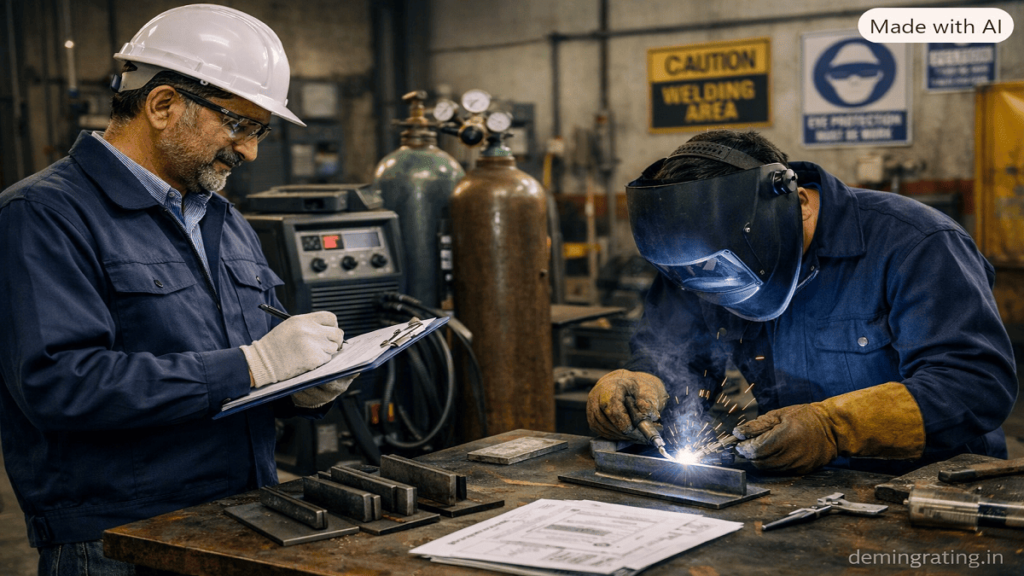
Proper documentation is an essential part of ISO 9606 welder qualification because the qualification must clearly demonstrate what the welder was tested on, whether the test was successfully completed, and the range of welding conditions covered. ISO 9606-1:2012, which covers qualification testing for fusion welding of steels, requires the qualification test certificate to record the applicable essential variables and relevant test information. ISO confirms that this edition remains the current published version while a replacement is being developed. (ISO)
1. Welder Identification
The qualification record should clearly identify the individual who performed the test. Typical information includes the welder’s name, identification details, employer, and other identification information required by the examining body. This ensures that the qualification certificate can be reliably linked to the person who completed the test.
2. Welder Qualification Test Certificate
The welder qualification test certificate is the primary document demonstrating successful qualification. Under ISO 9606-1, the certificate is issued under the responsibility of the examiner or examining body, and all relevant essential variables must be addressed. If the test piece fails any required examination or test, a qualification certificate should not be issued.
3. Welding Test Details
The certificate should document the conditions under which the test was performed. Depending on the applicable qualification, this can include:
- Welding process and transfer mode
- Plate or pipe
- Butt or fillet weld
- Parent material group or subgroup
- Filler material group and designation
- Material thickness or deposited thickness
- Pipe outside diameter, where applicable
- Welding position
- Weld details such as backing and single- or multi-layer welding
These variables are important because the qualification establishes a defined range of approval, rather than an unrestricted authorization to perform every type of welding.
4. Supporting Welding Information
The certificate should also record relevant additional information, including WPS reference, shielding gas, current type and polarity, and other applicable test conditions. ISO 9606-1 specifically identifies current/polarity, parent material group or subgroup, and shielding gas as information to be recorded on the certificate.
5. Examination and Test Results
Records should demonstrate that the completed test piece underwent the examinations and tests required by the applicable qualification procedure. Depending on the test arrangement, records may include results from visual examination, radiographic testing, fracture testing, bend testing, macro examination, or tensile testing.
The result should clearly indicate whether the test was performed and accepted according to the applicable requirements.
6. Examiner and Certification Details
The documentation should identify the examiner or examining body, reference number, examination location, test date, certificate issue date, and required signatures or approvals. Where applicable, revalidation or confirmation records should also be maintained according to the applicable standard and certification arrangement.
Conclusion
A strong ISO 9606 qualification record should provide a clear chain of evidence linking the welder, test piece, welding conditions, examination results, qualification range, and authorized examiner. Organizations should maintain certificates and supporting test records in a controlled system so that qualifications can be verified when required for audits, projects, clients, or quality-control purposes.
Because documentation requirements can vary according to the applicable part of ISO 9606, project specifications, certification body, and national requirements, organizations should verify the current requirements before testing. The official ISO 9606-1 standard information should be used as the primary reference. (ISO)
#WelderCertification
How Can Professional Preparation Improve Qualification Readiness, Welding Quality, and Compliance?
Professional preparation plays an important role in helping welders successfully approach an ISO 9606 qualification test while developing consistent welding practices and stronger quality-control processes. ISO 9606 provides requirements for qualification testing of welders, with different parts covering particular materials and welding applications. For example, ISO 9606-1 applies to the qualification testing of welders for fusion welding of steels. (ISO)
1. Improves Qualification Readiness
Professional preparation begins with understanding the exact qualification requirements. Trainers can help welders identify the applicable welding process, parent material, joint configuration, welding position, thickness, consumables, and other essential variables.
This allows practice sessions to be designed around the intended qualification test rather than general welding exercises. Mock tests can then be conducted under conditions similar to the actual examination, helping welders become familiar with the procedure, equipment, test-piece preparation, and time requirements.
2. Strengthens Welding Technique
Structured training provides welders with repeated opportunities to improve arc control, travel speed, electrode or torch manipulation, joint preparation, penetration, bead placement, and interpass cleaning.
Instead of focusing only on completing a test piece, professional preparation encourages consistency. This is important because qualification demonstrates welding capability under defined conditions, and production welding requires that capability to be repeated reliably.
3. Reduces Weld Defects
Experienced trainers can identify common causes of imperfections such as porosity, lack of fusion, incomplete penetration, undercut, slag inclusions, excessive reinforcement, and cracking.
Practice welds can be inspected before the formal qualification test. Identifying defects early allows the welder to correct technique, equipment settings, preparation methods, or material-handling practices before the actual test.
4. Improves Process and Parameter Control
Professional preparation emphasizes disciplined control of welding parameters. Depending on the process, this may include current, voltage, travel speed, shielding gas, polarity, preheat, interpass temperature, and filler-material selection.
Following the applicable Welding Procedure Specification (WPS) or test instructions helps welders understand how controlled parameters contribute to consistent weld quality.
5. Strengthens Documentation and Traceability
Compliance is not limited to welding performance. Qualification records must accurately identify the welder and document relevant test conditions and results. A structured preparation programme can help organizations establish proper records for training, test pieces, certificates, equipment checks, and qualification status.
Good documentation also supports traceability during customer audits, quality reviews, and project inspections.
6. Supports Long-Term Compliance
Professional preparation should not end when the qualification certificate is issued. Organizations can establish periodic competency reviews, monitor qualification validity, maintain controlled records, and ensure that welders are assigned work within their applicable qualification ranges.
The exact requirements depend on the relevant ISO 9606 part and certification arrangement, so organizations should verify current requirements with the applicable examining or certification body.
Conclusion
Professional ISO 9606 preparation creates a connection between qualification readiness, welding quality, and compliance. Through structured training, realistic practice, defect prevention, parameter control, documentation, and mock testing, welders can approach qualification testing with greater technical confidence while organizations strengthen their overall welding-quality practices.
For authoritative information, consult the official ISO 9606-1 standard page and confirm the applicable testing requirements with the relevant examining or certification body. (ISO)
#WeldingTraining
Case Study of ISO 9606 Qualification Preparation
Overview
ISO 9606 Qualification Preparation helps welding professionals develop the practical skills, process knowledge, and documentation readiness required for welder qualification testing. ISO 9606-1:2012 specifies requirements for qualification testing of welders performing fusion welding of steels and provides a systematic framework for demonstrating welding competence under defined conditions. ISO states that this edition remains current after its 2023 review, although a replacement is under development.
The Welder’s Challenge
Consider a fabrication company preparing one of its experienced welders for an ISO 9606 qualification test. The welder had several years of production experience but had not recently undertaken a formal qualification test.
An initial skills assessment showed that the welder was technically capable but needed greater consistency in joint preparation, welding-position control, parameter management, and documentation. The company therefore developed a structured preparation programme rather than sending the welder directly for examination.
Preparation and Skills Assessment
The programme began by identifying the intended welding process, parent material, joint type, test position, thickness, filler material, and other relevant variables. This was important because ISO 9606 qualification establishes a defined range based on the conditions demonstrated during the test.
The trainer then reviewed the applicable WPS or test instructions with the welder. Practice coupons were prepared to replicate the expected qualification conditions as closely as possible.
Practical Welding Training
During the practice stage, the welder completed repeated welds while the trainer monitored arc control, travel speed, electrode or torch manipulation, penetration, bead profile, interpass cleaning, and overall technique.
The practice welds were visually evaluated for common imperfections. Where weaknesses were identified, the welder repeated the relevant technique until the results became consistent.
The preparation also included a simulated qualification test. This allowed the welder to practice under controlled conditions while becoming familiar with test-piece preparation, welding sequence, stop-and-restart requirements, and examination procedures. ISO 9606-1 requires qualification testing to be conducted under defined welding conditions and provides requirements for examination and testing of test pieces.
Documentation Readiness
The company also established a documentation checklist covering welder identification, WPS information, parent-material details, consumables, test conditions, and examination results. This helped ensure that technical performance and supporting records were prepared together.
The company maintained traceability of the test material and preparation records, making it easier to demonstrate the conditions under which the welder was assessed.
Qualification Outcome
Following the preparation programme, the welder approached the formal qualification test with improved confidence and greater consistency. The practical training had helped identify technical weaknesses before the examination, while the mock test reduced uncertainty about the qualification procedure.
The organization also benefited by establishing a repeatable preparation system that could subsequently be applied to other welders.
Key Takeaway
This case demonstrates that effective ISO 9606 preparation should combine skills assessment, targeted practical training, WPS awareness, realistic practice, defect prevention, test simulation, and documentation control.
Professional preparation does not guarantee certification, because the qualification decision depends on the prescribed examination and testing process. Organizations should always confirm the applicable requirements with the authorized examiner or examining body.
#WeldingQualification
White Paper on ISO 9606 Qualification Preparation
Executive Summary
ISO 9606 Qualification Preparation is a structured approach to preparing welders for qualification testing against the applicable requirements of the ISO 9606 series. The purpose is to establish that a welder can manually produce acceptable-quality welds under specified conditions and within a defined qualification range.
For steel welding, ISO 9606-1:2012 specifies requirements for qualification testing of welders performing fusion welding of steels. ISO states that this edition was reviewed and confirmed in 2023 and remains the current published version, while a replacement standard is under development.
Professional preparation combines technical assessment, practical welding training, test simulation, parameter control, defect prevention, and documentation readiness.
1. Importance of Welder Qualification
Welder qualification provides documented evidence that an individual has demonstrated the ability to produce acceptable welds under defined test conditions. ISO 9606-1 establishes technical rules intended to support consistent qualification regardless of product, location, or examiner or examining body.
For manufacturers, fabricators, contractors, and welding professionals, this provides an important foundation for workforce competency and quality management.
2. Pre-Qualification Assessment
Preparation should begin with an assessment of the welder’s existing skills and the qualification required for the intended work.
The review should establish the applicable:
- Welding process
- Parent material
- Joint configuration
- Welding position
- Test-piece dimensions
- Filler material or consumables
- Backing conditions where applicable
- Relevant welding parameters
- Applicable qualification range
This ensures that training is aligned with the actual qualification objective rather than generic welding practice.
3. Practical Welding Preparation
Hands-on practice is central to effective preparation. Welders should practice using test configurations that closely represent the intended qualification test.
Training can focus on joint preparation, fit-up, arc or torch control, travel speed, electrode manipulation, penetration, bead profile, interpass cleaning, and control of relevant welding parameters.
The objective should be repeatable performance. A welder who can consistently reproduce acceptable weld quality is better prepared than someone who succeeds with an isolated practice coupon.
4. Defect Prevention and Quality Control
Professional preparation should include systematic identification and prevention of weld imperfections. Depending on the application, training may address porosity, lack of fusion, incomplete penetration, undercut, inclusions, excessive reinforcement, and cracking.
Practice welds can be evaluated through the examinations or tests applicable to the qualification arrangement. Feedback from these exercises allows technical problems to be corrected before the formal examination.
5. Equipment and Material Readiness
Qualification preparation should also verify the condition and suitability of welding equipment, test materials, consumables, shielding systems, measuring devices, and related tools.
Consumables should be correctly identified and handled according to applicable requirements. Test materials should be traceable, properly prepared, and suitable for the planned qualification.
6. Mock Qualification Testing
A mock qualification test provides an effective bridge between training and formal examination. The welder can complete a representative test under controlled conditions while an experienced trainer evaluates technique, parameter control, time management, cleaning, and overall weld quality.
Mock testing can expose weaknesses that might otherwise become apparent only during the actual examination.
7. Documentation and Traceability
Technical preparation should be supported by proper documentation. Records may include welder identification, training history, practice-test results, applicable WPS information, material and consumable details, equipment checks, and examination results.
Maintaining accurate records supports traceability and can help organizations demonstrate competency during customer audits, project reviews, or quality assessments.
8. Benefits to Organizations
A structured preparation programme can provide several organizational benefits:
- Improved qualification readiness
- More consistent welding performance
- Early identification of technical weaknesses
- Reduced avoidable test failures
- Better control of welding practices
- Improved documentation and traceability
- Stronger workforce competency management
Professional preparation does not guarantee qualification. The final result depends on the prescribed test, examination, acceptance requirements, and the responsible examiner or examining body.
9. Recommended Preparation Framework
Organizations can establish a repeatable preparation model:
Assess → Plan → Practice → Inspect → Correct → Simulate → Qualify → Maintain Records
This framework allows each welder’s preparation to be documented and adjusted according to individual skill level and qualification requirements.
Conclusion
ISO 9606 Qualification Preparation should be viewed as more than short-term training before an examination. It is a structured process for developing technical competence, welding consistency, quality awareness, and qualification readiness.
For organizations, a professional preparation programme can create a more reliable pathway from skills assessment to formal qualification while strengthening internal welding-quality practices.
Because ISO 9606 requirements vary according to the applicable part, material, welding process, and qualification arrangement, organizations should verify the current requirements before testing. The official ISO 9606-1 standard page confirms that ISO 9606-1:2012 remains the current published standard for fusion welding of steels, with a replacement under development.
#WelderQualification
Industry Application of ISO 9606 Qualification Preparation
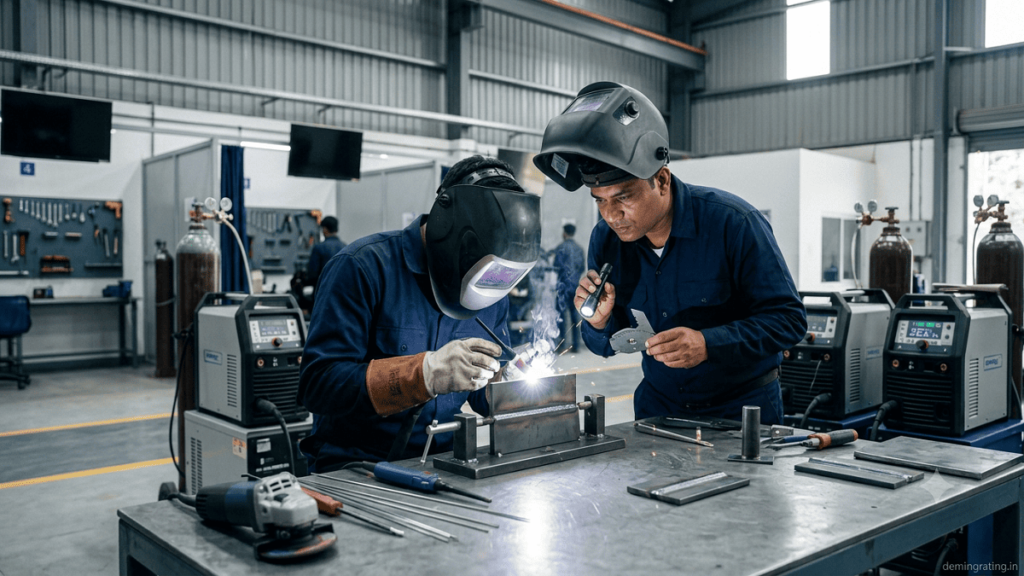
ISO 9606 Qualification Preparation has important applications across industries where welding quality, workforce competency, safety, and production reliability are critical. The ISO 9606 series provides requirements for welder qualification testing under specified conditions. For example, ISO 9606-1:2012 applies to qualification testing of welders for fusion welding of steels. (ISO) (iso.org)
Professional preparation helps organizations ensure that welders understand the applicable welding process and can consistently produce acceptable welds within the relevant qualification range.
1. Fabrication and Manufacturing
Metal fabrication companies use qualified welders for manufacturing structural components, machinery, frames, tanks, assemblies, and other welded products. Preparation programmes allow welders to practice specific joint configurations, materials, positions, and welding processes before formal qualification.
This can help manufacturers reduce avoidable defects, rework, production interruptions, and material waste.
2. Construction and Structural Welding
The construction sector frequently depends on reliable welding for structural steelwork and other fabricated components. ISO 9606 preparation can help welding personnel develop consistent technique and understand the requirements associated with their qualification.
Companies can incorporate welder qualification preparation into workforce planning before assigning personnel to projects that require documented welding competency.
3. Pressure Equipment and Process Industries
Industries involving pressure equipment, pipelines, process systems, and related fabrication often operate under strict quality requirements. Welder qualification preparation can support the organization’s broader welding-quality system by ensuring personnel are trained and assessed for the specific welding applications they will perform.
However, ISO 9606 qualification should not be treated as a substitute for project-specific codes, regulations, or welding procedure requirements.
4. Shipbuilding and Heavy Engineering
Shipbuilding and heavy engineering involve extensive welding across different materials, thicknesses, positions, and joint configurations. Structured qualification preparation allows companies to prepare welders for the specific combinations relevant to their production activities.
Training can include realistic practice coupons, parameter control, defect prevention, and simulated qualification tests.
5. Energy and Industrial Infrastructure
The power, energy, oil and gas, and industrial infrastructure sectors often require controlled welding processes and documented personnel competency. Qualification preparation can help organizations establish a systematic approach to training and testing while maintaining records that demonstrate workforce readiness.
The actual qualification requirements should always be determined by the applicable standard, contract, engineering specification, and regulatory framework.
6. Welding Training and Certification Centers
Professional training centers can use ISO 9606 preparation programmes to provide structured instruction before candidates undertake formal examinations. Such programmes can combine classroom instruction, practical welding sessions, mock testing, inspection, and corrective training.
This approach can help candidates understand not only how to weld but also how their welding performance is evaluated during qualification.
7. Quality Management and Workforce Development
ISO 9606 preparation also has an organizational application. Companies can integrate qualification preparation into their competency-management systems, maintaining records of training, qualifications, test results, and applicable qualification ranges.
This creates better visibility into workforce capabilities and helps organizations assign qualified personnel to appropriate work.
Conclusion
The industry application of ISO 9606 Qualification Preparation extends across fabrication, construction, manufacturing, pressure equipment, shipbuilding, heavy engineering, energy, and welding training. Its primary value is helping organizations develop welders who are technically prepared to demonstrate competence under controlled qualification conditions.
Effective preparation should combine practical training, process knowledge, defect prevention, equipment readiness, mock testing, and documentation. It does not guarantee certification, as qualification depends on the prescribed examination and acceptance requirements.
Organizations should verify the applicable ISO 9606 requirements before training or testing. The official ISO 9606-1 information provides authoritative information on qualification testing for fusion welding of steels. (iso.org)
#ISO9606
Ask FAQs
What is ISO 9606 welder qualification?
ISO 9606 is a series of standards for qualifying welders through practical testing under specified welding conditions. The applicable part depends on the material and welding application.
Why is ISO 9606 qualification important for welders?
It provides documented evidence that a welder has demonstrated the ability to produce acceptable welds within a defined qualification range, supporting professional credibility and welding quality.
What should welders practice before an ISO 9606 test?
Welders should practice the applicable welding process, joint configuration, material, position, thickness, consumables, and relevant parameters under conditions similar to the actual qualification test.
What industries use ISO 9606-qualified welders?
Qualified welders may be required across fabrication, construction, manufacturing, shipbuilding, heavy engineering, pressure equipment, energy, and industrial infrastructure, depending on applicable codes and project requirements.
Does ISO 9606 preparation guarantee qualification?
No. Preparation can improve technical readiness and reduce avoidable errors, but qualification depends on successful completion of the prescribed examination and testing requirements by the relevant examiner or examining body.
Table of Contents
Disclaimer: This content is for general informational purposes only. ISO 9606 requirements may vary by material, welding process, and applicable edition, so always verify current requirements with the relevant standard and authorized examining body.