Infrastructure and Resource Assessment
Infrastructure and Resource Assessment is a crucial step for schools preparing for ICSE Board affiliation. It involves evaluating the school’s physical facilities, academic resources, safety systems, technology, and other essential infrastructure against the applicable CISCE requirements. A systematic assessment helps school management identify gaps, prioritize improvements, and ensure the institution is adequately prepared for the affiliation and inspection process.
Key Areas of Assessment
A professional assessment typically examines classrooms, laboratories, libraries, computer facilities, playgrounds, sanitation facilities, administrative areas, staff facilities, and other essential campus resources. The evaluation considers not only whether a facility exists but also whether it is adequately equipped, functional, maintained, Infrastructure and Resource Assessment and appropriate for the school’s student strength.
Science laboratories are particularly important for schools offering subjects that require practical learning. The assessment should review laboratory space, equipment, safety arrangements, storage, and usability. Similarly, the library should be evaluated for its available space, books, reference materials, seating capacity, and accessibility to students.
Technology infrastructure is another important area. Infrastructure and Resource Assessment Schools should assess computer systems, internet connectivity, Infrastructure and Resource Assessment digital learning resources, and supporting facilities to determine whether they adequately support teaching and administrative requirements.
Safety and Student Facilities
Infrastructure assessment should also cover fire-safety systems, emergency exits, electrical safety, drinking water, sanitation, accessibility, first-aid arrangements, Infrastructure and Resource Assessment and general campus cleanliness. These facilities contribute to a safe and supportive learning environment and should be maintained consistently rather than prepared only before an inspection.
Resource and Staffing Review
Infrastructure alone is not sufficient. Schools should also assess academic and human resources, including teacher qualifications, staffing levels, teaching materials, laboratory support, library resources, and administrative personnel. The objective is to establish whether the institution has sufficient resources to deliver its academic programme effectively.
Benefits of Professional Assessment
A professional infrastructure and resource assessment provides school management with a structured compliance-gap report. It can highlight areas requiring immediate attention, recommend improvements, and help management prioritize expenditure. This approach can prevent unnecessary investments while ensuring that important deficiencies are addressed before the affiliation review.
For schools pursuing CISCE affiliation, the assessment should be based on the latest official requirements, as standards and procedures can change. The official CISCE affiliation resources and CISCE affiliation guidelines should be consulted before finalizing infrastructure plans.
In conclusion, Infrastructure and Resource Assessment provides schools with a practical roadmap for improving campus readiness, academic resources, safety, Infrastructure and Resource Assessment and operational capacity. When conducted systematically, it helps school management approach the ICSE affiliation process with greater confidence Infrastructure and Resource Assessment and preparedness.
#SchoolCompliance
What Is Infrastructure and Resource Assessment and Why Is It Important for Educational Institutions?
Infrastructure and Resource Assessment is a systematic evaluation of an educational institution’s physical facilities, academic resources, technology, staffing, safety systems, and operational capabilities. The purpose is to determine whether a school has adequate resources to deliver quality education and meet applicable regulatory and academic standards. For schools preparing for ICSE or CISCE affiliation, this assessment can also help identify areas that require improvement before the formal compliance and inspection process.
What Does an Infrastructure and Resource Assessment Include?
A comprehensive assessment examines the school’s infrastructure from multiple perspectives. Physical facilities may include classrooms, laboratories, libraries, Infrastructure and Resource Assessment computer rooms, administrative offices, staffrooms, playgrounds, Infrastructure and Resource Assessment sanitation facilities, drinking-water arrangements, and other student amenities.
Academic resources are assessed to determine whether students and teachers have appropriate books, laboratory equipment, teaching aids, digital resources, and other learning materials. Technology infrastructure may include computers, internet connectivity, audiovisual equipment, digital learning systems, and technology supporting school administration.
The assessment can also review safety and accessibility, including fire-safety equipment, emergency arrangements, electrical systems, building conditions, first-aid provisions, and facilities supporting students with accessibility needs.
Human resources are another important component. Schools may evaluate teacher qualifications, staffing levels, laboratory support, library personnel, administrative staff, Infrastructure and Resource Assessment and professional development systems.
Why Is It Important?
Infrastructure and Resource Assessment enables educational institutions to identify strengths, deficiencies, Infrastructure and Resource Assessment and compliance gaps before they become significant problems. Instead of making improvements based on assumptions, school management receives a structured understanding of where resources are sufficient and where investment or corrective action may be necessary.
For schools pursuing CISCE affiliation, this preparation can be particularly valuable because CISCE affiliation requirements address areas such as classrooms, laboratories, libraries, computer facilities, qualified staff, and other educational resources. (cisce.org)
A professional assessment can also support budget planning. By ranking improvements according to urgency and regulatory importance, Infrastructure and Resource Assessment management can allocate funds more effectively. It can help prevent unnecessary expenditure while ensuring critical facilities receive attention.
Supporting Long-Term Educational Quality
The value of infrastructure assessment extends beyond affiliation. Well-maintained facilities and adequate academic resources contribute to a productive learning environment, support practical and technology-enabled education, Infrastructure and Resource Assessment and improve institutional efficiency.
Educational institutions can therefore use periodic assessments as part of their continuous improvement strategy. Rather than viewing infrastructure review as a one-time compliance exercise, schools can establish regular evaluations to monitor facility conditions, Infrastructure and Resource Assessment resource utilization, and changing educational requirements.
Conclusion
Infrastructure and Resource Assessment provides school management with an objective framework for evaluating whether its facilities, resources, staff, technology, and safety systems are adequate for effective educational delivery. For institutions preparing for ICSE affiliation, it can serve as an important pre-affiliation readiness tool, helping identify gaps and establish a practical improvement plan.
Schools should always compare assessment findings with the latest applicable regulations and official requirements. The CISCE affiliation resources and CISCE Affiliation Guidelines are useful starting points for understanding current affiliation expectations.
#ICSEAffiliation
What Physical Infrastructure, Facilities, Equipment, and Resources Should Be Assessed?
A comprehensive Infrastructure and Resource Assessment helps educational institutions determine whether their campus, facilities, equipment, and academic resources are adequate for effective teaching and learning. For schools preparing for CISCE affiliation, the assessment should be aligned with the latest applicable affiliation requirements and should cover both the condition of existing resources and their capacity to support the school’s student population.
1. Classrooms and Academic Spaces
Classrooms should be assessed for adequate space, ventilation, lighting, furniture, cleanliness, electrical facilities, Infrastructure and Resource Assessment and overall maintenance. Schools should also evaluate whether the number of classrooms is appropriate for the proposed sections and student strength. Specialized rooms for activities such as art, music, and other academic programmes should also be reviewed where applicable.
2. Science Laboratories
Science laboratories should be evaluated for appropriate space, workstations, laboratory equipment, storage facilities, safety arrangements, and availability of consumable materials. Equipment should be functional, Infrastructure and Resource Assessment properly maintained, and suitable for the subjects and classes being offered. CISCE’s affiliation requirements include provisions relating to adequately equipped laboratories and practical facilities. (cisce.org)
3. Library and Learning Resources
The library assessment should cover its physical space, seating capacity, books, reference materials, periodicals, cataloguing system, and accessibility. Schools should evaluate whether the collection adequately supports the curriculum and provides students with opportunities for independent learning and research.
4. Computer and Digital Infrastructure
Schools should review computers, internet connectivity, networking equipment, audiovisual systems, smart-class facilities where provided, printers, projectors, Infrastructure and Resource Assessment and other digital learning resources. CISCE requirements also address computer facilities and technology resources within affiliated schools. (cisce.org)
5. Sports and Recreational Facilities
Playgrounds, indoor or outdoor sports facilities, physical education equipment, changing facilities, and storage areas should be inspected. The assessment should consider whether available facilities are safe, usable, and appropriate for the school’s student population.
6. Safety, Health, and Sanitation
Safety assessment should cover fire extinguishers, fire exits, emergency routes, electrical systems, first-aid facilities, drinking water, washrooms, waste management, and general hygiene. Schools should also examine building conditions and emergency preparedness.
7. Administrative and Staff Facilities
Principal and administrative offices, staffrooms, meeting spaces, record-storage areas, reception facilities, and other operational spaces should be assessed for functionality and security. Proper record management is particularly important during regulatory reviews.
8. Accessibility and Student Support
Schools should evaluate ramps, accessible washrooms, pathways, handrails, and other provisions that support students with disabilities or mobility requirements. Student welfare facilities, counselling spaces, and health-support arrangements should also be reviewed where applicable.
9. Equipment and Resource Management
Finally, schools should assess the quantity, quality, condition, usage, maintenance, and documentation of their equipment and resources. An inventory should identify essential assets, their location, maintenance status, and replacement requirements.
A professional assessment should conclude with a gap-analysis report and prioritized improvement plan. This enables school management to address critical deficiencies first and allocate resources efficiently.
For current requirements, institutions should consult the official CISCE affiliation resources and CISCE Affiliation Guidelines before making infrastructure decisions.
#CISCEAffiliation

How Can an Assessment Identify Gaps in Infrastructure, Safety, Technology, and Learning Resources?
A professional Infrastructure and Resource Assessment provides educational institutions with a structured method for identifying weaknesses in their physical facilities, safety systems, technology, and academic resources. Rather than relying on visual observation alone, the assessment compares the school’s existing conditions, resources, and practices against applicable regulatory requirements, educational objectives, and operational needs. For schools preparing for CISCE affiliation, this approach can help management identify areas requiring corrective action before an official review or inspection.
1. Establishing an Assessment Framework
The first step is to create a detailed checklist based on the institution’s requirements and the latest applicable CISCE affiliation standards. The checklist can cover classrooms, laboratories, libraries, computer facilities, sports areas, sanitation, fire safety, accessibility, staffing, and learning resources.
Each area can then be classified as compliant, partially compliant, or requiring improvement. This gives management a clear picture of institutional readiness.
2. Identifying Infrastructure Gaps
Physical infrastructure can be assessed through campus inspections, measurements, facility inventories, photographs, and maintenance records. Evaluators can examine classroom capacity, laboratory facilities, library space, furniture, ventilation, lighting, sanitation, playgrounds, and administrative areas.
The objective is not simply to determine whether a facility exists, but whether it is adequate, functional, safe, and appropriate for the school’s student strength.
3. Evaluating Safety Gaps
Safety assessment should examine fire extinguishers, emergency exits, evacuation routes, electrical systems, first-aid arrangements, drinking water, sanitation, building conditions, and emergency procedures. Documentation such as inspection certificates, maintenance records, and safety-training records can also be reviewed.
Any expired certificates, poorly maintained equipment, blocked exits, or inadequate emergency procedures should be recorded as compliance gaps requiring corrective action.
4. Assessing Technology Gaps
Technology assessment involves reviewing computers, internet connectivity, networking infrastructure, projectors, audiovisual equipment, digital learning platforms, and administrative systems. Evaluators can compare available technology with the school’s curriculum, student population, and operational requirements.
CISCE’s affiliation requirements include provisions relating to computer facilities and educational resources, making technology readiness an important component of institutional assessment. (cisce.org)
5. Reviewing Learning Resources
Libraries, textbooks, reference materials, laboratory equipment, teaching aids, and digital resources should be assessed for quantity, quality, relevance, accessibility, and condition. The evaluation should also consider whether teachers and students actually use these resources effectively.
6. Creating a Gap-Analysis Report
The final stage is to convert observations into an actionable report. Each identified gap can be categorized according to priority, risk, cost, responsible department, and recommended corrective action.
For example, a critical safety deficiency should receive immediate attention, while a non-essential resource upgrade may be scheduled for a later phase. This allows management to prioritize investments and monitor progress systematically.
Conclusion
Infrastructure and Resource Assessment transforms a general campus review into a structured compliance and improvement strategy. By examining infrastructure, safety, technology, learning resources, documentation, and resource utilization, schools can identify deficiencies before they affect affiliation readiness or educational quality.
Schools should compare their assessment criteria with the latest official requirements because CISCE regulations and procedures may change. The official CISCE affiliation resources and CISCE Affiliation Guidelines should be consulted when developing an institutional compliance checklist.
#EducationConsultancy
How Can Institutions Prioritize Infrastructure Improvements Based on Compliance, Needs, and Available Resources?
Educational institutions often have multiple infrastructure requirements, but limited budgets, time, and human resources. A structured Infrastructure and Resource Assessment helps management determine which improvements should be completed immediately and which can be implemented gradually. For schools preparing for CISCE affiliation, prioritization should be based on regulatory compliance, student needs, safety, educational value, urgency, and available resources.
1. Start With Compliance Requirements
The first priority should be facilities and systems that are essential for meeting applicable statutory and affiliation requirements. Schools should compare their existing infrastructure with the latest CISCE guidelines and identify mandatory requirements that are missing, inadequate, or non-compliant.
For example, issues involving land documentation, building requirements, laboratories, classrooms, library facilities, qualified staff, or prescribed infrastructure should be reviewed carefully. CISCE’s affiliation guidelines specify requirements concerning infrastructure, facilities, staffing, and other institutional arrangements. (cisce.org)
2. Give Safety the Highest Urgency
Safety-related deficiencies should generally receive immediate attention regardless of their cost. Fire protection, emergency exits, electrical safety, structural concerns, sanitation, drinking water, and emergency preparedness directly affect students and staff.
An institution should not postpone a critical safety improvement simply because other projects appear more visible or attractive.
3. Consider Student and Academic Needs
After essential compliance and safety requirements, schools should evaluate improvements according to their impact on learning. A science laboratory that is essential for practical education, for example, may deserve higher priority than a cosmetic campus renovation.
Management can consider student numbers, curriculum requirements, facility usage, accessibility, and the educational benefits expected from each improvement.
4. Assess Cost and Available Resources
Every proposed improvement should be evaluated according to estimated cost, available funding, implementation time, and long-term maintenance requirements. A simple priority matrix can classify projects as:
- Critical: Immediate compliance or safety requirement.
- High: Significant academic or operational requirement.
- Medium: Important improvement that can be scheduled.
- Low: Enhancement or long-term development project.
This approach helps institutions avoid spending heavily on low-priority improvements while critical deficiencies remain unresolved.
5. Develop a Phased Improvement Plan
Rather than attempting every project simultaneously, institutions can create short-term, medium-term, and long-term implementation phases.
Short-term projects may include correcting safety deficiencies and completing essential documentation.
Medium-term projects can include upgrading laboratories, libraries, technology infrastructure, or student facilities.
Long-term projects may involve campus expansion, additional specialized facilities, sustainability initiatives, or major modernization projects.
6. Monitor Progress
Prioritization should not end once a project begins. Management should maintain an improvement tracker showing the identified gap, required action, responsible person, budget, deadline, and completion status. Periodic reassessment can ensure that the institution remains aligned with changing academic and regulatory requirements.
Conclusion
Effective infrastructure planning requires institutions to balance compliance, safety, educational needs, financial capacity, and long-term development. A professional assessment provides the evidence required to make these decisions objectively. For schools pursuing CISCE affiliation, improvements should be planned against the latest official requirements rather than assumptions or outdated checklists.
Institutions can consult the official CISCE affiliation resources and CISCE Affiliation Guidelines when developing their infrastructure improvement plan. A well-prioritized strategy allows schools to strengthen compliance while making responsible and sustainable use of available resources.
#SchoolDevelopment
What Are the Benefits of Regular Infrastructure and Resource Assessments for Operational Efficiency and Educational Quality?
Regular Infrastructure and Resource Assessments help educational institutions maintain safe, functional, and effective learning environments while ensuring that available resources are used efficiently. Instead of treating infrastructure evaluation as a one-time compliance activity, schools can use periodic assessments as part of their continuous improvement strategy. Regular reviews help management identify emerging problems, plan investments, improve resource utilization, and maintain educational standards.
1. Improved Operational Efficiency
Regular assessments help schools identify underused, outdated, or poorly maintained facilities. By understanding how classrooms, laboratories, libraries, technology, and other resources are being utilized, management can make better decisions about maintenance, scheduling, replacement, and future investments.
For example, identifying frequently overloaded facilities can help administrators improve timetables or plan additional capacity before operational problems become serious.
2. Early Identification of Maintenance Issues
Small infrastructure problems can become expensive when they are ignored. Periodic inspections can identify damaged furniture, electrical issues, deteriorating buildings, outdated equipment, plumbing problems, or technology failures at an early stage.
Preventive maintenance can therefore reduce unexpected disruptions and potentially lower long-term repair costs.
3. Stronger Safety and Compliance
Regular assessments provide an opportunity to review fire-safety systems, emergency exits, sanitation, drinking-water facilities, electrical installations, accessibility, and other safety arrangements. Maintaining these systems continuously is more effective than attempting to correct deficiencies immediately before an inspection.
For schools associated with CISCE, regular reviews can also help management remain aligned with applicable affiliation requirements covering infrastructure, academic facilities, staffing, and other institutional standards. (cisce.org)
4. Better Educational Quality
The quality of a learning environment depends partly on the availability and condition of academic resources. Regular assessments can determine whether students have adequate access to books, laboratories, computers, digital learning resources, sports facilities, teaching aids, and other educational materials.
Schools can use these findings to improve resources that directly support teaching and student learning outcomes.
5. Smarter Budget Planning
Infrastructure assessments provide management with evidence for financial planning. Instead of replacing equipment or renovating facilities based solely on assumptions, administrators can prioritize projects according to urgency, educational value, condition, and cost.
This helps institutions allocate budgets more strategically and develop phased improvement plans.
6. Better Preparedness for Regulatory Reviews
Maintaining continuous compliance makes schools better prepared for affiliation inspections, accreditation reviews, and other regulatory evaluations. Documentation, maintenance records, facility inventories, and compliance evidence can be kept updated rather than recreated at the last minute.
7. Supporting Long-Term Institutional Development
Regular assessments create a continuous feedback cycle: assess, identify gaps, prioritize, improve, and reassess. This allows school leadership to track progress and align infrastructure development with changing student numbers, curriculum requirements, technology, and institutional goals.
Conclusion
Regular Infrastructure and Resource Assessments provide benefits that extend far beyond regulatory compliance. They support operational efficiency, preventive maintenance, safety, financial planning, educational quality, and long-term institutional development. For schools preparing for or maintaining CISCE affiliation, periodic assessments can provide valuable evidence that facilities and resources continue to meet applicable expectations.
Schools should base their assessment framework on current official requirements and institutional needs. The official CISCE affiliation resources and CISCE Affiliation Guidelines can be consulted when reviewing applicable affiliation standards.
#EducationalInfrastructure
Case Study of Infrastructure and Resource Assessment
Overview
An Infrastructure and Resource Assessment can help educational institutions evaluate whether their campus, facilities, technology, safety systems, and learning resources are adequate for their current and planned academic requirements. For schools preparing for CISCE affiliation, such an assessment is particularly useful because CISCE requirements address classrooms, laboratories, libraries, computer facilities, equipment, extracurricular resources, and overall infrastructure adequacy. (CISCE)
The Institutional Challenge
Consider a growing school preparing to expand its secondary-level programme and pursue CISCE affiliation. The institution had functional classrooms, a library, science laboratories, computer facilities, and sports infrastructure. However, management did not have a consolidated assessment showing whether these resources were sufficient for projected student numbers.
The school therefore commissioned a professional Infrastructure and Resource Assessment before making major capital investments.
Assessment Methodology
The assessment team conducted a campus inspection covering academic, administrative, technological, safety, and student-support facilities. Classrooms were reviewed for space, furniture, lighting, ventilation, electrical facilities, and capacity. Laboratories were evaluated for equipment, storage, safety arrangements, and maintenance records.
The library assessment examined its space, reading facilities, collection, cataloguing, and accessibility. CISCE’s current requirements call for a well-equipped library and specify expectations concerning books and library facilities. (CISCE)
The computer laboratory was assessed for equipment, connectivity, usability, and student-computer capacity. Safety systems, sanitation, drinking-water facilities, emergency arrangements, and general building conditions were also reviewed.
Identifying the Gaps
The assessment revealed several improvement areas. Some laboratory equipment required replacement, the library needed additional curriculum-supporting resources, and the technology infrastructure required upgrading to support the school’s projected student population. A few maintenance and safety records also needed better documentation.
Rather than recommending immediate spending on every identified issue, the consultants classified the findings according to compliance importance, safety risk, educational impact, urgency, and estimated cost.
Improvement Plan
The school developed a phased improvement programme. Critical safety and compliance issues were addressed first. Academic-resource improvements were implemented next, followed by technology upgrades and longer-term campus enhancements.
A resource register was also introduced to record equipment, condition, maintenance requirements, responsible departments, and replacement schedules. This created a more systematic approach to future infrastructure management.
Outcomes
The assessment gave school management a clearer understanding of its infrastructure strengths and weaknesses. More importantly, it enabled the institution to make investment decisions based on documented needs rather than assumptions.
The school also established a process for conducting periodic assessments, allowing management to monitor resource utilization and identify emerging deficiencies before they became major operational concerns.
Key Takeaway
This case demonstrates that Infrastructure and Resource Assessment is more than a pre-inspection exercise. It can become a strategic management tool for improving safety, operational efficiency, academic resources, technology readiness, and long-term institutional planning.
For schools pursuing CISCE affiliation, assessment criteria should always be compared with the latest official requirements. The CISCE Affiliation page and official affiliation instructions provide current information on affiliation requirements and documentation.
#SchoolInfrastructure
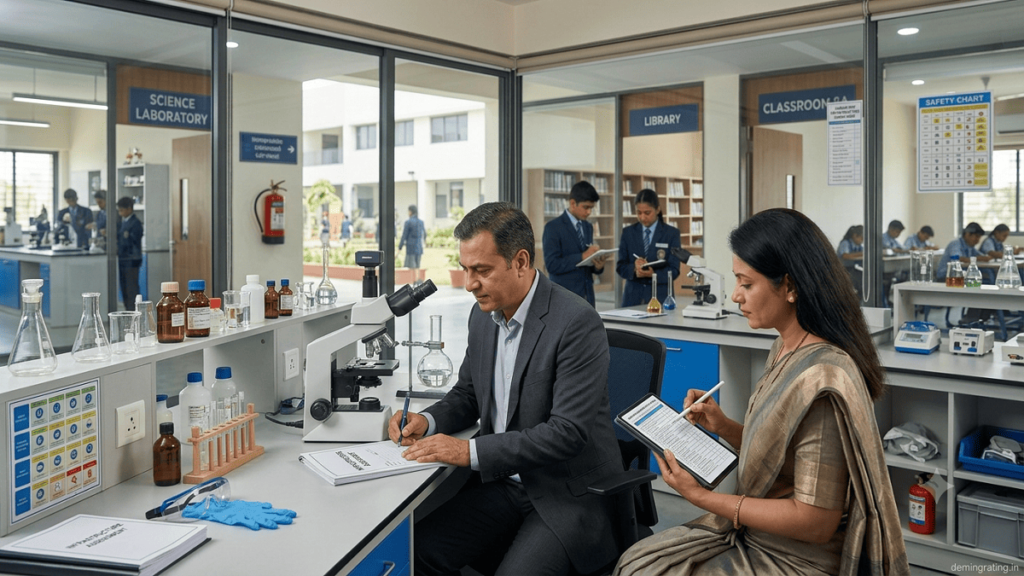
White Paper on Infrastructure and Resource Assessment
Executive Summary
Infrastructure and Resource Assessment is a structured process for evaluating whether an educational institution has the physical facilities, academic resources, technology, safety systems, and operational capacity required to support effective teaching and learning. For schools preparing for ICSE/CISCE affiliation, assessment also provides an important mechanism for identifying infrastructure and resource gaps before formal evaluation.
CISCE’s current affiliation requirements address classrooms, science laboratories, libraries, computer facilities, equipment, extracurricular facilities, and other aspects of school infrastructure. For example, its 2025 rules specify minimum expectations for classroom space, laboratory facilities, library resources, and computer availability.
1. Purpose of Infrastructure Assessment
Educational infrastructure directly influences the quality, safety, and efficiency of the learning environment. UNESCO has identified adequate education facilities and learning environments—including water, sanitation, electricity, and technology—as important dimensions of educational quality and access.
A professional assessment establishes the current condition of an institution and compares it with applicable regulatory standards, student requirements, academic objectives, and future growth plans.
2. Core Areas of Assessment
A comprehensive assessment should examine classrooms, laboratories, libraries, computer facilities, sports infrastructure, sanitation, administrative areas, staff facilities, and student-support spaces.
CISCE requires schools seeking affiliation to maintain appropriate classrooms and separate laboratories for subjects such as Physics, Chemistry, Biology, and Computer Science, as applicable. Its current requirements also specify that schools should maintain an adequately equipped library and prescribed computer facilities.
The assessment should evaluate not only whether these facilities exist but also their capacity, condition, usability, equipment, maintenance, accessibility, and suitability for the school’s student population.
3. Academic and Learning Resources
Infrastructure alone cannot guarantee educational quality. Schools should also assess textbooks, reference materials, laboratory equipment, teaching aids, digital resources, library collections, and other learning resources.
Resource assessment should consider quantity, quality, relevance, accessibility, utilization, and replacement requirements. This allows management to determine whether available resources adequately support the curriculum.
4. Safety and Operational Readiness
Safety should be treated as a high-priority assessment category. Reviews should cover fire protection, emergency exits, electrical systems, drinking water, sanitation, first-aid arrangements, building conditions, emergency procedures, and accessibility.
Regular monitoring is preferable to last-minute preparation because it allows institutions to identify deteriorating facilities and address risks before they affect students or operations.
5. Technology Assessment
Technology has become an important component of modern education. Schools should evaluate computers, networking, internet connectivity, audiovisual equipment, digital learning platforms, cybersecurity practices, and technical support.
For CISCE-affiliated schools, computer infrastructure should be evaluated against the applicable student-computer requirements and the institution’s academic needs.
6. Gap Analysis and Prioritization
The most valuable outcome of an assessment is a prioritized gap-analysis report. Each finding can be categorized as:
- Critical: Safety or essential compliance concern
- High: Significant academic or operational deficiency
- Medium: Improvement required for efficiency or quality
- Low: Long-term enhancement or modernization
This framework allows school management to allocate budgets according to urgency, educational impact, compliance relevance, and available resources.
7. Strategic Benefits
Regular assessments can improve operational efficiency by identifying underutilized facilities, outdated equipment, maintenance requirements, and capacity constraints. They can also support better capital budgeting by allowing institutions to plan upgrades according to documented needs.
For schools pursuing CISCE affiliation, assessment can provide additional preparation for the affiliation process. CISCE’s provisional affiliation procedure requires specific documentation and allows the Council to review applications and request clarifications before progressing.
8. Recommended Assessment Framework
A sustainable assessment programme can follow six stages:
Assess → Document → Compare → Prioritize → Improve → Reassess
This creates a continuous improvement cycle rather than a one-time inspection exercise. Institutions should maintain facility inventories, maintenance records, resource registers, compliance documentation, and improvement trackers.
Conclusion
Infrastructure and Resource Assessment should be viewed as a strategic management tool rather than simply a regulatory exercise. It enables educational institutions to understand their current capabilities, identify infrastructure and resource gaps, prioritize investments, improve safety, strengthen academic facilities, and plan sustainable institutional growth.
For schools seeking CISCE affiliation, assessment criteria should always be aligned with the latest official requirements. The CISCE Affiliation Guidelines and official provisional affiliation instructions should be consulted before making significant infrastructure or resource decisions.
Ultimately, a well-executed assessment provides school leadership with the evidence needed to make informed decisions, improve educational quality, and build infrastructure that remains effective as institutional needs evolve.
#ResourceAssessment
Industry Application of Infrastructure and Resource Assessment
Infrastructure and Resource Assessment has broad applications across the education sector because institutions must continuously ensure that their physical facilities, technology, academic resources, safety systems, and operational capacity remain suitable for their students and educational objectives. For schools preparing for ICSE/CISCE affiliation, assessment can also support compliance planning and institutional readiness.
1. New School Development
Infrastructure assessment is highly valuable during the planning and development of new schools. Before investing in construction or equipment, school promoters can evaluate proposed classrooms, laboratories, libraries, sports facilities, administrative areas, technology infrastructure, and student amenities.
Early assessment helps identify potential deficiencies before they become expensive to correct. CISCE affiliation requirements include provisions relating to classrooms, laboratories, libraries, computer facilities, and other infrastructure. (cisce.org)
2. School Expansion and Capacity Planning
Established schools can use assessment to determine whether existing infrastructure can support increasing enrolment. Classroom capacity, laboratory usage, library facilities, sanitation, sports areas, transportation arrangements, and technology resources can be evaluated against projected student numbers.
This allows management to plan expansion based on actual requirements rather than making infrastructure investments without sufficient demand analysis.
3. CISCE Affiliation Readiness
For schools planning CISCE affiliation, infrastructure and resource assessment can function as a pre-affiliation readiness exercise. Consultants can compare existing facilities with applicable CISCE standards and identify gaps requiring attention.
The assessment may cover academic facilities, equipment, staffing support, documentation, safety arrangements, and resource availability. CISCE’s affiliation framework requires schools to satisfy prescribed infrastructure and academic conditions before affiliation is granted. (cisce.org)
4. Safety and Risk Management
Safety assessment is another important industry application. Schools can periodically evaluate fire protection systems, emergency exits, electrical installations, sanitation, drinking water, structural conditions, first-aid arrangements, and emergency procedures.
Identifying risks early allows management to implement corrective measures and maintain a safer learning environment.
5. Technology and Digital Transformation
As schools increasingly adopt digital learning, technology assessments can determine whether existing computers, internet connectivity, networking systems, audiovisual equipment, digital platforms, and technical support are adequate.
The findings can guide technology upgrades while preventing unnecessary expenditure on systems that do not address actual institutional needs.
6. Resource Optimization
Institutions can also use assessment to determine whether existing resources are being utilized efficiently. Underused classrooms, outdated equipment, insufficient laboratory resources, or library materials that no longer support the curriculum can be identified.
Management can then redistribute, upgrade, replace, or retire resources according to educational priorities.
7. Institutional Quality Improvement
Regular assessments support continuous institutional improvement. Schools can establish performance benchmarks, track infrastructure conditions, monitor improvement projects, and develop annual investment plans.
This approach aligns infrastructure development with academic goals rather than treating facilities as isolated capital projects.
Conclusion
The industry application of Infrastructure and Resource Assessment extends from new school development and expansion planning to regulatory compliance, safety management, technology modernization, resource optimization, and educational quality improvement.
For institutions seeking CISCE affiliation, assessments should be based on the latest official requirements. Schools can consult the CISCE Affiliation Guidelines and official CISCE affiliation resources when developing assessment criteria and improvement plans.
A systematic assessment ultimately enables educational institutions to make evidence-based investment decisions, improve operational efficiency, and provide students with safer and better-equipped learning environments.
#InfrastructureAssessment
Ask FAQs
What is Infrastructure and Resource Assessment in education?
It is a systematic evaluation of a school’s buildings, classrooms, laboratories, library, technology, safety systems, equipment, and learning resources to identify strengths, deficiencies, and improvement requirements.
Why is Infrastructure and Resource Assessment important for schools?
It helps schools identify infrastructure gaps, improve safety, optimize resources, plan budgets, and maintain facilities that support effective teaching and learning.
What facilities are assessed during the process?
The assessment may cover classrooms, science laboratories, libraries, computer facilities, sports areas, sanitation, drinking water, administrative spaces, safety systems, accessibility facilities, and academic equipment.
How does assessment support ICSE/CISCE affiliation?
It helps schools compare their existing infrastructure and resources with applicable CISCE requirements, identify potential compliance gaps, and prepare improvement plans before the affiliation review or inspection.
How often should schools conduct an infrastructure assessment?
Schools should conduct assessments periodically rather than treating them as a one-time exercise. Annual reviews, supplemented by focused inspections when facilities change or regulations are updated, can support continuous compliance and institutional improvement.
Table of Contents
Disclaimer: This information is for general guidance only. Schools should verify current infrastructure and resource requirements with the relevant authorities before making compliance or investment decisions.