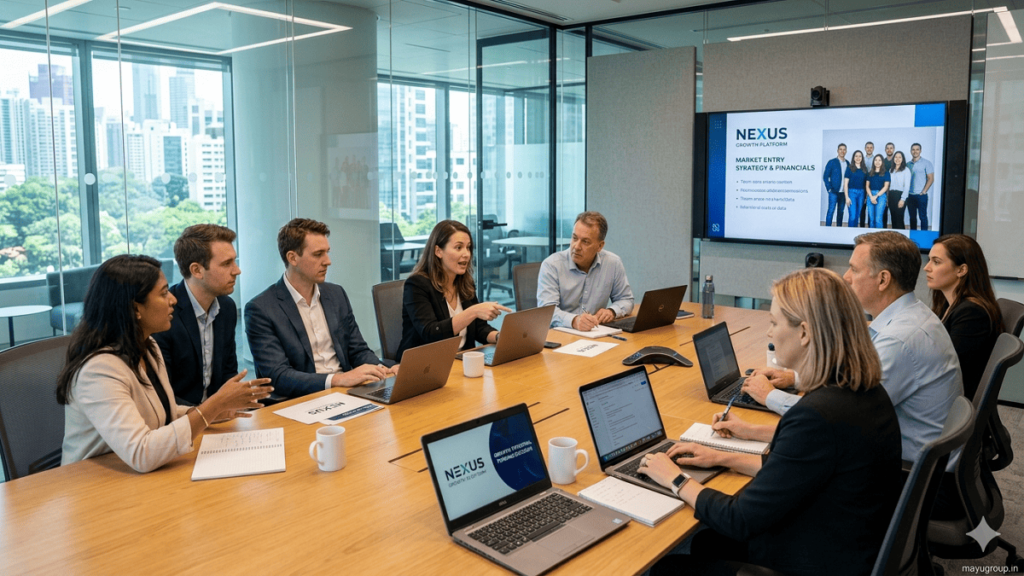
Business executives discussing mezzanine financing in a modern boardroom with capital structure visuals in the background.
Alternative Financing, Mezzanine Financing

Mezzanine Financing

Mezzanine financing is a hybrid form of capital that blends elements of debt and equity, commonly used by companies to fund expansion, acquisitions, and large-scale business projects. It is typically structured as subordinated debt, meaning it ranks below senior loans but above equity in the capital structure.

Business executives discussing leasing finance in a modern office with digital devices and asset visuals in the background.
Alternative Financing, Leasing Finance

Leasing Finance

Leasing finance is a financial arrangement that allows individuals and businesses to use assets without purchasing them outright. Instead of paying a full upfront cost, the user pays periodic lease rentals to the asset owner (lessor) for a fixed period of time. This system enables better cash flow management.

Business executives discussing hybrid financing strategies in a modern corporate boardroom with digital financial displays.
Alternative Financing, Hybrid Financing

Hybrid Financing

Hybrid financing refers to a funding approach that combines elements of debt and equity financing to create flexible capital structures for businesses. It allows companies to raise funds through instruments such as convertible bonds, mezzanine financing, and preferred shares while balancing ownership control and repayment obligations.

Professionals managing DAO funding and blockchain governance through futuristic digital finance systems.
Alternative Financing, DAO Funding

DAO Funding

DAO funding refers to the process of raising, managing, and distributing capital through decentralized autonomous organizations using blockchain technology and smart contracts. This topic explores how DAOs operate, their governance systems, funding models, benefits, risks, and real-world applications across decentralized finance (DeFi), Web3, NFTs, gaming, and blockchain-based communities.

Professional cryptocurrency investor analyzing Bitcoin and Ethereum trading charts in a futuristic financial office environment.
Alternative Financing, Cryptocurrency Investment

Cryptocurrency Investment

Cryptocurrency investment refers to the process of buying, holding, or trading digital currencies such as Bitcoin and Ethereum to generate potential financial returns. This topic covers the fundamentals of cryptocurrency, investment strategies, market risks, blockchain technology, and the growing role of digital assets in modern finance.

Corporate executives discussing bridge financing and short-term funding strategies in a modern office environment.
Alternative Financing, Bridge Financing

Bridge Financing

Bridge financing is a short-term funding solution that helps businesses, investors, and property buyers manage temporary financial gaps until long-term financing or future funds become available. This topic covers the meaning, benefits, risks, applications, and industry use of bridge loans in business growth, real estate, and financial management.

Financial analyst interacting with a transparent blockchain interface inside a luxury corporate office with futuristic fintech visuals.
Alternative Financing, Blockchain Investment

Blockchain Investment

Blockchain investment refers to investing in blockchain-based technologies, cryptocurrencies, decentralized finance platforms, and digital assets that use secure decentralized networks. This topic explores the benefits, risks, industry applications, and future potential of blockchain technology in transforming modern finance and digital transactions.

Professionals analyzing asset finance solutions in a manufacturing facility with machinery, production lines, and vehicles, with a โ€œmayugroup.inโ€ watermark in the top right corner.
Alternative Financing, Asset Finance

Asset Finance

Asset finance is a flexible business funding solution that enables companies to acquire essential assets such as machinery, vehicles, equipment, and technology without paying the full cost upfront. Instead, payments are spread over time through structured financing options like hire purchase, leasing, and asset refinancing.

Institutional investors discussing alternative assets in a modern boardroom with digital financial visuals and asset representations, with a โ€œmayugroup.inโ€ watermark in the top right corner.
Alternative Assets, Alternative Financing

Alternative Assets

Alternative assets refer to investment options outside traditional stocks, bonds, and cash, offering investors opportunities for diversification, risk management, and long-term wealth creation. These include real estate, private equity, hedge funds, commodities, infrastructure, collectibles, and digital assets such as cryptocurrencies.

Entrepreneurs collaborating in a modern coworking space with digital financial holograms and global connectivity visuals representing alternative financing, with a โ€œworldyoga.usโ€ watermark in the top right corner.
Alternative Financing

Alternative Financing

Alternative financing refers to modern funding methods that operate outside traditional banking systems, offering individuals, startups, and small businesses access to capital through innovative channels such as crowdfunding, peer-to-peer lending, invoice financing, revenue-based financing, and venture capital.

Medical Devices

Medical Devices

Medical devices are an essential and rapidly evolving segment of the healthcare industry. They encompass a vast range of instruments, apparatus, implants, in vitro reagents, and other articles used for the diagnosis, prevention, monitoring, treatment, or alleviation of disease, injury, or disability. What are Medical Devices? Medical devices can range from simple tongue depressors and bandages to complex pacemakers, MRI machines, robotic surgical systems, and advanced diagnostic test kits. Unlike pharmaceuticals, medical devices achieve their primary intended action by physical or mechanical means, rather than by pharmacological, immunological, or metabolic action. Broad Categories of Medical Devices: The Indian Medical Devices Market India’s medical device sector is a “sunrise sector” with immense growth potential, driven by several factors: Regulatory Landscape in India The regulation of medical devices in India has undergone significant reforms to align with global standards and ensure patient safety. Future Outlook The Indian medical device industry is poised for transformative growth. The focus is shifting from purely low-cost, low-tech products to fostering indigenous innovation, manufacturing high-value devices, and reducing import dependency. Digital integration, particularly with AI and data analytics, is expected to drive significant advancements in diagnostics and personalized healthcare. Collaboration between manufacturers, regulatory bodies, and healthcare providers will be crucial for developing solutions tailored to the unique needs of the Indian population and positioning India as a global MedTech hub. What is Medical Devices? A medical device is a broad category of instruments, apparatus, implants, software, materials, or other similar articles, that are intended by the manufacturer to be used, alone or in combination, for a medical purpose. Key characteristics that define a medical device: Examples of Medical Devices: The range is incredibly vast, from everyday items to cutting-edge technology: Why are medical devices important? Medical devices are indispensable to modern healthcare. They enable: Due to their direct impact on human health and safety, medical devices are subject to rigorous regulation by government bodies worldwide (e.g., FDA in the US, EMA in Europe, CDSCO in India) to ensure their safety, quality, and effectiveness before they can be marketed and used. Who is Required Medical Devices? Courtesy: Primerli Here’s a breakdown of the “who is required” for medical devices: 1. Patients: The Ultimate Users and Beneficiaries 2. Healthcare Professionals: The Direct Operators and Prescribers 3. Healthcare Facilities and Systems: The Infrastructure Providers 4. Manufacturers and Innovators: The Creators and Developers 5. Regulatory Bodies and Governments: The Overseers and Policymakers In summary, medical devices are “required” by an extensive ecosystem of stakeholders because they are fundamental to diagnosing, treating, monitoring, and preventing illnesses and disabilities, thereby enabling modern healthcare to function and continuously improve human health outcomes. When is Required Medical Devices? implies the specific moments or situations where medical devices become crucial, indispensable, or highly beneficial. It highlights their role throughout the entire patient journey and healthcare ecosystem. Here are the key “when” scenarios that necessitate medical devices: 1. During Diagnosis: 2. During Treatment and Intervention: 3. For Monitoring and Management of Chronic Conditions: 4. In Emergency and Critical Care Situations: 5. For Prevention and Public Health: 6. During Rehabilitation: In summary, medical devices are “required” across the entire spectrum of healthcare delivery, from preventative measures and initial diagnosis through active treatment, continuous monitoring, emergency interventions, and long-term rehabilitation. They are indispensable tools at every critical juncture of patient care. Where are the required medical devices? refers to their presence across the entire healthcare ecosystem, from manufacturing to point of use, and even in daily life. Here’s a breakdown of “where” medical devices are required: 1. Point of Use (Healthcare Facilities & Homes): 2. Manufacturing & Research & Development (R&D) Facilities: 3. Supply Chain & Distribution: 4. Regulatory & Government Bodies: In essence, medical devices are “required” across a pervasive and interconnected network that spans global manufacturing hubs, sophisticated R&D labs, complex supply chains, and every point of healthcare delivery, extending even into the personal space of patients’ homes. How is Required Medical Devices? When we ask “How is Medical Devices required?”, we’re looking at the mechanisms and processes by which medical devices fulfill essential functions across the entire healthcare spectrum. It’s about their inherent utility and the critical roles they play. Here’s how medical devices are “required”: 1. By Enabling Diagnosis: 2. By Facilitating Treatment and Intervention: 3. By Enabling Monitoring and Management: 4. By Ensuring Safety and Infection Control: 5. By Facilitating Rehabilitation and Improved Quality of Life: In essence, medical devices are “required” by acting as the tangible instruments and technological backbone of modern healthcare. They are the means through which medical knowledge is applied, allowing for precise actions, objective data collection, life support, and enhanced patient outcomes across every stage of care. Case Study on Medical Devices? Courtesy: Digital E-Learning Case Study: SMT (Sahajanand Medical Technologies) – A Homegrown Success in Cardiovascular Devices Sector: Medical Devices (Cardiovascular – specifically Coronary Stents) Geography: India (with global presence) Focus: Indigenous innovation, manufacturing prowess, clinical validation, and overcoming import dependency. 1. The “Before” Scenario (Indian Stent Market & Healthcare Landscape): Prior to the rise of companies like SMT, the Indian market for high-value, critical medical devices like coronary stents was overwhelmingly dominated by multinational corporations (MNCs) from the US and Europe. 2. The Catalyst for Change (SMT’s Emergence & Market Dynamics): Sahajanand Medical Technologies (SMT), founded in 1998, recognized this critical gap and the immense potential for indigenous innovation. They started with a vision to make advanced cardiovascular care affordable and accessible in India. 3. SMT’s Approach and Impact (The “How”): SMT’s success is a testament to its multi-pronged strategy: 4. Outcomes and Broader Impact: Conclusion: The success story of Sahajanand Medical Technologies (SMT) epitomizes the potential of India’s medical device sector. By strategically investing in indigenous R&D, adhering to rigorous clinical validation, and focusing on affordability, SMT not only broke the dominance of multinational corporations in a high-value segment but also significantly improved access to life-saving cardiac care for millions. It stands as a prime example of how local innovation, supported by a conducive policy environment, can lead

Translate ยป
Scroll to Top