Welder Certification
Table of Contents
Welder Certification is an important process used to verify that a welder has the knowledge, skills, and practical ability required to produce sound and reliable welds according to specified standards and procedures. In industries such as construction, manufacturing, oil and gas, pipelines, pressure vessels, shipbuilding, structural engineering, and infrastructure, welding quality can directly affect the safety, durability, and performance of the finished product. Welder certification therefore plays a critical role in maintaining consistent workmanship and meeting customer, regulatory, and industry requirements.
A certified welder is generally qualified to perform specific welding activities under defined conditions. These conditions may include the welding process, material type and thickness, joint configuration, welding position, filler material, and other variables specified by the applicable welding standard or qualification procedure. Certification is not simply a measure of general welding ability; it demonstrates competence within a defined range of work.
The certification process typically involves a practical welding test in which the welder produces a test coupon according to an approved welding procedure. The completed weld may then be examined through visual inspection and, depending on the applicable requirements, destructive or nondestructive testing such as bend testing, tensile testing, radiographic testing, or ultrasonic testing. If the weld meets the specified acceptance criteria, the welder can receive qualification or certification documentation defining the scope of work for which they are qualified.
Welder certification also supports quality assurance and quality control programs. Employers and contractors can use qualification records to verify that personnel performing welding work meet project requirements. This helps reduce welding defects, rework, production delays, and potential safety risks. Maintaining proper records and ensuring that qualified welders work within their approved ranges are also important aspects of effective welding quality management.
The requirements for welder qualification vary depending on the industry, application, location, and governing code or standard. Commonly referenced standards and codes include AWS, ASME, ISO, and other national or industry-specific requirements. Organizations should therefore select the appropriate qualification standard based on the nature of the welding work and applicable contractual or regulatory obligations.
Overall, Welder Certification provides documented evidence of welding competence and helps organizations establish confidence in the quality and reliability of welded work. By combining practical skill assessment, defined qualification requirements, testing, and proper documentation, welder certification contributes to safer operations, improved product quality, regulatory compliance, and professional welding practices.
#QualityAssurance
What is Welder Certification and Why Is It Important?
Welder Certification is a formal process used to verify that a welder has the practical skills and technical ability required to produce welds that meet defined quality and safety requirements. It demonstrates that the individual can perform a particular welding process under specified conditions and within the limits established by the applicable welding code, standard, or qualification procedure. Welder certification is widely used in manufacturing, construction, oil and gas, pipelines, pressure vessels, shipbuilding, structural fabrication, and other industries where welding quality is critical.
The certification process generally involves a practical welding test. The welder is required to produce a test weld using specified materials, welding processes, positions, joint configurations, and other essential variables. The completed test piece is then evaluated using appropriate inspection and testing methods. Depending on the applicable requirements, these may include visual inspection, bend testing, tensile testing, radiographic testing, or ultrasonic testing. When the weld satisfies the specified acceptance criteria, the welder receives documentation identifying the conditions and range for which they are qualified.
One of the main reasons Welder Certification is important is quality assurance. Welding defects such as cracks, porosity, incomplete fusion, and lack of penetration can reduce the strength and reliability of fabricated components. Qualified welders are trained and tested to follow approved welding procedures, helping organizations maintain more consistent welding quality and reduce defects and rework.
Welder Certification is also important for workplace safety and regulatory compliance. In safety-critical applications, welding failures can result in equipment damage, structural failure, production interruptions, or serious accidents. Demonstrating that welding personnel are properly qualified provides greater confidence that welding activities are being performed by competent personnel.
Another important benefit is customer and project compliance. Many contracts and industrial projects specify that welders must hold qualifications based on particular standards or codes. Proper certification records allow organizations to demonstrate that welding personnel meet these contractual requirements and are working within their approved qualification ranges.
Welder Certification also supports professional development and employability. For individual welders, recognized qualifications provide documented evidence of technical competence and can create opportunities to work on specialized or higher-value projects.
It is important to understand that welder certification is normally specific to defined welding conditions rather than being a universal approval for every type of welding. Requirements can vary according to the applicable code or standard, materials, welding process, thickness, position, and application.
Overall, Welder Certification helps organizations establish confidence in welding competence, improve quality, reduce risks, meet project requirements, and maintain reliable fabrication practices. It is an essential component of effective welding quality management in industries where the integrity of welded joints is critical.
#WeldingIndustry
What Skills and Welding Processes Are Typically Assessed During Certification?
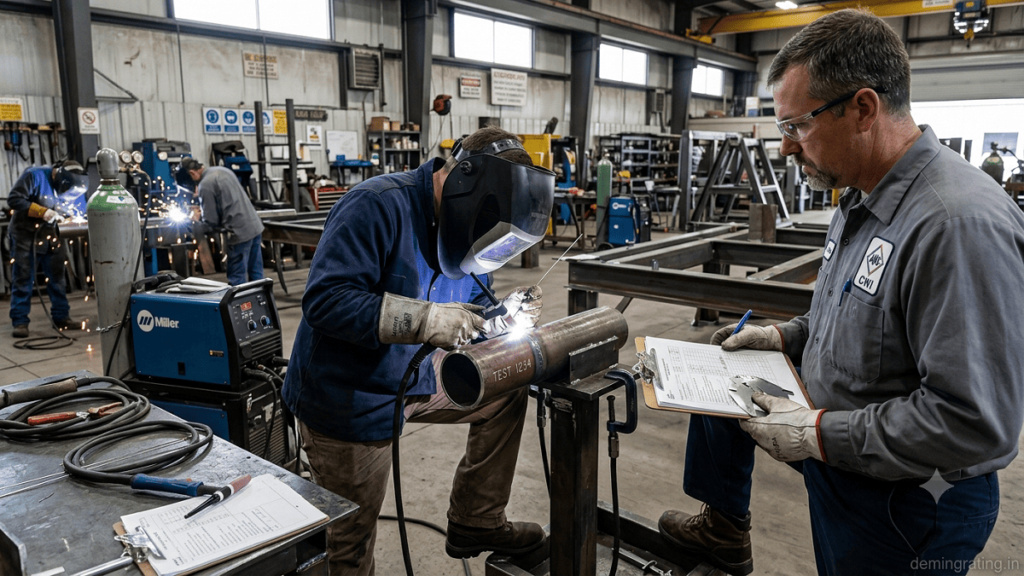
Welder certification is designed to verify that a welder can consistently produce sound welds while following an approved welding procedure and the requirements of the applicable code or standard. The assessment generally focuses on practical welding skills, technical understanding, process control, and the ability to work safely and accurately within defined qualification limits.
One of the most important areas assessed is welding technique. Welders may be evaluated on their ability to establish and maintain the correct arc, control travel speed, manage electrode or filler-metal manipulation, maintain appropriate torch or electrode angles, and achieve proper penetration and fusion. The welder must also demonstrate control of the weld bead and produce an acceptable weld profile without introducing defects.
Joint preparation and fit-up can also be important parts of the assessment. Depending on the qualification procedure, the welder may need to demonstrate the ability to work with specific joint designs, root gaps, bevel angles, alignment requirements, and welding positions. Correct preparation and fit-up are essential because they directly influence weld quality and penetration.
Certification tests may assess different welding positions, such as flat, horizontal, vertical, and overhead. Pipe welding qualifications can involve additional positions and requirements because of the changing orientation of the joint during welding. The qualification range depends on the applicable standard and the variables specified in the welding test.
Several welding processes may be covered by certification programs. Common examples include Shielded Metal Arc Welding (SMAW), Gas Metal Arc Welding (GMAW/MIG), Gas Tungsten Arc Welding (GTAW/TIG), Flux-Cored Arc Welding (FCAW), and Submerged Arc Welding (SAW). The process assessed depends on the type of work the welder is expected to perform.
The assessment may also consider the welder’s ability to work with different base materials, thicknesses, pipe diameters, filler metals, and shielding gases. These variables are important because welding performance can vary significantly depending on the material and process being used.
After welding, the test coupon is normally inspected and tested according to the applicable qualification requirements. Visual examination is commonly used to identify surface defects and assess weld appearance. Additional testing, such as bend, tensile, radiographic, or ultrasonic examination, may be required depending on the applicable code or specification.
Safety and procedural discipline are also essential. A competent welder should understand safe equipment operation, appropriate personal protective equipment, correct handling of consumables, and the importance of following the approved welding procedure.
Overall, welder certification assesses much more than the ability to make a visible weld. It verifies whether the welder can consistently apply the required process, technique, materials, positions, and procedures to produce welds that meet established acceptance criteria.
#WeldingSafety
How Are Welding Test Pieces Inspected and Evaluated for Certification?
Welding test pieces are inspected and evaluated during welder certification to determine whether the welder can produce a weld that meets the specified quality and acceptance requirements. The evaluation process is normally carried out according to an applicable welding code, standard, specification, or approved qualification procedure. The exact inspection and testing methods can vary depending on the welding process, material, application, and certification requirements.
The first stage is usually visual inspection. An examiner or qualified inspector examines the completed weld for visible defects and general workmanship. Factors such as weld size, profile, continuity, surface appearance, undercut, overlap, cracks, excessive porosity, arc strikes, and other visible imperfections may be assessed. The test piece must satisfy the specified acceptance criteria before it can proceed to additional examination, where required.
The next stage may involve nondestructive testing (NDT). Depending on the applicable requirements, methods such as radiographic testing (RT), ultrasonic testing (UT), magnetic particle testing (MT), or liquid penetrant testing (PT) may be used. These methods help identify internal or surface-breaking discontinuities that cannot always be detected through visual examination. For example, radiographic or ultrasonic testing can help evaluate internal weld quality, while magnetic particle and penetrant testing can identify certain surface or near-surface discontinuities.
Some certification tests also require destructive testing. In a bend test, a section of the welded test piece is bent to evaluate the soundness and ductility of the weld and surrounding material. Tensile testing may be used to determine whether the welded specimen achieves the required strength. Other mechanical or metallurgical tests may be specified depending on the applicable qualification standard.
Inspectors also verify important test variables and documentation. The test piece may need to be associated with specific information such as the welding process, base material, filler metal, thickness, pipe diameter, welding position, and applicable welding procedure. Accurate records are important because the resulting qualification normally applies only within defined ranges of essential variables.
The final decision is based on comparison of the inspection and test results with the acceptance criteria established by the applicable standard or code. If the test piece meets all required criteria, the welder can be qualified for the specified range of work. If unacceptable defects or test results are identified, the qualification may be rejected or require corrective action and retesting, depending on the governing requirements.
Overall, inspection and evaluation of welding test pieces provide objective evidence of a welder’s practical competence. By combining visual examination, nondestructive testing, destructive testing, and proper documentation where required, certification programs help ensure that qualified welders can produce welds that meet established quality and safety requirements.
#WeldingStandards
How Does Welder Certification Support Quality, Safety, and Industry Compliance?
Welder Certification plays an important role in maintaining the quality, safety, and compliance of welding activities across industries. Welding is frequently used in structures, pressure equipment, pipelines, machinery, transportation systems, and industrial facilities where the integrity of a welded joint can directly affect the reliability and safety of the finished product. Certification provides documented evidence that a welder has demonstrated the ability to produce acceptable welds under defined conditions.
Supporting Welding Quality
Welder certification helps organizations establish a consistent level of workmanship. During qualification testing, welders are required to follow specified welding procedures, materials, positions, and process parameters. Their completed test pieces are then examined against defined acceptance criteria. This provides an objective way to verify practical welding competence before the individual performs production welding.
Qualified welders can help reduce common welding problems such as incomplete fusion, lack of penetration, porosity, undercut, and cracking. Better control of welding quality can reduce rework, repair costs, production delays, and material waste while improving the reliability of fabricated components.
Improving Workplace and Product Safety
Poor-quality welds can create weaknesses that may eventually lead to structural failures, leakage, equipment damage, or other serious incidents. Welder certification helps reduce this risk by requiring welders to demonstrate their ability to produce sound welds within a defined qualification range.
Certification does not by itself guarantee that every production weld will be defect-free, but it provides an important competency control within a broader welding quality system. Organizations should also maintain appropriate procedures, inspections, supervision, equipment controls, and material traceability.
Supporting Industry Compliance
Many industrial projects require welding personnel to be qualified according to a particular code, standard, specification, or contractual requirement. Welder certification provides records that can demonstrate personnel qualification during customer reviews, project audits, inspections, or regulatory assessments.
Depending on the application, organizations may work with requirements associated with standards and codes such as ISO, AWS, ASME, or other national and industry-specific specifications. The applicable requirements should always be confirmed for the particular project because qualification ranges and testing requirements can differ.
Strengthening Customer Confidence
Documented welder qualifications also provide greater confidence to customers, contractors, inspectors, and other stakeholders. Maintaining accurate records of welder qualifications helps organizations demonstrate that appropriately qualified personnel are assigned to welding activities within their approved ranges.
Overall, Welder Certification supports a structured approach to welding competence. By combining practical skill assessment, defined qualification requirements, inspection, documentation, and compliance controls, it helps organizations improve welding quality, reduce safety risks, satisfy industry requirements, and strengthen confidence in the integrity of welded products and structures.
#WeldingInspection
What Are the Benefits of Certified Welders for Manufacturers, Contractors, and Employers?
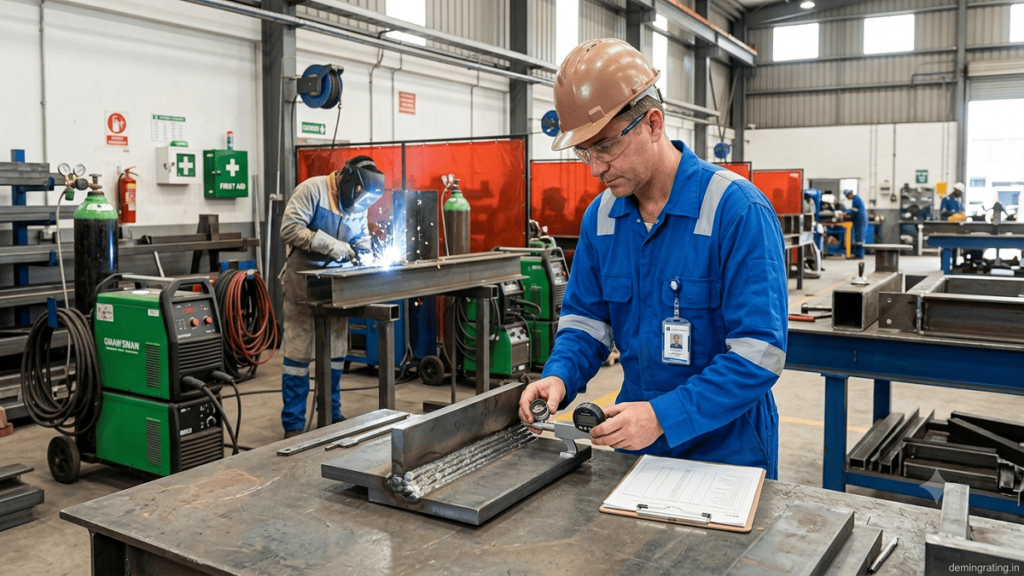
Certified welders provide significant benefits to manufacturers, contractors, and employers by demonstrating that welding personnel have successfully completed defined qualification requirements and can perform specific welding activities within an approved range. In industries where welding quality directly affects product performance and safety, having qualified personnel is an important part of an effective quality management system.
Improved Welding Quality
One of the primary benefits of certified welders is improved consistency in welding workmanship. Certification requires welders to demonstrate their practical ability under specified conditions, including particular welding processes, materials, positions, and thickness ranges. Employing qualified welders can help organizations reduce welding defects such as porosity, cracking, incomplete fusion, and lack of penetration.
Better welding quality can also reduce rework, repairs, material waste, and production interruptions, contributing to more efficient manufacturing and project execution.
Enhanced Workplace and Product Safety
For manufacturers and contractors working on structures, pressure equipment, pipelines, machinery, and other safety-critical applications, welding integrity is extremely important. Certified welders have demonstrated their ability to produce acceptable test welds according to defined requirements. This provides an additional layer of confidence when assigning personnel to production welding activities.
Certification should be supported by appropriate welding procedures, inspection, equipment controls, supervision, and other quality measures to maintain production quality.
Support for Industry and Contractual Compliance
Many industrial projects and customer specifications require welders to hold qualifications based on applicable codes or standards. Employing certified welders helps manufacturers and contractors demonstrate that welding personnel meet required competency criteria.
Proper qualification records can also support project audits, customer inspections, regulatory reviews, and quality documentation. However, the exact qualification requirements depend on the applicable code, standard, project specification, and welding application.
Greater Customer Confidence
Customers are more likely to have confidence in organizations that can demonstrate effective controls over welding competence. Documented welder qualifications provide evidence that appropriately trained and tested personnel are being assigned to relevant welding activities.
For contractors, this can strengthen technical credibility during tendering and project evaluation and may help demonstrate compliance with client requirements.
Better Workforce Management
For employers, welder certification provides a structured method for identifying personnel qualified for particular welding tasks. Qualification records can be used to determine which welders are authorized to perform specific processes, materials, positions, and other defined work conditions.
Overall, certified welders can help manufacturers, contractors, and employers improve welding quality, strengthen safety controls, reduce costly rework, support compliance, and build customer confidence. When properly managed within a broader welding quality system, welder certification becomes a valuable tool for maintaining reliable and professional welding operations.
#WeldingQuality
Case Study of Welder Certification
Improving Welding Quality and Compliance Through Welder Certification
A growing engineering and fabrication company specializing in industrial structures and equipment was experiencing challenges in maintaining consistent welding quality across its projects. The company employed welders with different levels of experience and worked on a variety of materials, joint configurations, and welding positions. Although production targets were generally being achieved, quality inspections identified recurring weld defects, resulting in rework, additional inspection costs, and occasional project delays.
To strengthen its welding quality controls, the company decided to implement a structured Welder Certification program based on the applicable project requirements and recognized welding standards.
Identifying the Requirements
The first step was to identify the welding processes and applications used in production. The organization reviewed its welding procedures, material specifications, joint configurations, welding positions, and customer requirements. Based on this review, appropriate welder qualification requirements were established.
The company then identified which welders needed qualification for specific welding activities. This ensured that personnel were tested for work relevant to their actual production responsibilities rather than relying only on general welding experience.
Practical Qualification Testing
Selected welders completed practical qualification tests under controlled conditions. Each welder was required to produce test pieces using specified welding processes, materials, positions, and other applicable variables.
The completed test pieces were inspected according to the applicable qualification requirements. Visual examination was performed, followed where required by appropriate nondestructive or destructive testing. Welders who successfully met the specified acceptance criteria received documented qualification records defining the applicable scope of their qualification.
Results and Improvements
Following implementation of the certification program, the company established a clearer system for assigning qualified welders to specific welding activities. Supervisors could verify qualification records before allocating work, while quality personnel had better documentation for inspections and project audits.
The company also reported improvements in welding consistency and a reduction in avoidable rework. Welders became more familiar with approved welding procedures and the importance of controlling variables such as welding position, technique, consumables, and joint preparation.
From a compliance perspective, the organization was better prepared to demonstrate welder competence during customer inspections and project reviews. Qualification records also provided useful evidence that welding personnel were working within their approved ranges.
Key Lessons
The case demonstrates that Welder Certification is more than a testing exercise. When integrated with approved welding procedures, inspection, training, supervision, and proper documentation, it can become an important part of an organization’s overall welding quality system.
For manufacturers and contractors, maintaining appropriately qualified welders can help improve workmanship, reduce rework, strengthen safety controls, support contractual compliance, and increase customer confidence in the reliability of welded products and structures.
#WeldingCertification
White Paper on Welder Certification
Executive Summary
Welder Certification is a structured method for demonstrating that a welder has the practical skills required to produce acceptable welds under defined conditions. In industries where welded joints are critical to structural integrity, equipment performance, and operational safety, verifying welding competence is an important quality-control activity.
Manufacturers, contractors, fabrication companies, and engineering organizations increasingly rely on qualified welding personnel to meet customer specifications, project requirements, applicable codes, and regulatory expectations. A well-managed certification program can help organizations improve welding consistency, reduce defects and rework, strengthen documentation, and increase confidence in production quality.
The Importance of Welder Certification
Welding performance depends on numerous variables, including the welding process, base material, filler metal, joint configuration, thickness, pipe diameter, welding position, and technique. Experience alone does not necessarily demonstrate competence across all these conditions.
Welder qualification testing provides objective evidence that an individual can produce a test weld meeting specified acceptance criteria within a defined range of variables. Depending on the applicable requirements, the test piece may undergo visual inspection, mechanical testing, or nondestructive examination.
Certification and Quality Management
Welder Certification should be integrated into the organization’s broader welding quality system. Qualification records can help supervisors and quality personnel determine whether a welder is authorized to perform particular welding activities.
Organizations can strengthen this system by maintaining appropriate welding procedures, controlling consumables, ensuring equipment is suitable and maintained, conducting inspections, and keeping accurate qualification records. These controls work together to reduce welding defects and improve process consistency.
Safety and Compliance
The quality of a welded joint can have significant safety implications in applications such as pressure equipment, pipelines, structural fabrication, transportation, and industrial machinery. Welder qualification helps reduce the risk associated with assigning inadequately qualified personnel to specialized welding activities.
Depending on the industry and project, requirements may be based on recognized standards and codes such as those developed by ISO, AWS, ASME, or other applicable organizations. Organizations should identify the specific requirements applicable to their products, projects, customers, and jurisdiction.
Benefits for Organizations
A structured Welder Certification program can provide several business benefits, including:
- Improved consistency and welding workmanship
- Reduction in weld defects and unnecessary rework
- Better control of qualified personnel
- Stronger project and quality documentation
- Improved readiness for customer and quality audits
- Support for contractual and industry requirements
- Greater customer confidence
- More effective workforce planning
Implementation Considerations
Organizations should begin by identifying their welding activities and applicable qualification requirements. They can then determine which welding personnel require qualification and establish appropriate testing arrangements.
Qualification results should be properly documented and controlled. Employers should also monitor qualification validity and ensure that welders perform work only within the scope of their approved qualifications, where required by the applicable standard or code.
Conclusion
Welder Certification provides an important mechanism for verifying welding competence and supporting reliable fabrication practices. By combining practical testing, defined qualification requirements, inspection, documentation, and ongoing quality controls, organizations can establish a stronger foundation for welding quality and compliance.
For manufacturers, contractors, and employers, investing in competent and appropriately qualified welding personnel can help reduce operational risks, improve productivity, support customer requirements, and strengthen confidence in the integrity of welded products and structures.
#CertifiedWelder
Industry Application of Welder Certification
Welder Certification is widely applied across industries where the quality and integrity of welded joints are essential to product performance, structural strength, and operational safety. Certification helps organizations verify that welders have demonstrated the practical competence required to perform specific welding processes under defined conditions. Its application varies according to industry requirements, welding procedures, materials, and applicable codes or standards.
1. Manufacturing and Fabrication
Manufacturing and fabrication companies use certified welders to produce machinery, equipment, frames, tanks, components, and industrial assemblies. Qualification helps manufacturers maintain consistent welding quality and reduce defects, rework, and production interruptions. It can also support customer specifications and quality-control requirements.
2. Construction and Structural Engineering
In construction, welding is commonly used for structural steelwork, bridges, commercial buildings, industrial structures, and infrastructure projects. Certified welders help contractors demonstrate that personnel performing critical welding activities have the required qualifications for specified processes and positions.
3. Oil and Gas Industry
The oil and gas sector relies heavily on welding for pipelines, storage tanks, process equipment, refineries, and offshore facilities. Because welding failures can create significant safety and environmental risks, qualified welding personnel and controlled welding procedures are important elements of project quality management.
4. Pressure Vessels and Process Equipment
Manufacturers of pressure vessels, boilers, heat exchangers, and other pressure-containing equipment require strict control of welding activities. Welder qualification helps demonstrate that personnel are capable of producing welds that meet the applicable requirements for critical components.
5. Shipbuilding and Marine Industry
Shipyards use welding extensively for hulls, decks, structural components, piping systems, and marine equipment. Welder certification helps maintain consistent workmanship across large-scale fabrication activities and supports project-specific quality and safety requirements.
6. Automotive and Transportation
Automotive, railway, and other transportation manufacturers use welding to assemble frames, chassis, components, and structural systems. Depending on the application, qualified personnel may be required to perform particular welding operations where joint integrity is important to product reliability and safety.
7. Power Generation
Power plants and equipment manufacturers use welding in boilers, turbines, pipelines, pressure systems, structural components, and maintenance activities. Welder qualification can help organizations control the competence of personnel working on safety- and performance-critical welding applications.
8. Aerospace and Specialized Engineering
Aerospace and other high-precision engineering sectors have demanding requirements for materials, processes, inspection, and traceability. Where manual welding is used, welder qualification can form part of the organization’s broader process and quality controls.
9. Infrastructure and Maintenance
Certified welders are also valuable in infrastructure maintenance, industrial repairs, plant shutdowns, and equipment refurbishment. Qualification provides employers and contractors with documented evidence of welding competence when carrying out specialized repair or maintenance activities.
Conclusion
Across these industries, Welder Certification provides a structured method for verifying welding competence and supporting quality assurance. It can help organizations assign appropriately qualified personnel, reduce welding-related risks, meet contractual requirements, strengthen documentation, and improve confidence in fabricated products and structures.
#WelderCertification
Ask FAQs
What is Welder Certification?
Welder Certification is a formal process used to verify that a welder can produce acceptable welds under specified conditions and according to applicable standards, codes, or welding procedures.
Why is Welder Certification important?
It helps organizations verify welding competence, improve weld quality, reduce defects and rework, support workplace safety, and meet customer, contractual, regulatory, or industry requirements.
What welding processes can be covered by certification?
Depending on the applicable requirements, certification may cover processes such as SMAW, GMAW/MIG, GTAW/TIG, FCAW, and SAW. The qualification is normally specific to defined welding variables and conditions.
How is a welder tested for certification?
A welder generally completes a practical welding test using specified materials, processes, positions, and joint configurations. The test piece may then undergo visual inspection and, where required, destructive or nondestructive testing.
Does Welder Certification qualify a person for every type of welding?
No. Welder qualification is generally limited to a defined range of variables, such as welding process, material, thickness, position, and joint type. The applicable code or standard determines the exact qualification range.
Desclaimer: This content is for general informational purposes only and should not be considered professional welding, certification, or compliance advice. Always consult qualified professionals and applicable standards for specific requirements.