Venture Capital
Table of Contents
Venture capital (VC) is a form of private investment that provides funding to startups and early-stage businesses with strong growth potential. In exchange for their investment, capitalists typically receive an ownership stake in the company. This funding helps entrepreneurs develop innovative products, expand operations, hire talent, and enter new markets.
Unlike traditional bank loans, capital generally does not require regular loan repayments. However, founders must share ownership and may give investors certain rights over important business decisions.
How Does Venture Capital Work?
The venture capital process typically begins when a startup presents its business plan, market opportunity, financial projections, and growth strategy to potential investors. Investors evaluate the company’s business model, management team, competitive position, and scalability before deciding whether to invest.
If the opportunity meets their investment criteria, the parties negotiate the investment amount, company valuation, equity percentage, and other terms. Funding may be provided in stages as the startup achieves agreed milestones.
Venture capital firms commonly raise money from institutional investors, pension funds, family offices, and other eligible investors. They invest this capital in businesses they believe can generate substantial returns over time.
Types of Venture Capital Funding
- Pre-seed and seed funding: Supports early ideas, product development, and market validation.
- Early-stage funding: Helps startups establish their products, attract customers, and build their teams.
- Growth-stage funding: Supports established startups that want to expand into new markets or increase their market share.
- Late-stage funding: Helps mature private companies scale operations and prepare for a potential acquisition or public listing.
Benefits of Venture Capital
Venture capital offers more than financial support. Experienced investors can provide strategic guidance, industry connections, recruitment assistance, and access to potential business partners. Their involvement may also improve a startup’s credibility when approaching customers and future investors.
For businesses operating in technology, healthcare, fintech, biotechnology, and clean energy, capital can help finance research, product development, and rapid expansion.
Risks and Challenges
Venture capital is competitive, and not every startup qualifies for investment. Founders may experience ownership dilution, increased performance expectations, and reduced control over certain decisions. Fundraising can also take considerable time, requiring detailed financial information and legal negotiations.
Entrepreneurs should carefully assess an investor’s experience, expectations, investment terms, and long-term objectives before accepting funding.
How to Attract Venture Capital Investors
Startups can improve their chances by demonstrating a clear market need, a scalable business model, a capable management team, realistic financial projections, and evidence of customer demand. A compelling pitch deck and a well-defined use of funds are also essential.
Entrepreneurs can explore resources from the National Venture Capital Association and Invest Europe to learn more about the capital industry.
Conclusion
Venture capital plays an important role in helping ambitious startups transform ideas into scalable businesses. It combines financial investment with strategic expertise and professional networks. However, founders should weigh the benefits against equity dilution, investor expectations, and potential governance changes before making a decision.
Choosing the right funding partner can help a startup build a stronger foundation for sustainable, long-term growth.
#BusinessExpansion

What Is Venture Capital and How Does It Work?
Introduction
Venture capital (VC) is a type of private investment that provides funding to startups and early-stage businesses with high growth potential. Instead of lending money that must be repaid with interest, venture capital investors typically invest in exchange for an ownership stake, known as equity. This funding helps entrepreneurs develop products, hire employees, expand operations, and enter new markets.
Venture capital is particularly important for innovative businesses that need significant funding to grow but may not qualify for traditional bank loans.
How Does Venture Capital Work?
Venture capital involves several stages, from identifying promising startups to investing capital and eventually generating returns.
1. Finding Potential Startups
Venture capital firms identify businesses with innovative ideas, scalable business models, and strong market opportunities. Investors often focus on industries such as technology, healthcare, fintech, biotechnology, and renewable energy.
2. Evaluating the Business
Before investing, capitalists assess the startup’s business plan, market size, competitors, financial projections, management team, and growth potential. This evaluation process is commonly called due diligence.
3. Negotiating Investment Terms
If a startup meets the investor’s requirements, both parties negotiate the company’s valuation, investment amount, equity percentage, and other contractual terms. Investors may also request certain governance rights, such as board representation.
4. Providing Capital and Support
Once the agreement is finalised, the investor provides funding according to the agreed terms. The startup uses the money for activities such as product development, marketing, recruitment, research, and expansion.
In addition to capital, capitalists may offer strategic advice, industry connections, and assistance with future fundraising.
5. Generating Returns
Venture capital investors generally aim to earn returns when their ownership stake increases in value. Possible exit routes include an acquisition by another company, a merger, or an initial public offering (IPO). Returns are not guaranteed, and investors may lose some or all of their investment.
Benefits of Venture Capital
Venture capital can provide startups with substantial funding without requiring scheduled loan repayments. It may also offer access to experienced mentors, professional networks, and strategic business guidance.
However, founders must consider equity dilution, investor expectations, and the possibility of sharing control over major decisions.
Conclusion
Venture capital is a financing option designed to support businesses with strong growth potential. By combining investment with strategic expertise, capitalists help startups develop their products and scale their operations. Entrepreneurs should carefully evaluate potential investors and understand all investment terms before accepting funding.
To learn more, visit the National Venture Capital Association for industry resources and insights.
#TechnologyStartups
How Can Startups Attract Venture Capital Investors?
Introduction
Attracting venture capital (VC) investors is an important milestone for startups seeking funding to develop products, expand operations, and enter new markets. capitalists typically invest in businesses with strong growth potential, scalable business models, and capable leadership teams. However, securing investment requires more than an innovative idea. Startups must demonstrate market demand, financial potential, and a clear strategy for generating returns.
1. Develop a Strong Business Plan
A comprehensive business plan helps investors understand what the startup does, which problem it solves, and how it intends to generate revenue. It should include the target market, competitive landscape, pricing strategy, growth projections, and funding requirements.
Investors want to see a realistic plan supported by research rather than unsupported claims about future success.
2. Demonstrate Market Demand
Venture capitalists look for evidence that customers need the product or service. Startups can demonstrate demand through customer interviews, pilot programmes, early sales, user growth, repeat purchases, or letters of intent from potential customers.
A startup that demonstrates genuine market demand may be better positioned to attract investors than one that has only an idea.
3. Build a Strong and Experienced Team
Investors evaluate the founders’ expertise, leadership abilities, industry knowledge, and capacity to execute the business strategy. A team with complementary skills in technology, operations, marketing, and finance can increase investor confidence.
Founders should communicate their experience honestly and explain how their team will overcome key business challenges.
4. Create a Compelling Pitch Deck
A pitch deck introduces the business opportunity in a concise and professional format. It should explain:
- The problem and proposed solution
- Target customers and market size
- Revenue model and competitive advantage
- Existing traction and key performance indicators
- Financial projections and funding requirements
- Team experience and long-term vision
Keep the presentation focused, evidence-based, and easy to understand.
5. Demonstrate Scalability and Financial Potential
Venture capital investors generally seek businesses capable of growing significantly. Startups should explain how they can acquire customers, increase revenue, manage costs, and expand without expenses rising at the same rate as sales.
Useful metrics may include customer acquisition cost, customer lifetime value, gross margin, recurring revenue, and customer retention, depending on the business model.
6. Network With Relevant Investors
Founders can connect with capital firms, angel investors, startup accelerators, industry events, and founder communities. Warm introductions from trusted entrepreneurs or industry professionals may help establish credibility.
Research investors before approaching them. Focus on firms that invest in the startup’s industry, development stage, location, and funding range.
7. Maintain Financial and Legal Readiness
Keep financial statements, ownership records, contracts, intellectual property documentation, and company registration details organised. Investors commonly conduct due diligence before finalising an investment.
Transparent records help reduce uncertainty and demonstrate professional management.
Conclusion
Startups attract capital by combining a strong business model, proven market demand, an effective team, measurable growth potential, and a clear funding strategy. Building relationships with suitable investors and preparing for due diligence can improve the fundraising process, although investment is never guaranteed.
For additional guidance, explore the National Venture Capital Association and Y Combinator’s Startup Library.
#InvestmentOpportunities
What Factors Do Venture Capital Firms Consider When Evaluating Startups?
Introduction
Venture capital (VC) firms invest in startups that demonstrate strong growth potential, innovative solutions, and the ability to build sustainable businesses. However, securing capital funding can be challenging because investors evaluate numerous opportunities before selecting companies for investment.
Understanding the factors capitalists consider can help entrepreneurs prepare stronger business proposals, improve their fundraising strategies, and increase investor confidence.
1. Market Size and Growth Potential
One of the first factors venture capital firms examine is the startup’s target market. Investors generally prefer businesses operating in markets with sufficient demand and room for significant expansion.
They assess the total addressable market, target customers, industry trends, and potential barriers to growth. A startup must explain not only how large its market is but also how it can realistically capture a meaningful share.
2. Business Model and Revenue Potential
Venture capitalists want to understand how a startup generates revenue and whether its business model can scale profitably. They evaluate pricing strategies, revenue streams, operating expenses, gross margins, and long-term financial projections.
Recurring revenue, repeat purchases, or strong customer retention can support a compelling investment case, depending on the industry.
3. Founding Team and Leadership
The experience and capabilities of the founding team are important considerations. Investors assess the founders’ industry knowledge, leadership skills, technical expertise, decision-making ability, and commitment to the business.
A capable team that understands its customers and adapts to changing market conditions can strengthen investor confidence.
4. Product Innovation and Competitive Advantage
VC firms examine whether the startup offers a valuable solution to a genuine problem. They consider product quality, technological innovation, intellectual property, customer experience, and differentiation from competitors.
A defensible competitive advantage may help a startup maintain its position as new competitors enter the market.
5. Traction and Customer Validation
Investors often look for evidence that customers want the product or service. Depending on the startup’s stage, relevant indicators may include revenue growth, customer acquisition, active users, retention rates, pilot results, and signed commercial agreements.
Early-stage companies may have limited revenue, so credible customer research and product validation can also be important.
6. Financial Health and Capital Efficiency
Venture capital firms review financial statements, cash flow, operating expenses, burn rate, and runway. They want to understand how efficiently the startup uses its capital and how much funding it needs to achieve its next milestones.
Realistic financial projections and a clear plan for using investment funds can demonstrate responsible management.
7. Scalability and Exit Opportunities
Investors consider whether the company can expand into new customer segments, regions, or markets without costs increasing disproportionately. They also evaluate possible exit opportunities, such as acquisition or an initial public offering (IPO), because these may allow them to realise returns.
8. Legal Compliance and Investment Risks
VC firms may examine company registration, ownership structure, intellectual property rights, employment agreements, contracts, regulatory obligations, and pending legal disputes. Weak documentation or unresolved compliance issues can delay or prevent an investment.
Conclusion
Venture capital firms evaluate startups through a combination of market opportunity, business model strength, team capabilities, product differentiation, customer traction, financial performance, scalability, and legal readiness. Although the relative importance of each factor varies by industry and development stage, founders should prepare clear evidence to support their business case.
For further guidance, explore the National Venture Capital Association and Y Combinator’s Startup Library.
#Entrepreneurship
What Are the Benefits and Risks of Venture Capital for Founders?
Introduction
Venture capital (VC) is a financing option that enables startups to raise money from investors in exchange for an ownership stake in the business. It can help founders develop products, hire employees, enter new markets, and accelerate growth. However, capital also introduces financial expectations, shared decision-making, and potential changes in company ownership.
Understanding both the benefits and risks helps entrepreneurs decide whether capital aligns with their business goals.
Benefits of Venture Capital for Founders
1. Access to Growth Capital
One of the main benefits of capital is access to funding without the scheduled principal and interest repayments associated with conventional loans. Startups can use this capital for research, product development, marketing, recruitment, and expansion.
This can be particularly valuable for businesses that need substantial upfront investment before generating consistent revenue.
2. Strategic Guidance and Mentorship
Many venture capital investors bring experience in business development, financial planning, hiring, and scaling operations. Their guidance can help founders identify challenges, refine strategies, and make informed decisions.
Experienced investors may also help startups prepare for subsequent fundraising rounds.
3. Access to Professional Networks
Venture capital firms often connect founders with potential customers, industry experts, suppliers, experienced executives, and other investors. These relationships can create opportunities that would otherwise take considerable time to develop.
4. Improved Credibility and Market Visibility
Investment from a reputable venture capital firm may increase a startup’s visibility and credibility. It can help attract employees, strategic partners, and future investors, although funding alone does not guarantee business success.
5. Faster Business Expansion
With sufficient funding and strategic support, startups may be able to enter new markets, strengthen their technology, and compete more effectively.
Risks of Venture Capital for Founders
1. Ownership Dilution
Founders generally give investors equity in exchange for capital. As additional funding rounds take place, their ownership percentage may decrease further. Founders should understand how valuation, option pools, and future fundraising could affect their stake.
2. Reduced Control Over Decisions
Venture capital agreements may provide investors with board seats, voting rights, veto rights over specified matters, or other governance protections. Founders may therefore need to share important decisions with investors.
3. Pressure for Rapid Growth
Venture capital firms typically seek substantial returns within an investment horizon. This can create pressure to increase revenue, expand quickly, or prioritise growth over short-term profitability. Rapid expansion without sound planning can increase business risk.
4. Complex Fundraising and Reporting
Securing venture capital often requires due diligence, financial disclosures, legal negotiations, and ongoing reporting. These processes can consume time and resources that founders might otherwise devote to operating the business.
5. Uncertain Future Funding and Exit Expectations
Raising one investment round does not guarantee future financing. If growth targets are missed or market conditions deteriorate, a startup may struggle to raise additional capital. Investors may also expect an eventual acquisition or public listing that does not align perfectly with the founder’s preferred outcome.
How Founders Can Balance the Risks
Founders should compare venture capital with alternatives such as bootstrapping, grants, loans, and angel investment. Before signing an agreement, they should review the valuation, dilution, investor rights, liquidation preferences, and exit-related provisions with qualified legal and financial advisers.
Conclusion
Venture capital can provide the capital, expertise, and connections needed to build a high-growth company. However, it comes with ownership dilution, shared control, and pressure to deliver returns. The best choice depends on the founder’s ambitions, the business model, and the level of growth the company intends to pursue.
For further information, explore the National Venture Capital Association and Y Combinator’s Startup Library.
#BusinessInnovation
How Can Businesses Use Venture Capital to Support Long-Term Growth and Expansion?
Introduction
Venture capital (VC) is a financing method that enables businesses with strong growth potential to raise funds from investors in exchange for equity. Beyond providing capital, venture capital investors may offer strategic guidance, industry expertise, and professional networks that help businesses scale effectively.
When used strategically, venture capital can help companies strengthen their operations, develop innovative products, enter new markets, and build a sustainable competitive advantage.
1. Invest in Product Development and Innovation
Businesses can use venture capital to develop new products, improve existing services, and invest in research and development. This is particularly valuable in industries such as technology, healthcare, biotechnology, and renewable energy, where innovation can determine long-term competitiveness.
For example, a software startup might use investment funds to improve its platform, introduce artificial intelligence features, and strengthen cybersecurity. These improvements can help attract new customers and retain existing ones.
2. Expand Into New Markets
Venture capital can support geographical expansion and entry into new customer segments. Businesses may use funding to conduct market research, establish regional offices, build distribution networks, and adapt products to local requirements.
Before expanding, companies should assess customer demand, local competition, regulatory obligations, and operating costs. A carefully planned expansion strategy can reduce risk and improve the chances of sustainable growth.
3. Strengthen Marketing and Customer Acquisition
Building a strong customer base is essential for long-term success. Venture capital can finance targeted advertising, content marketing, sales teams, partnerships, and customer relationship management systems.
Businesses should measure the effectiveness of these activities through relevant indicators, such as customer acquisition cost, conversion rates, retention, and customer lifetime value. This helps ensure that spending supports profitable growth rather than simply increasing short-term visibility.
4. Recruit Skilled Employees and Strengthen Leadership
Growth often requires specialised talent. Companies can use venture capital to hire experienced managers, engineers, sales professionals, financial specialists, and operational staff.
A strong team can improve productivity, strengthen decision-making, and help the business manage increasing operational complexity. Investment in training and leadership development can also support long-term organisational stability.
5. Improve Technology and Operational Infrastructure
As businesses expand, their existing systems may struggle to handle increased demand. Venture capital can finance automation, cloud infrastructure, inventory management, data analytics, and improved supply chains.
For example, an e-commerce company could invest in warehouse technology and logistics systems to process more orders while controlling costs.
6. Build Strategic Partnerships and Acquisitions
Venture capital may help businesses establish partnerships with established companies, distributors, technology providers, and industry specialists. Some businesses may also use funding to acquire complementary companies, products, or intellectual property.
However, acquisitions require careful financial and operational evaluation to ensure that the expected benefits justify the cost.
7. Maintain Financial Discipline and Track Progress
Raising capital is only the beginning. Businesses should establish clear milestones, allocate funds according to strategic priorities, monitor cash flow, and review performance regularly.
Useful indicators include revenue growth, gross margins, customer retention, operating efficiency, and cash runway. Companies should also maintain sufficient flexibility to respond to changing market conditions.
Conclusion
Venture capital can support long-term growth by financing innovation, market expansion, customer acquisition, talent development, operational improvements, and strategic partnerships. However, businesses must balance ambitious growth plans with financial discipline and realistic performance targets.
The most effective approach is to connect every investment decision to measurable business objectives while maintaining a sustainable path toward profitability.
For additional resources, visit the National Venture Capital Association and Y Combinator’s Startup Library.
#StartupGrowth
Case Study of Venture Capital: How Flipkart Transformed Indian E-Commerce
Introduction
Venture capital plays a significant role in helping startups turn innovative ideas into successful businesses. By providing financial resources, strategic guidance, and access to professional networks, venture capital investors can help companies expand their operations and compete in rapidly growing markets.
A notable example is Flipkart, an Indian e-commerce company that grew from a small online bookstore into one of India’s major digital commerce businesses. Its development illustrates how external investment can support business expansion, technology development, and market growth.
Company Background
Flipkart was founded in 2007 by Sachin Bansal and Binny Bansal. The company initially focused on selling books online before expanding into electronics, fashion, home products, and other consumer categories.
At the time, India’s online retail sector faced challenges such as limited internet access, concerns about online payments, and underdeveloped logistics infrastructure. Flipkart worked to address these challenges through customer-focused services, technology, and delivery improvements.
How Venture Capital Supported Flipkart
1. Early Investment and Business Development
Flipkart attracted external investors as it demonstrated opportunities for growth in India’s emerging e-commerce market. Early institutional investment helped the company strengthen its technology platform, expand its product range, and develop its operational capabilities.
2. Expansion of Logistics and Infrastructure
As order volumes increased, Flipkart needed more reliable delivery systems and stronger supply-chain operations. Investment supported the development of infrastructure and processes that helped the business serve customers across a wider geographical area.
3. Technology and Customer Experience
Funding also helped Flipkart improve its online platform, payment experience, product discovery, and customer service. These capabilities were important in building customer confidence and encouraging repeat purchases.
4. Market Expansion and Competition
With additional investment, Flipkart expanded into new product categories and competed more aggressively in India’s growing online retail market. Its development demonstrates how capital can support expansion when combined with effective execution and an understanding of local customer needs.
Major Milestone: Walmart’s Acquisition
In 2018, Walmart announced an agreement to acquire a 77% stake in Flipkart for approximately $16 billion. The transaction represented a major milestone in Flipkart’s development and provided an important example of how investors and founders may realise value through a strategic acquisition.
This transaction was an acquisition rather than a traditional initial public offering (IPO), illustrating that venture-backed companies can pursue different exit pathways.
Key Lessons for Startups
Flipkart’s journey offers several lessons for entrepreneurs:
- Solve real customer problems: Build products and services around genuine market needs.
- Use funding strategically: Direct investment toward technology, logistics, talent, and sustainable expansion.
- Build scalable operations: Prepare infrastructure to support increasing customer demand.
- Adapt to local markets: Tailor services to customer behaviour and market conditions.
- Plan for long-term value: Focus on building a durable business rather than pursuing growth without a clear strategy.
Conclusion
Flipkart’s growth illustrates how external investment can help a startup scale its operations, strengthen its technology, and establish a significant market presence. However, funding alone does not guarantee success. Business execution, customer trust, operational efficiency, and strategic decisions remain essential.
Entrepreneurs can learn from Flipkart by developing a clear growth strategy, choosing suitable investors, and using capital to build lasting business value.
For further reading, visit Walmart’s announcement of its Flipkart investment and the National Venture Capital Association.
#VentureCapitalInvestment
White Paper on Venture Capital: Driving Startup Innovation and Long-Term Growth
Executive Summary
Venture capital (VC) is an important source of financing for startups and emerging businesses with high growth potential. By investing capital in exchange for equity, venture capital firms help companies develop innovative products, expand operations, enter new markets, and build competitive advantages.
Beyond financial support, venture capitalists may provide strategic guidance, industry connections, management expertise, and assistance with future fundraising. However, this funding model also introduces challenges, including ownership dilution, investor oversight, and pressure to deliver substantial returns.
This white paper examines how venture capital works, its benefits and risks, the industries it supports, and the practices businesses can use to prepare for successful fundraising.
1. Introduction to Venture Capital
Startups frequently require substantial resources before they become profitable. Traditional bank loans may be difficult to obtain for businesses without sufficient collateral, revenue history, or predictable cash flow.
Venture capital addresses some of these challenges by providing equity financing to businesses with significant growth potential. Investors accept the risk of losing their investment in exchange for the possibility of substantial returns if the company succeeds.
Venture capital is commonly associated with technology companies, but it also supports healthcare, biotechnology, fintech, renewable energy, consumer businesses, and other innovation-driven industries.
2. How Venture Capital Works
The venture capital process generally involves five stages.
Stage 1: Startup identification. Investors identify companies that fit their preferred industries, development stages, and investment strategies.
Stage 2: Due diligence. Investors evaluate the business model, market size, founding team, financial projections, competitive position, legal structure, and growth potential.
Stage 3: Investment negotiation. The startup and investor negotiate valuation, investment amount, ownership percentage, governance rights, and other contractual terms.
Stage 4: Capital deployment. Funding is used for activities such as product development, recruitment, marketing, technology infrastructure, and expansion.
Stage 5: Exit and returns. Investors may realise returns through an acquisition, merger, or initial public offering (IPO). These outcomes are uncertain, and some investments may generate losses.
3. Key Benefits of Venture Capital
Venture capital can provide several advantages:
- Growth financing: Supports expansion without requiring scheduled loan repayments.
- Strategic mentorship: Provides access to experienced investors and business advisers.
- Industry connections: Creates opportunities to connect with customers, partners, and future investors.
- Innovation support: Helps finance research, product development, and new technologies.
- Business credibility: Investment from a reputable firm may improve visibility and attract talent.
These benefits can be especially valuable when a company has a scalable product but needs significant capital to capture its market opportunity.
4. Risks and Challenges
Despite its potential advantages, venture capital is not suitable for every business.
Equity dilution: Founders surrender part of their ownership in exchange for investment.
Governance considerations: Investors may receive board seats, voting rights, or approval rights over certain decisions.
Growth expectations: Venture capital firms often seek substantial returns, which can create pressure for rapid expansion.
Fundraising uncertainty: Investment is competitive, and future funding rounds are never guaranteed.
Exit expectations: Investors may expect an eventual acquisition or public listing, which may influence the company’s long-term strategy.
Founders should carefully review investment agreements and seek qualified legal and financial advice before accepting funding.
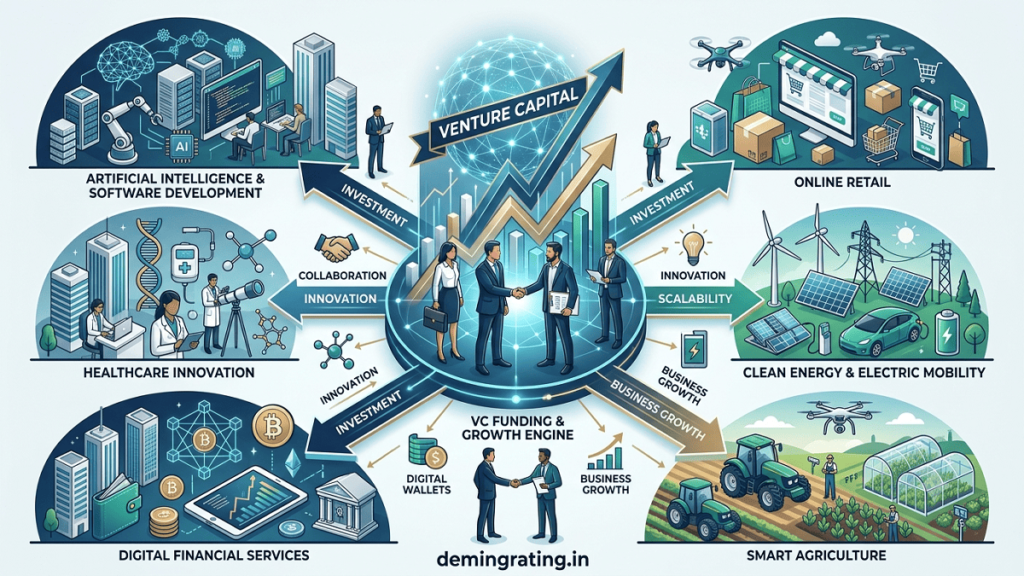
5. Industries Benefiting from Venture Capital
Venture capital supports businesses across a wide range of sectors.
- Technology: Artificial intelligence, cloud computing, cybersecurity, and enterprise software.
- Healthcare and biotechnology: Medical devices, diagnostics, digital health, and drug development.
- Fintech: Payment technology, financial software, and digital financial services.
- Clean energy: Renewable energy technology, energy storage, and electric mobility.
- Consumer businesses: E-commerce, digital marketplaces, and innovative consumer products.
- Agriculture: Precision farming, agricultural technology, and food supply-chain innovation.
Investment suitability depends on market opportunity, commercial viability, development risk, and the investor’s strategy.
6. Strategies for Attracting Venture Capital
Businesses seeking venture capital should demonstrate a clear problem-solution fit, evidence of customer demand, a capable management team, and a credible growth strategy.
Founders should prepare a concise pitch deck, realistic financial forecasts, reliable performance metrics, and organised legal and financial documentation. They should also research investors to identify firms whose investment focus matches the startup’s sector and stage.
A clear plan explaining how the funding will be used and which milestones it will achieve can strengthen an investment proposal.
7. Venture Capital and Long-Term Business Growth
Venture capital creates the greatest value when funding is connected to measurable business objectives. Companies should establish milestones for revenue growth, customer retention, product development, operational efficiency, and market expansion.
Regularly monitoring cash flow, spending, and business performance helps founders use capital responsibly. Sustainable growth requires more than fundraising; it depends on building products customers value and developing a business model capable of supporting long-term operations.
Conclusion
Venture capital can be a powerful driver of entrepreneurship, innovation, and economic development. It enables promising startups to access funding, expertise, and networks that may accelerate their growth.
Nevertheless, founders must balance these opportunities against ownership dilution, governance requirements, and investor expectations. Careful preparation, transparent communication, and disciplined capital allocation can help businesses make informed financing decisions.
For additional resources, consult the National Venture Capital Association and Invest Europe.
#StartupFunding
Industry Applications of Venture Capital: Driving Innovation Across Sectors
Introduction
Venture capital (VC) is a form of equity financing that supports startups and growing businesses with strong growth potential. In addition to providing capital, venture capital investors may offer strategic guidance, industry expertise, and professional connections. These resources help businesses develop innovative products, expand operations, and compete in evolving markets.
Venture capital is widely used in industries where companies require substantial investment to develop technology, validate products, or scale rapidly. Its role varies depending on each industry’s capital requirements, risk profile, and growth opportunities.
1. Technology and Software
Technology is one of the most prominent sectors for venture capital investment. Startups developing artificial intelligence, cloud computing, cybersecurity, enterprise software, and digital platforms often require funding for research, engineering, and product development.
Venture capital can help these businesses recruit specialised talent, improve their products, and expand internationally. Investors may also connect startups with enterprise customers and strategic partners.
2. Healthcare and Biotechnology
Healthcare and biotechnology companies often need significant funding for medical research, diagnostic tools, medical devices, drug development, and clinical testing.
Venture capital can help finance research programmes and support commercialisation. However, businesses in this sector face regulatory requirements, lengthy development cycles, and scientific uncertainty. Investors must carefully evaluate these risks before committing capital.
3. Financial Technology (Fintech)
Fintech companies use technology to improve financial services, including digital payments, lending platforms, financial management software, and fraud detection.
Venture capital helps these startups develop secure platforms, hire technical specialists, and expand their customer base. Because financial services are regulated, businesses must also invest in compliance, cybersecurity, and customer protection.
4. E-Commerce and Consumer Businesses
Online retailers, direct-to-consumer brands, and digital marketplaces can use venture capital to strengthen logistics, improve customer experiences, expand product ranges, and enter new markets.
Funding may support inventory management, marketing, technology infrastructure, and distribution networks. Startups should demonstrate that their customer acquisition costs, margins, and retention rates support sustainable growth.
5. Renewable Energy and Clean Technology
Venture capital supports companies developing solar technology, energy storage systems, electric mobility solutions, and energy-efficiency products.
Investment can help startups improve technology, conduct testing, establish commercial partnerships, and scale production. Because clean-energy projects may require substantial capital and long development periods, venture capital is sometimes combined with strategic investment, government incentives, or project financing.
6. Education Technology (EdTech)
EdTech companies use digital tools to improve learning, professional training, and educational access. Venture capital can support the development of online learning platforms, adaptive learning systems, assessment software, and digital education resources.
Investors typically assess customer demand, learner engagement, educational outcomes, and the company’s ability to generate sustainable revenue.
7. Agriculture and Food Technology
Agritech startups use technology to improve farming, food production, agricultural supply chains, and resource management. Examples include precision farming, smart irrigation, farm marketplaces, and crop-monitoring systems.
Venture capital can finance product development, field testing, distribution, and partnerships with farmers or agricultural businesses. Companies must consider seasonal demand, infrastructure limitations, and the financial realities of their target markets.
8. Transportation and Mobility
Transportation startups may use venture capital to develop electric vehicles, fleet-management software, mobility applications, and logistics platforms. Investment can support engineering, operational expansion, and technology improvements.
Businesses in this sector need to evaluate infrastructure requirements, regulatory conditions, safety standards, and the cost of scaling operations.
Conclusion
Venture capital supports innovation across technology, healthcare, fintech, e-commerce, clean energy, education, agriculture, and transportation. By combining financial resources with strategic expertise, investors can help promising companies develop solutions and expand their market presence.
However, venture capital is not suitable for every business. Startups should evaluate their growth objectives, funding requirements, ownership dilution, and investor expectations before choosing this financing model.
For further information, explore the National Venture Capital Association and Invest Europe.
#VentureCapital
Ask FAQs
Which industries benefit most from venture capital?
Technology, healthcare, biotechnology, fintech, e-commerce, renewable energy, education technology, agriculture, and transportation are among the industries that commonly benefit from venture capital investment.
How does venture capital support technology startups?
Venture capital helps technology startups finance research, develop software, recruit skilled employees, improve products, and expand into new markets. Investors may also provide industry connections and strategic guidance.
Why is venture capital important for healthcare and biotechnology companies?
Healthcare and biotechnology businesses often require substantial funding for research, product development, testing, and regulatory approval. Venture capital can help finance these activities and support the commercialisation of innovative medical solutions.
Can small businesses obtain venture capital funding?
Yes, small businesses can obtain venture capital if they demonstrate strong growth potential, a scalable business model, and an attractive market opportunity. However, venture capital is generally better suited to businesses seeking rapid growth than to companies with limited expansion plans.
What should businesses consider before accepting venture capital?
Businesses should evaluate ownership dilution, investor rights, growth expectations, valuation, funding terms, and long-term business objectives. Comparing venture capital with alternative financing options can help founders make informed decisions.
Disclaimer: This content is for informational purposes only and does not constitute financial or investment advice. Consult a qualified professional before making investment decisions.