Convertible Notes
Table of Contents
Convertible Notes are a popular financing instrument used by startups to raise capital during their early stages. They combine characteristics of debt and equity, allowing a startup to receive funding from investors while postponing the determination of the company’s precise valuation. This can make convertible notes particularly useful when a young company needs capital but has not yet established a clear market valuation.
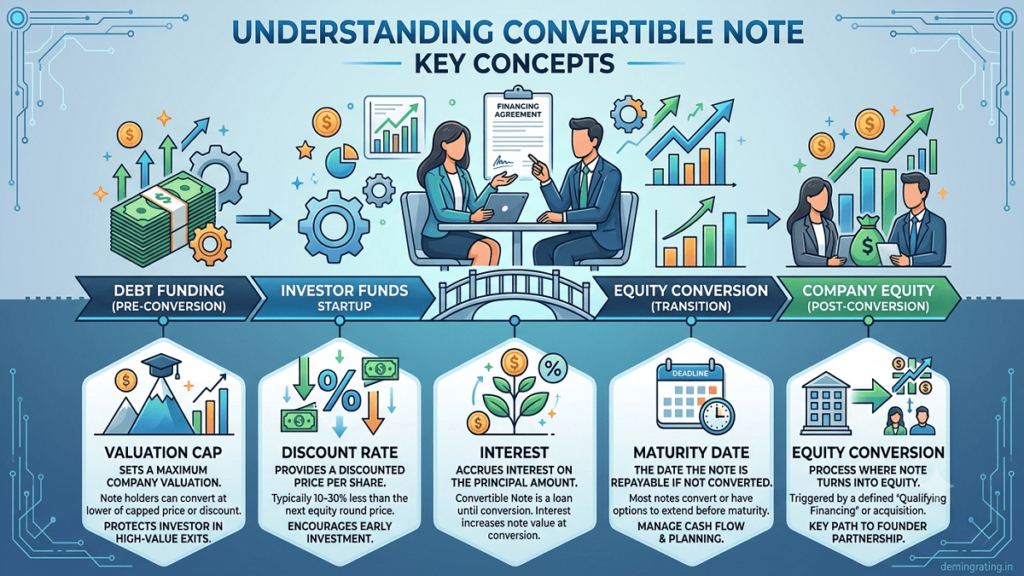
In a typical convertible note arrangement, an investor provides money to a startup in the form of a loan. Instead of necessarily being repaid in cash, the note may convert into equity shares during a future financing round, subject to agreed terms. The conversion usually occurs when the startup raises a qualifying equity financing round. The note may also include features such as an interest rate, maturity date, valuation cap, and discount rate, depending on the agreement between the startup and investor.
One of the major attractions of convertible notes is their relative simplicity compared with negotiating a complete equity financing transaction at the earliest stage. Founders can potentially raise funds faster while delaying a detailed valuation discussion until the business has developed further. Investors, meanwhile, may receive favorable conversion terms that compensate them for taking early-stage risk.
A valuation cap can establish the maximum company valuation at which the investor’s note converts into equity, potentially providing additional upside if the startup’s valuation increases significantly before the next financing round. A discount rate may allow the investor to convert the note into shares at a price lower than that paid by new investors in the subsequent financing round.
However, convertible notes also carry risks. Founders need to understand how future conversion could affect ownership and dilution, while investors must consider the possibility that the startup may fail to achieve a future financing event or become unable to meet its obligations. The legal and tax treatment of convertible notes can also vary depending on the jurisdiction and transaction structure.
According to the U.S. Securities and Exchange Commission, startups raising capital may use different securities and exemptions, and the applicable requirements depend on the structure of the offering. Entrepreneurs should therefore obtain appropriate legal and financial advice before issuing convertible securities.
Overall, Convertible Notes provide an important bridge between startup debt financing and future equity investment. They can help early-stage companies obtain capital efficiently while giving investors an opportunity to participate in future equity ownership. Understanding their structure, conversion mechanics, valuation caps, discounts, maturity terms, and dilution implications is essential before entering into a convertible note agreement.
#BusinessFunding
What Are Convertible Notes and How Do They Work?
Convertible Notes are a form of short-term debt financing that can convert into equity in a startup under specified conditions. They are commonly used by early-stage companies to raise capital before establishing a definitive company valuation. Instead of immediately issuing shares to investors, the startup receives funding as a loan, with the investment potentially converting into equity during a future financing round.
The basic process begins when an investor provides capital to a startup under a convertible note agreement. The agreement establishes important terms such as the principal amount, interest rate, maturity date, valuation cap, and discount rate. These terms determine how and when the investor’s investment may convert into shares.
A major feature of convertible notes is the qualified financing event. When the startup later completes a specified equity financing round, the outstanding note may automatically convert into shares. For example, an investor might provide $100,000 through a convertible note. If the startup subsequently raises a qualifying equity round, the $100,000 investment, together with applicable accrued interest, may convert into preferred shares according to the terms of the note.
Two important mechanisms can influence the conversion price. A valuation cap sets a maximum valuation used to calculate the conversion price. This can reward early investors if the company’s valuation rises substantially before the next financing round. A discount rate allows the note holder to purchase shares at a discount compared with investors participating in the subsequent financing round.
For example, suppose a startup’s next financing round values the company at $10 million, while the convertible note has a $6 million valuation cap. Depending on the agreement, the note may convert using the more favorable capped valuation rather than the $10 million valuation. The exact calculation depends on the note’s contractual terms.
Convertible notes also have a maturity date, which specifies when the debt becomes due if conversion has not occurred. Depending on the agreement and applicable law, possible outcomes may include repayment, conversion, extension, or renegotiation. Therefore, both founders and investors should understand the consequences of reaching maturity without a qualifying financing event.
Convertible notes can benefit startups because they may allow founders to raise capital without immediately negotiating a precise company valuation. They can also provide early investors with potential advantages through discounts or valuation caps. However, they introduce risks involving interest, repayment obligations, future dilution, and complex conversion calculations.
Entrepreneurs should carefully review the legal and financial implications before issuing convertible notes. The U.S. Securities and Exchange Commission provides information about securities offerings and applicable exemptions, while Investor.gov provides educational information about securities and investing.
In summary, a Convertible Note starts as a debt investment but may become an equity investment in the future. Its valuation cap, discount, interest, maturity date, and conversion conditions determine how the investor ultimately participates in the company’s ownership. Understanding these terms is essential for startups seeking flexible early-stage financing and investors evaluating opportunities in emerging businesses.
#EquityFinancing

Why Do Startups Use Convertible Notes to Raise Early-Stage Funding?
Startups often face a significant financing challenge in their early stages: they need capital to develop products, hire talent, acquire customers, and validate their business model, but they may not yet have enough operating history to establish a reliable company valuation. Convertible Notes can address this challenge by allowing startups to raise capital today while postponing the valuation discussion until a later financing round.
One of the primary reasons startups use convertible notes is valuation flexibility. Early-stage businesses may have limited revenue, uncertain market potential, or rapidly changing business models, making it difficult to determine a fair valuation. Instead of immediately negotiating the company’s equity value, founders and investors can agree on a convertible note that converts into equity during a future financing event.
Convertible notes can also make the fundraising process relatively simpler and faster than a traditional priced equity round. Because the parties may postpone detailed valuation negotiations, startups can potentially spend less time completing an early financing transaction. This can allow founders to focus more attention on product development, customer acquisition, and business operations.
Another important advantage is the ability to provide incentives to early investors. Convertible notes commonly include a valuation cap or discount rate. A valuation cap can give early investors a favorable conversion price if the startup’s valuation increases significantly before the next financing round. Similarly, a discount can allow investors to convert their investment into shares at a price below that paid by investors in a later round.
Convertible notes can also provide a bridge between financing rounds. A startup may use a note to obtain capital while working toward a larger equity financing round. This can be particularly useful when the company needs additional funding to reach milestones that could strengthen its position during a future fundraising process.
For founders, another attraction is that convertible notes generally do not require immediate equity issuance. Investors initially hold a debt instrument rather than directly owning shares. However, founders must recognize that conversion can eventually result in shareholder dilution, and the terms of the note can significantly influence the amount of equity ultimately issued.
Despite these benefits, convertible notes are not risk-free. Interest, maturity dates, valuation caps, discounts, repayment provisions, and conversion triggers can create financial and ownership consequences. If a startup does not complete a qualifying financing round before maturity, the parties may need to negotiate an extension, repayment, or another outcome depending on the agreement.
The U.S. Securities and Exchange Commission explains that companies raising capital through securities must consider the applicable securities laws and exemptions. Startups should therefore obtain appropriate legal and financial advice before using convertible notes.
Overall, startups use Convertible Notes because they can provide early-stage capital, valuation flexibility, fundraising efficiency, and incentives for early investors. When structured carefully, they can serve as an effective financing bridge while a young company develops the traction and valuation needed for a future equity round.
#FounderFinance
What Are Valuation Caps and Discount Rates in Convertible Notes?
Valuation caps and discount rates are two important terms commonly found in Convertible Note agreements. Both mechanisms are designed to compensate early investors for taking the higher risks associated with investing in a startup before its future valuation and growth prospects are fully established. Although they serve a similar purpose, they work differently when the note converts into equity.
What Is a Valuation Cap?
A valuation cap establishes a maximum company valuation that will be used to determine the conversion price of a Convertible Note. It does not necessarily mean that the startup’s actual valuation is limited to that amount. Instead, it provides a ceiling for calculating the price at which the investor’s note converts into shares.
For example, suppose an investor invests $100,000 through a Convertible Note with a valuation cap of $5 million. Later, the startup completes a financing round at a $10 million valuation. Depending on the agreement, the investor may be able to convert the note using the $5 million capped valuation rather than the higher $10 million valuation. This can result in the investor receiving more shares than they would have received if the note converted solely at the new round’s valuation.
The valuation cap therefore provides early investors with potential protection against significant increases in the company’s valuation before conversion.
What Is a Discount Rate?
A discount rate gives the Convertible Note investor the right to convert the investment into shares at a price lower than the price paid by investors in the subsequent financing round.
For example, if a Convertible Note has a 20% discount and new investors pay $1 per share during the next financing round, the note holder may convert at approximately $0.80 per share, subject to the specific terms of the agreement. This allows the early investor to receive more shares for the same investment amount.
Cap and Discount: How Do They Relate?
A Convertible Note may contain both a valuation cap and a discount. The agreement typically specifies how these provisions interact, often allowing the investor to benefit from the more favorable conversion mechanism. However, the exact calculation depends on the contractual terms, financing structure, and applicable law.
For founders, a lower valuation cap or higher discount can increase the amount of equity ultimately issued to the note holder. For investors, these provisions can provide additional upside for accepting the risks of investing at an earlier stage.
Why Are These Terms Important?
Understanding valuation caps and discount rates is essential because they directly affect future ownership and dilution. Founders should model different financing scenarios before agreeing to note terms, while investors should understand how their potential conversion compares with the terms offered to future investors.
The U.S. Securities and Exchange Commission provides information on securities offerings and exemptions that may apply when startups raise capital. Because Convertible Notes can have significant legal, financial, and ownership implications, professional legal and financial advice should be obtained before entering into an agreement.
In summary, a valuation cap protects early investors from excessive increases in the startup’s valuation, while a discount rate allows them to convert at a lower price than later investors. Both mechanisms are important components of Convertible Note financing and should be evaluated carefully by founders and investors before a funding agreement is finalized.
#VentureCapital
What Are the Benefits and Risks of Convertible Notes for Founders and Investors?
Convertible Notes can provide startups with a flexible way to raise early-stage capital while giving investors an opportunity to participate in future equity ownership. However, they also create financial, legal, and ownership considerations for both parties. Understanding these advantages and risks is essential before entering into a Convertible Note agreement.
Benefits for Founders
One of the biggest benefits is valuation flexibility. Early-stage startups may not have sufficient revenue, market traction, or operating history to establish a reliable valuation. Convertible Notes allow founders to postpone the detailed valuation discussion until a later equity financing round.
Convertible Notes can also make fundraising faster and relatively simpler than a traditional priced equity round. This can help founders obtain capital sooner and focus on product development, hiring, customer acquisition, and business growth.
Another advantage is that founders generally do not immediately transfer equity ownership when the note is issued. This allows them to maintain their existing ownership structure until the note converts. However, future conversion can still create dilution.
Benefits for Investors
For investors, Convertible Notes can provide an opportunity to invest in a company at an early stage while receiving potentially favorable conversion terms. Valuation caps and discount rates can provide investors with advantages when their investment converts into equity during a future financing round.
Convertible Notes may also provide contractual protections associated with debt, such as interest and a maturity date, although the precise rights depend on the agreement. Investors can therefore gain potential equity upside while investing before the startup’s future valuation is fully established.
Risks for Founders
A major risk is future dilution. When a Convertible Note converts into shares, existing shareholders may own a smaller percentage of the company. The extent of dilution depends on factors such as the amount raised, valuation cap, discount, accrued interest, and terms of the subsequent financing round.
Founders must also consider the maturity date. If the expected financing round does not occur before maturity, the startup may face repayment obligations, renegotiation, extension, or other consequences specified in the agreement.
Multiple Convertible Notes with different caps, discounts, or conversion terms can also make a company’s capitalization structure more complicated and difficult to manage.
Risks for Investors
Investors face the risk that the startup may fail to achieve its business objectives or complete a future financing round. If the company performs poorly or fails, the investor could lose some or all of the investment.
There is also conversion uncertainty. The ultimate number of shares an investor receives depends on the terms of the note and the circumstances of the future financing event. Investors should therefore understand the conversion formula, valuation cap, discount, interest, maturity provisions, and potential dilution before investing.
The U.S. Securities and Exchange Commission notes that companies raising capital through securities must consider applicable securities laws and exemptions. The specific legal and financial consequences of a Convertible Note can vary according to jurisdiction and contractual terms.
Conclusion
Convertible Notes can benefit founders by providing flexible early-stage financing and deferred valuation, while investors may benefit from discounts, valuation caps, and potential future equity ownership. At the same time, founders face dilution and maturity-related risks, while investors face startup failure and conversion risks.
For both parties, careful financial modeling, transparent negotiation, and professional legal advice are important before finalizing a Convertible Note agreement.
#StartupInvestment
How Should Startups Evaluate Convertible Notes Before Accepting This Type of Funding?
Convertible Notes can provide startups with valuable early-stage capital, but founders should carefully evaluate the financial, legal, and ownership implications before accepting this type of funding. A note that appears simple at first can significantly affect future equity ownership and financial obligations after conversion. Startups should therefore assess the complete terms rather than focusing only on the amount of capital being offered.
1. Evaluate the Valuation Cap
The valuation cap is one of the most important terms because it can influence the number of shares issued when the note converts. Founders should compare the proposed cap with the company’s current performance, expected growth, and realistic future valuation. A relatively low cap may result in greater dilution for existing shareholders if the company’s valuation increases significantly.
2. Review the Discount Rate
Startups should understand whether the note includes a discount rate and how it interacts with the valuation cap. For example, a 20% discount could allow the investor to convert at a price below that paid by investors in a future financing round. Founders should model different scenarios to understand the potential ownership impact.
3. Understand Interest and Maturity
Although Convertible Notes are commonly used as startup financing instruments, they generally begin as debt. Founders should review the interest rate and maturity date carefully. They should understand what happens if the company does not complete a qualifying financing round before maturity, including whether repayment, extension, renegotiation, or another outcome may apply.
4. Calculate Potential Dilution
Before accepting funding, founders should create a cap table projection showing how ownership could change after conversion. The calculation should consider the principal amount, accrued interest, valuation cap, discount, existing shareholders, and expected future financing. This helps founders understand the actual economic cost of the funding.
5. Examine Conversion Triggers
The agreement should clearly identify the circumstances that cause the note to convert. Founders should understand what qualifies as a financing event, whether conversion is automatic or optional, and what happens in other scenarios such as a company sale or maturity.
6. Review Investor Rights
Startups should carefully examine any additional investor rights contained in the agreement. These may include information rights, consent provisions, repayment rights, or other contractual protections. Founders should determine whether these provisions could restrict future financing or important business decisions.
7. Consider the Investor’s Strategic Value
Funding should not be evaluated solely on financial terms. An investor who provides industry expertise, customer introductions, hiring support, or strategic connections may offer substantial additional value. However, founders should balance these benefits against the investor’s contractual rights and long-term involvement.
8. Compare Alternatives
Finally, startups should compare the Convertible Note with other funding options, including priced equity financing, grants, revenue-based financing, or appropriate debt products. The best option depends on the startup’s stage, cash flow, growth plans, risk tolerance, and financing requirements.
The U.S. Securities and Exchange Commission provides educational information about securities offerings and exemptions. Because Convertible Notes can have significant legal and financial consequences, startups should obtain advice from qualified legal and financial professionals before signing an agreement.
Overall, startups should evaluate Convertible Notes by considering valuation caps, discounts, interest, maturity, conversion terms, dilution, investor rights, and alternative funding options. A careful evaluation can help founders secure necessary capital while maintaining a sustainable ownership structure and avoiding unexpected obligations.
#EarlyStageFunding
Case Study of Convertible Notes: Airbnb
Airbnb provides a useful case study for understanding how early-stage financing can help a startup move from an uncertain concept toward significant growth. Founded by Brian Chesky, Joe Gebbia, and Nathan Blecharczyk, the company began as a small home-sharing marketplace and initially faced considerable skepticism from investors.
Early Funding Challenge
In its early days, Airbnb had limited resources and an unconventional business model. The founders first used creative methods to keep the business operating and later joined Y Combinator in 2009. Sequoia Capital subsequently invested in Airbnb, with Sequoia describing its initial seed investment as $585,000 in April 2009; other accounts commonly report the broader seed financing as approximately $600,000.
Airbnb’s early financing is frequently cited in startup-finance discussions as an example involving a convertible note. Some sources report that the investment later converted into equity at a discount during Airbnb’s subsequent financing. Because historical accounts vary on the precise legal terms of the original instrument, founders should treat the case as an illustrative example rather than a template for structuring a modern Convertible Note.
How the Financing Supported Growth
The early capital gave Airbnb additional resources to improve its platform, expand its marketplace, acquire more hosts and travelers, and demonstrate stronger market traction. This was particularly important because the company was operating in a category that many investors initially found difficult to understand.
The company’s progress helped change the investment conversation from whether people would actually use a home-sharing service to how large the opportunity could become. Sequoia later described Airbnb’s early business as having a small website, approximately 2,500 listings, and 10,000 registered users when it made its initial investment.
Conversion and Subsequent Financing
Airbnb subsequently raised a $7.2 million Series A round in 2010, led by Greylock Partners and Sequoia Capital. This represented a major step forward from its early seed financing and provided additional capital for expansion.
The broader lesson from the financing journey is that early-stage capital can provide founders with the time and resources needed to reach meaningful milestones before a larger priced equity round.
Key Lessons for Startups
The Airbnb example highlights several important lessons about early-stage financing:
- Early capital can create valuable runway while a startup validates its business model.
- Flexible financing can help bridge the gap between an early concept and a later priced equity round.
- Traction matters: demonstrating real customer adoption can substantially strengthen a startup’s fundraising position.
- Investor relationships can extend beyond capital, providing strategic guidance and credibility.
- Funding terms matter: founders should understand conversion mechanics, valuation caps, discounts, interest, maturity dates, and potential dilution before accepting a Convertible Note.
Airbnb’s early financing journey ultimately became part of a much larger growth story. Sequoia notes that the company evolved from a small early-stage platform into a global marketplace over the following decade.
Overall, the Airbnb case demonstrates how carefully structured early-stage funding can help a startup move from initial validation to scalable growth. However, founders should evaluate the exact terms of any Convertible Note with qualified legal and financial advisers rather than relying solely on historical startup examples.
#StartupFinance
White Paper on Convertible Notes
Executive Summary
Convertible Notes are a widely used early-stage financing instrument that allows startups to raise capital without immediately establishing a fixed valuation for the company. They are structured as debt initially, with the expectation that the investment will convert into equity when a specified future financing event occurs.
This financing approach can help startups obtain capital quickly while they develop their products, acquire customers, and establish stronger market traction. For investors, Convertible Notes can provide potential equity upside through mechanisms such as valuation caps and discount rates.
However, Convertible Notes also create important financial and ownership considerations. Interest, maturity dates, conversion provisions, valuation caps, discounts, and potential dilution can significantly affect both founders and investors. Therefore, these instruments should be evaluated carefully before an agreement is finalized.
1. Introduction
Early-stage startups often need funding before they have sufficient revenue, operating history, or market data to establish a reliable valuation. A traditional equity financing round requires the company and investors to agree on a price per share and valuation. Convertible Notes offer an alternative by postponing that valuation decision.
Y Combinator notes that convertible debt can make fundraising quicker because founders do not have to negotiate all the details associated with selling stock immediately.
A Convertible Note generally begins as a loan. At a later financing event, it can convert into shares according to the terms established in the original agreement.
2. How Convertible Notes Work
The process generally involves four stages:
Stage 1 — Investment:
An investor provides capital to the startup under a Convertible Note agreement.
Stage 2 — Development:
The startup uses the funds for activities such as product development, hiring, marketing, customer acquisition, and working capital.
Stage 3 — Qualified Financing:
The startup later completes a financing round that meets the conversion conditions specified in the note.
Stage 4 — Conversion:
The outstanding principal and applicable accrued interest may convert into equity based on the agreed conversion formula.
The exact mechanics vary according to the contractual terms and applicable jurisdiction.
3. Key Terms
Valuation Cap
A valuation cap establishes a maximum valuation used when calculating the investor’s conversion price. If the startup’s subsequent financing occurs at a substantially higher valuation, the cap may allow the early investor to convert at a more favorable price.
Discount Rate
A discount provides the note holder with a lower conversion price than investors participating in the subsequent financing round.
Interest Rate
Because a Convertible Note is debt, interest may accrue during the period before conversion. The treatment of accrued interest should be clearly defined in the agreement.
Maturity Date
The maturity date specifies when the note becomes due if conversion has not already occurred. The agreement should clearly explain the consequences of reaching maturity without a qualifying financing event.
Conversion Trigger
The agreement should identify the financing or other event that causes conversion and explain how the conversion price will be calculated.
4. Benefits of Convertible Notes
Convertible Notes can provide several advantages to startups and investors.
For founders, they can offer faster fundraising and valuation flexibility. The company can obtain capital without immediately negotiating a detailed equity valuation.
For investors, valuation caps and discounts can provide potential advantages for accepting the risk of investing at an early stage.
Convertible Notes can also function as bridge financing, allowing a startup to obtain capital while working toward a larger priced equity round.
5. Risks and Challenges
The primary concern for founders is potential ownership dilution. When the note converts, investors receive equity, reducing the percentage ownership of existing shareholders.
Another concern is the maturity date. If the startup does not achieve the expected financing milestone, the company may face repayment, renegotiation, extension, or other consequences depending on the agreement.
Investors also face substantial risks. The startup may fail to achieve its business objectives, fail to raise another financing round, or become unable to satisfy its obligations. Consequently, a Convertible Note should not be viewed as a guaranteed path to equity or financial returns.
6. Convertible Notes vs. SAFEs
Convertible Notes and SAFEs both allow startups to obtain capital before a future equity financing, but they are structurally different.
A Convertible Note is debt, meaning it generally has interest and a maturity date. A SAFE, by contrast, is not debt and does not have interest or a maturity date. Y Combinator developed the SAFE in 2013 as an alternative to Convertible Notes, specifically to simplify some of the complications associated with convertible debt.
Y Combinator’s current comparison describes Convertible Notes as particularly relevant for bridge loans and situations where investors specifically want debt characteristics, while SAFEs are commonly used for early-stage fundraising.
7. Regulatory Considerations
Convertible Notes involve securities and therefore may be subject to securities regulations. In the United States, the Securities and Exchange Commission explains that businesses generally cannot offer or sell securities unless the offering is registered or qualifies for an applicable exemption.
Requirements differ by jurisdiction. Startups should therefore obtain qualified legal and financial advice before issuing Convertible Notes, particularly when raising funds from multiple investors or across different countries.
8. Strategic Evaluation for Startups
Before accepting Convertible Note financing, founders should evaluate:
- Total capital being raised
- Valuation cap
- Discount rate
- Interest rate
- Maturity date
- Conversion triggers
- Potential ownership dilution
- Investor rights
- Existing notes or other convertible securities
- Expected timing of the next financing round
- Alternative financing options
Founders should also model different scenarios to understand how the note could affect ownership after conversion.
9. Conclusion
Convertible Notes can be an effective financing tool for startups that need early-stage capital but are not yet ready to establish a definitive valuation. Their ability to defer valuation, simplify fundraising, and provide investors with potential conversion benefits makes them useful in certain financing situations.
At the same time, Convertible Notes are not simply a convenient alternative to equity. They create debt obligations and can have significant consequences for future ownership, dilution, and financial planning.
The most important principle for founders and investors is clarity of terms. Understanding the valuation cap, discount, interest, maturity, conversion mechanics, and potential dilution before signing an agreement can reduce unexpected financial and ownership consequences.
Convertible Notes should ultimately be selected based on the startup’s stage, funding requirements, investor expectations, projected growth, and applicable legal framework—not simply because they appear faster or easier than other financing options.
#StartupFunding
Industry Applications of Convertible Notes
Convertible Notes are primarily used as an early-stage financing instrument, particularly by businesses that need capital before establishing a definitive company valuation. Their usefulness varies by industry because sectors differ in capital requirements, development timelines, regulatory environments, and revenue potential. When appropriately structured, Convertible Notes can provide startups with funding flexibility while postponing detailed valuation negotiations.
1. Technology and Software
Technology startups are among the most common users of Convertible Notes. Software companies can often develop an initial product and demonstrate customer traction before raising a larger equity round. A Convertible Note allows founders to obtain capital for product development, engineering, hiring, and customer acquisition while postponing valuation until the business has stronger market evidence.
2. Fintech
Fintech startups may use Convertible Notes during early development and market-validation stages. Funding can support software development, compliance infrastructure, security systems, and customer acquisition. However, because financial services are highly regulated, founders and investors must carefully consider applicable securities, financial, and regulatory requirements.
3. Healthcare and Healthtech
Healthcare startups can require significant funding before generating substantial revenue because product development, clinical validation, technology development, and regulatory processes can take considerable time. Convertible Notes may provide interim capital while a company works toward important technical or commercial milestones.
4. E-Commerce and Consumer Startups
Early-stage e-commerce and consumer-product companies can use Convertible Notes to finance inventory, technology platforms, marketing, logistics, and customer acquisition. Funding may help a company establish sales traction before pursuing a larger priced financing round.
5. Biotechnology and Life Sciences
Biotechnology companies often face long development cycles and substantial research costs. Convertible Notes can sometimes be used as bridge financing while a company works toward scientific, clinical, regulatory, or commercialization milestones. However, the capital requirements and risk profiles of these businesses can make financing structures more complex.
6. EdTech
Education technology startups can use Convertible Notes to finance platform development, content creation, instructor acquisition, marketing, and user growth. Early funding can help an EdTech company demonstrate user engagement and revenue potential before a larger equity financing.
7. CleanTech and Climate Technology
Climate-focused startups may require funding to develop technologies, conduct testing, build prototypes, or establish commercial partnerships. Convertible Notes can provide interim capital while companies work toward technical or commercial milestones that may support a future equity valuation.
8. Media and Digital Businesses
Digital media platforms, creator-economy startups, and subscription businesses may also use Convertible Notes during their early growth stages. Funding can support technology, content production, marketing, and audience development while the company establishes recurring revenue and user growth.
Key Considerations Across Industries
The suitability of Convertible Notes depends on factors such as capital requirements, expected financing timeline, revenue model, valuation prospects, regulatory requirements, and anticipated dilution. Founders should carefully evaluate the valuation cap, discount rate, interest, maturity date, conversion triggers, and investor rights before accepting funding.
The U.S. Securities and Exchange Commission explains that companies raising capital through securities must consider registration requirements and applicable exemptions. The specific rules vary by jurisdiction, so businesses should obtain qualified legal and financial advice.
Overall, Convertible Notes can be particularly valuable in industries where startups need early capital to reach important milestones before a reliable valuation can be established. Technology, fintech, healthcare, biotechnology, consumer products, EdTech, CleanTech, and digital businesses can potentially benefit from this financing structure when its terms align with the company’s growth strategy and financial capacity.
#ConvertibleNotes
Ask FAQs
What is a Convertible Note?
A Convertible Note is a financing instrument that starts as debt and can convert into equity in a startup when specified conditions, such as a future financing round, are met.
Why do startups use Convertible Notes?
Startups use Convertible Notes to raise early-stage capital without immediately establishing a company valuation. They can provide funding flexibility while the business develops traction and prepares for a future equity round.
What is a valuation cap in a Convertible Note?
A valuation cap sets a maximum valuation used to calculate the investor’s conversion price. It can allow early investors to receive equity at a more favorable price if the startup’s valuation increases substantially.
What is a discount rate in a Convertible Note?
A discount rate allows the investor to convert the note into shares at a price lower than the price paid by investors in a subsequent financing round. For example, a 20% discount may allow conversion at 80% of the later investors’ share price, subject to the agreement.
What are the main risks of Convertible Notes?
Founders may face future equity dilution, interest obligations, and maturity-related risks. Investors face the possibility of losing their investment if the startup fails, while conversion terms may affect the ultimate amount of equity they receive.
Disclaimer: Convertible Notes involve financial, legal, and investment risks. This content is for educational purposes only and should not be considered financial, legal, or investment advice. Parties should consult qualified professionals before entering into a Convertible Note agreement.