Bootstrap Funding
Table of Contents
Bootstrap funding, commonly known as bootstrapping, is a business financing approach in which entrepreneurs use their own financial resources and the revenue generated by the business to start and grow a company. Instead of immediately relying on venture capital, angel investors, or large business loans, founders focus on building the company with available resources and carefully managing cash flow. The U.S. Small Business Administration describes self-funding, or bootstrapping, as using personal financial resources to support a business.
Bootstrapping can involve personal savings, income from an existing business, early customer payments, reinvested profits, or financial support from family and friends. Entrepreneurs may also reduce costs by working from home, using existing equipment, outsourcing selected tasks, Bootstrap Funding or launching a minimum viable product before making significant investments. The central principle is to make efficient use of limited resources while gradually building a sustainable business.
Why Is Bootstrap Funding Important?
One of the biggest advantages of bootstrapping is greater ownership and control. When founders do not rely on equity investors, they generally do not have to give away a portion of the company in exchange for capital. This allows entrepreneurs to retain greater control over strategic decisions and business direction. The SBA notes that self-funding allows business owners to retain complete control, Bootstrap Funding although it also means they take on the financial risk themselves.
Bootstrapping can also encourage financial discipline. Since resources are limited, founders are often required to prioritize essential expenses, monitor cash flow, Bootstrap Funding validate customer demand, and focus on activities that generate measurable business value. Shopify similarly describes bootstrapping as using existing resources to start and grow a company while avoiding dependence on outside investors or debt.
However, bootstrap funding also has limitations. A business may grow more slowly because its expansion depends largely on available cash and operating revenue. Founders also carry a greater share of the financial risk, particularly when personal savings are involved. Limited funding can make it difficult to hire quickly, invest heavily in marketing, purchase inventory, Bootstrap Funding or enter new markets.
For this reason, entrepreneurs should calculate startup costs, estimate ongoing expenses, and understand their expected break-even point before committing personal funds. The U.S. Small Business Administration recommends calculating startup costs Bootstrap Funding and developing financial projections before determining funding requirements.
Overall, bootstrap funding is a practical approach for entrepreneurs who want to build a business gradually while maintaining greater ownership and control. It is particularly suitable for businesses that can generate revenue relatively early and operate efficiently with limited capital. When combined with careful financial planning, customer-focused growth, Bootstrap Funding and disciplined spending, bootstrapping can provide a strong foundation for long-term business development.
#FounderFinance
What Is Bootstrap Funding and Why Is It Useful for Startups?
Bootstrap funding, also known as bootstrapping, is a method of financing a business using the founder’s own resources and the revenue generated by the business rather than relying primarily on external investors or substantial business loans. Entrepreneurs may use personal savings, early customer payments, retained profits, or income from another business to finance operations and growth. The U.S. Small Business Administration recognizes self-funding as one of the options entrepreneurs can consider when financing a business.
For startups, bootstrapping can be particularly useful because it allows founders to develop their businesses while maintaining greater ownership and control. Instead of giving investors equity in exchange for capital, founders can reinvest revenue into product development, marketing, hiring, technology, Bootstrap Funding and other essential activities. This can be especially valuable during the early stages when the company’s valuation may be difficult to establish.
Why Is Bootstrap Funding Useful for Startups?
1. Greater Ownership and Control
One of the main advantages of bootstrapping is that founders generally retain a larger percentage of their company. Without external equity investors, entrepreneurs have greater flexibility when making decisions about products, pricing, hiring, and long-term strategy. The SBA notes that self-funding can allow business owners to retain complete control, although they also assume the financial risk themselves.
2. Financial Discipline
Limited resources encourage founders to prioritize spending carefully. Instead of investing heavily in activities without proven results, startups may focus on validating their products, acquiring paying customers, and generating sustainable revenue. This discipline can help create a stronger financial foundation.
3. Reduced Investor Pressure
Startups backed by external investors may face expectations concerning rapid growth, future funding rounds, or potential exits. A bootstrapped company can generally focus more directly on its customers and long-term business objectives without having to satisfy external equity investors.
4. Stronger Focus on Revenue
Because bootstrapped startups cannot continuously rely on external capital, generating revenue often becomes an immediate priority. This can encourage founders to develop products and services that customers are willing to pay for.
5. Flexible Growth
Bootstrapping allows entrepreneurs to grow according to their available resources. Although this may result in slower expansion, it can reduce unnecessary spending and help founders build a business based on actual customer demand. Shopify’s guide to bootstrapping also highlights resourcefulness and financial independence as important characteristics of the approach.
However, bootstrapping is not suitable for every startup. Businesses requiring substantial upfront investment, such as biotechnology, advanced manufacturing, or capital-intensive technology companies, may need external financing to achieve their goals. Founders must also recognize that using personal savings can expose them to significant financial risk.
Overall, bootstrap funding is useful because it combines financial independence, greater ownership, disciplined spending, and a strong focus on customers and revenue. For startups capable of growing gradually with limited resources, bootstrapping can provide a sustainable path toward building a successful business.
#SmallBusinessFunding
What Are the Main Sources of Funding for a Bootstrapped Business?
A bootstrapped business is typically financed through the founder’s own resources and money generated by the business rather than depending heavily on external equity investors. The objective is to maintain financial independence while using available resources efficiently. Although bootstrapping does not mean that a company can never use outside funding, its early growth is primarily supported through internally controlled sources of capital.
1. Personal Savings
Personal savings are one of the most common starting points for bootstrapped businesses. Founders may use savings accumulated from employment, previous businesses, or other personal income to cover initial expenses such as registration, equipment, product development, software, and marketing. The U.S. Small Business Administration identifies self-funding as an option for entrepreneurs starting or expanding a business.
However, founders should carefully assess how much personal capital they can afford to risk. Business and personal finances should also be separated wherever possible to maintain accurate financial records.
2. Revenue From Early Customers
Customer revenue is one of the most valuable sources of bootstrap funding. Instead of waiting for a product to become fully established, entrepreneurs can launch a minimum viable product, acquire initial customers, and reinvest the resulting revenue into the business.
This approach creates a cycle in which customers fund growth. Businesses can use sales revenue to improve products, expand marketing, hire employees, and increase capacity.
3. Reinvested Profits
Once a bootstrapped company becomes profitable, founders can reinvest some or all of those profits rather than distributing them. Reinvested earnings can finance inventory, technology, additional employees, marketing campaigns, and geographic expansion without giving away equity.
4. Preorders and Customer Deposits
Some businesses can generate working capital before delivering their products or services through preorders, advance payments, subscriptions, or customer deposits. This can reduce the amount of personal capital required and provide evidence that customers are willing to pay.
5. Friends and Family
Founders may also receive financial support from friends or family members. While this can be more accessible than institutional financing, entrepreneurs should treat such arrangements professionally. Written agreements should clearly establish whether the money is a loan, investment, or gift and specify the relevant terms.
6. Founder Income or Side Businesses
Some entrepreneurs continue working another job or operate a separate income-generating activity while developing their startup. The additional income can cover personal expenses and allow more business revenue to remain within the company.
7. Supplier Credit and Flexible Payment Terms
Businesses may negotiate payment terms with suppliers, such as paying invoices after receiving customer payments. This can improve working capital without requiring an immediate cash outlay, although entrepreneurs should avoid taking on obligations they cannot comfortably meet.
Overall, the strongest bootstrapped businesses often combine several funding sources rather than relying on one. Personal savings may support the initial launch, customer revenue can finance operations, and retained profits can fund expansion. Careful cash-flow management is therefore essential. The U.S. Small Business Administration provides additional guidance on financial planning and funding requirements.
Bootstrapping ultimately depends on resourcefulness, disciplined spending, early revenue generation, and continuous reinvestment. By carefully managing these funding sources, entrepreneurs can grow their businesses while retaining greater ownership and control.
#StartupStrategy
How Can Entrepreneurs Manage Cash Flow Effectively While Bootstrapping?
Effective cash-flow management is one of the most important requirements for a bootstrapped business. Unlike startups supported by substantial external funding, bootstrapped companies generally depend on personal capital, customer revenue, and retained profits to finance daily operations and growth. Careful cash management helps entrepreneurs ensure that enough money is available to pay employees, suppliers, operating expenses, and other obligations while continuing to invest in the business.
1. Create a Detailed Cash-Flow Forecast
Entrepreneurs should regularly estimate how much money will enter and leave the business. A cash-flow forecast should include expected sales receipts, operating expenses, payroll, taxes, supplier payments, subscriptions, loan obligations, and planned investments.
The U.S. Small Business Administration recommends maintaining accurate financial records and monitoring business finances to support informed decision-making. A rolling forecast can help founders identify potential cash shortages before they become serious problems.
2. Prioritize Essential Expenses
Bootstrapped businesses cannot afford to spend heavily on activities that do not contribute to growth or customer value. Founders should separate essential costs from discretionary expenses and review recurring subscriptions, software, office expenses, advertising, and other overhead regularly.
The goal is not simply to spend less, but to ensure that available cash is allocated toward activities with a clear business purpose.
3. Focus on Faster Revenue Collection
Generating sales is only part of cash-flow management. Businesses must also collect payments promptly. Entrepreneurs can establish clear payment terms, issue invoices quickly, provide convenient payment methods, and follow up on overdue accounts.
For businesses serving other companies, reducing the time between delivering a product or service and receiving payment can have a significant effect on working capital.
4. Maintain a Cash Reserve
A cash reserve can protect a bootstrapped company against unexpected expenses, seasonal revenue changes, delayed customer payments, or temporary declines in sales. The appropriate reserve varies according to the business model, but founders should establish a target based on their monthly operating requirements and risk exposure.
5. Manage Inventory Carefully
For product-based businesses, excessive inventory can tie up valuable cash. Entrepreneurs should monitor sales patterns, reorder strategically, negotiate supplier terms where appropriate, and avoid purchasing large quantities without sufficient demand.
6. Separate Personal and Business Finances
Founders should maintain separate business and personal accounts and keep accurate records of money contributed to or withdrawn from the company. This makes it easier to understand the company’s actual financial position and simplifies accounting and tax management.
7. Monitor Key Financial Metrics
Entrepreneurs should regularly track revenue, gross margin, operating expenses, accounts receivable, accounts payable, cash balance, and monthly cash burn. Reviewing these indicators helps identify trends and allows founders to make adjustments before cash becomes constrained.
Effective bootstrapping is ultimately about controlling the timing and use of cash. A profitable business can still experience cash-flow problems if customers pay slowly or expenses become due before revenue is collected. By forecasting cash flow, controlling unnecessary expenses, collecting payments efficiently, maintaining reserves, and monitoring financial performance, entrepreneurs can improve their chances of sustaining growth without relying heavily on external funding.
For additional guidance, entrepreneurs can consult the SBA’s financial management resources and work with a qualified accountant or financial professional when necessary.
#BusinessGrowth
What Are the Advantages and Challenges of Bootstrap Funding?
Bootstrap funding, or bootstrapping, allows entrepreneurs to start and grow a business primarily through personal savings, customer revenue, and reinvested profits. This approach can give founders greater independence and control, but it also requires careful financial management and may limit how quickly a company can expand. Understanding both the advantages and challenges is essential before deciding whether bootstrapping is appropriate for a particular business.
Advantages of Bootstrap Funding
1. Greater Ownership and Control
One of the biggest advantages is that founders generally do not have to give equity to outside investors. This allows entrepreneurs to retain a larger ownership stake and make strategic decisions without investor approval. The U.S. Small Business Administration identifies self-funding as an option that can allow business owners to maintain control over their companies.
2. Financial Independence
Bootstrapped businesses are less dependent on external investors or lenders. Founders can determine their growth strategy based primarily on customer needs and business performance rather than external funding expectations.
3. Strong Financial Discipline
Limited capital encourages entrepreneurs to prioritize essential expenses and focus on activities that generate measurable returns. This can promote efficient operations and discourage unnecessary spending.
4. Focus on Revenue
Because external capital is limited, bootstrapped companies often need to generate revenue early. This can encourage founders to develop products and services that address genuine customer needs and create sustainable revenue streams.
5. Reduced Investor Pressure
External investors may expect rapid growth, future funding rounds, or specific exit opportunities. A bootstrapped company generally has more flexibility to pursue a long-term strategy without these expectations.
Challenges of Bootstrap Funding
1. Limited Capital
The most obvious challenge is that founders have fewer financial resources available. This can make it difficult to invest aggressively in technology, marketing, recruitment, inventory, or expansion.
2. Slower Growth
Because expansion depends largely on available cash and operating revenue, a bootstrapped business may grow more slowly than a well-funded competitor. This can be particularly challenging in industries where speed is important.
3. Personal Financial Risk
When founders use personal savings, they may face significant financial exposure if the business does not perform as expected. Entrepreneurs should carefully assess how much personal capital they can realistically afford to risk.
4. Operational Pressure
Founders may need to manage multiple responsibilities simultaneously, including product development, sales, marketing, finance, and customer service. Limited resources can make it difficult to hire specialists early.
5. Missed Growth Opportunities
A lack of capital can sometimes prevent a startup from pursuing valuable opportunities quickly. For example, a business may identify a major customer opportunity but lack sufficient cash to increase production or hire additional employees.
Despite these challenges, bootstrapping can be an effective strategy for businesses that can reach customers and generate revenue without substantial upfront investment. The key is disciplined financial management, realistic growth planning, and careful monitoring of cash flow. The U.S. Small Business Administration provides additional resources for financial planning and business development.
Ultimately, bootstrap funding is a trade-off between independence and financial limitations. It can help founders preserve ownership and develop strong financial discipline, but entrepreneurs must be prepared to accept slower growth and greater personal financial responsibility. The right approach depends on the company’s industry, capital requirements, growth objectives, and ability to generate revenue.
#Entrepreneurship

When Should a Bootstrapped Startup Consider Seeking External Funding?
A bootstrapped startup should consider seeking external funding when its growth opportunities, operational requirements, or financial needs exceed what can reasonably be supported through internal cash flow. Bootstrapping can provide founders with greater ownership and control, but relying exclusively on internal resources may eventually limit expansion. The decision to raise outside capital should therefore be based on a clear business need rather than simply the availability of investors.
1. When Cash Flow Limits Growth
A startup may reach a stage where customer revenue is healthy but insufficient to finance the next phase of growth. For example, the company may need additional employees, technology, inventory, equipment, or marketing investment. If these investments are likely to generate significant future revenue, external capital may help the business grow faster.
The U.S. Small Business Administration recommends determining funding requirements based on the company’s financial situation, business goals, and planned use of funds.
2. When a Major Market Opportunity Appears
Sometimes a startup identifies a valuable opportunity that cannot be captured using existing resources. This could involve entering a new geographic market, launching a new product, increasing production capacity, or responding quickly to rising customer demand.
External funding can provide the capital necessary to act before competitors capture the opportunity. However, founders should carefully evaluate whether the expected return justifies giving up equity or taking on debt.
3. When the Business Has Strong Traction
External funding is generally easier to justify when a startup can demonstrate customer demand, revenue growth, retention, or other meaningful traction. Evidence of product-market fit can make the company more attractive to investors and may allow founders to negotiate from a stronger position.
Y Combinator notes that many companies raise when they have identified their market and customer, developed a product, and demonstrated meaningful customer adoption and growth.
4. When Capital-Intensive Expansion Is Required
Some businesses require substantial upfront investment. Manufacturing, biotechnology, hardware, logistics, and certain technology businesses may need significant capital before they can generate sufficient revenue. In such cases, continuing to bootstrap may unnecessarily slow development.
5. Before the Cash Runway Becomes Critical
Founders should not wait until the company is nearly out of money before beginning fundraising. Raising capital can take time because investors may conduct due diligence, review financial information, evaluate the market, and negotiate investment terms. Y Combinator advises founders to think about fundraising well before their cash runway becomes dangerously short.
6. When External Expertise Adds Value
Funding can also be valuable when the investor provides more than capital. An experienced investor may offer industry connections, recruitment support, strategic advice, or access to future financing opportunities.
Before raising funds, founders should prepare realistic financial projections and clearly explain how the capital will be used. The SBA recommends including detailed funding requirements and financial projections when seeking financing.
Ultimately, a bootstrapped startup should seek external funding when capital can accelerate valuable growth without unnecessarily sacrificing ownership or financial stability. The decision should be based on measurable business needs, available alternatives, growth potential, and the terms being offered by investors. Not every successful startup needs venture capital; for some businesses, continuing to bootstrap may remain the better long-term strategy.
#StartupFinance
Case Study of Bootstrap Funding: Mailchimp
Mailchimp is one of the most notable examples of how a company can use bootstrap funding to grow into a highly successful technology business without relying on traditional venture capital during its early development. Founded in 2001 by Ben Chestnut and Dan Kurzius, Mailchimp began as a side project within their web-design business and eventually developed into a global email marketing and customer engagement platform. The company remained privately held and bootstrapped until its acquisition by Intuit in 2021.
The Beginning of Mailchimp
Before Mailchimp, Chestnut and Kurzius operated a web-design agency called Rocket Science Group. While working with corporate clients, they noticed that small businesses needed affordable and accessible email marketing tools. They developed Mailchimp as an alternative to the expensive and complex email marketing software available at the time. According to Mailchimp’s official history, the company was founded in Atlanta in 2001 and initially focused specifically on helping small businesses with email marketing.
Rather than raising substantial external investment, the founders grew the company through customer revenue. This approach allowed them to maintain control over the business while gradually improving the product based on customer feedback.
A Customer-Focused Growth Strategy
Mailchimp’s early growth demonstrates an important principle of bootstrapping: customers can become the primary source of funding for expansion. The company initially concentrated on doing one thing well—email marketing—before gradually expanding its product range.
Mailchimp explains that it grew slowly during its early years and focused on listening closely to small-business customers and responding to their needs. As customers requested additional marketing capabilities, the company expanded beyond email into a broader marketing platform.
This strategy helped Mailchimp avoid the pressure to pursue rapid expansion simply to satisfy outside investors. Instead, the company could prioritize product development, customer satisfaction, and sustainable growth.
From Bootstrapped Startup to Major Acquisition
The results were substantial. Mailchimp grew from a small startup into a major global technology company. In November 2021, Intuit completed its acquisition of Mailchimp for approximately $12 billion, consisting of cash and Intuit shares.
Mailchimp’s own resources describe the company as having been built without outside funding and identify its acquisition as one of the largest exits achieved by a bootstrapped company.
Key Lessons for Entrepreneurs
The Mailchimp case demonstrates several important lessons for entrepreneurs considering bootstrap funding. First, founders can use customer revenue as a growth engine when their business model allows it. Second, focusing on a specific customer problem can help create sustainable demand. Third, gradual expansion can allow a company to improve its product while maintaining financial discipline.
The case also shows that bootstrapping does not necessarily mean remaining a small business. With strong customer demand, effective cost management, and continuous reinvestment, a bootstrapped company can scale significantly.
Ultimately, Mailchimp demonstrates the potential of building a company through customer-focused innovation, disciplined spending, and reinvested revenue. Its journey from a small email marketing service to a $12 billion acquisition provides a powerful example of how bootstrapping can support long-term business growth while allowing founders to retain substantial control during the company’s development.
#StartupFunding
White Paper on Bootstrap Funding
Executive Summary
Bootstrap funding, commonly referred to as bootstrapping, is a business financing strategy in which entrepreneurs rely primarily on personal resources, customer revenue, and reinvested profits to establish and grow a company. Unlike equity financing, bootstrapping generally does not require founders to surrender ownership to outside investors. It can therefore provide entrepreneurs with greater control while encouraging financial discipline and a strong focus on sustainable revenue.
According to the U.S. Small Business Administration, self-funding is one of the financing options entrepreneurs can consider when starting or expanding a business. However, self-funding also places the financial risk primarily on the business owner.
The Role of Bootstrap Funding
Bootstrapping can be particularly useful during the early stages of a startup when founders are testing an idea, developing a minimum viable product, or establishing their first customer base. Common sources include personal savings, revenue from early customers, retained profits, preorders, and financial contributions from family or friends.
The central objective is to build the business using available resources rather than depending immediately on venture capital or substantial debt. Entrepreneurs may therefore operate with smaller teams, minimize overhead, negotiate supplier terms, and reinvest revenue into activities that directly support growth.
Advantages of Bootstrapping
One of the primary advantages is ownership retention. Founders generally maintain greater control over strategic decisions because they are not required to satisfy external equity investors. Bootstrapping can also encourage responsible spending and close attention to cash flow.
Another advantage is the ability to prioritize customers rather than investor expectations. A company can potentially pursue gradual, sustainable growth instead of focusing exclusively on rapid expansion or a future exit.
Resources from Shopify similarly highlight financial independence, resourcefulness, and reinvestment as important characteristics of bootstrapped businesses.
Challenges and Risks
Bootstrapping also creates significant challenges. Limited capital can restrict hiring, marketing, research, inventory, technology investment, and geographic expansion. Growth may therefore be slower than that of competitors with substantial external funding.
Founders may also face personal financial risk when using their savings. In addition, managing a business with limited resources can place considerable operational and financial pressure on the founding team.
For these reasons, entrepreneurs should develop realistic financial projections, monitor cash flow, establish spending priorities, and maintain adequate financial reserves. The SBA’s financial management resources provide guidance on managing business finances and monitoring financial performance.
When Should a Business Seek External Funding?
Bootstrapping does not necessarily mean avoiding external funding permanently. A startup may consider outside capital when customer demand exceeds its capacity, a major expansion opportunity requires substantial investment, or internal cash flow cannot support the company’s growth objectives.
The decision should be based on measurable business requirements rather than pressure to raise capital. Entrepreneurs should compare the benefits of additional funding with potential ownership dilution, financial obligations, and investor expectations.
Conclusion
Bootstrap funding provides entrepreneurs with a path toward building businesses through financial discipline, customer revenue, and reinvestment. It can preserve founder ownership and encourage sustainable operations, but it also requires careful cash-flow management and acceptance of greater financial responsibility.
The most appropriate financing strategy depends on the company’s industry, capital requirements, growth rate, revenue model, and long-term objectives. For businesses capable of generating revenue relatively early, bootstrapping can provide a strong foundation for sustainable growth. For capital-intensive businesses, a combination of bootstrapping and carefully selected external financing may be more appropriate.
#Bootstrapping
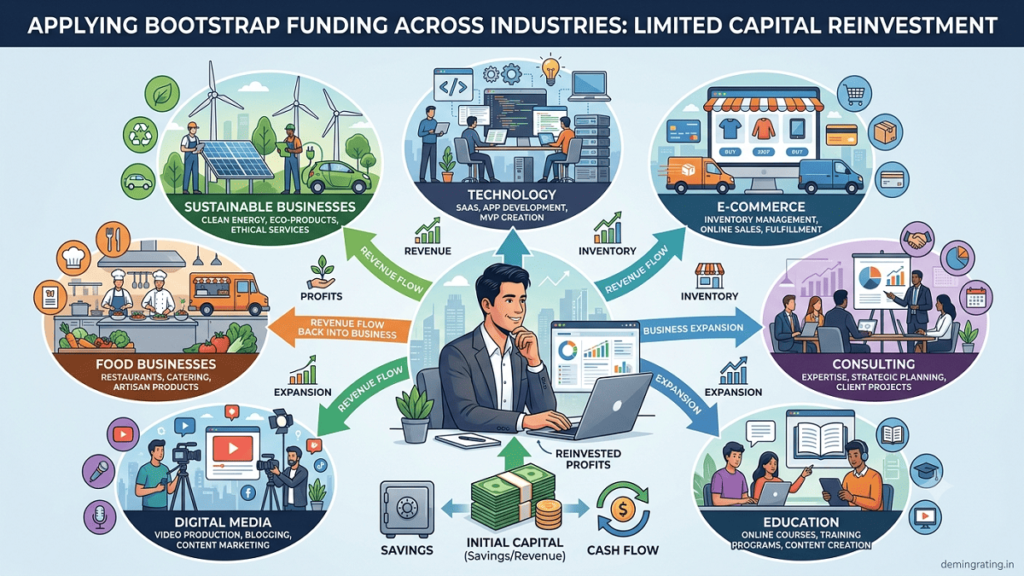
Industry Applications of Bootstrap Funding
Bootstrap funding, or bootstrapping, can be applied across many industries where entrepreneurs can start operations with manageable upfront costs and generate revenue relatively early. Instead of relying primarily on venture capital or large loans, businesses use personal savings, customer payments, retained earnings, and other internally generated resources to finance development and expansion. The suitability of bootstrapping depends largely on the industry’s capital requirements, revenue cycle, and ability to scale efficiently.
1. Technology and Software
Software businesses are particularly suited to bootstrapping because digital products can often be developed with relatively low initial infrastructure costs. Founders can create a minimum viable product, acquire early customers, and reinvest subscription or service revenue into product development, hiring, and marketing. Software-as-a-service businesses can benefit significantly from recurring revenue models that provide predictable cash flow.
2. Consulting and Professional Services
Consulting, accounting, design, marketing, legal-support services, and other professional businesses can often be launched with limited capital. Founders can use existing expertise and professional networks to acquire their first clients. Revenue from completed projects can then fund additional employees, technology, marketing, and geographic expansion.
3. E-Commerce and Consumer Brands
Bootstrapping can also work for small e-commerce companies and direct-to-consumer brands. Entrepreneurs may begin with a limited product range, test customer demand, and gradually increase inventory based on actual sales. Preorders and customer payments can help reduce the amount of personal capital tied up in inventory.
However, inventory-heavy businesses need particularly careful cash-flow management because unsold stock can consume significant working capital.
4. Education and Online Learning
Educational businesses, online courses, tutoring services, and specialized training platforms can often begin with relatively modest investment. Founders can use their expertise to develop initial content, attract customers through digital marketing, and reinvest revenue into additional courses, technology, and instructors.
5. Digital Media and Content Businesses
Blogs, niche publications, newsletters, podcasts, and creator-focused businesses can often start with limited infrastructure. Revenue from subscriptions, advertising, sponsorships, memberships, or digital products can be reinvested to increase audience reach and improve content production.
6. Food and Small Consumer Businesses
Restaurants, catering companies, bakeries, and specialty food businesses can sometimes use bootstrapping when founders can begin with manageable operations. However, these businesses often require greater upfront investment in equipment, premises, inventory, licenses, and staffing, making careful financial planning essential.
7. Sustainable and Local Businesses
Small recycling, repair, sustainable-product, and environmentally focused businesses can also use bootstrapping when their initial operating requirements are manageable. Founders can begin with a focused service or product and expand as customer revenue increases.
Strategic Considerations
The U.S. Small Business Administration identifies self-funding as one potential method of financing a business. However, entrepreneurs should evaluate their industry’s capital intensity, cash-flow cycle, regulatory requirements, inventory needs, and growth expectations before choosing this approach.
The SBA’s financial management resources also emphasize the importance of understanding business finances and maintaining accurate financial records.
Overall, bootstrap funding is particularly effective in industries where businesses can launch with limited capital, generate revenue early, and reinvest profits into gradual expansion. Technology, professional services, education, digital media, and selected consumer businesses can often benefit from this approach. Capital-intensive industries may require a combination of bootstrapping and external financing to achieve their growth objectives.
BootstrapFunding
Ask FAQs
What is Bootstrap Funding?
Bootstrap Funding is a financing approach in which entrepreneurs use personal savings, business revenue, retained profits, and other internal resources to start and grow a business without relying primarily on external investors.
Which industries are most suitable for Bootstrap Funding?
Technology, software, consulting, professional services, online education, digital media, and certain e-commerce businesses can be well suited to bootstrapping because they can often begin with relatively low upfront costs and generate revenue early.
What are the main advantages of Bootstrap Funding?
Key advantages include greater ownership and control, reduced dependence on investors, financial discipline, flexibility in decision-making, and the ability to reinvest business profits into future growth.
What are the major challenges of Bootstrap Funding?
Common challenges include limited capital, slower expansion, personal financial exposure, cash-flow pressure, and difficulty funding large investments such as equipment, inventory, technology infrastructure, or rapid hiring.
When should a bootstrapped business consider external funding?
A business may consider external funding when internal cash flow cannot support a significant growth opportunity, when substantial capital expenditure is required, or when additional expertise and strategic networks from investors can create meaningful value.
Disclaimer: Bootstrap Funding involves financial risks and may not be suitable for every business. The information provided is for educational purposes only and should not be considered financial, investment, or legal advice.