Warehousing Projects
Table of Contents
Warehousing projects are an important part of modern supply chain and logistics infrastructure. A warehouse is more than a facility for storing goods; it is a strategically planned asset that supports the movement, handling, processing, and distribution of products between manufacturers, suppliers, retailers, and customers. As e-commerce, manufacturing, organized retail, and global trade continue to expand, demand for efficient and well-designed warehousing facilities is increasing.
A successful warehousing project involves much more than constructing a large storage building. It requires careful planning of location, land, building design, storage systems, material-handling equipment, transportation connectivity, utilities, safety, technology, and operational processes. The objective is to create a facility that can handle inventory efficiently while minimizing operating costs and delivery times.
Importance of Warehousing Projects
Warehousing plays a critical role in maintaining a reliable supply chain. Strategically located warehouses can help businesses store inventory closer to production centres, distribution networks, and end customers. This can improve delivery efficiency, support inventory availability, and provide greater flexibility when market demand changes.
The World Bank recognizes logistics and transport infrastructure as important factors in connecting businesses and markets. Warehousing works as a key link within this broader logistics ecosystem.
Key Elements of a Warehousing Project
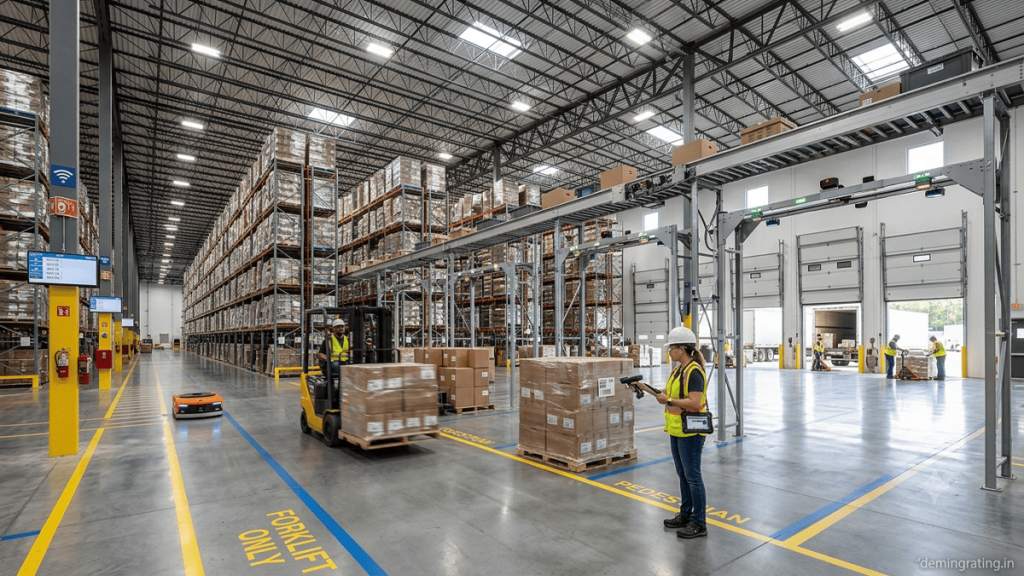
A modern warehousing project typically includes storage areas, loading and unloading docks, material-handling systems, inventory-management technology, offices, utilities, fire and safety systems, parking, and internal transportation routes. Depending on the industry, facilities may also require temperature-controlled storage, specialized handling areas, automated systems, or secure zones.
Location is another critical consideration. Proximity to highways, ports, airports, rail networks, industrial clusters, and major consumption markets can influence transportation costs and distribution performance.
Technology and Automation
Technology is transforming warehouse operations. Warehouse Management Systems (WMS), barcode and RFID technologies, automated storage and retrieval systems, robotics, conveyor systems, sensors, and data analytics can improve inventory visibility and operational efficiency.
Automation can be particularly valuable in large-scale distribution facilities where high volumes of products must be processed quickly and accurately.
Future of Warehousing
The future of warehousing is increasingly focused on automation, sustainability, scalability, energy efficiency, and digital connectivity. Solar power, energy-efficient lighting, electric material-handling equipment, smart monitoring systems, and optimized building designs can help reduce operational impacts.
Overall, warehousing projects are becoming strategic infrastructure investments rather than simple storage facilities. Well-planned projects can strengthen supply chains, improve logistics performance, support economic growth, and help businesses respond more effectively to changing customer and market requirements.
#IndustrialDevelopment
What are Warehousing Projects and Why are They Important?
Warehousing projects are planned facilities designed for the storage, handling, management, and distribution of goods and materials within a supply chain. They can range from traditional storage warehouses to large-scale distribution centres, fulfillment facilities, cold-storage units, and technology-enabled logistics parks. A warehousing project typically involves site selection, facility design, construction, storage infrastructure, material-handling systems, utilities, safety measures, and operational technology.
Unlike simple storage buildings, modern warehouses are increasingly designed as integrated logistics facilities. They may include loading and unloading docks, inventory-management systems, automated equipment, packaging areas, offices, parking, and specialized storage zones. The design depends on factors such as the type of products, inventory volume, customer requirements, transportation connections, and expected operational capacity.
Why Are Warehousing Projects Important?
1. Efficient Supply Chain Management
Warehouses provide a controlled location where goods can be received, stored, organized, and dispatched. This helps businesses maintain inventory and coordinate the movement of products between manufacturers, suppliers, distributors, retailers, and customers.
2. Faster Distribution
Strategically located warehouses can place inventory closer to major markets and transportation networks. This can support faster order fulfillment and more efficient distribution operations. The World Bank identifies efficient transport and logistics connectivity as important to economic activity and access to markets.
3. Inventory Management
Modern warehousing systems help businesses track stock levels, product locations, incoming shipments, and outgoing orders. Technologies such as barcode systems, RFID, and Warehouse Management Systems (WMS) can improve inventory visibility and operational control.
4. Support for E-Commerce
The growth of e-commerce has increased demand for fulfillment and distribution facilities capable of processing large numbers of individual orders. Warehouses support activities such as order picking, packing, returns processing, and last-mile distribution.
5. Industrial and Economic Development
Large warehousing facilities can support manufacturing, retail, agriculture, e-commerce, and logistics industries. Development of logistics infrastructure can also create demand for transportation, construction, equipment, technology, maintenance, and professional services.
6. Adoption of Automation and Sustainable Practices
Modern facilities increasingly incorporate automation, robotics, energy-efficient lighting, solar power, smart monitoring, and optimized material-handling systems. These technologies can improve productivity while supporting more efficient resource use.
Conclusion
Warehousing projects are a fundamental component of modern logistics infrastructure. By combining strategic locations, efficient facility design, inventory management, transportation connectivity, automation, and technology, warehouses can strengthen supply-chain operations and support changing business requirements. As e-commerce, manufacturing, organized retail, and distribution networks continue to evolve, well-planned warehousing infrastructure will remain an important part of efficient and resilient supply chains.
Further reading: World Bank – Transport · UNCTAD – Transport and Logistics
#SmartWarehousing
What Factors Should Be Considered When Planning a Warehouse Facility?
Planning a warehouse facility requires a combination of strategic location planning, operational analysis, facility design, technology, safety, and long-term scalability. A well-planned warehouse should not only provide adequate storage capacity but also support efficient material movement, inventory management, order fulfillment, and future business requirements.
1. Location and Connectivity
Location is one of the most important factors in warehouse planning. A facility should have convenient access to highways, ports, airports, rail networks, industrial areas, suppliers, and major customer markets. Good connectivity can help reduce transportation time and distribution costs.
2. Storage Capacity and Demand
The warehouse should be designed according to current and projected inventory requirements. Planners need to consider product volumes, storage duration, SKU variety, seasonal demand, inventory turnover, and future growth. Sufficient capacity should be provided without creating excessive unused space.
3. Facility Layout and Workflow
An efficient layout should support a logical movement of goods from receiving to inspection, storage, picking, packing, staging, and dispatch. The positioning of docks, aisles, storage racks, equipment, and work areas can significantly influence operational efficiency.
4. Type of Storage and Equipment
Storage requirements depend on the products being handled. Options may include pallet racking, shelving, automated storage systems, cold storage, bulk storage, or specialized handling areas. Material-handling equipment such as forklifts, conveyors, pallet movers, and automated systems should be selected according to operational needs.
5. Technology and Automation
Modern warehouses increasingly use Warehouse Management Systems (WMS), barcode scanning, RFID, sensors, robotics, automated storage and retrieval systems, and data analytics. Technology should be selected based on the facility’s scale, processes, budget, and expected return on investment.
6. Safety and Regulatory Requirements
Warehouse planning must address worker safety, fire protection, emergency exits, ventilation, electrical systems, structural safety, hazardous-material requirements where applicable, and relevant local regulations. Safety systems should be incorporated into the design rather than added after construction.
7. Energy Efficiency and Sustainability
Energy-efficient lighting, rooftop solar systems, efficient HVAC equipment, natural lighting, rainwater management, and environmentally responsible materials can help improve the facility’s resource efficiency. Sustainable design can also contribute to lower operating costs over the facility’s lifecycle.
8. Expansion and Flexibility
A warehouse should be capable of adapting to changing business requirements. Provision for future expansion, additional storage systems, automation upgrades, increased loading capacity, and changing product requirements can improve long-term usability.
Conclusion
Effective warehouse planning requires a holistic approach that combines location, capacity, layout, storage systems, technology, safety, sustainability, and future scalability. Careful consideration of these factors can help businesses develop facilities that are operationally efficient, cost-conscious, safe, and capable of supporting long-term supply-chain growth.
Further reading: World Bank – Transport · OSHA – Warehousing
#WarehouseAutomation
How Can Technology and Automation Improve Warehouse Operations?
Technology and automation are transforming modern warehouse operations by improving inventory visibility, material handling, order fulfillment, accuracy, productivity, and operational control. As warehouses handle larger product volumes and increasingly complex supply chains, digital systems and automated equipment can help businesses manage processes more efficiently.
1. Warehouse Management Systems
A Warehouse Management System (WMS) provides digital control over important warehouse activities such as receiving, put-away, storage, picking, packing, and dispatch. A WMS can provide real-time information about inventory locations and quantities, helping warehouse teams make better operational decisions.
2. Barcode and RFID Technology
Barcode scanning and Radio Frequency Identification (RFID) can improve the identification and tracking of products. These technologies can reduce manual data-entry requirements and help businesses maintain more accurate inventory records. RFID can also support faster identification of items and shipments in suitable warehouse environments.
3. Automated Material Handling
Automation can reduce the amount of repetitive manual movement required within a facility. Conveyors, automated storage and retrieval systems (AS/RS), automated guided vehicles (AGVs), and autonomous mobile robots (AMRs) can transport or position materials according to programmed workflows.
This can improve material flow and allow employees to focus on activities requiring greater judgment or supervision.
4. Robotics and Automated Picking
Robotic systems can assist with picking, sorting, packing, and palletizing. In high-volume operations, automated picking technologies can help process large numbers of orders consistently. The appropriate level of automation depends on factors such as order volume, product characteristics, facility design, and investment requirements.
5. Data Analytics and Real-Time Monitoring
Sensors and connected equipment can generate operational data covering inventory movement, equipment utilization, order processing, energy consumption, and warehouse performance. Analytics can help managers identify bottlenecks, monitor key performance indicators, and optimize processes.
6. Artificial Intelligence
Artificial intelligence can support applications such as demand forecasting, inventory optimization, route planning, anomaly detection, and workforce scheduling. When reliable data is available, AI-based tools can help organizations make more informed operational decisions.
7. Safety and Predictive Maintenance
Technology can also improve warehouse safety and equipment reliability. Monitoring systems can identify unusual equipment behavior, while predictive-maintenance approaches can help organizations identify potential failures before they cause significant operational disruption.
8. Improved Energy Efficiency
Smart lighting, automated climate controls, energy monitoring, and efficient equipment can help warehouses manage energy consumption. These technologies can be particularly valuable in large facilities operating for extended hours.
Conclusion
Technology and automation can make warehouse operations more visible, accurate, efficient, scalable, and data-driven. However, successful implementation requires more than purchasing automated equipment. Businesses should evaluate operational requirements, integration capabilities, workforce skills, cybersecurity, maintenance needs, and return on investment before selecting technologies.
A balanced combination of digital systems, automation, skilled employees, and effective processes can create a modern warehouse capable of adapting to changing supply-chain requirements.
Further reading: U.S. Department of Energy – Industrial Technologies · OSHA – Warehousing
#LogisticsInfrastructure
How Can Sustainable Design Make Warehousing Projects More Energy-Efficient?
Sustainable design can make warehousing projects more energy-efficient by reducing unnecessary energy consumption, improving building performance, and integrating renewable energy and efficient technologies into facility operations. Since warehouses often have large floor areas, high ceilings, lighting requirements, material-handling equipment, and extended operating hours, energy-efficient design can have a meaningful impact on operating costs and environmental performance.
1. Energy-Efficient Building Design
The building envelope plays an important role in energy performance. Insulated roofs and walls, reflective roofing materials, efficient doors, and appropriate glazing can help reduce unwanted heat transfer. In warmer climates, these measures can reduce the cooling load and improve indoor working conditions.
Warehouse orientation and building design can also be planned to make better use of natural daylight and prevailing environmental conditions.
2. Natural Lighting and Efficient LEDs
Large warehouses require substantial lighting for storage, picking, packing, and movement areas. Skylights, daylighting systems, occupancy sensors, and LED lighting can reduce the amount of electricity required for illumination.
Lighting controls can automatically adjust or switch off lights in areas that are temporarily unoccupied, helping avoid unnecessary energy consumption.
3. Rooftop Solar Energy
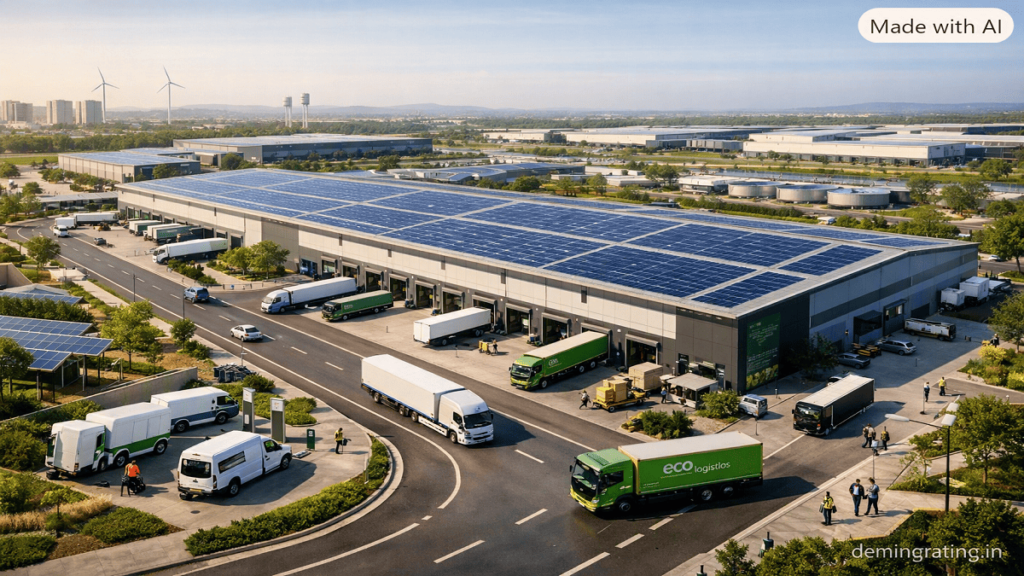
Warehouses generally provide extensive roof areas that can be suitable for solar photovoltaic (PV) installations, subject to structural, technical, regulatory, and economic considerations. On-site renewable generation can offset a portion of electricity purchased from the grid.
Battery storage may also be considered where the project’s energy profile and economics justify its use.
4. Efficient HVAC and Ventilation
Where warehouses require heating, ventilation, or air conditioning, high-efficiency equipment and intelligent controls can reduce energy consumption. Variable-speed systems, automated temperature controls, efficient ventilation, and zoning can help match energy use with actual operational requirements.
For naturally ventilated facilities, appropriate building openings and design strategies can reduce dependence on mechanical cooling where local conditions permit.
5. Energy-Efficient Material Handling
Material-handling equipment can represent a significant operational energy requirement. Businesses can consider electric forklifts, efficient conveyors, automated systems, and optimized warehouse layouts to reduce unnecessary movement and energy use.
Reducing travel distances within the facility can also improve operational efficiency.
6. Smart Energy Monitoring
Digital energy-management systems can monitor electricity consumption across different areas and equipment. Sensors and analytics can help identify unusual consumption patterns, inefficient equipment, and opportunities for improvement.
Regular measurement allows facility managers to compare actual performance against energy targets and make informed operational adjustments.
7. Sustainable Water and Site Management
Energy efficiency can be complemented by water-efficient fixtures, rainwater harvesting, efficient landscaping, and responsible stormwater management. These measures can reduce resource consumption and support broader sustainability objectives.
Conclusion
Sustainable warehouse design combines efficient building envelopes, LED lighting, renewable energy, efficient HVAC systems, optimized material handling, smart monitoring, and responsible site planning. Considering these measures during the design stage can help reduce energy demand rather than relying solely on operational changes after construction.
The most effective approach is to evaluate energy performance throughout the warehouse lifecycle—from site selection and building design to equipment selection, operations, maintenance, and future upgrades.
Further reading: U.S. Department of Energy – Better Buildings · International Energy Agency – Energy Efficiency
#SupplyChain
What Are the Key Challenges in Developing and Managing Modern Warehouses?
Modern warehouses have become increasingly sophisticated as businesses respond to e-commerce growth, faster delivery expectations, complex supply chains, and increasing inventory requirements. However, developing and managing these facilities involves several challenges related to location, cost, technology, workforce, sustainability, safety, and operational efficiency.
1. Site Selection and Connectivity
Finding suitable land in a strategically located area can be challenging. Warehouses need good access to highways, ports, airports, railways, industrial zones, and major markets. At the same time, land availability, zoning requirements, infrastructure, and development costs can significantly affect project feasibility.
2. High Development and Operating Costs
Warehouse projects require substantial investment in land, construction, utilities, storage systems, material-handling equipment, technology, and safety infrastructure. Operating expenses can also include energy, maintenance, labour, insurance, transportation, and equipment replacement.
Effective financial planning is therefore essential to maintain long-term operational viability.
3. Managing Automation and Technology
Automation can improve productivity, but integrating technologies such as Warehouse Management Systems, robotics, automated storage systems, conveyors, RFID, and artificial intelligence can be complex. Systems need to work together reliably, and businesses may require specialized technical skills for implementation, maintenance, and troubleshooting.
4. Workforce and Skills
Although automation is increasing, skilled employees remain essential for warehouse operations. Businesses may face challenges in recruiting and retaining workers with expertise in inventory management, equipment operation, technology, safety, and maintenance.
Continuous training becomes increasingly important as warehouse technologies evolve.
5. Inventory and Demand Management
Demand can change because of seasonal patterns, market conditions, product launches, and changing customer behaviour. Excess inventory can consume valuable storage capacity, while insufficient inventory can affect order fulfillment.
Accurate forecasting and effective inventory-management processes are therefore critical.
6. Safety and Compliance
Warehouses contain moving equipment, heavy loads, vehicles, elevated storage systems, and other operational hazards. Maintaining safe working conditions requires appropriate facility design, employee training, equipment maintenance, emergency procedures, and compliance with applicable regulations.
7. Energy Consumption and Sustainability
Large warehouses may consume significant amounts of electricity for lighting, HVAC systems, refrigeration, automation, and material-handling equipment. Businesses increasingly need to balance operational requirements with energy efficiency, renewable energy adoption, waste reduction, and environmental objectives.
8. Scalability and Changing Requirements
Warehouse requirements can change as businesses expand, introduce new products, modify distribution strategies, or adopt new technologies. A facility that cannot adapt may become inefficient over time.
Flexible layouts, modular storage systems, scalable technology, and provisions for future expansion can help address this challenge.
Conclusion
Modern warehouse development and management requires careful coordination of infrastructure, finance, technology, people, safety, inventory, sustainability, and scalability. Addressing these challenges during both the planning and operational stages can help businesses build facilities that remain efficient and adaptable over the long term.
Successful warehouse management is therefore not only about maximizing storage capacity; it is about creating an integrated facility that can respond effectively to changing supply-chain and business requirements.
Further reading: OSHA – Warehousing · World Bank – Transport
#Logistics
Case Study of Warehousing Projects
1. Project Background
Bhiwandi in Maharashtra is an important logistics location serving the Mumbai Metropolitan Region and surrounding markets. Its connectivity and proximity to a major consumption and industrial centre make it suitable for large-scale warehousing and distribution operations.
A notable example is Delhivery’s expansion of its Bhiwandi infrastructure, where the company developed large-scale, technology-enabled gateway facilities to support growing logistics demand. In its FY2025 annual report, Delhivery reported that its Bhiwandi gateway infrastructure had been expanded to 750,000 sq. ft., while its FY2024 report described a new Lonad, Bhiwandi mega-gateway spanning 1.2 million sq. ft.
2. Technology and Automation
A key feature of the project is the integration of automation with logistics operations. Delhivery reported automated material-handling systems at its Bhiwandi gateway, along with system-directed floor operations and machine-vision-guided truck-loading systems. As of March 31, 2025, the company reported operating 45 fully and semi-automated sortation centres and 111 gateways across India.
These technologies demonstrate how modern warehousing can move beyond conventional storage by integrating sorting, handling, data systems, and transportation operations within a coordinated facility.
3. Operational Approach
The project illustrates the importance of connecting warehousing infrastructure with a broader logistics network. Delhivery combines physical facilities with its logistics technology platform, data intelligence, and automation capabilities. Its reported technology applications include network design, route optimization, load aggregation, estimated-time-of-arrival prediction, and other operational functions.
This integrated approach can help facilities manage high shipment volumes while maintaining visibility across different stages of the logistics process.
4. Key Lessons for Warehousing Projects
The Bhiwandi example highlights several important planning principles:
- Strategic location: Proximity to major markets and transportation networks can support distribution efficiency.
- Scalable infrastructure: Large facilities can provide capacity for growing logistics requirements.
- Automation: Automated sorting and material handling can support high-volume operations.
- Technology integration: Warehouse infrastructure becomes more effective when connected with inventory, transportation, and data systems.
- Operational flexibility: Modern logistics facilities need to adapt to changing shipment volumes and customer requirements.
India’s broader warehousing market also continues to expand. CBRE reported that India’s warehousing absorption exceeded 30 million sq. ft. during H2 2025, with demand driven particularly by third-party logistics, engineering and manufacturing, and e-commerce.
Conclusion
The Delhivery Bhiwandi case demonstrates how modern warehousing projects can combine strategic location, large-scale infrastructure, automation, digital technology, and integrated logistics operations. The case also shows that successful warehouse development is not simply about creating storage space; it involves designing an interconnected logistics system capable of supporting changing supply-chain requirements.
For future warehousing projects, the combination of efficient facility design, technology, automation, connectivity, scalability, and operational planning can provide a strong foundation for long-term performance.
Further reading: Delhivery – Annual Report FY2025 · CBRE India – Logistics Figures H2 2025
#WarehouseManagement
White Paper on Warehousing Projects
Executive Summary
Warehousing projects are a critical component of modern supply-chain infrastructure. They provide facilities for storing, handling, sorting, processing, and distributing goods while connecting manufacturers, suppliers, retailers, and consumers. As e-commerce, manufacturing, organized retail, and third-party logistics continue to expand, warehouses are increasingly being developed as technology-enabled logistics facilities rather than conventional storage buildings.
In India, warehousing demand has remained strong. CBRE reported that warehousing absorption exceeded 30 million sq. ft. during H2 2025, with demand led by third-party logistics, engineering and manufacturing, and e-commerce.
1. Introduction
A modern warehousing project involves much more than constructing storage space. It requires coordinated planning of location, land use, connectivity, building design, storage capacity, material handling, technology, safety, energy efficiency, and future expansion.
The World Bank describes logistics infrastructure as a network of nodes and connections that includes warehouses, multimodal logistics parks, ports, stations, roads, railways, waterways, and other transport systems.
2. Strategic Importance
Well-planned warehouses can improve inventory availability, distribution efficiency, and supply-chain responsiveness. Facilities located near major consumption centres and multimodal transport networks can help businesses coordinate the movement of goods more effectively.
India’s logistics infrastructure is also increasingly supported by multimodal connectivity initiatives. The World Bank notes that platforms such as PM Gati Shakti are intended to improve coordination of infrastructure planning through integrated geographic information and logistics data.
3. Key Components
A successful warehousing project generally includes:
- Strategic site selection and transportation connectivity
- Efficient building and warehouse layout
- Adequate storage capacity and scalable design
- Loading and unloading infrastructure
- Material-handling and storage systems
- Warehouse Management Systems (WMS)
- Barcode, RFID, and inventory-tracking technologies
- Fire protection and occupational safety systems
- Energy-efficient building and equipment design
- Parking, circulation, and internal logistics infrastructure
4. Technology and Automation
Digitalization is becoming increasingly important in warehouse operations. Warehouse Management Systems, IoT sensors, robotics, automated storage and retrieval systems, conveyors, artificial intelligence, and data analytics can improve inventory visibility and operational decision-making.
Automation should, however, be selected according to the facility’s operating model, product characteristics, order volumes, workforce requirements, and expected return on investment.
5. Sustainability and Energy Efficiency
Modern warehouses are increasingly incorporating solar energy, LED lighting, efficient HVAC systems, energy monitoring, electric material-handling equipment, water management, and sustainable building practices.
CBRE’s 2025 India Logistics Occupier Survey found that more than half of surveyed occupiers identified on-site renewable energy as an important ESG criterion when selecting buildings.
6. Key Challenges
Major challenges include land availability, high development costs, transportation connectivity, regulatory requirements, skilled workforce availability, technology integration, cybersecurity, energy consumption, and changing customer expectations.
Warehouses must also be designed with sufficient flexibility to accommodate changes in inventory volumes, product types, automation requirements, and distribution models.
Conclusion
Warehousing projects are evolving into sophisticated logistics assets that integrate real estate, transportation, technology, automation, energy management, and supply-chain operations. Successful projects require strategic planning from site selection through facility design and long-term operations.
As India’s logistics market continues to develop, investment in well-connected, technologically capable, sustainable, and scalable warehousing infrastructure can support more efficient supply chains and strengthen the country’s broader logistics ecosystem.
Further reading: World Bank – Logistics and Transport · CBRE India – Logistics Figures H2 2025 · CBRE India – 2025 Logistics Occupier Survey
#Warehousing
Industry Application of Warehousing Projects
Warehousing projects play a vital role across multiple industries by providing the infrastructure required for storage, inventory management, order fulfillment, distribution, and supply-chain coordination. Modern warehouses are increasingly designed as technology-enabled logistics facilities that can support faster distribution, specialized storage requirements, and changing customer demand.
1. E-Commerce and Retail
E-commerce companies depend heavily on fulfillment centres and distribution warehouses to process online orders. Warehouses support inventory storage, order picking, packing, returns management, and dispatch. Strategically located facilities can help businesses position products closer to customers and support efficient delivery operations.
Retailers also use regional and distribution warehouses to supply stores and manage inventory across multiple locations.
2. Manufacturing
Manufacturing companies require warehouses for raw materials, components, work-in-progress goods, finished products, and spare parts. Well-organized storage facilities can help manufacturers maintain production continuity and coordinate inbound and outbound logistics.
Integration between warehouse management systems and manufacturing systems can also improve inventory visibility.
3. Third-Party Logistics
The third-party logistics (3PL) industry is one of the major users of modern warehousing infrastructure. Logistics providers operate facilities on behalf of multiple customers and may provide storage, transportation coordination, packaging, sorting, fulfillment, and distribution services.
Flexible warehouse layouts and technology are particularly important for 3PL facilities because they may handle different products and operational requirements.
4. Food and Cold Chain
Food, pharmaceuticals, agricultural products, and other temperature-sensitive goods require specialized storage. Cold-storage warehouses, refrigerated facilities, temperature monitoring, insulated infrastructure, and controlled handling systems help maintain appropriate conditions throughout the storage process.
Cold-chain infrastructure is particularly important for products where temperature fluctuations can affect quality or shelf life.
5. Pharmaceuticals and Healthcare
Pharmaceutical warehouses require controlled storage, traceability, security, and appropriate handling procedures. Depending on the products being stored, facilities may require temperature-controlled zones, monitoring systems, restricted-access areas, and specialized inventory-management processes.
Digital tracking can improve visibility and support accurate movement records.
6. Automotive Industry
Automotive manufacturers and suppliers use warehouses to store components, spare parts, accessories, and finished vehicles. Efficient parts warehousing helps manufacturers coordinate complex production schedules and maintain the availability of components.
Automated storage and material-handling systems can be used in high-volume operations.
7. Agriculture and Food Processing
Agricultural supply chains use warehouses and distribution centres for grains, packaged food, seeds, fertilizers, agricultural equipment, and processed products. Proper storage infrastructure can help reduce losses and connect production areas with processing and consumption markets.
8. Construction and Infrastructure
Construction companies use warehouses to manage building materials, tools, equipment, spare parts, and project supplies. Centralized storage can help coordinate materials across multiple construction sites and improve inventory control.
9. Technology and Electronics
Electronics and technology businesses require secure warehouses for components, devices, accessories, and finished products. These facilities may incorporate automated inventory systems, security technologies, barcode/RFID tracking, and controlled handling processes.
Conclusion
Warehousing projects support a broad range of industries, including e-commerce, retail, manufacturing, logistics, food, pharmaceuticals, automotive, agriculture, construction, and technology. Each sector has different requirements based on product characteristics, storage conditions, order volumes, and distribution models.
The growing adoption of automation, digital inventory systems, energy-efficient infrastructure, and specialized storage is transforming warehouses into strategic business assets. Well-planned warehousing infrastructure can help industries improve supply-chain visibility, operational efficiency, inventory management, and distribution performance.
Further reading: World Bank – Transport · CBRE India – Logistics · UNCTAD – Transport and Trade Logistics
#WarehousingProjects
Ask FAQs
What are warehousing projects?
Warehousing projects are planned facilities designed for the storage, handling, management, sorting, and distribution of goods. They can include conventional warehouses, fulfillment centres, cold-storage facilities, distribution centres, and technology-enabled logistics parks.
What factors are important when planning a warehouse?
Key factors include location, transportation connectivity, storage capacity, facility layout, material-handling systems, technology, safety, energy efficiency, operating costs, and future expansion requirements.
How does technology improve warehouse operations?
Technologies such as Warehouse Management Systems (WMS), RFID, barcode systems, robotics, automated storage and retrieval systems, IoT sensors, and data analytics can improve inventory visibility, accuracy, material movement, and operational efficiency.
How can warehouses become more sustainable?
Warehouses can improve sustainability through energy-efficient lighting, solar power, efficient HVAC systems, smart energy monitoring, electric material-handling equipment, water conservation, sustainable building materials, and optimized facility design.
Which industries use warehousing projects?
Warehousing infrastructure is widely used by e-commerce, retail, manufacturing, third-party logistics, pharmaceuticals, food and cold-chain businesses, automotive companies, agriculture, construction, and electronics industries.
Disclaimer: The information provided is for general informational and educational purposes only. Warehousing requirements, costs, regulations, technologies, and operational practices may vary by location, industry, and project. Readers should consult qualified professionals and relevant authorities before making project or investment decisions.