AS9100 Rev C Certification
Table of Contents
AS9100 Rev C Certification was a quality management system certification specifically developed for organizations operating in the aerospace and defense industry. Published in 2009, AS9100 Rev C was based on the ISO 9001:2008 quality management system requirements but added industry-specific controls addressing the demanding safety, reliability, traceability, and regulatory needs of aerospace manufacturing and related operations.
The standard was developed by the International Aerospace Quality Group (IAQG) to create a consistent quality framework across the global aerospace supply chain. It applied to organizations involved in activities such as aerospace design, manufacturing, maintenance, repair, distribution, and specialized services.
What Did AS9100 Rev C Certification Mean?
Certification demonstrated that an organization’s quality management system had been independently assessed against the applicable requirements of AS9100 Rev C. The certification process generally involved documentation review, implementation assessment, audits, corrective-action management, and ongoing surveillance.
AS9100 Rev C placed particular emphasis on areas where quality failures could have serious consequences. These included product safety, configuration management, supplier control, risk management, production planning, traceability, nonconforming product control, and measurement and monitoring.
A key objective was to ensure that aerospace organizations could consistently deliver products and services that met customer, statutory, regulatory, and technical requirements.
Why Was AS9100 Rev C Important?
Aerospace products often involve complex designs, long product life cycles, strict regulatory requirements, and extensive supply chains. A quality management system therefore needs stronger controls than a basic general-purpose quality framework may provide.
AS9100 Rev C helped organizations establish systematic processes for preventing defects, controlling production changes, managing suppliers, and maintaining documented evidence of conformity. Certification could also strengthen customer confidence and support qualification as an aerospace supplier.
The standard was particularly valuable for organizations seeking to demonstrate their commitment to internationally recognized aerospace quality practices.
AS9100 Rev C and Its Successors
It is important to understand that AS9100 Rev C is no longer the current edition. AS9100 Rev D was subsequently published and replaced Rev C. Organizations seeking certification today should generally evaluate the current AS9100 requirements rather than pursuing certification to the withdrawn Rev C edition.
For historical research, legacy quality documentation, or understanding the development of aerospace quality management systems, however, AS9100 Rev C remains significant.
#QualityAssurance
What Is AS9100 Rev C Certification and Why Is It Important for the Aerospace Industry?
AS9100 Rev C Certification was an internationally recognized certification for an aerospace-specific Quality Management System (QMS). Published in 2009, AS9100 Rev C was based on ISO 9001:2008 and incorporated additional requirements designed specifically for organizations involved in aerospace, aviation, and defense activities. It was developed to address the industry’s need for consistent quality, product safety, traceability, risk management, and supply-chain control.
Certification demonstrated that an organization’s quality management processes had been independently assessed against the applicable requirements of AS9100 Rev C. It was relevant to organizations involved in design, manufacturing, maintenance, repair, distribution, and aerospace-related services.
Why Was AS9100 Rev C Important?
The aerospace industry operates in an environment where quality failures can have significant safety, financial, and operational consequences. Aircraft and aerospace components must meet stringent technical specifications and regulatory requirements, often throughout very long product life cycles. AS9100 Rev C provided organizations with a structured framework for controlling these risks.
One of its important features was its focus on product safety and risk management. Organizations were expected to identify and control risks that could affect product conformity and safety. The standard also strengthened controls relating to configuration management, production processes, supplier performance, nonconforming products, and records.
Improving Aerospace Supply-Chain Quality
Aerospace manufacturers typically depend on extensive global supply chains. A component manufactured by one supplier may eventually become part of a complex aircraft or defense system. AS9100 Rev C helped establish consistent quality-management expectations throughout this supply chain.
Certification could therefore provide aerospace customers with greater confidence that a supplier had established documented processes for controlling quality and meeting specified requirements. It could also strengthen an organization’s position when seeking aerospace contracts or becoming an approved supplier.
Benefits for Aerospace Organizations
Implementing AS9100 Rev C could help organizations:
- Improve consistency and process control
- Reduce defects, rework, and nonconformities
- Strengthen supplier and purchasing controls
- Improve product traceability and documentation
- Establish systematic risk-management practices
- Support customer and regulatory requirements
- Increase confidence among aerospace customers
However, AS9100 Rev C is no longer the current edition. It was superseded by AS9100 Rev D, which organizations should consider when pursuing current aerospace quality certification. The International Aerospace Quality Group (IAQG) maintains the AS9100-series framework and aerospace quality requirements.
Therefore, AS9100 Rev C remains useful for understanding the development of aerospace quality management and legacy certifications, but organizations seeking certification today should verify the latest applicable requirements.
External resources: International Aerospace Quality Group (IAQG) | SAE International Aerospace Standards
#DefenseIndustry
What Are the Key Quality Management Requirements of AS9100 Rev C?
AS9100 Rev C was an aerospace Quality Management System (QMS) standard based on ISO 9001:2008, with additional requirements specifically addressing aviation, space, and defense organizations. Published in 2009, it was designed to ensure that aerospace organizations could consistently meet customer, statutory, regulatory, and product requirements while improving quality and process control. (SAE Mobilus)
The key requirements of AS9100 Rev C included the following areas:
1. Quality Management System
Organizations were required to establish, document, implement, and maintain an effective QMS. This included defining processes, responsibilities, documentation, records, and methods for monitoring and improving the system.
2. Management Responsibility
Top management had to demonstrate commitment to quality, establish a quality policy and objectives, assign responsibilities, and ensure that customer requirements were understood and fulfilled. Customer satisfaction and continual improvement were important elements of the management system.
3. Risk Management
AS9100 Rev C placed greater emphasis on identifying and managing risks associated with aerospace products and processes. Organizations needed systematic methods for addressing potential failures that could affect quality, reliability, delivery, or safety.
4. Configuration Management
Configuration management was particularly important for aerospace organizations. Companies needed controls to identify product configuration, manage changes, maintain appropriate documentation, and ensure that the correct product specifications and revisions were used during production.
5. Product Realization and Design Control
The standard established requirements for planning product realization and controlling design and development activities. This included design verification, validation, testing, design changes, and technical documentation where applicable.
6. Supplier and Purchasing Controls
Organizations had to evaluate and monitor suppliers according to their ability to meet specified requirements. Purchased products and services needed appropriate verification, and supplier performance had to be monitored to reduce quality and delivery risks.
7. Production and Process Control
AS9100 Rev C required controlled production processes, appropriate work instructions, suitable equipment, competent personnel, and monitoring and measurement activities. It also addressed special processes, production-process changes, and work performed outside the organization’s facilities. (Bureau of Industry and Security)
8. Product Identification and Traceability
Where required, organizations needed to maintain identification and traceability throughout relevant stages of the product life cycle. This was particularly important for aerospace components where material, configuration, inspection, and production records may need to be traced.
9. Nonconforming Product and Corrective Action
Organizations were required to control nonconforming products to prevent unintended use or delivery. Corrective-action processes were also required to address the causes of problems and prevent recurrence.
10. Internal Audits and Continual Improvement
Internal audits, monitoring, measurement, analysis, corrective action, and management review supported continual improvement of the QMS. The objective was not simply to identify defects but to strengthen processes and prevent recurring problems.
AS9100 Rev C therefore extended the general ISO 9001 framework with controls particularly relevant to product safety, configuration, traceability, supplier management, production control, and aerospace risk. The IAQG describes the 9100 standard as a harmonized quality framework intended for use throughout the aviation, space, and defense supply chain. (IAQG)
Note: AS9100 Rev C is a historical edition and has been superseded by later revisions. Organizations pursuing current aerospace certification should consult the applicable current 9100 requirements.
External resources: IAQG — 9100 Quality Management Systems | SAE International — AS9100C
#AviationQuality
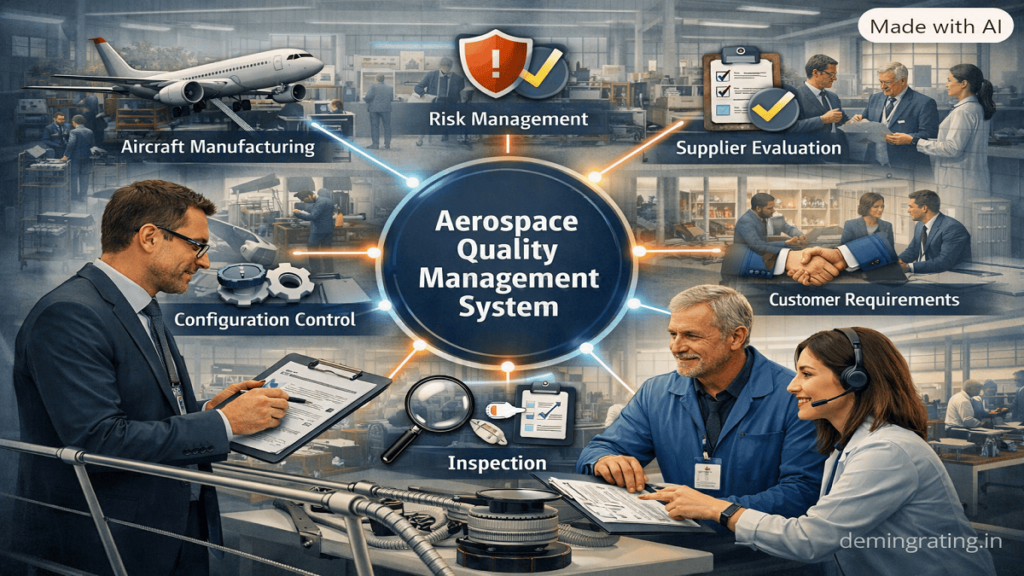
How Does AS9100 Rev C Address Risk Management, Product Safety, and Supplier Control?
AS9100 Rev C strengthened aerospace quality management by introducing additional controls that addressed the industry’s higher levels of operational, product, and supply-chain risk. The standard was based on ISO 9001:2008 but added aerospace-specific requirements for aviation, space, and defense organizations. SAE identifies AS9100C as a standard that adds industry requirements to the ISO 9001 framework. (SAE Mobilus)
Risk Management
Risk management was a significant addition in AS9100 Rev C. Under Clause 7.1.2, organizations were required to establish, implement, and maintain a process for managing risks associated with achieving applicable requirements.
The process included several key elements: assigning responsibility for risk management, establishing risk criteria such as likelihood, consequences, and risk acceptance, identifying and assessing risks throughout product realization, communicating identified risks, implementing mitigation actions when risks exceeded acceptable criteria, and formally accepting any remaining risk after mitigation. (ASQ)
This approach encouraged organizations to address potential problems before they resulted in product failures or delivery issues. Risk management could therefore influence project planning, manufacturing, inspection, suppliers, materials, and other product-realization activities.
Product Safety
Product safety was incorporated into AS9100 Rev C as an important consideration during product realization and design-related activities. Organizations needed to consider factors such as product and personnel safety, reliability, availability, maintainability, producibility, inspectability, and the suitability of parts and materials. (Mitti Content Library)
This was particularly important in aerospace because a quality failure can have consequences extending far beyond the manufacturer. The standard’s approach encouraged organizations to identify safety-related requirements and controls during planning, design, production, inspection, and delivery rather than treating safety solely as a final inspection activity.
Supplier Control
AS9100 Rev C also introduced stronger controls over the aerospace supply chain. Organizations were required to evaluate and select suppliers based on their ability to meet specified requirements and determine the type and extent of controls appropriate to purchased products and services.
The standard called for maintaining supplier approval information, periodically reviewing supplier performance, defining actions for suppliers that failed to meet requirements, and managing risks associated with supplier selection and use. Where applicable, customer-approved sources for special processes also had to be used. (Scribd)
Purchasing information could include technical specifications, inspection requirements, personnel qualifications, quality-system requirements, critical characteristics, notification of changes, nonconformance reporting, and applicable requirements that needed to be flowed down through the supply chain. (Scribd)
Overall Impact
By combining risk management, product-safety considerations, and supplier controls, AS9100 Rev C created a more proactive quality framework for aerospace organizations. Rather than focusing only on detecting defects after production, it emphasized identifying risks, preventing failures, controlling suppliers, and maintaining conformity throughout the product life cycle.
It is worth noting that AS9100 Rev C is now a historical edition and has been superseded by later revisions. Organizations seeking current aerospace certification should consult the applicable current AS9100 requirements.
External resources: SAE International — AS9100C | International Aerospace Quality Group (IAQG)
#AerospaceIndustry
What Steps Should an Organization Take to Prepare for an AS9100 Rev C Certification Audit?
Preparing for an AS9100 Rev C certification audit requires an organization to demonstrate that its aerospace Quality Management System (QMS) is not only documented but also effectively implemented. Although Rev C has been superseded by later editions, understanding its audit-preparation process remains useful for organizations reviewing legacy certification requirements. The IAQG certification scheme uses independent third-party certification bodies and audits against applicable aerospace quality requirements. (IAQG)
1. Understand the Applicable Requirements
Begin by reviewing AS9100 Rev C requirements and identifying how each requirement applies to the organization’s activities. Management should define the QMS scope, processes, responsibilities, and applicable customer, statutory, regulatory, and contractual requirements.
2. Conduct a Gap Analysis
Perform a detailed gap assessment comparing the existing QMS with AS9100 Rev C. Review areas such as document control, risk management, product safety, configuration management, supplier control, production processes, traceability, nonconforming products, corrective action, and records.
Document every identified gap and establish an action plan with responsibilities and completion dates. A structured gap analysis is also recommended as part of modern AS9100 certification preparation. (TÜV SÜD)
3. Implement and Document the QMS
Correct identified deficiencies and ensure that documented procedures reflect actual business practices. Employees should be able to demonstrate how their work contributes to quality objectives and customer requirements.
Particular attention should be given to supplier controls, product realization, risk management, configuration control, and product safety, as these are important aerospace-specific considerations.
4. Train Employees
Personnel should understand the procedures relevant to their responsibilities. Training should cover quality policies, work instructions, inspection requirements, nonconformance reporting, traceability, and other applicable aerospace controls.
5. Complete Internal Audits
Conduct a comprehensive internal audit before the certification audit. Auditors should examine both documentation and actual process implementation and collect objective evidence. Findings should be documented, corrected, and followed through to effective corrective action. IAQG guidance emphasizes audit evidence, reporting, corrective action, and retention of audit records. (IAQG)
6. Conduct Management Review
Management should formally review QMS performance and address issues such as audit results, customer feedback, process performance, nonconformities, supplier performance, risks, and opportunities for improvement. Certification bodies generally expect evidence that the QMS has been operating and has undergone management review before initial certification. (NQA)
7. Select an Appropriate Certification Body
Choose an accredited certification body participating in the applicable IAQG certification scheme. The IAQG states that organizations seeking certification should select and contract with a suitable accredited Certification Body (CB). (IAQG)
8. Prepare for the Audit
Before the audit, verify that procedures, records, personnel, production areas, equipment, and documented information are readily accessible. Employees should answer auditors honestly and demonstrate how processes are actually performed rather than simply describing procedures.
Finally, review all outstanding corrective actions and ensure that evidence demonstrates effective resolution. Good preparation should focus on consistent implementation and objective evidence, not merely creating documents for the audit.
Important: AS9100 Rev C is a superseded edition. Organizations seeking certification today should verify the applicable current AS9100 requirements and certification scheme with an accredited certification body.
External resources: IAQG Certification Scheme | IAQG Standards and Requirements | SAE International Aerospace Standards
#QualityManagementSystem
What Are the Benefits of AS9100 Rev C Certification for Quality, Compliance, Customer Confidence, and Aerospace Business Opportunities?
AS9100 Rev C Certification provided aerospace organizations with a structured Quality Management System (QMS) designed to address the demanding quality, safety, reliability, and supply-chain requirements of the aviation, space, and defense sectors. Although Rev C has been superseded by later editions, its core approach demonstrates why aerospace certification became an important business requirement across the industry.
1. Improved Quality and Process Control
AS9100 Rev C extended the ISO 9001 quality-management framework with aerospace-specific controls. Its implementation could help organizations improve process consistency, product conformity, traceability, risk management, supplier performance, and continual improvement. A systematic QMS can also help identify process weaknesses before they result in defects, delays, or customer complaints.
The IAQG states that the 9100 series is intended to standardize quality requirements throughout the aerospace supply chain and improve quality, schedule, and cost performance. (IAQG)
2. Stronger Compliance
Aerospace companies operate under extensive customer, statutory, regulatory, and contractual requirements. AS9100 certification provides documented evidence that an organization’s QMS has been independently assessed against aerospace-specific requirements.
However, certification should not be considered a substitute for legal or regulatory compliance. Organizations must continue to identify and satisfy the specific requirements applicable to their products, markets, customers, and operations.
3. Greater Customer Confidence
Certification can strengthen confidence among aerospace customers by demonstrating that an organization has established controlled and repeatable quality processes. Independent certification through the IAQG certification scheme provides internationally recognized evidence of an organization’s aerospace QMS. (IAQG)
It can also improve confidence in areas such as product quality, supplier management, traceability, risk control, and continual improvement.
4. Access to Aerospace Business Opportunities
One of the most significant commercial benefits is improved access to the aerospace supply chain. Major aerospace manufacturers and other customers may specify 9100-series certification as a supplier qualification or procurement requirement. NQA notes that certification can provide access to large OEMs and broader supply-chain opportunities. (NQA)
Certified organizations can also gain visibility through the Online Aerospace Supplier Information System (OASIS), which contains information on suppliers certified under the IAQG 9100-series certification scheme. (IAQG)
5. Reduced Duplication and Greater Efficiency
The IAQG certification scheme was created to harmonize aerospace certification and reduce the need for individual customer audits. This can reduce duplicated assessments and associated time and costs for both suppliers and customers. (IAQG)
Overall, AS9100 certification can support better quality, stronger process control, customer confidence, supply-chain credibility, and access to aerospace markets. Nevertheless, organizations should remember that AS9100 Rev C is a superseded edition; companies pursuing certification today should consult the applicable current 9100-series requirements.
External resources: IAQG — 9100 Quality Management Systems | IAQG Certification Scheme | IAQG OASIS
#AerospaceCertification

Case Study of AS9100 Rev C Certification
Background
Bosch Communications Systems, formerly Telex Communications, was an aerospace supplier whose aviation headset products were supplied to major customers, including Boeing. In 2006, Bosch Corporation acquired Minnesota-based Telex Communications and subsequently faced an important customer requirement: Boeing required its suppliers to achieve certification to AS9100, the aerospace Quality Management System standard.
The case is particularly relevant to organizations studying AS9100 Rev C because the certification initiative occurred during the period leading up to the 2009 revision. AS9100C, revised by SAE on January 15, 2009, incorporated ISO 9001:2008 requirements together with additional aviation, space, and defense requirements.
The Challenge
Bosch Communications needed to establish a robust quality management system capable of satisfying aerospace customer expectations while also preparing employees to understand and implement the applicable requirements.
Rather than treating certification simply as a documentation exercise, the organization launched a structured initiative involving employee training, internal auditing, cross-functional participation, and preparation for the external certification audit. The company contracted with ASQ to provide AS9100 lead-auditor and internal-auditor training to a cross-functional team.
Implementation Approach
The organization focused on building internal competence and audit capability. Employees from different functions were trained to understand the standard and participate in the auditing process. This helped create broader organizational ownership of the Quality Management System instead of leaving certification responsibility solely with the quality department.
The approach also supported the aerospace industry’s emphasis on controlled processes, customer requirements, documented quality practices, and continual improvement. The 9100:2009 framework introduced or strengthened areas such as project management, risk management, configuration management, work transfer, customer-satisfaction monitoring, and control of special requirements and key characteristics.
Result
Bosch Communications achieved both AS9100 and ISO 9001 certification in October 2008, approximately 11 months after beginning its certification effort.
This result demonstrates how a focused certification programme can combine leadership commitment, employee training, internal auditing, and systematic preparation to meet demanding aerospace customer expectations.
Key Lessons for Organizations
The Bosch case provides several important lessons for organizations pursuing AS9100 certification:
- Customer requirements can be a powerful certification driver. Aerospace customers may require suppliers to demonstrate conformity to recognized aerospace quality standards.
- Employee competence is critical. Training auditors and involving personnel across functions helps convert standard requirements into practical processes.
- Internal auditing should begin before certification. Internal audits help organizations identify weaknesses and prepare for independent assessment.
- Certification should strengthen the business, not merely create documents. Effective implementation integrates quality requirements into everyday operations.
- Leadership and cross-functional participation accelerate implementation. Certification becomes more sustainable when responsibility is shared across the organization.
Conclusion
The Bosch Communications case illustrates how an aerospace supplier can respond effectively to demanding customer expectations through structured AS9100 implementation, employee involvement, auditor training, and disciplined preparation. It also demonstrates the strategic value of aerospace quality certification in strengthening customer confidence and supporting participation in the aerospace supply chain.
Historical note: AS9100C was revised on January 15, 2009 and has since been superseded by AS9100D, issued in September 2016. Therefore, AS9100C should be treated as a historical revision when discussing current certification requirements. SAE identifies AS9100C as historical and AS9100D as the subsequent revision.
For current aerospace certification, organizations should also consider the IAQG certification scheme, which uses accredited third-party certification bodies and the OASIS system for aerospace quality-management-system certification information.
#AerospaceQuality
White Paper on AS9100 Rev C Certification
Executive Summary
AS9100 Rev C Certification represented an important milestone in the development of aerospace, space, and defense quality management systems. Published by SAE International on January 15, 2009, AS9100C incorporated the requirements of ISO 9001:2008 and added industry-specific requirements designed for organizations operating within the highly regulated aviation, space, and defense supply chain.
The standard was designed for organizations that needed to consistently provide products meeting customer, statutory, and regulatory requirements while improving customer satisfaction and continually improving the effectiveness of their Quality Management System (QMS).
This white paper examines the purpose of AS9100C, its major quality-management expectations, certification approach, organizational benefits, implementation challenges, and lessons for aerospace suppliers. Because AS9100C is now a historical revision, the paper also explains why organizations researching it should distinguish historical certification requirements from today’s applicable 9100-series requirements.
1. Introduction
Aerospace manufacturing and services require a particularly disciplined approach to quality. Components and services can have significant implications for aircraft safety, mission success, reliability, regulatory compliance, and customer performance.
AS9100 was developed to establish a common aerospace Quality Management System framework that extends ISO 9001 requirements with additional aviation, space, and defense expectations. AS9100C specifically incorporated ISO 9001:2008 requirements and added aerospace, space, and defense requirements.
The objective was not simply to create additional documentation. The standard sought to improve an organization’s ability to control processes, satisfy customer requirements, manage risks, and consistently deliver conforming products and services.
2. Purpose of AS9100 Rev C
AS9100C provided a structured framework for organizations that needed to demonstrate their ability to consistently meet customer and applicable statutory and regulatory requirements.
The standard emphasized a Quality Management System capable of supporting:
- Consistent product and service conformity
- Customer satisfaction
- Process control
- Continual improvement
- Regulatory and contractual compliance
- Aerospace-specific quality requirements
- Effective management of operational risks
An important characteristic of AS9100C was that its requirements were complementary to contractual, statutory, and regulatory requirements, rather than replacing them. Where applicable law or regulation conflicted with the standard, those legal or regulatory requirements took precedence.
3. Relationship Between ISO 9001 and AS9100C
AS9100C was built on ISO 9001:2008 but introduced additional aerospace-specific requirements.
This approach allowed aerospace organizations to establish a QMS based on internationally recognized quality-management principles while addressing the specialized needs of the aviation, space, and defense industries.
The additional requirements helped organizations address areas such as:
- Configuration management
- Product realization
- Risk-related controls
- Special processes
- Key characteristics
- Supplier management
- Product safety
- Design and development controls
- Traceability
- Nonconforming product
- Corrective and preventive action
Consequently, an organization could use its ISO 9001 foundation as a starting point while strengthening its processes to meet aerospace-sector expectations.
4. Major Areas of AS9100C Implementation
4.1 Quality Management System
Organizations were expected to establish, document, implement, maintain, and continually improve their QMS.
The system needed to address applicable customer, statutory, and regulatory requirements and demonstrate effective control of relevant processes.
4.2 Customer and Contract Requirements
Aerospace suppliers frequently work with detailed customer specifications and contractual obligations. AS9100C emphasized the need to properly determine and review customer requirements before committing to supply products or services.
Effective contract review helps organizations identify requirements that could affect quality, delivery, technical performance, or regulatory compliance.
4.3 Design and Development
Where applicable, organizations needed controlled design and development processes. These controls supported systematic planning, design inputs and outputs, verification, validation, reviews, and change management.
This is particularly important in aerospace because design changes can affect safety, reliability, interchangeability, and product performance.
4.4 Purchasing and Supplier Control
Aerospace organizations depend heavily on external suppliers and special-process providers. AS9100C therefore placed significant emphasis on controlling purchased products and services.
Organizations needed appropriate methods for evaluating suppliers, defining purchasing requirements, verifying purchased products, and monitoring supplier performance.
4.5 Production and Process Control
Production activities needed to be performed under controlled conditions. Depending on the product and process, controls could include documented instructions, suitable equipment, competent personnel, inspection activities, process monitoring, and traceability.
The objective was to reduce variation and prevent defects before products reached customers.
4.6 Risk, Critical Items, and Key Characteristics
Aerospace products can contain features whose variation has a significant effect on fit, form, function, performance, service life, or producibility.
AS9100C addressed concepts such as special requirements, critical items, and key characteristics, requiring appropriate controls where these conditions applied.
This strengthened the connection between engineering requirements, production controls, inspection, and product integrity.
5. Internal Auditing and Corrective Action
Internal auditing was an important mechanism for determining whether the QMS was effectively implemented.
A strong internal audit programme could evaluate:
- Compliance with documented procedures
- Effectiveness of operational processes
- Customer requirements
- Supplier controls
- Product realization
- Records and traceability
- Nonconformity management
- Corrective-action effectiveness
When an audit identified a nonconformity, the organization needed to determine appropriate corrective action and address the underlying cause rather than simply correcting the immediate problem.
This approach supports continual improvement by converting audit findings into opportunities to strengthen processes.
6. AS9100C Certification Process
Certification involved an independent assessment of the organization’s QMS by an appropriate certification body.
Under the IAQG certification model, aerospace QMS certification is based on an accredited third-party certification approach. The IAQG certification scheme was established to provide globally recognized and harmonized certification for organizations within the aerospace supply chain.
A typical certification programme includes:
- Understanding the applicable standard and requirements
- Conducting a QMS gap assessment
- Developing or improving processes
- Establishing required documented information
- Training personnel
- Conducting internal audits
- Implementing corrective actions
- Selecting an appropriate certification body
- Completing the certification audit
- Addressing audit findings
- Maintaining and continually improving the QMS
The IAQG certification framework also uses OASIS, the Online Aerospace Supplier Information System, for aerospace certification and audit information.
7. Benefits of AS9100C Certification
AS9100C certification could provide significant strategic and operational benefits to aerospace organizations.
Improved Customer Confidence
Certification demonstrated that an organization had implemented a recognized aerospace Quality Management System and subjected that system to independent assessment.
Stronger Process Control
The structured requirements encouraged organizations to establish repeatable and controlled processes.
Better Supplier Management
Formal supplier evaluation and monitoring could reduce risks associated with externally provided products and services.
Improved Risk Awareness
Aerospace-specific requirements encouraged organizations to identify and control conditions that could affect product conformity and performance.
Increased Market Opportunities
Aerospace customers and prime contractors frequently require suppliers to demonstrate conformity with recognized aerospace quality requirements. Certification could therefore support supplier qualification and business opportunities.
Continual Improvement
Internal auditing, corrective action, performance monitoring, and management review provided mechanisms for identifying weaknesses and improving QMS effectiveness.
8. Common Implementation Challenges
Organizations implementing AS9100C could encounter several challenges.
Documentation overload: Companies sometimes interpreted certification as a requirement to create excessive documentation. Effective implementation instead focuses on useful controls and objective evidence.
Employee resistance: New procedures and controls may initially be perceived as additional administrative work. Training and employee involvement can improve acceptance.
Weak internal auditing: Audits that focus only on paperwork may fail to identify actual process risks.
Supplier control difficulties: Aerospace supply chains can involve numerous suppliers, subcontractors, and special-process providers, making effective supplier monitoring essential.
Corrective-action weaknesses: Closing findings without addressing root causes can allow recurring problems to continue.
Integration challenges: Quality requirements should be integrated into engineering, purchasing, manufacturing, inspection, and management processes rather than isolated within the quality department.
9. Management Responsibility
Successful AS9100 implementation requires leadership involvement.
Management plays an important role in establishing quality objectives, providing resources, reviewing QMS performance, supporting employee competence, and ensuring that customer and regulatory requirements are understood.
Certification should therefore be viewed as a business-management initiative rather than simply a quality-department project.
When leadership connects aerospace quality requirements with operational performance, organizations are more likely to achieve sustainable improvements.
10. AS9100C as a Historical Standard
AS9100C should now be understood in its historical context.
SAE records AS9100C as revised on January 15, 2009 and identifies AS9100D as its subsequent revision. AS9100C is therefore not the current basis for new aerospace certification.
The IAQG currently describes the 9100 series as the Aerospace Quality Management System standards used across the aviation, space, and defense supply chain. The current certification framework uses accredited certification bodies and the IAQG certification scheme.
Organizations researching AS9100C should therefore use historical material to understand the evolution of aerospace quality requirements, while organizations seeking certification today should determine the current applicable 9100-series requirements.
11. Lessons for Aerospace Organizations
The experience of AS9100C provides several lasting lessons:
- Quality must be integrated into business processes.
- Customer and regulatory requirements must be clearly understood.
- Supplier performance can directly influence product quality.
- Internal audits should identify real process weaknesses.
- Corrective action should address root causes.
- Employee competence is essential to QMS effectiveness.
- Risk and product-safety considerations should influence process controls.
- Certification should support continual improvement rather than become a one-time compliance exercise.
12. Conclusion
AS9100 Rev C played an important role in strengthening Quality Management Systems throughout the aviation, space, and defense industries. By combining ISO 9001:2008 requirements with additional aerospace-specific controls, AS9100C provided organizations with a framework for improving process consistency, customer satisfaction, supplier control, product conformity, and continual improvement.
Although AS9100C has been superseded by later revisions, its underlying principles remain relevant to understanding the evolution of aerospace quality management. Its emphasis on controlled processes, customer requirements, risk-related considerations, supplier management, internal auditing, corrective action, and continual improvement continues to provide valuable lessons for aerospace organizations.
For organizations pursuing certification today, the appropriate approach is to reference the current applicable 9100-series requirements and IAQG certification scheme, rather than treating AS9100C as a current certification standard. The IAQG certification scheme continues to provide a globally harmonized framework for aerospace QMS certification through accredited third-party certification bodies.
#AS9100RevC
Industry Application of AS9100 Rev C Certification
AS9100 Rev C Certification was designed primarily for organizations operating within the aviation, space, and defense industries. Published by SAE International in January 2009, AS9100C incorporated ISO 9001:2008 Quality Management System requirements together with additional requirements specific to aerospace, space, and defense organizations. The standard was intended to help organizations consistently provide products that meet customer, statutory, and regulatory requirements while improving customer satisfaction and continually improving their quality management systems.
1. Aviation and Aerospace Manufacturing
A major application of AS9100C was in the manufacture of aircraft components, assemblies, materials, and related products. Manufacturers could use the standard to strengthen process control, traceability, inspection, configuration management, supplier management, and control of nonconforming products.
For aerospace manufacturers, these controls are particularly important because product defects can affect aircraft reliability, safety, performance, and regulatory compliance.
2. Aerospace Parts and Component Suppliers
Small and medium-sized suppliers producing precision components, fabricated parts, machined products, electrical assemblies, or specialized materials could apply AS9100C to establish a structured QMS.
Certification could also strengthen their position within the aerospace supply chain because aerospace customers and prime contractors often expect suppliers to demonstrate conformity to recognized aerospace quality requirements.
3. Defense Industry
AS9100C was also applicable to organizations supplying products and services to defense programmes. Defense manufacturers could apply its QMS requirements to improve production consistency, documentation, traceability, supplier control, and compliance with contractual requirements.
The standard’s requirements were complementary to contractual, statutory, and regulatory obligations; applicable legal and regulatory requirements took precedence where conflicts existed.
4. Space Industry
Space organizations operate under demanding requirements involving reliability, precision, traceability, configuration control, and product integrity. AS9100C provided a quality-management framework that could be applied to organizations producing spacecraft components, systems, assemblies, and related products.
A controlled QMS helped organizations manage design, production, inspection, supplier activities, and corrective actions systematically.
5. Aerospace Design and Engineering Organizations
Organizations involved in aerospace design and engineering could apply relevant AS9100C requirements to control design and development activities, engineering changes, verification, validation, documentation, and configuration.
These controls helped ensure that engineering requirements were properly translated into production and inspection activities.
6. Aerospace Material and Special-Process Suppliers
Material suppliers and organizations performing specialized manufacturing processes were another important part of the aerospace supply chain. AS9100-based quality controls helped organizations demonstrate consistent process performance, product conformity, documentation, and traceability.
7. Aerospace Distribution and Supply-Chain Organizations
Organizations involved in aerospace distribution and supply-chain activities could use aerospace QMS requirements to strengthen product identification, preservation, traceability, purchasing controls, and supplier management.
The broader 9100 framework is intended for use throughout different levels of the aerospace supply chain.
8. Maintenance, Repair, and Overhaul
Although AS9100C was focused on organizations providing products and related outputs, the wider 9100 family also includes standards addressing other aerospace activities. Organizations involved in maintenance, repair, and overhaul are generally associated with the AS9110 standard rather than AS9100.
9. Quality and Inspection Organizations
Quality-management and inspection functions supporting aerospace manufacturers could use AS9100C requirements to establish stronger approaches to inspection, nonconformity control, corrective action, internal auditing, and process monitoring.
10. Business and Supply-Chain Benefits
Across these industries, AS9100C certification could support improved process consistency, customer confidence, supplier control, quality performance, and access to aerospace supply chains. IAQG describes the 9100 standard as being applicable across the supply chain and intended to improve quality, schedule, and cost performance through standardized requirements and good practices.
Historical Context
AS9100C should now be treated as a historical revision. SAE records AS9100C as revised January 15, 2009, with AS9100D subsequently revised in September 2016. SAE’s current AS9100D listing shows the later revision, while IAQG describes the 9100 standard as the aerospace QMS framework for aviation, space, and defense organizations.
Therefore, organizations researching AS9100 Rev C can use it to understand the evolution of aerospace quality management, while organizations seeking certification today should refer to the current applicable 9100-series requirements.
In summary, AS9100 Rev C Certification was particularly valuable across aviation, aerospace manufacturing, defense, space, engineering, component manufacturing, material supply, and supporting aerospace supply-chain activities. Its focus on controlled processes, customer requirements, traceability, supplier management, conformity, and continual improvement helped establish a common quality-management foundation across the aerospace sector.
#AS9100
Ask FAQs
What is AS9100 Rev C Certification?
AS9100 Rev C Certification was an independent assessment of an organization’s Quality Management System against the AS9100 Rev C requirements for aviation, space, and defense organizations. It extended the ISO 9001:2008 framework with additional aerospace-specific requirements.
What are the main benefits of AS9100 Rev C Certification?
The certification helped organizations strengthen quality management, process control, risk management, traceability, supplier management, and continual improvement. It also provided evidence to customers that the organization had implemented a structured aerospace quality system.
Does AS9100 Rev C Certification improve customer confidence?
Yes. Certification by an accredited third-party certification body can provide objective evidence that an organization’s QMS has been independently assessed. The IAQG certification scheme was designed to provide globally recognized and verifiable aerospace QMS certifications.
Can AS9100 Certification help an organization win aerospace contracts?
Yes. Aerospace customers and supply-chain organizations may require 9100-series certification as part of supplier qualification. Certification can therefore support access to aerospace supply-chain opportunities. Certified supplier information is also maintained through the IAQG’s OASIS system.
Is AS9100 Rev C still the current certification standard?
No. AS9100 Rev C is a superseded edition. Organizations pursuing certification today should use the applicable current 9100-series requirements rather than Rev C. The IAQG currently identifies the 9100 standard as the aerospace Quality Management System standard for aviation, space, and defense organizations.
Short Disclaimer
Disclaimer: This content is for general informational purposes only and should not be considered professional certification, legal, or regulatory advice. AS9100 Rev C is a superseded standard; organizations should refer to the applicable current IAQG requirements for certification. (iaqg.org)