Quality Audits
Table of Contents
Quality audits are a systematic and objective method used by organizations to evaluate whether their processes, activities, and management systems are operating as planned and meeting applicable requirements. Unlike product inspection, which primarily focuses on whether an individual product or service meets specified requirements, an audit examines the processes and systems that support quality performance. Audits can therefore provide valuable insight into compliance, process effectiveness, risks, and opportunities for improvement.
A quality audit may be conducted internally by an organization’s own personnel, externally by customers or suppliers, or by an independent certification body. The purpose and scope can vary depending on the organization and the audit objectives. Internal audits, for example, help management determine whether the Quality Management System (QMS) is effectively implemented and maintained. Supplier audits can evaluate whether external providers are meeting defined requirements, while certification audits assess conformity with the requirements of a particular standard.
ISO 19011 provides internationally recognized guidance for auditing management systems. It covers principles of auditing, management of audit programmes, conducting audits, and evaluating the competence of people involved in the audit process. The newly published ISO 19011:2026 also emphasizes evidence-based and risk-based auditing approaches.
An effective quality audit normally begins with defining the audit objectives, scope, criteria, and schedule. Auditors then collect objective evidence through activities such as interviews, observation, document review, and examination of records. The evidence is compared with established audit criteria to determine conformity or identify findings. Where weaknesses or nonconformities are identified, appropriate corrective actions can be developed and their effectiveness subsequently evaluated.
Quality audits should not be viewed simply as fault-finding exercises. Their broader purpose is to provide management with reliable information about how well processes are performing and where improvements may be required. Effective audits can help organizations strengthen controls, reduce recurring problems, improve consistency, support compliance, and encourage continual improvement. ISO notes that effective auditing can help organizations strengthen management systems, improve performance, and build confidence among customers and stakeholders.
For organizations implementing standards such as ISO 9001, AS9100, ISO 14001, or other management-system standards, quality audits are an important mechanism for verifying that documented requirements are translated into effective day-to-day practices. A well-planned audit programme therefore becomes more than a compliance activity—it becomes a practical management tool for improving organizational performance and sustaining customer confidence.
External resource: ISO 19011:2026 – Guidelines for auditing management systems
#QualityCompliance
What Are Quality Audits and Why Are They Important?
Quality audits are systematic, independent, and documented activities used to collect objective evidence and determine whether defined quality requirements are being fulfilled. An audit may evaluate an entire Quality Management System (QMS), a particular process, department, supplier, or production activity. According to ASQ, quality audits can be used to verify conformity with organizational policies, contractual commitments, regulatory requirements, and applicable standards.
Unlike quality inspection, which primarily examines products or services to determine whether they meet specified requirements, auditing focuses on the processes and systems that support quality. This distinction makes audits an important management tool for identifying weaknesses before they result in recurring defects, customer complaints, or other quality problems. ISO also explains that auditing evaluates the effectiveness of systems and processes and can identify opportunities for continual improvement.
Why Are Quality Audits Important?
One of the primary benefits of quality audits is improved process control. By examining how work is actually performed against documented procedures and requirements, organizations can identify inconsistencies, ineffective controls, unnecessary activities, and potential risks. Audit findings can then be used to establish corrective actions and improve process performance.
Quality audits also support compliance. Organizations operating under standards such as ISO 9001, AS9100, ISO 14001, or industry-specific requirements need reliable methods for verifying that their management systems are implemented and maintained. ISO 19011 provides guidance for conducting first-, second-, and third-party management-system audits and for managing audit programmes.
Another important advantage is early problem detection. Audits can reveal gaps in documentation, training, supplier management, operational controls, recordkeeping, or corrective-action processes before these weaknesses become major failures. This proactive approach can help reduce rework, waste, costs, and customer dissatisfaction.
Audits can also strengthen customer confidence. Demonstrating that processes are regularly evaluated using objective evidence shows customers and other stakeholders that the organization takes quality and continual improvement seriously. ISO identifies effective auditing as a means of strengthening management systems, improving performance, and building confidence.
Quality audits generally fall into three categories: first-party audits, performed internally; second-party audits, commonly performed on suppliers or external providers; and third-party audits, performed independently for purposes such as certification. Each type provides a different perspective on organizational performance.
Ultimately, a quality audit should not be viewed simply as a search for mistakes or nonconformities. A well-planned audit provides management with objective information about whether processes are effective, requirements are being met, and improvement opportunities exist. When audit findings are properly analyzed and followed by effective corrective action, auditing becomes a powerful tool for quality improvement, risk reduction, compliance, operational efficiency, and customer satisfaction.
External resource: ISO 19011:2026 – Guidelines for auditing management systems
#ProcessImprovement
What Are the Different Types of Quality Audits Organizations Can Conduct?
Organizations can conduct several types of quality audits to evaluate their products, processes, management systems, suppliers, and compliance obligations. The appropriate audit type depends on the organization’s objectives, risk level, contractual requirements, and quality-management needs. ASQ identifies product, process, and system audits as major audit methods, while audits can also be classified according to the relationship between the auditor and the organization being audited.
1. First-Party or Internal Audit
A first-party audit is conducted by or on behalf of the organization itself. Internal auditors evaluate processes and the Quality Management System (QMS) against internal procedures, policies, applicable standards, and other defined requirements. These audits help identify nonconformities, weaknesses, risks, and improvement opportunities before they become significant problems.
2. Second-Party or Supplier Audit
A second-party audit is generally performed by a customer on its supplier or by an organization acting on behalf of the customer. These audits evaluate whether suppliers can consistently meet specified quality, technical, contractual, and delivery requirements. Supplier audits are particularly important when purchased materials, components, or services can significantly affect final product quality.
3. Third-Party or Certification Audit
A third-party audit is performed by an independent auditing organization. These audits may be conducted to determine conformity with a recognized management-system standard and can result in certification when applicable requirements are satisfied. Certification audits are therefore different from internal audits because the auditor is independent of the customer-supplier relationship.
4. Product Audit
A product audit examines a specific product or service to determine whether it conforms to defined specifications, performance requirements, customer requirements, and other applicable criteria. The audit may review characteristics such as dimensions, functionality, documentation, labeling, packaging, or required test results.
5. Process Audit
A process audit evaluates whether a particular process is being performed as planned and whether it is capable of achieving the intended results. For example, an organization might audit its purchasing, manufacturing, inspection, design, maintenance, or corrective-action process. The auditor typically compares actual practices with documented procedures and requirements.
6. System Audit
A system audit examines the broader QMS or multiple interconnected processes. Rather than focusing on one product or activity, it evaluates whether the overall management system is properly established, implemented, and effective. System audits are often more comprehensive and may involve several auditors and departments.
7. Compliance Audit
A compliance audit focuses on conformity with specific standards, regulations, contractual requirements, customer specifications, or organizational policies. It can be particularly valuable in highly regulated industries where failure to meet requirements may create significant operational or legal risks.
8. Follow-Up or Corrective-Action Audit
A follow-up audit verifies whether previously identified nonconformities or corrective actions have been properly addressed and whether the implemented actions are effective. This prevents organizations from simply closing findings without confirming that the underlying problem has actually been resolved.
In practice, organizations may combine several approaches. For example, an aerospace company could perform an internal process audit, a supplier audit, and a product audit as part of one broader quality-improvement programme. ISO 19011 provides guidance for managing and conducting management-system audits, particularly first- and second-party audits.
The most effective audit programme is therefore one that uses different audit types strategically according to risk, process importance, customer expectations, compliance obligations, and opportunities for improvement. When properly planned and supported by objective evidence, quality audits become an important tool for maintaining conformity, preventing problems, improving processes, and strengthening customer confidence.
External resources: ASQ – Auditing Resources | ISO 19011 – Guidelines for auditing management systems
#ContinuousImprovement
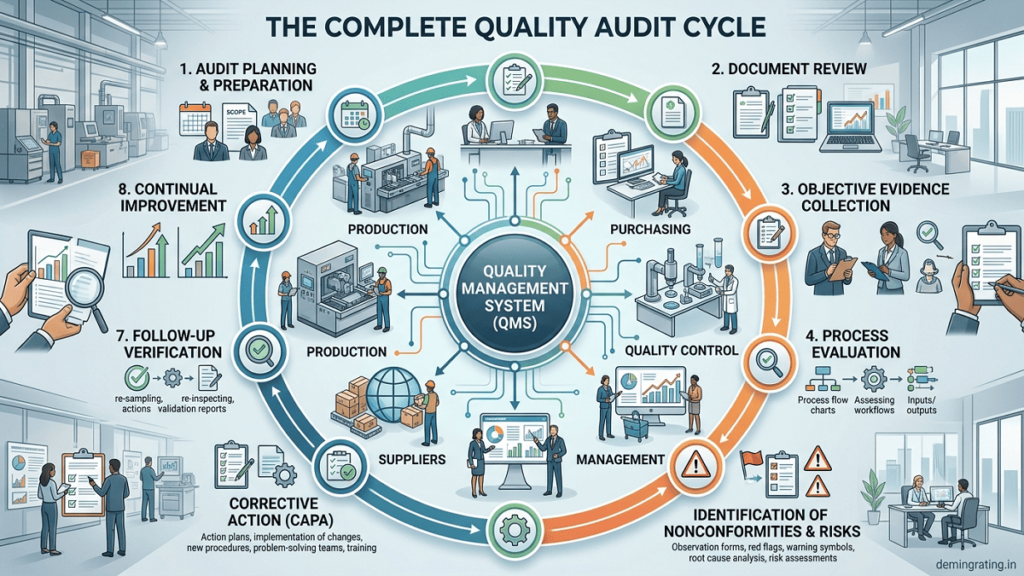
How Do Quality Audits Identify Nonconformities, Risks, and Process Weaknesses?
Quality audits provide organizations with a structured method for examining whether processes and management systems are operating as intended. Auditors compare objective evidence—such as records, documents, observations, measurements, interviews, and process results—with defined audit criteria. ISO 19011:2026 describes audit findings as the results of evaluating collected audit evidence against audit criteria; these findings can indicate conformity or nonconformity and can also reveal risks and opportunities for improvement.
1. Comparing Actual Practices with Requirements
The first step is to establish what should happen. Auditors review applicable standards, procedures, work instructions, customer requirements, regulatory obligations, and internal policies. They then examine what actually happens in the workplace.
For example, if a procedure requires inspection records to be completed and retained, an auditor may sample records and verify whether the required information is present, accurate, and properly controlled. A gap between the defined requirement and objective evidence may constitute a nonconformity.
ASQ emphasizes that a well-supported nonconformity should clearly connect the applicable requirement with the specific evidence observed and explain how that evidence demonstrates noncompliance.
2. Observing Processes in Operation
Auditors do not rely only on documents. During process audits, they observe employees performing activities, examine equipment and materials, review controls, and evaluate whether established procedures are actually effective.
This can reveal process weaknesses such as inconsistent work practices, inadequate training, unclear responsibilities, ineffective controls, outdated instructions, or gaps between documented procedures and actual operations. ASQ notes that process audits evaluate resources, methods, controls, and measurements to determine both conformity and effectiveness.
3. Reviewing Trends and Records
Quality records can reveal recurring problems that may not be obvious during a single observation. Auditors may examine customer complaints, defects, rework, scrap, corrective actions, supplier performance, inspection results, audit findings, and process-performance data.
Repeated failures or overdue corrective actions may indicate a systemic weakness rather than an isolated incident.
4. Identifying Risks
Audits can also identify conditions that could cause future nonconformities or failures. For example, inadequate supplier controls, insufficient employee competency, missing preventive controls, poorly maintained equipment, or weak change management may represent potential risks even when no current defect has been identified.
ISO 19011:2026 specifically recognizes that audit findings can lead to identification of risks and opportunities for improvement.
5. Following Up on Corrective Actions
The audit process does not necessarily end when findings are reported. Follow-up activities can verify whether corrections and corrective actions were implemented and whether they effectively addressed the underlying causes. ASQ identifies follow-up and verification as important parts of the audit cycle.
Ultimately, quality audits help organizations move beyond simply detecting individual defects. By systematically examining requirements, evidence, processes, trends, and risks, audits can uncover nonconformities, expose weaknesses, prevent recurring problems, and identify opportunities for continual improvement. When findings are properly analyzed and corrective actions are verified, auditing becomes a practical tool for strengthening the overall Quality Management System and improving organizational performance.
External resources: ISO 19011:2026 – Guidelines for auditing management systems | ASQ – Auditing Resources
#QualityAssurance
How Can Organizations Prepare Effectively for Internal and External Quality Audits?
Effective preparation is essential for ensuring that quality audits provide meaningful results and that organizations can demonstrate conformity with applicable requirements. Whether the audit is internal, customer-driven, supplier-related, or third-party, preparation should focus on understanding requirements, reviewing objective evidence, evaluating actual processes, and addressing weaknesses before the audit begins. ISO 19011 provides guidance for managing audit programmes and conducting management-system audits, while ASQ describes preparation, performance, reporting, and follow-up as important elements of the audit process.
1. Understand the Audit Criteria
Organizations should first identify the requirements against which they will be audited. These may include management-system standards, internal procedures, customer specifications, contractual obligations, regulatory requirements, or industry-specific requirements. Clearly understanding the audit scope, objectives, criteria, and processes helps departments prepare relevant evidence rather than creating unnecessary documentation.
2. Review Documentation and Records
Before an audit, review policies, procedures, work instructions, forms, quality records, inspection reports, training records, supplier evaluations, corrective-action records, and other documented information. Organizations should verify that documents are current, controlled, approved, and consistent with actual practices.
A document review is a recognized part of audit preparation because it helps determine whether the documented system is suitable for the activities being audited.
3. Conduct a Thorough Internal Audit
Internal audits should be completed before important external audits. Auditors should evaluate both conformity and effectiveness, rather than simply checking whether documents exist. They should interview personnel, observe activities, examine records, trace processes, and collect objective evidence.
Internal audits can provide an unbiased view of processes and help organizations identify areas requiring improvement before an external auditor evaluates them.
4. Correct Nonconformities
All significant internal-audit findings should be investigated and addressed before an external audit. Organizations should determine the root cause, implement appropriate corrective actions, and retain evidence demonstrating that actions were completed and effective.
Simply correcting an immediate problem may not be sufficient if the underlying cause remains.
5. Prepare Employees
Employees should understand the processes they perform, the applicable quality requirements, and where relevant records are maintained. Training should also help employees understand how to respond to auditor questions.
Personnel should answer honestly and clearly rather than attempting to provide rehearsed responses. Auditors are generally interested in seeing how processes actually operate.
6. Review Performance and Risks
Management should examine quality objectives, customer complaints, defects, rework, supplier performance, process indicators, previous audit findings, and corrective actions. Reviewing these trends can reveal potential weaknesses that auditors may investigate.
7. Organize Audit Logistics
For an external audit, ensure that required personnel, facilities, records, equipment, process owners, and subject-matter experts are available. Establish a clear audit schedule and communication process so that auditors can access the appropriate areas efficiently.
8. Treat the Audit as an Improvement Opportunity
The objective should not simply be to “pass” an audit. ASQ emphasizes that effective auditing includes planning, evidence collection, reporting, and follow-up.
Organizations that use audits to identify risks, strengthen processes, eliminate recurring problems, and improve their Quality Management System are more likely to achieve sustainable performance.
In summary, successful audit preparation involves understanding requirements, reviewing documentation, conducting effective internal audits, correcting weaknesses, training employees, analyzing performance, and maintaining objective evidence. When these activities are integrated into routine quality management rather than performed only before an audit, organizations become better prepared for both internal and external assessments.
External resources: ISO 19011:2026 – Guidelines for auditing management systems | ASQ – Quality Auditing Resources
#ISO19011
What Are the Benefits of Quality Audits for Compliance, Efficiency, and Continuous Improvement?
Quality audits are an important management tool for organizations seeking to maintain compliance, improve operational efficiency, reduce risks, and achieve continual improvement. By systematically evaluating processes against defined requirements and reviewing objective evidence, audits provide management with a clearer understanding of whether the Quality Management System (QMS) is working effectively. ISO 19011:2026 provides guidance for establishing audit programmes and conducting management-system audits, emphasizing effective auditing as a means of improving management systems and performance.
1. Strengthening Compliance
One of the key benefits of quality audits is their ability to identify gaps between actual practices and applicable requirements. Auditors can review internal procedures, customer specifications, regulatory obligations, and management-system standards to determine whether processes are being properly implemented.
Regular audits can identify nonconformities early, allowing organizations to take corrective action before problems become more serious. They also provide documented evidence that the organization actively monitors and evaluates its management system. ISO recognizes auditing as an important mechanism for verifying that quality processes are followed and remain effective.
2. Improving Operational Efficiency
Quality audits can uncover inefficient processes, duplicated activities, unnecessary paperwork, poor resource utilization, and ineffective controls. Examining how work is actually performed can reveal opportunities to simplify processes and eliminate activities that do not add value.
A well-designed QMS supports standardized processes, reduced errors, improved productivity, and lower waste. Audits help organizations determine whether those processes are producing the expected results and where improvements may be required.
For example, an audit may reveal repeated approval steps, delays in document processing, recurring production rework, or inefficient supplier-management practices. Addressing these issues can improve productivity while reducing operational costs.
3. Supporting Continuous Improvement
Audits provide valuable information for continual improvement by identifying nonconformities, risks, recurring problems, and improvement opportunities. Audit findings can be analyzed to determine root causes and develop appropriate corrective actions.
Follow-up audits can then verify whether corrective actions have been implemented and whether they are effective. ASQ notes that follow-up audits may be used to verify corrections and corrective actions, with the extent of follow-up influenced by the importance and risk of the finding.
4. Reducing Business Risks
Audits can identify potential weaknesses before they lead to significant quality failures. Reviewing process controls, supplier performance, employee competence, documentation, equipment, and previous corrective actions can help organizations recognize areas requiring preventive attention.
5. Increasing Customer Confidence
Consistent auditing demonstrates that an organization takes quality and process control seriously. Effective auditing can strengthen management systems, improve performance, and build confidence among customers and other stakeholders.
Overall, quality audits should not be viewed simply as compliance exercises. When planned according to organizational risks and objectives, they can become a powerful tool for maintaining compliance, improving efficiency, reducing costs, controlling risks, strengthening processes, and supporting continual improvement.
External resources: ISO 19011:2026 – Guidelines for auditing management systems | ISO – Quality Assurance | ASQ – Auditing Resources
#ExternalAudit
Case Study of Quality Audits
Improving Process Performance Through Internal Quality Audits
A manufacturing organization was experiencing recurring production defects, inconsistent process documentation, and delays in closing corrective actions. Although the organization had a documented Quality Management System (QMS), management recognized that having procedures in place did not necessarily mean that processes were being implemented effectively. An internal quality audit programme was therefore established to evaluate actual practices and identify opportunities for improvement.
The audit team reviewed production procedures, inspection records, training records, nonconformance reports, corrective-action documentation, and customer complaints. Auditors also interviewed employees and observed production activities to compare documented procedures with actual workplace practices.
Audit Findings
The audit identified several important weaknesses. First, some employees were using outdated work instructions. Second, inspection records were not consistently completed. Third, several previous corrective actions had addressed immediate problems but had not adequately eliminated their root causes. The audit also identified inconsistencies in how different departments documented and followed their processes.
These findings demonstrated that the organization’s main challenge was not simply a lack of documentation. The larger issue was inconsistent implementation and insufficient follow-up of corrective actions.
Corrective Action
Management prioritized the findings according to their potential impact and assigned responsibility for each corrective action. Updated work instructions were issued through document-control procedures, affected employees received additional training, and inspection records were standardized.
For recurring problems, the organization introduced stronger root-cause analysis rather than repeatedly correcting individual incidents. Managers also established regular reviews of open corrective actions to verify completion and effectiveness.
Results
Following implementation, the organization gained better visibility of process performance and recurring quality problems. Employees had clearer instructions, records became more consistent, and corrective actions received greater management attention.
This approach reflects lessons from documented quality-audit case studies. For example, ASQ reported that the Illinois Department of Transportation overhauled its internal audit system to systematically review its QMS and subsequently developed a stronger culture of continual improvement. Another ASQ case involving Navicent Health found that restructuring internal audit teams helped the organization focus more effectively on nonconformities and process improvement.
Key Lessons
This case demonstrates that an effective quality audit should go beyond checking whether procedures exist. Auditors should evaluate objective evidence, actual process performance, employee practices, records, recurring problems, and corrective-action effectiveness.
The most valuable outcome of an audit is not simply a list of findings. It is the organization’s ability to use those findings to strengthen processes and prevent recurrence. Effective audits can therefore support compliance, reduce quality risks, improve operational efficiency, and create a culture of continual improvement.
Organizations should treat internal audits as a management and improvement tool rather than merely a preparation exercise for external certification audits. When audit findings are investigated thoroughly and corrective actions are verified for effectiveness, quality auditing can make a measurable contribution to long-term organizational performance.
External resource: ASQ – The Road to Improvement case study | ASQ – Targeted Approach case study
#InternalAudit

White Paper on Quality Audits
Executive Summary
Quality audits are a systematic approach for evaluating whether processes, products, and management systems conform to defined requirements and are operating effectively. They provide organizations with objective evidence about the performance of their Quality Management System (QMS), helping management identify nonconformities, risks, process weaknesses, and opportunities for improvement.
ISO 19011:2026 provides international guidance for auditing management systems. It addresses auditing principles, audit-programme management, audit activities, and auditor competence. The standard emphasizes evidence-based and risk-based approaches to auditing.
1. Introduction
In competitive and highly regulated industries, maintaining consistent quality requires more than product inspection. Organizations need processes that are controlled, documented, implemented, measured, and continually improved. Quality audits provide a structured mechanism for evaluating these processes.
An audit can examine an entire QMS or focus on a specific department, process, supplier, product, or production activity. ASQ describes auditing as an on-site verification or examination activity used to determine compliance with requirements and notes that audits can address systems, processes, products, risks, performance, and corrective actions.
2. Objectives of Quality Auditing
A quality audit programme should have clearly defined objectives. Typical objectives include:
- Verifying conformity with applicable requirements
- Evaluating QMS implementation and effectiveness
- Identifying nonconformities and process weaknesses
- Assessing risks and controls
- Evaluating supplier performance
- Verifying corrective-action effectiveness
- Identifying opportunities for improvement
- Providing management with objective information for decision-making
ISO 19011:2026 recommends establishing audit-programme objectives and considering programme risks and opportunities when planning audits.
3. Major Types of Quality Audits
Organizations can use different audit approaches depending on their objectives.
First-party audits are internal audits performed by or on behalf of the organization. They help management evaluate its own processes and QMS.
Second-party audits are generally performed by customers or organizations acting on their behalf, commonly to evaluate suppliers and external providers.
Third-party audits are conducted independently, including certification audits performed by appropriately accredited certification bodies where applicable.
Audits can also be classified by their focus. System audits evaluate a management system, process audits examine the effectiveness and conformity of a specific process, and product audits evaluate whether a product meets specified requirements.
4. Audit Planning and Preparation
Effective auditing begins with proper planning. The organization should establish the audit objectives, scope, criteria, locations, schedule, responsibilities, and required resources.
Auditors should review relevant documented information before conducting audit activities. The audit team should also determine appropriate sampling methods and identify the processes or areas requiring particular attention.
ISO 19011:2026 provides guidance covering audit-programme management and the preparation and conduct of individual audits.
5. Collecting Objective Evidence
Objective evidence is central to an effective audit. Auditors may collect evidence through:
- Interviews with personnel
- Observation of activities
- Review of procedures and work instructions
- Examination of records
- Sampling of products or transactions
- Review of performance data
- Traceability exercises
- Verification of corrective actions
Evidence should be relevant, verifiable, and sufficient to support audit conclusions. ASQ identifies objective evidence and sampling as fundamental elements of quality auditing.
6. Identifying Nonconformities and Risks
Auditors compare collected evidence against defined audit criteria. When evidence demonstrates that a requirement has not been fulfilled, the auditor may record a nonconformity.
Audits can also expose potential risks even when an actual nonconformity has not occurred. Examples include weak supplier controls, inadequate employee competency, ineffective process monitoring, outdated documentation, poor equipment maintenance, or recurring corrective-action problems.
A risk-based approach allows organizations to focus audit resources on processes where failures could have greater consequences. ISO 19011:2026 specifically includes risk-based auditing as one of its principles.
7. Corrective Action and Follow-Up
Identifying a finding is only one part of the audit process. Organizations should investigate significant nonconformities, determine their causes, implement appropriate corrective actions, and evaluate effectiveness.
Follow-up audits or subsequent audit activities can verify whether corrective actions have been completed and whether they have successfully addressed the underlying problem. ASQ notes that follow-up activities may be used to verify corrections and corrective actions, with follow-up decisions influenced by the importance and risk of findings.
8. Benefits to Organizations
A mature quality-audit programme can deliver several benefits:
Compliance: Audits help verify conformity with applicable standards, procedures, customer requirements, and regulatory obligations.
Operational efficiency: Audits can reveal duplicated activities, ineffective controls, process delays, rework, and other inefficiencies.
Risk reduction: Regular examination of processes can identify weaknesses before they result in significant failures.
Customer confidence: Objective audit results demonstrate that the organization actively monitors and improves its processes.
Continuous improvement: Audit findings provide information that management can use to improve processes, eliminate recurring problems, and strengthen the QMS.
ISO states that structured auditing can help organizations improve management systems and processes and support consistent auditing practices.
9. Building an Effective Audit Programme
An effective audit programme should be based on more than a fixed calendar. Organizations should consider process importance, previous audit findings, changes, performance trends, customer concerns, supplier performance, and identified risks when determining audit priorities.
Auditors should also be competent, objective, and sufficiently independent for the audit activity. ISO 19011:2026 provides guidance on auditor competence and evaluation as part of effective audit-programme management.
Conclusion
Quality audits are much more than compliance exercises. When properly planned and executed, they provide management with reliable information about how processes actually perform and whether established requirements are being achieved.
The most effective organizations use audit results to identify nonconformities, assess risks, strengthen controls, improve efficiency, verify corrective actions, and drive continual improvement. By integrating auditing into everyday quality management rather than treating it as an activity performed only before certification or customer assessments, organizations can create a stronger, more resilient, and performance-oriented QMS.
Important: ISO 19011 is a guidance standard for auditing management systems; organizations are not certified to ISO 19011 itself. It supports audits of certifiable management-system standards such as ISO 9001.
External Resources
ISO 19011:2026 – Guidelines for auditing management systems
#QualityManagement
Industry Application of Quality Audits
Quality audits are widely used across industries to evaluate whether processes, products, and management systems meet defined requirements and operate effectively. Although the specific audit criteria differ from one sector to another, the fundamental purpose remains consistent: verify conformity, identify risks and weaknesses, improve processes, and support continual improvement. ISO 19011 provides guidance for auditing management systems and is applicable across different organizations and industries.
1. Manufacturing Industry
In manufacturing, quality audits are used to examine production processes, inspection activities, equipment controls, material handling, traceability, and corrective actions. Process audits can identify variations, inefficient operations, inadequate controls, and recurring defects. Product audits may verify that finished products meet specifications before delivery.
2. Aerospace and Defense
Aerospace and defense organizations use quality audits to evaluate highly controlled processes involving product safety, traceability, configuration management, supplier quality, production controls, and regulatory or customer requirements. Audits can be particularly valuable where product failures may have significant safety or operational consequences.
3. Automotive Industry
Automotive organizations use audits to evaluate manufacturing processes, supplier performance, product conformity, process capability, and corrective-action systems. Supplier and process audits can help identify quality risks throughout the automotive supply chain and support consistent production performance.
4. Healthcare and Medical Devices
In healthcare and medical-device environments, audits can evaluate quality systems, documented procedures, personnel competence, equipment controls, records, and regulatory requirements. Medical-device quality management is supported by sector-specific standards such as ISO 13485. ISO identifies ISO 13485 as a quality-management standard specifically adapted for medical devices and regulatory purposes.
5. Food and Beverage
Food organizations can use quality audits to evaluate hygiene practices, food-safety controls, supplier management, traceability, storage, production processes, and documentation. Auditing helps organizations verify that established controls are consistently implemented and that weaknesses are identified before they affect product safety or customer confidence.
6. Pharmaceutical Industry
Pharmaceutical companies use audits to examine manufacturing, laboratory, documentation, supplier, validation, and quality-control processes. Audits can provide evidence that critical activities are controlled and that procedures are consistently followed.
7. Information Technology and Software
In IT and software organizations, quality audits may focus on development processes, testing, configuration management, change control, information security-related controls, documentation, and service delivery. Auditing can help identify process gaps that could affect software reliability or customer requirements.
8. Financial and Professional Services
Quality auditing also applies to service organizations. Financial institutions and professional-service companies can audit processes such as customer service, transaction controls, documentation, data accuracy, compliance, and complaint handling. ISO notes that quality-assurance principles can be applied to service environments even when the “product” is an intangible service.
9. Construction and Engineering
Construction and engineering organizations can use audits to evaluate project controls, procurement, subcontractor performance, inspection and testing, document control, design processes, and compliance with contractual requirements.
10. Supply Chain and Logistics
Audits can evaluate supplier performance, purchasing controls, warehousing, transportation, traceability, inventory management, and delivery processes. This helps organizations identify vulnerabilities and maintain consistent quality across multiple supply-chain partners.
Conclusion
Quality audits are not limited to manufacturing or certification activities. They can be adapted to virtually any industry where organizations need to demonstrate conformity, manage risks, improve processes, and maintain reliable performance. ISO 19011:2026 emphasizes evidence-based and risk-based auditing and provides a common framework for managing audit programmes and conducting management-system audits.
When audits are integrated into normal business operations, organizations can use audit findings to strengthen controls, prevent recurring problems, improve efficiency, and support continual improvement and customer confidence.
External resource: ISO 19011:2026 – Guidelines for auditing management systems
#QualityAudits
Ask FAQs
What is a quality audit?
A quality audit is a systematic, independent, and documented evaluation used to collect objective evidence and determine whether defined audit criteria are being fulfilled. Audits can examine quality-management systems, processes, products, suppliers, or specific requirements.
What are the main types of quality audits?
The main types include first-party (internal) audits, second-party (supplier or customer) audits, and third-party (certification) audits. Organizations may also conduct system, process, product, compliance, and follow-up audits depending on their objectives.
How do quality audits identify nonconformities?
Auditors compare objective evidence—such as records, interviews, observations, documents, and process results—with established audit criteria. When the evidence shows that a requirement has not been fulfilled, an audit finding may identify a nonconformity. Findings can also reveal risks and opportunities for improvement.
How can organizations prepare for a quality audit?
Organizations should clearly define the audit scope and criteria, review relevant documentation and records, conduct internal assessments, train employees, address previous findings, and ensure that objective evidence is available. Effective audit planning and evidence-based evaluation are key principles of ISO 19011.
How do quality audits support continuous improvement?
Quality audits provide objective information about process performance and management-system effectiveness. Audit findings can lead to corrective actions, stronger controls, reduced risks, improved processes, and continual improvement. ISO identifies auditing as a tool for strengthening management systems and improving organizational performance.
Here is a concise disclaimer suitable for your Quality Audits blog:
Disclaimer: This content is for general informational and educational purposes only and should not be considered professional, legal, regulatory, or certification advice. Organizations should refer to applicable standards and requirements and consult qualified professionals when necessary. ISO 19011 provides guidance for auditing management systems and is not itself a certification standard.