Data Analytics Investment
Table of Contents
Data analytics investment is becoming an important strategy for businesses seeking to improve decision-making, understand customer behavior, and achieve sustainable growth. As organizations generate increasing amounts of data through websites, mobile applications, digital transactions, and business operations, investing in analytics technologies helps transform raw information into meaningful insights.
Data analytics investment refers to allocating financial resources to tools, technologies, infrastructure, and skilled professionals that collect, process, analyze, and interpret data. These investments may include business intelligence software, predictive analytics platforms, artificial intelligence, machine learning, cloud-based data systems, and data visualization tools.
One of the primary benefits of data analytics investment is improved decision-making. Instead of relying entirely on assumptions or historical experience, businesses can use data-driven insights to identify trends, evaluate performance, forecast demand, and discover new market opportunities. For example, retailers can analyze purchasing patterns to optimize inventory, while financial institutions can use analytics to assess risks and detect potentially fraudulent transactions.
Another important advantage is operational efficiency. Data analytics can help organizations identify bottlenecks, reduce unnecessary expenses, automate reporting, and allocate resources more effectively. Predictive analytics can also help businesses anticipate customer needs, estimate future sales, and identify potential operational problems before they become costly.
Data analytics investment creates opportunities across multiple industries. Healthcare organizations can use analytics to improve resource planning and study treatment outcomes. Manufacturing companies can analyze equipment performance to support predictive maintenance. E-commerce businesses can personalize customer experiences, while logistics providers can optimize delivery routes and supply chains.
However, investing in data analytics also presents challenges. Organizations may face high implementation costs, data privacy concerns, cybersecurity risks, a shortage of skilled professionals, and difficulties integrating information from different systems. The value of an analytics platform depends not only on its technical capabilities but also on data quality, employee adoption, and alignment with business objectives.
To achieve meaningful results, businesses should establish clear goals before investing. They should identify the problems they want to solve, select suitable technologies, train employees, and measure outcomes through relevant indicators such as cost savings, revenue growth, forecasting accuracy, and productivity improvements.
In conclusion, data analytics investment enables organizations to make informed decisions, improve efficiency, and identify new growth opportunities. With a well-planned strategy, reliable data, and appropriate technology, businesses can turn information into a valuable asset and strengthen their competitive position in an increasingly data-driven economy.
#DataScience
What Is Data Analytics Investment?
Data analytics investment refers to the allocation of financial resources to technologies, tools, infrastructure, and skilled professionals that help organizations collect, process, analyze, and interpret data. The primary objective is to transform raw information into useful insights that support better decision-making, improve business performance, and identify new growth opportunities.
In today’s digital economy, businesses generate large volumes of data through customer transactions, websites, mobile applications, supply chains, and daily operations. Investing in data analytics enables organizations to understand this information and use it to make more informed strategic decisions.
Key Components of Data Analytics Investment
1. Data Analytics Software: Businesses invest in business intelligence platforms, reporting tools, and visualization software to understand trends, monitor performance, and present information through dashboards and reports.
2. Artificial Intelligence and Predictive Analytics: AI-powered analytics and machine learning tools help organizations identify patterns, forecast demand, detect anomalies, and estimate future outcomes based on available data.
3. Cloud Data Infrastructure: Cloud-based data warehouses, data lakes, and processing platforms allow businesses to store and analyze information at scale without necessarily maintaining all infrastructure themselves.
4. Skilled Professionals: Data analysts, data scientists, data engineers, and analytics specialists help organizations manage data, develop models, interpret findings, and convert insights into practical business strategies.
Why Is Data Analytics Investment Important?
Data analytics investment can improve business performance in several ways. First, it supports evidence-based decision-making by helping managers identify patterns and evaluate business results. Second, it can improve operational efficiency by revealing unnecessary costs, process delays, and opportunities for automation.
Third, analytics helps businesses understand customer preferences and purchasing behavior. Retailers can improve inventory planning, while online businesses can personalize recommendations and marketing campaigns. Financial institutions can use analytical models to support fraud detection and risk assessment.
Data analytics also supports competitive advantage by helping organizations respond more quickly to market changes and identify emerging opportunities.
Examples of Data Analytics Investment
A retail company may invest in analytics software to forecast product demand and reduce excess inventory. A healthcare provider may analyze operational data to improve resource allocation. A manufacturing business may use predictive analytics to identify equipment problems before they cause production delays.
These examples demonstrate how analytics investment can address practical business challenges across different industries.
Challenges and Risks
Despite its potential benefits, data analytics investment involves costs and risks. Businesses must consider software licensing, infrastructure, data quality, employee training, privacy requirements, and cybersecurity. Poor-quality information or incorrectly interpreted results can lead to ineffective decisions.
Organizations should therefore define clear objectives, evaluate suitable technologies, and measure outcomes before expanding their analytics programs.
Conclusion
Data analytics investment helps businesses convert data into actionable insights, improve efficiency, understand customers, and support long-term growth. By combining reliable information, appropriate technology, and skilled professionals, organizations can make better decisions and strengthen their competitive position.
#BusinessGrowth
Why Are Businesses Investing in Data Analytics?
Businesses are increasingly investing in data analytics to make better decisions, improve operational efficiency, understand customers, and identify new growth opportunities. In today’s competitive digital economy, organizations generate large amounts of information through sales, customer interactions, online platforms, supply chains, and internal operations. Data analytics helps transform this information into actionable insights that support business success.
1. Better Decision-Making
One of the main reasons businesses invest in data analytics is to make informed decisions based on evidence rather than assumptions. Analytics tools help managers evaluate performance, identify trends, compare results, and forecast potential outcomes.
For example, a retail company can analyze sales data to determine which products perform best during different seasons. These insights help businesses plan inventory, allocate budgets, and develop more effective strategies.
2. Improved Operational Efficiency
Data analytics helps organizations identify inefficiencies, reduce unnecessary expenses, and optimize business processes. By analyzing operational data, companies can discover bottlenecks, monitor resource utilization, and identify opportunities for automation.
Manufacturers can use predictive analytics to anticipate equipment maintenance requirements, while logistics companies can analyze delivery routes to improve transportation efficiency. These improvements can reduce downtime and support better resource management.
3. Understanding Customer Behavior
Understanding customer preferences is essential for attracting and retaining customers. Data analytics allows businesses to study purchasing patterns, browsing behavior, feedback, and engagement across digital channels.
E-commerce companies can use these insights to recommend relevant products, personalize marketing campaigns, and improve customer experiences. Banks and service providers can also analyze customer interactions to identify common problems and improve service quality.
4. Increased Revenue and Business Growth
Businesses invest in analytics to identify profitable opportunities, evaluate marketing performance, and improve sales strategies. By examining historical sales data and market trends, companies can identify promising customer segments, forecast demand, and develop targeted campaigns.
Analytics can also help businesses identify products or services that generate stronger margins. Although these insights can support revenue growth, results depend on execution, market conditions, and the quality of the underlying data.
5. Competitive Advantage
Organizations that use data effectively can respond more quickly to changing customer needs and market conditions. Analytics helps businesses monitor competitors, identify emerging trends, and evaluate new opportunities.
For example, a financial services company may use analytics to identify unusual transaction patterns, while a retailer can adjust pricing and inventory based on changing demand. These capabilities help businesses make more timely and informed decisions.
6. Risk Management and Fraud Detection
Data analytics can help businesses detect unusual activity, identify potential fraud, and monitor financial or operational risks. Banks may use analytical models to flag suspicious transactions, while insurance companies can analyze claims for unusual patterns.
However, analytical systems require appropriate data quality, monitoring, and human oversight to reduce false alerts and avoid unreliable conclusions.
7. Artificial Intelligence and Predictive Insights
The growing adoption of artificial intelligence has increased interest in data analytics. Organizations use analytics platforms to prepare information for AI systems, generate forecasts, automate reporting, and identify patterns that may be difficult to detect manually.
Reliable data infrastructure and strong data governance are important because AI-generated insights depend heavily on the quality and suitability of the information being analyzed.
Conclusion
Businesses are investing in data analytics because it supports better decision-making, greater efficiency, improved customer experiences, revenue opportunities, and risk management. Across industries, analytics helps organizations turn information into practical business strategies.
To achieve meaningful results, businesses should establish clear objectives, invest in reliable technology, protect sensitive information, and measure outcomes. When aligned with business goals, data analytics can become a valuable foundation for innovation and sustainable growth.
#DigitalTransformation

What Are the Benefits of Data Analytics Investment?
Data analytics investment helps businesses transform raw data into valuable insights that support smarter decisions, improve efficiency, and create new growth opportunities. As organizations increasingly rely on digital platforms and technology, investing in analytics tools, infrastructure, and skilled professionals has become an important part of business strategy.
From small businesses to large enterprises, data analytics can improve performance by helping organizations understand customers, optimize operations, identify risks, and respond to changing market conditions.
1. Better Business Decision-Making
One of the main benefits of data analytics investment is improved decision-making. Analytics tools help businesses evaluate historical performance, identify trends, and forecast potential outcomes using available data.
Instead of relying solely on assumptions, managers can use measurable evidence to plan budgets, allocate resources, and develop business strategies. This supports more informed decisions and helps organizations evaluate whether their initiatives are achieving their objectives.
2. Improved Operational Efficiency
Data analytics helps businesses identify inefficiencies, reduce waste, and optimize workflows. By examining operational data, organizations can discover bottlenecks, monitor productivity, and identify processes that require improvement.
For example, manufacturing companies can use predictive analytics to anticipate equipment maintenance needs, while logistics businesses can optimize delivery routes. These applications can reduce downtime, improve resource utilization, and control operating costs.
3. Better Customer Understanding
Understanding customer needs is essential for business growth. Analytics enables organizations to examine purchasing patterns, customer feedback, website activity, and engagement across marketing channels.
Businesses can use these insights to personalize recommendations, improve customer service, and design more relevant marketing campaigns. A better understanding of customer behavior can also help organizations improve retention and build stronger customer relationships.
4. Increased Revenue Opportunities
Data analytics can help businesses identify profitable products, promising customer segments, and emerging market trends. By analyzing sales performance and customer demand, organizations can improve pricing decisions, identify cross-selling opportunities, and allocate marketing budgets more effectively.
Analytics also allows companies to measure campaign performance and direct resources toward strategies that produce better results. However, higher revenue is not guaranteed and depends on market conditions and the quality of business decisions.
5. Competitive Advantage
Businesses that use data effectively can respond more quickly to market changes and customer expectations. Analytics helps organizations monitor performance, evaluate market trends, and discover opportunities that may otherwise remain hidden.
For example, retailers can adjust inventory based on demand forecasts, while financial institutions can analyze transaction patterns to identify unusual activity. These capabilities can help businesses improve responsiveness and strengthen their market position.
6. Improved Risk Management
Data analytics supports risk identification by helping organizations detect anomalies, monitor performance indicators, and identify patterns associated with potential problems.
Financial institutions can use analytics to flag suspicious transactions, while healthcare organizations can examine operational data to improve resource planning. When combined with appropriate human oversight, these insights can support earlier intervention and more effective risk management.
7. Support for Artificial Intelligence and Innovation
Data analytics provides a foundation for many artificial intelligence applications. Clean, well-organized data helps organizations develop forecasting models, automate reporting, improve recommendations, and explore new products and services.
Investing in analytics infrastructure can therefore support future innovation, although businesses must also address data privacy, cybersecurity, and governance requirements.
Conclusion
Data analytics investment offers several potential benefits, including better decisions, greater operational efficiency, improved customer understanding, revenue opportunities, stronger risk management, and support for innovation.
To maximize these benefits, businesses should define measurable objectives, maintain reliable data, select suitable technologies, and invest in employee skills. A well-planned analytics strategy can help organizations turn information into actionable insights and support sustainable business growth.
#PredictiveAnalytics
What Are the Risks of Investing in Data Analytics?
Data analytics investment helps businesses make informed decisions, improve efficiency, and identify growth opportunities. However, investing in analytics software, infrastructure, services, or data-driven companies also involves risks. Organizations may face high implementation costs, poor data quality, privacy concerns, cybersecurity threats, and difficulties translating analytical insights into measurable business results.
Understanding these risks before investing helps businesses allocate resources effectively and make more realistic decisions about the expected benefits of data analytics.
1. High Implementation and Maintenance Costs
One of the primary risks of data analytics investment is the cost of implementing and maintaining the technology. Businesses may need to pay for software licenses, cloud infrastructure, data storage, system integration, employee training, and specialist support.
Costs can increase when organizations require customized solutions or need to combine data from multiple systems. Small businesses and startups may find these expenses particularly challenging if the benefits take longer than expected to materialize.
To manage this risk, businesses should establish a clear budget, begin with high-priority projects, and evaluate the expected return before expanding their analytics systems.
2. Poor Data Quality
Data analytics produces useful results only when the underlying information is sufficiently accurate, complete, and relevant. Inconsistent records, outdated information, duplicate entries, and missing values can distort analytical findings.
For example, a company using inaccurate sales data may incorrectly forecast demand, resulting in excess inventory or missed sales opportunities.
Businesses should invest in data cleaning, validation, governance, and regular quality checks to improve the reliability of their analysis.
3. Data Privacy and Regulatory Risks
Analytics systems often process sensitive information about customers, employees, transactions, and business operations. Collecting or using this information without appropriate safeguards can create privacy, legal, and reputational risks.
Organizations must understand the data protection requirements applicable to their operations and ensure that information is collected, stored, accessed, and processed appropriately.
Privacy-by-design practices, access controls, data minimization, and clear retention policies can help reduce these risks. Businesses should also review the privacy and security practices of third-party analytics providers.
4. Cybersecurity Threats
Analytics platforms can become targets for unauthorized access, ransomware, data theft, and other cyberattacks. A compromised analytics environment may expose sensitive information or allow attackers to manipulate data used for business decisions.
Cloud-based systems and integrations with external applications can introduce additional security challenges.
Organizations should implement multifactor authentication, encryption, access restrictions, secure backups, continuous monitoring, and incident response procedures. Security requirements should be considered when selecting an analytics platform rather than added only after deployment.
5. Shortage of Skilled Professionals
Effective data analytics requires people who can prepare information, select appropriate analytical methods, interpret results, and communicate findings clearly. Data scientists, analysts, and engineers may be difficult or expensive to recruit.
Without the right expertise, organizations may struggle to implement tools effectively or interpret results correctly. Purchasing sophisticated software does not automatically create analytical capability.
Businesses can reduce this risk by training existing employees, establishing clear responsibilities, and using qualified external specialists when necessary.
6. Incorrect Interpretation and Biased Results
Analytical models can produce misleading conclusions when they rely on inappropriate assumptions, incomplete information, or biased datasets. Correlation does not necessarily mean causation, and historical patterns may not accurately predict future conditions.
For example, a sales forecast based on unusual historical circumstances may perform poorly when market conditions change.
Organizations should validate models, document assumptions, monitor performance, and combine analytical findings with relevant business knowledge and human judgment.
7. Uncertain Return on Investment
A significant risk is that an analytics project may not generate the expected financial or operational benefits. Implementation delays, low employee adoption, integration problems, or unclear business objectives can reduce its value.
Businesses should define success measures before investing, such as reduced reporting time, improved forecast accuracy, lower operating costs, or increased customer retention. Progress should be reviewed regularly, and projects should be adjusted when results fall short of expectations.
Conclusion
Investing in data analytics can create valuable business opportunities, but it also involves financial, technical, operational, and regulatory risks. High costs, unreliable data, privacy concerns, cybersecurity threats, skills shortages, and uncertain returns can undermine the value of an analytics initiative.
Businesses can manage these challenges by setting clear objectives, maintaining high data quality, protecting sensitive information, training employees, and measuring results consistently. A thoughtful investment strategy helps organizations use data analytics more responsibly and improve the likelihood of achieving meaningful business outcomes.
#DataDrivenDecisions
How Can Data Analytics Startups Attract Investors?
Data analytics startups are attracting attention by helping businesses transform large volumes of data into actionable insights. Organizations increasingly rely on analytics to improve decision-making, understand customers, reduce operational costs, and identify new revenue opportunities. However, attracting investors requires more than developing an innovative analytics tool. Startups must demonstrate market demand, technical reliability, a clear business model, and the potential to scale.
By combining a strong product with measurable business value and a convincing growth strategy, data analytics startups can improve their chances of securing investment.
1. Solve a Real Business Problem
Investors want to support startups that address specific and important customer challenges. Rather than offering a general analytics platform without a clear purpose, founders should identify a problem that businesses are willing to pay to solve.
For example, a startup might develop predictive analytics for inventory management, customer behavior analysis for e-commerce businesses, fraud detection for financial institutions, or dashboards that simplify complex business reporting.
Founders should explain how their solution saves time, reduces costs, improves accuracy, or helps customers make better decisions. Demonstrating a clear business benefit makes the investment opportunity easier to evaluate.
2. Develop a Reliable and Differentiated Product
A strong analytics product should deliver accurate, understandable, and useful results. Startups should focus on data quality, system reliability, integration capabilities, security, and ease of use.
Investors also want to understand how the product differs from established competitors. Differentiation might come from industry-specific expertise, faster implementation, specialized predictive models, simpler workflows, or more affordable pricing.
Where possible, startups should validate their technology through pilot projects, independent testing, and customer feedback rather than relying solely on technical claims.
3. Demonstrate Market Demand and Customer Traction
Evidence of customer demand can strengthen a startup’s fundraising position. Paid pilot projects, commercial contracts, repeat customers, and customer testimonials help demonstrate that the product addresses a genuine market need.
Founders should track metrics appropriate to their business, including recurring revenue, customer retention, conversion rates, customer acquisition costs, and product usage.
Early-stage startups may not yet have substantial revenue. In such cases, successful pilot programs, letters of intent, and evidence of active customer engagement can help validate the opportunity, although they are not equivalent to confirmed sales.
4. Build a Scalable Business Model
Investors want to understand how a startup will generate revenue and expand over time. Common business models for data analytics startups include subscription-based software, usage-based pricing, enterprise licensing, consulting, and managed analytics services.
Subscription models can generate recurring revenue, while specialized analytics services may help startups establish early customer relationships. However, founders should consider delivery costs, support requirements, sales cycles, and the resources needed to acquire new customers.
A clear financial plan should explain expected revenue, operating expenses, funding requirements, and the milestones the company aims to achieve with the investment.
5. Use Artificial Intelligence Strategically
Artificial intelligence and machine learning create opportunities for startups developing predictive analytics, automated reporting, intelligent recommendations, and anomaly detection.
To attract investors, founders should explain how AI improves the product and why customers would choose it over alternatives. They should also address data privacy, model reliability, infrastructure costs, and the risks of inaccurate predictions.
AI should provide a meaningful customer benefit rather than serve only as a marketing label.
6. Assemble an Experienced Team
Investors evaluate whether a startup’s team can develop the product, acquire customers, and manage growth. Relevant expertise may include data engineering, analytics, software development, cybersecurity, product management, and business development.
Founders should clearly communicate their team’s experience and identify how they will address skill gaps. Partnerships with industry specialists or established technology providers may also strengthen credibility.
7. Prepare a Convincing Investor Pitch
A well-structured pitch deck should explain the business opportunity clearly and concisely. It should include:
- The customer problem and proposed solution.
- Target market and competitive landscape.
- Product demonstration and differentiation.
- Customer traction and business performance.
- Revenue model and growth strategy.
- Funding required and planned use of capital.
Startups can explore angel investors, venture capital firms, startup accelerators, technology incubators, and strategic corporate investors. Founders should research each investor’s sector interests, investment stage, and typical funding range before approaching them.
Conclusion
Data analytics startups can improve their chances of attracting investors by solving meaningful business problems, developing reliable products, demonstrating customer demand, and presenting a scalable business model. A capable team, clear differentiation, responsible AI practices, and realistic financial projections can further strengthen their fundraising efforts.
Ultimately, investors seek evidence that a startup can turn data expertise into measurable customer value and sustainable business growth. A focused strategy and credible execution are more persuasive than ambitious promises alone.
#BigDataAnalytics
Case Study of Data Analytics Investment: Netflix
Data analytics investment has become an important strategy for businesses seeking to understand customer behavior, improve decision-making, and gain a competitive advantage. One widely recognized example is Netflix, which uses data analytics and machine learning to personalize content recommendations, understand viewing patterns, and support decisions about its streaming service.
Netflix demonstrates how investment in data infrastructure, analytical capabilities, and recommendation technology can support a digital business. Its experience also highlights the importance of combining data insights with creative judgment and sound business strategy.
1. Company Background
Netflix began as a DVD rental business and developed into a global streaming entertainment platform. As its service expanded, the company gained access to large volumes of information about viewing habits, searches, user interactions, and content preferences.
Managing this information created an opportunity to understand audiences more effectively. Instead of relying exclusively on broad demographic assumptions, Netflix could analyze patterns in how people discovered, selected, and watched entertainment.
This made data analytics an important component of its technology and business operations.
2. Investment in Data Analytics
Netflix has invested in data infrastructure, experimentation, machine learning, and recommendation systems to improve its streaming experience. These capabilities help the company analyze viewing patterns and personalize the content displayed to different users.
For example, recommendation systems can use viewing history and interaction signals to identify titles that may interest a particular subscriber. Data analytics can also support decisions about the presentation of content, the user interface, and the evaluation of new features.
The goal is not simply to collect more information, but to use relevant data to improve the customer experience and inform business decisions.
3. Personalized Recommendations
One important application of Netflix’s analytics investment is its personalized recommendation system. The platform uses algorithms to help subscribers discover content that aligns with their interests.
Personalization can make content discovery easier in a library containing many titles. It can also help the service tailor recommendations to different viewing preferences rather than presenting exactly the same selection to every subscriber.
From a business perspective, improved content discovery may support customer engagement and satisfaction. However, the exact impact of recommendations on subscriber retention or revenue is difficult to isolate because many factors influence those outcomes, including content quality, pricing, competition, and service availability.
4. Business Impact and Results
Netflix’s analytics investment supports several business activities beyond personalized recommendations. Its technology teams use data science to evaluate streaming quality, understand user interactions, optimize content delivery, and test product improvements. The company also uses experimentation to compare alternative experiences and evaluate their effects on user behavior.
These applications illustrate how analytics can support both customer experience and operational decisions. However, the contribution of analytics to subscriber retention or revenue cannot be isolated from other factors, such as content quality, pricing, and market competition.
5. Challenges and Lessons Learned
Netflix’s example highlights several important considerations for businesses investing in analytics:
- Data quality matters: Reliable information is essential for useful recommendations and accurate analysis.
- Continuous improvement is necessary: Analytical models must evolve as user preferences and business needs change.
- Experimentation supports better decisions: Controlled tests can help companies evaluate whether a new feature improves outcomes.
- Privacy requires attention: Businesses should handle customer information responsibly and maintain appropriate safeguards.
- Technology must support business goals: Analytics should improve real decisions and customer experiences rather than exist as an isolated technical project.
Conclusion
Netflix provides a valuable case study of data analytics investment in practice. Its use of machine learning, personalization, experimentation, and data infrastructure demonstrates how analytics can become integrated into a company’s products and operations.
The key lesson for businesses is to invest in analytics that solves clearly defined problems, measure results consistently, and combine technical capabilities with sound business judgment. Although analytics can support better decisions and customer experiences, its success depends on data quality, responsible implementation, and continuous evaluation.
#BusinessIntelligence
White Paper on Data Analytics Investment: A Strategic Guide for Business Growth
Executive Summary
Data analytics investment is becoming an important priority for organizations seeking to improve decision-making, increase operational efficiency, understand customers, and identify new business opportunities. By investing in data infrastructure, analytical tools, skilled professionals, and data governance, businesses can transform raw information into actionable insights.
However, successful investment requires more than purchasing technology. Organizations need a clear strategy, measurable objectives, reliable data, and a practical plan for evaluating returns. This white paper presents a framework for planning, implementing, and measuring data analytics investments.
1. Introduction
Businesses generate data through sales, customer interactions, supply chains, digital platforms, and internal operations. When properly analyzed, this information can reveal patterns, identify inefficiencies, and support better strategic decisions.
Data analytics investment involves allocating financial and organizational resources to the systems, people, and processes required to collect, manage, analyze, and apply business data.
2. Key Areas of Investment
Organizations should consider five major investment areas:
- Data infrastructure: Databases, cloud platforms, data warehouses, and integration systems.
- Analytics software: Business intelligence dashboards, reporting tools, predictive analytics, and machine learning solutions.
- Talent development: Data analysts, data engineers, data scientists, and employee training.
- Data governance and security: Data quality, access controls, privacy safeguards, and regulatory compliance.
- Business integration: Connecting analytical insights with everyday workflows and strategic decisions.
The right combination depends on an organization’s size, industry, existing technology, and business objectives.
3. Business Benefits
A well-planned analytics investment can support several outcomes.
Improved decision-making: Managers can use evidence and measurable trends rather than relying solely on assumptions.
Operational efficiency: Analytics can help identify process delays, unnecessary expenses, and resource utilization problems.
Customer understanding: Businesses can examine customer preferences, purchasing patterns, and engagement to improve products and services.
Risk management: Analyzing unusual patterns and historical information can help organizations identify potential operational or financial risks.
Growth opportunities: Market trends and customer insights can inform product development, pricing strategies, and business expansion.
These benefits are potential outcomes, not guaranteed returns. Results depend on implementation quality and whether employees use the insights effectively.
4. Investment Risks and Challenges
Data analytics projects may face high implementation costs, fragmented data, limited technical skills, privacy concerns, cybersecurity threats, and resistance to organizational change.
Businesses can reduce these risks by starting with a defined business problem, assessing existing data capabilities, establishing governance policies, training employees, and expanding gradually based on demonstrated results.
5. Measuring Return on Investment
Organizations should define success before committing significant resources. Useful performance indicators include:
- Reduction in operating costs.
- Improvement in reporting speed and accuracy.
- Increase in conversion rates or customer retention.
- Reduction in manual work and process delays.
- Revenue generated through data-informed initiatives.
A basic ROI calculation is:
ROI (%) = (Financial benefits − Total investment cost) ÷ Total investment cost × 100
Total costs should include software, infrastructure, implementation, employee training, maintenance, and ongoing operations. Organizations should establish a baseline before implementation and compare results over an appropriate period.
6. Recommended Implementation Framework
A practical implementation strategy follows five stages:
- Assess business needs: Identify problems where better data could create measurable value.
- Evaluate readiness: Review data quality, systems, skills, and governance.
- Launch a pilot: Select one high-priority use case with clear success criteria.
- Measure performance: Compare actual results with the baseline and expected benefits.
- Scale strategically: Expand successful initiatives while monitoring cost, security, and adoption.
For additional guidance, consult the Microsoft Cloud Adoption Framework for data and analytics and Google Cloud’s data analytics white papers.
Conclusion
Data analytics investment can help organizations build a stronger foundation for informed decisions, operational improvement, and sustainable growth. The most effective approach connects technology spending with clearly defined business outcomes.
Rather than investing in every available analytics tool, businesses should prioritize high-value use cases, maintain trustworthy and secure data, develop employee capabilities, and measure results continuously. A disciplined strategy can help organizations make better investment decisions and turn data into a meaningful business asset.
#DataAnalytics
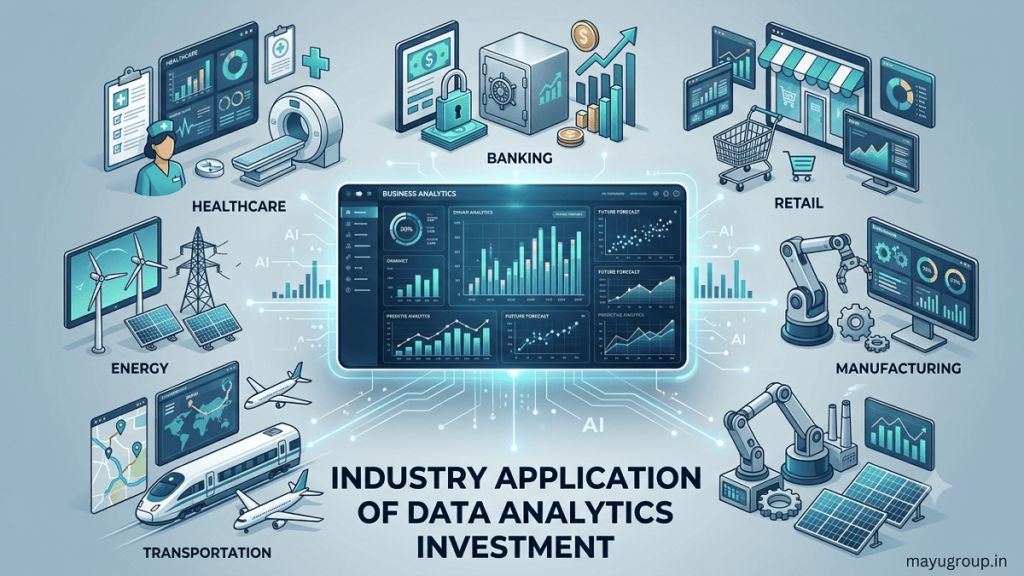
Industry Application of Data Analytics Investment: Transforming Business Across Sectors
Introduction
Data analytics investment is helping organizations across industries improve decision-making, optimize operations, understand customers, and identify new growth opportunities. By investing in analytics software, cloud infrastructure, data management, and skilled professionals, businesses can turn large volumes of information into actionable insights.
The value of this investment varies by industry. Retailers may focus on customer behavior, manufacturers on production efficiency, and financial institutions on risk management. Understanding these applications helps businesses identify where analytics can deliver the greatest value.
1. Healthcare Industry
Healthcare organizations invest in data analytics to improve patient care, manage resources, and support clinical and operational decisions. Hospitals can analyze patient records, appointment patterns, and resource utilization to identify bottlenecks and improve service delivery.
Predictive analytics can also help healthcare providers identify patients who may require additional attention, subject to appropriate clinical oversight and data protection measures.
Investment opportunity: Healthcare analytics platforms, electronic health record analysis, hospital management dashboards, and secure data integration systems.
2. Banking and Financial Services
Banks, insurance companies, and financial institutions use analytics to understand customer needs, assess financial risks, detect suspicious transactions, and improve operational efficiency.
For example, transaction monitoring systems can identify unusual activity for further investigation. Customer analytics can also support personalized services and help institutions evaluate product performance.
Investment opportunity: Fraud detection, risk analytics, regulatory reporting, credit assessment, and customer intelligence platforms.
3. Retail and E-commerce
Retailers invest in analytics to understand purchasing behavior, forecast demand, optimize inventory, and improve marketing performance. By examining sales trends and customer interactions, businesses can make better decisions about pricing, product selection, and promotions.
For example, an e-commerce company can analyze product searches and purchase patterns to improve recommendations and reduce the likelihood of stock shortages.
Investment opportunity: Customer analytics, demand forecasting, recommendation engines, inventory optimization, and marketing analytics.
4. Manufacturing and Industrial Operations
Manufacturers use data analytics to monitor production performance, identify quality problems, reduce waste, and improve equipment maintenance. Sensor data from connected machinery can help teams detect unusual operating conditions before they develop into major disruptions.
These applications can support productivity and more efficient use of resources.
Investment opportunity: Predictive maintenance, industrial Internet of Things (IoT) analytics, quality monitoring, and production optimization.
5. Telecommunications
Telecommunications companies analyze network performance, service usage, customer complaints, and subscription patterns. These insights can help providers improve network capacity, identify service issues, and understand customer churn.
Investment opportunity: Network analytics, customer retention models, service optimization, and usage forecasting.
6. Transportation and Logistics
Transport and logistics businesses use analytics to optimize routes, forecast delivery times, manage warehouse operations, and monitor fleet performance. Better visibility into transportation data can help reduce delays and improve resource allocation.
Investment opportunity: Route optimization, fleet analytics, supply chain forecasting, and warehouse intelligence.
7. Energy and Utilities
Energy companies invest in analytics to forecast demand, monitor equipment, improve grid performance, and identify opportunities to reduce energy waste. Utilities can also analyze consumption patterns to support capacity planning and operational decisions.
Investment opportunity: Smart meter analytics, energy demand forecasting, asset monitoring, and grid optimization.
Conclusion
Data analytics investment has applications across healthcare, finance, retail, manufacturing, telecommunications, logistics, and energy. Although each industry has different priorities, the central objective is the same: use reliable data to improve decisions and business performance.
Organizations should begin by identifying a specific operational or strategic challenge, estimating the potential value of solving it, and testing an appropriate analytics solution. Measuring results before expanding the investment can help control costs and demonstrate business value.
#DataAnalyticsInvestment
Ask FAQs
What is data analytics investment?
Data analytics investment involves spending on technology, software, infrastructure, and skilled professionals to analyze business data and improve decision-making, operational efficiency, and growth.
Which industries benefit most from data analytics investment?
Healthcare, banking, retail, manufacturing, telecommunications, transportation, and energy are among the industries that use data analytics to optimize operations, manage risks, understand customers, and improve performance.
How does data analytics investment improve business performance?
It helps businesses identify trends, forecast demand, reduce operational costs, detect potential risks, personalize customer experiences, and make more informed strategic decisions.
What are the main challenges of data analytics investment?
Common challenges include high implementation costs, poor data quality, cybersecurity threats, privacy concerns, a shortage of skilled professionals, and difficulties integrating analytics into existing business processes.
How can a business measure the ROI of data analytics investment?
A business can measure return on investment (ROI) by comparing the financial benefits of analytics with its total costs. Relevant indicators include cost savings, revenue growth, improved productivity, customer retention, and reduced operational risks.
Disclaimer: This article is for informational purposes only and does not constitute financial or investment advice. Actual results may vary depending on business needs, implementation, and market conditions.