Marks for UL Classification Service
Table of Contents
The Marks for UL Classification Service is associated with the use of UL Classification Marks to communicate that a product, material, or system has been evaluated by UL Solutions against specific requirements for particular properties, hazards, or performance characteristics. Unlike a general certification claim, a classification is typically limited to defined conditions, standards, and performance characteristics identified in the applicable evaluation.
UL Classification can be particularly valuable for manufacturers whose products need to demonstrate compliance with specific safety or performance requirements for a particular application or market. The evaluation may address characteristics such as fire performance, environmental conditions, electrical properties, mechanical performance, or other defined risks, depending on the product and applicable requirements.
A UL Classification Mark can provide manufacturers with a recognized way to communicate that their product has undergone an independent evaluation for the specified characteristics. It can also help purchasers, regulators, designers, contractors, Marks for UL and other stakeholders identify products that have been evaluated for particular requirements.
It is important to understand that UL Classification is not necessarily the same as UL Certification or Listing. The scope and meaning of a Classification Mark depend on the specific evaluation and the conditions stated in the product’s certification information. Manufacturers should therefore avoid presenting a Classification Mark as evidence of compliance beyond the characteristics and conditions covered by the applicable evaluation.
For manufacturers seeking UL Classification, the process generally involves identifying the applicable requirements, submitting the relevant product information and samples, undergoing evaluation and testing, addressing any identified issues, and maintaining compliance with applicable follow-up requirements. The exact process can vary depending Marks for UL on the product category and evaluation program.
The service can be especially relevant to industries such as construction materials, electrical and electronic products, building systems, industrial equipment, and fire-safety-related products, where demonstrating specific performance characteristics can support market acceptance.
Overall, the Marks for UL Classification Service can help manufacturers communicate independently evaluated product characteristics in a Marks for UL structured and recognizable manner. However, the specific meaning of a UL Classification Mark should always be determined from the applicable UL evaluation and certification details rather than from the mark alone.
#ManufacturingStandards
What Is the UL Classification Mark and Why Is It Important?
The UL Classification Mark is a certification mark used by UL Solutions to indicate that representative samples of a product have been evaluated for specific properties, a limited range of hazards, or suitability for use under particular or special conditions. Unlike the UL Listed Mark, which generally indicates that a product has been evaluated against applicable safety requirements, the Classification Mark communicates a more defined Marks for UL and limited scope of evaluation.
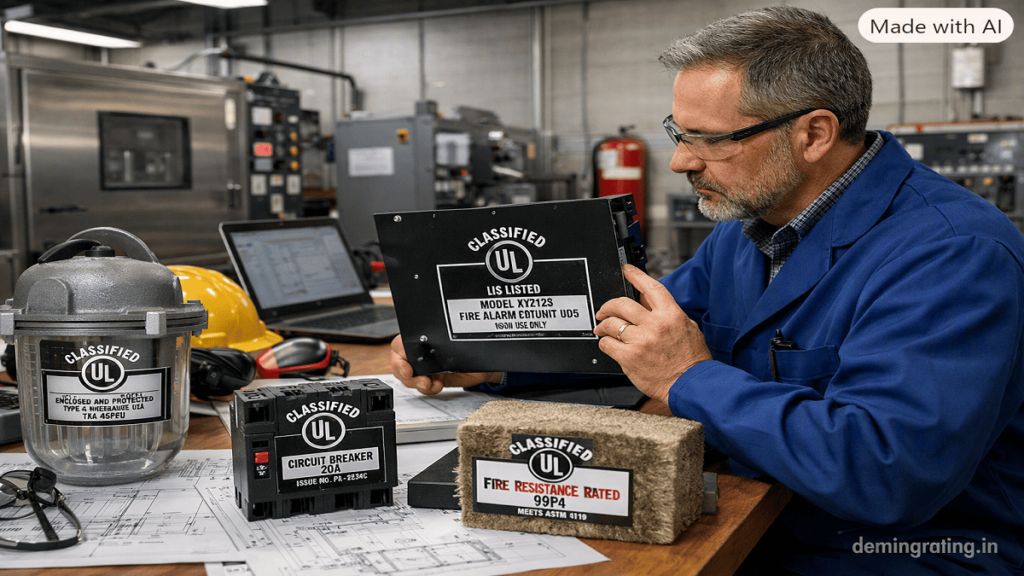
A typical UL Classified Mark includes the UL symbol, the word “Classified,” the product or category identification, a statement describing the scope of evaluation, and a control number. This information is important because the word “Classified” by itself does not describe everything that has been evaluated. Users need to consider the accompanying Marks for UL statement and applicable certification information to understand exactly what the evaluation covers.
1. Demonstrates Independent Evaluation
The mark provides evidence that UL Solutions has evaluated representative product samples against defined requirements within the applicable certification scope. This can give manufacturers, purchasers, regulators, designers, and other stakeholders Marks for UL greater confidence when assessing product characteristics.
2. Identifies Specific Performance or Hazard Evaluations
The UL Classification Mark is particularly useful when a product is evaluated for a specific characteristic rather than for all applicable safety requirements. For example, UL notes that Classified products may be evaluated for a specific hazard or for performance Marks for UL under specific conditions.
3. Supports Market Acceptance
For manufacturers, demonstrating that a product has undergone an independent evaluation can help communicate defined safety or performance characteristics to customers and other stakeholders. Depending on the product and market, this can support Marks for UL specification, procurement, installation, or regulatory decision-making.
4. Helps Stakeholders Understand Certification Scope
One of the most important aspects of the Classification Mark is its scope. Users should not assume that a Classified product has been evaluated for every possible safety characteristic. The specific statement accompanying the mark defines what UL Marks for UL Solutions evaluated.
UL Classified vs. UL Listed
The distinction is important. A UL Listed Mark generally indicates that UL Solutions evaluated representative samples against applicable requirements, while a UL Classified Mark indicates evaluation concerning specific properties, limited hazards, or suitability under limited or special conditions.
UL Solutions also offers an enhanced UL Certified Mark, which can communicate certification information and, where applicable, provide identifiers that allow stakeholders to access more detailed certification information through UL Product iQ. Existing Listing and Marks for UL Classification Marks remain valid.
Conclusion
The UL Classification Mark is important because it communicates independent evaluation within a defined scope. It can help manufacturers demonstrate specific product characteristics while giving customers and other stakeholders a clearer basis for evaluating suitability.
However, the mark should always be interpreted together with its scope statement and certification information. A Classification Mark should not be treated as Marks for UL a blanket indication that every aspect of a product has been evaluated.
Official reference: UL Solutions — Information on UL Marks
#Compliance
How Does the UL Classification Service Evaluate Products Against Applicable Requirements?
The UL Classification Service provides a structured third-party evaluation of products against defined requirements for specific properties, limited hazards, performance characteristics, regulatory codes, standards, or specified conditions. Unlike a general product evaluation covering a broad range of safety hazards, UL Classification focuses on the particular characteristics and conditions identified within the classification scope.
1. Identifying the Applicable Requirements
The process begins by determining what the product needs to demonstrate. Depending on the product and intended application, applicable requirements may relate to specific safety risks, performance under defined conditions, regulatory codes, or recognized standards. UL Solutions works with the manufacturer to establish the appropriate evaluation requirements for the product.
2. Reviewing Product Construction and Information
UL Solutions evaluates information about the product, including its construction, materials, components, ratings, intended use, and relevant technical documentation. Understanding the product’s design and intended application helps determine which requirements and evaluation methods are applicable.
Manufacturers can also conduct an assessment before submitting a product. UL Solutions recommends understanding the applicable requirements early in product development because addressing potential compliance issues before formal testing can help reduce redesign and testing delays.
3. Testing and Technical Evaluation
Representative samples may be tested, inspected, examined, or otherwise evaluated to gather evidence that the product meets the applicable requirements. The exact tests depend on the product category and the specific properties or hazards included within the Classification scope.
For example, an evaluation may focus on a particular fire characteristic, electrical property, mechanical performance requirement, environmental condition, or other defined attribute. The objective is not necessarily to evaluate every possible safety characteristic of the product, but to determine whether the product meets the requirements associated with its defined classification.
4. Assessment of Results
The technical results are reviewed against the applicable requirements. If the product demonstrates conformity within the defined scope, UL Solutions can authorize the applicable classification and associated marking arrangements.
The UL Classified Mark identifies the scope of evaluation through information accompanying the mark. UL states that the mark includes the UL symbol, the word “Classified,” product or category identification, a statement describing the scope of evaluation, and a control number.
5. Maintaining Continued Compliance
Classification is not simply a one-time laboratory exercise. Depending on the applicable UL program, Follow-Up Services can be used to audit the manufacturer’s means of maintaining continued compliance with UL requirements. UL describes these services as an audit of the manufacturer’s controls for determining continued compliance.
Changes to a certified product may also require additional testing, inspection, examination, or evaluation before continued authorization is maintained.
Conclusion
The UL Classification Service evaluates products through a combination of requirement identification, product review, representative-sample testing or evaluation, technical assessment, and—where applicable—ongoing follow-up activities. Its defining characteristic is its focused scope: a UL Classified product has been evaluated for specified properties, limited hazards, or particular conditions rather than necessarily for every reasonably foreseeable safety-related hazard.
For manufacturers, understanding the exact classification scope is therefore essential. The UL Classification Mark should always be interpreted together with its accompanying statement and applicable certification information.
Official UL Solutions resources:
UL Solutions — Certification, Listing and Classification
UL Solutions — Preparing for Your UL Mark Evaluation
#ThirdPartyCertification
What Testing and Documentation Are Typically Required for UL Classification?
The testing and documentation required for UL Classification depend on the product, intended use, applicable UL requirements, and the specific properties or hazards being evaluated. UL Solutions emphasizes that individual projects vary, so manufacturers should establish the evaluation scope and required information with the assigned UL Solutions team before submitting products or samples.
1. Product Samples
Representative product samples are commonly required for evaluation. The number and type of samples depend on the anticipated test program and product category. UL Solutions advises manufacturers not to send samples until they have been requested, because testing requirements can vary and some tests may be destructive.
Samples may be examined for construction characteristics and subjected to applicable performance or safety tests. Depending on the product, testing can address areas such as electrical, mechanical, thermal, flammability, environmental, or other defined characteristics. For example, UL’s insulating-tubing evaluation can include electrical, mechanical, thermal, and flammability testing.
2. Product Construction Information
Manufacturers generally need to provide detailed information describing how the product is constructed. UL Solutions identifies documentation such as critical component information, product dimensions, enclosures, openings, power connections, markings and labels, manufacturing locations, and factory test equipment as information that may be required for a UL Mark evaluation.
This information allows UL engineers to understand the product configuration and determine how it relates to the applicable requirements.
3. Technical Documentation and Specifications
Manufacturers should provide relevant technical information describing the product and its intended application. Depending on the product, this may include specifications, component information, ratings, drawings, construction details, installation information, and other engineering documentation.
UL recommends understanding the applicable standard or requirements before evaluation and assessing the product against those requirements before formal submission.
4. Applicable Test Results
The actual tests performed depend on the defined classification scope. UL engineers review the product and applicable requirements, conduct or oversee the necessary evaluation, and assess the resulting evidence against those requirements.
When a product meets the applicable requirements, UL Solutions develops formal documentation based on the test results. The evaluation information can then establish the basis for the applicable certification and Follow-Up Services procedures.
5. Manufacturing and Quality Information
Manufacturers may also need information demonstrating how the product will be consistently produced. Follow-Up Services can include factory inspections, examination of product construction, review of component markings and traceability, and examination of production or test records.
For some products, production-line testing and maintenance of test records may also be required under the applicable Follow-Up Services procedure.
6. Final Reports and Certification Documentation
After successful evaluation, UL Solutions prepares formal documentation describing the evaluated product and applicable requirements. The resulting documentation establishes important details about the product’s construction, testing, markings, and scope.
For products covered by evaluation reports, UL documentation may identify the evaluation scope, referenced standards or codes, product description, performance characteristics, installation requirements, limitations, and markings.
Conclusion
UL Classification typically involves a combination of representative product samples, construction information, technical documentation, applicable testing, evaluation of results, and manufacturing-control information. The exact requirements are product-specific and should not be assumed to be identical across all UL Classification projects.
Manufacturers can make the process more efficient by preparing complete and accurate product documentation, understanding the applicable requirements early, identifying critical components, and communicating intended markets and applications to UL Solutions before testing begins.
The most important principle is to ensure that the testing and documentation correspond directly to the specific properties, hazards, or conditions covered by the Classification. A UL Classification should therefore be interpreted according to its defined scope rather than as a blanket evaluation of every aspect of a product.
Official resource: UL Solutions — Preparing for Your UL Mark Evaluation
#SafetyStandards
How Can Manufacturers Maintain Compliance After Receiving a UL Classification Mark?
Receiving a UL Classification Mark is not the end of the compliance process. Manufacturers must continue to ensure that products bearing the mark remain consistent with the applicable UL requirements and the conditions established during the original evaluation. UL Solutions uses Follow-Up Services (FUS) to help verify continued compliance through ongoing inspections, audits, and, where applicable, sample testing.
1. Maintain the Certified Product Configuration
Manufacturers should ensure that products continue to be produced according to the construction, components, materials, ratings, and other characteristics covered by the applicable UL requirements. Changes to certified products should not be treated as routine engineering changes without first determining whether UL review is required.
UL Solutions states that changes to certified products may require additional testing, inspection, examination, or other evaluation before continued authorization to apply a UL Mark.
2. Follow the Follow-Up Services Procedure
Manufacturers participating in Follow-Up Services are subject to ongoing factory inspections and audits. These activities are intended to verify that products being manufactured remain consistent with the product evaluated during the original certification process. UL may also examine components, markings, production controls, and finished products.
Manufacturers should therefore understand and consistently follow their applicable Follow-Up Services Procedure.
3. Control Components and Materials
Maintaining compliance requires control over critical materials and components. UL Solutions notes that factory inspections can include reviewing component markings and traceability to confirm that components used in certified products are consistent with the applicable Follow-Up Services requirements.
Organizations should establish appropriate purchasing, receiving, identification, storage, and traceability controls for critical components.
4. Maintain Inspection, Testing, and Calibration Controls
Manufacturers should maintain appropriate production inspection and testing processes. Where testing equipment is required, it should be properly maintained and calibrated, with relevant records retained.
UL’s Follow-Up Service terms state that manufacturers are responsible for maintaining a quality-control program for inspection and testing and for maintaining appropriate testing and measuring equipment and calibration records.
5. Control the UL Mark
The UL Mark should only be applied to products that meet the applicable requirements. Manufacturers should have controls for labels, markings, packaging, and authorization to use the mark.
This is important because the UL Mark represents continued compliance, not simply successful initial testing. UL’s surveillance program is designed to protect the integrity of its certification marks through ongoing monitoring.
6. Manage Nonconformities and Corrective Actions
If an inspection or internal quality-control activity identifies a nonconforming product, manufacturers should promptly contain the affected products, investigate the cause, implement corrective action, and determine whether UL Solutions needs to be involved.
Serious or unresolved discrepancies can affect authorization to apply the UL Mark.
7. Monitor Changes to UL Requirements
Standards and certification requirements can change. UL Solutions communicates relevant certification requirement changes to affected customers and may identify whether reevaluation, samples, or additional information are required.
Manufacturers should therefore monitor communications from UL Solutions and maintain an internal process for reviewing changes that could affect their certified products.
Conclusion
Maintaining a UL Classification Mark requires ongoing control, not simply passing the initial evaluation. Manufacturers should maintain the certified product configuration, follow applicable Follow-Up Services procedures, control components and materials, maintain inspection and testing systems, control use of the UL Mark, address nonconformities, and respond to changes in applicable requirements.
The exact obligations depend on the product and its specific UL certification documentation. Manufacturers should therefore use their applicable UL requirements and Follow-Up Services documentation as the primary reference for maintaining continued compliance.
Official UL Solutions resource: Follow-Up Services: Ongoing Onsite Certification Inspections
#ProductSafety
What Are the Benefits of UL Classification for Product Safety, Market Acceptance, and Customer Confidence?
UL Classification provides manufacturers with an independent evaluation of a product against defined requirements for specific properties, a limited range of hazards, or suitability under limited or special conditions. Because the scope is clearly defined, the UL Classification Mark can provide useful evidence of evaluated product characteristics while helping manufacturers communicate those characteristics to customers and other stakeholders.
1. Supports Product Safety
One of the primary benefits of UL Classification is independent evaluation of specific product characteristics related to safety or performance. Depending on the product and classification, evaluation may address a particular hazard or performance condition.
This can help manufacturers identify whether their products meet the requirements applicable to the defined evaluation scope. It also provides purchasers and other stakeholders with information that can support product-selection and installation decisions.
It is important to recognize that a UL Classified Mark does not mean that every aspect of a product has been evaluated. The mark specifically identifies the scope of the evaluation, so users should review the accompanying statement and certification information.
2. Improves Market Acceptance
Independent third-party evaluation can help manufacturers demonstrate that specific product characteristics have been assessed against recognized requirements. UL Solutions states that its testing, assessment, and certification services can help manufacturers address retail and regulatory requirements and support market-access goals.
For products entering competitive markets, a recognizable certification mark can differentiate products from alternatives that do not have comparable third-party evaluation. Manufacturers can also use authorized UL certification marks in appropriate marketing and promotional materials according to UL’s requirements.
3. Builds Customer Confidence
Customers often need credible information when selecting products, particularly where safety or performance is important. A UL Classification Mark can provide an easily recognizable indication that representative product samples were evaluated for a defined scope.
UL describes its certification marks as symbols that help communicate safety, quality, or security credentials. The recognizable nature of the UL Mark can therefore contribute to confidence when customers, designers, contractors, regulators, and other stakeholders evaluate products.
4. Supports Informed Product Selection
The detailed scope associated with a UL Classification Mark helps stakeholders understand what was actually evaluated. This is especially useful for products intended for particular applications or operating conditions.
By reviewing the classification information and applicable conditions, engineers, designers, purchasing teams, and authorities can make more informed decisions about whether a product is appropriate for its intended application.
5. Strengthens Brand Credibility
For manufacturers, independent evaluation can strengthen the credibility of product-safety and performance communications. Instead of relying solely on internal claims, manufacturers can reference an evaluation performed by an established third-party organization.
UL Solutions also provides certification information through its systems, allowing stakeholders to obtain additional information about certified products and their applicable scope.
Conclusion
UL Classification can provide important benefits across three key areas: product safety, market acceptance, and customer confidence. It gives manufacturers a structured way to demonstrate that specific product properties, hazards, or conditions have been evaluated, while giving customers and other stakeholders a recognizable indicator of third-party assessment.
The most important consideration is scope. A UL Classification Mark should not be interpreted as a blanket approval of every aspect of a product. Instead, its value comes from understanding exactly what UL Solutions evaluated and using that information appropriately in product selection, specification, compliance, and marketing decisions.
Official UL Solutions resources:
UL Solutions — Third-Party Certification of Building Materials
UL Solutions — Product Safety, Performance and Sustainability
#ProductCertification
Case Study of Marks for UL Classification Service
Background
A manufacturer of building and electrical equipment was preparing to introduce a new product into the North American market. The product was designed for use in applications where specific safety and performance characteristics were important to contractors, engineers, distributors, and regulatory authorities.
Rather than presenting the product as having been evaluated for every possible safety characteristic, the manufacturer identified a specific set of properties and conditions for which independent third-party evaluation was needed.
The company therefore pursued the UL Classification Service. UL Solutions explains that the UL Classified Mark applies when representative product samples have been evaluated with respect to specific properties, a limited range of hazards, or suitability for use under limited or special conditions.
The Challenge
Before entering the market, the manufacturer faced several challenges:
- Demonstrating specific product-performance characteristics to prospective customers.
- Providing independent evidence that the product met applicable requirements within its defined scope.
- Helping engineers and contractors understand the conditions under which the product had been evaluated.
- Establishing confidence in the product without making broader certification claims than were justified.
- Maintaining consistent production after the initial evaluation.
The company recognized that a UL Classification Mark would need to communicate the exact scope of evaluation, rather than serve as a general statement that every aspect of the product had been certified.
UL Classification Approach
The manufacturer worked with UL Solutions to establish the applicable evaluation requirements based on the product’s intended use and the characteristics that needed to be demonstrated.
Representative product samples were then evaluated against the applicable requirements. The specific testing and evaluation methods depended on the product and the characteristics included in the classification.
After successful evaluation, the product was authorized to use the applicable UL Classification Mark. UL states that the Classified Mark includes the UL symbol, the word “CLASSIFIED,” product or category identification, a statement describing the scope of evaluation, and a control number.
This information allowed customers and other stakeholders to understand what UL Solutions had evaluated rather than assuming that the product had undergone an unrestricted or comprehensive safety evaluation.
Production and Follow-Up
Following certification, the manufacturer established controls to ensure that production remained consistent with the evaluated product.
UL Solutions’ Follow-Up Services are designed to confirm that certified products continue to comply with the original certification requirements through factory inspections and audits. These activities can include reviewing product construction, components, markings, and traceability.
The manufacturer therefore incorporated controls for:
- Approved product construction.
- Critical components and materials.
- Production inspection and testing.
- Product markings and labeling.
- Traceability and manufacturing records.
- Engineering-change review.
When design or construction changes became necessary, the company consulted UL Solutions to determine whether additional evaluation was required. This helped prevent unauthorized changes from affecting the certified configuration.
Results
The implementation produced several practical benefits.
Improved product credibility:
The manufacturer could demonstrate that specific product characteristics had undergone independent third-party evaluation.
Clearer communication:
The Classification Mark and its associated scope statement provided customers with a clearer understanding of what had been evaluated.
Greater market confidence:
The recognizable UL Mark helped communicate evaluated product characteristics to customers, designers, contractors, and other stakeholders.
Better production discipline:
The need to maintain conformity encouraged stronger controls over components, manufacturing processes, markings, and product changes.
Ongoing compliance awareness:
Follow-Up Services provided continued monitoring of certified production rather than treating the initial evaluation as the end of the compliance process.
Key Lessons
This case demonstrates that the value of UL Classification lies primarily in its defined evaluation scope.
Manufacturers should clearly identify the properties, hazards, performance characteristics, or special conditions they need to demonstrate. They should then ensure that product documentation, testing, manufacturing controls, and marketing statements remain consistent with that scope.
The company also learned that a UL Classification Mark should not be presented as a blanket approval of the entire product. UL specifically distinguishes Classification from Listing: Classification concerns specific properties, limited hazards, or limited/special conditions.
Conclusion
The UL Classification Service can provide manufacturers with a structured method for demonstrating specific product characteristics through independent evaluation. In this representative case, the manufacturer used the Classification process not only to support market introduction but also to establish clearer controls for continued conformity.
The most important outcome was the ability to communicate what had been evaluated, under which conditions, and within what scope.
For manufacturers, engineers, purchasers, and regulatory stakeholders, understanding that scope is essential to using the UL Classification Mark correctly and effectively.
Official UL Solutions resources:
UL Solutions — Information on UL Marks
UL Solutions — Follow-Up Services
UL Solutions — Third-Party Certification of Building Materials
#ULSolutions

White Paper on Marks for UL Classification Service
Executive Summary
Product manufacturers increasingly need to demonstrate that their products meet defined safety, performance, or application requirements. Independent third-party evaluation can provide valuable evidence to customers, regulators, designers, contractors, and other stakeholders.
The UL Classification Service is one mechanism provided by UL Solutions for evaluating products with respect to specific properties, a limited range of hazards, or suitability for use under limited or special conditions. The resulting UL Classification Mark communicates that defined scope of evaluation rather than serving as a blanket indication that every aspect of a product has been evaluated.
This white paper examines the purpose of the UL Classification Mark, the evaluation process, its benefits for manufacturers and customers, ongoing compliance responsibilities, and important considerations when interpreting the mark.
1. Introduction
Manufacturers operating in competitive and highly regulated markets must often demonstrate that their products meet applicable requirements. Customers and specifiers may also require credible evidence before selecting products for particular applications.
UL Solutions provides testing, inspection, certification, auditing, and related services that can help manufacturers demonstrate conformity with specified requirements. Within this framework, the UL Classification Mark is used for products evaluated for specific properties, limited hazards, or limited or special conditions.
The Classification approach is therefore different from simply making a broad product-safety claim. Its value depends on clearly understanding the requirements and conditions covered by the particular certification.
2. What Is the UL Classification Mark?
The UL Classification Mark indicates that UL Solutions has evaluated representative samples of a product with respect to a defined scope. UL describes Classification as addressing specific properties, a limited range of hazards, or suitability for use under limited or special conditions.
The mark itself contains information intended to identify the certified product and communicate the certification scope. UL’s published information on the U.S. Safety Classified Mark identifies elements including the UL symbol, the word CLASSIFIED, product identification, a statement further describing the certification, and an issue, serial, or control number.
This information is important because the word “Classified” alone does not explain the full meaning of the evaluation. Users should consider the complete marking and associated certification information.
3. Classification Versus Listing
Understanding the distinction between UL Listed and UL Classified is essential.
UL explains that the UL Listed Mark indicates that a product has been evaluated against a minimum set of requirements in the applicable standard, while the UL Classification Mark addresses specific properties, a limited range of hazards, or suitability under limited or special conditions.
Therefore, a Classification Mark should not automatically be interpreted as evidence that a product has been evaluated for all potential safety characteristics.
The scope of the individual certification remains the key reference for determining what has actually been evaluated.
4. How the Classification Service Works
A UL Classification project generally begins by establishing the applicable requirements and the characteristics that need to be evaluated.
The manufacturer provides information about the product and its intended application. UL Solutions then determines the appropriate evaluation activities based on the defined certification scope.
Depending on the product, evaluation may involve testing, inspection, examination, or other technical assessment. The exact procedures vary according to the product category and applicable requirements.
Representative samples are evaluated against the defined requirements. If the applicable requirements are satisfied, UL Solutions can authorize the appropriate certification marking subject to the applicable service arrangements and conditions.
5. Importance of Product Scope
A central principle of UL Classification is scope.
A manufacturer should clearly understand:
- Which product is covered.
- Which properties have been evaluated.
- Which hazards or conditions are included.
- Which markets or geographic regions apply.
- What limitations or special conditions exist.
- Which markings and statements are authorized.
UL Product iQ provides certification and product-category information, including information that can identify limitations or special conditions applicable to products.
This allows stakeholders to make more informed decisions about product suitability.
6. Benefits for Manufacturers
UL Classification can provide several potential advantages for manufacturers.
Independent Evaluation
Third-party evaluation can provide manufacturers with evidence that representative products have been assessed against specified requirements.
Product Differentiation
A recognized certification mark can help manufacturers communicate evaluated product characteristics in competitive markets.
Customer Communication
The Classification Mark provides a recognizable way to communicate that specific product properties or conditions have been evaluated.
Market Support
Depending on the product and applicable market requirements, certification can support product specification, procurement, installation, and regulatory discussions.
Brand Credibility
Independent certification can strengthen confidence in product-related safety or performance claims when those claims remain within the defined certification scope.
UL describes its certification marks as tools that communicate product certification information to the marketplace.
7. Customer and Stakeholder Confidence
Customers often need reliable information when selecting products for safety-critical or performance-sensitive applications.
The UL Classification Mark can help stakeholders identify products that have undergone evaluation for defined characteristics. Engineers, architects, contractors, purchasing teams, regulators, and other users can then review the certification information to determine whether the product is appropriate for the intended application.
The important point is that confidence should be based on the actual certification scope, rather than on the presence of the UL symbol alone.
8. Ongoing Compliance After Certification
UL Classification is not necessarily a one-time activity that ends when laboratory evaluation is completed.
UL Solutions’ Follow-Up Services program is designed to confirm that certified products continue to comply with the original certification requirements. Follow-Up Services can involve factory inspections and audits at locations where certified products are manufactured and where UL Marks are applied.
UL states that factory inspections can verify that the manufactured product is consistent with the product originally evaluated. They can also include review of materials, components, markings, and traceability.
This ongoing approach helps protect the integrity of the certification mark.
9. Managing Product Changes
Manufacturers frequently modify products to improve performance, reduce costs, introduce new components, or respond to supply-chain changes.
However, changes to a certified product may affect its certification status. UL Solutions advises manufacturers to submit changes for review when necessary so that additional testing, inspection, examination, or other evaluation can be performed when required.
A strong change-control process should therefore be integrated into the manufacturer’s quality and compliance management system.
10. Manufacturing Controls
Continued compliance also depends on maintaining appropriate manufacturing controls.
Manufacturers should ensure that:
- Certified product construction remains consistent.
- Critical components are properly controlled.
- Approved materials are used.
- Product markings remain accurate.
- Production testing and inspection requirements are followed.
- Relevant records are maintained.
- Nonconformities are identified and corrected.
- Engineering changes are reviewed before implementation.
UL’s Follow-Up Services specifically address product construction, components, markings, and traceability as part of ongoing certification inspections.
11. Handling Nonconformities
If inspections or internal controls identify discrepancies, manufacturers should investigate the issue and implement appropriate corrective action.
Depending on the nature and seriousness of a discrepancy, UL Solutions may require additional involvement. UL explains that serious discrepancies can result in discontinuation of production bearing the UL Mark or removal of the mark.
Consequently, manufacturers should treat UL certification requirements as an integral part of their production-control system.
12. Role in Market Acceptance
Third-party certification can be particularly valuable where customers or authorities require evidence of compliance with defined requirements.
The UL Mark is widely recognized, and UL Solutions states that its certification marks help communicate certification information to the marketplace.
For manufacturers, the Classification Mark can therefore support communication with customers and other stakeholders, provided that claims remain accurate and within the certification scope.
Certification should not, however, be represented as approval beyond what the applicable certification documentation establishes.
13. Digital Certification Information
UL Solutions provides certification information through Product iQ, its online certification database. UL explains that the database contains manufacturer certifications and relevant product-category information.
This type of accessible certification information can help stakeholders verify product details and understand applicable certification information.
UL also offers enhanced and smart certification marks. The smart version can include an optional QR code linking users to additional certification information.
14. Implementation Considerations for Manufacturers
Organizations considering UL Classification should approach the process systematically.
Step 1: Define the Product
Identify the exact product, model, configuration, and intended application.
Step 2: Identify Required Characteristics
Determine which specific properties, hazards, or conditions need independent evaluation.
Step 3: Review Applicable Requirements
Identify the applicable UL requirements, standards, codes, or other evaluation criteria.
Step 4: Prepare Technical Information
Maintain accurate product drawings, specifications, component information, ratings, materials information, and other technical documentation.
Step 5: Coordinate Evaluation
Work with UL Solutions to determine the appropriate evaluation and testing requirements.
Step 6: Establish Manufacturing Controls
Ensure production processes can consistently reproduce the evaluated product.
Step 7: Control Changes
Review engineering, material, component, manufacturing, and labeling changes for potential certification impact.
Step 8: Maintain Follow-Up Compliance
Prepare for applicable factory inspections, audits, testing, and documentation requirements.
15. Common Misunderstandings
One common misunderstanding is that the UL Classification Mark represents unrestricted approval of an entire product.
That interpretation is incorrect. UL specifically describes Classification as applying to specific properties, limited hazards, or limited or special conditions.
Another misunderstanding is that passing initial testing eliminates future compliance responsibilities. UL’s Follow-Up Services program demonstrates that continued conformity is an important part of maintaining certification.
Manufacturers should also avoid using the UL Mark on products that are outside the applicable certification requirements or scope.
16. Conclusion
The Marks for UL Classification Service provide manufacturers with a structured way to demonstrate that products have been independently evaluated for defined properties, limited hazards, or specific conditions.
The primary value of UL Classification is its combination of defined technical scope, independent evaluation, recognizable certification marking, and ongoing conformity activities.
For manufacturers, successful implementation requires more than obtaining the mark. Organizations must maintain the certified product configuration, control critical components and processes, manage engineering changes, comply with applicable Follow-Up Services requirements, and use the UL Mark only as authorized.
For customers and other stakeholders, the most important consideration is understanding exactly what the UL Classification covers. When the mark is interpreted together with its certification information, it can provide useful evidence for product selection, specification, compliance, and market communication.
Ultimately, UL Classification can contribute to stronger product credibility and market confidence while providing a structured framework for demonstrating specific product characteristics through third-party evaluation.
Official UL Solutions Resources
UL Solutions — Third-Party Certification of Building Materials
UL Solutions — Follow-Up Services
UL Solutions — UL Schemes and Certification Bodies
UL Solutions — UL Marks for Code Authorities
#ULClassificationMark
Industry Application of Marks for UL Classification Service
Introduction
The UL Classification Mark is used for products that UL Solutions has evaluated with respect to specific properties, a limited range of hazards, or suitability for use under limited or special conditions. This focused evaluation makes UL Classification particularly relevant to industries where a product must demonstrate defined performance or safety characteristics for a particular application.
The Classification Mark should always be interpreted according to its stated scope. It does not automatically indicate that every aspect of a product has been evaluated. UL Solutions provides certification information through Product iQ, allowing stakeholders to review detailed certification information and product-category data.
1. Building and Construction
The construction industry is an important application area for UL Classification. Building products may need to demonstrate particular fire, environmental, structural, or other performance characteristics depending on their intended use.
A UL Classification can provide architects, engineers, contractors, and code authorities with information about specific characteristics that have been independently evaluated. This can support product specification and selection when the evaluated property corresponds to the requirements of a particular project.
UL Solutions specifically identifies building materials as an area where UL Listed, UL Classified, and enhanced UL Certification Marks are used.
2. Electrical and Electronic Products
Electrical and electronic manufacturers may use UL certification services to demonstrate defined product characteristics and safety-related performance.
For products evaluated under a Classification program, the mark communicates the specific scope of the evaluation. This can be useful when a product has been assessed for a particular hazard, performance characteristic, or operating condition rather than for all reasonably foreseeable safety hazards.
Manufacturers can also use UL certification information to help customers and engineers verify certified products and components through Product iQ.
3. Fire and Life-Safety Products
Products associated with fire protection and life safety may require evidence of specific performance characteristics. Depending on the applicable program, UL Classification can communicate that a product has been evaluated for a defined fire-related property or particular application condition.
This information can assist designers, building professionals, authorities having jurisdiction, and purchasers when determining whether a product meets the requirements relevant to an installation.
The key consideration remains the certification scope rather than simply the presence of the UL symbol.
4. Industrial Equipment
Industrial manufacturers can benefit from Classification when equipment needs to demonstrate specific performance characteristics for particular operating conditions.
For example, an industrial product may require evaluation related to environmental conditions, mechanical performance, electrical characteristics, or a defined hazard. A focused Classification evaluation can provide evidence related to the characteristics included in the certification.
This can support communication between manufacturers, industrial customers, engineering teams, and procurement departments.
5. Components and Subassemblies
UL certification also plays an important role in component-level applications. UL Recognized Components, for example, are intended to be incorporated into larger certified end products and are evaluated under specific conditions of acceptability.
Although the Recognized Component Mark is distinct from the UL Classification Mark, this illustrates the broader role of UL certification in supply chains where manufacturers need verified components for larger systems.
6. Water and Plumbing Products
UL Solutions also maintains certification programs associated with water-quality and plumbing-related products. Certain products can carry specialized UL marks identifying the particular certification program and its scope.
This provides manufacturers with a structured method for demonstrating specific product characteristics to customers and other stakeholders. The applicable mark and certification information should always be reviewed to determine the exact requirements covered.
7. Communications and Technology Products
Technology and communications products can also benefit from third-party evaluation where customers or market requirements call for independent verification of defined performance characteristics.
UL Solutions offers different certification and verification programs for technology-related products. Where Classification is applicable, its value comes from clearly communicating the specific properties or conditions evaluated rather than suggesting unrestricted product approval.
8. Consumer and Commercial Products
Consumer and commercial products can use UL certification marks to communicate evaluated safety, quality, or security characteristics. UL Solutions notes that its marks appear across a wide range of products and that the Classification Mark is specifically associated with products evaluated for particular hazards or performance under specific conditions.
For manufacturers, this can strengthen product communication while giving customers additional information when comparing products.
9. Manufacturing and Production Controls
UL Classification is also relevant to manufacturers because certification does not necessarily end with initial evaluation. UL Solutions uses ongoing surveillance and Follow-Up Services for applicable certification programs to help verify that certified products continue to meet requirements. Factory visits may review product and production characteristics, and some products may be selected for retesting.
Manufacturers therefore need appropriate controls for components, product construction, labeling, testing, and engineering changes.
10. Market Acceptance and Product Verification
Across industries, one of the practical advantages of UL Classification is the ability to communicate independently evaluated product characteristics.
The availability of certification information through Product iQ can also help engineers, purchasers, code authorities, and other stakeholders verify certification details.
This can support more informed product selection and specification decisions.
Conclusion
The Marks for UL Classification Service can have practical applications across construction, electrical and electronics, fire and life safety, industrial equipment, components, plumbing and water-related products, communications, and consumer products.
Its primary value is its focused scope of evaluation. A UL Classification Mark communicates that a product has been evaluated for specified properties, limited hazards, or particular conditions.
For manufacturers, achieving and maintaining the mark can support product credibility, technical communication, and market acceptance. For customers and other stakeholders, the certification information can provide a useful basis for determining whether a product is appropriate for a particular application.
Organizations should always review the specific UL certification information, scope, limitations, and applicable conditions rather than interpreting the Classification Mark as a blanket certification of the entire product.
Official UL Solutions resources:
UL Solutions — UL Marks and Certifications
UL Solutions — Product iQ Certification Database
UL Solutions — Follow-Up Services
#ULClassification
Ask FAQs
What industries commonly use the UL Classification Mark?
The UL Classification Mark can be relevant across industries such as building and construction, electrical and electronic products, fire and life-safety equipment, industrial products, and other specialized product categories. Its application depends on the specific properties, hazards, or conditions evaluated by UL Solutions.
What does the UL Classification Mark indicate?
It indicates that UL Solutions has evaluated representative samples of a product with respect to specific properties, a limited range of hazards, or suitability for use under limited or special conditions. The mark includes information describing the scope of the evaluation.
Is UL Classification the same as UL Listing?
No. UL Listing generally relates to evaluation against applicable safety requirements, while UL Classification addresses specific properties, limited hazards, or particular conditions of use. Therefore, users should review the certification scope rather than assuming that a Classified product has been evaluated for every aspect of safety.
How can customers verify UL Classification information?
Customers, engineers, regulators, and other stakeholders can use UL Solutions’ Product iQ database to review certification information and product details. The applicable certification scope and any limitations should be checked before selecting a product for a specific application.
Can manufacturers continue using the UL Classification Mark after product changes?
Manufacturers must ensure that certified products continue to comply with applicable certification requirements. Product, component, construction, or manufacturing changes may require review or additional evaluation. UL Solutions also uses applicable follow-up activities to help verify continued compliance.
Disclaimer: This content is provided for general informational and educational purposes only. UL Classification requirements, certification scope, testing procedures, and marking requirements may vary by product and application. Readers should consult UL Solutions and the applicable certification documentation for current and product-specific requirements. UL and the UL Marks are trademarks of UL LLC and are used here for informational purposes.