Tokenized Assets
Tokenized assets are real-world or digital assets that are converted into blockchain-based tokens, allowing them to be owned, traded, and transferred in fractional or whole units on a distributed ledger. In simple terms, tokenization is the process of digitally representing ownership rights of an asset—such as real estate, stocks, commodities, bonds, intellectual property, or even artworks—using blockchain technology.
The core idea behind tokenized assets is to improve liquidity, accessibility, and transparency in traditionally illiquid or high-barrier markets. By breaking down high-value assets into smaller digital units, investors can participate with lower capital requirements. For example, instead of buying an entire commercial property, an investor can purchase tokenized shares representing a fraction of that property.
Tokenized assets are typically issued and managed on blockchain platforms using smart contracts. These smart contracts automate ownership records, compliance rules, dividend distribution, and transfer conditions without requiring traditional intermediaries like brokers or custodians. This reduces administrative costs and increases transaction efficiency.
There are several major categories of tokenized assets. The first is real-world asset (RWA) tokenization, which includes physical assets such as real estate, infrastructure, or commodities like gold. The second is financial asset tokenization, which involves equities, bonds, and funds being issued in digital form. The third category is intangible asset tokenization, which includes intellectual property, royalties, or digital collectibles.
One of the key advantages of tokenized assets is fractional ownership, which democratizes access to high-value investments. It allows retail investors to diversify portfolios more easily while enabling asset owners to unlock liquidity from otherwise locked capital. Another advantage is 24/7 global trading, since blockchain-based markets operate continuously without traditional market hour restrictions.
However, tokenized assets also come with challenges. Regulatory uncertainty remains a major issue, as different countries have varying rules regarding digital securities. There are also concerns related to cybersecurity, smart contract vulnerabilities, and valuation transparency. Additionally, widespread adoption depends on institutional trust and integration with traditional financial systems.
Major financial institutions and blockchain platforms are actively exploring tokenization. For example, global banks and asset managers are testing blockchain-based bond issuance and tokenized investment funds. Industry reports from firms like McKinsey highlight that tokenization could significantly transform capital markets by improving liquidity and reducing settlement times. McKinsey Digital Assets Insights
Similarly, organizations such as the World Economic Forum emphasize that tokenization may reshape ownership structures across multiple industries by enabling programmable and transparent asset systems. World Economic Forum Blockchain Insights
Overall, tokenized assets represent a major evolution in financial systems, bridging traditional asset ownership with blockchain technology to create more efficient, accessible, and globally connected investment markets.
#Tokenized Assets in India
What are tokenized assets?
Tokenized assets are real-world or digital assets whose ownership rights are converted into digital tokens on a blockchain. These tokens represent a share, fraction, or full ownership of an underlying asset and can be bought, sold, or transferred securely using distributed ledger technology.
In simple terms, tokenization is the process of turning physical or financial assets into digital units. For example, a commercial building, gold reserve, company share, or artwork can be divided into multiple blockchain tokens, allowing investors to own a fraction of the asset instead of purchasing it entirely. This makes high-value investments more accessible to a wider range of investors.
Tokenized assets work through smart contracts, which are self-executing programs on a blockchain. These contracts define ownership rules, automate transactions, and ensure transparency without requiring traditional intermediaries such as banks, brokers, or custodians. This reduces administrative costs and improves transaction efficiency.
There are several common types of tokenized assets. Real-world assets (RWA) include physical items like real estate, commodities, and infrastructure projects. Financial assets include stocks, bonds, and investment funds issued in digital token form. Digital-native assets include cryptocurrencies and blockchain-based collectibles or intellectual property rights.
One of the main advantages of tokenized assets is fractional ownership, which allows investors to buy smaller portions of expensive assets. This improves liquidity in markets that are traditionally difficult to trade, such as real estate or private equity. Another advantage is 24/7 global trading, since blockchain-based systems are not restricted by traditional market hours or geographic boundaries.
Tokenized assets also improve transparency because ownership records are stored on immutable blockchain ledgers, making it easier to verify transactions and reduce fraud risks. Additionally, settlement times are faster compared to traditional financial systems, which often require multiple intermediaries and delays.
However, tokenized assets also face challenges. Regulatory uncertainty is one of the biggest issues, as different countries have different legal frameworks for digital securities. Security risks such as smart contract vulnerabilities and hacking attempts are also concerns. Moreover, widespread adoption depends on institutional acceptance and integration with existing financial systems.
Despite these challenges, tokenization is gaining momentum in global finance. Research from institutions like McKinsey suggests that asset tokenization could significantly improve market efficiency and liquidity in the coming years. McKinsey Digital Assets Insights
Organizations such as the World Economic Forum also highlight tokenization as a key development in the future of digital financial infrastructure, enabling more inclusive and programmable markets. World Economic Forum Blockchain Insights
Overall, tokenized assets represent a modern financial innovation that combines blockchain technology with traditional asset ownership, making investment systems more efficient, accessible, and transparent.
#Tokenized Assets in Maharashtra
How does asset tokenization work using blockchain?
Asset tokenization using blockchain is the process of converting ownership rights of a real-world or digital asset into digital tokens that are recorded, managed, and transferred on a blockchain network. It enables assets such as real estate, commodities, stocks, or intellectual property to be represented digitally while maintaining verifiable ownership and transaction history.
The process begins with asset identification and valuation. A physical or financial asset is first evaluated and legally structured so that its ownership can be divided into shares or units. For example, a commercial building may be divided into 1,000 equal ownership units.
Next is the token creation stage, where a blockchain platform is used to generate digital tokens representing fractional ownership of the asset. These tokens are built using smart contracts, which are self-executing code programs that define the rules of ownership, transfer conditions, and compliance requirements. Common blockchain standards like ERC-20 or ERC-721 are often used depending on whether the token is fungible or non-fungible.
Once tokens are created, they are issued and recorded on the blockchain ledger. This step ensures that ownership records are transparent, immutable, and traceable. Each token corresponds to a specific share of the underlying asset, and all transactions are permanently stored on the blockchain, reducing the risk of fraud or duplication.
After issuance, tokens can be traded or transferred on digital marketplaces. Investors can buy, sell, or hold fractional ownership of the asset without needing traditional intermediaries such as brokers or custodians. Transactions are executed through smart contracts, which automatically update ownership records and ensure compliance with predefined rules.
A key feature of blockchain-based tokenization is fractional ownership and liquidity enhancement. Traditionally illiquid assets, such as real estate or private equity, become more accessible because investors can purchase small fractions instead of entire assets. This increases market participation and improves capital flow efficiency.
Another important aspect is automation through smart contracts. These contracts can distribute dividends, rental income, or profit shares automatically to token holders based on predefined conditions. This reduces administrative overhead and increases transparency.
Security and compliance are also built into the system. Blockchain ensures that all transactions are cryptographically secured, while regulatory compliance can be embedded into smart contract logic, such as identity verification (KYC/AML requirements) before trading.
However, the system still depends on legal frameworks that connect digital tokens to real-world ownership rights. Without proper regulation, tokenized assets may face enforcement challenges in traditional legal systems.
Industry research from McKinsey highlights that tokenization can significantly improve capital market efficiency by reducing settlement times and increasing asset liquidity. McKinsey Digital Assets Insights
Similarly, the World Economic Forum notes that blockchain-based tokenization has the potential to transform ownership structures and financial infrastructure globally by making assets more accessible and programmable. World Economic Forum Blockchain Insights
Overall, asset tokenization works by digitizing ownership rights, securing them on a blockchain ledger, and enabling automated, transparent, and fractional trading of assets through smart contract systems, fundamentally changing how value is stored and exchanged.
#Tokenized Assets in Ahemadabad
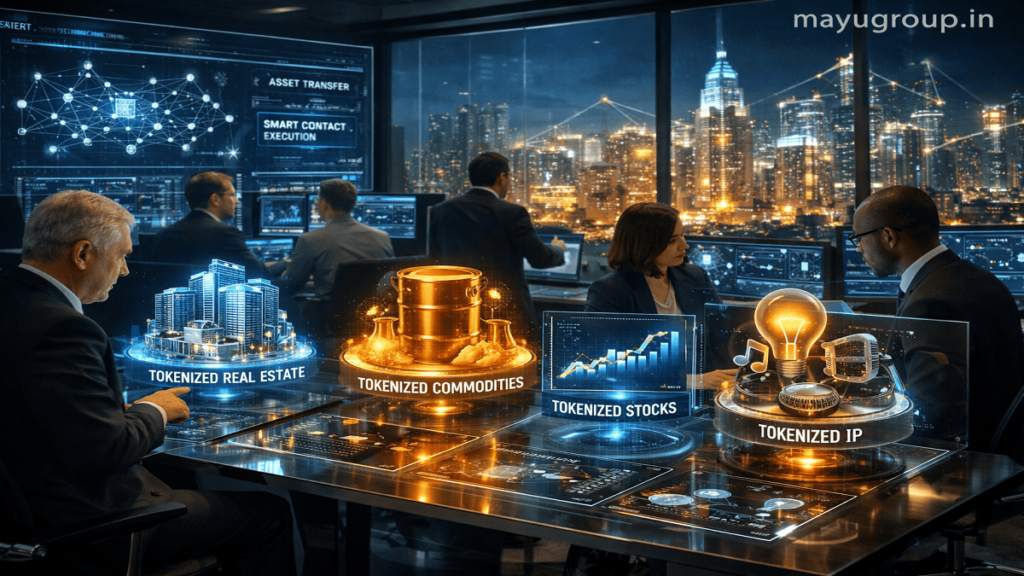
What types of assets can be tokenized?
A wide range of assets can be tokenized using blockchain technology, as long as their ownership rights can be clearly defined, legally structured, and digitally represented. Tokenization is not limited to financial instruments; it extends across physical, financial, and intangible asset classes.
1. Real Estate
Real estate is one of the most common applications of asset tokenization. Residential properties, commercial buildings, and land parcels can be divided into digital tokens representing fractional ownership. This allows investors to access high-value property markets with lower capital requirements and improves liquidity in an otherwise illiquid sector.
2. Commodities
Physical commodities such as gold, silver, oil, and agricultural products can be tokenized. Each token can represent a specific quantity of the underlying commodity stored in secure vaults or warehouses. This enables easier trading, faster settlement, and reduced dependency on traditional commodity exchanges.
3. Financial Assets
Traditional financial instruments such as stocks, bonds, ETFs, and mutual funds can be issued in tokenized form. This allows 24/7 trading, faster settlement cycles, and fractional ownership. Financial institutions are increasingly exploring blockchain-based securities to improve efficiency in capital markets.
4. Private Equity and Venture Capital
Private company shares and venture capital investments can be tokenized to improve liquidity in traditionally locked investment structures. Investors can buy and sell fractional stakes in startups or private funds, increasing access to high-growth opportunities.
5. Intellectual Property (IP)
Intangible assets such as patents, copyrights, trademarks, music royalties, and digital content rights can be tokenized. This enables creators and rights holders to monetize their intellectual property by selling fractional ownership or royalty streams to investors.
6. Art and Collectibles
High-value artworks, rare collectibles, and luxury goods can be tokenized to enable shared ownership. For example, a valuable painting can be divided into multiple tokens, allowing investors to own a share of the artwork without physically holding it.
7. Infrastructure and Energy Projects
Large-scale infrastructure assets such as solar farms, wind energy projects, toll roads, and bridges can be tokenized to raise capital from global investors. This model supports funding for long-term, capital-intensive projects.
8. Digital-Native Assets
Cryptocurrencies, in-game assets, virtual real estate in metaverse platforms, and NFTs are inherently tokenized or can be further fractionalized. These assets exist digitally and are naturally suited for blockchain-based ownership models.
Key Enabler: Legal and Smart Contract Structure
For any asset to be tokenized effectively, it must be backed by a legal framework that connects the digital token to real-world ownership rights. Smart contracts handle issuance, transfer, and compliance, while legal agreements ensure enforceability in traditional jurisdictions.
Research from McKinsey indicates that tokenization could transform multiple asset classes by increasing liquidity and reducing transaction friction across global markets. McKinsey Digital Assets Insights
Similarly, the World Economic Forum highlights that tokenization is expanding across industries as blockchain infrastructure matures and regulatory clarity improves. World Economic Forum Blockchain Insights
Conclusion
In essence, nearly any asset with clear ownership rights and measurable value can be tokenized, spanning physical goods, financial instruments, intellectual property, infrastructure, and digital-native assets, making tokenization a broadly applicable innovation in modern finance.
#Tokenized Assets in Hyderabad
Why do investors use tokenized assets?
Investors use tokenized assets because they make traditional and alternative investments more accessible, liquid, efficient, and transparent by leveraging blockchain technology. Tokenization changes how ownership is structured and traded, allowing investors to participate in markets that were previously difficult to access or inefficient to operate in.
One of the primary reasons is fractional ownership. High-value assets such as real estate, private equity, fine art, or infrastructure projects typically require large capital commitments. Tokenization divides these assets into smaller digital units, allowing investors to buy fractions instead of entire assets. This lowers entry barriers and enables portfolio diversification even with limited capital.
Another key reason is improved liquidity. Many traditional assets are illiquid, meaning they cannot be easily sold or exchanged without long settlement periods or intermediaries. Tokenized assets can be traded on blockchain-based platforms more quickly, sometimes in near real time, depending on regulatory frameworks. This makes it easier for investors to enter and exit positions compared to conventional markets.
Global accessibility is another major advantage. Tokenized assets can be traded across borders without the same level of friction found in traditional financial systems. Investors from different regions can access the same asset markets, expanding opportunities and increasing market participation.
Investors are also attracted by operational efficiency and lower costs. Blockchain-based smart contracts automate processes such as ownership verification, dividend distribution, compliance checks, and settlement. This reduces reliance on intermediaries like brokers, custodians, and clearinghouses, which lowers transaction fees and administrative overhead.
Transparency and security also play an important role. Blockchain records are immutable and publicly verifiable (depending on the network), which helps reduce fraud and improve trust in ownership records. Every transaction is permanently recorded, making auditing and verification simpler and more reliable than in traditional systems.
Another reason is access to previously exclusive asset classes. Tokenization opens up investments in private markets such as venture capital, early-stage startups, and infrastructure projects that were traditionally restricted to institutional investors. This democratizes access to high-growth opportunities.
However, investors are also motivated by portfolio diversification. Tokenized assets allow exposure to a broader range of asset classes—physical, financial, and digital—within a single digital ecosystem. This can help reduce overall portfolio risk.
Despite these advantages, investors remain aware of challenges such as regulatory uncertainty, market volatility, and smart contract risks. Legal recognition of tokenized ownership still varies across jurisdictions, which can impact enforcement and liquidity.
Research from McKinsey suggests that tokenization could significantly improve capital market efficiency by reducing friction, settlement time, and operational complexity. McKinsey Digital Assets Insights
Similarly, the World Economic Forum highlights that tokenization has the potential to reshape global financial systems by making asset ownership more programmable and accessible. World Economic Forum Blockchain Insights
Overall, investors use tokenized assets because they combine traditional investment value with modern digital efficiency, offering better access, flexibility, and market functionality compared to conventional asset ownership models.
#Tokenized Assets in Banglore
What are the risks of investing in tokenized assets?
Investing in tokenized assets introduces several risks that stem from a combination of blockchain technology limitations, regulatory uncertainty, and the underlying characteristics of the assets being tokenized. While tokenization improves accessibility and efficiency, it does not eliminate traditional investment risks and, in some cases, adds new layers of complexity.
1. Regulatory and Legal Risk
One of the most significant risks is the lack of consistent global regulation. Tokenized assets may be treated differently across jurisdictions—some countries classify them as securities, while others have no clear legal framework. This creates uncertainty around ownership rights, taxation, investor protection, and enforceability of claims in case of disputes. If the legal structure backing the token is weak, the digital token may not reliably represent real-world ownership.
2. Market and Liquidity Risk
Although tokenization is designed to improve liquidity, many tokenized assets still trade on limited or fragmented platforms. If trading volume is low, investors may struggle to buy or sell assets quickly at fair prices. Market demand can also fluctuate significantly, especially for niche assets like tokenized real estate or private equity.
3. Technology and Smart Contract Risk
Tokenized assets rely heavily on smart contracts—self-executing code that governs ownership and transactions. Bugs, coding errors, or vulnerabilities in these contracts can lead to financial loss, hacking incidents, or irreversible transactions. Blockchain infrastructure itself may also face outages or network congestion, affecting transaction reliability.
4. Custody and Asset Backing Risk
For tokenized real-world assets (such as property or gold), the digital token is only as strong as the legal and physical backing behind it. If the underlying asset is mismanaged, misrepresented, or not properly secured, token holders may face losses even if the blockchain records are intact. This is often referred to as “off-chain risk.”
5. Counterparty and Platform Risk
Many tokenized assets are issued and traded on specific platforms or exchanges. If the platform becomes insolvent, is hacked, or shuts down, investors may lose access to their assets. Unlike traditional regulated financial institutions, some tokenization platforms may not have strong investor protection mechanisms.
6. Valuation and Transparency Risk
Valuing tokenized assets can be difficult, especially for illiquid or unique assets like art, private equity, or infrastructure projects. In some cases, pricing may not reflect true market value due to limited trading data or lack of standardized valuation models.
7. Security and Cyber Risk
Because tokenized assets are digital, they are exposed to cybersecurity threats such as phishing attacks, wallet breaches, and exchange hacks. Even if blockchain networks are secure, user-side vulnerabilities can still lead to asset theft.
Research from institutions like McKinsey highlights that while tokenization can improve market efficiency, regulatory uncertainty and operational risks remain key barriers to large-scale adoption. McKinsey Digital Assets Insights
Similarly, the World Economic Forum notes that governance, legal clarity, and interoperability challenges must be addressed before tokenized markets can achieve full institutional trust. World Economic Forum Blockchain Insights
Conclusion
While tokenized assets offer innovation in liquidity, access, and efficiency, they also introduce regulatory, technological, and market risks. Investors must carefully evaluate both the blockchain infrastructure and the underlying real-world asset before participating.
#Tokenized Assets in Delhi
Case Study of Tokenized Assets
A well-known example of tokenized assets in practice is the real estate tokenization model developed by RealT, a platform that enables fractional ownership of rental properties through blockchain-based tokens. This case demonstrates how tokenization can transform an illiquid asset class like real estate into a more accessible, tradable, and income-generating digital investment.
1. Background and Objective
Traditional real estate investment requires high capital, long holding periods, and complex legal processes. Properties are typically illiquid and difficult to divide among multiple investors. RealT was created to solve this problem by converting ownership rights of U.S. rental properties into blockchain-based tokens, allowing investors to purchase fractional shares with relatively low entry barriers.
2. Tokenization Structure
Each property is legally owned by a Special Purpose Vehicle (SPV), which is then represented digitally on the blockchain. The ownership of this SPV is divided into tokens that represent fractional shares of the underlying real estate asset.
These tokens are issued on blockchain networks and comply with digital asset standards. Investors holding these tokens effectively own a proportional share of the property and are entitled to rental income generated by it.
3. Role of Blockchain and Smart Contracts
Blockchain technology is used to record ownership, ensure transparency, and facilitate trading. Smart contracts automate key functions such as:
- Distribution of rental income to token holders
- Recording ownership transfers
- Ensuring compliance with investor eligibility rules
- Maintaining transparent transaction history
This reduces reliance on traditional intermediaries like brokers, property managers, and settlement agencies.
4. Investor Benefits
The RealT model highlights several advantages of tokenized assets:
- Fractional ownership: Investors can buy small portions of high-value properties
- Liquidity: Tokens can be traded on secondary markets more easily than physical real estate
- Passive income: Rental income is distributed automatically to token holders
- Global access: Investors from different regions can participate in U.S. real estate markets
5. Risks and Limitations
Despite its innovation, the model also exposes key risks:
- Dependence on regulatory clarity for security token classification
- Limited liquidity compared to traditional financial markets
- Platform and custody risk if the issuing entity faces operational issues
- Valuation challenges in secondary trading markets
- Legal complexity in linking digital tokens to physical property rights
6. Market Impact
The RealT model has helped demonstrate that real estate tokenization is technically and operationally feasible. It has encouraged broader experimentation in real-world asset (RWA) tokenization across infrastructure, private credit, and commodity markets. Institutional interest in tokenized assets is also growing as blockchain infrastructure becomes more mature and regulatory frameworks gradually evolve.
Research from McKinsey highlights that tokenization can significantly improve liquidity and reduce friction in traditionally illiquid asset classes such as real estate. McKinsey Digital Assets Insights
The World Economic Forum also notes that real-world asset tokenization could reshape ownership structures by enabling programmable and fractional investment systems across global markets. World Economic Forum Blockchain Insights
7. Conclusion
The RealT case study illustrates how tokenized assets can bridge traditional real estate markets with blockchain technology. By enabling fractional ownership, automated income distribution, and improved liquidity, tokenization is reshaping how investors access and interact with physical assets, while still facing important regulatory and operational challenges.
#Tokenized Assets in Pune
White Paper on Tokenized Assets
1. Executive Summary
Tokenized assets represent a financial innovation where ownership rights of real-world or digital assets are converted into blockchain-based tokens. These tokens enable fractional ownership, improved liquidity, and programmable asset management through smart contracts. This white paper examines the structure, benefits, risks, and future outlook of tokenized assets as they evolve into a core component of next-generation financial infrastructure.
2. Introduction
Traditional asset markets are often constrained by illiquidity, high entry barriers, and reliance on intermediaries. Tokenization addresses these inefficiencies by digitizing ownership and recording it on distributed ledger systems. Institutions such as World Economic Forum and global financial analysts recognize tokenization as a foundational shift in how value is stored, transferred, and managed.
3. Concept of Tokenized Assets
Tokenized assets are digital representations of ownership rights stored on a blockchain. Each token corresponds to a fraction or full unit of an underlying asset such as:
- Real estate
- Commodities
- Stocks and bonds
- Private equity
- Intellectual property
- Infrastructure projects
- Digital-native assets
Ownership is enforced through cryptographic security and smart contract logic.
4. Technical Framework
4.1 Asset Structuring
The physical or financial asset is legally structured, often using a Special Purpose Vehicle (SPV), to enable divisible ownership.
4.2 Token Creation
Smart contracts are deployed on blockchain networks to issue tokens representing ownership shares. These tokens follow standards such as ERC-based frameworks.
4.3 Ownership Recording
Blockchain ledgers maintain immutable records of ownership, ensuring transparency and traceability.
4.4 Transfer and Trading
Tokens can be transferred peer-to-peer or traded on digital exchanges, depending on regulatory permissions.
5. Economic Benefits
5.1 Fractional Ownership
Investors can access high-value assets with low capital requirements.
5.2 Liquidity Enhancement
Previously illiquid markets become tradable through token-based exchanges.
5.3 Reduced Intermediation
Smart contracts reduce dependence on brokers, custodians, and clearinghouses.
5.4 Global Accessibility
Investors can participate in cross-border asset markets more easily.
6. Use Cases
6.1 Real Estate Tokenization
Platforms enable fractional property ownership and automated rental income distribution.
6.2 Capital Markets
Tokenized bonds and equities allow faster settlement and 24/7 trading capabilities.
6.3 Private Equity
Early-stage investments become more liquid and accessible to broader investor pools.
6.4 Commodities
Assets like gold and oil can be digitally represented and traded efficiently.
6.5 Intellectual Property
Royalties from music, patents, and media content can be tokenized for revenue sharing.
7. Risk Analysis
7.1 Regulatory Risk
Legal frameworks vary across jurisdictions, creating uncertainty in enforcement and classification.
7.2 Technology Risk
Smart contract vulnerabilities and blockchain security issues can lead to financial losses.
7.3 Liquidity Risk
Many tokenized assets still suffer from low trading volume and fragmented markets.
7.4 Custody Risk
The value of tokens depends on the integrity of the underlying real-world asset.
7.5 Market Risk
Asset valuation volatility and speculative behavior can impact pricing stability.
8. Industry Outlook
Tokenization is expected to expand significantly as financial institutions adopt blockchain infrastructure for settlement and asset issuance. Research indicates that tokenized markets could improve capital efficiency and reduce operational friction across global financial systems.
According to McKinsey, tokenization has the potential to reshape capital markets by increasing liquidity and enabling real-time settlement systems. McKinsey Digital Assets Insights
The World Economic Forum highlights that blockchain-based ownership models may redefine asset classes by enabling programmable, transparent, and globally accessible investment systems. World Economic Forum Blockchain Insights
9. Conclusion
Tokenized assets represent a structural evolution in financial systems, bridging traditional asset ownership with blockchain-enabled infrastructure. While challenges remain in regulation, liquidity, and security, the long-term trajectory suggests increasing adoption across real estate, capital markets, commodities, and digital assets, fundamentally transforming global investment frameworks.
#Tokenized Assets in Kolkata
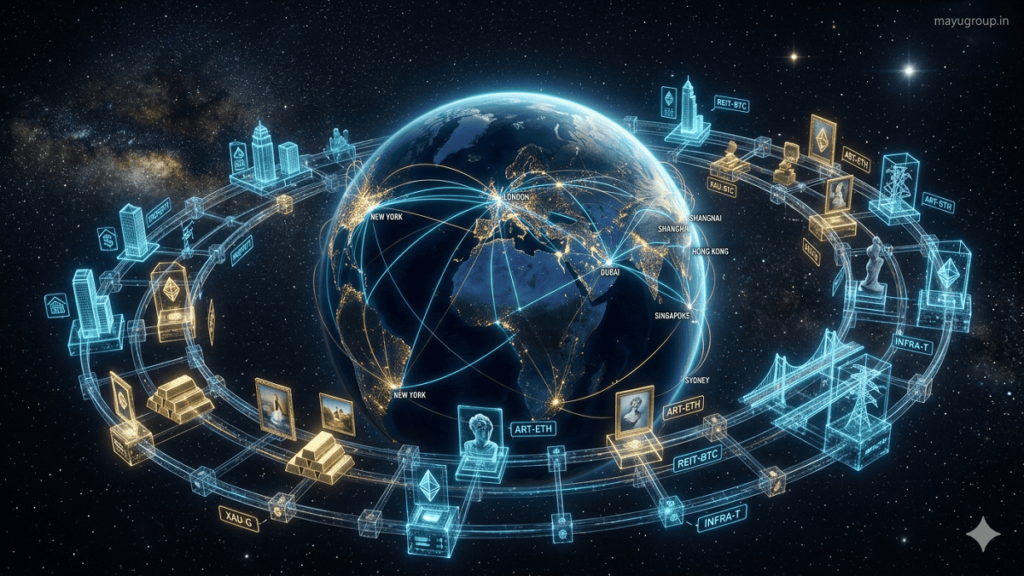
Industry Applications of Tokenized Assets
Tokenized assets are increasingly being applied across multiple industries by converting ownership rights of physical, financial, and digital assets into blockchain-based tokens. This enables fractional ownership, improved liquidity, faster settlement, and broader investor access. As blockchain infrastructure matures, tokenization is moving from experimental pilots into real-world deployment across several major sectors.
1. Real Estate and Property Investment
One of the most established applications of tokenized assets is real estate. Properties such as residential apartments, commercial buildings, and rental portfolios can be divided into digital tokens representing fractional ownership. This allows investors to participate in high-value property markets with lower capital requirements.
Tokenization also enables automated rental income distribution through smart contracts, reducing administrative overhead and increasing transparency in property management.
2. Capital Markets (Stocks and Bonds)
Tokenization is being explored in traditional capital markets to digitize equities, bonds, and exchange-traded funds (ETFs). Tokenized securities can potentially enable 24/7 trading, faster settlement cycles, and reduced reliance on intermediaries such as clearinghouses and custodians.
Financial institutions see tokenization as a way to improve efficiency in issuance, trading, and settlement processes across global capital markets.
3. Commodities Trading
Physical commodities such as gold, silver, oil, and agricultural products can be tokenized to represent ownership of stored physical assets. This allows investors to trade commodities digitally without needing direct physical handling.
Tokenized commodities improve liquidity, simplify global trading, and reduce friction in cross-border transactions.
4. Private Equity and Venture Capital
Private markets traditionally suffer from low liquidity and long investment lock-in periods. Tokenization enables fractional ownership of private equity funds and startup investments, making these assets more accessible to a broader investor base.
This also allows early investors to exit positions more easily by trading tokens on secondary markets.
5. Infrastructure and Energy Projects
Large-scale infrastructure projects such as solar farms, wind energy plants, toll roads, and transportation networks can be tokenized to raise capital from global investors. Tokenization helps fund long-term projects by distributing investment risk across multiple participants.
It also enables transparent tracking of revenue distribution from infrastructure assets.
6. Intellectual Property and Royalties
Tokenization is widely applied to intellectual property (IP) such as music rights, film royalties, patents, and digital content. Artists and creators can tokenize future revenue streams, allowing investors to purchase fractional rights to royalty income.
This creates new financing models for creative industries and improves liquidity for intangible assets.
7. Art, Collectibles, and Luxury Assets
High-value artworks, rare collectibles, luxury watches, and fine wines can be tokenized to enable shared ownership. This allows multiple investors to collectively own valuable assets that would otherwise be inaccessible due to high costs.
Tokenization also improves transparency in provenance tracking and ownership history.
8. Supply Chain and Trade Finance
Tokenized assets are used in supply chain financing to represent goods in transit, invoices, and trade receivables. This improves transparency, reduces fraud, and enhances financing efficiency for global trade operations.
Blockchain-based tracking ensures real-time visibility of asset movement and ownership changes.
9. Digital-Native Assets and Gaming
In gaming, metaverse platforms, and digital ecosystems, tokenized assets represent in-game items, virtual land, and digital identities. These assets can be traded freely across marketplaces, creating new digital economies.
Conclusion
Tokenized assets are transforming multiple industries by enabling fractional ownership, improving liquidity, and reducing transaction friction. From real estate and capital markets to intellectual property and digital ecosystems, tokenization is becoming a foundational technology for next-generation asset management systems.
Research from McKinsey highlights that tokenization can significantly enhance capital market efficiency and unlock liquidity in traditionally illiquid asset classes. McKinsey Digital Assets Insights
Similarly, the World Economic Forum emphasizes that tokenization has the potential to reshape global ownership structures by enabling programmable and transparent asset systems. World Economic Forum Blockchain Insights
#Tokenized Assets in Mumbai
Ask FAQs
What are tokenized assets?
Tokenized assets are real-world or digital assets whose ownership rights are converted into blockchain-based tokens. Each token represents a fraction or full ownership of an underlying asset such as real estate, stocks, commodities, or intellectual property.
How do tokenized assets work?
Tokenized assets work by using blockchain technology and smart contracts to represent ownership digitally. The asset is first legally structured, then divided into tokens, which are recorded on a blockchain ledger. These tokens can be traded or transferred digitally while maintaining transparent ownership records.
What are the benefits of tokenized assets?
Key benefits include fractional ownership, improved liquidity, lower transaction costs, faster settlement, and global accessibility. Investors can also diversify portfolios by investing in high-value assets with smaller capital amounts.
Are tokenized assets safe to invest in?
Tokenized assets offer transparency and security through blockchain technology, but they still carry risks such as regulatory uncertainty, platform dependency, smart contract vulnerabilities, and market volatility. Investors should evaluate both the underlying asset and the tokenization platform.
What types of assets can be tokenized?
Almost any asset with defined ownership can be tokenized, including real estate, commodities, financial securities, private equity, intellectual property, infrastructure projects, and digital assets like NFTs and virtual goods.
Table of Contents
Disclaimer:
This content is for general informational and educational purposes only. It does not constitute financial, legal, or investment advice. Readers should consult qualified professionals before making any financial or investment decisions.