Green Crowdfunding
Green Crowdfunding refers to the practice of raising funds from a large group of individuals through online platforms specifically to support environmentally sustainable, climate-friendly, or eco-conscious projects. These projects can include renewable energy systems, waste reduction initiatives, conservation programs, sustainable agriculture, clean technology development, and community-based environmental actions. Unlike traditional financing, green crowdfunding relies on public participation and shared environmental values rather than institutional investors or government funding alone.
This funding model operates through digital crowdfunding platforms where project creators present their environmental goals, implementation plans, and funding requirements. Supporters contribute small or large amounts of money in exchange for recognition, updates, or symbolic rewards. Some platforms also focus exclusively on sustainability-driven campaigns, ensuring that all listed projects align with environmental impact criteria. Well-known general crowdfunding platforms like Kickstarter and Indiegogo also host green projects, while specialized platforms such as EcoCrowd and StartSomeGood focus more directly on social and environmental impact initiatives.
Green crowdfunding plays a significant role in accelerating climate action and sustainability innovation. It enables individuals, startups, and non-profit organizations to bypass traditional funding barriers, which often prioritize profit-driven projects over ecological concerns. By directly engaging the public, it also raises awareness about environmental issues and encourages collective responsibility for sustainable development. Many renewable energy startups, for example, use crowdfunding to finance solar installations, wind energy prototypes, or energy-efficient technologies that might otherwise struggle to secure early-stage investment.
A key advantage of green crowdfunding is its ability to validate demand for eco-friendly solutions. If a project receives strong public support, it signals market readiness and environmental interest, which can attract additional funding from investors or government grants. It also helps build communities of environmentally conscious supporters who actively participate in promoting sustainable change.
However, green crowdfunding also faces challenges. Projects may suffer from delays, limited scalability, or insufficient funding if public interest is low. Additionally, the environmental impact claims of some projects may lack verification, raising concerns about “greenwashing,” where projects exaggerate their sustainability benefits to attract funding. Transparency and accountability are therefore critical to maintaining trust in the ecosystem.
Overall, green crowdfunding represents a powerful intersection of finance, technology, and environmental activism. It empowers individuals to directly support climate solutions while helping innovators bring sustainable ideas to life. As global attention to climate change increases, green crowdfunding is expected to play an even more important role in supporting grassroots environmental innovation and accelerating the transition toward a more sustainable future.
References
- https://www.investopedia.com/terms/c/crowdfunding.asp
- https://www.ecocrowd.com/
- https://www.startsomegood.com/
- https://www.weforum.org/agenda/
#Green Crowdfunding in India
What is green crowdfunding?
Green crowdfunding is a method of raising money from a large number of people through online platforms to fund projects that focus on environmental protection and sustainability. Instead of relying on banks, governments, or large investors, individuals contribute small amounts of money to support eco-friendly initiatives such as renewable energy systems, climate action projects, recycling programs, conservation efforts, and sustainable agriculture.
This model works through crowdfunding platforms where project creators present their ideas along with funding goals, timelines, and expected environmental impact. Supporters, often called backers, donate money because they believe in the project’s environmental value. In return, they may receive updates, acknowledgments, or symbolic rewards, depending on the campaign structure.
Green crowdfunding is commonly used to support innovations like solar panel installations, wind energy prototypes, electric mobility solutions, water conservation systems, and community-driven environmental restoration projects. It is especially valuable for startups, non-profits, and local communities that may not have access to traditional funding sources but still want to implement sustainability-focused solutions.
One of the key benefits of green crowdfunding is that it democratizes environmental action. It allows everyday people to directly participate in funding climate solutions rather than relying only on large institutions. It also helps validate eco-friendly ideas by showing whether there is public interest and support, which can later attract investors or government assistance.
However, green crowdfunding also carries risks. Some projects may fail due to poor planning, lack of funding, or technical challenges. In some cases, environmental claims may be exaggerated, leading to concerns about greenwashing. Because of this, transparency and accountability are important in ensuring trust between creators and supporters.
Overall, green crowdfunding plays an important role in promoting sustainability by connecting environmental innovators with global communities willing to support positive ecological change.
References:
- https://www.investopedia.com/terms/c/crowdfunding.asp
- https://www.weforum.org/agenda/
- https://www.ecocrowd.com/
- https://www.startsomegood.com/
#Green Crowdfunding in Maharashtra
How does green crowdfunding support environmental projects?
Green crowdfunding supports environmental projects by providing direct financial resources, public engagement, and early-stage validation for initiatives focused on sustainability and climate action. Instead of relying solely on governments, banks, or large investors, environmental projects can raise small contributions from a large number of individuals through online crowdfunding platforms. This distributed funding model helps accelerate eco-friendly innovation and community-driven environmental change.
One of the primary ways green crowdfunding supports environmental projects is by enabling access to capital for early-stage ideas. Many environmental solutions—such as renewable energy prototypes, waste management systems, or conservation programs—struggle to secure traditional funding because they are considered high-risk or long-term investments. Crowdfunding platforms allow these projects to present their goals directly to the public and raise funds based on interest and perceived impact.
Another important contribution is market validation. When a green project receives strong financial backing from the public, it demonstrates that there is demand and support for the solution. This validation can help project creators attract additional funding from impact investors, NGOs, or government grants. It essentially acts as a proof-of-concept stage for environmental innovation.
Green crowdfunding also strengthens community participation in environmental action. Supporters are not just financial contributors but often become active advocates for the project. Many campaigns provide updates, progress reports, and educational content, helping backers stay engaged and informed. This creates a sense of shared responsibility and increases awareness about environmental challenges such as climate change, pollution, and resource depletion.
In addition, green crowdfunding encourages innovation in sustainability. Developers and organizations are more willing to experiment with new technologies—such as solar energy systems, electric mobility solutions, or carbon reduction tools—because they can test public interest before large-scale production. This reduces financial barriers and promotes experimentation in clean technology.
However, it also indirectly supports transparency and accountability in environmental projects. Since campaigns are public, creators must clearly explain their environmental goals, expected outcomes, and implementation plans. This public scrutiny helps reduce the likelihood of misinformation or exaggerated sustainability claims.
Despite these benefits, challenges still exist. Some projects may fail due to insufficient funding or poor execution, and there is always a risk of greenwashing if environmental claims are not properly verified. Therefore, credibility and communication are essential for successful campaigns.
Overall, green crowdfunding supports environmental projects by funding innovation, validating demand, engaging communities, and promoting transparency. It plays a growing role in accelerating global sustainability efforts by connecting environmental ideas directly with people willing to support them financially and socially.
References:
- https://www.investopedia.com/terms/c/crowdfunding.asp
- https://www.weforum.org/agenda/
- https://www.ecocrowd.com/
- https://www.startsomegood.com/
#Green Crowdfunding in Ahemadabad

What types of projects use green crowdfunding?
Green crowdfunding is used to finance a wide range of projects that focus on environmental protection, sustainability, and climate action. These projects typically aim to reduce environmental harm, promote clean energy, or restore natural ecosystems. Because traditional funding sources often prioritize profit-driven ventures, crowdfunding has become an important alternative for early-stage and community-based environmental initiatives.
One of the most common categories is renewable energy projects. These include solar panel installations, wind energy systems, and small-scale hydroelectric solutions. Many startups and community organizations use green crowdfunding to finance pilot installations or expand access to clean energy in rural or underserved areas. These projects help reduce dependence on fossil fuels and lower carbon emissions.
Another major category is sustainable agriculture. Projects in this area focus on organic farming, permaculture systems, water-efficient irrigation methods, and soil restoration techniques. Crowdfunding helps farmers and agricultural innovators adopt eco-friendly practices that improve food security while reducing environmental impact.
Waste management and recycling initiatives are also widely supported through green crowdfunding. These projects may include plastic recycling systems, composting programs, circular economy solutions, and innovative waste-to-energy technologies. They aim to reduce landfill waste and promote responsible consumption patterns.
Environmental conservation and biodiversity protection projects also frequently use crowdfunding. These include wildlife protection programs, reforestation efforts, coral reef restoration, and habitat preservation campaigns. Such initiatives often rely on public support because they provide long-term ecological benefits rather than immediate financial returns.
Clean technology development is another key area. This includes electric vehicle innovations, energy-efficient appliances, carbon capture systems, and pollution monitoring tools. Startups often use crowdfunding to develop prototypes and demonstrate feasibility before seeking larger investments.
Community-based environmental projects are also common. These may involve local clean-up drives, water conservation systems, urban gardening, and climate education programs. Crowdfunding allows communities to take direct action on environmental issues affecting their local surroundings.
In addition, research and innovation projects focused on climate science and sustainability often rely on green crowdfunding. These projects help develop new methods for understanding climate change, improving resource efficiency, and creating sustainable infrastructure.
Overall, green crowdfunding supports a diverse ecosystem of projects ranging from large-scale renewable energy systems to small community initiatives. It enables innovators, organizations, and individuals to access funding while engaging the public in environmental responsibility and sustainable development efforts.
References:
- https://www.investopedia.com/terms/c/crowdfunding.asp
- https://www.weforum.org/agenda/
- https://www.ecocrowd.com/
- https://www.startsomegood.com/
#Green Crowdfunding in Hyderabad
Why do investors support green crowdfunding campaigns?
Investors support green crowdfunding campaigns for a combination of financial, environmental, and strategic reasons. Unlike traditional investments that focus primarily on profit, green crowdfunding often attracts individuals and institutions interested in both financial returns and measurable environmental impact. This blend of economic and ethical motivation makes green crowdfunding a key part of the growing “impact investing” ecosystem.
One major reason is environmental and social responsibility. Many investors today prioritize sustainability and want their money to contribute to solutions for climate change, pollution reduction, and resource conservation. Supporting green crowdfunding allows them to directly fund renewable energy, conservation projects, and clean technology innovations that align with their values.
Another important factor is early access to innovative technologies. Green crowdfunding often features startups developing new solutions such as solar energy systems, electric mobility tools, carbon capture technologies, and waste reduction systems. Investors are attracted to these campaigns because they provide an opportunity to support promising ideas at an early stage, potentially before they gain mainstream market adoption.
Financial return potential is also a strong motivator. While many green crowdfunding campaigns are reward-based or donation-based, some platforms offer equity crowdfunding models where investors receive ownership stakes or profit-sharing opportunities. If the project succeeds commercially, early investors may benefit from significant long-term returns.
Market validation is another reason investors participate. A successful crowdfunding campaign demonstrates strong public interest and demand for a product or solution. This reduces perceived risk and signals that the project may have commercial viability. Investors often use crowdfunding performance as a data point when evaluating future funding opportunities.
Additionally, investors are motivated by portfolio diversification. Green crowdfunding allows them to invest in emerging sectors like renewable energy, sustainable agriculture, and climate technology, which may behave differently from traditional financial markets. This helps balance risk across their investment portfolio.
There is also a reputational benefit. Supporting environmentally responsible projects can enhance an investor’s or organization’s public image, particularly for companies focused on corporate social responsibility (CSR). Being associated with sustainability-driven innovation can improve brand perception and stakeholder trust.
However, investors are also aware of the risks involved. Green crowdfunding projects may face technical challenges, regulatory barriers, or funding shortfalls. There is also the possibility of “greenwashing,” where environmental claims are exaggerated. As a result, investors typically conduct due diligence and rely on transparent reporting before committing funds.
Overall, investors support green crowdfunding campaigns because they combine ethical impact with innovation and financial opportunity. This funding model allows them to contribute to environmental solutions while also participating in the growth of emerging sustainable industries.
References:
- https://www.investopedia.com/terms/i/impact-investing.asp
- https://www.weforum.org/agenda/
- https://www.ecocrowd.com/
- https://www.unep.org/resources/report/investment-and-sustainable-finance
#Green Crowdfunding in Delhi
What are the risks in green crowdfunding?
Green crowdfunding offers strong benefits for sustainability projects, but it also carries several important risks for both backers and project creators. These risks arise mainly because most projects are in early development stages and depend heavily on public participation rather than established financial systems.
One of the most common risks is project failure or non-completion. Many green crowdfunding initiatives involve new technologies or experimental environmental solutions such as renewable energy prototypes, waste reduction systems, or conservation programs. Because these ideas are still being developed, there is a significant chance that the project may not reach completion due to technical difficulties, lack of expertise, or insufficient funds.
Another major risk is delays in execution. Environmental projects often involve complex engineering, regulatory approvals, and field implementation. These factors can extend timelines far beyond initial expectations. As a result, backers may experience long waiting periods before seeing any tangible outcomes.
Financial risk is also a key concern. In most crowdfunding models, contributions are not treated as traditional investments or purchases. This means there is usually no guarantee of refunds if the project fails or does not deliver as promised. Even in equity-based green crowdfunding, returns are uncertain and depend entirely on the commercial success of the project.
Greenwashing is another significant risk. Some campaigns may exaggerate or misrepresent their environmental impact to attract funding. For example, a project might claim to be highly sustainable without clear evidence or measurable outcomes. This can mislead investors and reduce trust in genuine environmental initiatives.
Lack of transparency and communication can also create problems. If project creators fail to provide regular updates or clear progress reports, backers may lose confidence in the campaign. Poor communication can also make it difficult to assess whether funds are being used effectively.
Regulatory and compliance risks are also relevant, especially for projects involving energy systems, waste management, or large-scale environmental infrastructure. Such projects may face legal restrictions, permitting delays, or changes in environmental regulations that impact feasibility.
Market risk is another factor. Even if a green project is successfully funded and completed, it may not achieve commercial success or widespread adoption. This can limit its long-term sustainability and financial viability.
Finally, there is reputational risk for both creators and supporters. Failed or controversial projects can damage trust in green crowdfunding as a whole, making it harder for future environmental initiatives to secure funding.
Overall, while green crowdfunding is a powerful tool for supporting sustainability, it requires careful evaluation, transparency, and realistic planning to minimize risks and ensure that environmental goals are achieved effectively.
References:
- https://www.investopedia.com/terms/c/crowdfunding.asp
- https://www.weforum.org/agenda/
- https://www.unep.org/resources/report/investment-and-sustainable-finance
- https://www.ecocrowd.com/
#Green Crowdfunding in Pune
Case Study of Green Crowdfunding
A strong example of green crowdfunding in action is the use of community-funded solar energy projects across Europe, particularly through platforms such as Ecocrowd. These projects demonstrate how public participation can directly finance renewable energy infrastructure while promoting environmental awareness and clean energy adoption.
Project Overview
One representative case involved a mid-sized European city community initiative focused on expanding solar rooftop installations for residential and small commercial buildings. The goal was to reduce dependency on fossil fuels and lower local carbon emissions by increasing access to affordable solar energy systems.
Instead of relying solely on government subsidies or private utility investments, the project was launched through green crowdfunding. Citizens, local investors, and environmentally conscious supporters contributed small to medium-sized financial pledges through an online platform. The funds were pooled to install solar panels across multiple buildings, creating a decentralized renewable energy network.
Implementation and Process
The campaign began with detailed environmental impact projections, including estimated CO₂ reduction, energy savings, and long-term sustainability benefits. The project creators also provided technical breakdowns of installation costs, maintenance plans, and expected energy output.
Once funding targets were reached, installation was carried out in phases. Local contractors were hired to install solar panels on participating rooftops, and smart monitoring systems were integrated to track energy production in real time. Backers received regular updates, performance reports, and community impact summaries.
Outcomes and Impact
The project successfully demonstrated several key outcomes:
- Significant reduction in household electricity costs for participating buildings
- Measurable decrease in carbon emissions at the community level
- Increased public awareness of renewable energy adoption
- Strong community engagement in sustainability initiatives
Beyond environmental benefits, the project also strengthened trust in green crowdfunding as a viable financing model for infrastructure-scale sustainability projects.
Challenges Faced
Despite its success, the project encountered several challenges:
- Delays due to regulatory approvals for rooftop installations
- Variability in solar efficiency due to seasonal weather conditions
- Coordination complexity across multiple property owners
- Need for ongoing maintenance funding after installation
These challenges highlighted the importance of long-term planning and transparent communication in green crowdfunding campaigns.
Key Learnings
This case study shows that green crowdfunding is most effective when:
- Projects have clear, measurable environmental goals
- Technical feasibility is validated before fundraising begins
- Regular updates are provided to maintain trust
- Community involvement is integrated into execution
Conclusion
Green crowdfunding enabled this solar energy project to move from concept to real-world implementation by directly engaging the public in funding and decision-making. It demonstrated that distributed financial support can successfully drive local sustainability efforts while accelerating renewable energy adoption.
References
- https://www.ecocrowd.com/
- https://www.investopedia.com/terms/c/crowdfunding.asp
- https://www.weforum.org/agenda/
- https://www.unep.org/resources/report/investment-and-sustainable-finance
#Green Crowdfunding in Banglore
White Paper of Green Crowdfunding
1. Executive Summary
Green crowdfunding is a financial model that enables individuals, communities, and organizations to raise capital for environmentally sustainable projects through online crowdfunding platforms. It supports initiatives such as renewable energy systems, conservation programs, waste reduction technologies, and climate innovation. By connecting project creators directly with the public, green crowdfunding democratizes access to funding while accelerating global sustainability efforts.
2. Introduction
Environmental challenges such as climate change, pollution, and resource depletion require large-scale investment in sustainable solutions. However, many green projects struggle to secure early-stage funding from traditional financial institutions due to perceived risks and long payback periods. Green crowdfunding addresses this gap by allowing small contributions from many supporters to collectively fund impactful environmental initiatives.
3. Operational Model
Green crowdfunding typically operates through online platforms such as Ecocrowd or general crowdfunding services like Kickstarter.
The process includes:
- Project creators submit environmental proposals with funding goals
- Campaigns describe expected ecological impact, timelines, and technical plans
- Supporters contribute funds in exchange for updates, recognition, or symbolic rewards
- Funds are released upon reaching campaign targets (model varies by platform)
Some models also include equity-based participation, allowing investors to share in financial returns.
4. Key Applications
Green crowdfunding supports a wide range of environmental sectors:
- Renewable energy (solar, wind, hydro projects)
- Sustainable agriculture and organic farming
- Waste management and recycling systems
- Climate tech innovation (carbon capture, clean mobility)
- Biodiversity conservation and reforestation
- Community-driven environmental initiatives
5. Benefits
Green crowdfunding provides multiple advantages:
- Democratized funding: Enables public participation in environmental financing
- Market validation: Demonstrates demand for sustainable solutions
- Early-stage support: Funds innovation that traditional finance avoids
- Community engagement: Builds awareness and participation in climate action
- Transparency: Public campaigns encourage accountability
6. Risks and Challenges
Despite its benefits, green crowdfunding faces limitations:
- Project delays or non-completion due to technical complexity
- Greenwashing risks where environmental claims are exaggerated
- Lack of guaranteed returns for contributors
- Regulatory barriers for energy and infrastructure projects
- Limited scalability for large capital-intensive projects
- Communication gaps between creators and backers
7. Industry Impact
Green crowdfunding has influenced sustainability finance by:
- Accelerating grassroots environmental innovation
- Supporting decentralized renewable energy adoption
- Encouraging impact investing models
- Strengthening ESG (Environmental, Social, Governance) awareness
- Enabling public participation in climate solutions
It plays a complementary role alongside government funding, private investment, and NGO initiatives.
8. Future Outlook
The future of green crowdfunding is expected to include:
- Integration with blockchain for transparency and tracking
- Growth of tokenized environmental assets
- Stronger regulatory frameworks for investor protection
- Expansion of AI-driven project evaluation systems
- Increased collaboration with impact investment funds
9. Conclusion
Green crowdfunding is an emerging financial mechanism that bridges environmental innovation and public participation. It empowers communities to directly fund sustainability projects while helping innovators overcome early-stage financial barriers. Although risks exist, improved transparency, regulation, and technological integration are expected to strengthen its role in global climate action.
References
- https://www.investopedia.com/terms/c/crowdfunding.asp
- https://www.weforum.org/agenda/
- https://www.unep.org/resources/report/investment-and-sustainable-finance
- https://www.ecocrowd.com/
#Green Crowdfunding in Kolkata
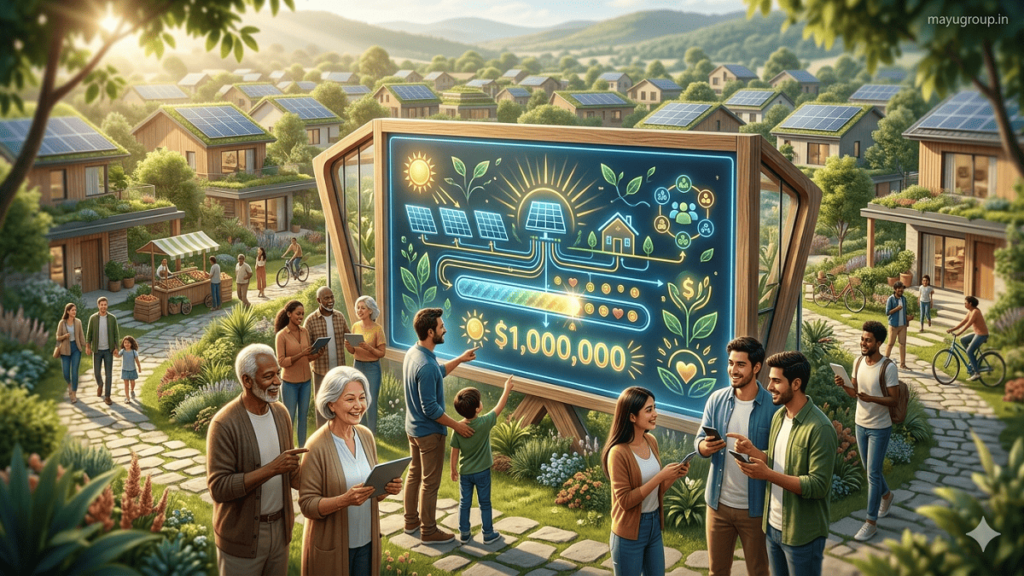
Industry Application of Green Crowdfunding
Green crowdfunding has become an important financing and engagement tool across multiple industries focused on sustainability, climate action, and environmental innovation. It is not limited to fundraising alone; it also supports product development, market validation, and community participation in eco-friendly initiatives.
1. Renewable Energy Industry
One of the largest applications of green crowdfunding is in renewable energy. Projects such as solar rooftop installations, community wind farms, and micro-hydropower systems often use crowdfunding to raise early-stage capital. This is especially useful for decentralized energy systems where local communities directly invest in clean energy infrastructure. Platforms like Ecocrowd have supported such initiatives by connecting investors with clean energy developers.
2. Sustainable Agriculture and Food Systems
Green crowdfunding is widely used in agriculture to support organic farming, permaculture, and water-efficient irrigation systems. Farmers and agri-tech startups use it to fund soil restoration projects, climate-resilient crops, and local food production systems. This helps reduce chemical dependency and promotes environmentally responsible farming practices.
3. Waste Management and Circular Economy
The waste management industry uses green crowdfunding to develop recycling systems, composting infrastructure, and circular economy solutions. Projects often focus on plastic waste reduction, e-waste recycling, and upcycling innovations. Crowdfunding helps test pilot programs before scaling them into larger municipal or industrial systems.
4. Clean Technology and Green Innovation
Startups developing clean technologies rely heavily on green crowdfunding for prototyping and early development. This includes electric mobility solutions, carbon capture technologies, energy-efficient appliances, and pollution monitoring systems. Crowdfunding allows innovators to validate ideas before seeking venture capital or government funding.
5. Environmental Conservation Sector
Non-profits and conservation groups use crowdfunding to finance reforestation, wildlife protection, marine conservation, and biodiversity preservation projects. These initiatives often depend on public support because they provide long-term ecological benefits rather than immediate financial returns.
6. Smart Cities and Urban Sustainability
Green crowdfunding is increasingly used in urban development projects such as green buildings, urban gardening, rainwater harvesting systems, and smart energy-efficient infrastructure. These projects help cities reduce emissions and improve environmental quality while engaging citizens in local sustainability efforts.
7. Climate Research and Education
Research institutions and NGOs use green crowdfunding to support climate studies, environmental data collection, and public awareness campaigns. Educational projects focused on sustainability also benefit from crowdfunding by reaching wider audiences and encouraging community participation.
Conclusion
Green crowdfunding is widely applied across industries ranging from energy and agriculture to technology and conservation. It enables innovation, reduces financial barriers, and strengthens public participation in sustainability initiatives. As environmental concerns grow globally, its role in industry-level transformation is expected to expand further.
References
- https://www.investopedia.com/terms/c/crowdfunding.asp
- https://www.weforum.org/agenda/
- https://www.unep.org/resources/report/investment-and-sustainable-finance
- https://www.ecocrowd.com/
#Green Crowdfunding in Mumbai
Ask FAQs
What is green crowdfunding?
Green crowdfunding is a method of raising funds from a large number of people through online platforms to support environmentally friendly projects such as renewable energy, conservation, recycling, and sustainable agriculture initiatives.
How does green crowdfunding work?
Project creators publish their environmental project on a crowdfunding platform with funding goals, timelines, and impact details. Supporters contribute money in exchange for updates, recognition, or rewards. Once the funding goal is reached, the project is implemented.
What types of projects are funded through green crowdfunding?
Common projects include solar and wind energy systems, organic farming initiatives, waste management solutions, reforestation programs, clean technology development, and climate research projects.
Why is green crowdfunding important?
It helps environmental projects that may not qualify for traditional funding by providing direct public support. It also increases awareness, encourages innovation, and allows communities to participate in sustainability efforts.
What are the risks of green crowdfunding?
Risks include project delays, failure to complete the project, greenwashing (misleading environmental claims), lack of refunds, and uncertain financial or environmental outcomes.
Table of Contents
Disclaimer: Green crowdfunding projects may involve financial, technical, and execution risks, including delays, changes in scope, or non-completion. Contributions are typically voluntary and do not guarantee financial returns, refunds, or specific environmental outcomes.