Drone Startup Investment
Drone Startup Investment refers to the funding provided by venture capital firms, angel investors, government agencies, and corporate investors to companies developing unmanned aerial vehicle (UAV) technologies and related services. As drones become increasingly important in industries such as agriculture, logistics, defense, infrastructure inspection, healthcare, disaster management, and surveillance, investment in drone startups has grown significantly worldwide.
The global drone industry is experiencing rapid expansion due to technological advancements in artificial intelligence (AI), autonomous navigation, computer vision, and battery systems. Investors are attracted to startups that offer innovative drone hardware, software platforms, drone-as-a-service (DaaS) models, and data analytics solutions. These technologies improve operational efficiency, reduce costs, and enable businesses to automate complex tasks.
In India, the drone ecosystem has witnessed remarkable growth following supportive government policies such as the Drone Rules 2021 and the Production Linked Incentive (PLI) Scheme for drone manufacturing. These initiatives encourage domestic production, innovation, and startup participation while reducing regulatory barriers for commercial drone operations. Government support has strengthened investor confidence and accelerated the development of indigenous drone technologies.
Investment opportunities in drone startups exist across multiple sectors. Agricultural drones help farmers monitor crop health, spray fertilizers, and optimize irrigation. Logistics companies are exploring drone delivery systems for faster transportation of medical supplies and essential goods. Infrastructure firms use drones for surveying, mapping, and inspection of bridges, roads, and power lines. Defense and security applications have also become major investment areas due to increasing demand for surveillance and autonomous systems. Recent developments indicate growing investment interest in India’s defense-focused drone companies as domestic manufacturing capabilities expand.
However, investing in drone startups also involves risks. Regulatory changes, limited battery life, high research and development costs, airspace restrictions, cybersecurity concerns, and intense market competition can affect profitability. Investors therefore evaluate factors such as technological innovation, intellectual property, market demand, scalability, management expertise, and regulatory compliance before committing capital.
Successful drone startups often secure multiple rounds of funding as they demonstrate commercial viability and expand into new markets. The increasing integration of AI, machine learning, and cloud computing with drone technology is expected to create additional investment opportunities over the coming years. Analysts expect drone applications to expand further in precision agriculture, smart cities, emergency response, and industrial automation, making the sector an attractive destination for long-term investment.
For further reading, the following resources provide valuable information:
- Invest India – Drone Sector Overview
- Directorate General of Civil Aviation (DGCA) Drone Regulations
- Drone Federation of India
#Drone Startup Investment in India
What is Drone Startup Investment?
Drone startup investment refers to the financial support provided by investors to emerging companies that develop or offer products and services based on drone or unmanned aerial vehicle (UAV) technology. These investments help startups design innovative drone hardware, software, artificial intelligence (AI) systems, navigation technologies, and industry-specific applications. Funding is typically provided by venture capital firms, angel investors, private equity firms, government programs, and corporate investors in exchange for equity or future returns.
The drone industry has become one of the fastest-growing technology sectors due to its applications across agriculture, logistics, infrastructure inspection, defense, healthcare, surveillance, mapping, photography, and disaster management. As businesses increasingly adopt drones to improve efficiency and reduce operational costs, investors view drone startups as attractive opportunities with strong long-term growth potential.
Drone startup investment generally occurs through multiple funding stages. Early-stage startups often receive seed funding from angel investors or incubators to develop prototypes and validate business ideas. As the company demonstrates market potential, it may secure Series A, B, or later-stage investments from venture capital firms to expand production, enter new markets, and scale operations. Strategic investments from large technology or aerospace companies may also provide technical expertise and market access.
In India, drone startup investment has accelerated due to supportive government initiatives such as the Drone Rules 2021, the Production Linked Incentive (PLI) Scheme, and policies encouraging indigenous drone manufacturing. These measures aim to establish India as a global drone hub while promoting innovation, research, and entrepreneurship in the UAV sector. The government has also simplified regulations and expanded opportunities for commercial drone operations, making the industry more attractive for investors. (Invest India)
Despite significant opportunities, drone startup investment involves certain risks. Regulatory changes, technological challenges, cybersecurity concerns, competition, battery limitations, and high research and development costs can affect business performance. Therefore, investors carefully evaluate a startup’s technology, intellectual property, management team, scalability, revenue model, and compliance with aviation regulations before making investment decisions.
Overall, drone startup investment plays a crucial role in advancing drone technology and supporting innovation across multiple industries. As demand for autonomous aerial solutions continues to rise, investments in drone startups are expected to increase, creating new business opportunities and contributing to economic and technological development worldwide.
For further information:
#Drone Startup Investment in Maharashtra
How do investors fund drone technology startups?
Investors fund drone technology startups by providing financial capital in exchange for equity, convertible securities, or debt instruments that support the company’s growth and innovation. These funds enable startups to develop drone hardware, software, artificial intelligence (AI) systems, autonomous navigation technologies, sensors, and industry-specific applications. Investment is essential because drone startups typically require significant capital for research and development, manufacturing, testing, regulatory compliance, and market expansion.
The funding process usually begins with seed funding, where founders receive capital from angel investors, incubators, accelerators, or government grant programs to develop prototypes and validate business ideas. At this stage, investors evaluate the startup’s technology, business model, market potential, and the expertise of its founding team before committing funds. Seed capital is primarily used for product development, initial testing, and customer acquisition.
As the startup demonstrates commercial viability, it may raise Series A and Series B venture capital funding. Venture capital (VC) firms invest larger amounts to help companies expand production, hire skilled professionals, improve technology, and enter new markets. In return, investors receive equity ownership and may participate in strategic decision-making. According to Startup India, venture capital remains one of the most common funding sources for high-growth technology startups.
Some drone startups also obtain venture debt financing, which provides loans without requiring significant equity dilution. This type of funding is particularly useful for startups that have established revenues and need working capital for expansion or equipment purchases. Government-backed financing initiatives and specialized venture debt funds have increasingly supported technology-driven startups in sectors such as agricultural drones and Drone-as-a-Service (DaaS) businesses.
Government initiatives play a significant role in supporting drone technology startups, especially in India. Programs such as the Startup India Seed Fund Scheme (SISFS) provide financial assistance for proof of concept, prototype development, product trials, commercialization, and market entry through recognized incubators. These schemes help reduce financial barriers faced by early-stage innovators.
In addition, the Indian government has strengthened startup financing through the Startup India Fund of Funds 2.0, which mobilizes venture capital for deep-tech and advanced manufacturing startups, including drone technology companies. The fund invests indirectly through Alternative Investment Funds (AIFs), encouraging greater private sector participation in emerging technologies.
Before investing, investors carefully assess factors such as technological innovation, intellectual property, scalability, competitive advantage, regulatory compliance, revenue potential, and management capability. Startups that demonstrate strong market demand and sustainable business models are more likely to secure multiple rounds of investment.
Overall, investors fund drone technology startups through a combination of equity investments, venture capital, venture debt, strategic partnerships, and government-supported financing programs. These funding mechanisms accelerate innovation, strengthen manufacturing capabilities, and enable drone companies to commercialize advanced technologies across industries such as agriculture, logistics, infrastructure, healthcare, and defense.
#Drone Startup Investment in Ahemadabad
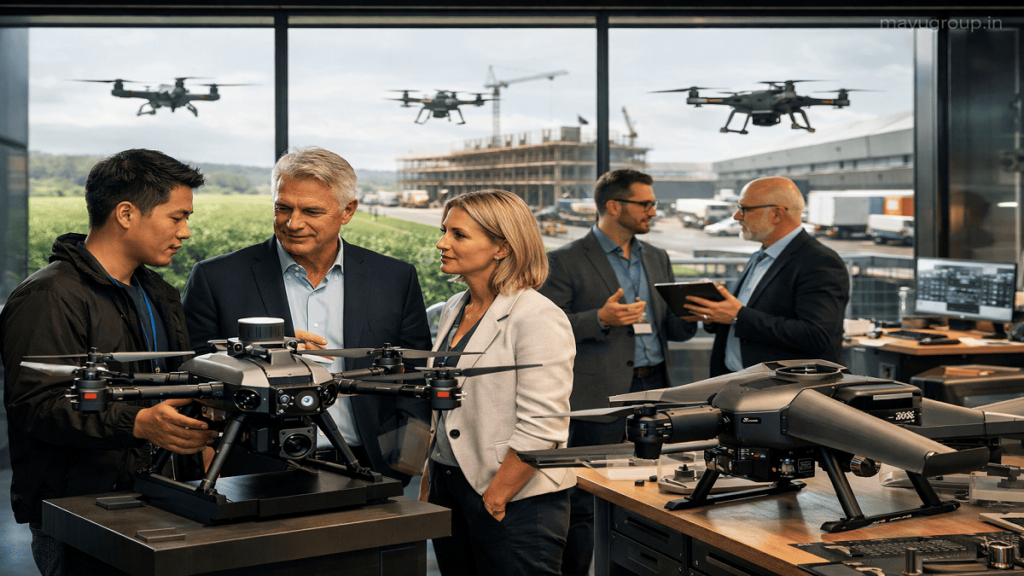
What industries benefit from drone startup investments?
Drone startup investments create value across a wide range of industries by supporting the development of advanced unmanned aerial vehicle (UAV) technologies, artificial intelligence (AI), automation systems, and data analytics platforms. As drone capabilities continue to improve, businesses are adopting these technologies to increase efficiency, reduce operational costs, improve safety, and enhance decision-making.
One of the biggest beneficiaries is the agriculture industry. Modern drones help farmers monitor crop health, assess soil conditions, detect pests and diseases, and perform precision spraying of fertilizers and pesticides. These capabilities improve productivity while reducing resource consumption and environmental impact. Agricultural drone startups are attracting significant investment because they support precision farming and sustainable agriculture practices.
The logistics and delivery sector also benefits from drone startup investments. Companies are exploring drones for transporting medicines, food, emergency supplies, and small consumer packages to remote or congested areas. Drone delivery systems can reduce transportation time and improve last-mile connectivity, especially in regions with limited infrastructure.
Another major beneficiary is the construction and infrastructure industry. Drones equipped with high-resolution cameras and LiDAR sensors can survey land, monitor construction progress, inspect bridges and buildings, and create accurate 3D maps. These applications reduce manual inspection costs, improve project management, and enhance worker safety by minimizing hazardous field operations.
The energy and utilities sector increasingly uses drones to inspect power lines, solar farms, wind turbines, pipelines, and oil and gas facilities. Regular aerial inspections help identify faults quickly, reduce maintenance costs, and minimize downtime without exposing workers to dangerous environments.
Drone startup investments have also transformed the healthcare industry. Medical drones are used to transport blood samples, vaccines, medicines, and emergency medical supplies to rural and hard-to-reach locations. During natural disasters or public health emergencies, drones can significantly improve the speed and reliability of medical logistics.
The defense and security sector remains one of the largest markets for drone technology. Governments and security agencies use drones for surveillance, border monitoring, reconnaissance, intelligence gathering, and disaster response operations. Investments in autonomous drone systems and AI-powered navigation technologies continue to drive innovation in this field.
The mining and environmental management sectors also benefit from drone technology through aerial mapping, mineral exploration, environmental monitoring, wildlife conservation, and forest management. Drones provide high-quality data while reducing the need for expensive and time-consuming ground surveys.
Finally, the media and entertainment industry utilizes drones for aerial photography, filmmaking, live event coverage, and sports broadcasting, enabling creative perspectives that were previously difficult or costly to achieve.
Overall, drone startup investments support innovation across multiple industries by improving efficiency, safety, automation, and data collection. As drone technology advances, its applications are expected to expand further, creating new opportunities for businesses and investors alike.
For additional information:
#Drone Startup Investment in Hyderabad
Why are drone startups attractive to investors?
Drone startups have become increasingly attractive to investors because they operate in a rapidly growing technology sector with applications across numerous industries. Advances in artificial intelligence (AI), automation, robotics, computer vision, and sensor technology have expanded the capabilities of unmanned aerial vehicles (UAVs), creating significant commercial opportunities. Investors recognize that drone technology has the potential to transform industries by improving efficiency, reducing costs, and enabling new business models.
One of the primary reasons investors are interested in drone startups is the large and expanding market potential. Drones are now widely used in agriculture, logistics, infrastructure inspection, mining, healthcare, disaster management, defense, security, environmental monitoring, and media production. As governments and private organizations increasingly adopt drone solutions, demand for innovative products and services continues to grow, offering startups substantial opportunities for revenue generation and long-term expansion.
Another important factor is the high level of technological innovation within the drone industry. Many startups develop advanced technologies such as autonomous flight systems, AI-powered navigation, machine learning algorithms, real-time data analytics, cloud-based fleet management, and Drone-as-a-Service (DaaS) platforms. These innovations create competitive advantages and can generate valuable intellectual property, making startups attractive acquisition targets or candidates for future public offerings.
Government policies and regulatory reforms have also strengthened investor confidence. In India, initiatives such as the Drone Rules 2021 and production incentives for drone manufacturing encourage domestic innovation and simplify commercial drone operations. These supportive policies create a favorable environment for startups to develop new products and expand into emerging markets.
Drone startups also appeal to investors because they offer diversified business opportunities. Some companies manufacture drone hardware, while others specialize in software, mapping services, surveillance systems, agricultural solutions, inspection services, or logistics platforms. This diversity allows investors to select startups that match their investment strategies and target industries with strong growth potential.
In addition, drones provide cost-effective alternatives to traditional methods of data collection, inspection, and transportation. Businesses using drones can often complete tasks faster, improve worker safety, and reduce operational expenses. These measurable economic benefits increase customer adoption and strengthen the commercial viability of drone startups.
Despite these opportunities, investors carefully evaluate potential risks, including regulatory changes, cybersecurity concerns, technological challenges, competition, and high research and development costs. Successful startups are typically those with experienced management teams, scalable business models, strong intellectual property portfolios, and clear paths to profitability.
Overall, drone startups are attractive to investors because they combine technological innovation, expanding market demand, government support, and the potential for significant financial returns. As industries continue to embrace automation and digital transformation, investment in drone technology is expected to remain an important driver of future economic growth.
For additional information:
#Drone Startup Investment in Pune
What risks are associated with investing in drone startups?
Investing in drone startups offers significant growth potential, but it also involves several risks that investors must carefully evaluate before committing capital. The drone industry is still evolving, and many companies operate in a highly competitive and rapidly changing technological environment. Understanding these risks helps investors make informed decisions and develop appropriate investment strategies.
One of the primary risks is regulatory uncertainty. Drone operations are governed by aviation authorities that establish rules related to airspace usage, licensing, safety standards, and privacy protection. Changes in government regulations or delays in obtaining approvals can restrict commercial operations and affect a startup’s ability to generate revenue. Compliance with these regulations often requires additional investment in technology and legal processes.
Another major risk is technological obsolescence. Drone technology is advancing rapidly, with continuous improvements in artificial intelligence (AI), autonomous navigation, battery performance, sensors, and communication systems. Startups that fail to innovate or keep pace with technological developments may quickly lose their competitive advantage. Continuous research and development require substantial financial resources, increasing operational costs.
Market competition also presents a significant challenge. The drone industry includes numerous startups as well as established aerospace, defense, and technology companies with greater financial resources and stronger distribution networks. New entrants may struggle to gain market share or compete on pricing, product quality, and technological capabilities.
Investors must also consider financial risks. Many drone startups operate for several years before achieving profitability due to high expenses related to product development, testing, certification, manufacturing, and marketing. If customer adoption is slower than expected or funding becomes limited, startups may experience cash flow problems or fail to sustain operations.
Cybersecurity and data privacy concerns represent another important risk. Many commercial drones collect sensitive images, videos, and geographical data while relying on wireless communication systems. Security vulnerabilities could expose companies to data breaches, hacking attempts, or unauthorized drone control, leading to legal liabilities and reputational damage.
The industry also faces operational risks, including limited battery life, weather dependency, equipment failures, and maintenance challenges. These technical limitations can reduce efficiency and restrict the use of drones in certain environments or applications. Delays in solving these issues may impact customer satisfaction and commercial success.
Another concern is customer adoption and market demand. While drones offer numerous advantages, some industries may be slow to adopt new technologies due to cost concerns, regulatory barriers, or limited awareness of drone capabilities. Slower market acceptance can delay revenue growth and reduce returns for investors.
Despite these risks, careful evaluation of a startup’s management team, intellectual property, financial stability, technology, scalability, and regulatory compliance can help reduce investment uncertainty. Diversifying investments across multiple technology sectors can also minimize overall portfolio risk.
Overall, investing in drone startups offers promising opportunities but requires thorough due diligence and a long-term perspective. Investors who understand both the potential rewards and associated risks are better positioned to identify innovative companies capable of achieving sustainable growth.
For further information:
#Drone Startup Investment in Delhi
Case Study of Drone Startup Investment
A notable example of successful drone startup investment is IdeaForge Technology, an Indian drone manufacturer that has grown from a university-backed startup into one of the country’s leading unmanned aerial vehicle (UAV) companies. The company’s journey demonstrates how strategic investment, technological innovation, and supportive government policies can help a drone startup achieve commercial success.
IdeaForge was founded in 2007 by engineering graduates from the Indian Institute of Technology Bombay with the objective of developing indigenous drone technology for defense and industrial applications. Initially, the company focused on research and prototype development, requiring substantial financial support to convert innovative ideas into market-ready products.
During its early stages, IdeaForge attracted investments from venture capital firms and strategic investors who recognized the long-term potential of India’s emerging drone industry. These investments enabled the company to expand its research and development capabilities, recruit skilled engineers, improve manufacturing facilities, and develop advanced UAV platforms for surveillance, mapping, and security operations. Funding also supported testing, certification, and compliance with aviation regulations, which are essential for commercial drone deployment.
As the company matured, its drones found applications in defense, homeland security, infrastructure inspection, mining, agriculture, and disaster management. Government agencies and private organizations increasingly adopted its technology because of its reliability, autonomous flight capabilities, and high-quality imaging systems. The growing customer base strengthened investor confidence and increased the company’s valuation.
The Indian government’s focus on promoting domestic drone manufacturing through initiatives such as the Drone Rules 2021 and production-linked incentives created a favorable environment for companies like IdeaForge. These policy reforms encouraged innovation, reduced regulatory complexity, and expanded opportunities for indigenous drone manufacturers to compete in both domestic and international markets.
One of the most significant milestones in the company’s journey was its successful public listing on the stock market, allowing investors to participate in its future growth while providing additional capital for expansion. The company’s progress illustrates how startup investments can accelerate technological development, strengthen manufacturing capabilities, and create long-term economic value.
The IdeaForge case highlights several important lessons for investors. First, investing in companies with strong technological expertise and intellectual property can provide a competitive advantage. Second, startups operating in sectors supported by government policies often benefit from improved market conditions and increased funding opportunities. Finally, patient long-term investment is often necessary, as technology startups typically require years of research, product development, and commercialization before achieving significant profitability.
Overall, the IdeaForge story demonstrates that well-planned investments in drone startups can generate substantial returns while promoting innovation, employment generation, and technological self-reliance. As drone applications continue expanding across agriculture, logistics, defense, healthcare, and infrastructure management, similar investment opportunities are expected to emerge in the coming years.
For further reading:
- IdeaForge Technology Official Website
- Invest India – Commercial Drone Market Overview
- Startup India Portal
#Drone Startup Investment in Banglore
White Paper on Drone Startup Investment
Executive Summary
Drone startup investment has emerged as one of the fastest-growing segments within the global technology and aerospace ecosystem. The increasing adoption of unmanned aerial vehicles (UAVs) across agriculture, logistics, defense, infrastructure inspection, healthcare, and smart city applications has created significant opportunities for investors and entrepreneurs. Venture capital firms, angel investors, government agencies, and corporate investors are actively funding innovative drone startups that combine artificial intelligence (AI), robotics, cloud computing, and autonomous navigation technologies.
India, in particular, has witnessed rapid growth in its drone ecosystem due to favorable government policies, indigenous manufacturing initiatives, and increasing commercial adoption across multiple sectors. These developments position drone startups as attractive long-term investment opportunities while also presenting challenges related to regulation, competition, and technological advancement.
Introduction
Drone startups focus on designing UAV hardware, flight control software, imaging systems, analytics platforms, and Drone-as-a-Service (DaaS) solutions. Investment in these companies enables research, product development, certification, manufacturing, and market expansion.
The growing demand for automation and data-driven decision-making has accelerated drone adoption worldwide. Industries are increasingly relying on drones for surveying, surveillance, inspection, delivery services, crop monitoring, and emergency response, creating substantial business opportunities for startups and investors alike.
Investment Landscape
Drone startup investments generally occur through multiple funding stages:
- Seed funding from angel investors and incubators
- Venture capital financing for scaling operations
- Strategic corporate investments
- Government grants and innovation programs
- Public market funding through IPOs
Investors evaluate factors such as intellectual property, market size, scalability, management capability, regulatory compliance, and competitive advantage before providing capital.
Market Opportunities
Drone technology is transforming numerous industries:
- Agriculture: Precision farming, crop monitoring, and pesticide spraying.
- Defense and Security: Border surveillance, reconnaissance, and autonomous missions.
- Infrastructure: Bridge, railway, and power-line inspections.
- Healthcare: Medical supply and vaccine delivery.
- Logistics: Last-mile package delivery and emergency transportation.
- Mining and Energy: Site mapping, environmental monitoring, and pipeline inspection.
The expanding range of applications continues to attract investment into specialized drone startups offering industry-specific solutions.
Investment Drivers
Several factors contribute to growing investor interest:
- Rapid advances in AI and autonomous flight systems
- Expanding commercial applications
- Government support for indigenous manufacturing
- Increased defense modernization initiatives
- Growing demand for Drone-as-a-Service business models
- Digital transformation across industrial sectors
India’s policy reforms and manufacturing incentives have significantly strengthened investor confidence in domestic drone companies.
Risks and Challenges
Despite strong growth potential, drone startup investments carry several risks:
- Regulatory uncertainty
- Rapid technological change
- High research and development costs
- Cybersecurity vulnerabilities
- Battery and endurance limitations
- Market competition
- Capital-intensive manufacturing processes
Investors must perform thorough due diligence before investing in early-stage drone companies.
Future Outlook
The future of drone startup investment appears highly promising. AI-powered autonomous systems, swarm technology, smart city integration, precision agriculture, and defense modernization are expected to drive sustained market growth. Increasing government support and private sector participation are likely to create additional funding opportunities for innovative startups over the next decade.
As drone technology becomes an essential component of industrial automation and digital infrastructure, startups with scalable business models and proprietary technologies are expected to attract significant domestic and international investment.
Conclusion
Drone startup investment represents a strategic opportunity within the emerging technology sector. The convergence of AI, robotics, data analytics, and autonomous aviation is reshaping industries and creating new commercial possibilities. While investors must carefully manage regulatory and technological risks, the sector offers considerable long-term growth potential through innovation, expanding applications, and supportive government policies. Companies that successfully combine advanced technology with sustainable business models are likely to become major contributors to the future digital economy.
Further Reading
- Invest India – Commercial Drone Market Overview
- IMARC India Drones Market Report
- Reuters: India’s Expanding Drone Industry
#Drone Startup Investment in Kolkata

Industry Application of Drone Startup Investment
Introduction
Drone startup investment has become a significant driver of technological innovation and industrial transformation across the world. Investments in drone startups support the development of unmanned aerial vehicles (UAVs), artificial intelligence (AI), autonomous navigation systems, data analytics platforms, and cloud-based monitoring solutions. These technologies are helping industries improve operational efficiency, reduce costs, enhance safety, and automate complex tasks. As governments and private organizations increasingly adopt drone technology, startup investments continue to create new business opportunities across multiple sectors.
Agriculture
Agriculture is one of the largest beneficiaries of drone startup investment. Modern agricultural drones are used for crop monitoring, precision spraying, irrigation management, soil analysis, and yield estimation. Equipped with advanced cameras and sensors, drones collect real-time data that enables farmers to make informed decisions regarding fertilizer application, pest control, and water management. Startup investments in agricultural drones contribute to higher productivity while reducing labor costs and resource wastage.
Logistics and Delivery
Drone startups are transforming logistics by developing autonomous delivery systems for packages, medicines, and emergency supplies. Drone delivery significantly reduces transportation time, especially in remote or congested urban areas where conventional transportation is inefficient. Investments in logistics drone startups support innovations in route optimization, obstacle avoidance, and fleet management systems, making last-mile delivery faster and more reliable.
Infrastructure and Construction
The construction industry increasingly utilizes drones for land surveying, project monitoring, site inspections, and 3D mapping. High-resolution aerial imagery allows engineers and project managers to monitor construction progress accurately while reducing manual inspections and operational risks. Drone startup investments have accelerated the development of advanced mapping software and automated inspection systems that improve project planning and cost management.
Defense and Security
Defense remains one of the most important sectors benefiting from drone startup investment. Governments invest heavily in surveillance drones, reconnaissance systems, border monitoring, intelligence gathering, and autonomous defense technologies. Startup innovations in AI-powered navigation, thermal imaging, and long-range communication systems strengthen national security capabilities while reducing operational risks for defense personnel.
Healthcare
Healthcare applications of drone technology continue to expand through investments in medical logistics startups. Drones transport vaccines, blood samples, medicines, and emergency medical supplies to rural and inaccessible regions where traditional transportation is difficult. During natural disasters and public health emergencies, drone delivery systems improve healthcare accessibility and reduce response times.
Energy and Utilities
Power generation companies, renewable energy providers, and oil and gas industries use drones for infrastructure inspection and maintenance. Drones inspect transmission lines, solar farms, wind turbines, pipelines, and refineries while minimizing human exposure to hazardous environments. Startup investments in AI-powered inspection systems help companies detect faults early, reduce maintenance costs, and improve operational reliability.
Mining and Environmental Monitoring
Mining companies utilize drones for topographical mapping, mineral exploration, stockpile measurement, and safety inspections. Environmental organizations use drones to monitor forests, wildlife habitats, pollution levels, and natural disasters. Startup investment has enabled the development of sophisticated remote sensing technologies that provide accurate environmental data while reducing survey costs.
Media and Entertainment
The media industry benefits from drone startups through aerial photography, filmmaking, live event broadcasting, sports coverage, and tourism promotion. High-definition drone cameras produce cinematic visuals that were previously expensive or impossible to capture using traditional equipment. Investments in camera stabilization and autonomous flight technology continue to improve production quality.
Smart Cities and Urban Planning
Drone technology supports smart city development by assisting with traffic monitoring, infrastructure inspection, disaster management, environmental assessment, and urban planning. Municipal authorities increasingly rely on drone-generated data for efficient city management and infrastructure development. Startup investments are accelerating the integration of drones with AI and Internet of Things (IoT) technologies for intelligent urban solutions.
Conclusion
Drone startup investment has transformed numerous industries by enabling automation, improving efficiency, enhancing safety, and supporting data-driven decision-making. Agriculture, logistics, defense, healthcare, construction, energy, mining, media, and smart city development all benefit from continued innovation in drone technology. As artificial intelligence, robotics, and autonomous systems continue to evolve, drone startups are expected to play an increasingly important role in industrial modernization and economic growth. Continued investment in this sector will drive technological advancement and create sustainable opportunities for businesses worldwide.
#Drone Startup Investment in Mumbai
Ask FAQs
What is drone startup investment?
Drone startup investment refers to the financial support provided by investors, venture capital firms, angel investors, government agencies, or corporations to companies developing drone technologies and related services. The funding helps startups conduct research, develop products, expand operations, and commercialize innovative drone solutions across various industries.
Which industries benefit the most from drone startup investments?
Several industries benefit from drone startup investments, including agriculture, logistics, healthcare, defense, construction, mining, energy, infrastructure inspection, environmental monitoring, and media production. Drones improve operational efficiency, reduce costs, enhance safety, and provide accurate real-time data for decision-making.
Why are investors interested in drone startups?
Investors are attracted to drone startups because the industry offers high growth potential, technological innovation, and expanding commercial applications. Advances in artificial intelligence, automation, and autonomous flight systems have increased demand for drone solutions, creating opportunities for strong financial returns and long-term market expansion.
What are the major risks of investing in drone startups?
The primary risks include changing government regulations, rapid technological advancements, intense market competition, cybersecurity challenges, high research and development costs, limited battery technology, and uncertain customer adoption. Investors typically conduct thorough due diligence before investing to minimize these risks.
What is the future outlook for drone startup investment?
The future of drone startup investment is highly promising due to increasing adoption across industries, supportive government policies, and continuous technological advancements. Emerging applications such as autonomous delivery, smart city management, precision agriculture, industrial inspection, and defense modernization are expected to drive substantial growth in the global drone market over the coming years.
Table of Contents
Disclaimer: The information provided in this document is for educational and informational purposes only. It should not be considered financial, legal, or investment advice. Readers should conduct their own research and consult qualified professionals before making any investment decisions.