SpaceTech Funding
SpaceTech Funding refers to the capital investment directed toward companies and projects involved in space exploration, satellite systems, launch vehicles, orbital infrastructure, and related downstream applications such as Earth observation, communication, and in-orbit services. Over the past decade, and especially from 2024–2026, SpaceTech funding has evolved from speculative, hype-driven investments into a more structured, infrastructure-focused asset class aligned with defense, communications, and data-driven commercial demand.
In 2025, global SpaceTech venture funding reached record levels, estimated at over $8 billion in startup investment alone, representing strong year-over-year growth after a correction period in 2022–2024. (Blacknight Space Labs) A major shift is the concentration of capital into “mega-rounds,” typically $100 million or more, indicating that investors now prefer scaling proven aerospace platforms rather than funding early-stage speculative concepts. This reflects a maturing industry where technical validation, government contracts, and revenue pathways are becoming central to investment decisions.
A key driver of SpaceTech funding is the rise of defense and national security applications. Governments increasingly view space infrastructure—especially satellites, launch systems, and orbital monitoring—as strategic assets. This has led to increased public-private partnerships and dual-use technologies that serve both civilian and military needs. Satellite constellations for Earth observation, intelligence gathering, and secure communications are among the most heavily funded areas.
Another major trend is the growth of the in-space economy, which includes satellite servicing, orbital transportation, space logistics, and manufacturing in microgravity environments. Companies like Impulse Space have raised hundreds of millions of dollars to develop orbital transfer vehicles and in-space mobility solutions, reflecting investor belief that the next frontier is not just launching payloads, but managing them after deployment. (Reuters)
Geographically, SpaceTech funding is also expanding beyond the United States into Europe and Asia. Countries such as India, Lithuania, and the UK are developing competitive ecosystems supported by government space agencies, venture capital firms, and defense programs. Small satellite manufacturers and launch startups are particularly attractive due to lower entry costs enabled by reusable rockets and standardized satellite buses.
Despite strong growth, the sector remains capital intensive and high risk. Long development cycles, regulatory constraints, and technical complexity mean that many startups require sustained funding over multiple years before generating revenue. However, investor sentiment remains positive due to falling launch costs, expanding satellite demand, and increasing reliance on space-based data services across industries.
Overall, SpaceTech funding is transitioning from speculative aerospace betting to a strategic, infrastructure-driven investment category. It is increasingly defined by long-term contracts, defense alignment, and scalable orbital systems rather than short-term technological demonstrations.
Further reading:
- https://www.seraphimspace.com/insights/
- https://www.nasa.gov/press-release/nasa-commercial-partnerships
- https://www.spacetechexpo.com/insights/
- https://www.mckinsey.com/industries/aerospace-and-defense/our-insights
- https://www.brycetech.com/reports/
#SpaceTech Funding in India
What is SpaceTech funding?
SpaceTech funding refers to the allocation of financial capital—by governments, venture capital firms, corporations, and institutional investors—into companies and projects that develop technologies for space exploration, satellite infrastructure, orbital systems, and space-enabled services. These investments support activities ranging from rocket launch systems and satellite manufacturing to downstream applications such as Earth observation, global communications, navigation, and space-based data analytics.
Traditionally, space funding was dominated by government agencies such as NASA and ESA, which financed large-scale missions, scientific exploration, and defense-related satellite systems. However, over the past decade, the sector has undergone a major transformation driven by commercial participation, private investment, and technological innovation.
Modern SpaceTech funding is primarily structured into three major sources. The first is government and public-sector funding, which continues to play a foundational role through contracts, grants, and public-private partnerships. Programs supporting satellite launches, lunar exploration, and Earth monitoring remain heavily subsidized due to their strategic and scientific importance.
The second is venture capital (VC) and private equity investment, which has grown significantly since the mid-2010s. Venture capital firms fund startups developing reusable rockets, small satellite constellations, in-orbit servicing systems, and space logistics platforms. Companies such as SpaceX have demonstrated how private capital can scale space operations and reduce launch costs through innovation and reusability.
The third source is corporate and strategic investment. Large aerospace and defense contractors, telecommunications companies, and cloud computing firms increasingly invest in SpaceTech startups to secure supply chains and expand capabilities in satellite communications and space-based data services.
A defining characteristic of SpaceTech funding is its high capital intensity and long development cycles. Unlike software startups, space companies often require years of research, testing, and regulatory approval before generating revenue. As a result, funding rounds tend to be larger and more staged, often including Series A through Series D investments followed by strategic partnerships or government contracts.
In recent years, investor interest has shifted toward infrastructure-focused SpaceTech. This includes satellite mega-constellations for global internet coverage, in-orbit servicing vehicles, and lunar infrastructure projects. The market is also increasingly driven by defense applications, as governments view space systems as critical national security assets.
According to industry research from Seraphim Space, global SpaceTech investment has grown steadily, with increasing concentration in late-stage funding rounds and scale-up companies rather than early-stage experimentation. Seraphim Space Insights highlights that the sector is transitioning from speculative investment toward infrastructure-backed commercial models.
Additional industry analysis from McKinsey notes that falling launch costs and rising satellite demand are key enablers of private capital inflows. McKinsey Aerospace and Defense Insights further explains how space is becoming an integrated part of global digital and industrial ecosystems.
Overall, SpaceTech funding represents the financial backbone of the modern space economy, bridging government exploration programs with private-sector innovation and enabling the expansion of space as a commercially viable and strategically essential domain.
#SpaceTech Funding in Maharashtra
How does SpaceTech funding support space innovation?
SpaceTech funding plays a central role in enabling and accelerating innovation in the space sector by providing the financial resources required for research, engineering development, testing, deployment, and commercialization of space technologies. Because space systems are highly capital-intensive and technically complex, most breakthroughs would not be possible without sustained and structured funding from governments, private investors, and strategic corporate partners.
At the core level, funding supports early-stage research and development (R&D). Space technologies such as propulsion systems, satellite miniaturization, reusable launch vehicles, and advanced materials require long development cycles and expensive testing environments. Public agencies such as NASA and ESA provide grants, research contracts, and collaborative programs with private firms and universities. These initiatives reduce technological risk and help validate experimental concepts before commercialization.
Private investment, especially venture capital, plays a crucial role in scaling innovations beyond the laboratory stage. Companies like SpaceX have demonstrated how sustained funding enables iterative engineering improvements, such as reusable rockets that significantly reduce launch costs. This cost reduction, in turn, unlocks new markets like satellite constellations and frequent low-cost launches, which were previously economically unviable.
Funding also accelerates commercialization by supporting infrastructure development. This includes satellite manufacturing facilities, launch sites, ground communication networks, and orbital logistics systems. Without adequate funding, these infrastructure layers would be too expensive for startups or research institutions to build independently. As a result, investors often focus on “platform companies” that create reusable systems or services rather than single-mission technologies.
Another major contribution of SpaceTech funding is risk absorption. Space innovation involves a high probability of failure due to extreme operating conditions, including vacuum environments, radiation exposure, and launch uncertainties. Funding mechanisms such as staged investments, government-backed contracts, and milestone-based grants allow companies to experiment and iterate without collapsing under early-stage failures. This risk-sharing model is essential for breakthrough innovation.
In addition, funding helps foster ecosystem growth. Capital inflows attract engineers, scientists, and entrepreneurs into the sector, while also supporting supplier networks for components such as sensors, propulsion units, and onboard computing systems. Over time, this creates a self-sustaining innovation ecosystem where startups, research institutions, and large aerospace firms collaborate and compete.
Modern SpaceTech funding increasingly focuses on scalable and data-driven applications. Satellite-based Earth observation, climate monitoring, defense intelligence, and global communications are major areas where innovation is rapidly advancing. Investors are particularly interested in technologies that convert space data into actionable insights for industries like agriculture, logistics, insurance, and disaster management.
Industry research from Seraphim Space highlights that funding has shifted from experimental missions to infrastructure-led innovation, where capital is directed toward reusable systems and orbital services. Seraphim Space Insights
Similarly, McKinsey notes that reduced launch costs and increasing satellite demand have made private-sector innovation more commercially viable than ever before. McKinsey Aerospace and Defense Insights
Overall, SpaceTech funding supports innovation by reducing financial barriers, distributing technical risk, enabling large-scale infrastructure, and creating market conditions where new space technologies can evolve from experimental concepts into operational, revenue-generating systems.
#SpaceTech Funding in Ahemadabad

What types of companies receive SpaceTech investment?
SpaceTech investment is directed toward a broad ecosystem of companies operating across the space value chain, from launch systems and satellite manufacturing to downstream data analytics and space-enabled services. As the industry has matured, investors have increasingly diversified their portfolios across both “upstream” infrastructure providers and “downstream” application companies.
One of the primary categories receiving investment is launch and propulsion companies. These firms develop rockets, reusable launch systems, and orbital transfer vehicles that transport satellites and payloads into space. Their innovations are critical because access to space remains the foundation of the entire industry. Companies like SpaceX have demonstrated how reusable launch systems can drastically reduce costs and increase launch frequency, reshaping investor expectations across the sector.
Another major category is satellite manufacturers and constellation operators. These companies design, build, and deploy satellites for communication, navigation, Earth observation, and scientific research. Small satellite (smallsat) and mega-constellation providers are especially attractive to investors due to lower production costs and scalable deployment models. These systems enable global broadband connectivity, climate monitoring, and real-time geospatial intelligence.
A third key segment is space infrastructure and in-orbit services. This includes companies focused on satellite servicing, orbital logistics, debris removal, refueling systems, and space station support technologies. These firms are increasingly important as orbital environments become more crowded and long-term satellite maintenance becomes essential. The rise of in-orbit servicing reflects a shift from one-time satellite deployment to continuous space operations.
Ground infrastructure and communication networks also attract significant investment. These companies build and operate Earth-based systems such as satellite communication terminals, tracking stations, data relay systems, and mission control software. Without these systems, space assets cannot effectively transmit or process data. As satellite constellations expand, demand for scalable ground infrastructure is increasing rapidly.
Another fast-growing category is Earth observation and space data analytics companies. These firms process satellite imagery and sensor data to deliver insights for industries such as agriculture, insurance, defense, urban planning, and climate science. Instead of building space hardware, they focus on extracting economic value from space-generated data. This segment is particularly attractive because it has faster revenue cycles and lower capital requirements compared to hardware-focused companies.
Defense and dual-use technology companies also receive substantial SpaceTech investment. These firms develop secure communication systems, surveillance satellites, missile tracking technologies, and situational awareness platforms. Governments increasingly rely on private contractors for space-based defense capabilities, making this segment strategically important and financially stable due to long-term contracts.
Finally, emerging investment is flowing into space exploration and habitation companies. These include firms working on lunar missions, deep space exploration, asteroid mining concepts, and long-duration human spaceflight systems. While still high-risk and long-term in nature, these companies represent future-facing bets on the expansion of human activity beyond Earth orbit.
Industry analysis from McKinsey highlights that capital is increasingly concentrated in scalable infrastructure and data-driven applications rather than purely experimental projects. McKinsey Aerospace and Defense Insights
Similarly, Seraphim Space reports that investors now prioritize companies with clear revenue pathways, government contracts, or dual-use applications. Seraphim Space Insights
Overall, SpaceTech investment spans a vertically integrated ecosystem—from launch providers and satellite manufacturers to data analytics and defense systems—reflecting the industry’s evolution into a commercially scalable and strategically important global sector.
#SpaceTech Funding in Hyderabad
Why are investors interested in SpaceTech startups?
Investors are increasingly interested in SpaceTech startups because the sector has transitioned from a purely government-led, exploration-focused domain into a commercially scalable industry with strong demand, improving economics, and strategic importance. This shift has created multiple overlapping investment opportunities across infrastructure, data services, and defense applications.
One of the primary reasons is the rapid decline in launch costs. Historically, space access was extremely expensive, limiting commercial participation. However, reusable rocket technologies and improved engineering efficiencies have significantly reduced the cost per kilogram to orbit. Companies like SpaceX have demonstrated that reusable launch systems can increase launch frequency while lowering costs, enabling entirely new markets such as satellite mega-constellations and frequent commercial payload deployment. Lower barriers to entry make SpaceTech more attractive to venture capital and growth-stage investors.
Another major factor is the expanding demand for satellite-based services. Modern economies increasingly rely on space infrastructure for communication, navigation, Earth observation, and real-time data analytics. This demand is driven by industries such as agriculture, logistics, insurance, climate monitoring, and defense. As satellite constellations scale, investors see recurring revenue models similar to traditional telecom and cloud infrastructure businesses, but with global coverage and high-margin data services.
Defense and national security applications also play a critical role in attracting investment. Governments are investing heavily in space-based surveillance, secure communications, and missile tracking systems, often through public-private partnerships. This creates stable, long-term contracts for SpaceTech companies, reducing revenue volatility and increasing investor confidence. Space assets are now considered strategic infrastructure, which strengthens demand even during broader economic downturns.
Investors are also attracted by the “platform effect” of SpaceTech. Once deployed, satellites, launch systems, and orbital infrastructure can serve multiple customers and applications simultaneously. This scalability allows companies to generate high returns on initial capital expenditures. For example, a single satellite constellation can support broadband internet, Earth imaging, and environmental monitoring simultaneously, creating diversified revenue streams.
Another key reason is the emergence of the in-space economy. This includes satellite servicing, orbital logistics, debris management, and potential future industries such as space manufacturing and lunar exploration. While still early-stage, these areas represent long-term growth opportunities similar to early internet infrastructure investments in the 1990s.
Additionally, SpaceTech benefits from strong government support and policy alignment. Agencies such as NASA and ESA provide funding, contracts, and research partnerships that reduce risk for private investors. This public backing acts as a stabilizing force in an otherwise high-risk industry.
Industry reports from McKinsey emphasize that falling launch costs and rising data demand are transforming space into a scalable digital infrastructure layer. McKinsey Aerospace and Defense Insights
Similarly, Seraphim Space highlights that investors are increasingly focused on companies with clear commercialization pathways and dual-use (civilian + defense) applications. Seraphim Space Insights
Overall, investors are drawn to SpaceTech startups because they combine long-term structural growth, improving unit economics, strategic government demand, and the potential to build foundational infrastructure for future global digital and physical systems.
#SpaceTech Funding in Delhi
What risks are involved in SpaceTech funding?
SpaceTech funding carries a distinct set of risks that reflect the technical complexity, capital intensity, and long development timelines of the space industry. While the sector offers high-growth potential, investors must carefully manage uncertainty across engineering, market adoption, regulatory environments, and geopolitical dynamics.
One of the most significant risks is technical and execution risk. Space systems operate in extreme conditions such as vacuum, radiation, and microgravity, where small design flaws can lead to complete mission failure. Unlike software or consumer industries, hardware failures in SpaceTech are often irreversible and extremely costly. Launch vehicle failures, satellite malfunctions, or orbital deployment errors can result in total loss of invested capital for a project.
Closely related is financial risk due to high capital intensity. Space companies require substantial upfront investment in research, prototyping, testing, and infrastructure long before generating revenue. Development cycles can take years or even decades, which creates prolonged periods of cash burn. If funding markets tighten or milestones are delayed, startups may face liquidity crises or down rounds that dilute investor returns.
Market adoption risk is another major challenge. Even if a technology is successfully developed, demand may not scale as expected. For example, satellite constellations depend on sustained customer demand for broadband connectivity or Earth observation data. If competing terrestrial technologies (such as fiber networks or 5G infrastructure) outperform expectations, SpaceTech solutions may struggle to achieve projected revenue targets.
Regulatory and compliance risk also plays a critical role. Space activities are heavily regulated by national governments and international treaties. Companies must obtain launch licenses, frequency allocations, and orbital permissions, which can be delayed or restricted due to policy changes or geopolitical tensions. Export controls and defense-related restrictions can further limit international collaboration and market expansion.
Geopolitical risk is particularly relevant in today’s environment, as space assets are increasingly tied to national security. Satellites and launch systems can be considered dual-use technologies, making them subject to sanctions, trade restrictions, and military concerns. Conflicts between major spacefaring nations can disrupt supply chains, funding flows, or access to critical technologies.
There is also technological obsolescence risk. The SpaceTech sector evolves rapidly, and innovations such as reusable rockets, miniaturized satellites, and AI-driven analytics can quickly render older systems uncompetitive. Companies that fail to innovate continuously may lose relevance before achieving profitability.
Finally, there is timing and long-horizon risk. Many SpaceTech investments are based on future markets—such as in-orbit servicing, lunar infrastructure, or space manufacturing—that are not yet fully developed. While these opportunities may be large, their timelines are uncertain, making returns difficult to predict and increasing exposure to shifts in investor sentiment.
Industry analysis from McKinsey highlights that long development cycles and capital intensity make SpaceTech particularly sensitive to macroeconomic conditions and funding availability. McKinsey Aerospace and Defense Insights
Similarly, Seraphim Space notes that while the sector is growing, it remains vulnerable to execution failures and uneven commercialization timelines across startups. Seraphim Space Insights
Overall, SpaceTech funding risk is defined by a combination of engineering uncertainty, long payback periods, regulatory complexity, and dependence on future market creation, making it a high-risk but potentially high-reward investment domain.
#SpaceTech Funding in Pune
Case Study of SpaceTech Funding
A leading example of SpaceTech funding driving industry transformation is the growth of SpaceX. Founded in 2002, SpaceX illustrates how sustained private investment, combined with government contracts, can reshape an entire sector that was once dominated by public agencies such as NASA.
In its early years, SpaceX was funded primarily through founder capital from Elon Musk and a series of venture investments aimed at developing low-cost launch capabilities. The company’s core mission was to reduce the cost of access to space by building reusable and efficient launch vehicles. However, the high capital intensity of rocket development meant that early funding was critical not only for innovation but for survival.
A major turning point in SpaceX’s funding journey came with its partnership with NASA through the Commercial Orbital Transportation Services (COTS) program. This public-private partnership provided milestone-based funding to develop cargo transport services to the International Space Station. This arrangement significantly reduced financial risk for SpaceX while ensuring NASA had access to commercial launch capabilities at lower costs. It also validated SpaceX’s technology in a highly regulated and safety-critical environment.
Following technical success with the Falcon 1 and Falcon 9 rockets, SpaceX attracted substantial private investment from venture capital firms and institutional investors. These funding rounds supported the development of reusable rocket technology, which became a defining innovation in the SpaceTech industry. Reusability dramatically reduced launch costs, increasing demand for satellite deployment and enabling the rise of large-scale satellite constellations.
A key milestone in SpaceX’s funding evolution was its transition from venture-backed startup to a highly valued private aerospace company. It has raised billions of dollars across multiple funding rounds, with later investments focusing on scaling Starlink, its satellite internet constellation. Starlink represents a shift from a launch-service company to a vertically integrated space infrastructure provider, generating recurring revenue through global broadband services.
Government contracts remain a crucial part of SpaceX’s financial model. In addition to NASA partnerships, the company also works with the U.S. Department of Defense for satellite launches and secure communications infrastructure. These contracts provide stable revenue streams and reduce dependence on purely commercial demand, which is especially important in a capital-intensive industry with long development cycles.
The success of SpaceX has had a broader impact on SpaceTech funding globally. It has encouraged venture capital firms to invest in launch startups, satellite manufacturers, and in-orbit service providers. The company’s cost reductions have also expanded the total addressable market for space services, attracting new entrants across Europe, India, and Asia.
According to McKinsey, the commercialization of reusable launch systems has fundamentally changed the economics of the space industry by lowering barriers to entry and enabling scalable satellite deployment. McKinsey Aerospace and Defense Insights
Seraphim Space research also highlights SpaceX as a catalyst for increased private capital inflows into SpaceTech, particularly in infrastructure and downstream data services. Seraphim Space Insights
Overall, SpaceX demonstrates how SpaceTech funding—when structured through a combination of venture capital, government partnerships, and strategic reinvestment—can transform a high-risk engineering challenge into a scalable commercial ecosystem that defines an entire industry.
#SpaceTech Funding in Banglore
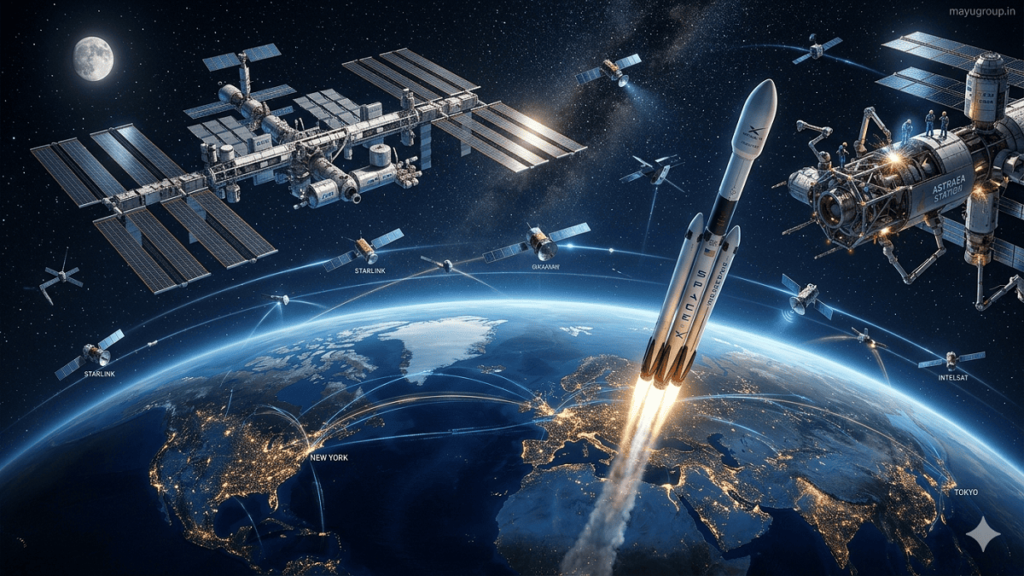
White Paper on SpaceTech Funding
1. Executive Summary
SpaceTech funding refers to the structured flow of capital into technologies and enterprises that enable space access, orbital infrastructure, satellite systems, and downstream space-enabled applications. The sector has transitioned from government-dominated expenditure to a hybrid ecosystem involving venture capital, strategic corporate investment, and public-private partnerships. This white paper outlines funding mechanisms, market structure, risk profiles, and future investment trajectories shaping the global SpaceTech economy.
2. Introduction
Historically, space activity was financed almost entirely by national agencies such as NASA and ESA, with objectives centered on exploration, defense, and scientific research. Since the 2010s, commercialization has expanded rapidly due to reusable launch systems, miniaturized satellites, and declining launch costs. This shift has enabled private capital participation across the value chain, transforming SpaceTech into an emerging infrastructure asset class.
3. Funding Ecosystem Structure
3.1 Government Funding
Government remains the largest stabilizing force in SpaceTech. Funding is delivered through:
- R&D grants and innovation programs
- Procurement contracts for launch and satellite services
- Defense and intelligence infrastructure spending
- Public-private partnerships (e.g., ISS logistics programs)
These mechanisms reduce technical risk and provide baseline demand.
3.2 Venture Capital and Private Equity
Venture capital targets high-growth SpaceTech startups, especially in:
- Reusable launch systems
- Small satellite manufacturing
- Earth observation platforms
- In-orbit servicing and logistics
A key example is SpaceX, which demonstrated how iterative funding rounds can scale launch capabilities and satellite broadband services.
3.3 Corporate and Strategic Investment
Large aerospace, telecom, and cloud firms invest in SpaceTech to secure supply chains and expand infrastructure capabilities. These investments often prioritize long-term strategic positioning over short-term returns.
4. Capital Flow Characteristics
SpaceTech funding is distinguished by:
- High upfront capital expenditure
- Long development cycles (5–15 years)
- Milestone-based financing structures
- Dual-use (civil + defense) revenue models
- Increasing concentration in late-stage funding rounds
The sector is gradually shifting from speculative early-stage funding to infrastructure-backed scaling investments.
5. Investment Drivers
Key drivers include:
- Falling launch costs due to reusable rocket technology
- Growth in satellite-based data demand
- Expansion of global broadband connectivity needs
- Defense modernization and space security priorities
- Emerging in-orbit economy (servicing, logistics, manufacturing)
These drivers are creating scalable, recurring revenue models across multiple verticals.
6. Risk Profile
SpaceTech funding carries elevated risk exposure:
- Technical failure risk (launch or system failure)
- Long payback periods and capital lock-in
- Regulatory constraints and licensing delays
- Geopolitical and defense-related restrictions
- Market adoption uncertainty for emerging space services
Despite this, risk is partially offset through government contracts and phased financing.
7. Market Outlook
The SpaceTech sector is evolving into a foundational infrastructure layer for global communications and data systems. Investment is expected to concentrate in:
- Satellite mega-constellations
- Orbital logistics and servicing
- Defense-grade space infrastructure
- Earth intelligence and climate analytics platforms
According to McKinsey, falling launch costs and rising data demand are reshaping space into a scalable digital infrastructure market. McKinsey Aerospace and Defense Insights
Seraphim Space research further indicates that capital is increasingly concentrated in infrastructure-led SpaceTech rather than experimental missions. Seraphim Space Insights
8. Conclusion
SpaceTech funding represents a structural shift in how humanity builds and finances space infrastructure. The convergence of public funding stability, private capital scalability, and corporate strategic investment is transforming space from a government-led exploration domain into a commercially integrated global industry. The long-term trajectory suggests continued expansion into infrastructure-heavy, data-driven, and defense-aligned applications.
#SpaceTech Funding in Kolkata
Industry Applications of SpaceTech Funding
SpaceTech funding plays a critical role in enabling a wide range of real-world industrial applications by financing the development and deployment of space infrastructure such as satellites, launch systems, and orbital platforms. As capital flows into the sector, it translates directly into technologies that support global communications, environmental monitoring, defense systems, transportation, and data-driven economic services.
1. Telecommunications and Connectivity
One of the largest applications of SpaceTech funding is satellite-based telecommunications. Investments support the development of low Earth orbit (LEO) satellite constellations that provide broadband internet to remote and underserved regions. Companies like SpaceX, through its Starlink program, demonstrate how funding enables global connectivity infrastructure. This has significant implications for rural internet access, maritime communication, aviation connectivity, and disaster recovery networks.
2. Earth Observation and Climate Monitoring
SpaceTech funding also drives Earth observation systems that collect high-resolution imagery and environmental data. These satellites are essential for monitoring climate change, deforestation, ocean temperatures, and natural disasters. Agencies such as ESA and NASA fund large-scale observation missions that support climate science, environmental policy, and sustainability tracking.
Industries such as agriculture and insurance heavily rely on this data for predictive analytics and risk modeling.
3. Defense and National Security
A significant portion of SpaceTech funding supports defense-related applications, including surveillance satellites, missile detection systems, and secure communication networks. Governments increasingly treat space assets as critical infrastructure. These systems enhance situational awareness, border monitoring, and intelligence gathering. Private companies benefit from long-term government contracts that provide stable revenue streams while advancing technological capabilities.
4. Navigation and Transportation
Global navigation satellite systems (GNSS), such as GPS and Galileo, are foundational to modern transportation networks. SpaceTech funding supports the maintenance and enhancement of these systems, enabling applications in aviation, shipping logistics, autonomous vehicles, and supply chain optimization. Without continuous investment, global positioning accuracy and reliability would degrade.
5. Agriculture and Resource Management
Precision agriculture is another key application area. Satellite data allows farmers to monitor soil health, crop conditions, irrigation patterns, and weather impacts. This improves yield efficiency and reduces resource waste. SpaceTech funding enables the development of analytics platforms that convert raw satellite data into actionable insights for large-scale farming operations.
6. Financial Services and Insurance
The financial sector uses satellite-derived data for risk assessment, catastrophe modeling, and asset monitoring. Insurance companies rely on Earth observation data to evaluate damage from floods, wildfires, and storms in near real time. This reduces claim processing time and improves underwriting accuracy.
7. Logistics and Supply Chain Optimization
Global shipping, aviation, and logistics industries use satellite tracking and communication systems to optimize routes, reduce fuel consumption, and improve delivery accuracy. SpaceTech funding supports the infrastructure needed for real-time global asset tracking and predictive logistics systems.
Conclusion
SpaceTech funding acts as a foundational enabler across multiple industries by supporting the infrastructure that powers global data collection, communication, and analytics systems. As investment continues to grow, the integration of space-based services into everyday industrial operations is expected to deepen significantly.
#SpaceTech Funding in Mumbai
Ask FAQs
What is SpaceTech funding?
SpaceTech funding refers to financial investment provided to companies and projects that develop space-related technologies such as rockets, satellites, space infrastructure, and space-based data services. Funding comes from governments, venture capital firms, and private corporations, enabling research, development, and commercialization of space systems.
Who are the main investors in SpaceTech startups?
The main investors include government space agencies, venture capital firms, private equity funds, and strategic corporate investors. Agencies like NASA and ESA provide grants and contracts, while private companies such as SpaceX attract large-scale venture and institutional funding for scalable space infrastructure.
Why is SpaceTech considered a high-growth investment sector?
SpaceTech is high-growth because of falling launch costs, increasing demand for satellite data, and expanding applications in communications, defense, and Earth observation. Reusable rocket technology and satellite constellations have made space services more commercially viable, opening new markets such as global broadband internet and real-time geospatial analytics.
What are the major risks in SpaceTech funding?
Key risks include technical failure (rocket or satellite malfunctions), long development timelines, high capital requirements, regulatory delays, and uncertain market adoption. Geopolitical tensions can also impact space operations due to defense and national security considerations. These risks make SpaceTech a high-reward but high-uncertainty investment domain.
Which industries benefit most from SpaceTech funding?
Major beneficiary industries include telecommunications (satellite internet), agriculture (precision farming), defense (surveillance and security systems), logistics (global tracking), insurance (disaster risk assessment), and climate science (Earth observation). These sectors use space-generated data and infrastructure to improve efficiency, decision-making, and global connectivity.
Table of Contents
Disclaimer:
This content is for general informational and educational purposes only. It does not constitute financial, investment, legal, or technical advice. Readers should conduct their own research or consult qualified professionals before making any decisions based on this information.