Solar Energy Funding
Solar Energy Funding refers to the financial mechanisms, incentives, and investment channels used to develop solar power projects ranging from small rooftop systems to large utility-scale solar farms. Because solar energy infrastructure requires high upfront capital but offers low operating costs over time, Solar Energy Funding funding structures are typically designed to reduce initial investment barriers and improve long-term returns.
At the government level, funding is often provided through subsidies, tax incentives, and viability gap funding. In India, the Ministry of New and Renewable Energy (MNRE) plays a central role in designing and implementing solar policy support, including capital subsidies for rooftop solar and incentive schemes for large-scale solar parks. MNRE India Official Website Governments also support solar expansion through national programs and procurement guarantees, such as long-term power purchase agreements (PPAs), which ensure that electricity generated from solar plants is bought at a fixed rate, Solar Energy Funding improving project bankability.
A key institutional player in India’s solar ecosystem is the Solar Energy Corporation of India, which facilitates auctions for solar projects, Solar Energy Funding and acts as an intermediary procurer of renewable energy. This reduces risk for private developers by guaranteeing demand through competitive bidding structures.
International financial institutions are also major contributors to solar funding. Organizations such as the World Bank and the International Finance Corporation (IFC) provide concessional loans, guarantees, and technical assistance to de-risk solar investments in developing markets. World Bank Renewable Energy Support IFC Climate and Renewable Energy In addition, climate-focused organizations such as the International Renewable Energy Agency (IRENA) promote global investment frameworks and policy guidance to scale renewable energy financing. IRENA Official Website
Private sector investment is another major pillar. Infrastructure funds, private equity firms, and energy companies increasingly invest in solar assets due to stable long-term returns. Green bonds have also become a popular financing tool, allowing corporations and governments to raise capital specifically for environmentally sustainable projects. These bonds attract institutional investors seeking ESG-compliant portfolios.
In addition, innovative financing models such as third-party ownership, leasing systems, and pay-as-you-go solar are expanding access to solar energy, Solar Energy Funding particularly in residential and off-grid markets. These models reduce upfront costs for consumers while allowing investors to recover capital through long-term service payments.
Overall, solar energy funding is a multi-layered system combining public policy support, international development finance, and private capital markets. The continued evolution of blended finance models and risk-sharing mechanisms is critical for accelerating the global transition to clean energy and achieving large-scale solar deployment.
#Solar Energy Funding in Maharashtra
What is solar energy funding?
Solar energy funding refers to the collection of financial tools, investments, and support mechanisms used to develop, install, and expand solar power systems. Since solar projects require significant upfront investment for equipment like photovoltaic panels, Solar Energy Funding inverters, batteries, and installation infrastructure, funding plays a crucial role in making solar energy accessible and scalable. The goal of solar energy funding is to reduce financial barriers and encourage adoption of clean, renewable energy.
Solar funding comes from multiple sources, including governments, private investors, banks, and international organizations. Governments often provide subsidies, tax credits, and grants to lower installation costs for individuals and businesses. They also support large-scale solar projects through policies such as feed-in tariffs and power purchase agreements (PPAs), which guarantee a fixed price for the electricity generated. These mechanisms make solar investments more attractive by ensuring stable long-term revenue.
Financial institutions and banks contribute by offering loans specifically designed for renewable energy projects. These loans may have lower interest rates or flexible repayment terms to encourage adoption. In many countries, public-sector banks and development finance institutions play a key role in supporting solar expansion in both urban and rural areas.
Private investment is also a major component of solar energy funding. Companies, venture capital firms, and infrastructure funds invest in solar farms and rooftop installations because of their long-term returns and increasing global demand for clean energy. New financing models such as leasing, pay-as-you-go systems, and third-party ownership allow consumers to install solar systems with little or no upfront cost, paying gradually over time.
International organizations also support solar energy funding. Institutions like the World Bank and International Finance Corporation (IFC) provide loans, Solar Energy Funding guarantees, and technical assistance to promote renewable energy projects in developing countries. These efforts help reduce risk and attract private capital into emerging markets.
In addition, green bonds have become an important funding tool. These are fixed-income financial instruments where the raised money is used exclusively for environmentally friendly projects, including solar energy development.
Overall, solar energy funding is a combination of public policy support, private capital, and international financial assistance aimed at making solar power more affordable, widespread, and sustainable.
References:
https://mnre.gov.in
https://www.irena.org
https://www.worldbank.org/en/topic/renewableenergy
https://www.ifc.org/en/what-we-do/sector-expertise/infrastructure/energy
#Solar Energy Funding in Ahemadabad

How does solar energy financing work?
Solar energy financing refers to the way capital is raised, structured, and repaid to build and operate solar power projects. Because solar installations require high upfront investment but generate predictable long-term electricity output, financing models are designed to spread costs over time while ensuring returns for investors.
At its core, solar financing usually combines two main components: equity and debt. Equity is the money invested by project developers or investors who own a share of the solar asset. Debt is borrowed capital from banks or financial institutions that must be repaid with interest over time. In most large solar projects, a “project finance” structure is used, where repayment is based primarily on the cash flow generated by selling electricity rather than the balance sheet of the company developing the project.
A key mechanism in solar financing is the Power Purchase Agreement (PPA). Under a PPA, a solar developer builds a plant and sells electricity to a utility, government body, or large corporate buyer at a fixed price for a long-term period, often 15–25 years. This predictable revenue stream reduces financial risk and makes it easier to secure loans from banks and institutional investors. In India, entities such as the Solar Energy Corporation of India facilitate competitive bidding and sign PPAs with developers, improving transparency and bankability of projects.
Another important model is leasing or third-party ownership, especially in rooftop solar systems. In this structure, a financing company owns the solar panels and leases them to the customer. The customer pays a monthly fee that is typically lower than their previous electricity bill. This eliminates the need for upfront capital and makes solar accessible to households and small businesses.
Green bonds are also increasingly used to finance solar projects. These are debt instruments issued by governments or corporations specifically to fund environmentally sustainable projects. Investors buy these bonds, and the issuer uses the funds to develop solar infrastructure while paying back interest over time. This method attracts institutional investors who focus on environmental, social, and governance (ESG) criteria.
Multilateral institutions such as the World Bank and International Finance Corporation (IFC) also play a major role by providing concessional loans, credit guarantees, and risk-sharing mechanisms. These tools reduce the perceived risk for private lenders and help mobilize larger volumes of capital in developing markets. World Bank Renewable Energy Overview IFC Energy Sector Support
In addition, government subsidies, tax incentives, and accelerated depreciation benefits further improve project viability by reducing capital costs and improving return on investment. Agencies like the International Renewable Energy Agency (IRENA) provide policy guidance and global best practices that help countries design effective financing frameworks. IRENA Official Website
Overall, solar energy financing works by combining multiple funding sources and risk-sharing mechanisms to convert high upfront costs into manageable long-term payments, enabling large-scale adoption of solar power across residential, commercial, and utility sectors.
#Solar Energy Funding in Hyderabad
What types of solar projects receive funding?
Solar energy funding is directed toward a wide range of project types, depending on scale, technology, and end use. These projects generally fall into four main categories: utility-scale solar plants, commercial and industrial (C&I) installations, residential rooftop systems, and emerging or decentralized solar solutions. Each category attracts different funding structures based on risk, return potential, and policy support.
Utility-scale solar projects are the largest recipients of solar funding. These include solar parks and grid-connected solar farms that generate electricity at a large scale and supply it directly to the power grid. Because they require substantial capital investment and land acquisition, they are typically financed through a mix of equity, long-term debt, and structured project finance. These projects often rely on long-term Power Purchase Agreements (PPAs) with utilities or government agencies to ensure stable revenue. In India, institutions such as the Solar Energy Corporation of India play a key role in aggregating demand and facilitating competitive bidding for such projects.
Commercial and industrial (C&I) solar projects are another major category. These installations are built on factories, office buildings, warehouses, and other business facilities. Funding for C&I projects often comes from corporate investments, green loans, or third-party ownership models. Businesses adopt solar to reduce electricity costs, improve energy reliability, and meet sustainability goals. Financial institutions are increasingly offering tailored loan products to support this segment due to its relatively low credit risk and predictable consumption patterns.
Residential rooftop solar systems also receive significant funding, primarily through government subsidies, consumer loans, and leasing models. Homeowners typically install smaller systems to reduce electricity bills and gain energy independence. Because upfront costs can be a barrier, financing models such as “no-money-down” leasing or pay-as-you-go systems are widely used. Many governments support this segment through direct subsidies or net metering policies that allow households to sell excess electricity back to the grid.
Decentralized and off-grid solar projects are especially important in rural or remote areas where grid access is limited. These include solar microgrids, solar home systems, and community-based solar installations. Funding for these projects often comes from development banks, non-governmental organizations, and climate funds. Institutions like the World Bank and International Finance Corporation (IFC) actively support such initiatives to improve energy access in underserved regions. World Bank Renewable Energy Projects IFC Renewable Energy Investments
In addition, innovative solar projects such as floating solar plants, agrivoltaics (combining agriculture and solar panels), and battery-integrated solar systems are beginning to attract funding from private investors and climate-focused funds. These projects are seen as future-oriented solutions that improve land use efficiency and energy storage capabilities.
Overall, solar funding is distributed across multiple project types based on scale, purpose, and risk profile, with strong participation from governments, private investors, and international financial institutions.
#Solar Energy Funding in Delhi
Why do investors support solar energy projects?
Investors support solar energy projects because they combine long-term financial stability with growing global demand for clean energy. Unlike many traditional infrastructure investments, solar projects typically generate predictable cash flows, benefit from policy support, and align with global environmental, social, and governance (ESG) priorities. This combination makes solar energy an increasingly attractive asset class for institutional and private investors.
One of the main reasons is stable and predictable returns. Solar power plants sell electricity under long-term Power Purchase Agreements (PPAs), usually lasting 15–25 years. These agreements guarantee a fixed or pre-agreed tariff, which reduces revenue uncertainty. Because sunlight is a free and abundant resource, operating costs remain relatively low once a project is built. This stability makes solar assets similar to fixed-income investments, appealing to pension funds, insurance companies, and infrastructure funds that prioritize steady returns over high-risk gains.
Another key factor is government policy support. Many countries promote solar energy through subsidies, tax incentives, renewable purchase obligations, and guaranteed grid access. These policies reduce financial risk and improve project bankability. In markets like India, institutions such as the Solar Energy Corporation of India help structure competitive auctions and standardize contracts, further increasing investor confidence by reducing regulatory uncertainty.
Cost competitiveness is also a major driver. Over the past decade, the cost of solar photovoltaic technology has fallen significantly due to improvements in manufacturing efficiency and global supply chain scaling. In many regions, solar energy is now cheaper than fossil fuel-based electricity generation. This makes solar projects economically viable without heavy reliance on subsidies, increasing investor interest in both developed and emerging markets.
Investors are also motivated by diversification benefits. Solar assets behave differently from traditional equities and commodities, helping investors spread risk across their portfolios. Infrastructure funds, in particular, view solar projects as low-correlation assets that provide long-term yield stability.
Environmental, social, and governance (ESG) considerations have become another strong driver. Many institutional investors are under pressure from stakeholders and regulatory frameworks to reduce the carbon footprint of their portfolios. Investing in solar energy allows them to meet sustainability targets while still generating returns. Green bonds and climate-focused investment funds further channel capital into solar projects by explicitly targeting environmentally responsible investments.
International financial institutions such as the World Bank and International Finance Corporation (IFC) also play a role by reducing investment risk through guarantees, concessional loans, and technical assistance. These mechanisms help attract private capital to markets that might otherwise be considered high-risk. World Bank Climate and Energy Financing IFC Renewable Energy Support
Finally, investors see solar energy as a long-term growth sector. As global energy demand rises and countries transition toward net-zero emissions, solar is expected to remain one of the fastest-growing energy sources. This structural growth outlook further strengthens investor confidence and ensures continued capital inflow into the sector.
#Solar Energy Funding in Banglore
What challenges exist in solar energy financing?
Solar energy financing has expanded rapidly over the past decade, but it still faces several structural, financial, and policy-related challenges. These challenges affect the cost of capital, project viability, and the speed at which solar energy can scale globally.
One of the primary challenges is high upfront capital requirement. Although solar energy has low operating costs, building solar plants or installing rooftop systems requires significant initial investment in panels, inverters, land, transmission infrastructure, and storage systems. In developing economies, access to affordable long-term financing is often limited, making it difficult for developers and households to adopt solar without subsidies or external funding support.
Another major issue is policy and regulatory uncertainty. Solar projects depend heavily on government incentives, net metering rules, renewable purchase obligations, and tariff structures. Frequent policy changes or unclear regulations can increase perceived risk for investors and lenders. For example, delays in tariff approvals or changes in subsidy frameworks can disrupt cash flow expectations, making financing more expensive or harder to secure. Institutions such as the Solar Energy Corporation of India help reduce some of this uncertainty through standardized auctions and long-term contracts, but regulatory risk still exists in many markets.
Credit risk from off-takers (buyers of electricity) is another challenge. Many solar projects rely on long-term Power Purchase Agreements (PPAs) with utilities or government agencies. If these buyers have weak financial health or delay payments, project revenues can become unstable. In several developing regions, distribution companies (DISCOMs) face financial stress, which increases payment risk and reduces lender confidence.
Currency and interest rate fluctuations also impact solar financing, especially in countries that rely on foreign investment or imported equipment. A depreciation in local currency can increase repayment costs for foreign-denominated loans, while rising global interest rates can make borrowing more expensive, reducing project returns and slowing investment.
Another challenge is land acquisition and infrastructure constraints. Utility-scale solar projects require large, suitable land parcels with good sunlight exposure and grid connectivity. Acquiring land can be slow and complex due to legal disputes, local opposition, or environmental clearances. In addition, weak transmission infrastructure can limit the ability to evacuate power from solar plants to demand centers.
Technological and performance risks also affect financing decisions. Although solar technology is mature, factors such as panel degradation, weather variability, and grid instability can impact actual energy output. Lenders often require detailed feasibility studies and performance guarantees to mitigate these risks.
Finally, access to affordable financing remains uneven across regions. While developed markets benefit from deep capital pools and green finance instruments like green bonds, emerging economies often depend on concessional funding from institutions such as the World Bank and International Finance Corporation (IFC). World Bank Energy Finance Overview IFC Renewable Energy Investment Support
Overall, solar energy financing is challenged by a combination of financial risk, policy instability, infrastructure limitations, and market maturity differences, all of which influence the cost and availability of capital for solar development.
#Solar Energy Funding in India
Case Study of Solar Energy Funding
The Bhadla Solar Park, located in Rajasthan, India, is one of the largest solar power plants in the world and serves as a strong case study of how solar energy funding can be structured effectively at utility scale. The project demonstrates how coordinated policy support, competitive bidding, and blended financing models can attract large volumes of private capital into renewable energy infrastructure.
The park spans over 14,000 acres in the desert region of Bhadla, an area chosen due to its high solar irradiance and low population density. The development of the project was supported by the Government of India through the Ministry of New and Renewable Energy (MNRE), which provided policy backing, infrastructure planning, and viability support for transmission connectivity. MNRE India Official Website
A key institutional driver in the funding and procurement process was the Solar Energy Corporation of India, which played a central role in aggregating demand and conducting reverse auctions. Instead of government bodies directly financing construction, SECI invited private developers to bid for long-term Power Purchase Agreements (PPAs), ensuring price discovery through competitive bidding. This structure significantly reduced procurement risk and improved transparency.
The financing structure of Bhadla Solar Park is primarily based on a public-private partnership (PPP) model. Private developers were responsible for raising equity and debt financing from commercial banks, infrastructure funds, and international lenders. The presence of long-term PPAs with guaranteed tariff rates—typically spanning 25 years—provided stable revenue streams, which made the projects bankable and attractive to investors.
Multilateral financial institutions also contributed indirectly by improving market confidence. Organizations such as the World Bank and International Finance Corporation (IFC) have supported India’s renewable energy ecosystem through risk mitigation instruments, technical assistance, and policy advisory support. World Bank Renewable Energy Program IFC Energy Investments These interventions helped reduce perceived risk for private investors participating in large-scale solar auctions.
A key success factor in the financing model was the reduction in solar technology costs over time. Due to global manufacturing scale and improved efficiency, bid tariffs for solar power in India dropped significantly during the auction phases of the Bhadla project. This allowed developers to secure financing at lower costs and improve return on investment, further attracting institutional capital.
Another important element was strong grid integration planning. The Power Grid Corporation of India developed transmission infrastructure to evacuate electricity from the solar park to high-demand regions. This reduced curtailment risk, which is an important factor for lenders evaluating project viability.
The Bhadla Solar Park case demonstrates that successful solar energy funding depends on a combination of policy stability, competitive procurement, risk-sharing mechanisms, and strong institutional coordination. It also highlights how structured auction systems and long-term PPAs can unlock large-scale private investment in renewable energy, even in emerging markets.
Overall, this case illustrates how solar energy funding evolves from government-led support to market-driven investment frameworks, enabling cost-effective and scalable clean energy deployment.
#Solar Energy Funding in Pune
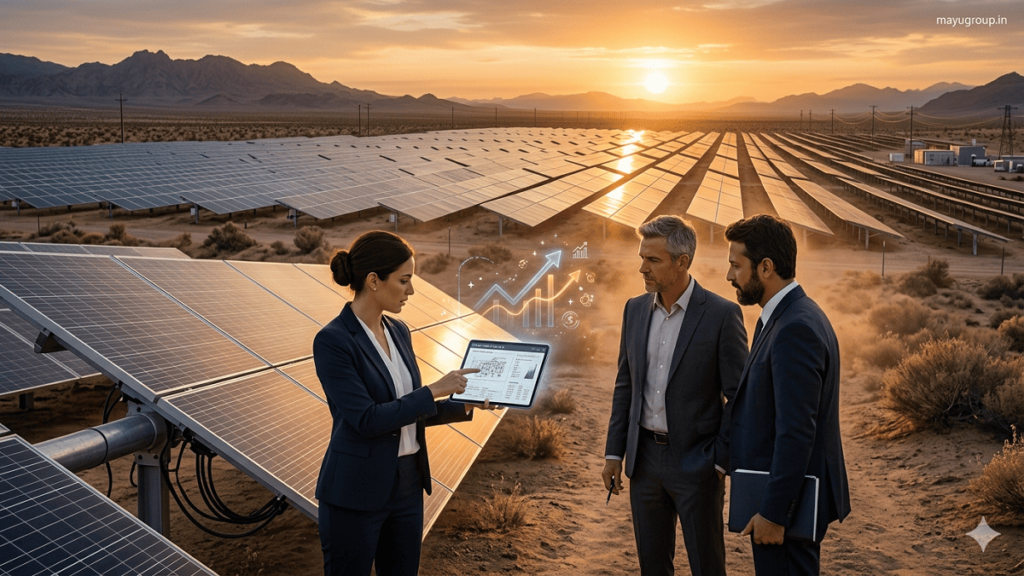
White Paper on Solar Energy Funding
1. Executive Summary
Solar energy funding is a critical enabler of the global transition toward low-carbon electricity systems. Despite rapidly declining technology costs, solar projects remain capital-intensive at the development stage. This white paper examines how solar energy is financed, the structures that reduce investment risk, and the policy and market conditions required to scale funding efficiently. It highlights blended finance models, public-private partnerships, and institutional investment as key drivers of growth in the sector.
2. Introduction
Solar energy funding refers to the financial ecosystem that supports the planning, development, construction, and operation of solar power projects. This includes government subsidies, commercial loans, equity investments, green bonds, and multilateral development financing. The International Renewable Energy Agency (IRENA) estimates that trillions in cumulative investment are required globally to meet net-zero targets, with solar power forming a central pillar of this transition. IRENA Renewable Energy Investment
3. Funding Structure Overview
Solar projects are typically financed through a mix of:
- Equity financing: Provided by developers or institutional investors who take ownership stakes.
- Debt financing: Loans from commercial banks or development finance institutions.
- Grants and subsidies: Government incentives to reduce upfront costs.
- Green bonds: Debt instruments dedicated to climate-related investments.
A standard utility-scale project uses “project finance,” where repayment is based on cash flow from electricity sales rather than corporate balance sheets.
4. Key Market Mechanisms
Power Purchase Agreements (PPAs) are central to solar financing. These long-term contracts guarantee electricity purchase at a fixed or indexed price, ensuring predictable revenue streams for investors. In India, institutions such as the Solar Energy Corporation of India facilitate competitive auctions and standardize PPAs, reducing risk and improving transparency.
Other mechanisms include net metering for rooftop solar, feed-in tariffs in some markets, and reverse auctions for utility-scale procurement.
5. Role of Development Finance Institutions
Multilateral organizations such as the World Bank and International Finance Corporation (IFC) provide concessional loans, guarantees, and risk mitigation tools that help attract private capital to emerging markets. These institutions reduce country risk, improve creditworthiness of projects, and support policy development frameworks. World Bank Energy Financing IFC Renewable Energy Support
6. Investment Drivers
Solar energy attracts investors due to:
- Stable long-term cash flows under PPAs
- Declining technology costs
- Strong ESG (Environmental, Social, Governance) demand
- Portfolio diversification benefits
- Government policy support and incentives
Institutional investors such as pension funds increasingly treat solar assets as infrastructure investments with predictable yields.
7. Key Challenges
Despite strong growth, solar financing faces:
- High upfront capital requirements
- Policy and regulatory uncertainty
- Utility credit risk in some regions
- Currency and interest rate volatility
- Land acquisition and transmission constraints
These factors increase the cost of capital and can delay project deployment.
8. Emerging Trends
- Expansion of green bonds and climate funds
- Growth of distributed rooftop solar financing
- Increased use of battery-integrated solar systems
- Digital financing platforms for small-scale investors
- Greater participation of private equity in renewable infrastructure
9. Conclusion
Solar energy funding is evolving into a mature global financial ecosystem combining public policy, private capital, and international development finance. The future of solar expansion depends on improving risk-sharing mechanisms, stabilizing regulatory frameworks, and expanding access to low-cost capital, particularly in emerging economies.
#Solar Energy Funding in Kolkata
Industry Application of Solar Energy Funding
Solar energy funding plays a crucial role in enabling adoption across multiple industries by reducing upfront capital barriers and improving long-term energy cost stability. Different sectors apply solar financing in ways that align with their energy demand patterns, financial structures, and sustainability goals. The main industries benefiting from solar funding include manufacturing, real estate, agriculture, telecommunications, utilities, and emerging digital infrastructure sectors.
1. Manufacturing and Heavy Industry
Manufacturing is one of the largest adopters of solar energy funding due to high and continuous electricity consumption. Industries such as textiles, automotive, steel, and cement use solar power to reduce operational costs and improve energy security. Funding structures typically include long-term Power Purchase Agreements (PPAs), rooftop solar leasing, and captive solar plants financed through debt and equity.
Large factories often adopt “open access” solar systems, where they procure electricity from off-site solar farms. This reduces reliance on grid electricity and stabilizes energy expenses. Institutions like the Solar Energy Corporation of India indirectly support this segment by enabling competitive solar auctions and standardizing procurement frameworks that attract private investment.
2. Commercial Real Estate and Infrastructure
Commercial buildings such as shopping malls, IT parks, airports, and hospitals increasingly use rooftop solar systems funded through leasing or third-party ownership models. In these arrangements, solar developers install and maintain systems while building owners pay a fixed monthly fee lower than conventional electricity bills.
Real estate developers also integrate solar systems into new construction projects to meet green building certifications such as LEED. Financing is often secured through green loans and infrastructure investment trusts.
3. Agriculture Sector
Agriculture is a major beneficiary of decentralized solar funding models. Solar-powered irrigation pumps replace diesel pumps, reducing fuel costs and emissions. Governments and development banks often subsidize these systems heavily to support rural electrification and farmer income stability.
Solar microgrids also power cold storage facilities, reducing post-harvest losses. Funding for these projects often comes from blended finance models involving public subsidies and concessional loans from institutions like the World Bank and IFC. World Bank Energy Access Programs IFC Renewable Energy Initiatives
4. Telecommunications Industry
Telecom towers require uninterrupted power supply, especially in remote areas. Solar energy funding enables hybrid systems combining solar panels, batteries, and backup generators. Telecom companies finance these systems through operational expenditure (OPEX) models, where third-party energy service companies own and operate solar installations.
This reduces diesel dependency and lowers long-term operational costs while improving network reliability in off-grid locations.
5. Utilities and Power Sector
Utility companies use solar energy funding to build large-scale solar parks and integrate renewable energy into national grids. These projects are typically financed through project finance models backed by long-term PPAs.
Utilities also invest in grid modernization and energy storage systems to manage solar variability. Green bonds and sovereign-backed financing are increasingly used to fund such large infrastructure investments.
6. Emerging Digital and Data-Driven Industries
Data centers, cloud service providers, and technology companies are rapidly adopting solar energy to meet sustainability commitments. These firms often sign corporate renewable PPAs to secure long-term clean energy supply and reduce carbon emissions.
Global tech companies invest directly in solar farms or purchase renewable energy credits (RECs), using structured financing mechanisms supported by institutional investors and climate funds.
Conclusion
Solar energy funding enables cross-industry transformation by aligning financial mechanisms with sector-specific energy needs. Whether through PPAs, leasing models, subsidies, or institutional investment, solar financing is driving operational efficiency, cost reduction, and sustainability across diverse industrial sectors.
#Solar Energy Funding in Mumbai
Ask FAQs
What is solar energy funding?
Solar energy funding refers to the financial systems and investment methods used to support the development of solar power projects. It includes government subsidies, bank loans, private equity investments, green bonds, and international financing. The goal is to reduce the high upfront cost of solar installations and make renewable energy more accessible for households, businesses, and utilities.
How is solar energy typically financed?
Solar projects are usually financed through a combination of debt and equity under a project finance model. Revenue from electricity sales, often secured through long-term Power Purchase Agreements (PPAs), is used to repay loans. Additional financing methods include leasing models for rooftop solar and third-party ownership systems where developers retain ownership of the installation.
Who provides funding for solar energy projects?
Funding comes from multiple sources including commercial banks, government agencies, private investors, and international financial institutions. Organizations such as development banks and climate funds also provide concessional loans and risk guarantees. In India, institutions like the Solar Energy Corporation of India play a key role in facilitating solar auctions and attracting private investment.
Why is government support important in solar funding?
Government support reduces financial risk and improves project viability. Policies such as subsidies, tax incentives, renewable purchase obligations, and guaranteed tariffs encourage investment in solar energy. These measures help lower the cost of capital and ensure stable returns for investors, especially in emerging markets where financial risk is higher.
What are the main challenges in solar energy financing?
Key challenges include high initial investment costs, regulatory uncertainty, credit risk from electricity buyers, and fluctuations in interest or currency exchange rates. In addition, land acquisition and transmission infrastructure limitations can delay project implementation. International institutions like the World Bank and IFC help reduce these risks through financial support and guarantees. World Bank Renewable Energy
Table of Contents
Disclaimer
This content is provided for general informational and educational purposes only. It does not constitute financial, investment, legal, or technical advice. While efforts have been made to ensure accuracy, no guarantee is made regarding completeness or reliability. Readers should consult qualified professionals or official sources before making any financial or investment decisions related to solar energy projects.