Tech Crowdfunding
Tech Crowdfunding is a funding method where technology-based startups raise capital from a large number of individuals through online platforms. Instead of relying solely on venture capitalists, angel investors, or bank loans, tech entrepreneurs present their product ideas—such as apps, hardware devices, software tools, artificial intelligence solutions, or wearable technology—to the public and invite financial support.
This model is especially popular in the technology sector because it allows startups to validate innovative ideas before large-scale production. Many tech products require significant upfront investment for research, prototyping, and manufacturing. Crowdfunding helps bridge this gap by providing early-stage funding while also testing real-world demand.
Tech crowdfunding typically operates through platforms such as Kickstarter and Indiegogo, which are widely used for hardware and consumer tech products. Equity-based tech startups may use platforms like SeedInvest or Wefunder to raise funds in exchange for ownership stakes. These platforms provide structured environments for showcasing prototypes, explaining technical features, and attracting early adopters.
One of the main advantages of tech crowdfunding is market validation. When a technology product receives strong backing, it signals demand and reduces the risk of product failure. It also helps startups build a community of early users who provide feedback, test beta versions, and promote the product organically. Additionally, crowdfunding serves as a marketing tool, increasing visibility and credibility in competitive tech markets.
However, tech crowdfunding also presents challenges. Hardware startups may face production delays due to manufacturing complexity, supply chain issues, or scaling difficulties. Software-based startups may struggle with delivering promised features on time. Intellectual property exposure is another risk, as publicly sharing innovative ideas can attract competitors. Regulatory requirements also apply in equity crowdfunding, especially when raising funds from public investors.
Despite these challenges, tech crowdfunding has enabled the launch of several successful innovations. Products like smart devices, gaming hardware, and AI-powered tools have gained global attention through crowdfunding campaigns, proving that public-backed funding can compete with traditional investment models.
In conclusion, tech crowdfunding is a powerful financing strategy that supports innovation, reduces early-stage risk, and connects technology creators directly with users and investors. It continues to play a major role in shaping the future of the global tech startup ecosystem.
#Tech Crowdfunding in India
What is Tech Crowdfunding?
Tech crowdfunding is a method of raising funds for technology-based projects or startups by collecting small contributions from a large number of people through online platforms. Instead of depending on traditional sources like banks, venture capitalists, or angel investors, tech entrepreneurs present their innovative ideas directly to the public and seek financial support to develop, prototype, and launch their products.
This funding model is widely used in the technology sector because tech products often require significant early investment for research, development, prototyping, and manufacturing. These costs can be difficult for early-stage startups to cover without external support. Crowdfunding helps bridge this gap by enabling startups to raise capital while also testing whether there is real market demand for their idea.
Tech crowdfunding typically takes place on specialized platforms such as Kickstarter and Indiegogo, which are popular for consumer electronics, hardware devices, gaming products, and innovative gadgets. In equity-based models, platforms like SeedInvest and Wefunder allow investors to fund startups in exchange for ownership shares.
One of the key advantages of tech crowdfunding is market validation. When a tech product attracts a large number of backers, it signals strong consumer interest and reduces the risk of launching an unsuccessful product. It also helps startups build an early user community that can provide feedback, test prototypes, and contribute to product improvement.
Additionally, tech crowdfunding serves as a marketing tool. Campaigns generate visibility, attract media attention, and help startups build brand awareness even before the product is officially launched. This early exposure can be critical in highly competitive technology markets.
However, tech crowdfunding also involves risks. Hardware startups may face production delays due to manufacturing challenges, supply chain issues, or scaling difficulties. Software startups may struggle to deliver promised features on time. There is also the risk of intellectual property exposure, as publicly sharing technical details may allow competitors to replicate ideas. In equity crowdfunding, startups must also comply with financial regulations, such as those outlined by the U.S. Securities and Exchange Commission: SEC Crowdfunding Guidelines.
In conclusion, tech crowdfunding is an important financing approach that enables technology startups to raise capital, validate ideas, and engage with early adopters. It plays a significant role in accelerating innovation and supporting the growth of emerging tech companies worldwide.
#Tech Crowdfunding in Maharashtra
How Does Tech Crowdfunding Work?
Tech crowdfunding works as a structured online fundraising process where technology startups raise money from a large number of individuals to develop, prototype, and launch innovative products. Instead of relying on a single investor or institution, founders present their idea publicly and collect small contributions from many backers through specialized crowdfunding platforms.
The process begins when a tech startup creates a campaign on a crowdfunding platform. This campaign includes a detailed explanation of the product idea, the problem it solves, target users, technical features, funding goal, and timeline for development. For tech products, founders often include prototype demonstrations, product renders, or videos to help backers understand how the technology works and what makes it innovative.
Once the campaign is published, the startup actively promotes it using digital marketing strategies such as social media campaigns, influencer outreach, email marketing, and press coverage. In the tech industry, storytelling and product demonstration are critical because backers need to trust both the idea and the technical capability of the team.
Backers then contribute funds through the platform. In reward-based tech crowdfunding, supporters usually receive early access to the product, limited editions, or discounted pricing once the product is developed. Platforms like Kickstarter and Indiegogo commonly support this model. In equity-based tech crowdfunding, investors receive shares in the startup, typically through platforms such as SeedInvest or Wefunder.
Most crowdfunding platforms operate using either a fixed funding model or a flexible funding model. In fixed funding, the startup must reach its funding target within a set timeframe, or all contributions are returned to backers. In flexible funding, the startup receives whatever amount is raised, even if the target is not fully achieved.
Once the campaign successfully ends, the platform transfers funds to the startup after deducting service fees. The startup then uses the capital to complete product development, manufacturing, and launch activities. In reward-based campaigns, they must also deliver promised products to backers. In equity crowdfunding, startups must manage investor relations and comply with regulatory reporting requirements, such as those outlined by the U.S. Securities and Exchange Commission: SEC Crowdfunding Rules.
In conclusion, tech crowdfunding works by combining public fundraising, product validation, and digital marketing into a single process that helps startups finance innovation while building an early customer base and testing real market demand.
#Tech Crowdfunding in Ahemadabad
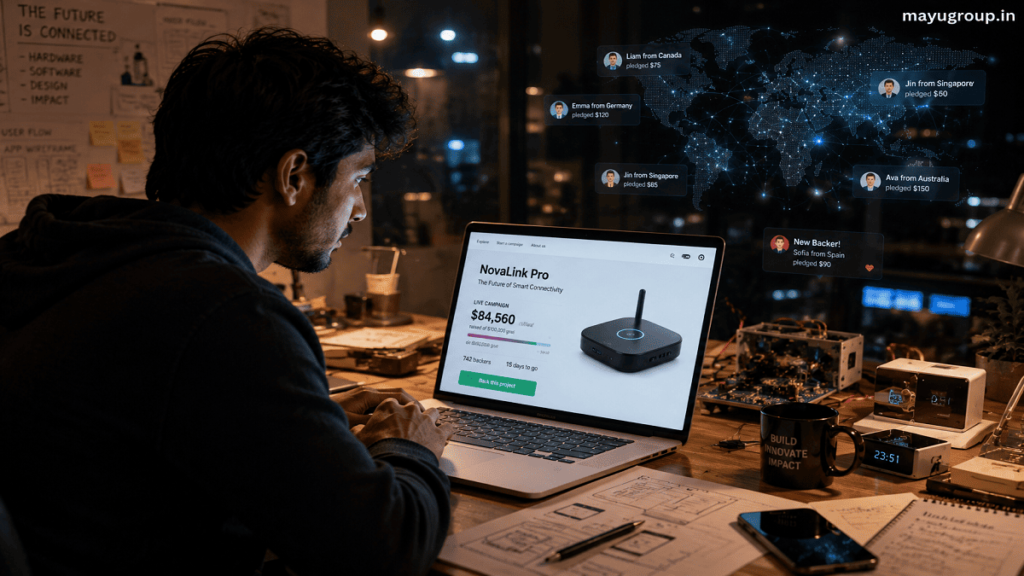
What Types of Tech Projects Use Crowdfunding?
Tech crowdfunding is widely used across different categories of technology projects, especially those that require early-stage capital for development, prototyping, and market validation. It is particularly effective for innovative products that may be too risky or unconventional for traditional investors at the initial stage.
One of the most common categories is consumer electronics and hardware devices. This includes smartwatches, wireless earbuds, smart home devices, fitness trackers, drones, and IoT (Internet of Things) products. These projects often require expensive prototyping and manufacturing, making crowdfunding an ideal way to test demand before mass production. Platforms like Kickstarter and Indiegogo are widely used in this category.
Another major category is software and mobile applications. Independent developers and small startups use crowdfunding to finance app development, SaaS (Software as a Service) platforms, productivity tools, and niche software solutions. Crowdfunding helps them avoid early reliance on venture capital and allows them to build a user base while still in development.
Gaming projects are also a strong segment within tech crowdfunding. This includes video games for PC, console, and mobile platforms, as well as virtual reality (VR) and augmented reality (AR) experiences. Game developers often use crowdfunding to maintain creative control and fund production without interference from traditional publishers. Early backers typically receive beta access, exclusive content, or in-game rewards.
Another growing area is artificial intelligence (AI) and machine learning tools. Startups working on AI assistants, automation tools, and data-driven applications use crowdfunding to demonstrate feasibility and gather early user feedback. These projects often require validation due to their technical complexity and evolving nature.
Wearable technology and health tech projects are also popular. These include smart medical devices, fitness monitoring systems, and assistive technologies for healthcare. Crowdfunding helps validate both technical functionality and real-world usability, which is critical in health-related innovations.
Additionally, green technology and sustainability projects increasingly use crowdfunding. This includes clean energy devices, eco-friendly gadgets, recycling innovations, and climate-focused technology solutions. These projects often appeal to socially conscious backers who want to support environmental innovation.
In some cases, emerging technologies like robotics, blockchain applications, and decentralized platforms also rely on crowdfunding to raise early capital and build communities around their ecosystems.
In conclusion, tech crowdfunding supports a wide range of projects including hardware devices, software applications, gaming, AI systems, wearable tech, and sustainability innovations. It plays a key role in helping technology creators validate ideas, raise funds, and build early user communities before full-scale commercialization.
#Tech Crowdfunding in Hyderabad
Why Do Tech Startups Choose Crowdfunding?
Tech startups choose crowdfunding because it provides a flexible, accessible, and market-driven way to raise capital while simultaneously validating their product ideas. Unlike traditional funding sources such as banks or venture capital firms, crowdfunding allows startups to directly engage with potential users and investors at an early stage of development.
One of the primary reasons is access to early-stage funding. Many tech startups struggle to secure financing because they lack revenue history, collateral, or proven traction. Crowdfunding helps bridge this gap by allowing them to raise small contributions from a large audience through platforms like Kickstarter and Indiegogo. This makes it especially useful for hardware prototypes, software tools, and emerging technologies.
Another key reason is market validation. Tech startups often deal with innovative or untested ideas. Crowdfunding campaigns act as real-world experiments that measure customer interest. If a product receives strong backing, it confirms demand and reduces the risk of launching a product that may fail in the market. This validation is highly valuable for attracting future investors.
Crowdfunding also provides marketing and visibility benefits. A well-executed campaign can generate global attention, media coverage, and social media engagement. This helps startups build brand awareness even before their product is officially launched. Early adopters who support the campaign often become loyal customers and advocates.
Another important factor is community building and user feedback. Tech startups benefit from having early supporters who test prototypes, provide feedback, and suggest improvements. This collaborative development process helps refine the product and increase its chances of success in the market.
Additionally, crowdfunding allows startups to retain more control and ownership. Compared to venture capital funding, which often requires significant equity dilution and governance changes, reward-based crowdfunding lets founders maintain full ownership of their company.
In equity crowdfunding models, startups can still raise capital while accessing a wider pool of investors through platforms such as SeedInvest and Wefunder, often under structured regulatory frameworks like those outlined by the U.S. Securities and Exchange Commission: SEC Crowdfunding Guidelines.
However, despite its advantages, crowdfunding also requires strong execution. Startups must create compelling campaigns, manage production expectations, and deliver promised products on time.
In conclusion, tech startups choose crowdfunding because it combines funding access, market validation, marketing exposure, and community engagement, making it a powerful tool for launching and scaling innovative technology products.
#Tech Crowdfunding in Delhi
What are the Risks of Tech Crowdfunding?
Tech crowdfunding offers an accessible way for startups to raise funds and validate innovative ideas, but it also comes with several significant risks that can affect financial stability, reputation, product delivery, and long-term business success.
One of the most common risks is failure to meet funding goals. Many crowdfunding platforms operate on an “all-or-nothing” model, meaning the startup receives no funds if the target is not achieved within the campaign period. Even in flexible funding models, insufficient capital can lead to incomplete product development or poor execution.
Another major risk is production and delivery challenges, especially for hardware-based tech startups. Manufacturing issues, supply chain disruptions, and unexpected scaling problems can cause significant delays. Many tech products require complex engineering and mass production, which often becomes more difficult than initially planned.
Intellectual property (IP) exposure is also a serious concern. Since crowdfunding campaigns are public, startups must disclose details about their product design, features, and technology. This openness increases the risk of competitors copying the idea or launching similar products before the original startup reaches the market.
There is also a reputational risk. If a startup fails to deliver its product on time or meets low-quality standards, it can face negative reviews, social media backlash, and loss of trust. Crowdfunding backers are often early adopters who expect transparency and timely communication, making reputation management critical.
Financial mismanagement is another challenge. Startups may underestimate production costs, logistics expenses, taxes, and platform fees. This can lead to budget shortages even after a successful campaign, putting pressure on operations and product delivery.
For tech startups using equity crowdfunding, there are also regulatory and compliance risks. These include legal obligations related to investor disclosures, reporting requirements, and fundraising limits. Platforms like SeedInvest and Wefunder operate under strict financial regulations, such as those enforced by the U.S. Securities and Exchange Commission: SEC Crowdfunding Regulations.
Another important risk is over-demand or scalability pressure. A successful campaign may generate more orders than the startup can realistically fulfill, leading to production bottlenecks and delayed deliveries.
Finally, there is the risk of loss of focus on long-term strategy. Some startups become overly focused on fulfilling crowdfunding obligations instead of building sustainable business models, which can affect future growth.
In conclusion, while tech crowdfunding provides valuable opportunities for funding, validation, and marketing, it also carries risks related to execution, finance, intellectual property, reputation, and regulation. Careful planning, realistic projections, and strong operational capability are essential to minimize these risks and ensure successful outcomes.
#Tech Crowdfunding in Bangllore
Case Study on Tech Crowdfunding
A well-known and influential case study in tech crowdfunding is the Oculus Rift virtual reality headset, which demonstrated how crowdfunding can accelerate breakthrough innovation in the technology sector.
Oculus VR, founded by Palmer Luckey, aimed to develop an affordable and immersive virtual reality headset for gaming and interactive experiences. At the time, VR technology was still considered niche and high-cost, and traditional investors were uncertain about its commercial viability. To validate the idea and raise early funding, Oculus launched a campaign on Oculus Rift Kickstarter Campaign in 2012.
The campaign introduced a prototype headset designed for developers and gaming enthusiasts. The presentation included technical demonstrations, product specifications, and a clear vision for the future of virtual reality. Oculus set a funding goal of $250,000, which was relatively modest for a hardware-based tech project.
The response was overwhelming. The campaign raised approximately $2.4 million from nearly 10,000 backers, far exceeding its original target. This success demonstrated strong public interest in virtual reality technology and validated the commercial potential of immersive gaming experiences.
The impact of this crowdfunding success was significant. First, it provided Oculus with the capital needed to refine its hardware, improve software compatibility, and move toward mass production. Second, it helped build a strong community of early adopters and developers who contributed feedback and created VR content for the platform. Third, it generated global media attention, positioning Oculus as a leader in the emerging VR industry.
However, the case also highlights important challenges associated with tech crowdfunding. Hardware development proved more complex than expected, requiring multiple iterations of the product. The company also faced pressure to meet backer expectations while scaling production efficiently. These challenges are common in tech crowdfunding, where early enthusiasm must be balanced with real-world engineering constraints.
Despite these difficulties, Oculus successfully delivered its product and later expanded into a full VR ecosystem. In 2014, Oculus VR was acquired by Facebook (now Meta Platforms) for approximately $2 billion, marking one of the most notable exits in tech startup history. This acquisition demonstrated how crowdfunding can serve as a launchpad for high-growth technology companies.
The Oculus case is often compared with other successful tech crowdfunding projects like the Pebble smartwatch campaign on Kickstarter Pebble Campaign, which also showed how early public funding can validate consumer demand for innovative hardware products.
In conclusion, the Oculus Rift case study illustrates how tech crowdfunding can transform an experimental idea into a globally recognized technology product by combining public funding, early validation, and community engagement. It also highlights the importance of strong technical execution and scalable production planning after a successful campaign.
#Tech Crowdfunding in Pune
White Paper on Tech Crowdfunding
1. Executive Summary
Tech crowdfunding is an alternative financing mechanism that enables technology startups to raise capital from a large number of individuals through online platforms. It plays a critical role in funding innovation by supporting early-stage development of hardware, software, artificial intelligence, and emerging technologies. This white paper examines the structure, benefits, risks, regulatory environment, and future outlook of tech crowdfunding, highlighting its importance in accelerating technological innovation and democratizing access to capital.
2. Introduction
Tech crowdfunding refers to the process of financing technology-driven projects by collecting small contributions from a broad pool of backers via digital platforms. It has gained prominence through platforms such as Kickstarter and Indiegogo, which allow startups to present prototypes and raise funds directly from the public. This model is particularly valuable in the tech sector, where early-stage funding is often difficult to secure through traditional channels.
3. Objectives of Tech Crowdfunding
- Enable early-stage funding for technology innovation
- Validate market demand for new tech products
- Reduce dependency on traditional investors
- Build early user communities and feedback loops
- Accelerate product development cycles
4. Operational Framework
Tech crowdfunding operates through structured campaigns hosted on online platforms. Startups present product descriptions, prototypes, videos, and funding goals. Backers contribute funds in exchange for rewards, equity, or early access. Equity-based platforms such as SeedInvest and Wefunder facilitate investment-based participation under regulatory compliance frameworks.
The process typically includes campaign creation, promotion, funding collection, platform fee deduction, and post-campaign execution including product development and delivery.
5. Key Applications in Technology
Tech crowdfunding supports multiple innovation areas:
- Consumer electronics (smart devices, wearables, IoT)
- Software and SaaS platforms
- Gaming and virtual reality systems
- Artificial intelligence and automation tools
- Health tech and medical devices
- Green technology and sustainable innovation
6. Benefits of Tech Crowdfunding
- Provides access to early-stage capital
- Enables real-time market validation
- Reduces reliance on institutional investors
- Enhances product visibility and branding
- Builds engaged early adopter communities
- Encourages innovation with lower entry barriers
7. Risks and Challenges
Despite its advantages, tech crowdfunding involves several risks:
- Failure to meet funding targets
- Manufacturing and production delays (especially hardware)
- Intellectual property exposure due to public disclosure
- Regulatory compliance requirements for equity crowdfunding
- Financial mismanagement and underestimation of costs
- Reputation damage due to unmet expectations
Regulatory oversight for equity crowdfunding is enforced in many regions, including the United States under the Securities and Exchange Commission framework: SEC Crowdfunding Overview.
8. Industry Impact
Tech crowdfunding has significantly influenced the innovation ecosystem by enabling products like smartwatches, VR headsets, and AI-based tools to reach market validation before full-scale investment. It has also democratized startup funding by allowing global participation from non-institutional investors.
9. Future Outlook
The future of tech crowdfunding is expected to include blockchain-based funding models, tokenized equity systems, and AI-driven investor matching. These advancements may improve transparency, reduce friction in fundraising, and expand global participation in technology investment.
10. Conclusion
Tech crowdfunding is a powerful financial and innovation tool that supports early-stage technology development while reducing barriers to capital. Although it presents operational and regulatory risks, its ability to validate ideas, attract early adopters, and accelerate innovation makes it a key component of the modern technology startup ecosystem.
#Tech Crowdfunding in Kolkata

Industry Application of Tech Crowdfunding
Tech crowdfunding has become a widely adopted financing and validation tool across multiple industries that rely on innovation, rapid prototyping, and early customer feedback. It allows technology startups to raise funds directly from the public while simultaneously testing market demand and building early user communities. Its applications span both consumer-facing products and highly specialized industrial technologies.
1. Consumer Electronics and Smart Devices
One of the strongest applications of tech crowdfunding is in consumer electronics. Startups use crowdfunding to launch products such as smartwatches, wireless earbuds, smart home systems, drones, and IoT-enabled devices. These products often require high upfront manufacturing costs and extensive prototyping. Platforms like Kickstarter and Indiegogo are commonly used to validate demand before mass production.
2. Software and SaaS Industry
Software startups, including SaaS (Software as a Service) companies, use crowdfunding to finance development and server infrastructure. This includes productivity tools, design software, cybersecurity platforms, and niche enterprise applications. Crowdfunding helps these startups gain early adopters who provide feedback, report bugs, and help improve product-market fit before full-scale launch.
3. Gaming and Entertainment Technology
The gaming industry is one of the earliest adopters of crowdfunding. Independent developers use it to fund PC games, console titles, mobile games, and immersive VR/AR experiences. Crowdfunding allows developers to bypass traditional publishers, maintain creative control, and directly engage with their gaming community. Backers often receive early access or exclusive in-game content.
4. Artificial Intelligence and Machine Learning
AI startups use crowdfunding to test experimental tools such as chatbots, automation platforms, predictive analytics systems, and generative AI applications. Since AI development is resource-intensive and highly experimental, crowdfunding helps validate feasibility and attract early technical communities that contribute feedback and testing.
5. HealthTech and Medical Devices
Healthcare innovation is another important application area. Startups developing wearable health trackers, diagnostic tools, telemedicine platforms, and assistive medical devices use crowdfunding to demonstrate real-world usability and gather early funding. This also helps validate social and clinical demand before regulatory approval stages.
6. Green Technology and Sustainability Solutions
Crowdfunding supports clean energy innovations such as solar devices, electric mobility solutions, recycling technologies, and climate-monitoring systems. These projects often attract socially conscious backers who want to support environmental sustainability and green innovation.
7. Robotics and Advanced Engineering
Robotics startups use crowdfunding to develop automation systems, industrial robots, educational robotics kits, and service robots. These projects benefit from early public interest, which helps refine design, usability, and real-world applications.
8. Blockchain and Fintech Innovations
Tech crowdfunding is also widely used in blockchain-based platforms, decentralized applications (dApps), and fintech solutions. These projects often rely on community participation and benefit from early network building through token-based or equity crowdfunding models.
Conclusion
Tech crowdfunding has diverse applications across industries including consumer electronics, software, gaming, AI, healthcare, sustainability, robotics, and blockchain. Its ability to combine funding with market validation makes it a powerful tool for accelerating innovation and reducing early-stage startup risk.
#Tech Crowdfunding in Mumbai
Ask FAQs
What is tech crowdfunding?
Tech crowdfunding is a method of raising funds for technology-based startups or projects by collecting small contributions from a large number of people through online platforms. It is commonly used for products like gadgets, apps, software, and innovative tech solutions.
Which platforms are used for tech crowdfunding?
Popular platforms include Kickstarter and Indiegogo for reward-based funding, and SeedInvest and Wefunder for equity-based crowdfunding.
What types of tech projects use crowdfunding?
Tech crowdfunding is used for consumer electronics, mobile apps, SaaS platforms, video games, AI tools, wearable devices, robotics, and green technology solutions. It is especially popular for early-stage innovative products that need market validation.
What are the benefits of tech crowdfunding?
It provides early-stage funding, validates market demand, builds a customer base, increases product visibility, and allows startups to test ideas before full-scale production. It also reduces dependence on traditional investors.
What risks are involved in tech crowdfunding?
Key risks include failure to reach funding goals, production delays, intellectual property exposure, financial mismanagement, regulatory compliance issues, and reputational damage if the startup fails to deliver promised products.
Table of Contents
Disclaimer
This content is provided for general informational and educational purposes only. It does not constitute financial, investment, or legal advice. Readers should conduct independent research or consult a qualified professional before making any decisions related to tech crowdfunding.