Startup Crowdfunding
Startup Crowdfunding is a financing method in which entrepreneurs raise small amounts of capital from a large number of individuals, typically through online platforms. Instead of relying on a single investor, bank loan, or venture capital firm, startups present their ideas to the public and invite contributions in exchange for rewards, equity, debt repayment, or simply support. It has become an important alternative funding channel for early-stage businesses, particularly those that may not yet meet traditional investment criteria.
There are four main types of crowdfunding. Reward-based crowdfunding allows backers to receive a product, service, or incentive in return for their contribution. Equity crowdfunding enables contributors to become partial owners of the startup by purchasing shares. Debt crowdfunding (also called peer-to-peer lending) involves borrowing money that is repaid with interest over time. Donation-based crowdfunding is used primarily for social causes or nonprofit projects, where contributors do not expect financial returns.
The process typically begins with a startup creating a campaign on a crowdfunding platform, including a business pitch, funding goal, timeline, and rewards or equity structure. The campaign is then promoted through social media, email marketing, and digital advertising to attract backers. If the funding goal is met within the specified time, the funds are released (often minus platform fees). If the goal is not reached, some platforms return the money to contributors, depending on the campaign rules.
Startup crowdfunding offers several advantages. It provides access to capital without giving up significant control to venture capitalists. It also helps validate a business idea by measuring public interest before full-scale production. Additionally, it serves as a marketing tool, generating early visibility and customer engagement. However, it also carries risks. Campaigns may fail to reach funding goals, intellectual property can be exposed to competitors, and startups may face pressure to deliver promised rewards on time. Equity crowdfunding also involves regulatory compliance and investor reporting requirements.
Popular crowdfunding platforms include reward-based services like Kickstarter and Indiegogo, which are widely used for creative and tech products. For equity crowdfunding, platforms such as SeedInvest provide access to accredited investors. Donation-based funding is commonly facilitated through GoFundMe. In India, platforms like Ketto and Milaap are widely used for both social and startup-related fundraising.
Regulatory frameworks also play a role in shaping crowdfunding ecosystems. For example, in the United States, equity crowdfunding is regulated by the Securities and Exchange Commission under Regulation Crowdfunding, which sets limits on how much companies can raise and how investors participate. More details can be found at the official SEC website: U.S. Securities and Exchange Commission.
In conclusion, startup crowdfunding is a powerful mechanism that democratizes access to capital, enables innovation, and connects entrepreneurs directly with their potential customers and supporters. However, success requires strong planning, transparent communication, and effective marketing to build trust and reach funding goals.
#Startup Crowdfunding in India
What is startup crowdfunding?
Startup crowdfunding is a method of raising capital for a new business by collecting small amounts of money from a large number of people, usually through online platforms. Instead of depending on a single investor such as a venture capitalist or taking a bank loan, entrepreneurs publicly present their business idea and invite contributions from individuals who are interested in supporting or investing in the startup.
This approach has become increasingly popular because it makes funding more accessible, especially for early-stage startups that may not yet have a proven track record or collateral for traditional financing. Crowdfunding platforms act as intermediaries, allowing startups to showcase their ideas through campaign pages that typically include a business description, funding target, timeline, and sometimes prototypes or demos.
There are several types of startup crowdfunding. In reward-based crowdfunding, contributors receive non-financial rewards such as early access to a product or branded merchandise. Equity crowdfunding allows investors to receive ownership shares in the startup in return for their funding. Debt crowdfunding involves borrowing money from multiple lenders and repaying it with interest over time. Donation-based crowdfunding is primarily used for social or charitable initiatives where contributors do not expect any financial return.
One of the key benefits of startup crowdfunding is that it helps validate a business idea before large-scale investment. If a campaign attracts significant interest and funding, it signals that there is market demand for the product or service. It also helps startups build an early customer base and generate marketing exposure. However, it also comes with challenges such as high competition on platforms, the need for strong promotional efforts, and the risk of not reaching the funding goal. Additionally, startups must be careful about intellectual property exposure when publicly sharing ideas.
Popular crowdfunding platforms include Kickstarter and Indiegogo for reward-based projects. For equity-based investments, platforms like SeedInvest are commonly used. Donation-based fundraising is widely supported by platforms such as GoFundMe.
In conclusion, startup crowdfunding is an innovative financing model that enables entrepreneurs to raise capital directly from the public while also testing market interest and building early traction.
#Startup Crowdfunding in Maharashtra
How does startup crowdfunding work?
Startup crowdfunding works as a structured online fundraising process where entrepreneurs raise capital from a large number of individuals in exchange for rewards, equity, repayment, or donations. It operates through dedicated crowdfunding platforms that connect startups with potential backers and provide tools to manage campaigns, payments, and communication.
The process begins when a startup creates a campaign on a crowdfunding platform. This campaign typically includes a detailed description of the business idea, the problem it solves, target market, funding goal, timeline, and how the money will be used. Many campaigns also include visual elements such as prototype images, videos, and pitch presentations to build credibility and attract attention.
Once the campaign is published, the startup promotes it through digital marketing channels such as social media, email marketing, influencer outreach, and press coverage. The success of crowdfunding depends heavily on visibility and storytelling, as backers need to be convinced of both the idea and the team behind it.
Backers then contribute money through the platform. Depending on the crowdfunding model, they may receive different benefits. In reward-based crowdfunding, contributors receive perks such as early product access or merchandise. In equity crowdfunding, they receive shares in the company, making them partial owners. In debt crowdfunding, they lend money with the expectation of repayment with interest. In donation-based crowdfunding, they contribute without expecting financial returns.
Most platforms operate on either a “fixed funding” or “flexible funding” model. In fixed funding, the startup must reach its target amount within a set timeframe, or all funds are returned to backers. In flexible funding, the startup keeps whatever amount is raised, even if the goal is not fully met.
Once the campaign ends successfully, the platform transfers the funds to the startup, usually after deducting a service fee. The startup then uses the capital as planned and is responsible for delivering any promised rewards or managing investor relations in the case of equity crowdfunding.
Regulatory compliance is an important part of the process, especially for equity-based crowdfunding, which is regulated in many countries. For example, in the United States, equity crowdfunding operates under rules set by the Securities and Exchange Commission (SEC): U.S. Securities and Exchange Commission Crowdfunding Overview.
Popular platforms that facilitate this process include Kickstarter for creative and product-based campaigns, Indiegogo for flexible fundraising, SeedInvest for equity investment opportunities, and GoFundMe for donation-based funding.
In summary, startup crowdfunding works by combining digital fundraising platforms, public engagement, and structured financial models to help startups raise capital directly from a large pool of supporters while also validating their market potential.
#Startup Crowdfunding in Ahemadabad
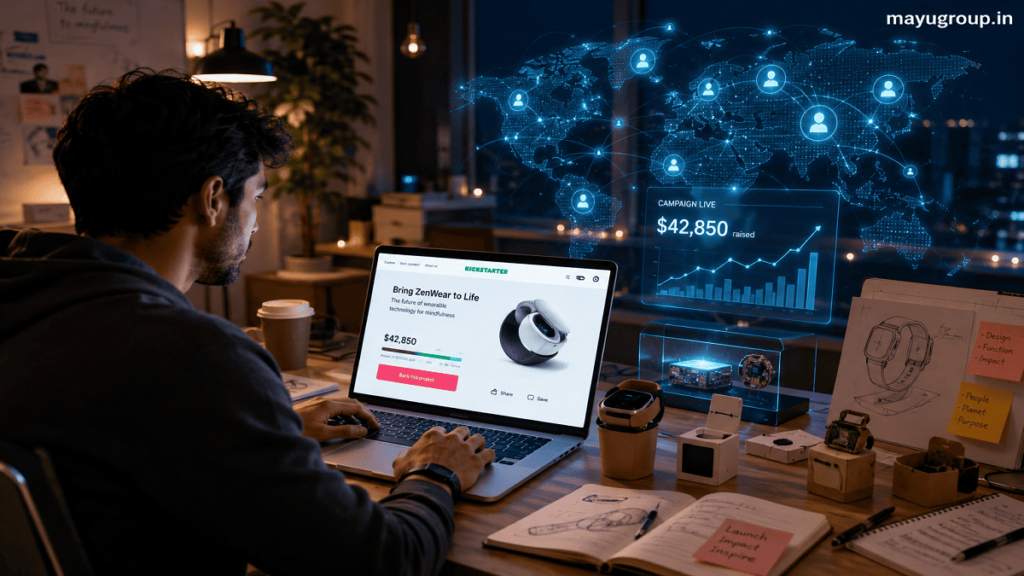
What platforms are used for startup crowdfunding?
Startup crowdfunding platforms are online intermediaries that enable entrepreneurs to raise funds from a large pool of individual backers. These platforms provide the infrastructure for hosting campaigns, processing payments, verifying creators, and connecting startups with potential investors or supporters. Each platform typically specializes in one or more crowdfunding models such as reward-based, equity-based, debt-based, or donation-based funding.
One of the most widely recognized reward-based crowdfunding platforms is Kickstarter. It is primarily used by startups developing creative products, technology prototypes, games, and design innovations. Kickstarter operates on an “all-or-nothing” model, meaning projects must reach their funding goal to receive any money. Another major platform in this category is Indiegogo, which offers more flexibility by allowing both fixed and flexible funding options, making it suitable for a wider range of entrepreneurial projects.
For equity crowdfunding, where investors receive ownership shares in a startup, platforms such as SeedInvest and Wefunder are widely used in the United States. These platforms allow startups to raise capital from both accredited and, in some cases, non-accredited investors, depending on regulatory compliance. Another major player is StartEngine, which focuses on helping early-stage companies raise funds while offering equity stakes to contributors. In Europe, Crowdcube and Seedrs (now part of Republic) are leading equity crowdfunding platforms that connect startups with retail investors across multiple countries.
Donation-based crowdfunding platforms are typically used for social causes, personal initiatives, and community projects. The most prominent example is GoFundMe, which allows individuals and organizations to raise funds without offering financial returns. While not exclusively a startup platform, it is sometimes used for early-stage social enterprises and nonprofit ventures.
In India, crowdfunding has also grown significantly, with platforms like Ketto and Milaap playing a major role. These platforms support medical fundraising, social impact initiatives, and increasingly early-stage startup ideas, particularly in the social entrepreneurship space. They are widely used due to their accessibility and strong presence in local communities.
Each platform differs in terms of audience, funding model, fee structure, and regulatory requirements. Some platforms focus on global reach and investor-driven funding, while others emphasize community support or regional accessibility. Choosing the right platform depends on the startup’s goals, target audience, funding type, and compliance obligations.
In conclusion, startup crowdfunding platforms such as Kickstarter, Indiegogo, SeedInvest, Wefunder, StartEngine, Crowdcube, GoFundMe, Ketto, and Milaap form a diverse ecosystem that supports different types of fundraising models. Together, they enable entrepreneurs to access capital, validate ideas, and build early traction without relying solely on traditional financial institutions.
#Startup Crowdfunding in Hyderabad
Why do startups choose crowdfunding for funding?
Startups choose crowdfunding as a funding method because it provides access to capital, market validation, and early customer engagement without relying entirely on traditional financial institutions or large investors. It is especially useful for early-stage ventures that may not yet have strong financial history, collateral, or established networks to secure bank loans or venture capital funding.
One of the primary reasons startups use crowdfunding is accessibility. Traditional funding sources such as banks and venture capital firms often have strict eligibility criteria. Crowdfunding platforms lower this barrier by allowing entrepreneurs to present their ideas directly to the public. This enables even small or emerging startups to raise funds based on the strength of their concept rather than their financial track record.
Another major advantage is market validation. When a startup launches a crowdfunding campaign, the response from backers serves as real-time feedback on the product or service. If a campaign attracts significant funding, it indicates strong market demand. Conversely, a lack of interest may signal the need to refine the idea before investing further resources. This validation helps reduce the risk of launching unsuccessful products.
Crowdfunding also serves as a powerful marketing and brand-building tool. Campaigns are publicly visible, which allows startups to generate awareness, attract early adopters, and build a community around their product before it is even launched. This early visibility can be more cost-effective than traditional advertising and can create momentum that supports long-term growth.
Additionally, crowdfunding reduces dependence on a single investor or institution. Instead of giving up significant equity or control to venture capitalists, startups can raise smaller amounts from many contributors. This diversification of funding sources can help founders retain more ownership and decision-making power.
Another important reason is speed. Compared to traditional funding routes, which can take months of negotiations and due diligence, crowdfunding campaigns can be launched relatively quickly. Once approved by a platform, startups can begin raising money almost immediately.
However, startups also choose crowdfunding with an understanding of its challenges. These include high competition on platforms, the need for strong marketing efforts, and the obligation to deliver promised rewards or returns. Despite these challenges, the benefits often outweigh the drawbacks for early-stage ventures.
Popular platforms that enable this process include Kickstarter, Indiegogo, SeedInvest, and Wefunder.
In conclusion, startups choose crowdfunding because it offers a unique combination of funding access, validation, marketing exposure, and control retention, making it a practical and strategic option for early-stage business growth.
#Startup Crowdfunding in Delhi
What are the risks of startup crowdfunding?
Startup crowdfunding offers significant opportunities for raising capital, but it also comes with several risks that entrepreneurs must carefully consider before launching a campaign. These risks can affect financial stability, intellectual property, reputation, and long-term business execution.
One of the most common risks is the failure to reach the funding goal. Many crowdfunding platforms operate on an “all-or-nothing” model, meaning that if the target amount is not achieved within the campaign period, the startup receives no funds. Even on flexible funding platforms, raising less than expected can leave the business underfunded and unable to execute its plan effectively.
Another major risk is execution pressure. Once a campaign is successful, startups are obligated to deliver promised rewards, products, or returns to backers. For reward-based crowdfunding, delays in production or supply chain issues can lead to dissatisfied backers, negative reviews, and reputational damage. For equity crowdfunding, founders must also manage investor expectations and comply with ongoing reporting requirements.
Intellectual property exposure is another important concern. Because crowdfunding campaigns are public, startups must share details about their product, design, and business model to attract backers. This visibility increases the risk of competitors copying the idea before the product is fully developed or launched. While patents and trademarks can offer protection, not all startups have the resources to secure them early.
Reputational risk is also significant. A poorly managed campaign, unrealistic promises, or failure to deliver can damage a startup’s credibility. Since crowdfunding relies heavily on public trust, negative feedback can spread quickly across social media and crowdfunding communities, making it harder to raise funds in the future.
Financial mismanagement is another potential issue. Startups may underestimate production costs, logistics expenses, or platform fees, leading to budget shortfalls even after a successful campaign. This can result in unfinished products or compromised quality.
Regulatory and legal risks are especially relevant for equity-based crowdfunding. Different countries have strict securities regulations that govern how startups can raise money from the public. For example, in the United States, equity crowdfunding is regulated under SEC rules: U.S. Securities and Exchange Commission Crowdfunding Regulations. Non-compliance can lead to penalties or legal disputes.
Additionally, there is the risk of overexposure. If a campaign becomes highly popular, startups may receive demand that exceeds their production capacity. This can strain operations and negatively impact customer satisfaction.
Crowdfunding platforms such as Kickstarter, Indiegogo, and GoFundMe illustrate both the opportunities and challenges of public fundraising, where visibility is both an advantage and a risk factor.
In conclusion, while startup crowdfunding provides access to capital and market validation, it also involves risks related to funding uncertainty, execution challenges, intellectual property exposure, reputational damage, and regulatory compliance. Careful planning and realistic goal setting are essential to mitigate these risks.
#Startup Crowdfunding in Banglore
Case Study of Startup Crowdfunding
Pebble Technology, founded by Eric Migicovsky, aimed to create a customizable smartwatch that could connect with both iOS and Android devices. At the time (early 2012), smartwatches were not mainstream, and traditional investors were hesitant to fund the concept due to uncertainty about consumer demand and hardware feasibility. To overcome this challenge, Pebble turned to crowdfunding.
The company launched its campaign on Kickstarter Pebble Campaign in April 2012 with a funding goal of $100,000. The campaign presented a clear product vision, demonstrating a functional prototype that could show notifications, run apps, and sync with smartphones. Strong storytelling, a working demo video, and early tech community interest helped the campaign gain rapid traction.
Within 28 hours, Pebble had already surpassed its initial funding goal. By the end of the campaign, it had raised over $10 million from more than 68,000 backers, making it one of the most successful crowdfunding campaigns in Kickstarter history at the time. This overwhelming response demonstrated strong market demand for wearable technology and validated the startup’s product concept.
The success of Pebble’s crowdfunding campaign had multiple strategic impacts. First, it provided the company with the capital needed to move from prototype to mass production without relying on traditional venture capital in the early stage. Second, it created a large, engaged community of early adopters who contributed feedback during product development. Third, it generated significant media attention, positioning Pebble as a pioneer in the emerging smartwatch industry.
However, the case also highlights important challenges of crowdfunding. Pebble faced production delays due to manufacturing complexities and supply chain limitations. Managing tens of thousands of early backers created logistical pressure, including shipping coordination and customer support. These challenges illustrate that while crowdfunding can validate demand, it does not eliminate operational risks.
Despite these difficulties, Pebble successfully delivered its product and later released improved versions such as Pebble Time, which also raised millions through Kickstarter. Eventually, Pebble sold its intellectual property to Fitbit in 2016, which was later acquired by Google. This outcome demonstrates how crowdfunding can act as a launchpad for startups that later become acquisition targets in larger tech ecosystems.
Pebble’s case is often analyzed alongside other crowdfunding successes like Oculus Rift Kickstarter, which raised $2.4 million before being acquired by Facebook, further proving that crowdfunding can serve as an early validation mechanism for disruptive technology startups.
In conclusion, the Pebble smartwatch case study illustrates how startup crowdfunding can transform an unproven idea into a globally recognized product by combining public funding, market validation, and community engagement. At the same time, it highlights the importance of operational readiness and supply chain planning to manage post-funding execution effectively.
#Startup Crowdfunding in Pune
White Paper on Startup Crowdfunding
1. Executive Summary
Startup crowdfunding is an alternative financing model that enables entrepreneurs to raise capital from a large pool of individuals through online platforms. It has emerged as a significant component of the modern entrepreneurial ecosystem, complementing traditional funding sources such as venture capital, angel investment, and bank loans. This white paper examines the structure, benefits, risks, regulatory environment, and future outlook of startup crowdfunding, highlighting its role in democratizing access to capital and accelerating innovation.
2. Introduction
Startup crowdfunding refers to the practice of funding early-stage businesses by collecting small contributions from many supporters via internet-based platforms. These platforms act as intermediaries that connect startups with potential backers globally. The model gained prominence after platforms such as Kickstarter and Indiegogo demonstrated the viability of public-driven financing for product development and innovation.
3. Types of Startup Crowdfunding
Startup crowdfunding is broadly categorized into four models:
- Reward-based crowdfunding: Contributors receive non-financial rewards such as early product access.
- Equity crowdfunding: Investors receive ownership stakes in the startup. Platforms like Wefunder facilitate this model.
- Debt crowdfunding: Funds are raised as loans that are repaid with interest.
- Donation-based crowdfunding: Contributions are made without expecting financial returns, often used for social impact ventures such as those on GoFundMe.
4. Operational Framework
The crowdfunding process typically involves campaign creation, marketing, funding collection, and post-campaign execution. Startups prepare a pitch including business goals, funding requirements, and prototypes. Once published, campaigns are promoted through digital channels to attract backers. Funding is processed through the platform, which deducts service fees and transfers capital upon successful completion.
5. Benefits of Startup Crowdfunding
Crowdfunding provides several strategic advantages:
- Capital accessibility for early-stage ventures
- Market validation through public interest and funding response
- Brand visibility and community building
- Reduced dependence on institutional investors
- Faster fundraising cycles compared to traditional financing
6. Risks and Challenges
Despite its advantages, crowdfunding carries inherent risks:
- Failure to meet funding targets
- Intellectual property exposure due to public disclosure
- Execution and delivery pressures after funding success
- Regulatory compliance requirements, particularly in equity crowdfunding (e.g., SEC guidelines: U.S. Securities and Exchange Commission Crowdfunding)
- Reputational damage from unmet expectations or delays
7. Regulatory Environment
Regulation varies by jurisdiction. In the United States, equity crowdfunding is governed by the Securities and Exchange Commission under Regulation Crowdfunding. Similar frameworks exist in Europe and Asia to ensure investor protection, transparency, and fraud prevention. Compliance requirements often include funding caps, disclosure obligations, and reporting standards.
8. Industry Applications
Crowdfunding is widely used across sectors such as consumer technology, gaming, healthcare devices, creative industries, and social enterprises. It is particularly effective for products requiring early user validation and community-driven development.
9. Future Outlook
The future of startup crowdfunding is expected to be shaped by blockchain-based fundraising, tokenized equity models, and increased integration with social media ecosystems. Artificial intelligence is also likely to enhance campaign targeting and investor matching, improving success rates for startups.
10. Conclusion
Startup crowdfunding has transformed the entrepreneurial financing landscape by democratizing access to capital and enabling direct engagement between founders and supporters. While it presents operational and regulatory challenges, its benefits in validation, funding accessibility, and market exposure make it a critical tool for modern startups.
#Startup Crowdfunding in Kolkata

Industry Application of Startup Crowdfunding
Startup crowdfunding has evolved into a versatile financing mechanism that supports innovation across multiple industries. Its application extends beyond simple capital raising, functioning as a tool for market validation, customer acquisition, and product development. Different industries leverage crowdfunding in distinct ways depending on their capital needs, product cycles, and consumer engagement strategies.
1. Technology and Hardware Startups
The technology sector is one of the most active users of crowdfunding. Hardware startups use platforms like Kickstarter and Indiegogo to fund prototypes and early production runs. Products such as smartwatches, IoT devices, and consumer electronics often require significant upfront capital for manufacturing. Crowdfunding helps validate demand before large-scale production, reducing financial risk. Successful campaigns also attract media attention and potential venture capital investment.
2. Software and Gaming Industry
In software and gaming, crowdfunding is used to finance development of video games, apps, and digital platforms. Independent game developers frequently rely on community funding to bypass traditional publishers. This model allows developers to maintain creative control while building an early user base. Backers often receive early access, beta versions, or exclusive in-game content as incentives.
3. Healthcare and Medical Devices
Crowdfunding is increasingly used in healthcare innovation, especially for medical devices and assistive technologies. Startups in this sector use crowdfunding to test feasibility and gather early-stage funding for prototypes. While regulatory approvals are still required, crowdfunding helps demonstrate public interest and potential impact, which can support later-stage institutional funding.
4. Social Enterprises and Nonprofits
Donation-based platforms like GoFundMe are widely used for social enterprises, humanitarian projects, and nonprofit initiatives. In this context, crowdfunding supports causes such as education, environmental sustainability, poverty alleviation, and community development. It enables rapid mobilization of funds for urgent or impactful social projects.
5. Creative Industries
Film, music, publishing, and design industries have significantly benefited from crowdfunding. Independent filmmakers and musicians use crowdfunding to finance production costs while retaining ownership rights. It also helps them build a loyal audience before release. Backers often receive exclusive content, early screenings, or credits in productions.
6. Consumer Goods and Lifestyle Products
Startups in fashion, home goods, and lifestyle products use crowdfunding to test product-market fit. It allows them to launch limited production runs and assess consumer interest before scaling manufacturing. This reduces inventory risk and improves supply chain planning.
7. Real Estate and Infrastructure
Equity crowdfunding is increasingly being applied in real estate development. Investors pool funds to support property development projects, earning returns from rental income or property appreciation. Platforms like Wefunder and similar investment platforms have expanded access to such opportunities for retail investors.
8. Emerging Applications (Fintech and Blockchain)
With the rise of fintech and blockchain, crowdfunding is being integrated into decentralized finance (DeFi) systems. Token-based crowdfunding models allow startups to raise capital through digital assets, increasing global participation and liquidity.
Conclusion
Startup crowdfunding is widely applicable across industries because it combines financing with validation and community engagement. Its flexibility allows it to support both high-tech innovation and social impact initiatives. As digital platforms continue to evolve, crowdfunding is expected to become even more integrated into industry-specific startup ecosystems.
#Startup Crowdfunding in Mumbai
Ask FAQs
What is startup crowdfunding?
Startup crowdfunding is a method of raising funds for a new business by collecting small contributions from a large number of people through online platforms. Instead of relying on banks or venture capitalists, startups present their ideas publicly and invite support in exchange for rewards, equity, repayment, or donations.
How does crowdfunding benefit startups?
Crowdfunding helps startups access capital without traditional funding barriers. It also provides market validation, as public interest and funding levels indicate demand for the product or service. Additionally, it helps startups build early customer communities and gain marketing exposure before launch.
What are the main types of crowdfunding?
The four main types are reward-based crowdfunding (contributors receive products or perks), equity crowdfunding (investors receive ownership shares), debt crowdfunding (funds are repaid with interest), and donation-based crowdfunding (support without financial return). Platforms like Kickstarter
What risks are involved in startup crowdfunding?
Key risks include failure to reach funding goals, production and delivery delays, intellectual property exposure, reputational damage, and regulatory compliance issues. Equity crowdfunding, in particular, requires adherence to financial regulations such as those outlined by the U.S. Securities and Exchange Commission: SEC Crowdfunding Rules
Which platforms are commonly used for crowdfunding?
Popular platforms include Kickstarter for creative projects, Indiegogo for flexible fundraising, SeedInvest and Wefunder for equity investments, and GoFundMe for donation-based campaigns.
Table of Contents
Disclaimer
This content is provided for general informational and educational purposes only. It does not constitute financial, legal, or investment advice. Readers should conduct their own research or consult a qualified professional before making any business or investment decisions related to startup crowdfunding.