Islamic Crowdfunding Guide
Islamic Crowdfunding is a modern financial model that combines the principles of Islamic finance with digital crowdfunding platforms to raise capital for businesses, social projects, and investments in a Shariah-compliant manner. It allows individuals and organizations to pool funds online while ensuring that all transactions adhere to Islamic ethical and legal principles. Unlike conventional crowdfunding, which may involve interest-based loans or speculative investments, Islamic crowdfunding avoids riba (interest), gharar (excessive uncertainty), and maysir (gambling/speculation), focusing instead on real economic activity and asset-backed funding.
The system operates through various Shariah-compliant structures. One of the most common models is equity-based crowdfunding, where investors provide capital in exchange for ownership shares in a business and share in its profits and losses. This aligns with Islamic principles of risk-sharing and partnership. Another model is reward-based crowdfunding, where contributors fund a project in exchange for non-financial rewards such as products or services, provided the project itself is halal (permissible). Donation-based crowdfunding (Sadaqah or Waqf-based models) is also widely used for charitable, educational, and humanitarian projects, reflecting Islamic values of social welfare and community support.
Islamic crowdfunding platforms also use debt-based models, but these are structured in a Shariah-compliant way, often using Qard Hasan (benevolent loans), where loans are provided without interest and only the principal is repaid. Some platforms also integrate Murabaha-based financing, where assets are purchased and resold with a transparent profit margin instead of interest-based returns.
This financing model is particularly important for startups, small and medium enterprises (SMEs), and social enterprises that may struggle to access traditional bank financing. By connecting entrepreneurs directly with investors, Islamic crowdfunding enhances financial inclusion and supports innovation while maintaining ethical standards. It also allows individuals to participate in investment opportunities with relatively small amounts of capital.
Technology plays a central role in Islamic crowdfunding, with online platforms enabling global participation and transparency. These platforms often include Shariah advisory boards to ensure compliance with Islamic principles, increasing trust among investors. As digital finance continues to expand, Islamic crowdfunding is gaining popularity in regions such as Southeast Asia, the Middle East, and parts of Europe.
Overall, Islamic crowdfunding represents a modern extension of Islamic finance principles, combining ethical investment, community participation, and technological innovation to support sustainable economic development.
Relevant External Resources
- International Monetary Fund – Islamic Finance Overview
- Islamic Financial Services Board (IFSB)
- Asian Development Bank – Islamic Finance
#ProfitSharingFinance
What is Islamic crowdfunding?
Islamic crowdfunding is a Shariah-compliant method of raising funds through online platforms where individuals collectively contribute money to finance businesses, projects, or social causes in accordance with Islamic financial principles. It is an extension of the broader crowdfunding model, but it is structured to comply with Islamic law (Shariah), which prohibits interest (riba), excessive uncertainty (gharar), and speculative transactions (maysir). Instead, it emphasizes ethical investment, transparency, and real economic activity.
In Islamic crowdfunding, funds are raised for ventures that are considered halal (permissible) and socially beneficial. These can include startups, small and medium enterprises (SMEs), real estate projects, infrastructure development, educational initiatives, and charitable causes. Unlike conventional crowdfunding, where returns may include interest-based lending or speculative equity structures, Islamic crowdfunding ensures that all financial arrangements are based on asset-backed or partnership-based models.
There are several forms of Islamic crowdfunding. Equity-based crowdfunding allows investors to provide capital in exchange for ownership shares in a business, sharing both profits and losses according to Islamic principles of risk-sharing. Reward-based crowdfunding involves contributors receiving non-financial rewards such as products or services, provided the underlying project is Shariah-compliant. Donation-based crowdfunding is commonly used for charitable purposes such as healthcare, disaster relief, and education, often aligned with Islamic concepts of Sadaqah (charity) and Waqf (endowment). In some cases, Qard Hasan (interest-free loan) models are used, where funds are repaid without any additional profit or interest.
Islamic crowdfunding platforms typically operate with the guidance of Shariah advisory boards to ensure that all projects and financial structures comply with Islamic law. This adds credibility and trust among investors and participants. These platforms also rely heavily on digital technology, allowing global participation and increasing access to funding for entrepreneurs who may not qualify for traditional bank loans.
The importance of Islamic crowdfunding lies in its ability to promote financial inclusion and support economic development. It enables individuals with limited capital to participate in investment opportunities while helping entrepreneurs access funding in an ethical and accessible manner. By combining modern financial technology with Islamic ethical principles, Islamic crowdfunding provides an innovative alternative to conventional fundraising methods.
Relevant External Resources
- International Monetary Fund – Islamic Finance Overview
- Islamic Financial Services Board (IFSB)
- Asian Development Bank – Islamic Finance
#FinancialEthics
How does Islamic crowdfunding follow Sharia principles?
Islamic crowdfunding follows Sharia principles by structuring fundraising and investment activities in a way that complies with Islamic law (Shariah), which emphasizes ethical conduct, fairness, transparency, and the avoidance of prohibited financial practices. Unlike conventional crowdfunding, Islamic crowdfunding ensures that all transactions are free from riba (interest), gharar (excessive uncertainty), and maysir (gambling or speculation), while also ensuring that funds are used only for halal (permissible) purposes.
One of the core Sharia principles applied in Islamic crowdfunding is the prohibition of interest (riba). This means that investors cannot earn fixed, guaranteed returns on their money. Instead, returns must come from profit-sharing arrangements or asset-based investments. For example, in equity-based crowdfunding, investors share both profits and losses of the project according to pre-agreed ratios, aligning with the Islamic principle of risk-sharing.
Another key principle is the requirement of asset-backed and real economic activity. Islamic crowdfunding platforms ensure that funds are used for genuine business activities such as startups, real estate development, agriculture, or infrastructure projects. This prevents speculative financial practices and ensures that money is tied to productive economic outcomes rather than purely financial trading.
Islamic crowdfunding also strictly avoids gharar, meaning that all contracts must be clear, transparent, and well-defined. The purpose of the project, the use of funds, risk factors, and profit distribution mechanisms must be clearly disclosed to all participants. This reduces uncertainty and ensures informed decision-making for investors.
Similarly, the principle of maysir (prohibition of gambling and excessive speculation) is enforced by ensuring that crowdfunding projects are not based on chance-driven returns or high-risk speculative ventures. Investments must be based on realistic business models with tangible outcomes.
Islamic crowdfunding platforms also ensure compliance through Sharia supervisory boards, which review and approve projects and financial structures. These boards consist of Islamic scholars and financial experts who verify that all activities align with Islamic ethical and legal standards. This governance structure builds trust and ensures ongoing compliance.
Additionally, Islamic crowdfunding supports social responsibility and ethical investment. Many platforms encourage funding for socially beneficial projects such as education, healthcare, renewable energy, and humanitarian relief. Donation-based models like Sadaqah (charity) and Waqf (endowment) further strengthen the system’s alignment with Islamic values of community welfare.
Overall, Islamic crowdfunding follows Sharia principles by ensuring that fundraising is ethical, transparent, risk-sharing, and linked to real economic and socially beneficial activities, making it a modern extension of Islamic financial ethics.
Relevant External Resources
- International Monetary Fund – Islamic Finance Overview
- Islamic Financial Services Board (IFSB)
- Asian Development Bank – Islamic Finance
#IslamicEconomy
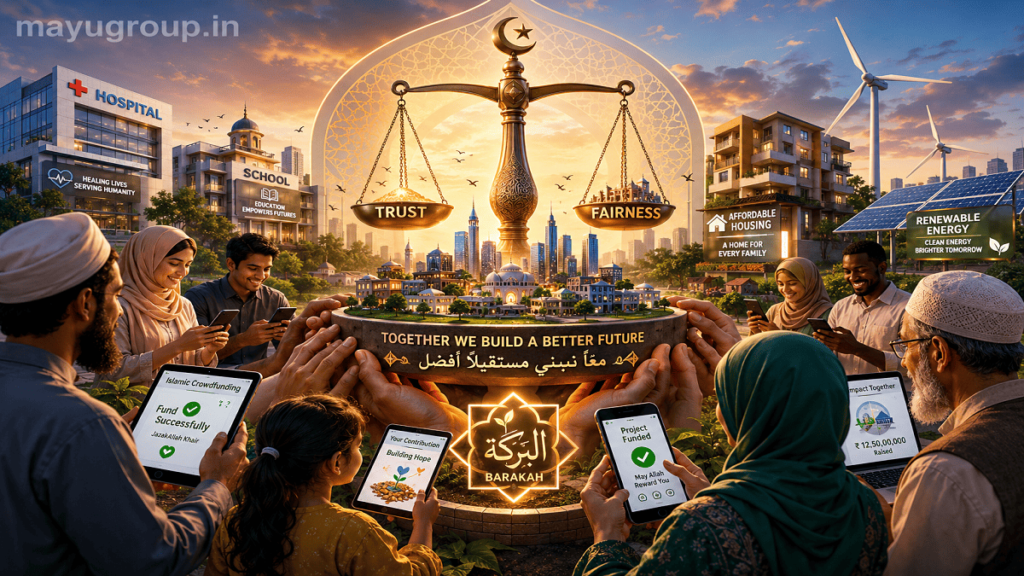
Who can participate in Islamic crowdfunding?
Islamic crowdfunding is an inclusive, Shariah-compliant fundraising model that allows a wide range of participants to take part in financing and investment activities, provided that all contributions and projects comply with Islamic ethical principles. Unlike traditional financial systems that may have strict eligibility requirements, Islamic crowdfunding is designed to be accessible to individuals, businesses, and organizations across different backgrounds, as long as the purpose and structure of participation remain halal (permissible).
Primarily, individual investors can participate in Islamic crowdfunding platforms. These individuals may be Muslim or non-Muslim, as participation is not restricted by religion. Many investors are attracted to Islamic crowdfunding because of its ethical framework, transparency, and focus on real economic activity. Individuals typically contribute small to moderate amounts of capital to support startups, social projects, or business ventures and may receive returns depending on the crowdfunding model used.
Entrepreneurs and business owners are also key participants. Startups, small and medium enterprises (SMEs), and social enterprises often use Islamic crowdfunding to raise capital for business expansion, product development, or project execution. Since Islamic banking principles avoid interest-based loans, crowdfunding provides an alternative funding source based on equity participation, profit-sharing, or reward-based contributions.
Institutional investors and organizations such as Islamic banks, investment firms, and charitable foundations can also participate in Islamic crowdfunding. These institutions may fund larger projects or co-invest alongside individual contributors. Their involvement helps increase trust, liquidity, and scale within the crowdfunding ecosystem.
Non-profit organizations and charitable entities play a significant role as well. Many Islamic crowdfunding platforms support donation-based models aligned with Islamic concepts such as Sadaqah (voluntary charity) and Waqf (endowment). These organizations use crowdfunding to raise funds for humanitarian aid, education, healthcare, disaster relief, and community development projects.
Participation is also open to project developers and issuers, who propose and manage crowdfunding campaigns. However, all projects must be reviewed and approved by a Shariah supervisory board to ensure compliance with Islamic principles. This includes ensuring that funds are not used for prohibited industries such as alcohol, gambling, or other non-halal activities.
Overall, Islamic crowdfunding is designed to be a broad and inclusive financial system where individuals, businesses, institutions, and charities can all participate, provided that their activities align with Shariah principles of ethical investment, transparency, and risk-sharing.
Relevant External Resources
- International Monetary Fund – Islamic Finance Overview
- Islamic Financial Services Board (IFSB)
- Asian Development Bank – Islamic Finance
#EthicalBanking
What types of projects are funded through Islamic crowdfunding?
Islamic crowdfunding supports a wide range of projects that comply with Shariah principles, focusing on ethical investment, real economic activity, and social welfare. All funded projects must be halal (permissible), avoid interest-based structures, and exclude industries considered unethical under Islamic law. The platform enables individuals, businesses, and organizations to raise capital for both commercial and social objectives through Shariah-compliant financial models.
1. Startup and Small Business Projects
One of the most common uses of Islamic crowdfunding is financing startups and small and medium enterprises (SMEs). Entrepreneurs use equity-based or profit-sharing models such as Musharakah and Mudarabah to raise capital for launching or expanding businesses. These projects may include retail businesses, technology startups, manufacturing units, and service-based enterprises. Investors share in profits and losses, aligning with Islamic principles of risk-sharing.
2. Real Estate and Construction Projects
Islamic crowdfunding is widely used in real estate development, including residential housing, commercial buildings, and infrastructure projects. Investors contribute funds for property development, and returns are generated through rental income or asset appreciation. These projects often follow Shariah-compliant structures such as Ijara (leasing) or joint ownership models, ensuring that investments are backed by tangible assets.
3. Social and Humanitarian Projects
Donation-based crowdfunding is frequently used for social welfare initiatives. These include healthcare support, education programs, disaster relief, poverty alleviation, and orphan care. Such projects are often funded through Islamic charitable concepts like Sadaqah (voluntary charity) and Waqf (endowment). These initiatives focus on improving community welfare and supporting vulnerable populations.
4. Education and Skill Development Projects
Islamic crowdfunding also funds educational initiatives such as building schools, scholarships, vocational training centers, and digital learning platforms. These projects aim to enhance human capital development and provide access to quality education, particularly in underserved communities.
5. Agriculture and Rural Development Projects
Agricultural projects are another important category, including farming equipment, irrigation systems, livestock development, and organic farming initiatives. These projects are often structured using profit-sharing models where investors and farmers share yields, ensuring fair distribution of risk and returns.
6. Healthcare and Medical Projects
Crowdfunding is also used to support hospitals, clinics, medical equipment purchases, and patient treatment funding. These projects are typically structured as charitable or donation-based initiatives to ensure access to essential healthcare services.
Conclusion
Islamic crowdfunding supports diverse projects as long as they comply with Shariah principles. The focus is on ethical investment, real asset backing, social welfare, and risk-sharing, making it a versatile financing model for both economic development and community support.
Relevant External Resources
- International Monetary Fund – Islamic Finance Overview
- Islamic Financial Services Board (IFSB)
- Asian Development Bank – Islamic Finance
#HalalFinance
How is Islamic crowdfunding different from conventional crowdfunding?
Islamic crowdfunding and conventional crowdfunding both use online platforms to raise funds from a large number of people for projects, businesses, or social causes. However, they differ significantly in their underlying financial principles, investment structures, and ethical guidelines. Islamic crowdfunding is governed by Shariah principles, while conventional crowdfunding operates under general financial and legal frameworks without religious restrictions.
1. Ethical and Religious Framework
The most fundamental difference is that Islamic crowdfunding follows Islamic law (Shariah). It prohibits riba (interest), gharar (excessive uncertainty), and maysir (gambling/speculation). In contrast, conventional crowdfunding does not have religious restrictions and may include interest-based lending, speculative investments, or projects in any legal industry.
2. Type of Returns Offered
In Islamic crowdfunding, returns must be Shariah-compliant and based on real economic activity. Investors typically earn profits through equity participation, profit-sharing (Mudarabah), or joint ventures (Musharakah). Donation-based and reward-based models are also widely used.
In conventional crowdfunding, returns may include fixed interest (in lending models), equity shares, rewards, or no returns at all depending on the platform type. Interest-based lending is commonly used in some conventional crowdfunding systems, which is not allowed in Islamic crowdfunding.
3. Investment Structure
Islamic crowdfunding requires that investments be asset-backed and linked to real economic activities. Funds must be used for halal (permissible) projects such as startups, real estate, agriculture, or social welfare initiatives. Conventional crowdfunding may fund any legal project, including speculative ventures, entertainment, or industries restricted under Shariah.
4. Risk-Sharing Approach
Islamic crowdfunding is based on the principle of risk-sharing, where investors and entrepreneurs share both profits and losses. This encourages fairness and discourages guaranteed returns. Conventional crowdfunding may involve fixed-return lending models where the borrower bears most of the risk, especially in debt-based campaigns.
5. Governance and Oversight
Islamic crowdfunding platforms are supervised by Shariah advisory boards, which ensure compliance with Islamic principles in all transactions. These boards review projects and financial structures. Conventional crowdfunding platforms are regulated primarily by financial authorities and legal frameworks without religious oversight.
6. Purpose and Social Impact
Islamic crowdfunding places strong emphasis on ethical investment and social responsibility, often supporting education, healthcare, humanitarian aid, and community development. Conventional crowdfunding also supports social causes but does not have mandatory ethical restrictions based on religious principles.
Conclusion
While both systems aim to democratize access to capital, Islamic crowdfunding is distinguished by its strict adherence to Shariah principles, focus on ethical finance, risk-sharing structure, and prohibition of interest-based and speculative activities. Conventional crowdfunding is more flexible but less constrained by ethical or religious guidelines.
Relevant External Resources
- International Monetary Fund – Islamic Finance Overview
- Islamic Financial Services Board (IFSB)
- Asian Development Bank – Islamic Finance
#RibaFreeBanking
Case Study of Islamic Crowdfunding
A notable case study of Islamic crowdfunding can be observed in the development and operations of Ethis Global, one of the leading Shariah-compliant crowdfunding platforms based in Southeast Asia and the Middle East. The platform was established to provide ethical investment opportunities that align with Islamic financial principles while supporting real economic and social development projects.
Background and Objective
Ethis Global was created to address two major challenges: limited access to financing for small and medium enterprises (SMEs) and the need for Shariah-compliant investment channels. Traditional financing systems often rely on interest-based lending, which is not permissible under Islamic law. Ethis aimed to bridge this gap by offering an alternative investment model based on equity crowdfunding and profit-sharing structures (Musharakah and Mudarabah).
Project Structure and Operations
The platform operates by connecting investors with vetted, Shariah-compliant projects. Each project undergoes strict screening by a Shariah advisory board to ensure compliance with Islamic principles, including the prohibition of riba (interest), gharar (excessive uncertainty), and investments in non-halal industries.
For example, in real estate crowdfunding projects, investors pool funds to finance property development. Once the project is completed, returns are generated through property sales or rental income. Profits are then distributed among investors based on their contribution ratio, while risks are also shared accordingly. This structure ensures alignment with Islamic risk-sharing principles.
Real-World Impact
One of Ethis Global’s significant contributions has been in financing affordable housing projects in countries like Indonesia and Malaysia. These projects allow middle-income families to access housing while providing investors with ethical, asset-backed investment opportunities. The platform has also supported SME financing, infrastructure development, and social impact projects such as education and healthcare.
Through its model, Ethis Global has demonstrated how Islamic crowdfunding can mobilize capital efficiently while maintaining ethical and religious compliance. It has enabled individuals with relatively small investments to participate in large-scale development projects, promoting financial inclusion.
Challenges Faced
Despite its success, Islamic crowdfunding platforms like Ethis Global face challenges such as regulatory differences across countries, limited investor awareness, and the need for standardized Shariah compliance frameworks. Additionally, ensuring project success and managing default risks remain ongoing concerns.
Conclusion
The case of Ethis Global illustrates how Islamic crowdfunding can effectively combine technology, ethical finance, and community participation to support economic development. By adhering to Shariah principles and focusing on real asset-backed investments, it provides a sustainable alternative to conventional crowdfunding systems.
Relevant External Resources
- Ethis Global Official Website
- International Monetary Fund – Islamic Finance Overview
- Islamic Financial Services Board (IFSB)
#ShariahCompliance

White Paper on Islamic Crowdfunding
1. Introduction
Islamic crowdfunding is a Shariah-compliant financial innovation that combines digital crowdfunding mechanisms with Islamic principles of finance. It enables individuals, institutions, and organizations to raise and invest funds in ethical, transparent, and asset-backed projects. Unlike conventional crowdfunding, which may include interest-based lending or speculative investments, Islamic crowdfunding strictly adheres to Islamic law (Shariah), prohibiting riba (interest), gharar (excessive uncertainty), and maysir (gambling/speculation). It has emerged as an important tool for financial inclusion, particularly for startups, SMEs, and social development projects.
2. Objectives of Islamic Crowdfunding
The primary objectives of Islamic crowdfunding are to:
- Promote ethical and Shariah-compliant investment opportunities
- Improve access to capital for SMEs and startups
- Encourage risk-sharing and asset-backed financing
- Support social welfare and community development
- Enhance financial inclusion through digital platforms
- Mobilize small investments into productive economic activities
3. Core Principles
Islamic crowdfunding operates under key Islamic financial principles:
- Prohibition of Riba: No fixed or guaranteed interest-based returns
- Risk-Sharing: Investors share profits and losses with entrepreneurs
- Asset-Backed Financing: Investments must be linked to real economic activities
- Shariah Compliance: Funds must be used only for halal (permissible) projects
- Transparency: Full disclosure of project risks, objectives, and financial structure
- Ethical Investment: Avoidance of industries such as alcohol, gambling, and other prohibited sectors
4. Models of Islamic Crowdfunding
Islamic crowdfunding operates through several Shariah-compliant models:
- Equity-Based Crowdfunding: Investors receive ownership shares and profit participation
- Profit-Sharing Models (Mudarabah & Musharakah): Returns based on business performance
- Reward-Based Crowdfunding: Contributors receive non-financial rewards
- Donation-Based Crowdfunding (Sadaqah & Waqf): Used for charitable and social projects
- Qard Hasan Model: Interest-free loans repaid without profit
5. Economic and Social Impact
Islamic crowdfunding plays a significant role in economic development by:
- Supporting entrepreneurship and innovation
- Financing SMEs and startups with limited access to banks
- Promoting affordable housing and infrastructure development
- Funding education, healthcare, and humanitarian projects
- Encouraging wealth circulation within the real economy
- Strengthening community-based financial systems
Its social impact is especially strong in developing economies where access to traditional financing is limited.
6. Challenges
Despite its growth, Islamic crowdfunding faces several challenges:
- Lack of global regulatory standardization
- Varying interpretations of Shariah compliance
- Limited investor awareness and education
- Project default and risk management issues
- Cross-border legal and financial complexities
- Dependence on digital infrastructure and trust systems
7. Conclusion
Islamic crowdfunding represents a modern evolution of Islamic finance, integrating ethical principles with digital innovation. It provides a powerful platform for inclusive economic development by connecting investors with real, productive, and socially responsible projects. With proper regulation, increased awareness, and technological advancement, it has the potential to become a major pillar of the global Islamic financial ecosystem.
Relevant External Resources
- International Monetary Fund – Islamic Finance Overview
- Islamic Financial Services Board (IFSB)
- Asian Development Bank – Islamic Finance
#IslamicFinance
Industry Application of Islamic Crowdfunding
Islamic crowdfunding is a Shariah-compliant financing model that combines digital fundraising platforms with Islamic financial principles such as prohibition of riba (interest), avoidance of gharar (uncertainty), and emphasis on risk-sharing and asset-backed investment. It has increasingly become an important funding mechanism across multiple industries, especially where access to traditional financing is limited or where ethical investment is prioritized.
1. Real Estate and Construction Industry
One of the largest applications of Islamic crowdfunding is in real estate development. Investors collectively fund housing projects, commercial buildings, and infrastructure developments through equity-based or profit-sharing models such as Musharakah. Returns are generated through rental income or property sales, ensuring that investments are tied to tangible assets. Platforms such as Ethis Global have successfully funded affordable housing projects in Southeast Asia using this model.
2. Startup and SME Financing
Islamic crowdfunding plays a vital role in supporting startups and small and medium enterprises (SMEs). Entrepreneurs raise capital through equity crowdfunding or profit-sharing structures like Mudarabah, where investors share both profits and losses. This enables early-stage businesses to access funding without relying on interest-based loans, promoting entrepreneurship and innovation in sectors such as technology, retail, and services.
3. Agriculture and Agribusiness
In the agricultural sector, Islamic crowdfunding is used to finance farming equipment, irrigation systems, livestock development, and crop production. Investors participate in profit-sharing arrangements where returns depend on agricultural yields. This model is particularly useful in rural economies where farmers face limited access to formal banking services.
4. Social and Humanitarian Development
Islamic crowdfunding is widely used for charitable and social impact projects. Donation-based models aligned with Sadaqah (charity) and Waqf (endowment) fund initiatives such as poverty alleviation, disaster relief, healthcare support, and education programs. These projects focus on community welfare rather than financial returns, aligning closely with Islamic ethical values.
5. Education Sector
Educational institutions and nonprofit organizations use Islamic crowdfunding to build schools, provide scholarships, develop online learning platforms, and improve educational infrastructure. These initiatives help increase access to quality education, especially in underserved communities.
6. Healthcare Industry
Islamic crowdfunding is also applied in healthcare financing, including hospital construction, medical equipment procurement, and patient treatment support. Many campaigns operate on donation-based models to ensure that essential healthcare services remain accessible to low-income populations.
7. Renewable Energy and Infrastructure
Crowdfunding platforms are increasingly used to finance renewable energy projects such as solar and wind farms, as well as infrastructure development like roads, water supply systems, and public utilities. These projects are structured to ensure asset-backed financing and long-term sustainable returns.
Conclusion
Islamic crowdfunding has diverse applications across real estate, startups, agriculture, education, healthcare, and infrastructure. Its emphasis on ethical finance, transparency, and real economic activity makes it a powerful tool for inclusive economic development and socially responsible investment.
Relevant External Resources
- Ethis Global Official Website
- International Monetary Fund – Islamic Finance Overview
- Islamic Financial Services Board (IFSB)
#IslamicBanking
Ask FAQs
What is Islamic crowdfunding?
Islamic crowdfunding is a Shariah-compliant way of raising funds online where multiple investors contribute money to finance businesses, startups, or social projects. It follows Islamic principles by avoiding interest (riba), excessive uncertainty (gharar), and speculative investments, and ensures that funds are used only for halal (permissible) activities.
How does Islamic crowdfunding work?
Islamic crowdfunding works through online platforms where project owners present their funding needs. Investors then contribute small or large amounts depending on the model used. Returns, if any, are generated through profit-sharing (Mudarabah), partnerships (Musharakah), rewards, or donations, rather than fixed interest payments.
Is Islamic crowdfunding only for Muslims?
No, Islamic crowdfunding is open to everyone. Non-Muslims can also participate as investors or project owners. Many people choose it because of its ethical structure, transparency, and focus on real economic activity and socially responsible investment.
What types of returns do investors receive?
Returns depend on the crowdfunding model:
Equity-based: Profit and loss sharing
Reward-based: Non-financial rewards like products or services
Donation-based: No financial return (charitable support)
Qard Hasan: Interest-free loan repayment without profit
All returns must comply with Shariah principles and cannot involve interest.
Is Islamic crowdfunding safe and regulated?
Islamic crowdfunding platforms are generally regulated by financial authorities in their respective countries and supervised by Shariah advisory boards. While it offers ethical and transparent investment opportunities, like all investments, it carries risks such as project failure or delayed returns.
Table of Contents
Disclaimer
The information provided about Islamic banking is for general educational purposes only and does not constitute financial, legal, or religious advice. Islamic banking principles may vary based on different interpretations of Shariah law and regional regulations. Readers should consult qualified professionals or authorized financial institutions before making any financial decisions.