Eco-Friendly Startups
Eco-Friendly Startups are emerging as a critical force in addressing environmental challenges while reshaping traditional business models. These companies focus on developing sustainable solutions that minimize environmental harm, reduce carbon emissions, and promote responsible consumption. Unlike conventional businesses that often prioritize profit over environmental impact, eco-friendly startups integrate sustainability into their core mission, making it a central pillar of innovation, operations, and growth strategy.
A defining characteristic of eco-friendly startups is their emphasis on circular economy principles. Instead of the traditional “take-make-dispose” model, they design products and services that prioritize reuse, recycling, and waste reduction. Many of these startups operate in sectors such as renewable energy, sustainable packaging, waste management, plant-based food alternatives, and green construction materials. Their innovation often lies in replacing resource-intensive processes with cleaner, more efficient alternatives.
For example, Climeworks focuses on direct air carbon capture technology, removing CO₂ from the atmosphere and storing it safely underground. In the food industry, Impossible Foods and Beyond Meat develop plant-based meat substitutes that significantly reduce greenhouse gas emissions and land use compared to traditional livestock farming. In packaging and materials innovation, Ecovative uses mycelium (mushroom root structures) to create biodegradable alternatives to plastic and Styrofoam. In India, Phool.co converts floral waste from temples into eco-friendly incense products and compostable materials, addressing both pollution and waste management challenges.
A key support system for such startups is the B Corp certification, which recognizes businesses meeting high standards of social and environmental performance, accountability, and transparency. Organizations such as B Lab help certify and guide companies committed to balancing profit with purpose.
Despite their positive impact, eco-friendly startups face significant challenges. High production costs, limited consumer awareness, and scalability issues often restrict rapid expansion. Additionally, competing with established industries that benefit from economies of scale can make market entry difficult. Funding is another critical hurdle, as investors may perceive green technologies as long-term bets with uncertain short-term returns.
However, the future outlook remains strong. Increasing regulatory pressure on carbon emissions, growing consumer preference for sustainable products, and advancements in green technology are driving rapid growth in this sector. Governments and venture capital firms are also increasingly supporting climate-focused innovation through grants, subsidies, and dedicated investment funds.
In conclusion, eco-friendly startups represent a transformative shift in global entrepreneurship. By combining innovation with sustainability, they are not only building profitable businesses but also contributing meaningfully to environmental preservation and long-term ecological balance.
#Eco-Friendly Startups in India
What is an eco-friendly startup?
An eco-friendly startup is a business venture designed to minimize environmental impact while delivering products or services. Unlike traditional startups that primarily focus on profitability and growth, eco-friendly startups integrate sustainability into their core business model. Their main goal is to create economic value while also addressing environmental challenges such as climate change, pollution, deforestation, and resource depletion.
These startups typically emphasize the use of renewable resources, energy efficiency, waste reduction, and environmentally responsible production methods. They often adopt circular economy principles, meaning they aim to reuse, recycle, or repurpose materials instead of discarding them after use. This reduces pressure on natural resources and helps reduce long-term environmental damage.
Eco-friendly startups operate across many industries. In energy, they may develop solar, wind, or bioenergy solutions that replace fossil fuels. In food and agriculture, they may focus on organic farming, plant-based alternatives, or reducing food waste. In manufacturing, they often use biodegradable materials, sustainable packaging, or low-emission production techniques. Some also work in environmental services such as carbon capture, recycling technologies, or water purification.
A key feature of eco-friendly startups is innovation driven by sustainability. They do not simply modify existing systems but often redesign them to be environmentally responsible from the ground up. For example, companies like Climeworks focus on removing carbon dioxide directly from the atmosphere, while firms like Beyond Meat create plant-based proteins to reduce the environmental footprint of livestock farming. These examples show how eco-friendly startups combine science, technology, and environmental awareness.
Another important aspect is their alignment with global sustainability goals, such as the United Nations Sustainable Development Goals (SDGs), especially those related to climate action, responsible consumption, and clean energy. Many eco-friendly startups also seek certifications or partnerships that validate their environmental commitments, such as those supported by B Lab.
Funding for eco-friendly startups often comes from impact investors, green venture capital firms, and government sustainability programs. These investors are interested not only in financial returns but also in measurable environmental and social impact.
In summary, an eco-friendly startup is a business that prioritizes environmental sustainability alongside profit. It uses innovation to solve ecological problems while building scalable and economically viable solutions. As environmental concerns continue to grow globally, these startups are becoming increasingly important in shaping a more sustainable future for industries and societies worldwide.
#Eco-Friendly Startups in Maharashtra
How do eco-friendly startups promote sustainability?
Eco-friendly startups promote sustainability by redesigning business models, technologies, and consumer behavior to reduce environmental harm while maintaining economic viability. Their contribution goes beyond compliance with environmental regulations; they actively integrate sustainability into innovation, operations, supply chains, and product life cycles.
One of the primary ways these startups promote sustainability is through the adoption of clean and renewable energy solutions. Many companies focus on replacing fossil fuels with solar, wind, or bioenergy systems, significantly reducing greenhouse gas emissions. For example, organizations like Climeworks contribute to sustainability by removing carbon dioxide directly from the atmosphere using direct air capture technology. This helps offset emissions that are difficult to eliminate entirely.
Another major approach is the development of sustainable products and materials. Eco-friendly startups often replace non-biodegradable or high-impact materials with environmentally safe alternatives. Companies such as Ecovative use mycelium-based materials to create biodegradable packaging, reducing dependence on plastic and Styrofoam. Similarly, in the food industry, Beyond Meat promotes sustainability by offering plant-based meat alternatives that require significantly less land, water, and energy compared to traditional animal farming.
Waste reduction is another key strategy. Many eco-friendly startups operate within a circular economy framework, where products are designed to be reused, recycled, or composted rather than discarded. This reduces landfill waste and encourages efficient use of resources. Startups in this space also develop technologies for recycling plastics, managing electronic waste, and converting organic waste into usable products like compost or biofuel.
In addition, these startups promote sustainability by improving supply chain transparency and efficiency. They often use digital tools such as blockchain or data tracking systems to monitor environmental impact across production and distribution processes. This helps businesses identify inefficiencies and reduce carbon footprints at every stage.
Consumer awareness and behavioral change also play an important role. Eco-friendly startups actively educate customers about sustainable choices and encourage responsible consumption. By making eco-friendly products more accessible and affordable, they shift demand away from environmentally harmful alternatives.
Certifications and partnerships further strengthen their sustainability impact. Organizations like B Lab certify companies that meet high environmental and social standards, helping consumers identify genuinely sustainable businesses.
In conclusion, eco-friendly startups promote sustainability through innovation in clean energy, sustainable materials, waste reduction, supply chain optimization, and consumer education. By integrating environmental responsibility into their core operations, they create scalable solutions that contribute to long-term ecological balance and a more sustainable global economy.
#Eco-Friendly Startups in Ahemadabad

What industries do eco-friendly startups operate in?
Eco-friendly startups operate across a wide range of industries, as sustainability challenges exist in almost every sector of the global economy. These startups are not limited to one niche; instead, they apply environmental innovation to transform traditional industries into more sustainable systems.
One of the most prominent sectors is renewable energy. Startups in this field develop solar power systems, wind energy solutions, energy storage technologies, and carbon capture systems. Their goal is to reduce dependence on fossil fuels and lower greenhouse gas emissions. Companies like Climeworks work on direct air carbon capture, removing CO₂ from the atmosphere and contributing to climate mitigation efforts.
The food and agriculture industry is another major area. Eco-friendly startups here focus on plant-based proteins, organic farming, vertical agriculture, and reducing food waste. For example, Beyond Meat develops plant-based meat alternatives that require fewer natural resources compared to conventional livestock farming. Other startups work on precision agriculture technologies that help farmers optimize water usage, fertilizers, and crop yields, reducing environmental impact.
In the waste management and recycling industry, startups are developing innovative ways to handle plastic waste, electronic waste, and industrial byproducts. Many use circular economy models to ensure materials are reused or repurposed rather than discarded. This includes biodegradable packaging solutions, compostable materials, and advanced recycling technologies.
The sustainable fashion and textile industry is also rapidly growing. Eco-friendly startups in this space use organic fabrics, recycled materials, and ethical production methods to reduce pollution and water consumption caused by traditional textile manufacturing. They also promote slow fashion, encouraging consumers to buy fewer, higher-quality items.
Transportation and mobility is another key sector. Startups in this industry focus on electric vehicles, shared mobility platforms, hydrogen fuel technologies, and smart transportation systems that reduce emissions and traffic congestion. These innovations help cities transition toward cleaner and more efficient transport networks.
In construction and real estate, eco-friendly startups develop green building materials, energy-efficient architecture, and smart home technologies. These solutions reduce energy consumption and improve sustainability in urban development.
Water management and environmental technology (cleantech) is also important. Startups in this sector work on water purification, desalination, and smart water monitoring systems to address global water scarcity.
Overall, eco-friendly startups operate in nearly every major industry, including energy, agriculture, waste management, fashion, transportation, construction, and water management. Their shared mission is to integrate sustainability into traditional systems and create environmentally responsible alternatives that support long-term ecological balance and economic growth.
#Eco-Friendly Startups in Hyderabad
Why do investors support eco-friendly startups?
Investors support eco-friendly startups because they combine financial opportunity with long-term environmental and social value creation. In recent years, sustainability has shifted from being a niche concern to a mainstream investment priority, driven by climate change risks, regulatory pressure, and changing consumer expectations.
One of the main reasons is long-term financial potential. Eco-friendly startups often operate in high-growth sectors such as renewable energy, electric mobility, sustainable agriculture, and waste management. As governments introduce stricter environmental regulations and carbon reduction targets, demand for sustainable solutions is expected to increase significantly. Investors view these startups as early entry points into future-defining industries.
Another key factor is risk management. Traditional industries that rely heavily on fossil fuels, intensive resource use, or high emissions are increasingly exposed to regulatory and market risks. Eco-friendly startups, on the other hand, are generally aligned with emerging environmental policies such as carbon taxes, emissions caps, and sustainability reporting standards. This makes them more resilient in a transitioning global economy.
Impact investing also plays a major role. Many investors today are not focused solely on financial returns; they also want measurable environmental and social impact. Eco-friendly startups allow them to contribute to climate action, resource conservation, and social responsibility while still earning competitive returns. Investment frameworks such as ESG (Environmental, Social, and Governance) guide capital toward companies that meet sustainability criteria. More information on this approach can be found through Principles for Responsible Investment.
Technological innovation is another attraction. Eco-friendly startups often develop cutting-edge solutions such as carbon capture, biodegradable materials, smart energy systems, and AI-driven resource optimization. These innovations can disrupt traditional industries and create new markets. Investors are drawn to the scalability and transformative potential of these technologies.
Consumer demand is also influencing investment decisions. A growing number of customers prefer environmentally responsible products and services. This shift encourages investors to fund startups that align with changing market behavior, as these companies are more likely to achieve long-term brand loyalty and revenue growth.
Additionally, governments and financial institutions are increasingly offering incentives for green investments, including tax benefits, subsidies, and green bonds. These mechanisms reduce financial risk and improve returns for investors supporting sustainable ventures.
In summary, investors support eco-friendly startups because they offer a powerful combination of profitability, future market relevance, reduced regulatory risk, technological innovation, and positive environmental impact. As sustainability becomes central to global economic development, eco-friendly startups are increasingly viewed not just as ethical choices, but as strategic and forward-looking investments.
#Eco-Friendly Startups in Delhi
What challenges do eco-friendly startups face?
Eco-friendly startups face a unique set of challenges that stem from balancing environmental goals with economic viability, technological constraints, and market adoption barriers. While they play an important role in promoting sustainability, their growth is often more complex compared to conventional startups.
One of the primary challenges is high initial cost and capital intensity. Many sustainable technologies—such as renewable energy systems, biodegradable materials, or carbon capture solutions—require significant research, development, and infrastructure investment. For example, scaling clean technologies from prototype to mass production often demands large funding rounds, which can be difficult to secure in early stages when revenue is limited.
Another major issue is scalability. Eco-friendly solutions may work efficiently on a small scale but face technical, logistical, or cost-related difficulties when expanded. For instance, producing sustainable materials or plant-based alternatives at scale while keeping prices competitive with conventional products is a persistent challenge. This often slows down market penetration.
Market competition also poses a barrier. Traditional industries benefit from established supply chains, economies of scale, and lower production costs, often due to long-standing reliance on fossil fuels or non-sustainable materials. Eco-friendly startups must compete against these entrenched players while convincing consumers to switch to greener but sometimes more expensive alternatives.
Consumer awareness and behavior change is another difficulty. Although sustainability awareness is growing, many consumers still prioritize price and convenience over environmental impact. This creates a gap between eco-friendly innovation and widespread adoption, requiring startups to invest heavily in education, branding, and trust-building.
Regulatory complexity can also be both a support and a challenge. While environmental policies can create opportunities, compliance requirements across different countries and regions can be complex and costly. Startups operating internationally must navigate varying standards for emissions, materials, and certifications.
Funding uncertainty is another significant issue. Although impact investing is increasing, eco-friendly startups may still struggle to attract investors who prioritize short-term financial returns. Sustainable technologies often require longer timelines to become profitable, which can deter traditional venture capital.
Additionally, supply chain limitations can hinder growth. Sourcing sustainable raw materials, maintaining ethical production practices, and ensuring transparency across suppliers can be difficult and expensive, especially in developing markets.
Despite these challenges, organizations like B Lab support businesses in meeting high environmental and social standards, while initiatives such as the Principles for Responsible Investment (PRI) encourage long-term sustainable funding strategies: UN PRI.
In conclusion, eco-friendly startups face challenges related to cost, scalability, competition, consumer behavior, regulation, funding, and supply chains. However, overcoming these barriers is essential for building a more sustainable economy, and continuous innovation is helping many of these startups gradually turn challenges into opportunities.
#Eco-Friendly Startups in Pune
Case Study of Eco-Friendly Startups
A case study of eco-friendly startups helps illustrate how sustainability-driven innovation translates into real-world business impact. These startups typically operate at the intersection of environmental science, technology, and entrepreneurship, aiming to solve pressing ecological problems while remaining financially viable. The following examples highlight different approaches across industries.
One notable case is Climeworks, a Swiss company specializing in direct air carbon capture technology. Climeworks builds machines that filter carbon dioxide directly from the atmosphere and store it underground or reuse it in industrial applications. The startup demonstrates how deep-tech solutions can address climate change at scale. Its business model relies on subscription-based carbon removal services, where individuals and corporations pay to offset emissions. The challenge for Climeworks lies in high operational costs and energy requirements, but it has gained strong investor and governmental support due to its long-term climate mitigation potential.
Another significant example is Beyond Meat, a U.S.-based food technology company that produces plant-based meat alternatives. The company’s mission is to reduce the environmental impact of animal agriculture, which is a major contributor to greenhouse gas emissions, deforestation, and water consumption. Beyond Meat uses plant proteins such as pea, rice, and mung bean to replicate the taste and texture of traditional meat. Its success shows how eco-friendly startups can scale in highly competitive consumer markets. However, it also faces challenges such as fluctuating demand, competition from traditional meat producers, and price sensitivity among consumers.
A third example is Ecovative, a materials science startup that develops biodegradable packaging and leather alternatives using mycelium, the root structure of mushrooms. Ecovative’s technology replaces petroleum-based plastics and synthetic foams with compostable materials that naturally decompose. This case highlights the role of biomaterials in reducing waste and promoting circular economy practices. The company has partnered with various industries, including fashion and packaging, to expand its applications. Its main challenge is scaling production while maintaining cost competitiveness with conventional plastic materials.
In India, Phool.co provides a strong example of grassroots innovation. The startup collects floral waste from temples and converts it into incense sticks, organic fertilizers, and biodegradable products. This model not only reduces pollution in rivers like the Ganges but also creates employment opportunities for marginalized communities. Phool.co demonstrates how eco-friendly startups can combine environmental sustainability with social impact.
Across these case studies, several common themes emerge. First, innovation is central—each startup uses science or technology to redesign traditional systems. Second, scalability remains a key challenge, particularly in balancing sustainability with cost efficiency. Third, consumer adoption and investor confidence play critical roles in determining long-term success.
In conclusion, eco-friendly startups like Climeworks, Beyond Meat, Ecovative, and Phool.co illustrate how businesses can address environmental challenges through innovation while building viable economic models. These case studies show that sustainability is not only an ethical goal but also a powerful driver of modern entrepreneurship and industrial transformation.
#Eco-Friendly Startups in Banglore
White Paper of Eco-Friendly Startups
1. Executive Summary
Eco-friendly startups are emerging as key drivers in addressing global environmental challenges while reshaping modern economic systems. These ventures integrate sustainability into core business models, focusing on reducing carbon emissions, minimizing waste, and promoting resource efficiency. This white paper examines their role, operational frameworks, opportunities, and constraints in contributing to a more sustainable global economy.
2. Introduction
Eco-friendly startups, often referred to as green or sustainable startups, are enterprises designed to provide environmentally responsible solutions. Unlike traditional firms, they embed environmental considerations into product design, supply chains, and long-term strategy. Their emergence is strongly linked to climate change concerns, regulatory shifts, and growing consumer demand for sustainable products and services.
3. Core Operational Areas
Eco-friendly startups operate across multiple industries:
- Renewable energy (solar, wind, carbon capture)
- Sustainable food systems (plant-based alternatives, organic farming)
- Waste management (recycling, circular economy solutions)
- Green materials (biodegradable plastics, eco-packaging)
- Sustainable mobility (electric vehicles, shared transport systems)
For instance, Climeworks focuses on direct air carbon capture, while Beyond Meat develops plant-based protein alternatives to reduce environmental impact from livestock production.
4. Sustainability Framework
These startups typically follow three key sustainability principles:
- Reduce: Minimizing resource consumption and emissions
- Reuse: Extending product life cycles through circular design
- Recycle: Transforming waste into usable materials
Organizations such as B Lab support these principles by certifying businesses that meet high environmental and social performance standards.
5. Economic and Environmental Impact
Eco-friendly startups contribute to:
- Reduction in greenhouse gas emissions
- Conservation of natural resources
- Development of green jobs and industries
- Innovation in clean technologies
- Promotion of responsible consumption patterns
These impacts align with global frameworks such as the UN Sustainable Development Goals (SDGs), particularly climate action and responsible production.
6. Challenges
Despite their benefits, eco-friendly startups face significant barriers:
- High research and development costs
- Difficulty in scaling sustainable technologies
- Price competition with traditional industries
- Limited consumer willingness to pay premiums
- Complex regulatory and certification requirements
- Funding gaps for long-term sustainability projects
7. Investment Landscape
Investment in eco-friendly startups is increasingly driven by ESG (Environmental, Social, and Governance) criteria and impact investing. Investors are motivated by long-term returns, regulatory alignment, and risk diversification in a transitioning global economy. Frameworks such as the Principles for Responsible Investment (PRI) guide sustainable capital allocation: https://www.unpri.org
8. Future Outlook
The future of eco-friendly startups is strongly positive due to rising climate awareness, technological advancements, and government incentives. Growth is expected in sectors such as carbon neutrality technologies, circular manufacturing, and sustainable consumer goods.
9. Conclusion
Eco-friendly startups represent a structural shift in modern entrepreneurship. By integrating environmental responsibility into business innovation, they are redefining profitability and sustainability as complementary goals. Their continued growth is essential for achieving global environmental targets and building a resilient green economy.
#Eco-Friendly Startups in Kolkata
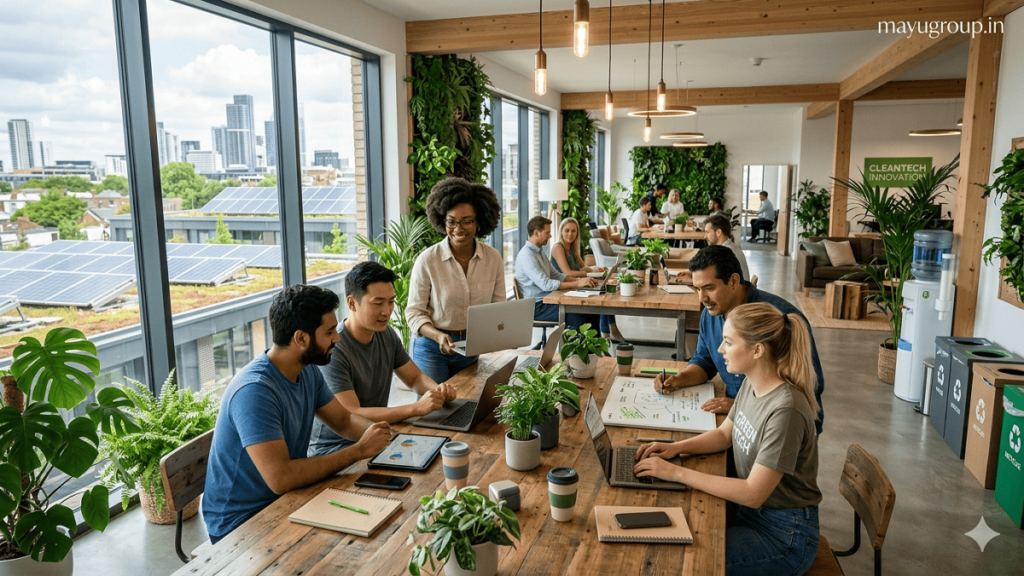
Industry Application of Eco-Friendly Startups
Eco-friendly startups are transforming traditional industries by embedding sustainability into core production systems, supply chains, and consumer services. Their applications span nearly every major sector of the global economy, enabling businesses to reduce environmental impact while improving efficiency and innovation.
1. Energy Industry
In the energy sector, eco-friendly startups focus on replacing fossil fuels with renewable and low-carbon alternatives. They develop solar power systems, wind energy technologies, smart grids, and carbon capture solutions. These innovations help reduce greenhouse gas emissions and improve energy accessibility.
For example, Climeworks applies direct air capture technology to remove carbon dioxide from the atmosphere, supporting global decarbonization efforts. Startups in this sector also work on battery storage systems that improve the reliability of renewable energy sources.
2. Agriculture and Food Industry
Eco-friendly startups in agriculture aim to improve food production efficiency while reducing environmental damage. They promote organic farming, precision agriculture, vertical farming, and plant-based food alternatives. These solutions reduce water usage, land degradation, and methane emissions from livestock.
Companies like Beyond Meat illustrate this transformation by producing plant-based proteins that significantly lower environmental impact compared to traditional meat production. Other startups develop AI-based farming tools to optimize fertilizer and irrigation use.
3. Waste Management and Recycling
In this sector, startups focus on circular economy models where waste is minimized and materials are reused. They develop biodegradable packaging, plastic recycling technologies, and waste-to-energy systems. These innovations reduce landfill dependency and environmental pollution.
Startups also design systems that convert organic waste into compost or biofuel, contributing to cleaner urban environments and sustainable resource use.
4. Manufacturing and Materials
Eco-friendly startups in manufacturing replace harmful materials with sustainable alternatives such as biodegradable plastics, recycled metals, and bio-based composites. uses mycelium technology to create compostable packaging and leather substitutes, reducing reliance on petroleum-based products.
These innovations are crucial for reducing industrial emissions and supporting circular production systems.
5. Transportation and Mobility
In transportation, eco-friendly startups develop electric vehicles, battery technologies, shared mobility platforms, and hydrogen fuel systems. These solutions reduce air pollution and dependence on fossil fuels while improving urban mobility efficiency.
They also invest in smart transportation systems that optimize traffic flow and reduce fuel consumption.
6. Construction and Real Estate
Green construction startups design energy-efficient buildings using sustainable materials, smart energy systems, and water-saving technologies. They promote green architecture that reduces long-term operational costs and environmental impact.
7. Water and Environmental Technology
Startups in this field focus on water purification, desalination, wastewater recycling, and smart water monitoring systems. These innovations address global water scarcity and improve access to clean water.
Conclusion
Eco-friendly startups have broad industry applications across energy, agriculture, waste management, manufacturing, transportation, construction, and water systems. By integrating sustainability into industrial processes, they are reshaping traditional sectors into environmentally responsible and resource-efficient systems that support long-term ecological and economic stability.
#Eco-Friendly Startups in Mumbai
Ask FAQs
What is an eco-friendly startup?
An eco-friendly startup is a business that focuses on providing products or services that reduce environmental harm. These startups integrate sustainability into their operations by using renewable resources, minimizing waste, reducing carbon emissions, and promoting environmentally responsible practices. Their goal is to balance profit with environmental protection.
How do eco-friendly startups differ from traditional startups?
Eco-friendly startups differ from traditional startups mainly in their core objectives. While traditional startups primarily focus on profitability and market growth, eco-friendly startups prioritize sustainability alongside financial success. They design their products, services, and supply chains to reduce environmental impact and support long-term ecological balance.
Which industries do eco-friendly startups operate in?
Eco-friendly startups operate in multiple industries, including renewable energy, agriculture, waste management, transportation, manufacturing, construction, and sustainable fashion. For example, companies like Beyond Meat
Why are eco-friendly startups important?
Eco-friendly startups are important because they help address critical environmental challenges such as climate change, pollution, and resource depletion. They introduce innovative solutions like clean energy, biodegradable materials, and circular economy systems, which reduce environmental damage and promote sustainable development globally.
What challenges do eco-friendly startups face?
Eco-friendly startups face several challenges, including high production and research costs, difficulty in scaling sustainable technologies, competition from traditional industries, and limited consumer awareness. They may also struggle with funding, as some investors prefer short-term returns over long-term sustainability-focused projects.
Table of Contents
Disclaimer: The information provided is for general educational purposes only and is not intended as financial, business, or professional advice. While efforts are made to ensure accuracy, no guarantee is given regarding completeness or reliability. Readers should conduct their own research or consult qualified professionals before making any decisions.