
Biophilia Pest Solutions
- Biophilia Pest Solutions
- Chapter 1 – The Beginning of a Green Quality Journey
- Chapter 2 – Building a Strong Foundation Through ISO 9001:2015
- Chapter 3 – Strengthening Customer Trust Through Consistent Quality
- Chapter 4 – Strengthening Manufacturing and Supply Processes
- Chapter 5 – Developing People and Creating a Culture of Quality
- Chapter 6 – Green Innovation and Responsible Business Growth
- Chapter 7 – Expanding Market Reach Through Quality and Customer Confidence
- Chapter 8 – Operational Excellence and the Strength to Grow
- Chapter 9 – Leadership, Sustainability and the Vision for the Future
- Chapter 10 – A Legacy of Quality, Green Solutions and Sustainable Growth
- Take the Next Step Today
Chapter 1 – The Beginning of a Green Quality Journey
In the peaceful and naturally rich surroundings of Dehradun, Uttarakhand, where the Himalayan foothills meet expanding residential and commercial communities, a business began developing around an important idea: pest management could be effective while also being more conscious of environmental responsibility. This vision became the foundation of Biophilia Pest Solutions, located at Mech. Khasra No. 387, Johri Gaon, P.O. Anarwala, Dehradun, Uttarakhand, India.
Biophilia Pest Solutions was established around the scope of manufacturing and supplying green pest solutions. From its early development, the organization had an opportunity to address a growing need in the market. Pest management is an essential requirement for homes, commercial establishments, agricultural activities, institutions and many other environments. At the same time, customers increasingly expect businesses to provide solutions responsibly, consistently and with awareness of their impact on people and surroundings.
For the promoter of Biophilia Pest Solutions, this created an important business philosophy. The objective was not simply to manufacture products and supply them to customers. The larger objective was to build an organization that customers could trust.
Building that trust required many things. Products needed to be manufactured consistently. Customer requirements needed to be understood. Materials needed to be managed carefully. Production activities needed to be controlled. Orders needed to be supplied according to requirements. Employees needed to understand their responsibilities. Feedback needed to reach management. And when something went wrong, the organization needed to learn from the experience.
As the business developed, the promoter recognized that personal supervision alone could not provide a permanent foundation for growth. A growing organization needs systems.
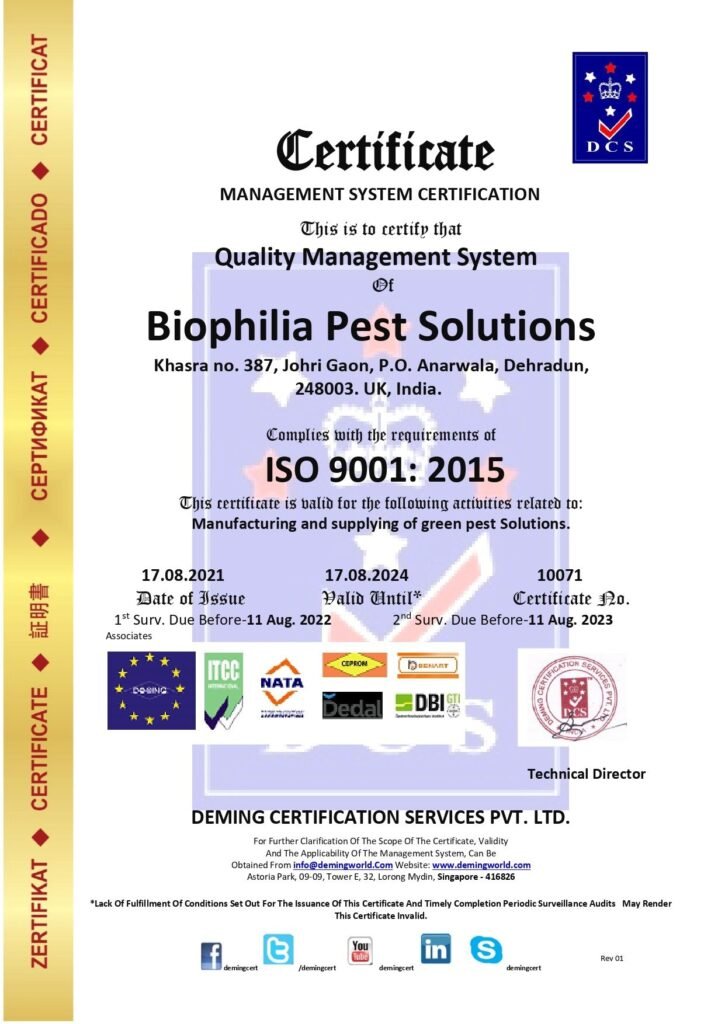
This realization became particularly important as Biophilia Pest Solutions began strengthening its quality-management practices. The organization decided to pursue ISO 9001:2015 certification, achieving certification in 2021 for its specified scope of manufacturing and supplying green pest solutions.
The certification represented an important milestone in the company’s history. ISO 9001 is a quality management system standard that provides organizations with a framework for consistently meeting customer and applicable requirements while continually improving their processes. Its principles include customer focus, leadership, engagement of people, process approach, improvement, evidence-based decision-making and relationship management.
For Biophilia Pest Solutions, the significance of certification extended beyond having a certificate. It encouraged the company to examine how work was actually being performed.
The leadership began asking fundamental questions.
How were customer requirements being received and understood?
How were manufacturing activities controlled?
How were materials and suppliers managed?
How were products checked before supply?
How were complaints handled?
How were employees trained?
How could recurring problems be prevented?
How could the organization measure its performance?
These questions encouraged a new way of thinking.
Instead of considering every problem separately, the company began looking at the processes that produced the results. If an order was delayed, management could examine planning, material availability, production scheduling, inspection and dispatch rather than simply asking an employee to work faster. If a customer raised a concern, the organization could investigate its cause and determine whether a corrective action was necessary.
This process-oriented approach gradually became an important part of the company’s development.
The promoter also recognized that quality could not belong to one individual or one department. Everyone involved in the organization had a role.
A purchasing employee contributed by ensuring that requirements were properly communicated to suppliers.
A production employee contributed by following defined processes.
An inspection activity contributed by verifying conformity.
An administrative employee contributed through accurate records.
A customer-service representative contributed by communicating clearly.
Management contributed by establishing direction and providing resources.
Together, these activities created the organization’s quality culture.
The green focus of Biophilia Pest Solutions made this quality journey especially meaningful. The company’s identity was connected with green pest solutions, so consistency and responsible business practices became important parts of its reputation. The organization understood that simply describing a product as green was not enough to build long-term confidence. Customers needed dependable products, professional service and consistent communication.
ISO 9001:2015 helped provide a structured management framework through which these expectations could be addressed.
The promoter began to see certification as the beginning of a journey rather than the end of one.
A certificate could demonstrate that the organization had established a quality-management system, but maintaining that system required daily commitment. Procedures had to be followed. Records had to be maintained. Employees had to remain aware. Customer feedback had to be considered. Internal processes had to be reviewed. Opportunities for improvement had to be identified.
This changed the meaning of quality within the organization.
Quality was no longer viewed only as checking the finished product.
It became part of planning, purchasing, manufacturing, supply, customer service and management.
The company gradually began moving away from dependence on informal methods toward more structured and documented practices. This did not mean that experience became less important. Instead, experience could be captured and converted into organizational knowledge.
That was an important step for the promoter.
A business dependent entirely on one person’s knowledge can face difficulties when that person is unavailable. A business supported by defined processes can distribute knowledge among its employees and become more resilient.
The certification journey therefore contributed to the professionalization of Biophilia Pest Solutions.
The organization could begin looking at growth from a broader perspective. Growth was not simply about receiving more orders. It was about becoming capable of handling increased responsibility without compromising quality.
This meant strengthening people.
It meant improving processes.
It meant developing supplier relationships.
It meant listening to customers.
It meant measuring performance.
And it meant learning from mistakes.
The year 2021 thus became a significant chapter in the company’s history. It marked the point at which Biophilia Pest Solutions formally strengthened its commitment to a systematic quality-management approach.
The promoter’s vision began taking a more structured form.
The company had a clear field of operation—manufacturing and supplying green pest solutions—but now it also had a framework for improving how that work was performed.
From its base in Dehradun, Biophilia Pest Solutions began looking toward the future with a stronger foundation. The road ahead would bring new customers, new expectations, operational challenges and opportunities for innovation. Yet the organization had gained an important lesson at the beginning of its quality journey:
Sustainable business growth begins when quality becomes part of the way an organization thinks, works and improves every day.
#BiophiliaPestSolutions
Chapter 2 – Building a Strong Foundation Through ISO 9001:2015
After achieving ISO 9001:2015 certification in 2021, Biophilia Pest Solutions entered a new phase of its development. The certification was an important achievement, but for the promoter and management team, it was not the final destination. Instead, it became the beginning of a more organized and disciplined approach toward manufacturing and supplying green pest solutions.
The organization was operating from Johri Gaon, P.O. Anarwala, Dehradun, in the naturally rich environment of Uttarakhand. Its business identity was closely connected with green pest solutions, and this created an important responsibility. The company needed to ensure that its products and services were supported by dependable processes, trained people and a consistent approach to customer requirements.
The promoter understood a fundamental principle: growth without process control can create instability.
As a business becomes larger, the number of activities increases. More customers mean more requirements. More orders mean more planning. More production means greater coordination. More suppliers mean greater need for supplier management. More employees mean greater need for training and clearly defined responsibilities.
Therefore, the company began looking at ISO 9001:2015 not simply as a certification requirement but as a management framework.
The first major change was the development of a stronger process-oriented culture.
Earlier, many business activities could naturally depend on individual experience and direct communication. After certification, the organization increasingly focused on defining how important activities should be performed and how their results could be monitored.
Customer requirements became an important starting point.
Before manufacturing or supplying a product, the organization needed to understand what the customer expected. Clear requirements helped reduce misunderstandings and supported better planning.
The next stage involved procurement and material management. Manufacturing depends heavily on the availability and suitability of materials. Therefore, supplier relationships became increasingly important. The organization needed to communicate requirements properly and monitor supplier performance so that the supply chain could support consistent manufacturing.
Production itself became another area of attention.
The promoter encouraged employees to understand that manufacturing quality could not be created through final inspection alone. Quality had to be built into the process. Employees needed to follow appropriate methods, maintain required records and identify problems when they occurred.
This changed the company’s attitude toward errors.
A mistake was no longer viewed simply as something that needed immediate correction. Management increasingly asked why the mistake had occurred.
If a problem was caused by unclear instructions, the instructions could be improved.
If training was insufficient, employees could receive additional training.
If material specifications were unclear, purchasing controls could be strengthened.
If communication was responsible, the communication process could be reviewed.
This approach helped move the organization toward corrective and preventive thinking.
The promoter also realized that documentation could play a valuable role. Proper documentation created consistency and accountability. It allowed employees to understand what was expected and gave management evidence for reviewing performance.
However, the company did not want documentation to become unnecessary paperwork.
The goal was to make documents useful.
A procedure should help people understand a process.
A checklist should help prevent omissions.
A record should provide evidence.
A report should help management make decisions.
A corrective-action record should help prevent recurrence.
This practical approach helped employees understand the real purpose of the quality system.
Another important change was the clarification of responsibilities.
As the organization grew, it became increasingly important that employees knew who was responsible for particular activities. Confusion about responsibility can result in delays, duplication of work or overlooked tasks.
The ISO-based system encouraged greater clarity.
Employees became more aware that their individual responsibilities contributed to the performance of the entire organization.
A person involved in purchasing affected production.
A person involved in production affected product quality.
A person involved in inspection affected product release.
A person involved in dispatch affected customer satisfaction.
A person communicating with customers affected the organization’s reputation.
The promoter began emphasizing this interconnectedness.
The company was not a collection of independent activities. It was a system.
This understanding also strengthened internal communication.
When departments communicate effectively, problems can be identified earlier. When information is delayed or misunderstood, even a well-designed process can fail.
Therefore, meetings, records, instructions and feedback became important tools for maintaining coordination.
The company’s green-pest-solutions identity added another layer to this development.
The promoter wanted Biophilia Pest Solutions to be recognized not only for the nature of its products but also for professional and consistent business practices. A green product could attract attention, but long-term customer relationships would depend on reliability.
This led to an important business philosophy:
Environmental responsibility could create interest, but quality could create trust.
The ISO 9001:2015 framework supported the company’s effort to strengthen that trust by encouraging customer focus, process management, performance evaluation and continual improvement.
The promoter also began paying greater attention to customer feedback.
A customer’s complaint could reveal a process weakness.
A customer’s suggestion could reveal an opportunity.
A repeated customer question could indicate that information needed to be communicated more clearly.
A positive response could identify practices worth continuing.
This transformed customer feedback from a simple service activity into a source of organizational knowledge.
At the same time, employees became increasingly important participants in improvement.
The promoter understood that employees working closest to manufacturing and customers often notice issues before senior management. Their observations could help identify inefficiencies and opportunities.
Consequently, the organization began developing a culture where employees could participate in quality improvement rather than simply follow instructions.
This was an important step toward organizational maturity.
The company’s leadership also began reviewing performance more systematically.
Instead of relying entirely on impressions, management could consider available records, customer feedback, operational performance and corrective actions when making decisions.
This encouraged evidence-based management.
The result was a gradual transformation.
Biophilia Pest Solutions was moving from a business where quality depended heavily on individual attention toward a business where quality was supported by an organizational system.
For the promoter, this was a major achievement.
The purpose of certification was becoming clearer. ISO 9001:2015 was helping the organization create a foundation on which future growth could be built.
The company could now look toward increased production, wider customer relationships and new opportunities with a greater understanding of what responsible growth required.
Growth would require resources.
It would require capable employees.
It would require reliable suppliers.
It would require customer confidence.
And above all, it would require consistency.
The promoter understood that the strongest companies are not those that never encounter problems. They are the companies that can identify problems, learn from them and improve their systems.
This philosophy gradually became part of Biophilia Pest Solutions’ organizational culture.
The 2021 certification had opened the door to a new way of working.
Now the organization had to walk through that door every day.
Every process became an opportunity for improvement.
Every customer became a source of learning.
Every employee became a contributor.
Every challenge became a chance to strengthen the system.
And every successful improvement became another step toward sustainable growth.
For Biophilia Pest Solutions, the journey after certification was therefore not simply about maintaining an ISO certificate. It was about building an organization capable of delivering its green pest solutions with greater consistency, professionalism and customer focus.
The foundation had been established.
The next challenge would be to convert that foundation into customer trust, stronger market relationships and long-term business growth.
#ISO9001
Chapter 3 – Strengthening Customer Trust Through Consistent Quality
After establishing a stronger quality-management foundation through ISO 9001:2015 certification, Biophilia Pest Solutions entered an important stage of its development. The company had already begun organizing its internal processes, defining responsibilities and improving documentation. The next major objective was to convert these internal improvements into something every business ultimately depends upon—customer trust.
For a company engaged in the manufacturing and supplying of green pest solutions, customer confidence is particularly important. Customers do not simply purchase a product. They expect consistency, dependable supply, clear communication and professional service. They want to know that the organization behind the product understands their requirements and will make a genuine effort to meet them.
The promoter of Biophilia Pest Solutions recognized that ISO 9001:2015 could support this objective by placing strong emphasis on customer focus and continual improvement. The certification therefore became part of a broader effort to build relationships rather than simply complete individual transactions.
Before this quality journey, like many developing businesses, the organization could depend heavily on direct communication and personal supervision. As operations became more systematic, the promoter began encouraging the team to capture customer requirements more clearly. This helped reduce the possibility of misunderstandings and allowed different departments to work with better information.
The principle was straightforward:
Understand the requirement before attempting to fulfill it.
This philosophy influenced the way customer orders and inquiries were handled. Information needed to be communicated clearly to the appropriate people. Production needed to understand what was required. Supply and dispatch activities needed to correspond with customer expectations. Any special requirements needed to receive proper attention.
The organization gradually learned that customer satisfaction begins long before the product reaches the customer.
It begins with listening.
It continues with planning.
It develops through controlled production.
It is reinforced through accurate supply.
And it is strengthened through after-sales communication and feedback.
This realization changed the way the promoter viewed customer relationships.
A customer was no longer simply someone who placed an order. A customer represented a source of information about the market.
Every interaction could reveal something useful.
A customer might ask for a particular type of solution.
Another might highlight an issue with delivery.
Someone might suggest an improvement.
Another customer might appreciate a particular aspect of the product or service.
These observations could be valuable inputs for management.
The company therefore began treating customer feedback as an opportunity for learning.
When a complaint occurred, the first response was to understand the issue. The team could then determine whether the problem was isolated or whether it indicated a weakness in a process.
This was an important difference.
A temporary correction could solve one customer’s immediate problem.
A root-cause-based corrective action could help prevent similar problems from affecting future customers.
The promoter encouraged this approach because the objective was not merely to resolve complaints but to learn from them.
Suppose an order was delayed. Instead of simply apologizing and sending the order as quickly as possible, management could examine the reasons behind the delay. Was the material unavailable? Was production planning inadequate? Was information received late? Was inspection taking longer than expected? Was dispatch coordination responsible?
Each question could lead to a different solution.
This process-oriented thinking helped the company become more proactive.
The same philosophy could be applied to product-related concerns. If a customer reported an issue, the organization could examine available records, production information, inspection results and communication history. This evidence could help management make better decisions.
The promoter increasingly understood that customer satisfaction and internal discipline are closely connected.
A company cannot consistently satisfy customers if its internal processes are unreliable.
Therefore, improving customer service also meant improving manufacturing, procurement, documentation, employee awareness and communication.
This created a valuable cycle.
Better processes supported better products.
Better products supported greater customer confidence.
Customer feedback revealed opportunities for further improvement.
Improvement strengthened processes.
The cycle could then begin again.
The green focus of Biophilia Pest Solutions gave customer trust an additional dimension. The organization wanted its reputation to be associated with green pest solutions and responsible business practices. However, the promoter understood that reputation could not be created through words alone.
The organization needed to demonstrate professionalism through its actions.
Consistency became an important part of this philosophy.
If a customer received dependable service once, it was positive.
If the same level of service was received repeatedly, confidence began to develop.
That confidence could eventually become loyalty.
Loyal customers could generate repeat business and recommendations.
Recommendations could introduce the company to new customers.
Therefore, quality management had an indirect connection with business growth.
The promoter began recognizing that every department contributed to customer satisfaction.
The production team had a responsibility to maintain consistency.
The procurement team had a responsibility to manage materials and suppliers.
The inspection function had a responsibility to verify applicable requirements.
The dispatch team had a responsibility to ensure correct and timely supply.
The administrative team had a responsibility to maintain accurate information.
Customer-facing employees had a responsibility to communicate clearly.
Management had a responsibility to provide direction and resources.
This shared responsibility helped create a stronger quality culture.
Employees also began to understand that customer satisfaction was not something controlled only by management. Their individual decisions could affect the customer’s experience.
An accurately maintained record could prevent confusion.
A timely internal communication could prevent a delay.
A properly followed process could prevent an error.
A carefully handled customer query could prevent dissatisfaction.
Small actions could therefore have larger consequences.
The promoter encouraged employees to think beyond their individual tasks and consider the effect of their work on the entire customer journey.
This approach helped create greater ownership.
As the organization became more structured, customer relationships also became more professional. Communication was increasingly supported by records and defined processes rather than relying entirely on memory.
This helped the company develop greater consistency as it grew.
The lesson was becoming clear:
Customer trust is built through repeated evidence of reliability.
The ISO 9001:2015 journey provided Biophilia Pest Solutions with a framework for strengthening that reliability. The certification itself did not automatically guarantee customer satisfaction. Instead, it encouraged the company to develop systems through which customer requirements could be understood, processes could be controlled, performance could be evaluated and improvements could be made.
For the promoter, this was an important turning point.
The company’s growth vision began to expand beyond manufacturing and supplying products. It now included building lasting customer relationships based on quality and confidence.
The organization understood that markets can change, competitors can emerge and customer expectations can increase. A company that wants to grow over the long term must therefore remain attentive to its customers.
Biophilia Pest Solutions began developing that capability.
From its base in Dehradun, the company continued strengthening its identity around green pest solutions while simultaneously building a more systematic quality culture.
The journey had moved from certification toward implementation.
The certificate had established recognition.
The quality system was establishing discipline.
Customer focus was beginning to establish trust.
And trust would become one of the most valuable foundations for the company’s future growth.
As Biophilia Pest Solutions moved forward, the promoter knew that the next challenge would be equally important: strengthening manufacturing and supply processes so that growing customer expectations could be met with consistency.
The company had learned how to listen.
Now it had to ensure that its operations could consistently deliver on what it heard.
#ISO9001Certification
Chapter 4 – Strengthening Manufacturing and Supply Processes
As Biophilia Pest Solutions continued its journey after achieving ISO 9001:2015 certification in 2021, the organization reached another important stage of development. Customer trust had begun to grow through greater attention to requirements, communication and feedback. The next challenge was to ensure that the company’s manufacturing and supply processes were strong enough to consistently support that trust.
For an organization whose defined scope was manufacturing and supplying green pest solutions, operational consistency was essential. A customer might appreciate the company’s green-product philosophy, but long-term confidence would depend on whether the organization could repeatedly deliver products and services according to agreed requirements.
The promoter understood this clearly.
A successful order was not created only when a finished product was dispatched. It was the result of many connected activities that began much earlier.
Customer requirements had to be understood.
Materials had to be planned.
Suppliers had to be managed.
Production had to be organized.
Processes had to be controlled.
Products had to be appropriately checked.
Records had to be maintained.
Finished goods had to be handled correctly.
Orders had to be dispatched.
Customer feedback had to return to the organization.
The promoter began encouraging employees to see these activities as parts of one complete system rather than as separate departmental responsibilities.
This process approach became one of the important benefits of the company’s quality-management journey.
Creating Discipline in Manufacturing
Manufacturing growth can create significant challenges if processes are not properly controlled. As demand increases, employees may face pressure to produce faster. Without appropriate planning and controls, increased activity can lead to inconsistency.
Biophilia Pest Solutions therefore began emphasizing the importance of following defined processes.
The objective was not to make manufacturing unnecessarily complicated. Instead, the organization wanted to create a reliable method of working that employees could understand and repeat.
The promoter encouraged the team to ask practical questions.
What is required before production begins?
Are the necessary materials available?
Are requirements clearly communicated?
Are employees aware of their responsibilities?
Are appropriate checks being performed?
Are production records properly maintained?
Is the finished product ready for supply?
These questions helped transform manufacturing from a sequence of activities into a controlled process.
Employees gradually understood that quality could not be added at the very end.
Quality had to be built into the work.
If an error occurred during production, finding it only after completion could create additional cost and delay. Identifying a problem earlier could make correction easier.
This encouraged greater awareness among employees.
The promoter also recognized that process discipline did not mean eliminating flexibility. Manufacturing environments inevitably face changing requirements. The organization needed to remain responsive while maintaining appropriate controls.
The balance between flexibility and consistency became an important management principle.
Strengthening Supplier Relationships
Another important area was procurement.
No manufacturing organization operates independently of its supply chain. The quality of incoming materials can influence the quality and consistency of finished products.
For Biophilia Pest Solutions, supplier management therefore became an important part of the quality system.
The company began paying greater attention to supplier requirements, communication and performance.
The promoter emphasized that purchasing decisions should not be based solely on price.
A reliable supplier can contribute to continuity.
Consistent materials can contribute to consistent production.
Clear communication can reduce misunderstandings.
Reliable delivery can support production planning.
Thus, supplier relationships became part of the organization’s broader quality strategy.
This approach also encouraged the company to maintain appropriate information about suppliers and purchased materials.
When problems occurred, records could help management investigate what had happened and determine whether corrective action was needed.
The promoter increasingly viewed suppliers as partners in the company’s quality journey.
The organization could communicate expectations, monitor performance and work with suppliers to resolve issues.
This was particularly important for a growing company because supply-chain weaknesses can become more significant as production volumes and customer expectations increase.
Reducing Waste and Improving Efficiency
As the quality system matured, Biophilia Pest Solutions also began paying greater attention to operational efficiency.
Waste does not always mean discarded material.
Time can be wasted.
Information can be lost.
Employees can repeat the same work.
Approvals can be delayed.
Poor planning can create unnecessary movement.
Unclear instructions can cause rework.
All of these issues can reduce organizational efficiency.
The promoter therefore encouraged employees to identify activities that could be improved.
The objective was not simply to make people work harder.
It was to make the system work better.
This distinction became an important part of the company’s growth philosophy.
If a process repeatedly created unnecessary rework, the solution was not to ask employees to work faster. The better approach was to understand why the rework was occurring.
Was the requirement unclear?
Was the process insufficiently defined?
Was training required?
Was information missing?
Was there a communication problem?
By asking these questions, the organization could search for root causes.
This approach supported continual improvement and helped the company develop a more mature quality culture.
Documentation as a Management Tool
Another important development was the way employees viewed documentation.
Initially, quality records can sometimes be perceived as paperwork created mainly for certification purposes. Over time, Biophilia Pest Solutions began recognizing their practical value.
A properly maintained record could demonstrate that an activity had been performed.
A production record could provide useful historical information.
A supplier record could support purchasing decisions.
A customer complaint record could reveal recurring trends.
A corrective-action record could demonstrate whether an identified problem had been addressed.
Documentation therefore became part of organizational knowledge.
The promoter emphasized that records should be accurate, understandable and useful.
This helped create greater accountability across the organization.
Employees began understanding that documentation was not simply an administrative responsibility. It could help the company understand itself.
Preparing for Controlled Growth
As these improvements developed, the promoter began seeing a broader connection between quality management and business growth.
A company cannot safely expand if its processes remain dependent entirely on individual memory.
Growth requires systems that can accommodate increased activity.
If the number of customers increases, customer-management processes must be capable of handling them.
If production increases, manufacturing controls must remain effective.
If employees increase, training and responsibility structures must expand.
If suppliers increase, supplier-management systems must remain organized.
This understanding helped Biophilia Pest Solutions approach growth more carefully.
The company did not want growth at the expense of quality.
It wanted quality-supported growth.
That distinction became central to the promoter’s business philosophy.
The ISO 9001:2015 framework provided a useful structure for achieving this objective by encouraging a process approach, customer focus, performance evaluation and continual improvement.
For Biophilia Pest Solutions, these principles became practical management ideas rather than theoretical concepts.
The company was learning that manufacturing excellence comes from coordination.
Purchasing must support production.
Production must support quality.
Quality must support customer confidence.
Supply must support customer satisfaction.
Management must support all of these functions.
When these activities work together, the organization becomes stronger.
A Stronger Operational Identity
By this stage, Biophilia Pest Solutions was developing a clearer operational identity.
The company was not simply a manufacturer.
It was becoming a process-driven organization.
It was not simply supplying green pest solutions.
It was building systems to support consistent supply.
It was not simply responding to problems.
It was learning to investigate causes.
And it was not simply seeking more customers.
It was preparing itself to serve customers more professionally.
For the promoter, this represented a major stage of organizational growth.
The ISO 9001:2015 certification achieved in 2021 had encouraged the company to examine its processes more carefully. The improvements that followed helped establish a stronger foundation for future development.
The company now had an increasingly clear understanding of what sustainable growth required: reliable suppliers, disciplined manufacturing, capable employees, controlled processes, useful documentation and continuous attention to customer requirements.
From its base in Dehradun, Biophilia Pest Solutions continued building its future one process at a time.
The journey was no longer simply about obtaining recognition for quality.
It was about making quality part of everyday operations.
And as the organization prepared for its next stage, one lesson had become clear:
A company’s ability to grow is ultimately limited by its ability to maintain quality while it grows.
Biophilia Pest Solutions was determined to build that capability.
#QualityManagement
Chapter 5 – Developing People and Creating a Culture of Quality
As Biophilia Pest Solutions continued to strengthen its manufacturing and supply processes after achieving ISO 9001:2015 certification in 2021, the promoter and management team recognized another fundamental truth: no quality-management system can become successful without capable and committed people.
Processes can be documented, responsibilities can be defined and records can be maintained, but the people performing the work ultimately determine how effectively those systems operate. For Biophilia Pest Solutions, this realization became an important part of the company’s development.
The organization was growing with a clear focus on the manufacturing and supplying of green pest solutions. Such growth required employees who understood not only their individual duties but also the larger purpose behind the company’s quality objectives.
The promoter therefore began giving greater attention to employee awareness, competence and participation.
People at the Center of Growth
In the early stages of an organization, employees often learn through experience. They observe senior colleagues, receive instructions and gradually develop practical knowledge. While experience is valuable, the promoter understood that a growing organization needs a more structured approach to competence.
As Biophilia Pest Solutions developed its quality-management system, employees increasingly needed to understand:
- Their individual responsibilities
- Applicable work procedures
- Customer requirements
- Quality expectations
- Documentation requirements
- The importance of consistency
- How to report problems
- How to participate in improvement activities
This helped transform training from an occasional activity into an important part of organizational development.
The promoter believed that an employee should not simply be told what to do. Employees should also understand why it matters.
For example, maintaining a production record was not simply an administrative formality. It could provide evidence of what had happened during a process.
Following an established procedure was not merely about satisfying an auditor. It helped ensure that an activity was performed consistently.
Checking information before dispatch was not just another task. It helped protect customer satisfaction.
When employees understood these connections, routine responsibilities gained greater importance.
Building Awareness Through Training
Training became one of the ways through which the organization strengthened this understanding.
Employees could be introduced to quality objectives, operational responsibilities and the importance of following controlled processes. Where particular activities required specific knowledge or skills, management could identify appropriate training needs.
The objective was to build competence that supported both present operations and future growth.
The promoter also understood that training should not be limited to technical knowledge.
Communication was important.
Teamwork was important.
Problem-solving was important.
Customer awareness was important.
Documentation was important.
A company can have technically skilled employees and still experience difficulties if people do not communicate effectively.
Therefore, Biophilia Pest Solutions gradually developed a culture in which employees were encouraged to communicate operational concerns rather than allowing small problems to remain unnoticed.
This created an important change.
Employees began to understand that identifying a problem was not necessarily an admission of failure.
Sometimes, identifying a problem early was itself a contribution to quality.
Employees as Contributors to Improvement
One of the most valuable ideas emerging from the company’s ISO journey was that improvement should not belong exclusively to management.
Employees who work directly with production, materials, documentation and customers often see practical issues that may not be immediately visible to senior leadership.
A production employee may notice unnecessary repetition.
A purchasing employee may identify a recurring supplier issue.
A customer-facing employee may recognize a changing customer expectation.
An administrative employee may notice a documentation gap.
These observations can become valuable sources of improvement.
The promoter therefore encouraged greater employee involvement.
When employees were given opportunities to communicate their observations, the organization gained access to a broader pool of knowledge.
This also increased employee ownership.
People were more likely to care about a process when they felt that their experience and ideas were valued.
The quality system thus began influencing not only procedures but also organizational culture.
Moving from Blame to Root-Cause Thinking
Another important cultural change involved the way the organization approached mistakes.
In any manufacturing and supply operation, problems can occur. The important question is how an organization responds to them.
The promoter encouraged the team to avoid focusing only on who was responsible.
Instead, management increasingly considered why the problem occurred.
If an employee made an error, was the instruction unclear?
If a task was missed, was responsibility properly defined?
If a delay occurred, was planning adequate?
If a customer complaint was repeated, had the underlying cause been addressed?
This way of thinking encouraged root-cause analysis.
The purpose was not to eliminate accountability. It was to ensure that accountability led to improvement rather than simply blame.
This approach also helped employees feel more comfortable reporting issues.
When employees believe that reporting a problem will automatically result in blame, problems may remain hidden.
When employees understand that reporting a problem can help improve the process, communication becomes more open.
For Biophilia Pest Solutions, this was an important step toward a mature quality culture.
Leadership Through Example
The promoter’s own behavior became increasingly important during this phase.
Employees watch what leadership actually does.
If management talks about quality but ignores procedures, employees notice.
If management demands customer focus but does not listen to customers, employees notice.
If management expects accurate records but does not use them for decision-making, employees notice.
Therefore, the promoter understood that leadership commitment had to be demonstrated through action.
Management needed to participate in reviews.
It needed to take customer feedback seriously.
It needed to provide appropriate resources.
It needed to support training.
It needed to recognize improvement opportunities.
It needed to follow through on corrective actions.
This leadership-by-example helped strengthen organizational credibility.
Employees could see that quality was not simply a certification requirement imposed from outside.
It was becoming part of management’s own approach to running the business.
Creating a Shared Purpose
The company’s green pest-solutions focus also helped provide employees with a broader sense of purpose.
Biophilia Pest Solutions was not simply engaged in manufacturing and supplying products. Its identity was connected with the idea of providing green pest solutions.
This gave employees an opportunity to see their daily responsibilities in a wider context.
A production activity contributed to product consistency.
A quality check contributed to customer confidence.
A properly maintained record contributed to traceability and accountability.
A timely response contributed to customer satisfaction.
A supplier evaluation contributed to reliable operations.
Every activity could therefore be connected with the organization’s larger objectives.
The promoter increasingly emphasized this connection.
Building Organizational Independence
As employees became more capable and involved, another benefit appeared.
The company became less dependent on the promoter for every operational decision.
This was an important sign of organizational maturity.
In a small organization, the promoter may be required to solve almost every issue personally. But sustainable growth requires delegation and capability development.
Employees needed to own responsibilities.
Managers needed to monitor processes.
Leadership needed to focus increasingly on strategy.
This created greater organizational capacity.
The promoter could devote more attention to market development, customer relationships, innovation and future planning while employees managed established processes with greater confidence.
A Culture That Supports Growth
By the end of this phase, Biophilia Pest Solutions had begun developing something more valuable than a collection of procedures.
It was developing a culture of quality.
Employees were becoming more aware of customer expectations.
Training was becoming more structured.
Problems were increasingly viewed as opportunities to learn.
Communication was becoming more important.
Leadership was becoming more systematic.
Employee participation was becoming part of improvement.
These changes created a stronger foundation for future expansion.
The promoter understood that machines, materials and systems could support growth, but people would ultimately determine whether growth remained sustainable.
The company’s ISO 9001:2015 journey therefore became a journey of people as much as processes.
From its operations in Dehradun, Biophilia Pest Solutions continued moving toward a future in which quality was not controlled by one person or one department.
It was shared across the organization.
The company had learned an important lesson:
When employees understand quality, participate in improvement and take ownership of their responsibilities, a quality-management system becomes part of the organization’s culture rather than simply a documented requirement.
That culture would become a powerful foundation as Biophilia Pest Solutions continued developing its green pest-solutions business and preparing for the next stage of growth.
#GreenPestSolutions
Chapter 6 – Green Innovation and Responsible Business Growth
The journey of Biophilia Pest Solutions after achieving ISO 9001:2015 certification in 2021 entered a new and important phase as the organization began connecting quality management with its vision of green pest solutions. The company had already worked on strengthening its processes, developing employees and improving customer focus. Now the promoter and management team began looking more closely at how these foundations could support innovation and responsible business growth.
Biophilia Pest Solutions operated from Johri Gaon, P.O. Anarwala, Dehradun, Uttarakhand, an area surrounded by a natural environment that made the company’s green-oriented business identity particularly meaningful. Its defined scope was the manufacturing and supplying of green pest solutions, giving the organization a clear opportunity to build a differentiated position in the pest-management market.
For the promoter, however, being associated with green solutions was not intended to be merely a marketing message. It represented a direction for the company’s development.
The organization wanted customers to associate its name with responsible solutions, professional service and consistent quality.
This required a careful balance.
Innovation was important, but innovation without process control could create inconsistency.
Growth was important, but growth without adequate systems could create operational pressure.
Environmental responsibility was important, but responsible positioning needed to be supported by accurate information and dependable business practices.
ISO 9001:2015 provided a useful quality-management framework within which these objectives could be pursued.
Connecting Quality with Innovation
The promoter gradually began to understand that quality and innovation were not opposing ideas.
Quality provided discipline.
Innovation provided development.
Together, they could create sustainable progress.
Whenever the company considered an improvement to a product or process, management could ask several questions.
Would the change meet customer requirements?
Could the process be controlled consistently?
Would employees understand the new method?
Could the organization maintain the required quality?
Would suppliers be able to support the change?
Could customer feedback be used to evaluate the result?
These questions encouraged a more structured approach to innovation.
Instead of making changes simply because they appeared attractive, the company could evaluate their practical value.
This was particularly important for a developing organization. Every new product, process or market opportunity requires resources. The promoter wanted those resources to produce meaningful results.
The ISO approach to evidence-based decision-making supported this philosophy. Management could consider available information, customer feedback, operational experience and performance data before making important decisions.
Listening to the Market
One of the company’s strongest sources of innovation was the market itself.
Customers experience pest-management challenges in different ways. Their requirements can vary according to their environment, application, expectations and operational circumstances.
The promoter encouraged the organization to listen carefully.
A customer question could reveal an information gap.
A complaint could reveal a process weakness.
A repeated request could indicate an opportunity.
A suggestion could inspire a product or service improvement.
A change in market expectations could encourage management to review its strategy.
This made customer feedback an important source of knowledge.
The company began viewing customers not only as purchasers but also as participants in its learning process.
This approach strengthened the connection between customer focus and innovation.
Green Business as a Distinct Identity
The company’s focus on green pest solutions also provided a distinctive identity.
In a competitive market, organizations need reasons for customers to remember them. Biophilia Pest Solutions could build its identity around the combination of green solutions and systematic quality management.
The promoter understood that a company’s reputation is developed through repeated experiences.
If the organization communicated responsibly, supplied consistently and responded professionally, customers would gradually develop confidence.
The green identity could create interest.
Quality could create reliability.
Customer service could create loyalty.
Innovation could create differentiation.
Together, these elements could support long-term growth.
This became an increasingly important part of the promoter’s vision.
Responsible Expansion
As the company developed, the promoter began considering opportunities for expansion. But rather than pursuing growth simply for the sake of increasing business volume, management wanted to ensure that expansion remained controlled.
This required asking important questions.
Could existing processes handle additional orders?
Were sufficient resources available?
Could employees manage increased responsibilities?
Would suppliers be able to support higher requirements?
Could customer service remain consistent?
Would quality be maintained during expansion?
These questions reflected a mature approach to growth.
The company understood that rapid expansion can place pressure on manufacturing, supply chains and employees. If systems are not prepared, growth can sometimes create customer dissatisfaction rather than success.
Biophilia Pest Solutions therefore increasingly viewed ISO 9001:2015 as a foundation for controlled growth.
The promoter wanted the company to become stronger before becoming significantly larger.
This meant improving systems continuously.
Efficiency and Resource Awareness
Responsible business growth also required efficient use of resources.
The company began considering how unnecessary waste could be reduced within its operations.
Waste could take many forms.
It could be excess material.
It could be unnecessary movement.
It could be repeated work.
It could be delays.
It could be unclear communication.
It could be incorrect documentation.
It could be time spent correcting preventable mistakes.
By identifying these areas, the organization could improve efficiency while supporting its overall quality objectives.
The promoter encouraged employees to think about improvement in practical terms.
If a process could be simplified without compromising quality, it should be considered.
If information could be communicated more clearly, the organization should improve it.
If a recurring error could be prevented through better training or instructions, that opportunity should be pursued.
This created a culture where improvement was not necessarily associated with expensive investments.
Sometimes, improvement could come from a better method.
Strengthening the Company’s Reputation
As these activities developed, the promoter recognized another important connection: quality management contributes to reputation.
Customers rarely see the internal quality-management system directly. They experience its results.
They experience whether information is accurate.
They experience whether orders are handled professionally.
They experience whether products are supplied consistently.
They experience how quickly concerns are addressed.
They experience whether the organization listens.
Thus, internal quality can eventually become external reputation.
For Biophilia Pest Solutions, this was particularly important because the company wanted to establish itself as a dependable provider of green pest solutions.
The promoter understood that reputation cannot be built overnight.
It develops through repeated interactions.
Every customer becomes part of that journey.
Every successful delivery reinforces confidence.
Every resolved complaint can strengthen trust.
Every improvement can strengthen the organization.
Preparing for Future Opportunities
By this stage, Biophilia Pest Solutions was beginning to look beyond the immediate benefits of certification.
The organization was developing the capability to learn from its own operations.
That capability could become a major competitive advantage.
Markets change.
Customer expectations change.
Technology changes.
Business conditions change.
Organizations that refuse to adapt can eventually lose relevance.
Organizations that learn and improve can respond more effectively.
The promoter therefore encouraged a forward-looking culture.
The question was no longer simply:
“How can we maintain what we have?”
It became:
“How can we make what we have better?”
That question reflected the spirit of continual improvement.
The ISO 9001:2015 framework gave the company a structured way to evaluate performance, identify improvement opportunities and strengthen processes.
For Biophilia Pest Solutions, the combination of green business vision and quality management created a promising platform for future development.
The company had a clear scope.
It had a growing quality culture.
It had increasingly capable employees.
It had greater customer awareness.
It had more systematic processes.
And it had leadership that was beginning to think strategically about the future.
The promoter could now see that the company’s long-term success would depend on maintaining the balance between innovation, quality, customer expectations and responsible growth.
The journey from certification to organizational maturity was continuing.
Biophilia Pest Solutions was no longer looking at ISO 9001:2015 merely as recognition achieved in 2021.
It was using the principles behind the system to shape its future.
From its Dehradun base, the company continued building its identity around green pest solutions while strengthening the systems that supported them.
The lesson of this chapter was simple but powerful:
Innovation may create new opportunities, but disciplined quality management gives those opportunities the foundation needed to become sustainable business growth.
And as Biophilia Pest Solutions moved forward, that foundation would help the company explore wider markets, stronger relationships and new possibilities for the future.
#QualityAssurance
Chapter 7 – Expanding Market Reach Through Quality and Customer Confidence
As Biophilia Pest Solutions continued its journey after ISO 9001:2015 certification, the organization entered a stage where internal improvements began creating opportunities for broader market development. The company had already worked on its processes, employee awareness, customer focus, manufacturing controls and approach to innovation. The next challenge was to convert these improvements into stronger market confidence.
For the promoter, business growth was not simply about finding more customers. Sustainable growth meant developing relationships with customers who valued reliability, consistency and responsible solutions.
The company’s scope of manufacturing and supplying green pest solutions gave it a distinctive business identity. However, the promoter understood that a distinctive identity alone was not enough. Customers ultimately judge a supplier through their experience.
A company may have a strong product concept, but customers also expect dependable supply, clear communication, appropriate documentation, responsive service and consistent quality.
This realization encouraged Biophilia Pest Solutions to place greater emphasis on the complete customer experience.
From Product Supplier to Trusted Business Partner
The company gradually began looking at its customers from a broader perspective.
A transaction begins when a customer places an order, but the relationship does not end with delivery.
Before an order, customers need information.
During an order, they need confidence.
After delivery, they may need assistance, clarification or follow-up.
Therefore, every stage creates an opportunity to strengthen trust.
The promoter encouraged employees to understand that customer service was not the responsibility of one department alone. Manufacturing, purchasing, quality activities, administration, sales and dispatch all influenced the customer’s experience.
If materials were delayed, customer service could be affected.
If production information was unclear, delivery could be affected.
If documentation was incomplete, customer confidence could be affected.
If complaints were not communicated internally, the same problem could return.
This understanding encouraged greater coordination between different activities.
Building Confidence Through Consistency
One of the most valuable outcomes of a quality-management culture is consistency.
Customers want to know that the organization they choose today will remain dependable tomorrow.
For Biophilia Pest Solutions, consistency became particularly important because its business was connected with green pest solutions. The company’s market identity created expectations regarding responsible products and professional business practices.
The promoter therefore emphasized that every customer interaction should reinforce the company’s reputation.
Orders needed proper attention.
Requirements needed to be understood.
Production activities needed appropriate control.
Finished products needed suitable checks.
Dispatch needed coordination.
Customer concerns needed to be recorded and addressed.
Each successful interaction became another piece of evidence supporting customer confidence.
Over time, this could contribute to repeat business and positive recommendations.
Learning From Customer Feedback
Customer feedback became one of the company’s important sources of learning.
Positive feedback showed the organization what customers valued.
Questions showed where information could be improved.
Complaints revealed possible weaknesses.
Suggestions could indicate new opportunities.
Instead of treating negative feedback as something to hide, the company increasingly treated it as an opportunity for improvement.
The promoter encouraged a problem-solving approach.
When an issue appeared, the important question was not simply, “Who made the mistake?”
The more useful questions were:
What happened?
Why did it happen?
Was the process clear?
Was the employee adequately trained?
Was the required information available?
Was the supplier involved?
Could the issue happen again?
What preventive action could reduce the possibility of recurrence?
This approach helped shift the organization away from blame and toward learning.
Developing a Stronger Market Identity
The company’s green-product focus also became increasingly important in its market identity.
The promoter understood that modern businesses need a clear reason for customers to remember them. Biophilia Pest Solutions could position itself around a combination of responsible product development, systematic quality practices and customer-oriented service.
However, management also recognized that claims about products needed to remain accurate and responsible.
The company did not want its green identity to become merely promotional language. It wanted its business practices to support the credibility of that identity.
This encouraged greater attention to product information, customer communication and internal controls.
A responsible brand is built when what a company communicates and what it consistently delivers are aligned.
That principle became increasingly important to the organization.
Exploring New Business Opportunities
With stronger internal systems and increasing confidence in its operations, the promoter could begin considering new business opportunities.
These opportunities could come from existing customers, referrals, new geographical markets, institutional requirements, distributors or other business relationships.
The company did not need to pursue every opportunity.
Instead, management could evaluate whether a potential opportunity matched its capabilities and strategic direction.
Could the organization meet the customer’s requirements?
Could production support the demand?
Could materials be sourced reliably?
Could employees manage the additional workload?
Could quality remain consistent?
Would the opportunity strengthen the company’s long-term position?
This structured thinking helped reduce the risk of uncontrolled expansion.
The promoter’s role was gradually changing from simply managing today’s activities to evaluating tomorrow’s possibilities.
Strengthening Business Relationships
Supplier relationships also became increasingly important as the company considered growth.
A manufacturing organization depends on its supply chain. The quality of incoming materials and the reliability of suppliers can influence production and customer satisfaction.
Biophilia Pest Solutions therefore had an interest in developing dependable relationships with suppliers.
The focus was not necessarily on finding the cheapest source. Instead, management could consider consistency, communication, reliability and the ability to meet requirements.
A supplier who understands expectations and consistently supports them can become an important business partner.
This relationship-based approach could provide greater stability as the organization developed.
The Promoter’s Changing Leadership Role
As the company became more process-oriented, the promoter’s leadership role also evolved.
In the early stages of a business, promoters often remain closely involved in daily activities. They may personally monitor customers, suppliers, production and administrative matters.
But as an organization grows, this approach becomes increasingly difficult to sustain.
The promoter therefore began placing greater emphasis on delegation, accountability and management systems.
Employees were given clearer responsibilities.
Processes provided guidance.
Records created visibility.
Meetings encouraged communication.
Feedback supported improvement.
The promoter could consequently spend more time thinking about strategy, market opportunities, customer relationships and future development.
This transition represented an important stage in organizational maturity.
Growth Through Reputation
The company increasingly recognized that reputation itself could become a business asset.
A satisfied customer may return.
A dependable supplier may support expansion.
A trained employee may improve productivity.
A professional process may reduce mistakes.
A well-managed complaint may preserve a relationship.
A consistent product may strengthen the company’s name.
These individual outcomes can gradually combine to create a stronger organization.
For Biophilia Pest Solutions, ISO 9001:2015 certification had helped create greater awareness of systematic quality management. The real value of that journey, however, depended on how consistently the organization continued to apply those principles.
The certificate represented an important milestone in the company’s history, but the company’s reputation would ultimately be shaped by its ongoing performance.
Looking Toward a Wider Future
By this stage, the promoter could see that the company had developed more than a quality-management system.
It had developed a different way of thinking.
Customers were no longer viewed simply as sources of orders.
Employees were no longer viewed simply as people completing assigned tasks.
Suppliers were no longer viewed simply as sources of materials.
Processes were no longer viewed simply as paperwork.
Each element was connected to the organization’s long-term success.
This systems-based perspective gave Biophilia Pest Solutions a stronger foundation for future growth.
The company’s journey demonstrated that certification can become meaningful when it is transformed into daily business discipline.
From its base in Dehradun, Biophilia Pest Solutions continued to build its identity around green pest solutions while strengthening the quality and customer-focused practices necessary for sustainable development.
The promoter’s vision was becoming clearer: growth should not come at the expense of consistency.
Instead, growth should be supported by consistency.
The company was therefore preparing itself for a future in which stronger customer relationships, dependable processes, responsible innovation and a clear market identity could work together.
The journey that began with certification in 2021 was becoming a broader journey of organizational development.
Quality created confidence. Confidence strengthened relationships. Relationships created opportunities. And opportunities, when managed responsibly, could become the foundation for long-term business growth.
#ContinuousImprovement
Chapter 8 – Operational Excellence and the Strength to Grow
As Biophilia Pest Solutions moved forward after achieving ISO 9001:2015 certification, the organization entered a period in which the foundations created during the earlier stages of its journey began to influence everyday operations more deeply. The company had developed greater awareness of customer requirements, employee responsibilities, manufacturing controls, supplier relationships and continual improvement. The next challenge was to transform these practices into a stronger and more resilient operating system.
For the promoter, this stage was about creating an organization that could function effectively even as business requirements changed.
A company can achieve initial success through hard work and personal involvement. But sustainable growth requires something more. It requires processes that employees understand, responsibilities that are clearly defined, information that can be trusted and decisions that are supported by evidence.
This became increasingly important for Biophilia Pest Solutions as it continued manufacturing and supplying green pest solutions.
Creating Stability in Daily Operations
Operational excellence begins with discipline in routine activities.
Every production cycle, material movement, inspection, packing activity, dispatch and customer interaction contributes to the final result.
The promoter encouraged the organization to look at these activities as connected parts of one system rather than isolated tasks.
A delay in procurement could influence production.
A production issue could influence delivery.
A delivery problem could influence customer satisfaction.
A customer complaint could reveal a weakness in an earlier process.
This interconnected view encouraged employees to understand the importance of their individual responsibilities.
Even a small activity could affect the larger business.
The organization therefore continued working toward clearer procedures and better coordination.
Preventing Problems Instead of Only Correcting Them
One of the important changes in the company’s thinking was a stronger emphasis on prevention.
Earlier, a problem might have been considered solved once the immediate issue was corrected.
The quality-management approach encouraged a deeper question:
Why did the problem occur in the first place?
If an error appeared repeatedly, simply correcting each individual incident would consume time and resources.
A better approach was to identify the underlying cause.
Perhaps an instruction was unclear.
Perhaps information was not communicated properly.
Perhaps a responsibility had not been clearly assigned.
Perhaps an employee needed additional training.
Perhaps a supplier requirement needed greater clarity.
Perhaps a particular step in the process required better control.
By identifying causes, the organization could work toward preventing recurrence.
This approach gradually strengthened the company’s operational maturity.
The Importance of Records
As the company developed, records became increasingly valuable.
Records were not treated simply as files to be stored for compliance purposes. They could provide evidence of what had happened and help management understand performance.
Production records could support traceability.
Inspection records could support quality evaluation.
Training records could demonstrate employee development.
Supplier records could support purchasing decisions.
Customer feedback could reveal areas for improvement.
Corrective-action records could show how problems had been addressed.
Together, such information could help management make better decisions.
The promoter increasingly recognized that reliable information was an important business resource.
Without dependable information, management decisions can become dependent on assumptions.
With useful information, decisions can become more structured.
Measuring Performance
As the organization matured, management also became more interested in evaluating whether processes were actually achieving their intended results.
It was not enough to create a procedure.
The organization needed to understand whether the procedure was working.
It was not enough to conduct training.
Management needed to consider whether employees had developed the required understanding and competence.
It was not enough to respond to complaints.
The organization needed to determine whether corrective actions were preventing similar issues.
This performance-oriented thinking encouraged a more practical approach to management.
The promoter wanted quality activities to produce visible business value.
Internal Reviews and Management Attention
Internal reviews became another useful mechanism for identifying strengths and weaknesses.
A review could reveal whether established processes were being followed, whether records were maintained appropriately and whether opportunities for improvement existed.
The purpose was not to create fear among employees.
Instead, the promoter wanted internal reviews to become opportunities for learning.
An observation could lead to an improvement.
A recurring weakness could lead to additional training.
An unclear procedure could be revised.
An unnecessary activity could be simplified.
This approach helped create a culture in which employees could discuss problems more openly.
The organization began understanding that discovering a weakness internally was often better than allowing the same weakness to be discovered by a customer.
Building Resilience Through People
Operational strength also depended on employees.
As the company developed, it became increasingly important that knowledge should not remain concentrated in one individual.
If only one person understood a particular process, the organization could become vulnerable when that person was unavailable.
The promoter therefore encouraged knowledge sharing and greater employee involvement.
Employees were encouraged to understand not only their own tasks but also how their work affected other activities.
This strengthened teamwork.
It also helped create greater continuity.
A growing organization needs people who can take responsibility, communicate effectively and solve problems.
The promoter’s leadership therefore increasingly focused on developing people rather than personally controlling every activity.
Managing Growth Carefully
Growth creates opportunities, but it also creates pressure.
More orders can mean greater production requirements.
Greater production can mean additional material requirements.
Additional materials can increase supplier dependence.
More customers can increase communication requirements.
More activities can increase the possibility of mistakes.
Biophilia Pest Solutions therefore understood that growth needed to be matched by organizational capability.
The company wanted to avoid a situation where increasing business volume weakened quality.
The objective was to build capacity in a controlled manner.
This meant strengthening processes before they became overloaded.
It meant training employees before responsibilities increased significantly.
It meant maintaining supplier relationships.
It meant improving communication.
It meant identifying risks and addressing weaknesses before they became serious problems.
Making Improvement a Habit
Over time, continual improvement became less of a special activity and more of a management habit.
Improvement could be large or small.
A new process might create significant efficiency.
A revised instruction might eliminate confusion.
Better planning might reduce delays.
Employee training might prevent repeated mistakes.
Improved communication might strengthen customer service.
Each improvement contributed to organizational development.
The promoter encouraged employees to recognize that they did not need to wait for management to identify every opportunity.
People working directly with processes often understand practical problems better than anyone else.
Their experience could therefore become an important source of improvement ideas.
This created greater engagement and ownership.
Preparing the Company for the Future
By this stage, the organization was developing an increasingly mature approach to business management.
Its journey after ISO 9001:2015 certification was no longer limited to obtaining a certificate. It was about creating an organization capable of managing change.
The promoter understood that future markets could bring new requirements.
Customer expectations could evolve.
Competition could increase.
Technology could change manufacturing and communication.
Supplier conditions could change.
Economic circumstances could create new pressures.
A resilient company must therefore be prepared to adapt.
Biophilia Pest Solutions was building that adaptability through stronger processes, better information, employee involvement and continual improvement.
A Stronger Organization
The real achievement of this stage was not a single improvement.
It was the gradual creation of organizational strength.
The company was learning to identify problems earlier.
It was learning to use information more effectively.
It was learning to involve employees.
It was learning to evaluate processes.
It was learning to manage growth responsibly.
And it was learning that quality is not something checked only at the end of production.
Quality is created throughout the process.
For the promoter, this represented an important change in perspective.
The goal was no longer simply to make the business successful today.
The goal was to build a business capable of remaining successful tomorrow.
Biophilia Pest Solutions had begun its post-certification journey by strengthening quality management. It had then developed customer focus, employee participation, innovation and market confidence. Now, through operational discipline and continual improvement, the company was building the resilience required for its next stage.
The journey demonstrated an important principle:
A strong organization is not one that never faces problems. It is one that has the systems, people and leadership required to identify problems, learn from them and continuously become better.
For Biophilia Pest Solutions, this strength would become an important foundation for future opportunities, broader customer relationships and sustainable business development.
#CustomerSatisfaction
Chapter 9 – Leadership, Sustainability and the Vision for the Future
The journey of Biophilia Pest Solutions after ISO 9001:2015 certification was gradually becoming a story of organizational transformation. What began as an effort to establish a structured quality-management system had developed into a broader change in the way the company approached customers, employees, suppliers, manufacturing and business growth.
By this stage, the promoter’s understanding of leadership had also evolved.
In the early days of a business, leadership often means being present everywhere. The promoter may personally supervise operations, speak with customers, monitor suppliers, resolve problems and make important decisions. Such involvement can help a company establish itself, but as the organization develops, leadership must gradually become more strategic.
For Biophilia Pest Solutions, the ISO 9001:2015 journey encouraged this transition.
The promoter began focusing increasingly on the question of how to build an organization that could perform consistently through systems and people rather than depending entirely on individual supervision.
Leadership Through Direction and Example
The promoter understood that employees observe leadership through actions.
If management emphasizes quality but ignores procedures, employees receive a conflicting message.
If management demands customer satisfaction but does not respond to customer concerns, the quality culture becomes weak.
If management encourages improvement but refuses to consider employee suggestions, participation declines.
Therefore, leadership had to be demonstrated through everyday decisions.
The promoter encouraged employees to take quality seriously and supported a working environment where problems could be discussed openly.
This helped create a stronger connection between management expectations and employee behavior.
The company’s quality culture was not created by documents alone.
It was created through repeated leadership actions.
Strengthening Stakeholder Relationships
As Biophilia Pest Solutions continued developing, management recognized that business success depended on more than customers.
Suppliers, employees, service providers and other business relationships could all influence performance.
A dependable supplier could contribute to stable operations.
A trained employee could contribute to consistent production.
A responsive service provider could support business continuity.
A satisfied customer could contribute to repeat business and recommendations.
The promoter therefore encouraged the organization to view relationships as long-term partnerships rather than isolated transactions.
Communication became increasingly important.
Expectations needed to be clear.
Responsibilities needed to be understood.
Problems needed to be communicated promptly.
Feedback needed to be considered.
This relationship-oriented approach helped strengthen the organization’s ability to work effectively with different stakeholders.
Protecting the Company’s Green Identity
Biophilia Pest Solutions had built its business scope around the manufacturing and supplying of green pest solutions. As the organization matured, protecting the credibility of this identity became an important responsibility.
The promoter understood that a green business identity must be supported by responsible communication and consistent business practices.
The company therefore needed to be careful about how products were described and how customer expectations were managed.
The objective was not simply to use the word “green” as a promotional advantage.
The objective was to build a reputation in which the company’s stated identity was supported by professional quality practices.
This distinction was important.
ISO 9001:2015 provided a framework for quality management; it did not by itself certify a product as environmentally friendly. For Biophilia Pest Solutions, therefore, the quality-management system served as a foundation for consistency and customer confidence while the company’s green positioning remained connected to its own products, practices and responsible communication.
This approach helped the company maintain credibility.
Turning Experience Into Organizational Knowledge
Another important development was the recognition that experience itself was an organizational resource.
Every completed order generated experience.
Every customer interaction created knowledge.
Every production challenge offered a lesson.
Every supplier issue provided information.
Every corrective action created an opportunity to understand the process better.
The promoter wanted this knowledge to remain within the organization rather than disappearing when an individual employee changed roles or left the company.
Documentation, training and communication helped convert individual experience into organizational knowledge.
This was particularly valuable as the company developed.
An organization becomes stronger when employees can learn from previous experiences rather than repeatedly solving the same problems.
Preparing for Changing Customer Expectations
Markets rarely remain static.
Customer expectations can change because of technology, competition, awareness, regulations, economic conditions and new business practices.
The promoter therefore encouraged Biophilia Pest Solutions to remain attentive to changing expectations.
Customers could increasingly expect faster communication.
They could expect clearer product information.
They could demand consistent quality.
They could seek more responsible solutions.
They could compare suppliers more carefully.
The company needed to remain prepared.
Its quality-management approach provided a structure for reviewing processes and identifying areas where improvement could be introduced.
This created a mindset of readiness rather than reaction.
Strategic Thinking and Business Development
As operational responsibilities became more systematic, the promoter gained greater opportunity to think about the company’s long-term direction.
Strategic questions became increasingly important.
Which customer segments could the company serve effectively?
Which products or solutions should receive greater attention?
How could customer relationships be strengthened?
How could employee capabilities be developed?
How could operational efficiency be improved?
How could the organization protect its reputation while expanding?
These questions represented a transition from daily management toward strategic leadership.
The promoter’s role was becoming less about personally controlling every activity and more about creating the conditions in which the organization could perform successfully.
Quality as a Long-Term Business Asset
One of the most important lessons from the company’s journey was that quality could become an asset rather than simply a compliance requirement.
A strong quality culture could reduce repeated errors.
Better processes could improve consistency.
Clear responsibilities could improve accountability.
Customer feedback could support improvement.
Supplier relationships could strengthen continuity.
Employee training could improve competence.
Together, these elements could contribute to stronger business performance.
The certificate achieved in 2021 was therefore only one milestone in the company’s development. The more important achievement was the organizational learning that followed.
The promoter recognized that a certificate has value when an organization continues to apply the principles behind it.
Creating a Culture That Can Survive Change
Businesses can face unexpected challenges.
A supplier may become unavailable.
A customer requirement may change.
An employee may leave.
Production priorities may shift.
Market competition may increase.
New opportunities may appear suddenly.
A rigid organization can struggle under such circumstances.
A learning organization can adapt.
Biophilia Pest Solutions was working toward becoming the latter.
The company had developed processes, but it was also developing the ability to review and improve those processes.
Employees were becoming more involved.
Management was becoming more evidence-oriented.
Customer feedback was becoming more valuable.
Operational experience was becoming organizational knowledge.
This combination created greater resilience.
The Promoter’s Broader Vision
Looking back at the journey, the promoter could see that the company’s development was not defined by one event.
It was a series of connected improvements.
Certification created awareness.
Awareness encouraged discipline.
Discipline strengthened processes.
Processes supported consistency.
Consistency strengthened customer confidence.
Customer confidence created opportunities.
Opportunities encouraged further improvement.
This cycle gradually created a stronger organization.
The promoter’s vision was therefore becoming broader than simply increasing business.
The objective was to create a company recognized for dependable quality, responsible solutions, professional service and continuous improvement.
Such a company could potentially develop stronger relationships and pursue new opportunities without losing sight of its foundational principles.
Preparing for the Next Chapter
By the end of this stage, Biophilia Pest Solutions had established a stronger platform for its future.
The company had gained experience in systematic quality management.
Its employees had developed greater awareness of responsibilities.
Its processes had become more structured.
Its customer focus had strengthened.
Its green-product identity remained an important part of its business direction.
And its promoter had developed a more strategic approach to leadership.
The organization now stood at the threshold of another stage of development.
The next challenge would be to bring together everything learned since certification and transform those lessons into a sustainable long-term business model.
The journey had shown that growth is not simply measured by the size of a company.
Growth can also be measured by the quality of its systems, the capability of its people, the trust of its customers and the maturity of its leadership.
For Biophilia Pest Solutions, the post-certification journey had become a process of becoming stronger from within.
The company’s story demonstrated that a quality-management system can influence much more than production and documentation. When supported by committed leadership, it can encourage better thinking, stronger relationships and continuous organizational learning.
The promoter now understood that the company’s greatest strength was not any single product, process or certificate.
It was the ability to learn, improve and adapt while maintaining its commitment to quality.
And with that understanding, Biophilia Pest Solutions moved toward its final stage of the journey—one in which the lessons of certification, customer trust, employee development, innovation and operational discipline would come together to shape the company’s long-term legacy.
#SustainableBusinessGrowth
Chapter 10 – A Legacy of Quality, Green Solutions and Sustainable Growth
The story of Biophilia Pest Solutions after ISO 9001:2015 certification is ultimately a story about transformation. The certification received in 2021 was an important milestone, but the deeper achievement was the change it encouraged within the organization.
From its base at Johri Gaon, P.O. Anarwala, Dehradun, Uttarakhand, Biophilia Pest Solutions continued its work in the manufacturing and supplying of green pest solutions. Its journey demonstrated how a company can use quality management as a foundation for stronger processes, better customer relationships, employee development and responsible business growth.
The certificate had a defined period, with the stated validity extending to 2024. The lasting value of the journey, however, was not limited to the dates printed on the certificate. The real value was in the systems, discipline and organizational learning developed during that period.
From Certification to Transformation
When the company began its ISO 9001:2015 journey, quality could have remained simply a certification objective.
Instead, it gradually became a management philosophy.
The organization learned to examine its processes.
It learned to listen to customers.
It learned to understand the importance of employee competence.
It learned to manage suppliers more systematically.
It learned to document important activities.
It learned to investigate problems rather than simply correct them.
Most importantly, it learned that quality is created through everyday actions.
This was the foundation of the company’s transformation.
The Promoter’s Journey
The promoter’s role changed significantly throughout this journey.
Initially, business leadership often requires direct involvement in almost every important decision. As the organization develops, however, the promoter must begin creating systems that allow employees to take responsibility.
This transition requires trust.
It requires delegation.
It requires training.
It requires accountability.
And it requires leadership that focuses not only on today’s problems but also on tomorrow’s opportunities.
The promoter of Biophilia Pest Solutions gradually moved toward this broader leadership perspective.
Instead of asking only whether a particular task had been completed, management increasingly considered whether the underlying process was effective.
Instead of asking only who was responsible for an error, management considered why the error occurred.
Instead of focusing only on immediate customer requirements, the organization began thinking about long-term customer relationships.
This represented genuine leadership development.
A Stronger Quality Culture
The greatest long-term result of the certification journey was the development of a quality culture.
Quality was no longer the responsibility of one person or one department.
Everyone had a role.
The employee involved in manufacturing contributed to product consistency.
The person managing materials contributed to supply reliability.
The person handling documentation contributed to information accuracy.
The person communicating with customers contributed to customer satisfaction.
Management contributed through leadership and decision-making.
This shared responsibility strengthened the organization.
A quality culture becomes powerful when employees understand that their work affects the entire company.
Biophilia Pest Solutions continued developing this understanding throughout its post-certification journey.
Green Solutions and Business Responsibility
The company’s identity around green pest solutions remained an important part of its future vision.
The promoter understood that responsible business requires more than attractive terminology. It requires appropriate product information, consistent processes, responsible communication and attention to customer expectations.
The company therefore had an opportunity to build its reputation around a combination of green-oriented solutions and systematic quality management.
These two elements served different purposes.
The green focus represented the company’s product and business direction.
The quality-management system provided a framework for controlling and improving organizational processes.
Together, they could support a credible business identity.
The company did not need to choose between quality and its green vision.
Quality could help strengthen the credibility and consistency of the business behind that vision.
Customer Trust as the Greatest Achievement
Throughout the journey, customer trust remained one of the most important outcomes.
A customer may initially choose a supplier because of product interest, pricing, availability or recommendation.
But long-term relationships are usually built through experience.
Customers remember whether commitments are handled professionally.
They remember whether communication is clear.
They remember whether problems are addressed.
They remember whether quality remains consistent.
They remember whether the supplier listens.
For Biophilia Pest Solutions, every successful customer interaction therefore represented an opportunity to strengthen its reputation.
The company learned that trust cannot be created by a certificate alone.
It must be earned through performance.
Continuous Improvement as a Permanent Journey
Another important lesson was that improvement never truly ends.
There is no final point at which an organization can declare that every process is perfect.
There will always be new customer expectations.
There will always be opportunities to improve efficiency.
There will always be new technologies and business practices.
There will always be lessons from suppliers and employees.
There will always be opportunities to strengthen processes.
This understanding changed the company’s perspective.
Improvement was no longer viewed as a one-time project.
It became a continuing responsibility.
The promoter encouraged the organization to remain open to new ideas and willing to learn from experience.
Preparing for Future Growth
The company’s future growth would depend on maintaining the balance between opportunity and capability.
New business opportunities could bring greater demand.
Greater demand could require stronger production planning.
Additional customers could require better communication.
Business expansion could require stronger supplier relationships.
New employees could require structured training.
Therefore, growth would need to be supported by systems.
This was one of the most important lessons of the ISO journey.
Growth without control can create problems.
Growth supported by capable people and reliable processes can create strength.
Biophilia Pest Solutions had therefore built a foundation from which future development could be approached more systematically.
The Meaning of Sustainable Success
For the promoter, sustainable success was increasingly understood as something broader than financial performance.
A strong company should have satisfied customers.
It should have capable employees.
It should have dependable suppliers.
It should have controlled processes.
It should respond to problems.
It should learn from experience.
It should improve continuously.
And it should maintain a clear sense of purpose.
These elements create organizational resilience.
The company’s journey showed that business growth becomes more meaningful when it is supported by such foundations.
A Continuing Legacy
The period following ISO 9001:2015 certification became an important chapter in the history of Biophilia Pest Solutions.
The company began with a vision connected to green pest solutions.
It strengthened that vision through structured quality management.
It developed greater customer awareness.
It improved process discipline.
It encouraged employee participation.
It strengthened supplier relationships.
It developed a more systematic approach to problem-solving.
It encouraged innovation while recognizing the importance of control.
And it helped the promoter evolve from direct operational supervision toward strategic leadership.
Each stage contributed to the next.
The result was not simply a collection of procedures.
It was a stronger way of thinking.
Looking Ahead
As the organization looked toward the future, the lessons learned during the certification period remained valuable.
The company could continue improving its processes.
It could continue strengthening customer relationships.
It could continue developing employees.
It could continue evaluating new opportunities.
It could continue building its identity around green pest solutions.
And it could continue using quality management as a foundation for disciplined growth.
The future would inevitably bring new challenges, but the organization had developed an important capability: the ability to learn.
That ability could become one of its greatest competitive strengths.
The story of Biophilia Pest Solutions therefore does not end with the conclusion of the certification period in 2024.
Instead, that period can be viewed as one significant stage in a continuing journey of organizational development.
The certificate marked recognition of a quality-management system.
The years that followed demonstrated the importance of applying that system in daily business.
The promoter’s vision became clearer.
The employees became more involved.
The processes became more structured.
Customer expectations became more central.
The company’s green-product identity became more closely connected with responsible business practices.
And the organization became better prepared to face the future.
The greatest lesson from Biophilia Pest Solutions’ journey is simple:
Certification can mark the beginning of change, but lasting growth comes from the people, processes, leadership and culture that continue the change every day.
For Biophilia Pest Solutions, ISO 9001:2015 was therefore more than a certificate.
It was a milestone that encouraged a stronger quality culture, a more systematic business approach and a clearer vision for the future.
From Dehradun, the company continued its journey with an opportunity to build upon those foundations—serving customers, developing its capabilities, strengthening its green-oriented business identity and pursuing growth with greater confidence.
Its story demonstrates that when quality becomes part of an organization’s culture, certification becomes more than recognition.
It becomes a starting point for trust, improvement, resilience and sustainable business growth.
#DehradunBusiness
#GreenPestManagement #EcoFriendlyPestControl #PestControlInnovation #ResponsiblePestSolutions #DehradunEntrepreneurship
Take the Next Step Today
Don’t wait to enhance your business’s quality and efficiency. Partner with Mayu Group India and experience the transformation that comes with expert consultancy and training. Contact us today to learn more about how we can help you achieve your business goals. Reach out via phone at +91-9322728183, visit our website at www.mayugroup.in, or email us at investor@mayugroup.in Let us be your guide on the journey to excellence and innovation.