
Bogie Manufacturing Factory, Budge Budge, Eastern Railway
- Bogie Manufacturing Factory, Budge Budge, Eastern Railway
- Chapter 1 – The Beginning of a Manufacturing Vision
- Chapter 2 – The Importance of LHB Bogie Frames
- Chapter 3 – The Road Toward Certification
- Chapter 4 – The Role of Leadership, Management and Organisational Commitment
- Chapter 5 – Building a Quality Culture
- Chapter 6 – Workforce Development, Skill Enhancement and Employee Participation
- Chapter 7 – Operational Improvement, Productivity and Process Control
- Chapter 8 – Impact of Certification on Organisational Growth and Performance
- Chapter 9 – Challenges, Lessons Learned and Future Opportunities
- Chapter 10 – A Continuing Journey of Excellence and Future Growth
- Take the Next Step Today

Chapter 1 – The Beginning of a Manufacturing Vision
The story of Bogie Manufacturing Factory, Budge Budge, Eastern Railway, is closely connected with the continuous development and modernisation of the Indian railway system. Railway manufacturing is not simply an industrial activity; it is an essential part of a larger national infrastructure that connects people, industries, markets, and communities across the country. Within this extensive system, the manufacture of reliable railway components requires engineering precision, disciplined processes, skilled manpower, effective supervision, and an uncompromising approach to quality.
Bogie Manufacturing Factory, associated with Eastern Railway and located in the Budge Budge area of West Bengal, represents this important manufacturing responsibility. Its principal scope of work is the manufacturing of LHB bogie frames, components that play a fundamental structural role in modern railway coaches. The development of LHB technology has been an important step in the modernisation of passenger coaches in India, creating greater emphasis on engineering quality, safety, riding performance, and manufacturing consistency.
The bogie is one of the most important assemblies beneath a railway coach. It supports the coach body, accommodates the wheel and axle arrangement, assists in suspension and braking systems, and contributes to the stability and riding characteristics of the vehicle. Consequently, the bogie frame must possess the necessary structural integrity and dimensional accuracy to perform reliably under demanding operating conditions. Manufacturing such a component requires a carefully controlled sequence of operations rather than simply assembling individual pieces of metal.
The factory’s manufacturing activities therefore carry a significant responsibility. Every stage, from receipt and preparation of material through fabrication, welding, dimensional checking, inspection, finishing, and final acceptance, contributes to the quality of the finished bogie frame. A weakness in any one stage can influence subsequent operations and potentially increase rework, production delays, or quality-related difficulties.
The growth of the factory can be understood against this background. Industrial growth is not measured only by the number of products manufactured. It is also reflected in the development of processes, people, infrastructure, technical knowledge, documentation, quality systems, productivity, and organisational discipline. For a specialised railway manufacturing establishment, these factors become particularly important because the ultimate objective is dependable service in a demanding operational environment.
An important milestone in this journey was the certification received in 2020, with the supplied certification information identifying ISO 13053-1:2011 and a validity period extending to 2023. The reference to ISO 13053-1:2011 is significant because the standard provides a framework associated with quantitative process-improvement methodology and Six Sigma principles. Such an approach encourages organisations to understand their processes through data, identify variation, analyse causes of problems, and implement improvements in a structured manner.
Certification should not be viewed merely as an external recognition or a certificate displayed on an office wall. Its greater significance lies in the discipline required to achieve and maintain the associated processes. For a manufacturing organisation, this means developing a culture in which activities are planned, procedures are followed, results are measured, deviations are investigated, and corrective actions are implemented.
The certification period also represented an opportunity for the factory to examine its manufacturing practices from a process-improvement perspective. In a complex production environment, even apparently small variations can influence efficiency and quality. Delays in material movement, inconsistent work practices, equipment downtime, repeated inspection, rework, or inadequate communication can collectively affect production performance.
A structured quality approach provides a way to identify such issues and address them systematically. Instead of relying exclusively on individual experience, the organisation can make greater use of documented procedures, measurements, inspection records, process data, and root-cause analysis. This encourages a transition from reactive problem-solving toward preventive improvement.
The human element is equally important. No manufacturing system can succeed without the commitment and competence of its workforce. Engineers, supervisors, technicians, welders, inspectors, operators, maintenance personnel, and administrative staff all contribute to the performance of the factory. When employees understand the importance of their work and how their activities affect the final product, quality becomes a collective responsibility.
Training and experience therefore form an important part of the factory’s development. Skilled personnel are required not only to operate equipment but also to recognise abnormalities, maintain process discipline, interpret technical requirements, and respond effectively to manufacturing problems. Over time, such knowledge becomes part of the institution’s technical strength.
The pursuit of quality also supports productivity. At first glance, inspection and quality assurance may appear to add time to a manufacturing process. In reality, effective process control can reduce repeated work and prevent defects from progressing to later stages. A stable process generally produces more predictable results, allowing resources to be used more efficiently.
For the manufacture of LHB bogie frames, this relationship between quality and productivity is especially important. Fabrication and welding operations involve multiple stages, and any dimensional or structural issue discovered late can require additional effort to correct. Identifying potential problems earlier can therefore save time, materials, labour, and equipment capacity.
The factory’s journey after certification can consequently be viewed as part of a broader effort toward organisational maturity. The objective is not simply to manufacture more bogie frames, but to manufacture them through increasingly capable, controlled, and reliable processes.
Looking back at the beginning of this journey, the significance of Bogie Manufacturing Factory lies in its contribution to a vital national system. Its work supports railway manufacturing and maintenance requirements while providing an environment in which engineering skill, process discipline, and continuous improvement can develop together.
The certification milestone of 2020 provided an important framework for this development. It encouraged attention to measurable processes, variation reduction, systematic analysis, and continuous improvement. More importantly, it created an opportunity to strengthen the idea that quality must be built into manufacturing rather than inspected only at the end.
Thus, the beginning of the factory’s growth story is not defined by a single machine, production target, or certificate. It is defined by a gradual transformation in the way manufacturing is approached: from production alone toward controlled production, measurable quality, process improvement, and institutional excellence. This foundation would become increasingly important as the organisation moved toward the next stages of its development and responded to the evolving requirements of modern railway engineering.
#BogieManufacturingFactory
Chapter 2 – The Importance of LHB Bogie Frames
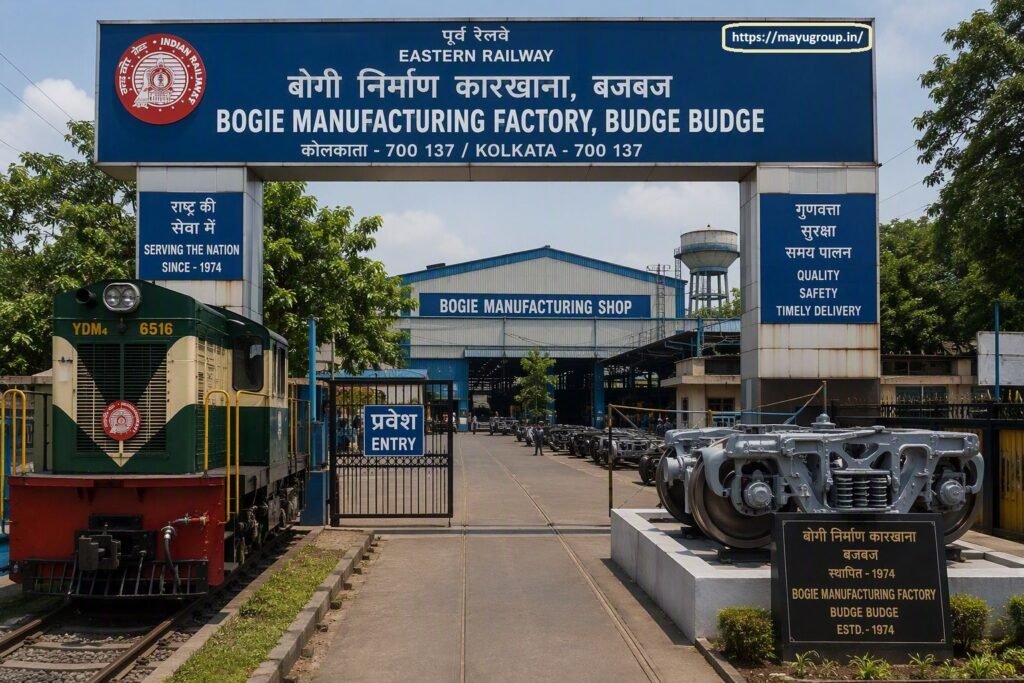
The development of modern railway transportation depends heavily on the reliability of the components that operate beneath and within every coach. Among these components, the bogie occupies a particularly important position. It connects the coach body with the wheel and axle arrangement and plays a central role in supporting the vehicle, absorbing dynamic forces, and contributing to safe and stable movement. For this reason, the manufacture of an LHB bogie frame is a highly responsible engineering activity requiring precision, consistency, and disciplined quality control.
Bogie Manufacturing Factory, Budge Budge, Eastern Railway, has its stated scope of work in the manufacturing of LHB bogie frames. This activity places the factory within an important part of the railway manufacturing ecosystem. The quality of a bogie frame cannot be considered independently from the overall performance of a railway coach. The frame must be capable of performing its structural function throughout demanding operating conditions while maintaining the required dimensional and manufacturing characteristics.
The adoption of LHB technology represented an important development in Indian passenger-coach manufacturing. LHB coaches are based on a modern design philosophy intended to provide improved riding characteristics and enhanced operational performance compared with older coach designs. The bogie arrangement is an essential part of this system. Consequently, the manufacture of LHB bogie frames requires a manufacturing environment where technical specifications are carefully understood and consistently implemented.
A bogie frame is not simply a metal structure assembled through welding. It is an engineered component produced through a sequence of interdependent operations. Materials must be properly received, identified, prepared, positioned, fabricated, welded, inspected, and finished. Dimensions and geometry must be controlled throughout the manufacturing cycle. Each stage creates conditions for the next stage, meaning that an error introduced early in production can become more difficult and expensive to correct later.
This makes process control particularly important. If components are not accurately positioned before welding, for example, subsequent operations may be affected. Similarly, variations in welding practices can influence the quality and appearance of fabricated joints. Inspection therefore needs to be integrated into the manufacturing process rather than regarded only as a final activity.
The importance of welding in bogie-frame manufacturing deserves special attention. Welding is one of the fundamental processes used to join structural components. It requires suitable equipment, qualified procedures, competent personnel, appropriate preparation, and effective inspection. A strong welding culture is therefore essential for achieving consistent manufacturing results.
Dimensional accuracy is another critical consideration. A bogie frame must conform to the relevant engineering requirements so that it can function correctly as part of the complete bogie assembly. Measurement and inspection systems therefore become essential tools for manufacturing control. Regular verification can identify deviations before they become larger problems.
The manufacture of such components also requires traceability. Materials, operations, inspections, corrections, and approvals need to be documented in an organised manner. Good documentation helps an organisation understand what was manufactured, how it was manufactured, what inspections were conducted, and how any deviations were addressed. It also supports accountability and provides valuable information for future improvement.
This is where systematic quality and process-improvement methods become valuable. The certification information supplied for the factory identifies ISO 13053-1:2011, issued in 2020 and valid through 2023. The standard is associated with quantitative approaches to process improvement and Six Sigma methodology. Such principles can be applied to manufacturing environments where reduction of variation and improvement of process performance are important objectives.
For the factory, the significance of adopting such an approach lies in moving beyond the simple identification of defects. A defect is an outcome; sustainable improvement requires understanding the process conditions that allowed the defect to occur. If a recurring problem appears in fabrication, for instance, an improvement-oriented organisation seeks to identify whether the underlying cause involves material preparation, tooling, alignment, equipment condition, work instructions, training, environmental conditions, or another factor.
This way of thinking can produce benefits beyond quality. When manufacturing processes become more stable, production planning becomes easier. Reduced rework can improve productivity. Better documentation can strengthen traceability. More consistent procedures can reduce dependence on individual practices. In this way, quality improvement becomes closely connected with organisational efficiency.
The human contribution remains central to all these activities. A well-designed manufacturing system still depends upon people who understand its requirements and follow them consistently. Engineers establish technical controls; supervisors coordinate work; skilled workers perform fabrication and welding; inspectors verify compliance; maintenance personnel keep equipment available; and management provides direction and resources.
Continuous training can strengthen these capabilities. Employees who understand not only what procedure must be followed but also why it is important are more likely to identify abnormalities and participate in improvement activities. Over time, this can create a strong internal culture in which employees actively contribute ideas for reducing waste, improving safety, increasing reliability, and preventing recurring defects.
The importance of LHB bogie frames also extends beyond the factory itself. Railway equipment operates as an interconnected system. The performance of a bogie depends upon the relationship between its frame, wheelsets, suspension components, braking arrangements, coach structure, and other assemblies. Therefore, reliable manufacturing at the component level contributes to the reliability of the larger railway system.
For Eastern Railway, maintaining dependable manufacturing and maintenance capabilities is particularly significant because railway operations require continuity and reliability. Every component must support the larger objective of safe and efficient transportation. A manufacturing facility such as Bogie Manufacturing Factory therefore performs a role that extends beyond its workshop boundaries.
The factory’s certification journey can be seen in this wider context. The achievement recorded in 2020 provided an opportunity to formalise and strengthen process-improvement practices at a facility responsible for an important railway component. The emphasis on measurement, process analysis, variation reduction, and continuous improvement was relevant to the challenges inherent in precision fabrication.
Ultimately, the importance of LHB bogie frames lies in their role as a foundation of modern railway coach performance. Their manufacture requires engineering knowledge, skilled workmanship, reliable equipment, accurate measurement, disciplined inspection, and a culture of quality.
Bogie Manufacturing Factory’s development is therefore not simply a story of producing a particular railway component. It is a story of building the capabilities necessary to produce that component consistently and responsibly. By strengthening manufacturing processes and embracing systematic improvement, the factory could contribute to a more reliable production environment and support the continuing modernisation of railway engineering.
The LHB bogie frame thus becomes more than a fabricated structure. It represents the combined effort of design, engineering, manufacturing, inspection, management, and workforce skill. The quality achieved at this level ultimately contributes to the performance of the railway system as a whole.
#BudgeBudge
Chapter 3 – The Road Toward Certification
The journey toward certification at Bogie Manufacturing Factory, Budge Budge, Eastern Railway, can be understood as an important stage in the organisation’s continuing development of manufacturing discipline and process improvement. In a specialised railway production environment, certification is not merely an administrative achievement. It represents the establishment of a structured approach to processes, responsibilities, measurement, documentation, corrective action, and continuous improvement.
The factory’s stated scope of work is the manufacturing of LHB bogie frames, an activity requiring careful control of fabrication, welding, dimensional accuracy, inspection, and supporting processes. The importance of these operations created a natural need for systematic methods capable of identifying process weaknesses and improving consistency. The certification information provided for the organisation records ISO 13053-1:2011, with an issue date of 2020 and validity through 2023. This milestone became an important reference point in the factory’s quality journey.
ISO 13053-1:2011 is associated with quantitative process-improvement methodology and the Six Sigma approach. Its underlying philosophy encourages organisations to understand processes through measurement and data, identify sources of variation, investigate root causes, and implement improvements systematically. Such principles are particularly relevant to manufacturing because variation can influence productivity, quality, rework, resource utilisation, and delivery performance.
Before any certification can become meaningful, an organisation must understand its own processes. Manufacturing a bogie frame involves many interconnected activities. Material has to be available in the required condition. Components need to be prepared and positioned correctly. Fabrication and welding must be performed according to applicable procedures. Dimensions and geometry require verification. Inspection findings must be recorded, and deviations must be addressed through appropriate corrective measures.
Each activity creates an opportunity either for quality to be strengthened or for variation to enter the process. A systematic certification approach encourages the organisation to examine these activities as parts of a complete process rather than treating them as isolated operations.
One of the most important changes associated with process improvement is the movement from reaction to prevention. In a purely reactive system, a problem is discovered after it has occurred and then corrected. A process-oriented system asks a deeper question: Why did the problem occur in the first place?
For example, if a dimensional deviation repeatedly appears during fabrication, simply correcting the affected component may not prevent the problem from returning. A systematic investigation may examine tooling, fixtures, component preparation, measurement practices, equipment condition, operator methods, work instructions, and other contributing factors. Once the underlying cause is understood, an appropriate corrective or preventive action can be introduced.
This approach can produce long-term benefits. Correcting the cause of a recurring problem can reduce rework and improve production stability. It can also reduce the amount of time spent responding to the same issue repeatedly. In this way, certification-related practices can contribute to both quality improvement and operational efficiency.
Documentation forms another important part of the certification journey. A manufacturing organisation needs reliable records to demonstrate that processes have been followed and that inspections have been completed. Documentation also provides historical information that can be used when investigating problems or evaluating improvement programmes.
For a railway manufacturing facility, traceability is particularly valuable. The ability to understand the manufacturing history of a component strengthens confidence in the production system. Records can also support communication between departments and help ensure that technical requirements are consistently understood.
Certification also requires attention to responsibilities. Quality cannot be the responsibility of the inspection department alone. The person performing an operation has an immediate influence on its quality. The supervisor has responsibility for ensuring that work is properly planned and controlled. Engineers may establish technical requirements and investigate process problems. Maintenance teams influence equipment reliability. Management provides resources and establishes priorities.
Consequently, certification can encourage a broader organisational understanding of quality. Every department becomes part of the process, and every employee can influence the final result.
Training is another essential element. Process-improvement systems depend upon people who understand the purpose of the methodology and know how to apply it. Employees may need awareness of quality objectives, process measurements, problem-solving techniques, documentation practices, inspection requirements, and corrective-action procedures.
The benefits of training extend beyond formal certification. When employees develop stronger problem-solving capabilities, they can become active participants in improving the manufacturing process. A worker who notices repeated variation in an operation may identify a practical cause that is not immediately visible through management-level analysis. Encouraging such participation helps an organisation capture valuable shop-floor knowledge.
The certification journey can also encourage the use of measurable performance indicators. Instead of evaluating improvement only through general impressions, an organisation can examine indicators such as rejection levels, rework, cycle time, equipment downtime, process deviations, inspection findings, or material utilisation. The exact measures may differ between operations, but the principle remains the same: improvement should be observable and, wherever possible, measurable.
For Bogie Manufacturing Factory, this approach could provide a structured basis for examining the manufacture of LHB bogie frames from beginning to end. Each major stage can be evaluated in terms of inputs, activities, outputs, risks, controls, and opportunities for improvement.
The certification achieved in 2020 therefore represented more than a formal milestone. It provided a framework through which the factory could strengthen its manufacturing culture. The validity period through 2023 also represented a period during which the organisation could continue applying and developing the practices associated with certification.
It is important to recognise that certification itself is not the end of improvement. A certificate may confirm that an organisation has established and implemented an appropriate system, but sustainable excellence depends upon what happens after certification. Processes must continue to be monitored. Problems must continue to be investigated. Employees must continue to learn. Procedures must be reviewed when circumstances change.
For this reason, the certification journey should be viewed as the beginning of a more disciplined phase rather than the conclusion of one. It established a foundation for continuous improvement and encouraged the organisation to connect manufacturing performance with measurable process behaviour.
For a railway manufacturing facility, this philosophy is particularly valuable. The objective is not merely to produce components but to produce them consistently, efficiently, and responsibly. Every improvement in manufacturing control has the potential to strengthen reliability, reduce avoidable waste, and support the larger railway system.
The road toward certification at Bogie Manufacturing Factory was therefore a journey of organisational learning. It brought greater attention to processes, data, variation, people, documentation, and preventive action. Most importantly, it reinforced the principle that quality should be designed into the manufacturing process itself.
The 2020 certification milestone can consequently be regarded as an important chapter in the factory’s development. It provided a structured foundation for process improvement and created an opportunity for the organisation to build a stronger culture of engineering excellence—one capable of supporting the demanding requirements of LHB bogie-frame manufacturing and the continuing evolution of Indian Railways.
#EasternRailway
Chapter 4 – The Role of Leadership, Management and Organisational Commitment
The growth of Bogie Manufacturing Factory, Budge Budge, Eastern Railway, cannot be understood only through machinery, production figures, or certification documents. Behind every successful manufacturing system are people who establish direction, organise resources, maintain discipline, solve problems, and ensure that technical requirements are translated into practical action. Leadership and organisational commitment therefore form one of the most important foundations of the factory’s development.
The manufacture of LHB bogie frames is a specialised engineering activity. It involves fabrication, welding, dimensional control, inspection, maintenance, material management, documentation, and coordination between different departments. Such a complex production environment cannot operate effectively when individual activities are managed in isolation. There must be a common understanding of objectives and responsibilities.
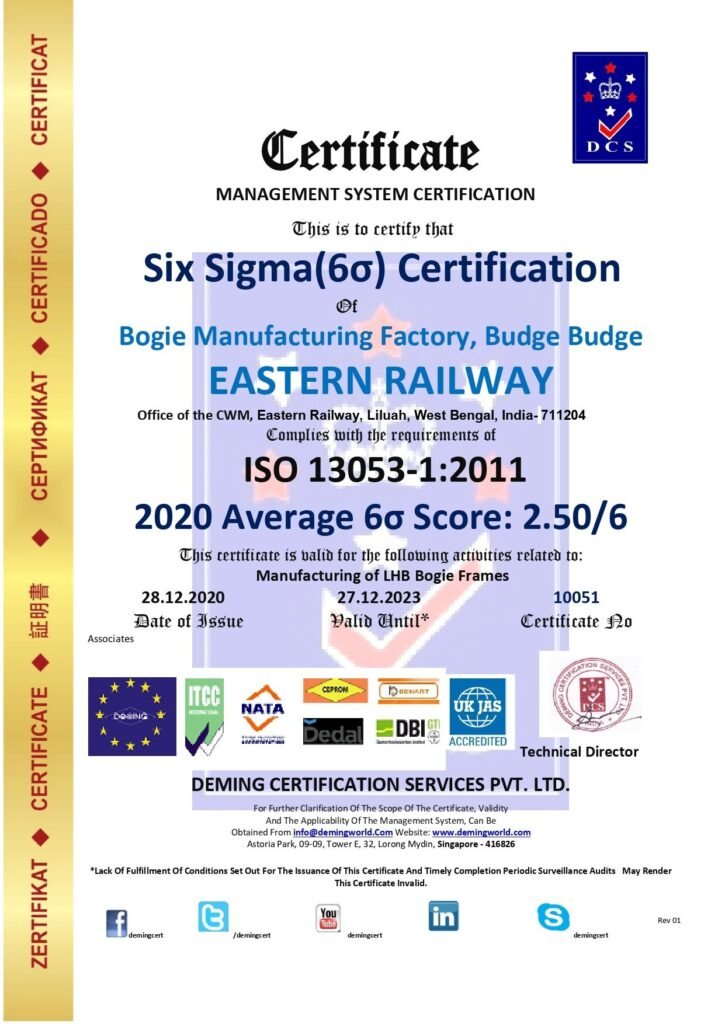
The certification information supplied for Bogie Manufacturing Factory records ISO 13053-1:2011, issued in 2020 and valid through 2023. The significance of this certification is closely connected with the role of management. A process-improvement methodology can succeed only when leadership provides the necessary support, resources, time, training, and authority for improvement activities.
Leadership in a manufacturing organisation begins with establishing a clear quality objective. Employees need to understand that production quantity and quality are not competing objectives. The real goal is to manufacture the required product correctly, efficiently, and consistently. If production targets are pursued without adequate process control, increased output may be accompanied by greater rework, defects, delays, or resource consumption. Strong management therefore seeks a balance in which productivity and quality reinforce each other.
An important responsibility of leadership is resource allocation. Manufacturing processes require suitable equipment, measuring instruments, maintenance support, materials, trained personnel, workplace facilities, and inspection capabilities. Even the best procedure cannot deliver reliable results if employees do not have the resources necessary to follow it.
Equipment reliability is particularly important in fabrication work. Machines, welding equipment, fixtures, measuring devices, lifting arrangements, and other tools must be maintained appropriately. Unexpected equipment problems can interrupt production schedules and introduce process variation. A management system that recognises preventive maintenance as part of quality improvement can help reduce such disruptions.
Management also plays a critical role in establishing accountability. Each employee should understand his or her responsibilities, authority, and expected contribution. Clear responsibilities reduce confusion and improve coordination. When a problem occurs, an organisation with clearly defined roles can respond more quickly and identify appropriate corrective action.
However, accountability should not become a culture of blame. Effective leadership recognises that recurring problems are often connected to processes rather than individual mistakes alone. If an operator repeatedly encounters difficulty with an operation, management should investigate whether the work instruction, equipment, training, tooling, material, or workplace conditions may also contribute to the problem.
This philosophy is particularly compatible with process-improvement thinking. The objective is to understand why a process produces an undesired result and then improve the process so that the problem becomes less likely to recur.
Communication is another essential responsibility. A manufacturing facility contains employees with different technical roles and levels of experience. Engineers may understand design and technical requirements, inspectors may focus on conformity, supervisors may manage production activities, and workers may possess detailed practical knowledge of shop-floor conditions. Effective communication allows these different forms of knowledge to come together.
Regular discussions, inspections, reviews, meetings, and documented feedback can help management understand operational realities. Employees should also have appropriate opportunities to report abnormalities and suggest improvements. When workers feel that their observations are valued, they are more likely to participate actively in continuous improvement.
The leadership role becomes even more important during organisational change. Certification and the introduction of systematic process-improvement practices can require employees to change familiar working habits. New documentation requirements, measurements, analysis methods, or review procedures may initially appear burdensome. Management must therefore explain the purpose of the changes and demonstrate how they support the factory’s larger objectives.
Training can help make this transition successful. Rather than simply instructing employees to follow a new procedure, leaders can explain the reasoning behind it. When people understand that a measurement is intended to detect variation or that a record is needed for traceability, compliance becomes more meaningful.
Leadership also has a role in recognising achievement. Quality improvement can involve many small contributions that may not immediately produce dramatic results. A worker who prevents repeated defects, a supervisor who improves workflow, an engineer who identifies a root cause, or a maintenance employee who prevents equipment failure can all contribute to organisational progress. Recognising these contributions helps establish a culture in which improvement becomes part of everyday work.
The role of management also extends to long-term planning. A factory must consider future requirements rather than focusing only on current production. Changes in railway technology, increasing quality expectations, new manufacturing techniques, workforce retirement, equipment ageing, and digitalisation can all influence future performance.
Long-term planning can therefore include investment in employee development, modern inspection methods, improved production monitoring, equipment renewal, data management, and process optimisation. Such planning helps the organisation remain capable of meeting changing demands.
Leadership is especially important in ensuring that certification remains meaningful after the certification period. The stated validity of the certification extended through 2023, but the principles of process improvement should not be limited to the life of a certificate. A mature organisation treats certification as a milestone within a continuing journey rather than as the final objective.
The deeper value of certification is the culture it can help establish. When management consistently asks whether processes are stable, whether variation is understood, whether defects are being prevented, and whether resources are being used effectively, employees begin to adopt the same mindset.
For Bogie Manufacturing Factory, organisational commitment can therefore become a major driver of growth. The factory’s performance depends on the interaction between technical systems and human decisions. Machinery provides capability, but people determine how effectively that capability is used.
The growth story following the 2020 certification milestone is consequently not simply a story of a standard being implemented. It is a story of leadership supporting a more systematic approach to manufacturing. It demonstrates the importance of management commitment in building quality awareness, strengthening teamwork, developing skills, improving processes, and preparing the organisation for future challenges.
Ultimately, strong leadership creates the conditions in which continuous improvement can become sustainable. When management provides direction, employees contribute knowledge, departments cooperate, and processes are measured and improved, the factory becomes more than a production facility. It becomes a learning organisation—one capable of identifying its weaknesses, building upon its strengths, and continually improving its contribution to railway engineering.
#IndianRailways
Chapter 5 – Building a Quality Culture
The growth of Bogie Manufacturing Factory, Budge Budge, Eastern Railway, after its certification milestone in 2020 can be understood most clearly through the development of a stronger quality culture. In a manufacturing organisation, quality is not created by inspection alone. It is created through the combined effect of people, processes, equipment, materials, technical knowledge, documentation, supervision, and management commitment. When these elements work together consistently, quality becomes part of the organisation’s daily behaviour rather than a separate activity.
For a factory engaged in the manufacturing of LHB bogie frames, this philosophy is particularly important. A bogie frame is a critical structural component, and its manufacturing involves several interconnected operations. The quality achieved in the final product depends upon the quality of every preceding operation. Consequently, building a quality culture means ensuring that each employee understands the importance of doing the work correctly at the appropriate stage.
The certification information provided for Bogie Manufacturing Factory identifies ISO 13053-1:2011, with an issue date of 2020 and validity through 2023. The standard’s association with quantitative process improvement and Six Sigma principles provides a useful framework for developing a culture based on measurement, variation reduction, analysis, and continuous improvement.
One of the most significant changes that a quality culture can introduce is the movement away from a purely inspection-based approach. Inspection remains essential, but it should not be the only defence against defects. If a defect is repeatedly created during production and discovered only during final inspection, the organisation is effectively spending resources correcting a process problem after it has already occurred.
A stronger culture asks employees to identify potential problems earlier. This means understanding the process, recognising important control points, monitoring critical characteristics, and responding to deviations before they become larger issues. Prevention becomes more valuable than repeated correction.
For example, if a recurring dimensional variation is discovered in fabricated bogie-frame components, the objective should not simply be to repair or reject the affected item. The organisation should investigate why the variation occurred. Possible causes may include incorrect positioning, fixture condition, measurement practices, equipment settings, material preparation, work instructions, or operator technique. By examining these factors systematically, the factory can identify a root cause and implement a lasting solution.
This approach also changes the role of employees. Instead of viewing quality as the exclusive responsibility of inspectors, every person becomes responsible for the quality of his or her work. A welder has responsibility for following the applicable procedure. A supervisor has responsibility for ensuring that work is correctly planned. An engineer has responsibility for resolving technical problems. A maintenance employee contributes by keeping equipment reliable. An inspector provides independent verification and valuable feedback.
Such shared responsibility can create a sense of ownership. Employees are more likely to take pride in their work when they understand how their individual contribution affects the final product.
Training is essential to developing this attitude. Employees must understand the importance of technical specifications, process controls, inspection requirements, safety practices, and documentation. Training can also introduce problem-solving methods that encourage employees to examine causes rather than symptoms.
A quality culture also depends upon communication. Manufacturing problems often cross departmental boundaries. A difficulty identified by an inspector may have originated in fabrication. A production delay may be connected with equipment maintenance. A material issue may affect several subsequent operations. If departments communicate effectively, problems can be addressed before they become more serious.
Documentation provides another important foundation. Manufacturing records help establish what work was performed, what inspections were conducted, and whether deviations occurred. Proper records can support traceability and provide evidence for analysis. Historical data can also reveal recurring patterns that may not be visible from individual incidents.
The use of data is especially relevant to the process-improvement philosophy associated with ISO 13053-1:2011. Decisions based on reliable information are generally more useful than decisions based solely on assumptions. By measuring process performance, an organisation can determine whether an improvement has actually produced the intended result.
For example, if a particular corrective action is introduced to reduce rework, the organisation can monitor rework levels over time. If the problem decreases consistently, the action may be considered effective. If it does not, further investigation may be necessary. This creates a cycle of improvement based on evidence.
A mature quality culture also encourages employees to report problems without fear of unfair blame. Reporting a deviation early provides an opportunity to correct it before it affects subsequent operations. If employees are discouraged from reporting problems, issues may remain hidden until they become more difficult and expensive to resolve.
Therefore, management must create an environment in which transparency is valued. The purpose of identifying a problem should be to improve the process, not simply to find someone to blame. This principle encourages learning and helps the organisation develop stronger systems.
Quality culture is also closely connected with workplace discipline. Standardised procedures are useful only when they are consistently followed. Tools, measuring equipment, materials, drawings, work instructions, and records need to be properly controlled. Orderly workplaces can make abnormalities easier to identify and reduce unnecessary movement or confusion.
Continuous improvement should also be encouraged through small, practical changes. Not every improvement requires major investment. Better arrangement of tools, clearer instructions, improved inspection points, more effective communication, or a minor modification to workflow may produce meaningful benefits. When many such improvements accumulate, the overall manufacturing system can become significantly stronger.
The period following certification therefore offered an opportunity for Bogie Manufacturing Factory to strengthen these behaviours. The certification itself provided a formal recognition of process discipline, but its lasting value depended upon whether the underlying principles became part of everyday work.
Building a quality culture is a gradual process. It requires repeated reinforcement from management, supervisors, technical personnel, and workers. It develops when employees see that quality objectives are taken seriously, improvement suggestions are considered, problems are investigated systematically, and successful practices are recognised.
For an organisation manufacturing LHB bogie frames, the result of such a culture can be substantial. Stable processes can reduce variation. Early detection can reduce rework. Better documentation can strengthen traceability. Employee participation can increase problem-solving capacity. Improved coordination can support production planning.
Most importantly, a quality culture creates a mindset in which every activity is connected to the final objective of reliable railway service.
The development of this culture can therefore be regarded as one of the most important outcomes of the factory’s certification journey. It transformed quality from a final checkpoint into a shared organisational value. Through discipline, measurement, training, communication, prevention, and continuous improvement, Bogie Manufacturing Factory could build a stronger foundation for sustainable manufacturing performance.
The true measure of certification is ultimately not the certificate itself, but the habits that remain after it is achieved. When quality becomes part of everyday thinking, every employee becomes a participant in improvement, and every manufacturing operation becomes an opportunity to strengthen the organisation.
#LHBBogie
Chapter 6 – Workforce Development, Skill Enhancement and Employee Participation
The development of Bogie Manufacturing Factory, Budge Budge, Eastern Railway, cannot be separated from the people who operate its manufacturing systems. Machines, equipment, technical standards, inspection methods, and quality procedures provide the framework for production, but skilled employees transform that framework into actual results. For a specialised manufacturing facility producing LHB bogie frames, workforce capability is therefore one of the most important factors influencing quality, productivity, safety, and long-term organisational growth.
The certification milestone recorded for the factory in 2020, based on the supplied information concerning ISO 13053-1:2011 and valid through 2023, provided an opportunity to strengthen not only processes but also employee capabilities. A quantitative process-improvement approach depends upon people who can understand processes, recognise variation, interpret information, identify causes of problems, and participate in corrective and preventive actions. Workforce development is consequently an essential part of any sustainable improvement programme.
Manufacturing an LHB bogie frame requires different categories of skills. Engineers need to understand technical requirements, manufacturing methods, dimensional controls, and process performance. Supervisors must coordinate work, allocate resources, monitor progress, and ensure adherence to procedures. Skilled fabrication and welding personnel must perform operations consistently. Inspection personnel must understand measurement and conformity requirements. Maintenance staff must keep equipment reliable. Administrative and support personnel contribute through planning, documentation, procurement, and coordination.
Each role is different, but all are connected to the final product.
One of the first requirements for workforce development is technical training. Employees need appropriate knowledge of the equipment, materials, tools, procedures, and safety requirements associated with their work. In welding and fabrication operations, for example, consistency depends on proper preparation, correct equipment use, appropriate working practices, and adherence to approved procedures.
Training also helps reduce dependence on informal or inconsistent methods. When employees are clearly trained and work instructions are properly communicated, processes become more repeatable. This is especially important in a manufacturing environment where small variations can accumulate and influence the final result.
Quality-related training is equally important. Employees should understand why inspection points exist and what can happen when a deviation is overlooked. If workers understand the relationship between an individual operation and the complete bogie-frame assembly, they are more likely to take ownership of the quality of their work.
The principles associated with process improvement also require employees to develop problem-solving skills. Traditional manufacturing approaches may sometimes focus on correcting an individual defective item. A more systematic approach asks why the defect occurred and whether the same cause could affect other products.
This change in thinking can be powerful. Suppose a recurring problem is observed in a fabrication operation. An employee trained in structured problem-solving can help identify possible causes, gather relevant information, compare actual conditions with expected conditions, and support corrective action. Instead of merely repairing the result, the team attempts to improve the process.
Employee participation is therefore a valuable source of organisational knowledge. People working directly on the shop floor often have detailed understanding of practical difficulties. They may notice equipment behaviour, workflow problems, material-handling issues, or procedural weaknesses that are not immediately visible from reports.
Management can encourage such participation by creating suitable channels for employees to communicate observations and improvement suggestions. Regular meetings, review discussions, suggestion systems, team-based problem solving, and informal technical interactions can all contribute.
A successful improvement culture does not require every suggestion to be implemented. Rather, employees should know that useful ideas will be considered fairly and that their participation is valued. Even when a suggestion cannot be adopted, explaining the reasons can strengthen trust and communication.
Another important aspect of workforce development is cross-functional understanding. Manufacturing activities are interconnected. Production employees need to understand the importance of inspection. Inspectors need awareness of manufacturing realities. Maintenance teams need to understand how equipment availability affects production. Engineers need to appreciate practical shop-floor constraints.
When departments understand one another’s responsibilities, communication improves and problems can be resolved more quickly.
Continuous learning is particularly important because manufacturing technology and railway requirements evolve over time. New equipment, improved inspection techniques, digital records, updated procedures, and changing technical expectations can create new learning requirements. An organisation that invests in continuous learning is better positioned to adapt to such changes.
The transfer of knowledge between experienced and newer employees is also valuable. Experienced personnel possess practical knowledge developed through years of work. Younger employees may bring familiarity with newer technologies, digital tools, and analytical methods. When these forms of knowledge are shared, the organisation can benefit from both experience and innovation.
Workforce development also contributes to safety. A well-trained employee is better prepared to recognise hazards, use equipment appropriately, follow established procedures, and respond to abnormal situations. In a manufacturing facility involving heavy components, welding, material handling, machinery, and inspection activities, safety awareness must remain an integral part of operational discipline.
The relationship between employee development and productivity is equally important. Skilled employees can often identify problems earlier, perform tasks more consistently, reduce unnecessary rework, and use equipment more effectively. Training therefore represents not merely an expense but an investment in organisational capability.
Measurement can help management evaluate whether workforce-development activities are producing results. Indicators may include training completion, competency assessments, recurring process deviations, rework levels, inspection findings, equipment-related problems, or employee participation in improvement activities. Such information can help identify areas requiring additional attention.
The certification period provided an opportunity to formalise this connection between people and process improvement. ISO 13053-1:2011 emphasises quantitative and systematic approaches, but quantitative tools are only effective when employees have the knowledge and discipline to use them appropriately. People remain at the centre of improvement.
For Bogie Manufacturing Factory, the development of a capable workforce can therefore become one of the strongest foundations for sustainable growth. As employees become more skilled, the organisation’s ability to maintain stable processes and respond to problems improves. As employees participate more actively, the organisation gains access to a wider range of practical knowledge. As communication improves, departments can work more effectively as a single system.
The journey after certification is consequently also a journey of human development. A certificate may establish a framework, but people give that framework life through their daily decisions and actions.
The future success of the factory will depend not only on how advanced its machinery becomes, but also on how effectively it develops its people. Technical competence, problem-solving ability, quality awareness, teamwork, safety consciousness, and willingness to learn will remain essential characteristics of a modern railway manufacturing workforce.
Ultimately, workforce development transforms an organisation from a collection of machines and procedures into a capable and learning institution. For Bogie Manufacturing Factory, investment in people can therefore support the larger goals of quality, productivity, reliability, and continuous improvement while strengthening its ability to contribute effectively to the manufacture and maintenance requirements of modern Indian Railways.
#RailwayManufacturing
Chapter 7 – Operational Improvement, Productivity and Process Control
The certification journey of Bogie Manufacturing Factory, Budge Budge, Eastern Railway, created an important foundation for examining manufacturing operations in a more systematic manner. Once quality and process improvement become organisational priorities, attention naturally turns toward the efficiency of everyday production. For a factory engaged in the manufacturing of LHB bogie frames, operational improvement is particularly important because production involves several interconnected stages, and the performance of one stage can influence the efficiency of all subsequent activities.
The certification information supplied for the factory records ISO 13053-1:2011, issued in 2020 and valid through 2023. The quantitative process-improvement philosophy associated with this standard provides a useful basis for understanding operational performance through measurement, analysis, reduction of variation, and continuous improvement.
Operational improvement begins with understanding the manufacturing process as a complete system. The production of an LHB bogie frame involves material preparation, component fabrication, positioning, welding, inspection, dimensional verification, finishing, documentation, and other supporting activities. Each stage has its own requirements, but none operates independently.
If material is not available at the required time, production may stop. If a component requires repeated correction, downstream activities may be delayed. If equipment is unavailable, planned work may be interrupted. If inspection identifies a problem late in the process, additional labour and time may be required for rectification. Consequently, improving one isolated activity may not always improve the overall system. The factory must consider the complete flow of work.
One important objective of process improvement is reducing unnecessary variation. Variation can arise from many sources, including equipment condition, materials, methods, measurement systems, working practices, environmental conditions, and human factors. Not all variation can be eliminated, but excessive or uncontrolled variation can create instability.
A stable process is easier to manage because its results are more predictable. When a process behaves consistently, production planning becomes more reliable, inspection becomes more effective, and recurring problems become easier to identify.
Data plays an important role in achieving this stability. Instead of relying solely on personal impressions, the organisation can monitor suitable indicators to understand how its processes are performing. Depending on the operation, these indicators may include rework, rejection, production cycle time, equipment downtime, inspection findings, material usage, or recurring process deviations.
The purpose of measurement is not simply to create reports. Data should support decisions. If a particular process repeatedly produces deviations, management can use available information to determine when and where the problem occurs. The organisation can then investigate potential causes and evaluate whether corrective action produces a measurable improvement.
Rework reduction is one area where operational improvement can have a direct impact. Rework consumes labour, equipment time, materials, and production capacity without creating additional finished output. Repeated rework can also disturb production schedules and create unnecessary pressure on employees.
Preventing rework is therefore generally more valuable than simply increasing the speed of correction. If a recurring defect is identified, the factory can investigate the underlying process conditions. A corrective action that eliminates the source of the problem can produce benefits across subsequent production cycles.
Material movement is another area where efficiency can be improved. Manufacturing facilities contain raw materials, fabricated components, tools, fixtures, equipment, inspection instruments, and finished assemblies. Unnecessary movement consumes time and can create additional handling risks. Better workplace organisation and workflow planning can reduce such inefficiencies.
Equipment utilisation is equally significant. Production equipment represents a major organisational resource. Unplanned downtime can affect production targets, while poor maintenance can gradually reduce equipment performance. Preventive maintenance, timely inspection, and proper operating practices can help improve equipment availability.
Process control also depends on accurate measurement. If measuring equipment is unsuitable, damaged, or poorly maintained, decisions based on its results may be unreliable. Therefore, measurement systems need appropriate control, verification, and maintenance. Reliable measurement provides confidence that the process is being evaluated against accurate information.
Another important aspect of operational improvement is standardisation. When the same task is performed differently by different individuals, process variation may increase. Clear work instructions and standard operating practices can reduce unnecessary differences while still allowing employees to report genuine difficulties and improvement opportunities.
Standardisation does not mean that workers should stop thinking. On the contrary, a stable standard provides a reference point from which improvement can be measured. If a new method produces better results, it can be evaluated, documented, and potentially adopted as the improved standard.
Communication between production and inspection departments is also important. Inspection findings can provide valuable information about process performance. Instead of viewing inspection as an activity that occurs after production, the organisation can use inspection data to improve upstream processes.
For example, if a particular dimensional deviation occurs repeatedly, the information should be communicated to the responsible manufacturing team. This allows the issue to be investigated before it becomes a persistent source of rework.
Operational improvement can also strengthen delivery performance. A process with fewer interruptions and less rework is more predictable. Predictability allows supervisors to plan manpower and equipment more effectively and helps the organisation respond to production requirements with greater confidence.
However, improvement must always be balanced with safety and quality. Increasing production speed at the expense of proper controls is not sustainable improvement. The objective should be to remove waste and unnecessary variation while preserving or strengthening the characteristics required for a reliable product.
The role of employees is once again central. Workers who understand the process can often identify practical opportunities for improvement. A minor change in tool arrangement, material handling, sequence, or communication may save time repeatedly. When such improvements are identified and evaluated systematically, small gains can accumulate into significant organisational benefits.
The period following the 2020 certification therefore provided a valuable framework for linking quality improvement with operational efficiency. The principles associated with quantitative process improvement encouraged the factory to examine performance through measurable evidence rather than assumptions.
For Bogie Manufacturing Factory, operational improvement can consequently be understood as a continuous process rather than a one-time project. Processes must be monitored, problems analysed, corrective actions evaluated, and successful improvements standardised.
The ultimate objective is to create a manufacturing system in which quality and productivity support one another. A reliable process reduces defects; reduced defects lower rework; lower rework improves productivity; improved productivity supports better utilisation of resources; and better process control strengthens confidence in the finished product.
The factory’s growth after certification can therefore be viewed not merely as an increase in manufacturing capability, but as an improvement in the way manufacturing is organised and controlled. By focusing on process stability, data, preventive action, equipment reliability, standardisation, workflow, and employee participation, the organisation can build a more efficient and dependable production environment.
In the manufacture of LHB bogie frames, where precision and reliability are essential, such operational discipline provides an important foundation for continued growth and long-term engineering excellence.
#ISO13053
Chapter 8 – Impact of Certification on Organisational Growth and Performance
The certification journey of Bogie Manufacturing Factory, Budge Budge, Eastern Railway, represents more than the achievement of a formal quality milestone. It can be viewed as an important stage in the broader development of the organisation’s manufacturing capabilities, process discipline, employee awareness, and approach to continuous improvement. For a facility engaged in the manufacturing of LHB bogie frames, these areas are closely connected because product reliability depends upon the stability and effectiveness of the processes used to manufacture each component.
According to the information supplied for this study, the factory received certification based on ISO 13053-1:2011 in 2020, with validity extending to 2023. The certification therefore provides an important reference point for examining how systematic process-improvement principles can contribute to organisational development.
One of the most significant effects of a structured certification programme is the creation of greater process awareness. Manufacturing activities that may previously have been considered routine can be examined more carefully in terms of inputs, methods, outputs, risks, measurements, and opportunities for improvement. This encourages the organisation to understand not only what it produces but also how effectively and consistently it produces it.
For Bogie Manufacturing Factory, this perspective is particularly relevant because LHB bogie-frame manufacturing involves multiple stages. Material preparation, fabrication, welding, alignment, dimensional verification, inspection, finishing, and documentation all contribute to the final product. If any stage performs inconsistently, the effects can extend to subsequent operations.
A process-oriented approach helps the organisation identify these relationships. Instead of viewing every defect or delay as an isolated incident, teams can investigate whether the problem indicates a wider process weakness. This creates an opportunity to make improvements that benefit future production rather than merely correcting one individual case.
Certification can also strengthen organisational discipline. Documented procedures, defined responsibilities, inspection requirements, records, and corrective actions provide a common framework for employees. Such a framework helps reduce uncertainty and promotes greater consistency between different shifts, teams, and operations.
Another important impact is the development of measurable performance. A mature improvement system encourages organisations to identify appropriate indicators and monitor them over time. For a manufacturing facility, these may include rework, rejection, process deviations, equipment availability, inspection findings, production cycle time, or other relevant measures.
The value of such measurement lies in its ability to support informed decisions. If a particular problem occurs repeatedly, historical data can help determine its frequency and identify possible patterns. If an improvement action is introduced, subsequent measurements can help determine whether the action has actually produced the desired result.
This creates a cycle of improvement: measure, analyse, improve, verify, and standardise.
The certification process can also influence the organisation’s approach to problem-solving. Traditional responses may focus on repairing the immediate problem. A process-improvement culture encourages a deeper examination of root causes. This shift can have a substantial effect on long-term performance.
Suppose repeated rework is associated with a particular manufacturing operation. Simply increasing final inspection may detect more problems, but it does not necessarily eliminate their causes. A root-cause investigation may identify issues involving equipment, tooling, material preparation, work methods, training, or process sequence. Addressing the actual cause can reduce the likelihood of recurrence.
Reduced rework can contribute directly to organisational growth. Rework consumes resources without increasing productive output. It occupies equipment, uses employee time, may consume additional materials, and can disrupt planned schedules. Therefore, preventing recurring defects can release capacity for productive manufacturing.
Certification can also improve communication between departments. In a complex manufacturing environment, quality problems frequently involve more than one function. Production, inspection, engineering, maintenance, stores, and planning may all have relevant information. A systematic process framework encourages greater coordination and clearer responsibility.
Improved communication can also strengthen decision-making. When information flows effectively from the shop floor to supervisory and management levels, problems can be addressed more quickly. Conversely, when employees receive clear feedback about decisions and improvement actions, they are more likely to understand organisational priorities.
The impact of certification extends to employee development as well. Process-improvement methodologies require employees to understand measurement, analysis, documentation, and corrective action. Training in these areas can expand the technical and problem-solving capabilities of the workforce.
Over time, this can create an organisational knowledge base. Employees learn from previous problems, successful corrective actions, and improvement projects. When lessons are properly documented and shared, the organisation becomes less dependent on individual memory and more capable of retaining institutional knowledge.
Another potential benefit is improved confidence among internal stakeholders. A systematic manufacturing process demonstrates that quality is being approached through defined methods rather than depending entirely upon individual judgement. This can strengthen confidence in the factory’s ability to manufacture its assigned products consistently.
The effect on productivity should also be recognised. Quality and productivity are sometimes treated as separate objectives, but a well-controlled process can support both. Reduced variation can reduce rework. Better workflow can reduce waiting time. Preventive maintenance can improve equipment availability. Clear procedures can reduce confusion. Effective training can improve employee performance.
Together, these improvements can contribute to greater operational efficiency.
However, certification should never be regarded as a guarantee of permanent improvement. Manufacturing environments change continuously. Equipment ages, personnel change, production requirements evolve, technologies develop, and new challenges emerge. Therefore, the organisation must continue to review and improve its processes even after receiving certification.
The stated validity period through 2023 highlights this point. The real achievement is not the existence of a certificate for a particular period, but the creation of a management and manufacturing culture capable of continuing improvement beyond that period.
For Bogie Manufacturing Factory, the certification journey can therefore be regarded as an important stage in organisational maturity. It encouraged attention to measurable processes, variation, root causes, employee capability, documentation, and continuous improvement. These elements collectively strengthen the foundation upon which future growth can be built.
Growth should not be measured only through physical production. It can also be reflected in greater process capability, improved workforce competence, stronger technical systems, reduced inefficiencies, better coordination, and increased confidence in manufacturing results.
The factory’s contribution to railway engineering depends upon all these factors. Reliable LHB bogie frames require reliable processes, and reliable processes require capable people and disciplined management.
The broader lesson from the certification experience is that organisational growth becomes more sustainable when improvement is embedded in everyday work. A certification programme can provide structure, but the lasting transformation comes when employees and management adopt continuous improvement as a normal way of operating.
In this sense, the 2020 certification milestone became part of a larger story of institutional development. It provided an opportunity for Bogie Manufacturing Factory to strengthen its processes, develop its workforce, improve operational control, and establish a stronger foundation for future performance.
The impact of certification, therefore, lies not only in formal recognition. Its deeper contribution is the creation of a mindset in which every process can be measured, every problem can be analysed, every improvement can be evaluated, and every employee can contribute to organisational excellence. This mindset can support the factory’s continuing role in the manufacture of important railway components and in the broader development of modern Indian railway engineering.
#SixSigma
Chapter 9 – Challenges, Lessons Learned and Future Opportunities
The development of Bogie Manufacturing Factory, Budge Budge, Eastern Railway, following its certification milestone represents an ongoing journey rather than a completed achievement. The certification information supplied for the organisation records ISO 13053-1:2011, issued in 2020 and valid through 2023, with the stated scope of work being the manufacturing of LHB bogie frames. While certification can establish a structured framework for process improvement, the long-term success of an organisation depends upon its ability to respond to changing requirements, overcome operational challenges, retain knowledge, and continuously develop its capabilities.
Manufacturing environments are rarely static. Equipment becomes older, technology changes, employee experience evolves, materials and suppliers may change, and production requirements can increase or become more demanding. At the same time, railway engineering continues to place strong emphasis on safety, reliability, quality, maintainability, and efficiency. These conditions require an organisation to remain adaptable.
One of the most important challenges is maintaining process consistency. In a complex manufacturing environment, variation can enter a process through many sources. Equipment condition, material characteristics, tooling, measurement methods, operator practices, environmental conditions, and work instructions can all influence results. Complete elimination of variation may not always be practical, but identifying and controlling significant sources of variation is essential.
The principles associated with ISO 13053-1:2011 provide a useful approach to this challenge because they encourage quantitative analysis and systematic improvement. Instead of relying entirely on assumptions, the organisation can use data to understand process performance. This can help identify recurring problems and distinguish isolated incidents from systematic weaknesses.
Another challenge is preventing the loss of organisational knowledge. Experienced employees accumulate practical knowledge through years of manufacturing work. Their understanding of equipment behaviour, fabrication practices, inspection difficulties, and problem-solving can be extremely valuable. However, if such knowledge remains only in individual experience, it can be lost when employees retire, transfer, or change responsibilities.
Knowledge management is therefore an important future opportunity. Successful corrective actions, process improvements, technical lessons, training materials, and operating experience can be documented and shared. This allows the organisation to convert individual experience into institutional knowledge.
Workforce development will remain equally important. New employees require training, while experienced employees need opportunities to update their skills. Modern manufacturing increasingly involves digital systems, data analysis, advanced inspection, automation, and improved production-monitoring methods. Developing workforce capability in these areas can help the factory adapt to future requirements.
Technology provides another significant opportunity. Digitalisation can improve the way production and quality information is collected, stored, analysed, and communicated. Electronic records can potentially reduce manual documentation, improve accessibility, and make historical information easier to analyse.
Data collected over time can also support predictive decision-making. If recurring patterns are identified in equipment downtime, process deviations, or rework, management may be able to intervene before the problem becomes more serious. The goal is to move gradually from reactive management toward preventive and predictive improvement.
Equipment modernisation can similarly contribute to future performance. Manufacturing capability depends upon the condition and suitability of machinery, fixtures, measuring equipment, lifting systems, and supporting infrastructure. Regular assessment of equipment capability can help identify where renewal, modification, or improved maintenance may be beneficial.
Preventive maintenance is particularly important. Equipment failures can interrupt production schedules and create additional pressure on employees. A systematic maintenance programme can help identify developing problems before unexpected failure occurs. It can also support greater equipment availability and more predictable production.
Another challenge concerns material management. Manufacturing quality depends partly upon receiving suitable materials in the required condition and maintaining proper identification and control. Efficient material planning can also reduce production interruptions. Better coordination between procurement, stores, planning, and production can therefore contribute to both quality and productivity.
Inspection systems will also continue to play an important role. As manufacturing expectations become more demanding, inspection techniques must remain capable of detecting relevant deviations. The future may provide opportunities to use increasingly advanced measurement and non-destructive inspection technologies, subject to applicable technical requirements and organisational capabilities.
However, technological improvement must always be accompanied by process discipline. New equipment alone cannot solve organisational problems. If procedures are unclear, employees are inadequately trained, or data is not properly interpreted, technology may fail to deliver its potential benefits. Future development therefore needs to combine technology with people and management systems.
One of the most important lessons from the certification journey is that improvement should be continuous. Certification should not be treated as the conclusion of quality development. The principles established during the certification period should continue to influence everyday operations.
Another lesson is the importance of root-cause analysis. Repeatedly correcting the same problem consumes resources and does not create sustainable improvement. Organisations become stronger when they investigate why problems occur and modify processes to reduce the likelihood of recurrence.
A further lesson is that quality and productivity should be considered together. A high-quality product manufactured through an inefficient process may not represent the best possible performance. Similarly, high production output achieved with excessive rework or unstable processes is not sustainable. The ideal situation is a controlled process that produces the required quality efficiently.
Employee participation is another important lesson. Improvement ideas do not come only from management or engineering departments. Workers involved directly in manufacturing often understand practical difficulties in greater detail. Creating opportunities for their participation can reveal valuable improvement opportunities.
The future growth of Bogie Manufacturing Factory can therefore be based on several interconnected priorities: stronger process control, continuous employee development, improved data management, equipment reliability, effective preventive maintenance, digitalisation, knowledge retention, and systematic problem-solving.
The organisation can also strengthen its culture of review. Every improvement project should ideally answer three questions: What was the problem? What action was taken? Did the action produce the expected result? This final question is particularly important because an action should not be considered successful merely because it was implemented. Its effectiveness should be evaluated.
The challenges facing the factory should therefore be regarded as opportunities for learning. A manufacturing organisation that can identify its weaknesses and respond constructively becomes more resilient. Each problem can provide information about the process, and each improvement can increase organisational capability.
The certification period from 2020 to 2023, as provided in the project information, can consequently be regarded as one stage in this continuing journey. Its lasting significance depends on how effectively the principles of measurement, analysis, variation reduction, and continuous improvement are carried forward.
The future of railway manufacturing will demand increasing levels of precision, reliability, efficiency, and technical capability. Bogie Manufacturing Factory can prepare for these demands by combining the strengths developed through experience with new approaches to technology, data, training, and process management.
Ultimately, the most important lesson is that growth is sustainable when an organisation continuously learns. Machines can be upgraded, procedures can be revised, and technologies can be introduced, but the ability to learn from experience remains one of the greatest organisational strengths.
For Bogie Manufacturing Factory, the journey after certification therefore provides a foundation for the future. By maintaining a strong quality culture, developing its workforce, embracing appropriate technology, and treating every challenge as an opportunity for improvement, the organisation can continue strengthening its contribution to modern railway manufacturing.
#QualityManagement
Chapter 10 – A Continuing Journey of Excellence and Future Growth
The story of Bogie Manufacturing Factory, Budge Budge, Eastern Railway, is ultimately a story of engineering responsibility, organisational development, quality consciousness, and continuous improvement. Its stated scope of work—the manufacturing of LHB bogie frames—places the factory within an important area of railway engineering, where precision, reliability, process discipline, and skilled workmanship are essential.
The certification information provided for the organisation identifies ISO 13053-1:2011, with an issue date of 2020 and validity through 2023. This certification milestone provides an important point from which to understand the factory’s development. More importantly, it provides an opportunity to consider how a structured approach to process improvement can contribute to long-term organisational excellence.
The journey began with the fundamental responsibility of manufacturing a critical railway component. An LHB bogie frame is not an ordinary fabricated structure. It forms an important part of a railway bogie and must satisfy demanding requirements relating to structural integrity, dimensional accuracy, fabrication quality, welding, inspection, and consistency.
Because the finished product is part of a larger railway system, the manufacturing process must be controlled carefully. Quality cannot be added at the end of production through inspection alone. It must be developed throughout the entire process.
This principle lies at the heart of the factory’s quality journey.
The certification milestone created a structured opportunity to examine processes more systematically. The quantitative process-improvement philosophy associated with ISO 13053-1:2011 encourages organisations to understand variation, use data, investigate causes, and implement improvements. For a manufacturing facility, these principles can help transform individual experiences into measurable organisational knowledge.
One of the most important achievements of such a journey is the development of a quality culture. When quality becomes part of everyday work, employees begin to consider the consequences of their actions beyond the immediate operation. A welder understands the importance of consistent workmanship. An inspector understands that inspection results provide information about the manufacturing process. A maintenance employee recognises the connection between equipment condition and product quality. A supervisor understands the importance of process discipline and communication.
In this way, quality becomes a shared responsibility.
The role of leadership is equally important. Management must provide direction, resources, training, equipment, and encouragement. Certification cannot produce sustainable improvement if it remains isolated from management decisions and daily manufacturing activities.
Strong leadership creates an environment in which employees can identify problems, propose improvements, and participate in solving operational challenges. It also ensures that corrective actions are followed through and that successful improvements become part of standard practice.
The development of the workforce represents another major part of the factory’s continuing journey. Railway manufacturing requires technical knowledge and practical experience. As technologies evolve, employees must continue learning. Training in manufacturing methods, inspection, quality systems, problem-solving, safety, digital tools, and equipment operation can strengthen organisational capability.
Experienced employees also provide an important source of institutional knowledge. Their practical understanding of manufacturing processes can be preserved through documentation, mentoring, and knowledge-sharing programmes. Combining this experience with new technical approaches can create a strong foundation for future development.
Operational improvement provides another path toward growth. A high-performing manufacturing system should seek to reduce unnecessary variation, prevent defects, minimise rework, improve equipment availability, optimise material movement, and make better use of available resources.
The principles of continuous improvement encourage the factory to examine even familiar processes with fresh attention. A process that works today may still have opportunities for improvement tomorrow. Changes in technology, production requirements, workforce capabilities, or equipment condition may create new challenges and new opportunities.
Data can play an increasingly important role in this future. Digital records and systematic performance measurement can help the organisation understand trends and identify recurring problems. Information relating to rework, inspection findings, equipment downtime, production performance, and process deviations can support evidence-based decision-making.
The future may also provide opportunities for greater digitalisation of manufacturing and quality systems. Electronic documentation, digital measurement, automated data collection, improved traceability, and analytical tools can potentially strengthen process visibility. However, technology should support rather than replace sound engineering judgement and employee competence.
Equipment reliability will remain another essential consideration. Manufacturing performance depends upon the availability and capability of machines, welding equipment, fixtures, measuring instruments, lifting arrangements, and other supporting resources. Preventive maintenance and planned modernisation can help reduce unexpected interruptions and support stable production.
The organisation’s future growth should therefore be viewed in a broad sense. Growth is not limited to increased production volume. It also includes improved process capability, greater employee competence, stronger documentation, better problem-solving, reduced inefficiency, improved equipment reliability, and greater organisational resilience.
One of the most important lessons from the certification journey is that certification should never be treated as the final destination. The supplied validity period ended in 2023, but the principles of quality and continuous improvement remain relevant beyond any individual certificate period. The real value of certification is the discipline and learning that it encourages.
An organisation that continuously measures its processes, studies problems, implements corrective actions, and learns from experience can continue improving regardless of changes in external circumstances.
For Bogie Manufacturing Factory, the future can therefore be built upon the foundations of engineering knowledge and manufacturing experience developed over time. The factory’s role within Eastern Railway provides an important institutional context, while its focus on LHB bogie-frame manufacturing gives its work a clear technical purpose.
The next stage of development can be guided by several enduring principles: quality first, safety always, people at the centre, data for decision-making, technology with purpose, and continuous improvement without interruption.
These principles are interconnected. Safety depends upon reliable processes. Quality depends upon competent people and controlled operations. Productivity improves when variation and rework are reduced. Technology becomes valuable when employees know how to use it effectively. Continuous improvement connects all these elements into a single organisational philosophy.
The story of Bogie Manufacturing Factory therefore does not end with certification. The certification milestone of 2020 should instead be regarded as one important chapter in a much longer story. The real measure of success lies in what the organisation learns, how it applies that learning, and how effectively it carries the principles of improvement into future operations.
As railway technology continues to develop, manufacturing facilities must also evolve. The requirements of modern railway transportation demand reliable components, disciplined processes, skilled personnel, efficient resource utilisation, and strong quality systems. Organisations capable of meeting these expectations will remain valuable contributors to the future of railway engineering.
Bogie Manufacturing Factory has the opportunity to continue that journey by building upon its experience, strengthening its workforce, improving its processes, adopting appropriate technologies, and maintaining a culture of responsibility.
In the final analysis, the story is about much more than a certificate or a manufacturing facility. It is about people working together to create reliable engineering products for an essential national transportation system. Every correctly fabricated component, every successfully completed inspection, every prevented defect, every improvement idea, and every lesson learned contributes to the larger objective.
The journey toward excellence is never truly complete. There is always another process to improve, another skill to develop, another problem to understand, and another opportunity to make the organisation stronger.
For Bogie Manufacturing Factory, this continuing commitment to improvement can remain the most important foundation for sustainable growth and a lasting contribution to the future of Indian Railways.
#ContinuousImprovement
#BogieFrameManufacturing #BudgeBudgeRailway #RailwayEngineering #LHBCoachTechnology #RailwayComponentQuality
Take the Next Step Today
Don’t wait to enhance your business’s quality and efficiency. Partner with Mayu Group India and experience the transformation that comes with expert consultancy and training. Contact us today to learn more about how we can help you achieve your business goals. Reach out via phone at +91-9322728183, visit our website at www.mayugroup.in, or email us at investor@mayugroup.in Let us be your guide on the journey to excellence and innovation.