
Bankura Railway Station
- Bankura Railway Station
- Chapter 1: The Beginning of a New Journey at Bankura Railway Station
- Chapter 2: Recognising the Need for Change
- Chapter 3: The ISO 14001:2015 Certification Journey
- Chapter 4: Creating a Cleaner and More Hygienic Railway Station
- Chapter 5: Building a Green and Environmentally Responsible Station
- Chapter 6: The People Behind the Transformation
- Chapter 7: Improving the Passenger Experience
- Chapter 8: From Certification to Organisational Growth
- Chapter 9: Wider Impact on the Community and Railway Environment
- Chapter 10: A Continuing Journey Toward Sustainable Excellence
- Take the Next Step Today

Chapter 1: The Beginning of a New Journey at Bankura Railway Station
Bankura Railway Station stands as an important gateway to the Bankura region of West Bengal. Located under the Adra Division of South Eastern Railway, the station connects people, communities, businesses and destinations through one of the most important modes of public transportation in India. Every day, passengers arrive at and depart from the station for different purposes—work, education, business, family visits, tourism and many other personal journeys. For many travellers, the railway station is not simply a place where a train stops; it is the first and last impression they receive of the city.
Because of this important role, maintaining a railway station requires much more than operating trains efficiently. A modern station must also provide a clean, hygienic, safe and environmentally responsible environment. Passengers expect clean platforms, properly maintained sanitation facilities, organised waiting areas and surroundings that reflect care and responsibility. Meeting these expectations became an important part of the development journey of Bankura Railway Station.
The scope of work associated with the station was focused on providing passenger amenities in a clean and green environment and maintaining sanitation throughout the railway station premises. This objective brought together two closely connected responsibilities: passenger service and environmental management.
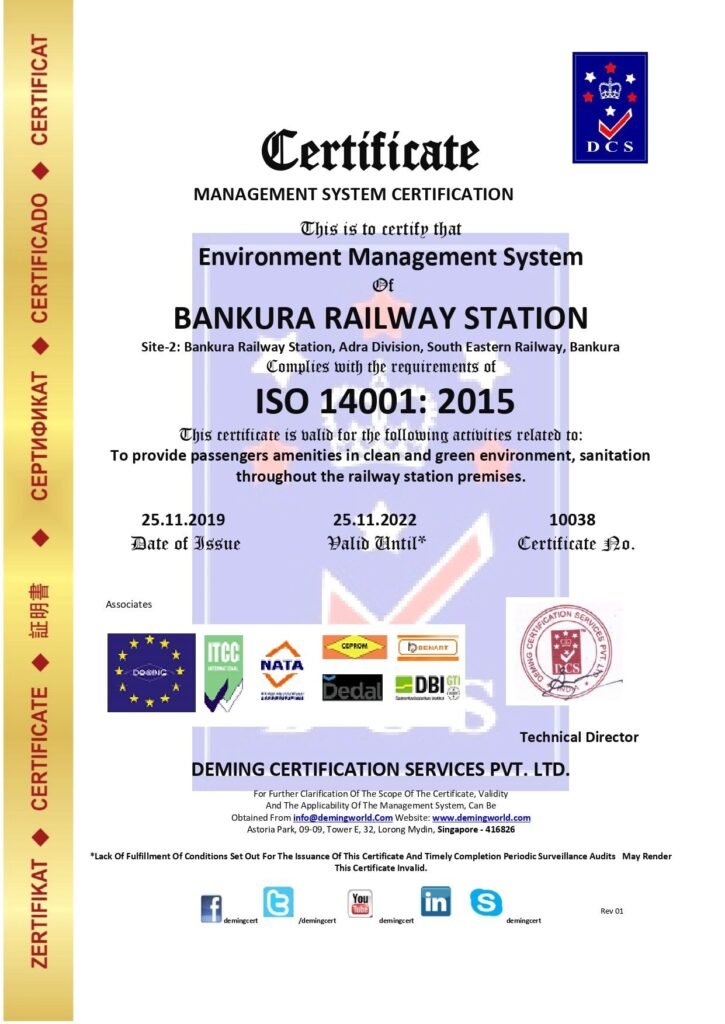
The journey toward systematic environmental management gained an important milestone in 2019, when the station received ISO 14001:2015 certification, according to the certification details provided for this case study. The certification was valid through 2022. ISO 14001:2015 is an internationally recognised framework for environmental management systems. Its basic philosophy is that environmental responsibilities should be managed systematically rather than treated as occasional activities.
For a busy railway station, this approach is particularly significant. A station is a constantly changing environment. Trains arrive and depart, passengers move across platforms, vendors operate, employees perform their duties and cleaning activities take place throughout the day. Such continuous activity naturally creates environmental challenges. Waste can accumulate quickly, sanitation facilities require regular maintenance, and public areas need frequent cleaning.
Therefore, maintaining cleanliness cannot depend on a single cleaning operation. It requires planning, supervision, awareness, resources and continuous monitoring.
The introduction of an environmental management approach helped establish a more organised way of looking at these responsibilities. Cleanliness could be connected with defined processes and responsibilities. Sanitation could be treated as an essential part of passenger service. Environmental concerns could be incorporated into routine station management.
This was important because the real success of environmental certification is not the certificate hanging on a wall. The real success is the change in working culture that takes place behind the certificate.
At Bankura Railway Station, the emphasis on a clean and green environment reflected a broader understanding of public infrastructure. A railway station belongs to everyone who uses it. Railway employees have the responsibility to maintain it, but passengers also have an important role in protecting it. A clean platform remains clean only when people understand the importance of responsible behaviour.
Consequently, environmental awareness can become a shared responsibility. Proper disposal of waste, respect for sanitation facilities, avoidance of littering and cooperation with railway cleanliness initiatives can all contribute to a better station environment.
The role of sanitation workers is equally important. Behind every clean platform and passenger area is a workforce that performs essential tasks every day. Their work may often go unnoticed, but it directly affects passenger comfort and public health. A systematic environmental management approach gives greater importance to these activities by connecting daily cleaning and sanitation work with larger organisational objectives.
The clean and green concept also has an important psychological impact. A well-maintained station creates an impression of order and professionalism. When passengers see clean surroundings, properly managed facilities and environmentally responsible practices, they develop greater confidence in the organisation providing the service.
For Bankura, this has an additional significance. The station is part of the identity of the region. People arriving by train may form their first impression of Bankura from what they see around the station. A clean and welcoming railway environment therefore contributes not only to passenger satisfaction but also to the image of the locality.
The certification journey beginning in 2019 can consequently be viewed as an important chapter in the station’s development. It represented an effort to bring environmental considerations into the everyday management of railway premises.
The story of Bankura Railway Station is therefore not merely a story about obtaining an ISO certificate. It is a story about recognising that cleanliness, sanitation, greenery and passenger amenities are essential elements of quality public service.
The certification provided a structured foundation, but people and processes gave that foundation meaning. Every cleaned platform, every maintained sanitation facility, every responsibly managed waste area and every effort to improve the surroundings contributed to the larger objective.
The journey toward a cleaner and greener Bankura Railway Station began with a simple idea: a railway station should not only take passengers from one destination to another; it should also provide them with a safe, clean, comfortable and dignified environment throughout their journey.
#BankuraRailwayStation
Chapter 2: Recognising the Need for Change
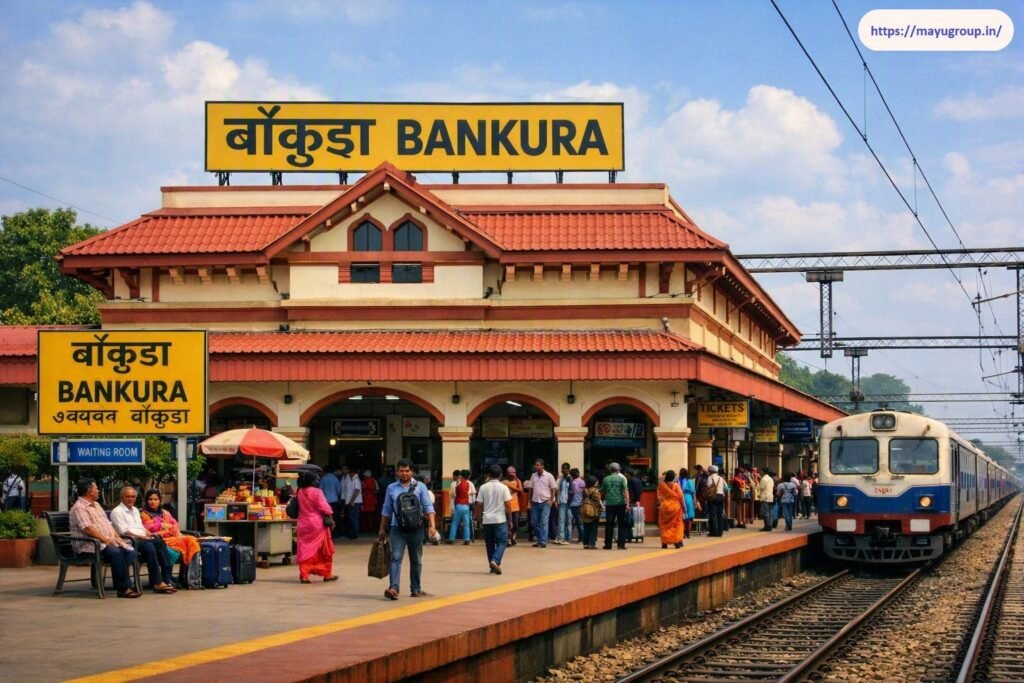
Every successful transformation begins with the recognition that existing practices can be improved. For Bankura Railway Station, the journey toward a more systematic environmental management approach was rooted in an important understanding: cleanliness and sanitation at a railway station cannot be treated as occasional activities. They must become continuous, organised and measurable responsibilities.
A railway station is one of the busiest public spaces in any city. Unlike a private building, it remains active throughout the day as passengers arrive, depart, wait for trains, purchase refreshments, use facilities and move between platforms. The constant movement of people creates a continuous requirement for cleaning and sanitation. Waste can be generated within a short period, while dust, food packaging, paper, plastic and other materials can affect the appearance of the premises if they are not managed properly.
Bankura Railway Station therefore faced the same fundamental challenge experienced by many busy public transport facilities: how to maintain a consistently clean and hygienic environment despite continuous passenger movement.
The answer could not simply be “clean more often.” A sustainable solution required a management system in which responsibilities were understood, activities were planned and environmental performance was considered as part of everyday operations.
This was the importance of developing a systematic approach.
The stated scope of work for Bankura Railway Station was “to provide passengers amenities in clean and green environment, sanitation throughout the railway station premises.” This scope placed the passenger at the centre of environmental management. Cleanliness was not merely an administrative requirement. It was directly connected to passenger comfort, dignity and satisfaction.
A passenger entering a railway station immediately notices its surroundings. Clean platforms, organised passenger areas and properly maintained sanitation facilities can create a positive impression. Conversely, unclean surroundings can create discomfort and dissatisfaction even when train services themselves are operating efficiently.
Recognising this connection encouraged a broader understanding of station management. Environmental performance and passenger service were not two separate subjects. They were interconnected.
The need for change also involved the way employees viewed their responsibilities. Cleaning and sanitation are sometimes seen as routine tasks that are repeated every day. However, when viewed through an environmental management framework, these activities become part of a larger system.
Employees need to understand what is expected, when activities should take place, how problems should be reported and how corrective actions should be implemented. Supervisors need to monitor performance. Management needs to ensure that appropriate resources and processes are available.
Such an approach helps reduce dependence on individual effort and creates greater consistency.
Another important area was waste management. A railway station naturally generates different forms of waste through passenger activity, station operations and commercial activities. Effective environmental management requires attention to how waste is collected, handled, stored and removed. The objective is not simply to remove visible waste but to establish responsible practices throughout the process.
Sanitation represented another major priority. Passenger facilities must be maintained regularly because they are used by large numbers of people. Clean sanitation facilities contribute to passenger confidence and support a healthier public environment.
The emphasis on a green environment added another dimension to the station’s improvement journey. Green management involves more than planting trees or maintaining decorative areas. It represents an overall attitude toward reducing environmental impact, protecting public spaces and using resources responsibly.
For a railway station, this can include attention to cleanliness, greenery, responsible waste practices, efficient use of resources and environmental awareness among employees and passengers.
The decision to adopt ISO 14001:2015 provided a framework through which these objectives could be managed more systematically. The certification details supplied for this case study indicate that certification was issued in 2019 and was valid until 2022.
The significance of ISO certification was therefore not limited to recognition. It encouraged the station’s environmental responsibilities to be viewed through a structured management system.
This shift in thinking was important. Instead of asking only, “Is the station clean today?” the organisation could consider broader questions: Are cleaning activities properly planned? Are environmental responsibilities clearly assigned? Are sanitation conditions monitored? Are environmental problems identified and corrected? Can existing practices be improved?
These questions encourage continuous improvement.
The transformation also depended upon awareness among passengers. Railway authorities can provide facilities and maintain premises, but public cooperation is equally important. Littering, careless disposal of waste and misuse of sanitation facilities can quickly undermine cleaning efforts.
Therefore, environmental improvement requires both infrastructure and behaviour.
The station environment can itself influence behaviour. When passengers see that a public space is carefully maintained, they may become more conscious of their own responsibility. Clean surroundings communicate a message that the space is valued and should be respected.
In this way, the need for change was not simply about making Bankura Railway Station look better. It was about developing a culture of environmental responsibility.
The certification journey beginning in 2019 represented a step toward that culture. It encouraged the integration of environmental considerations into station operations and helped establish a stronger relationship between cleanliness, sanitation, passenger amenities and organisational responsibility.
The lesson from this chapter is clear: real improvement begins when cleanliness is no longer considered merely a cleaning task, but becomes a shared organisational objective.
For Bankura Railway Station, recognising this need created the foundation for the next stage—the implementation of a more structured environmental management system and the journey toward ISO 14001:2015 certification.
#ISO14001
Chapter 3: The ISO 14001:2015 Certification Journey
The journey of Bankura Railway Station toward environmental improvement reached an important milestone with the adoption of ISO 14001:2015. According to the certification information provided for this case study, the certification was issued in 2019 and remained valid until 2022. For the station, this was more than an administrative achievement. It represented a structured commitment to environmental responsibility, sanitation and the creation of a cleaner and greener passenger environment.
ISO 14001:2015 is an international standard for an Environmental Management System, commonly known as an EMS. Its purpose is to help organisations manage their environmental responsibilities in a systematic manner. Rather than treating environmental protection as a separate activity, the standard encourages organisations to incorporate environmental considerations into their regular operations.
For a railway station, such an approach is particularly relevant.
A station is a complex public environment. It contains platforms, passenger areas, sanitation facilities, offices, circulation spaces and other operational areas. At the same time, thousands of people may pass through these spaces. The resulting pressure on cleanliness, waste management, sanitation and resources requires organised systems.
The certification journey encouraged a change in perspective. Environmental management was no longer simply about responding to visible problems. It was about identifying responsibilities, establishing appropriate practices, monitoring performance and seeking continuous improvement.
One of the important principles associated with ISO 14001 is understanding the environmental aspects of an organisation’s activities. In a railway environment, this can include waste generation, sanitation, resource consumption, cleanliness, maintenance activities and other operational factors that may have an environmental impact.
Recognising these aspects helps an organisation determine where attention is required.
For Bankura Railway Station, the stated scope of work focused specifically on providing passenger amenities in a clean and green environment and maintaining sanitation throughout the railway station premises. This gave the environmental management effort a clear practical direction.
The certification process also encouraged greater clarity regarding responsibilities. Environmental management cannot succeed if responsibility is unclear. Different people contribute to station cleanliness and environmental performance, including station officials, maintenance teams, sanitation workers, supervisors and other supporting personnel.
A structured management system helps bring these different responsibilities together.
Training and awareness are also essential components of such a system. Employees need to understand why environmental procedures matter and how their daily activities contribute to the overall performance of the station. A person responsible for cleaning a platform, for example, is contributing not only to appearance but also to passenger comfort, hygiene and environmental quality.
This understanding can increase the importance attached to routine work.
Documentation and monitoring are additional features of systematic management. When activities are documented and monitored, it becomes easier to identify recurring problems and determine where improvements are required. Instead of depending entirely on memory or informal instructions, the organisation develops a more consistent method of working.
The certification process therefore encouraged discipline.
However, ISO certification should not be misunderstood as a guarantee that environmental problems will never occur. A certification provides a framework for managing environmental responsibilities. The real value comes from implementing the system consistently and improving it over time.
For Bankura Railway Station, the 2019 certification can therefore be viewed as the beginning of an important phase rather than the end of a project.
The certification also had significance from the perspective of passenger confidence. When a public facility demonstrates commitment to recognised environmental management practices, it can strengthen perceptions of professionalism and responsibility. Passengers may not see every management process behind the scenes, but they experience the results through cleaner surroundings, maintained sanitation facilities and improved organisation.
The relationship between certification and passenger experience is therefore indirect but meaningful.
A railway station is also an important part of the identity of a town. Bankura receives visitors for many reasons, including education, employment, business, family activities and tourism. The railway station may provide the first impression of the region to a visitor arriving by train.
A clean and well-managed station can contribute positively to that impression.
The environmental management journey also created an opportunity to promote shared responsibility. Employees could support environmental objectives through their daily work, while passengers could contribute by using waste facilities correctly and keeping public areas clean.
This creates a cycle in which management practices and public behaviour reinforce each other.
The period from 2019 to 2022, therefore, represents an important chapter in the environmental management story of Bankura Railway Station. The certification gave the station a recognised framework through which cleanliness, sanitation and environmental responsibilities could be approached more systematically.
Its significance lies not only in obtaining ISO recognition but in the organisational thinking associated with it: identify environmental responsibilities, establish appropriate processes, involve people, monitor performance and pursue continual improvement.
The journey demonstrates that environmental management in a railway station is ultimately about people. A system becomes successful when employees understand it, managers support it and passengers benefit from it.
Bankura Railway Station’s ISO 14001:2015 journey can consequently be seen as an important step toward creating a stronger culture of cleanliness and environmental responsibility.
The certificate had a defined period of validity, but the principles behind it have a much longer life. Certification may have a date, but the commitment to a clean, green and hygienic railway environment must continue every day.
#EnvironmentalManagement
Chapter 4: Creating a Cleaner and More Hygienic Railway Station
The true value of an environmental management system is visible in the way an organisation performs its everyday responsibilities. At Bankura Railway Station, the objective of creating a clean and green environment was closely connected with the practical task of maintaining sanitation throughout the station premises. With the adoption of ISO 14001:2015 in 2019, cleanliness could increasingly be viewed as a systematic responsibility rather than an occasional activity.
A railway station presents a unique cleanliness challenge. Passenger movement is continuous, and the condition of public areas can change rapidly. A platform that is clean in the morning may require attention several times during the day. Waiting areas, entrances, stairways, circulating spaces and sanitation facilities are similarly exposed to continuous use.
Therefore, maintaining cleanliness requires regularity.
The first principle was to ensure that cleaning became part of planned station operations. Instead of waiting for visible accumulation of waste, regular cleaning and inspection activities could be incorporated into daily routines. This approach helps create a more consistent standard across different parts of the station.
The role of sanitation personnel was central to this effort. Cleaning workers are the people who directly transform management objectives into visible results. Their work includes maintaining public areas, removing accumulated waste and supporting hygienic conditions in passenger facilities.
Their contribution is especially important in a busy public environment because cleanliness cannot be achieved through infrastructure alone.
Supervision also plays an important role. A systematic approach requires someone to ensure that expected standards are being maintained. When problems are identified, corrective action can be taken rather than allowing the condition to continue.
This creates an important cycle: clean, inspect, identify, correct and improve.
Waste management forms another important part of station cleanliness. Railway passengers generate different kinds of waste, including food packaging, paper, bottles and other discarded materials. If waste is not handled properly, it can affect the appearance of the station and create sanitation concerns.
A responsible environmental management approach therefore considers the entire waste-handling process. Waste needs to be collected regularly and removed appropriately. Passenger awareness also becomes important because the best waste management system can be weakened when people throw rubbish in unsuitable places.
Visible waste bins and clear communication can support better behaviour. When passengers are provided with convenient facilities and understand the importance of using them, the burden on cleaning teams can be reduced.
Sanitation facilities deserve particular attention. Railway toilets and other passenger amenities are among the most frequently used facilities in a station. Their cleanliness directly influences passenger perception of the entire railway environment.
A passenger may forgive a temporary delay, but an unhygienic sanitation facility can create a strong negative impression. Maintaining such facilities therefore becomes an important part of passenger service.
The concept of cleanliness also extends beyond removing waste. A truly clean station should provide an environment that feels organised, cared for and welcoming. Platforms should be free from unnecessary accumulation of rubbish, passenger areas should be maintained properly, and the overall premises should reflect a sense of order.
This is where environmental management and passenger satisfaction meet.
The clean environment initiative also encouraged a shift in organisational culture. When cleanliness becomes a recognised responsibility, every employee can contribute. Station staff can identify problems, supervisors can ensure corrective action and sanitation workers can maintain public areas.
Passengers, too, become part of the system.
Public awareness is essential because railway stations are shared spaces. A passenger who disposes of waste correctly contributes to the cleanliness of the station. A passenger who avoids damaging facilities helps preserve the infrastructure for others.
The result is a shared environmental responsibility.
Another important aspect is consistency. A station cannot be considered environmentally successful because it is cleaned only before inspections or special occasions. The standard must be maintained throughout normal operations.
This is one of the reasons why an environmental management framework is valuable. It encourages organisations to develop systems rather than depend entirely on individual enthusiasm.
For Bankura Railway Station, the ISO 14001:2015 journey provided an opportunity to connect everyday cleaning activities with broader environmental objectives. The focus on sanitation throughout the railway premises supported the central purpose of providing passengers with a cleaner and more comfortable environment.
The station’s environmental development was therefore not simply a visual transformation. It represented a change in the way cleanliness could be understood and managed.
A clean platform can appear to be a simple achievement, but behind that appearance lies a chain of activities: planning, manpower, cleaning materials, supervision, waste handling, inspection and passenger cooperation. Each part contributes to the final result.
The experience also demonstrates that environmental improvement is a continuous process. Even after a station reaches a good standard, new challenges appear every day. Passenger numbers change, weather conditions affect cleanliness, facilities require maintenance and waste patterns vary.
Continuous improvement is therefore essential.
The certification period beginning in 2019 gave Bankura Railway Station an opportunity to strengthen this approach. The goal was not simply to obtain recognition but to establish a culture in which cleanliness and sanitation were treated as permanent priorities.
Ultimately, a railway station is judged by the experience it provides to its passengers. Clean platforms, hygienic facilities and well-maintained public areas communicate respect for the travelling public.
For Bankura Railway Station, the effort to create a cleaner environment was therefore an investment in both environmental responsibility and passenger dignity.
The central lesson of this chapter is simple: cleanliness is not a single activity performed by a cleaning team; it is a continuous management process supported by employees, infrastructure, supervision and public participation.
#CleanAndGreenStation
Chapter 5: Building a Green and Environmentally Responsible Station
The vision for Bankura Railway Station was not limited to maintaining clean platforms and sanitation facilities. The broader objective was to provide passengers with a clean and green environment. This idea introduced an important environmental dimension to station management. Cleanliness addressed the immediate condition of the premises, while the concept of a green environment encouraged a longer-term approach to responsible resource use, environmental awareness and the protection of public spaces.
The adoption of ISO 14001:2015 in 2019 provided a framework for looking at these responsibilities systematically. According to the certification information supplied for this case study, the certification remained valid through 2022. During this period, environmental management could be connected with the everyday activities of the railway station.
A green railway station begins with the understanding that environmental responsibility is not limited to planting trees. Green management is a combination of many practices. It can involve maintaining greenery, reducing unnecessary waste, using resources responsibly, keeping public areas clean and encouraging employees and passengers to develop environmentally conscious habits.
For a busy station such as Bankura, these principles are particularly relevant.
Railway stations are high-use public spaces. Electricity, water, cleaning materials and other resources are required to keep operations functioning. Passenger activity also produces waste and places continuous pressure on public facilities. Environmental management therefore requires a balance between providing good passenger services and minimising unnecessary environmental impacts.
One of the most visible elements of a green environment is greenery itself. Plants and landscaped areas can improve the appearance of a station and create a more pleasant atmosphere for passengers. Green spaces can also contribute to the overall visual identity of a railway station.
For Bankura, environmental consciousness has a natural connection with the character of the surrounding region. The station forms part of a city and district known for its distinctive landscape, cultural heritage and connection with nature. A railway station that reflects environmental responsibility can therefore complement the identity of the area.
However, greenery must be supported by maintenance. Plants require care, watering and protection. A neglected green area can quickly lose its value. Consequently, the principle of continuous management applies to greenery just as it applies to sanitation.
Waste reduction is another important part of environmental responsibility. The most effective waste is often waste that is never unnecessarily generated. Encouraging responsible consumption, reducing careless disposal and ensuring appropriate collection can help create a cleaner environment.
Passenger awareness is essential in this process.
A railway station is shared by thousands of people, and no cleaning system can be successful without public cooperation. When passengers understand that throwing waste on platforms or in circulation areas damages the environment, they can become partners in maintaining cleanliness.
Simple actions can make a difference. Using designated waste bins, avoiding littering, respecting sanitation facilities and protecting greenery are all examples of responsible passenger behaviour.
Communication can support these actions. Signboards, notices and awareness campaigns can remind passengers that environmental protection is a shared responsibility. Such messages are especially valuable in busy public facilities because they reach people from different backgrounds and communities.
Employees also have an important role in creating an environmental culture. Their daily behaviour can influence passengers. When railway personnel follow environmental practices consistently, they demonstrate that cleanliness and resource responsibility are organisational values rather than temporary campaigns.
The ISO 14001 framework reinforces this idea by encouraging awareness and continual improvement. An organisation should not assume that reaching one environmental target means the work is finished. Conditions change, new challenges arise and better practices become available.
Therefore, environmental management must remain dynamic.
The green environment initiative can also contribute to passenger comfort. A station that is clean, orderly and visually pleasant can reduce the stress associated with travelling. Railway journeys can involve waiting, crowds, luggage and uncertainty. A well-maintained environment provides passengers with a greater sense of comfort and order.
This is particularly important for families, senior citizens, children and passengers travelling long distances.
Environmental responsibility can also strengthen the public image of an organisation. When a railway station demonstrates care for its surroundings, it sends a message about professionalism and accountability. Passengers may not understand every technical requirement of ISO 14001:2015, but they can recognise the practical results of good environmental management.
The certification therefore becomes meaningful when its principles are visible in everyday station life.
Another important lesson is that environmental improvement does not always require dramatic changes. Small improvements, when consistently implemented, can have a significant cumulative effect. Better waste practices, regular maintenance, improved awareness and attention to cleanliness can gradually change the character of a public space.
This is the essence of continuous improvement.
For Bankura Railway Station, the move toward a clean and green environment can therefore be understood as a long-term commitment rather than a one-time project. The ISO certification period provided a structured opportunity to strengthen environmental awareness and integrate it into station management.
The ultimate objective was simple but significant: passengers should be able to enter the station and experience an environment that is clean, hygienic, organised and welcoming.
A green station is not merely a station with plants. It is a station where people understand the value of the environment and where everyday operations are conducted with responsibility.
The Bankura experience demonstrates that environmental management can become part of passenger service itself. When cleanliness, greenery, sanitation and responsible behaviour come together, the railway station becomes more than a transportation facility—it becomes a model of responsible public infrastructure.
The journey toward a green Bankura Railway Station therefore represents an important principle: protecting the environment and improving passenger experience can be achieved together when environmental responsibility becomes part of everyday management.
#IndianRailways
Chapter 6: The People Behind the Transformation
Policies, procedures, certificates and standards provide direction, but it is the people working within an organisation who turn those principles into daily practice. At Bankura Railway Station, the journey toward a cleaner, greener and more hygienic environment depended on the combined efforts of railway personnel, sanitation workers, supervisors, maintenance teams and passengers.
The ISO 14001:2015 certification obtained in 2019, as specified for this case study, provided a structured framework for environmental management. However, certification itself could not clean a platform, maintain a sanitation facility or prevent littering. Those results required human effort and continued commitment.
The first group at the centre of this transformation was the sanitation workforce. Cleaning railway premises is demanding work. Platforms and passenger areas must be attended to repeatedly because thousands of people may use them throughout the day. Waste can appear immediately after a cleaning activity, making consistency essential.
The contribution of sanitation workers therefore goes far beyond physical cleaning. Their work supports public hygiene, passenger comfort and the overall image of the station.
A systematic environmental management approach can help give this work greater recognition and structure. Cleaning activities need to be planned, responsibilities need to be understood and performance needs to be monitored. When employees know what is expected and why their work matters, routine activities can become part of a larger organisational objective.
Supervisors also play an important role.
A good management system requires observation and follow-up. Supervisors can identify areas requiring additional attention, communicate problems and ensure that corrective actions are taken. Their role is especially important in a railway environment because conditions can change quickly.
For example, a platform may become crowded after a train arrives. Food waste, paper and packaging may accumulate within minutes. A sanitation team must respond appropriately, while supervisors need to ensure that the expected standard is restored.
This demonstrates why environmental management is a continuous process.
Station officials also have a broader responsibility. They help coordinate activities, support environmental objectives and ensure that passenger amenities are maintained. Their decisions can influence the availability of resources, the organisation of work and the effectiveness of environmental practices.
The certification process encouraged greater attention to these responsibilities.
Training and awareness are particularly important. Employees may perform their assigned duties every day, but environmental management asks them to understand the wider impact of those duties.
A person responsible for collecting waste is contributing to environmental protection. A worker maintaining a sanitation facility is supporting public health. An employee reporting a maintenance problem is helping prevent a small issue from becoming a larger one.
When people understand these connections, environmental management becomes part of organisational culture.
Communication among employees is equally important. A station operates through teamwork. Cleaning, maintenance, passenger service and administration cannot function independently. If one part of the system fails, the effect may be visible to passengers.
For this reason, environmental responsibility should be shared across different levels of the organisation.
Passengers themselves form another important part of the environmental system. A railway station is a public facility, and its condition depends partly on how people use it. Even the most efficient sanitation team cannot maintain a clean environment if passengers continually throw waste in unsuitable places or misuse facilities.
Passenger awareness can therefore multiply the effectiveness of railway management.
A passenger who uses a waste bin correctly reduces the amount of litter that needs to be collected. A passenger who respects sanitation facilities helps preserve them for other travellers. A passenger who protects greenery contributes to the appearance of the station.
These may seem like small actions, but thousands of passengers making responsible choices can create a substantial difference.
Awareness also helps create a positive relationship between passengers and railway employees. Instead of viewing cleanliness as the sole responsibility of railway workers, passengers can understand that they are partners in maintaining the environment.
This shared responsibility is one of the strongest foundations of sustainable cleanliness.
The people behind the transformation also include contractors and supporting service personnel wherever such responsibilities are assigned. Environmental standards must be communicated throughout the operational chain so that everyone understands the required level of performance.
A management system becomes stronger when expectations are clear and responsibilities are coordinated.
The certification period from 2019 to 2022 also represented an opportunity to strengthen this organisational culture. The objective was not simply to pass an assessment but to develop habits that could continue beyond individual inspections or certification dates.
This distinction is important.
A temporary campaign can create impressive results for a short period. A culture creates results every day.
For Bankura Railway Station, the environmental journey was therefore fundamentally a human journey. Every clean platform reflected someone’s effort. Every maintained sanitation facility reflected someone’s responsibility. Every correctly disposed piece of waste reflected a passenger’s cooperation.
The visible cleanliness of the station was the final result of many small actions taking place behind the scenes.
Leadership also has an important role in sustaining this culture. When management gives importance to environmental performance, employees are more likely to recognise it as a genuine organisational priority. When good performance is appreciated and problems are addressed constructively, employees can become more engaged with improvement.
The journey can then develop into a cycle of learning: identify a problem, understand its cause, take corrective action and improve the process.
This approach is consistent with the broader philosophy of environmental management systems, where continual improvement is central.
The experience of Bankura Railway Station demonstrates that certification is ultimately about people. ISO 14001:2015 can provide the framework, but employees and passengers provide the energy required to make that framework work.
The greatest achievement is therefore not simply having a certificate. It is creating a culture where people believe that a clean and green station is everyone’s responsibility.
The story of the people behind Bankura’s environmental transformation can be summarised in one principle: when management provides direction, employees provide commitment and passengers provide cooperation, environmental improvement becomes a shared achievement.
#RailwayCleanliness
Chapter 7: Improving the Passenger Experience
The ultimate purpose of any railway station is to serve passengers. Trains may be the centre of railway operations, but the quality of the passenger experience depends on many other factors: cleanliness, sanitation, accessibility, comfort, organisation and the condition of public facilities. For Bankura Railway Station, the effort to create a clean and green environment was therefore closely connected with the goal of improving the everyday experience of travellers.
The ISO 14001:2015 certification issued in 2019, as specified for this case study, provided an environmental management framework that supported this objective. The certification was valid through 2022. During this period, environmental management could be viewed not simply as an internal responsibility but as a service directly experienced by passengers.
A passenger’s experience begins before boarding a train. It begins when they enter the station premises.
The first impression can be powerful. Clean surroundings, orderly passenger areas and properly maintained facilities communicate a sense of organisation. A passenger arriving at Bankura Railway Station may be travelling for business, education, employment, family reasons or tourism. Regardless of the purpose of travel, the passenger expects a basic level of dignity and comfort.
Cleanliness contributes significantly to that expectation.
A railway platform is a constantly changing environment. Passengers arrive with luggage, families wait for trains, vendors and railway personnel carry out their duties, and trains bring new groups of travellers at regular intervals. These activities create continuous pressure on station facilities.
Maintaining a clean environment under such conditions requires regular effort.
The value of sanitation is particularly important. Sanitation facilities are among the most essential amenities in any public transport facility. Passengers may spend considerable time at a station, particularly when waiting for connecting services or delayed trains. Clean and usable facilities can make that experience significantly more comfortable.
For families with children, older passengers and people travelling long distances, the availability and condition of sanitation facilities can be especially important.
The scope of work at Bankura Railway Station specifically included maintaining sanitation throughout the station premises. This demonstrates that sanitation was not considered a secondary activity. It formed part of the overall passenger-service objective.
A clean environment also contributes to a passenger’s perception of safety and order. While cleanliness alone cannot guarantee safety, well-maintained surroundings can make a public place feel more organised and cared for.
The passenger experience is also influenced by the appearance of the station. A clean and green environment can provide visual relief from the busy nature of railway travel. Greenery, maintained surroundings and organised public spaces can create a more welcoming atmosphere.
This is where environmental management becomes part of customer service.
Passengers may never read an ISO 14001 procedure or understand the technical requirements of an Environmental Management System. They experience the system indirectly through its results. They see whether waste is lying on the platform. They notice whether sanitation facilities are maintained. They observe whether public spaces appear clean and orderly.
In this sense, the passenger becomes the final observer of environmental performance.
The relationship works in both directions. Passenger behaviour also affects the environment. A railway station can provide waste bins and cleaning services, but passengers need to use these facilities responsibly.
Responsible passenger behaviour can reduce litter, protect infrastructure and make cleaning activities more effective.
Therefore, improving passenger experience requires a partnership between the railway administration and the travelling public.
Awareness is an important part of this partnership. Simple messages encouraging passengers not to litter, to use designated waste facilities and to protect public property can reinforce the environmental objectives of the station.
When such messages are combined with visible cleanliness, they become more convincing. People are more likely to respect an environment that is already well maintained.
Another important element is consistency. Passengers do not visit the station only during special events or inspections. They experience it on ordinary days. Therefore, environmental standards must be maintained as part of normal operations.
The real test of a clean-station initiative is not whether the station looks good on one particular day. It is whether passengers can consistently experience acceptable conditions throughout the year.
This is why systematic management is important.
The ISO 14001:2015 framework encourages organisations to monitor their environmental processes and pursue continual improvement. Applied to a railway station, this philosophy supports a cycle in which problems are identified, actions are taken and practices are improved.
Such a cycle can have a positive effect on passenger satisfaction.
A clean station can also contribute to the reputation of the surrounding city. Bankura Railway Station serves as an important arrival and departure point for the region. Visitors may form an early impression of Bankura from the station environment.
A well-maintained station can therefore contribute to a welcoming image of the locality.
For regular passengers, improvements can have an even greater effect. People who use the station frequently notice changes over time. When cleanliness improves and facilities are maintained consistently, passengers may develop greater confidence in the station.
This confidence is an important form of organisational value.
The story of Bankura Railway Station demonstrates that environmental management should never be separated from passenger service. Cleanliness is passenger service. Sanitation is passenger service. A pleasant environment is passenger service.
The environmental certification journey helped reinforce this connection.
The 2019–2022 certification period can therefore be understood as a period in which environmental responsibility and passenger experience became increasingly connected within the station’s management philosophy.
The objective was ultimately straightforward: when passengers enter Bankura Railway Station, they should feel that the public space has been maintained for them.
A clean platform tells passengers that their comfort matters. A hygienic sanitation facility tells them that their dignity matters. A green and orderly environment tells them that environmental responsibility matters.
The lasting lesson is clear: the success of a railway station’s environmental management system is ultimately measured not only by procedures and certificates, but by the quality of the experience it creates for the people who use it every day.
#SustainableRailways
Chapter 8: From Certification to Organisational Growth
The achievement of ISO 14001:2015 certification at Bankura Railway Station represented an important milestone in its environmental management journey. According to the certification details provided for this case study, the certification was issued in 2019 and was valid until 2022. However, the significance of certification cannot be measured simply by the presence of a certificate. Its greater value lies in how the principles of environmental management can influence organisational discipline, service quality and long-term development.
For a railway station, growth has a broader meaning than financial expansion. Bankura Railway Station is a public-service facility, and its development should be understood through improvements in passenger experience, environmental performance, operational discipline, cleanliness, sanitation and public confidence.
ISO 14001:2015 provided a structured framework for achieving these improvements.
Before discussing growth, it is important to understand the difference between certification and transformation. Certification is formal recognition that an organisation’s environmental management system meets the applicable requirements of the standard at the time of assessment. Transformation is the ongoing process of changing attitudes, systems and practices.
For Bankura Railway Station, certification could provide the foundation, but continued effort was necessary to convert that foundation into lasting improvement.
One of the most important effects of a structured environmental management system is greater organisational discipline. Environmental responsibilities become part of planned activities rather than being handled only when problems become visible.
For example, cleanliness can be approached through regular schedules and monitoring. Sanitation can be treated as a continuous operational responsibility. Waste management can be considered as a process rather than simply the removal of rubbish. Environmental concerns can become part of routine decision-making.
This type of discipline can improve the overall functioning of an organisation.
Another area of organisational growth is accountability. When responsibilities are clearly defined, employees and supervisors have a better understanding of their roles. Problems can be reported more effectively, corrective actions can be identified and management can review performance.
Accountability does not mean placing blame. Its purpose is to ensure that environmental objectives are not forgotten amid the many other demands of railway operations.
The certification journey also encourages a culture of continual improvement. A good environmental management system does not assume that existing practices are perfect. Instead, it encourages organisations to examine what is working, identify weaknesses and consider better methods.
This approach can be especially valuable in a railway station because passenger volumes, operational requirements and environmental challenges can change over time.
Growth can also be seen in employee awareness. When workers understand the connection between their duties and environmental objectives, routine activities acquire greater importance.
A sanitation worker is not simply cleaning a floor. That person is contributing to hygiene and passenger comfort.
A supervisor checking a public area is not simply completing an inspection. The supervisor is helping maintain an environmental standard.
A station employee identifying a waste-management problem is not simply reporting a fault. The employee is helping prevent a recurring environmental issue.
When these connections become part of organisational thinking, the quality of work can improve.
Passenger confidence is another form of organisational growth. A well-maintained station creates a positive perception among travellers. Passengers may associate clean surroundings and orderly facilities with professionalism and responsible management.
This confidence can contribute to the reputation of the railway station and the wider railway organisation.
The station also represents the city and region it serves. Visitors arriving in Bankura may encounter the railway station before experiencing other parts of the locality. A clean and welcoming station can therefore contribute positively to the public image of the area.
Environmental certification can support this image by demonstrating a formal commitment to environmental management.
However, it is important not to claim that ISO certification alone automatically creates growth. Organisational improvement results from many factors, including management commitment, employee participation, resources, infrastructure, passenger behaviour and continuous monitoring.
Certification is one component of this larger process.
The period from 2019 to 2022 can therefore be viewed as an important phase in the development of environmental awareness and management discipline at Bankura Railway Station. The certification created a framework within which cleanliness and sanitation could be linked more closely with environmental responsibility.
This connection can also influence future planning.
When environmental concerns become part of organisational culture, future improvements can be evaluated not only for their immediate operational benefit but also for their environmental consequences. Decisions about facilities, maintenance, waste handling and passenger amenities can be considered from a broader perspective.
Such thinking supports sustainable development.
The concept of growth also includes learning. Every environmental problem provides an opportunity to understand what went wrong and how the system can be strengthened. If waste accumulates in a particular area, management can examine why. If sanitation facilities require additional attention at certain times, schedules can be reviewed. If passengers repeatedly misuse a facility, awareness measures can be improved.
This creates a learning organisation.
A learning organisation does not simply repeat the same process. It observes, evaluates and adapts.
This is one of the most valuable principles that can emerge from an environmental management journey.
For Bankura Railway Station, the ISO 14001:2015 certification was therefore a milestone in organisational development. It encouraged a more systematic approach to environmental responsibility and provided a basis for connecting station cleanliness with wider goals of passenger service and institutional improvement.
The story also demonstrates that public infrastructure can grow without growth being defined solely by revenue or physical expansion. A station becomes better when its people work more effectively, its public spaces become cleaner, its sanitation improves, its environmental responsibilities are understood and its passengers experience greater comfort.
These are meaningful forms of growth.
The most important challenge, however, is continuity. Certification had a defined validity period, but environmental responsibility cannot have an expiry date. The principles developed during the certification period need to remain relevant beyond 2022.
The journey therefore continues.
The experience of Bankura Railway Station demonstrates that certification can be a catalyst for organisational development when it is supported by genuine implementation. A certificate can recognise achievement, but continuous improvement creates lasting value.
The central lesson of this chapter is: true organisational growth occurs when environmental responsibility becomes part of everyday management, employee culture and passenger service—not merely a requirement associated with certification.
#SanitationAndHygiene
Chapter 9: Wider Impact on the Community and Railway Environment
The transformation of Bankura Railway Station through a stronger focus on cleanliness, sanitation and environmental responsibility has significance beyond the station itself. A railway station is a public institution that connects people and communities. Its condition influences passengers, employees, visitors, businesses and the wider image of the area it serves.
The ISO 14001:2015 certification issued in 2019, according to the certification information provided for this case study, represented an important milestone in this journey. The certification was valid through 2022. While the certification itself applied to the environmental management system, its broader significance can be understood through the culture of environmental responsibility that such a system encourages.
A railway station is one of the most visible forms of public infrastructure in a city. People may visit a railway station for only a few minutes or remain there for several hours, but during that period they directly experience the condition of the premises.
A clean station communicates a message.
It tells passengers that public spaces deserve care. It demonstrates that sanitation is important. It shows that environmental responsibility can be incorporated into everyday operations.
These messages can influence behaviour.
When passengers see clean platforms and properly maintained public spaces, they may become more conscious about keeping those spaces clean. Responsible behaviour can gradually become normal behaviour.
This is particularly important because cleanliness at a railway station is a shared responsibility. Railway authorities provide facilities and cleaning services, but passengers determine how those facilities are used.
The impact therefore extends beyond the work of sanitation personnel.
A passenger who places waste in the appropriate facility contributes to environmental management. A passenger who avoids littering helps reduce the pressure on cleaning teams. A passenger who protects plants and public property helps preserve the station environment.
When thousands of passengers make these choices, the combined effect can be significant.
The station can also influence the behaviour of young people. Children and students travelling through Bankura Railway Station observe how adults use public facilities. A clean environment can help teach the importance of civic responsibility.
Environmental awareness developed in public places can eventually influence behaviour in homes, schools, workplaces and communities.
This is one reason why railway stations can play an important role in environmental education.
The wider community also benefits from better-maintained public infrastructure. A railway station is not isolated from the city around it. It is connected with roads, markets, commercial areas, residential communities and other public facilities.
Improving the station environment can therefore contribute to the overall perception of the locality.
Bankura has its own cultural, historical and natural identity. Visitors arriving by train may form an initial impression of the region from the condition of the railway station. A clean, organised and welcoming station can contribute positively to that first impression.
This becomes particularly relevant for tourism and local economic activity. Visitors who arrive comfortably may develop a more favourable perception of the destination. Although the environmental certification should not be presented as directly causing economic growth, a well-maintained public environment can support the broader attractiveness of a city.
The railway station also has an important role in supporting local economic activity. Passengers use transport services to reach workplaces, educational institutions, markets, businesses and tourist destinations. A well-managed station contributes to the overall efficiency and usability of this network.
Environmental management can support that role by ensuring that the station remains functional, hygienic and welcoming.
Another important area of impact is employee culture.
When environmental standards become part of station management, employees may develop stronger awareness of their responsibilities. They begin to see cleanliness and sanitation not simply as separate housekeeping duties but as part of the quality of railway service.
This can strengthen organisational pride.
Employees who work in a clean and organised environment may also experience a greater sense of professionalism. The condition of the workplace communicates how much importance the organisation places on its employees and public responsibilities.
Environmental management can therefore influence both external and internal stakeholders.
The wider railway system can also benefit from examples of good practice. A successful approach at one station can provide ideas that may be considered elsewhere, subject to local conditions and railway policies.
This is particularly relevant within a large railway network. Stations differ in size, passenger volume, geography and operational requirements, but many environmental challenges are common.
Waste management, sanitation, cleanliness, resource use and passenger awareness are concerns shared by railway facilities across the country.
The experience of Bankura Railway Station can therefore be viewed as part of a larger movement toward more responsible public infrastructure.
The importance of monitoring should also be recognised. Environmental improvement cannot depend only on initial enthusiasm. Conditions need to be reviewed continuously. If a particular area repeatedly becomes unclean, management needs to understand why. If passengers are not using waste facilities correctly, awareness efforts may need to be strengthened. If sanitation facilities require additional maintenance, procedures may need to be reviewed.
This process creates continuous learning.
The environmental management philosophy also encourages prevention. Instead of waiting for a problem to become serious, organisations can attempt to identify potential environmental issues and address them earlier.
Such preventive thinking can reduce operational difficulties and improve consistency.
For Bankura Railway Station, the certification period was therefore significant not only because it established an environmental management framework but because it reinforced the idea that public infrastructure has responsibilities toward society and the environment.
The wider impact can be understood through several connected outcomes: better public awareness, improved employee responsibility, stronger passenger confidence, a more positive image of the station and greater recognition of environmental management as part of public service.
These outcomes are not necessarily measured only in numbers. Some of the most important benefits are qualitative.
A child seeing a clean platform learns that public spaces should be respected.
A passenger finding a hygienic facility experiences greater dignity.
A worker following environmental procedures develops a stronger sense of responsibility.
A visitor arriving at a well-maintained station receives a positive first impression of Bankura.
Together, these small experiences contribute to a larger social impact.
The journey of Bankura Railway Station demonstrates that environmental management can extend beyond technical standards. It can become part of civic culture.
The central lesson is therefore: when a railway station becomes cleaner, greener and more environmentally responsible, the benefits can travel with the passengers beyond the station gates and into the wider community.
#PassengerAmenities
Chapter 10: A Continuing Journey Toward Sustainable Excellence
The story of Bankura Railway Station’s environmental journey is ultimately a story of continuous improvement. The adoption of ISO 14001:2015, with certification issued in 2019 and valid through 2022 according to the information provided for this case study, represented an important milestone. But the true significance of that milestone lies in what it encouraged: a continuing commitment to cleanliness, sanitation, passenger amenities and environmental responsibility.
A certificate has a beginning and an end date. Environmental responsibility should not.
For a railway station, every day presents a new test. Trains arrive and depart, passengers move across platforms, waste is generated, facilities are used and environmental conditions change. Maintaining a consistently clean and green environment therefore requires constant attention.
This makes continuous improvement the most important lesson of the entire journey.
The first priority for the future is maintaining cleanliness. A clean station should not depend on inspections, special events or occasional campaigns. Cleanliness must remain part of normal station operations.
Regular cleaning, inspection and corrective action can help maintain standards. When an area becomes dirty, it should be addressed promptly. When a recurring problem is identified, management should examine its cause rather than repeatedly treating only the visible symptom.
This approach transforms cleaning from a reactive activity into a management process.
Sanitation must receive the same level of attention. Passenger sanitation facilities are essential public amenities, and their condition can strongly influence the travelling experience.
Maintaining hygienic facilities requires regular cleaning, appropriate maintenance and timely response to problems. It also requires passengers to use the facilities responsibly.
The future environmental journey of Bankura Railway Station can therefore continue to focus on both infrastructure and behaviour.
Passenger awareness remains essential. Railway authorities can provide waste-management facilities, maintain sanitation and create green spaces, but passengers are partners in protecting the environment.
Awareness messages can encourage responsible disposal of waste, protection of greenery and proper use of public facilities. The objective should not be to lecture passengers but to make environmental responsibility easy to understand and participate in.
The concept of a green station can also continue to develop.
Greenery should be maintained as a living part of the station environment. Plants and landscaped areas require regular care, but they can provide an attractive setting and contribute to a more pleasant public space.
Environmental responsibility should also extend to the efficient use of resources wherever practical. Water, electricity, cleaning materials and other resources should be used responsibly. Small improvements in resource management can become significant when repeated every day.
Another important future priority is employee engagement.
The people who operate and maintain the station understand its everyday challenges better than anyone else. Their observations can help identify problems and opportunities for improvement.
Employees should therefore be encouraged to report environmental issues and suggest practical solutions. A worker who notices repeated waste accumulation in a particular area may have valuable insight into why it occurs. A sanitation employee may identify a maintenance problem before it becomes serious.
This creates an organisational culture in which improvement comes from experience as well as management planning.
Training and awareness can support this culture. Environmental responsibilities should be understood by employees at different levels of station operations. New employees and supporting personnel should also become familiar with the station’s environmental expectations.
The objective is to make environmental responsibility part of professional behaviour.
Monitoring is equally important.
What is not observed cannot be improved effectively. Regular reviews can help management understand whether environmental objectives are being achieved. Where performance is below expectations, corrective actions can be considered.
This creates the continual improvement cycle associated with effective environmental management: plan, implement, monitor, correct and improve.
The future of Bankura Railway Station should also be viewed in the context of changing passenger expectations. Modern travellers increasingly value cleanliness, hygiene, environmental responsibility and comfortable public facilities.
A station that responds to these expectations can strengthen passenger confidence.
The station’s environmental performance can also contribute to the image of Bankura. Visitors arriving by railway experience the station as part of their introduction to the region. A clean and welcoming station can reinforce the perception of a city that values its public spaces.
This does not mean that environmental certification alone creates tourism or economic growth. Rather, a well-maintained station can form one positive element of a broader regional development environment.
The experience of Bankura Railway Station also offers a wider lesson for public infrastructure.
Environmental management should not be considered a luxury. It is connected with public health, passenger comfort, organisational responsibility and sustainable development.
Railway stations are particularly important because they bring together large numbers of people from different backgrounds. Improvements made in such places can influence public attitudes toward cleanliness and environmental responsibility.
The journey that began with the certification milestone in 2019 can therefore be understood as part of a larger commitment to better public service.
The period of certification through 2022 should not be viewed simply as a closed chapter. Its principles can continue to guide future environmental practices.
The most important measure of success is not the certificate itself. It is whether the habits, systems and attitudes associated with environmental management continue to deliver value.
For Bankura Railway Station, the future can therefore be built around several enduring principles: maintain cleanliness, protect sanitation, encourage greenery, manage waste responsibly, involve employees, educate passengers, monitor performance and continually seek improvement.
These principles are simple, but their consistent implementation can have a powerful effect.
The station’s journey demonstrates that sustainable excellence is created through thousands of everyday actions. A clean platform, a properly maintained sanitation facility, a protected green area, a correctly disposed piece of waste and a responsible passenger may each appear insignificant on their own.
Together, they define the character of the station.
Bankura Railway Station’s environmental story is therefore not simply about what was achieved between 2019 and 2022. It is about creating a foundation for what can be achieved in the years that follow.
The final message of this ten-chapter journey is clear:
Certification can mark an achievement, but commitment creates lasting change. A truly successful railway station is one where environmental responsibility becomes part of everyday service, where passengers feel respected, employees feel responsible, and the surrounding community benefits from a cleaner, greener and more sustainable public space.
#EnvironmentalResponsibility
#BankuraDivision #SouthEasternRailway #GreenRailwayInitiative #RailwayEnvironmentalManagement #SustainableStationDevelopment
Take the Next Step Today
Don’t wait to enhance your business’s quality and efficiency. Partner with Mayu Group India and experience the transformation that comes with expert consultancy and training. Contact us today to learn more about how we can help you achieve your business goals. Reach out via phone at +91-9322728183, visit our website at www.mayugroup.in, or email us at investor@mayugroup.in Let us be your guide on the journey to excellence and innovation.