
Adra Railway Station
- Adra Railway Station
- Chapter 1 – The Station at the Heart of Adra
- Chapter 2 – The Meaning of ISO 14001:2015 for Adra Railway Station
- Chapter 3 – The People Behind the Environmental Transformation
- Chapter 4 – Cleanliness Becomes a Daily Discipline
- Chapter 5 – The Green Station Vision
- Chapter 6 – Passenger Amenities and the Meaning of Service
- Chapter 7 – From Certification to Institutional Growth
- Chapter 8 – Adra Railway Station Within the Larger Railway Ecosystem
- Chapter 9 – The Legacy of the 2019–2022 Certification Period
- Chapter 10 – From Certificate to Culture: Adra Railway Station’s Continuing Journey
- Take the Next Step Today

Chapter 1 – The Station at the Heart of Adra
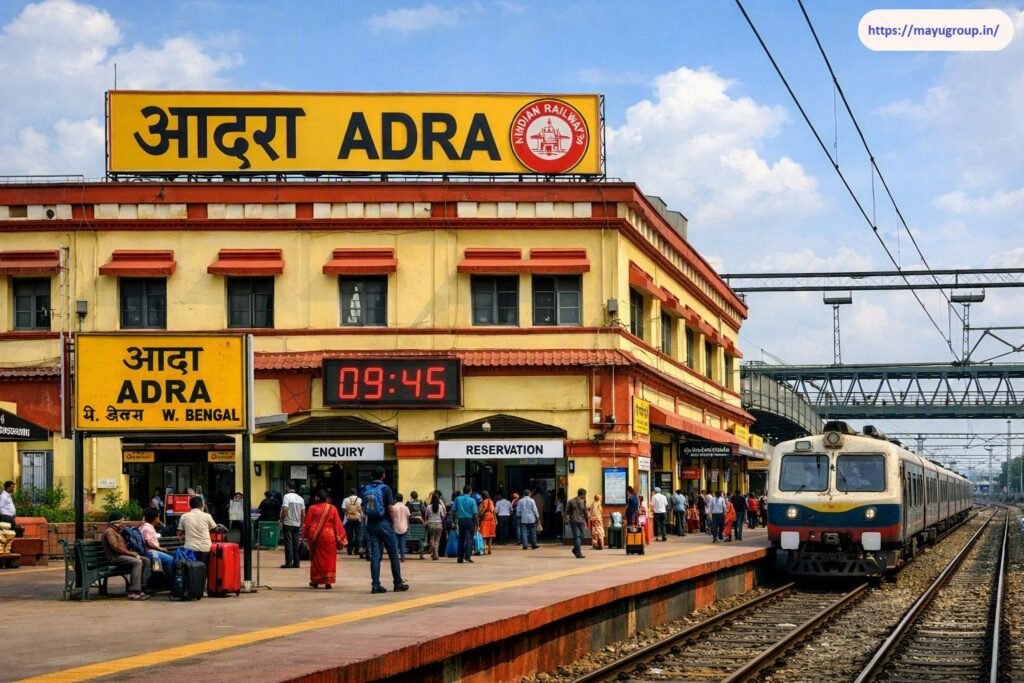
Every railway station has a personality of its own. Some are remembered for their historic architecture, some for their busy platforms, and others for the constant movement of passengers and trains. Adra Railway Station has a distinctive place within this railway landscape. Located in Adra Division of South Eastern Railway, Adra Railway Station is not merely a point where passengers board and leave trains. It is part of a larger railway ecosystem that connects people, communities, businesses and regions.
Adra Railway Station, situated in Adra Division, South Eastern Railway, Adra – 723121, serves as an important public facility for the surrounding region. Adra is also the headquarters of the Adra Division, giving the location significance beyond the station itself. The station is therefore closely connected with railway administration, operations, passenger movement and the economic and social life of the area.
Every day, railway stations experience a continuous flow of human activity. Passengers arrive with luggage, families wait for trains, railway employees perform their duties, vendors serve customers, maintenance teams attend to infrastructure, and trains arrive and depart according to operational schedules. Such activity makes the railway station a living environment. It also creates a responsibility to ensure that the surroundings remain safe, clean, hygienic and comfortable.
For Adra Railway Station, cleanliness was therefore more than an issue of appearance. It was directly connected with passenger comfort and the quality of railway service.
A passenger’s experience of a railway journey does not begin when the train starts moving. It begins when the passenger enters the station premises. The condition of the entrance, circulating area, platforms, waiting spaces, toilets, drinking-water facilities and surrounding environment can strongly influence the passenger’s impression of the railway.
A clean platform can make a passenger feel comfortable.
A hygienic toilet can provide dignity.
A well-maintained waiting area can reduce the stress of waiting.
Properly managed waste can create a sense of order.
Green surroundings can make a busy railway environment more pleasant.
These seemingly simple elements form an important part of passenger service.
At the same time, maintaining cleanliness at a busy railway station is not an easy task. Thousands of people may pass through public spaces over the course of a day. Food packaging, paper, plastic bottles and other forms of waste can be generated continuously. Toilets require frequent attention. Drains must be maintained. Public areas need regular cleaning. Water and other resources must be used responsibly.
Consequently, cleanliness cannot depend only on occasional campaigns.
It must become a system.
This understanding became particularly important in the years leading to Adra Railway Station’s environmental certification.
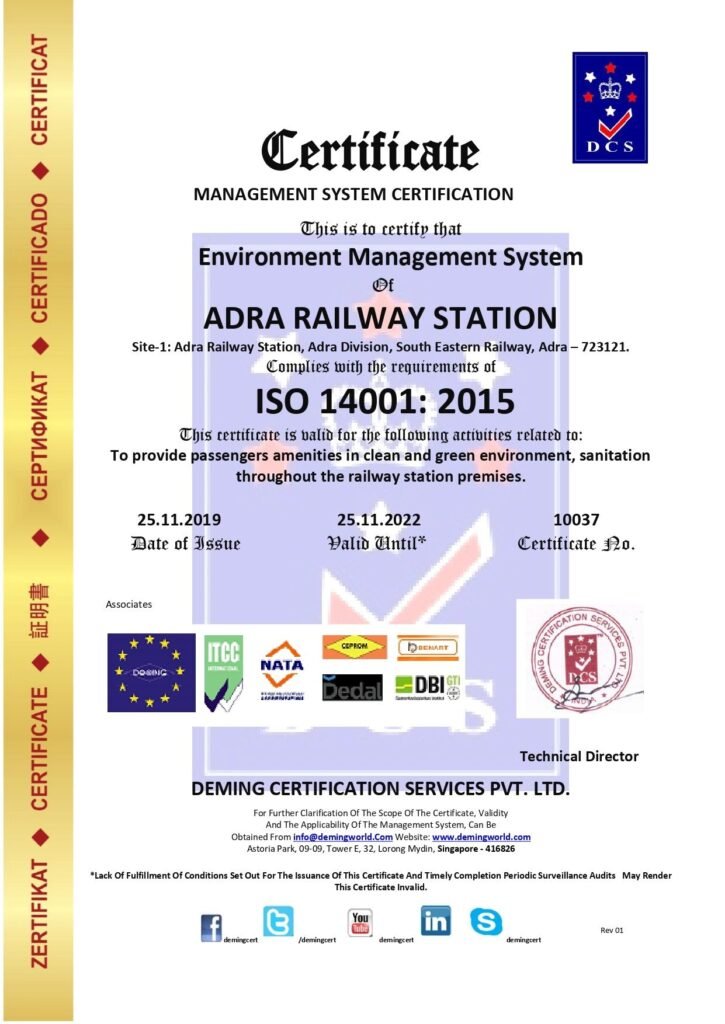
In 2019, Adra Railway Station received ISO 14001:2015 certification for its Environmental Management System. Certification records identify the issue date as 25 November 2019 and the validity period as extending to 25 November 2022. The scope associated with the station focused on providing passenger amenities in a clean and green environment and maintaining sanitation throughout the railway station premises.
The certification was significant because ISO 14001:2015 is not simply a cleanliness award. It is an internationally recognized framework for establishing and maintaining an Environmental Management System. Its purpose is to help an organization systematically identify environmental aspects, manage environmental impacts, meet applicable requirements and continually improve its environmental performance.
For Adra Railway Station, this approach provided an opportunity to connect everyday railway activities with environmental responsibility.
The importance of such an approach becomes clear when we consider the number of people involved in maintaining a station. Cleaning personnel, railway employees, supervisors, maintenance teams, contractors, vendors and passengers all influence the condition of the station. Environmental management therefore cannot be the responsibility of one department alone.
It has to become a shared responsibility.
A cleaner who removes waste from a platform contributes to environmental management.
A supervisor who checks sanitation contributes to environmental management.
A maintenance worker who identifies a drainage problem contributes to environmental management.
A vendor who disposes of waste correctly contributes to environmental management.
A passenger who uses a designated waste bin contributes to environmental management.
Together, these small actions create a larger system.
This was one of the important ideas behind Adra’s journey toward ISO 14001:2015 certification. The objective was not simply to make the station look better on the day of an inspection. The objective was to establish practices that could be repeated every day.
The concept of a clean and green station also brought together two important aspects of public infrastructure: sanitation and environmental quality.
A clean railway station provides immediate benefits to passengers. A green railway station adds another dimension by creating a more pleasant environment and demonstrating respect for natural surroundings. Plantation, maintenance of green spaces, responsible waste management and awareness among railway users can all contribute to this objective.
For Adra, the environmental initiative also carried institutional importance. A railway station associated with a divisional headquarters naturally represents the standards and values of the railway organization operating in the region. The condition of the station can influence how passengers perceive not only the facility but also the wider railway system.
The ISO 14001 certification therefore represented a milestone in Adra’s development.
It recognized the importance of systematic environmental management.
It emphasized sanitation.
It reinforced the relationship between environmental responsibility and passenger amenities.
It encouraged employees to think about environmental performance as part of their regular duties.
Most importantly, it created a foundation for continual improvement.
The story of Adra Railway Station after certification is therefore not simply a story about a certificate. It is a story about people, processes, infrastructure and changing expectations.
The certificate provided recognition, but daily work provided the real substance.
Every clean platform, every maintained toilet, every properly managed waste collection point and every carefully maintained green area contributed to the larger vision.
Adra’s journey demonstrates that a railway station can be more than a transportation facility. It can become a place where environmental responsibility, passenger service and operational discipline work together.
This was the beginning of the Adra story: a railway station at the heart of a busy division, facing the everyday challenges of public infrastructure, and taking an important step toward building a cleaner, greener and more environmentally responsible future.
#AdraRailwayStation
Chapter 2 – The Meaning of ISO 14001:2015 for Adra Railway Station
The journey of Adra Railway Station toward environmental responsibility reached an important milestone in 2019 with the achievement of ISO 14001:2015 certification. For an organization operating a busy railway station, this certification represented more than a formal recognition. It reflected an organized approach to managing environmental responsibilities while continuing to provide essential passenger services.
ISO 14001:2015 is an international standard for an Environmental Management System, commonly known as an EMS. The purpose of an EMS is to provide an organization with a structured method for identifying environmental aspects, controlling potential environmental impacts, fulfilling applicable requirements and continually improving environmental performance.
For Adra Railway Station, these principles were particularly relevant because the station is a continuously active public environment.
A railway station is different from many other types of workplaces. It is used by large numbers of people every day, while railway employees and service personnel operate continuously around them. Trains arrive and depart, passengers move between platforms, food and beverages are consumed, cleaning activities take place, water is used, waste is generated and maintenance work is performed.
Every one of these activities can have an environmental dimension.
Before environmental management becomes systematic, cleanliness can sometimes depend on individual effort. A dedicated employee may maintain an area extremely well, while another area may receive less attention. A cleaning drive may temporarily improve the appearance of a station, but without regular procedures the improvement can disappear.
An Environmental Management System changes this approach.
Instead of treating environmental performance as an occasional activity, it encourages the organization to establish processes and responsibilities. Activities can be planned, implemented, monitored and reviewed. Problems can be identified and corrective measures can be taken. Employees can be made aware of their responsibilities, and management can evaluate whether environmental objectives are being achieved.
This systematic approach was especially important for Adra because its certification scope focused on providing passenger amenities in a clean and green environment and maintaining sanitation throughout the station premises.
The phrase “clean and green environment” carries a broad meaning.
Cleanliness involves the regular removal and proper handling of waste, maintenance of platforms and public areas, sanitation of toilets and other facilities, and prevention of unhygienic conditions.
Green development involves maintaining vegetation and landscaped areas, improving the visual environment and encouraging responsible use of natural resources.
Together, these objectives create a station environment that is more comfortable for passengers and more responsible from an environmental perspective.
One of the most important principles of ISO 14001 is continual improvement. Certification does not mean that an organization has reached a perfect environmental condition. Instead, it means that the organization has established a management framework through which it can continue improving.
This distinction is important for a railway station.
Even if a platform is completely clean in the morning, it may require cleaning again after several trains arrive. Even if a toilet is thoroughly sanitized, it will need repeated maintenance throughout the day. Even if waste bins are correctly positioned, they must be emptied and managed regularly.
Environmental management is therefore a continuing cycle.
Planning is followed by action.
Action is followed by monitoring.
Monitoring identifies opportunities for improvement.
Improvement becomes part of the next cycle.
This way of working can help create consistency.
At Adra Railway Station, the certification also placed greater emphasis on awareness. Environmental management cannot succeed if only senior officials understand its importance. Cleaning personnel, maintenance teams, railway employees, contractors and other people working on the premises all have a role to play.
For example, a cleaning employee needs to understand the importance of proper waste handling. A supervisor needs to recognize environmental risks and monitor sanitation. Maintenance personnel need to report problems that could affect cleanliness or environmental performance. Vendors need to understand their responsibility for maintaining cleanliness around their operating areas.
Passengers also have an important role.
A railway station is a shared public space. The railway administration can provide waste bins, sanitation facilities, signs and other infrastructure, but passengers must use these facilities responsibly. When the organization maintains a clean environment and passengers cooperate with it, a positive cycle can develop.
The environment influences behaviour, and behaviour influences the environment.
A clean platform encourages passengers to maintain cleanliness. Properly marked waste bins make responsible disposal easier. Green spaces can encourage greater appreciation of the surroundings. Clear communication can help passengers understand what is expected from them.
In this way, ISO 14001 can influence not only organizational processes but also public behaviour.
The certification was also part of a wider environmental movement within Indian Railways. During the 2019–20 period, Indian Railways reported that numerous railway stations had been certified for implementation of ISO 14001 Environmental Management Systems. Environmental sustainability initiatives included station cleanliness, waste management, water conservation and measures aimed at reducing environmental impacts.
Adra’s certification therefore formed part of a broader effort to make railway operations more environmentally responsible.
For the station itself, the achievement created a new benchmark.
The question was no longer simply whether the station could become clean enough to receive recognition. The more important question was whether the environmental standards and habits established during the certification process could be maintained over time.
That question gives the certification its lasting importance.
A certificate has a fixed issue date and validity period. Environmental responsibility does not.
Adra Railway Station’s ISO 14001:2015 certification was issued on 25 November 2019 and was valid until 25 November 2022. The certification period can therefore be understood as a significant stage in the station’s environmental journey.
The real achievement, however, lies in the practices developed around the certification.
If employees became more conscious of environmental responsibilities, that was an achievement.
If sanitation became more systematic, that was an achievement.
If waste management improved, that was an achievement.
If passengers experienced cleaner surroundings, that was an achievement.
If the station developed a stronger culture of cleanliness and environmental awareness, that was perhaps the greatest achievement of all.
The significance of ISO 14001:2015 at Adra Railway Station can therefore be summarized in one central idea: environmental management became part of the way the station was expected to operate, rather than being treated as an occasional activity.
The certification provided a framework.
The railway workforce gave it life.
The passengers experienced its results.
And continual improvement gave the journey a future.
For Adra Railway Station, ISO 14001:2015 was therefore not simply a certificate displayed as evidence of achievement. It represented a commitment to make cleanliness, sanitation, environmental awareness and passenger comfort an integral part of railway service.
#ISO14001
Chapter 3 – The People Behind the Environmental Transformation
A railway station may be made of platforms, tracks, buildings, waiting rooms, toilets, signs and equipment, but the success of a station ultimately depends upon people. Infrastructure can provide the foundation for cleanliness and environmental management, but people create the habits, discipline and care that keep that infrastructure functioning.
For Adra Railway Station, the journey toward ISO 14001:2015 certification was therefore not only a story of environmental systems. It was also a story of people.
When a passenger enters a clean railway station, the result may appear simple. A platform looks swept, a waste bin is available, a toilet is maintained, and the surroundings appear orderly. Behind this appearance is a considerable amount of work performed by railway employees, cleaning personnel, supervisors, maintenance workers, contractors and other members of the station community.
Their work begins long before many passengers arrive.
In the early hours of the day, cleaning teams may already be preparing the station for the first wave of passengers. Platforms and public areas need attention. Waste generated during earlier operations has to be collected. Toilets and other sanitation facilities require inspection and cleaning. Circulating areas need to be kept presentable. The station gradually changes from a quiet railway facility into a busy public environment.
This daily transformation demonstrates an important principle of environmental management: cleanliness is not an occasional event.
It is a continuous responsibility.
ISO 14001:2015 provides a framework for assigning responsibilities, creating awareness, monitoring environmental performance and improving processes. In a railway environment, such a system can help ensure that environmental responsibilities are not dependent on one individual.
Everyone has a role.
Railway officers provide leadership and direction. Supervisors coordinate activities and monitor performance. Cleaning workers carry out essential sanitation work. Maintenance personnel address physical conditions that may affect environmental performance. Vendors interact directly with passengers and can influence the cleanliness of commercial areas. Security and operational employees also contribute by helping maintain order and communicating expectations.
Even passengers become part of the system.
This shared responsibility is one of the most important features of a successful environmental programme.
Consider waste management. A station may provide appropriate bins, but the system can work effectively only when waste is disposed of correctly and then collected and handled through an organized process. A single employee cannot control the behaviour of every passenger. Awareness and cooperation are therefore essential.
The same principle applies to sanitation.
Cleaning personnel can maintain toilets and public spaces, but passengers must use those facilities responsibly. When people understand that a clean environment is a shared responsibility, the effort of the railway workforce becomes more effective.
This is why awareness is such an important part of environmental management.
Training employees helps them understand not only what they are expected to do but why their work matters. A cleaner who understands waste segregation is more likely to follow the correct procedure. A supervisor who understands environmental objectives is more likely to notice potential problems. A maintenance worker who recognizes an environmental risk can report it before it becomes a larger issue.
Small decisions can have large consequences.
A waste container placed in the right location can reduce litter.
A blocked drain reported at the right time can prevent sanitation problems.
A damaged water facility repaired promptly can reduce unnecessary water loss.
A maintained green area can improve the appearance of the station.
A clean waiting room can improve the passenger experience.
Together, these actions create the environmental character of the station.
The role of leadership is equally important.
For an environmental management system to succeed, senior management must demonstrate commitment. Environmental objectives need to be treated as part of organizational performance rather than as an additional burden placed upon cleaning staff.
When managers regularly review cleanliness, sanitation and environmental performance, employees receive a clear message that these matters are important.
When good performance is recognized, employees gain confidence.
When problems are identified and corrected constructively, the organization learns.
This creates a culture of continual improvement.
The concept of continual improvement is particularly valuable in a railway station because conditions change constantly. Passenger volumes fluctuate. Weather affects cleanliness and drainage. Maintenance activities create temporary environmental challenges. New facilities may change patterns of movement. Different types of waste may be generated at different times.
A system that works perfectly under one condition may require adjustment under another.
People therefore have to remain alert.
The environmental management system provides the structure, but employees provide the judgment required to apply that structure to real situations.
This is also where the idea of pride becomes important.
A railway employee who sees the station as more than a workplace may develop a sense of ownership. When employees feel that the station represents their work and their organization, they are more likely to care about its condition.
The same principle applies to passengers.
A clean station can encourage passengers to feel that the place deserves respect. A well-maintained environment can discourage careless disposal of waste. Green areas can create a sense that the station is part of the community rather than merely a transit point.
The result is a positive relationship between infrastructure and behaviour.
The station provides the conditions for responsible behaviour.
People respond to those conditions.
Their behaviour helps maintain the environment.
The maintained environment then reinforces the same behaviour.
This cycle is one of the hidden strengths of environmental management.
The ISO 14001:2015 certification obtained by Adra Railway Station in 2019 therefore represented a collective achievement. The certification may have been formally associated with the organization, but its success depended on people performing their responsibilities every day.
The certificate could not sweep a platform.
It could not clean a toilet.
It could not collect waste.
It could not plant or maintain greenery.
It could not educate a passenger.
People did all of those things.
The certification simply provided a structured framework that helped connect those activities to a common environmental objective.
This perspective changes the way the station’s achievement should be understood.
Instead of seeing ISO certification as an administrative milestone, it can be seen as recognition of a working culture.
A culture where cleanliness matters.
A culture where sanitation matters.
A culture where environmental impacts are considered.
A culture where employees understand their responsibilities.
A culture where passengers are encouraged to participate.
And a culture where improvement is never considered complete.
The people behind Adra Railway Station’s environmental transformation are therefore its most important asset. Their daily work may often remain unnoticed, but every clean platform, every maintained facility and every properly managed waste collection point represents their contribution.
The long-term success of environmental management ultimately depends on keeping this human commitment alive.
As trains continue to arrive and depart, new employees join and others retire, and passenger patterns change over time, the system must continue to transfer knowledge and responsibility from one generation to the next.
That is how certification becomes culture.
And that is how the people of a railway station can transform an environmental standard into a living part of everyday service.
#EnvironmentalManagement
Chapter 4 – Cleanliness Becomes a Daily Discipline
Cleanliness is one of the first things a passenger notices when entering a railway station. Before checking the train number, reading the timetable or finding a platform, the passenger encounters the physical environment of the station. The condition of the floor, platform, waiting area, toilets, drains, waste bins and surrounding spaces immediately creates an impression.
For Adra Railway Station, maintaining this environment became an important part of its environmental-management journey.
The scope associated with the station’s ISO 14001:2015 certification focused on providing passenger amenities in a clean and green environment and maintaining sanitation throughout the railway station premises. This objective reflected a simple but demanding principle: cleanliness should not be an occasional activity. It should become a daily discipline.
A railway station is constantly changing.
A platform may be thoroughly cleaned early in the morning, but passengers, vendors and railway operations soon begin creating new demands. Food packets may be discarded, paper may accumulate, dust may enter from surrounding areas, and other forms of waste may appear. Toilets experience repeated use and therefore require frequent attention. Waiting areas become busy during peak periods. Circulating areas are affected by passengers, vehicles and weather.
The challenge is therefore not simply to clean the station.
The challenge is to keep it clean.
This difference is fundamental.
A one-time cleanliness campaign can produce a visible improvement. A management system seeks to make that improvement repeatable.
For Adra, ISO 14001:2015 provided a framework within which cleaning and sanitation activities could be approached systematically. Responsibilities could be identified, procedures could be followed, inspections could be conducted and problems could be addressed.
The concept of regularity became essential.
Cleaning had to be scheduled.
Sanitation had to be monitored.
Waste had to be collected.
Public facilities had to be inspected.
Problems had to be reported and corrected.
This systematic approach helped transform cleanliness from a visual objective into an operational responsibility.
Waste management was another important part of this process.
Railway stations generate different forms of waste because they serve a large and diverse population. Passengers may carry food, drinks and other products onto trains and platforms. Vendors may generate packaging waste. Railway activities can also produce maintenance-related waste.
If waste is left unmanaged, it quickly affects the appearance and hygiene of the station.
If it is collected systematically, the environment can remain under control.
Waste segregation is particularly important because different forms of waste may require different methods of handling. Railway cleaning-related specifications in the Adra Division around the certification period included provisions for separate biodegradable and non-biodegradable waste bins, demonstrating the practical connection between cleanliness and environmental management.
The presence of appropriate bins is only the first step.
Passengers need to understand their purpose.
Cleaning personnel need to collect the waste correctly.
Supervisors need to monitor the system.
The collected material needs to be handled through an appropriate disposal or further-management process.
Thus, a simple waste bin becomes part of a larger environmental chain.
Sanitation is equally important.
Public toilets are among the most frequently used facilities at a railway station. Their condition can strongly influence passenger satisfaction. A poorly maintained toilet can undermine the impression created by an otherwise clean station.
For this reason, sanitation requires more than occasional washing.
Cleaning needs to be repeated according to usage.
Supplies need to be checked.
Odour and drainage problems need attention.
Fixtures need maintenance.
The surrounding area needs to remain clean.
Inspection is therefore essential.
A well-designed sanitation system can identify a problem before it becomes a major complaint.
The same preventive principle applies to drains.
Drainage is an important but often unnoticed part of railway-station cleanliness. When drains are blocked or poorly maintained, stagnant water and unhygienic conditions can develop. During periods of heavy rainfall, effective drainage becomes even more important.
Regular cleaning and inspection can therefore contribute to both sanitation and environmental performance.
This illustrates a wider lesson from ISO 14001.
Environmental management is often about preventing problems rather than reacting to them.
Instead of waiting for a platform to become visibly dirty, cleaning is scheduled.
Instead of waiting for a toilet to become unacceptable, it is inspected regularly.
Instead of waiting for a drain to overflow, it is maintained.
Instead of allowing waste to accumulate, it is collected at defined intervals.
This preventive approach makes the station more resilient.
It also improves the working environment for employees.
Cleaning personnel can perform their duties more effectively when responsibilities are clearly defined and equipment and procedures are available. Supervisors can monitor performance more objectively when there are established standards against which conditions can be reviewed.
The process can also create accountability.
If an area is not maintained properly, the organization can identify where the process failed and determine what corrective action is needed.
This does not mean that every problem represents failure.
On the contrary, an effective management system recognizes that problems are opportunities to learn.
A damaged waste bin may indicate a need for stronger infrastructure.
Repeated litter in one area may indicate that a bin needs to be relocated.
Frequent toilet complaints may indicate that cleaning frequency needs adjustment.
Water accumulation may indicate a drainage issue.
Each problem can provide information that helps improve the system.
This is the essence of continual improvement.
Over time, small improvements can produce significant results.
A cleaner platform can improve passenger comfort.
Better waste management can reduce litter.
Improved sanitation can protect public hygiene.
Regular drain maintenance can reduce environmental problems.
Clear responsibilities can improve employee performance.
Together, these improvements strengthen the station.
Cleanliness also has a psychological effect.
People generally respond to the environment around them. A well-maintained railway station creates an impression of order and care. Passengers may be more likely to use waste bins when they see that the station is already clean. They may also feel greater respect for a facility that is clearly maintained.
This creates a positive cycle.
Good maintenance encourages responsible behaviour.
Responsible behaviour makes maintenance more effective.
The result is a stronger cleanliness culture.
For Adra Railway Station, this culture was an important part of the environmental-management journey that began with ISO 14001:2015 certification in 2019.
The certification itself had a defined validity period, but the principle of daily cleanliness was not limited to those dates.
A clean railway station requires commitment every day.
Every morning begins another cycle.
Every arriving train brings new passengers.
Every passenger creates new responsibilities.
Every shift brings new employees to the task.
The work continues.
That is why the real achievement is not the ability to clean the station once.
It is the ability to maintain cleanliness continuously.
Adra’s environmental journey demonstrates that cleanliness becomes meaningful when it is transformed from an occasional campaign into a daily discipline.
A clean platform is not an isolated achievement.
It is the visible result of planning, people, monitoring, maintenance and responsibility.
And when those elements work together consistently, the railway station becomes more than a clean place.
It becomes a well-managed public environment.
#CleanAndGreenStation
Chapter 5 – The Green Station Vision
Cleanliness is one important part of environmental responsibility, but a truly environmentally conscious railway station must look beyond the removal of waste. It must also consider the quality of the surroundings, the use of natural resources, greenery, water, energy and the overall relationship between railway infrastructure and the environment.
For Adra Railway Station, the idea of providing passengers with a clean and green environment gave a broader meaning to its ISO 14001:2015 journey.
A railway station is naturally dominated by hard infrastructure. Platforms, tracks, buildings, roads, footpaths and other structures are necessary for railway operations. Steel, concrete and paved surfaces are essential to transportation, but they can also create a visually harsh environment.
Greenery provides balance.
Trees, plants, landscaped areas and maintained vegetation can soften the appearance of railway premises. They can make waiting and walking areas more pleasant and contribute to a stronger sense of environmental responsibility. For passengers arriving at a railway station, the presence of greenery can create an immediate impression of care and attention.
The green-station concept therefore became more than decoration.
It represented an environmental philosophy.
The purpose of greenery in a railway environment is not simply to make a station attractive. It can also encourage people to think differently about public spaces. When passengers see well-maintained plants and green areas, they are reminded that the station is part of the wider natural environment.
This is particularly important in a busy railway location.
Trains operate continuously. Passengers move rapidly. Vehicles enter and leave. Commercial activities take place. Equipment operates throughout the day. In such an environment, greenery can provide a visual reminder that transportation and environmental responsibility can coexist.
For Adra Railway Station, the green vision could therefore be understood through several interconnected activities: maintaining existing green areas, encouraging plantation, protecting vegetation, improving station surroundings, managing waste responsibly and increasing awareness of environmental issues.
Plantation is one of the simplest ways of introducing environmental improvement into railway premises.
A newly planted tree may appear insignificant compared with the size of a railway station. But environmental improvement often begins with small actions. As plants grow, they can gradually change the appearance of the surroundings.
More importantly, plantation creates a long-term responsibility.
A tree cannot simply be planted and forgotten.
It requires care, water and protection.
This creates another connection between environmental management and employee responsibility.
The broader Adra Division has undertaken plantation and station-beautification activities in different locations. Official divisional material has documented plantation-based beautification along approaches to stations including Salboni, Piardoba and Santhaldih.
Such initiatives demonstrate that the idea of greener railway surroundings fits within the larger environmental direction of the division.
For Adra itself, the green-station vision can also be connected with passenger comfort.
Imagine two railway stations with identical platforms and train services. One has barren surroundings, unmanaged waste and little greenery. The other has clean platforms, maintained plants, organized public spaces and attractive surroundings.
The basic transportation function may be the same, but the passenger experience is different.
The second station communicates care.
This illustrates why environmental management can contribute to service quality.
Greenery can also help create a more welcoming environment for visitors to the region. Railway stations often provide the first impression of a town or city for people arriving by train. A clean and attractive station can therefore become part of the public image of the locality.
Adra, as an important railway location and divisional headquarters, has particular significance in this regard.
The station is not only a railway facility.
It is also a gateway.
People arriving from other places may form their first impression of the area from what they see around the station. A clean and green environment can contribute positively to that impression.
The environmental vision also extends beyond plants.
Water is an important resource in railway operations. Cleaning, sanitation, drinking-water facilities and other activities require water. Responsible environmental management therefore includes the need to use water carefully and prevent unnecessary wastage.
During the period around Adra’s certification, Indian Railways was implementing broader water-conservation and sustainability initiatives. Its environmental reporting for 2019–20 described measures including reuse of reject water for activities such as platform washing and toilet-related purposes, along with other resource-conservation efforts.
These wider initiatives show how environmental management can move beyond visible cleanliness.
A station can be environmentally responsible not only because it looks clean but because its resources are managed thoughtfully.
Waste reduction is another important part of the green vision.
The best waste is waste that is not generated unnecessarily.
Where waste is unavoidable, proper segregation and responsible handling can reduce environmental impacts. Awareness among vendors, railway employees and passengers can help reduce litter and encourage responsible disposal.
Plastic waste is especially visible in railway environments because bottles, packaging and food containers can accumulate quickly.
Indian Railways has implemented measures such as plastic bottle crushing machines at stations as part of broader efforts to address plastic waste.
Such initiatives illustrate an important principle: environmental improvement requires both infrastructure and behaviour.
A station may provide facilities, but people have to use them correctly.
This is why awareness is essential.
Signs, announcements, employee communication and visible cleanliness can all influence passenger behaviour. When people understand that the railway is making an effort to maintain a clean environment, they may become more willing to cooperate.
The green-station vision therefore becomes a partnership between the organization and the public.
The railway provides infrastructure and management.
Employees provide daily care.
Passengers provide cooperation.
Together, they create the environmental character of the station.
The vision can also support employee morale.
Working in a clean and green environment is generally more pleasant than working in a neglected one. Employees spend many hours at the station. A better environment can contribute to a stronger sense of pride in the workplace.
This sense of pride can become an important part of organizational culture.
When employees feel that their workplace represents quality, they are more likely to protect it.
When passengers see employees taking pride in the station, they may also become more conscious of their own behaviour.
This creates a positive chain.
Cleanliness creates pride.
Pride encourages responsibility.
Responsibility protects the environment.
The protected environment creates a better passenger experience.
The cycle continues.
The green vision associated with Adra Railway Station can therefore be understood as a long-term journey rather than a single project.
The ISO 14001:2015 certification provided a formal environmental-management framework during its 2019–2022 certification period. But the underlying principles—cleanliness, sanitation, resource responsibility, greenery, awareness and continual improvement—can continue beyond the certificate’s validity.
That is the true meaning of a green station.
It is not simply a station with plants.
It is a station where environmental responsibility is visible in everyday decisions.
It is a place where waste is managed carefully, resources are respected, public spaces are maintained and greenery is valued.
For Adra Railway Station, the vision of a clean and green environment therefore became an important part of its identity.
The railway may continue to grow.
Passenger expectations may continue to change.
Infrastructure may continue to modernize.
But one principle remains constant: the best railway station is not only efficient and functional. It is also clean, responsible, welcoming and respectful of the environment.
That is the green vision that gives environmental management its lasting purpose.
#IndianRailways
Chapter 6 – Passenger Amenities and the Meaning of Service
A railway station exists to serve people. Trains may be the most visible part of railway operations, but the quality of a passenger’s journey is influenced by everything that happens before boarding and after arrival. The condition of the station, the availability of basic amenities, sanitation, cleanliness, information, accessibility and the general atmosphere all contribute to the passenger experience.
For Adra Railway Station, the objective of providing passenger amenities in a clean and green environment was therefore closely connected with its environmental-management journey.
The ISO 14001:2015 certification obtained in 2019 recognized an Environmental Management System associated with the station. Its stated scope focused on providing passenger amenities in a clean and green environment and maintaining sanitation throughout the railway station premises. This created an important connection between environmental responsibility and passenger service.
At first, environmental management and passenger amenities may appear to be two separate subjects.
They are not.
A clean toilet is an environmental-management concern and a passenger amenity.
A clean platform is an environmental achievement and a passenger-service improvement.
Proper waste collection benefits the environment and improves passenger comfort.
Clean drinking-water facilities serve passengers while also requiring responsible management of an important natural resource.
Green surroundings contribute to environmental quality while making the station more pleasant for passengers.
The connection becomes clear when the station is viewed through the eyes of a traveller.
Imagine a passenger arriving at Adra Railway Station for the first time. Perhaps the passenger is travelling with family. Perhaps an elderly person is accompanying them. Perhaps a student is travelling alone with luggage. Perhaps a visitor is arriving in the region for business or personal reasons.
Before the passenger boards a train, several questions naturally arise.
Where is the platform?
Where can luggage be placed?
Where is the waiting area?
Where is drinking water available?
Where are the toilets?
Is the station clean?
Are the surroundings comfortable?
These simple needs define much of the passenger experience.
A railway organization can provide excellent train services, but if passengers encounter poor sanitation or neglected public spaces, their overall impression can still be negative.
This is why passenger amenities are an important part of railway development.
For Adra Railway Station, environmental management helped strengthen the idea that passenger comfort should be supported by a clean and healthy public environment.
Sanitation is particularly important.
Railway stations serve large numbers of people, and public toilets can experience heavy usage. Maintaining them requires regular cleaning, inspection, water management and timely maintenance. A toilet that is technically available but poorly maintained cannot be considered a satisfactory passenger facility.
Therefore, sanitation needs to be treated as an ongoing service.
Cleaning personnel must work according to defined routines.
Supervisors must inspect facilities.
Maintenance issues need to be reported.
Problems need to be corrected promptly.
This creates a cycle of service improvement.
The same principle applies to waiting areas.
A waiting room is not simply an empty space where passengers sit. It is a place where people spend time before their train arrives. Clean floors, maintained seating, proper waste disposal and a hygienic atmosphere can make waiting more comfortable.
For families with children, elderly passengers and travellers with luggage, these details can become particularly important.
The station environment also influences accessibility and dignity.
A clean, organized and well-maintained public space is easier to navigate. Clear pathways and properly maintained areas can reduce unnecessary difficulty for passengers.
Later development within Adra Division has included passenger-amenity improvements such as lifts, foot overbridges, platform shelters, platform extensions and station beautification. These developments demonstrate that passenger service is an ongoing process rather than a one-time achievement.
It is important, however, to distinguish between the effects of ISO certification and broader railway investment.
ISO 14001:2015 did not by itself create every later infrastructure improvement. Such developments arise from wider railway planning, investment and operational requirements.
The value of the environmental certification lies in how it complemented this wider development.
Infrastructure provides facilities.
Environmental management helps ensure that those facilities operate within a responsible system.
Passenger service therefore becomes stronger when physical development and environmental discipline work together.
Waste management is another example.
Passengers generate waste during their journeys. If bins are clearly available and the surrounding area is maintained, responsible disposal becomes easier. If waste is allowed to accumulate, passengers may become less willing to cooperate.
The physical environment therefore influences behaviour.
A clean station communicates an expectation of cleanliness.
A neglected station can unintentionally communicate the opposite.
This is why environmental management has a social dimension.
Passengers are not passive users of the railway environment. They are participants.
When passengers use bins correctly, avoid littering, respect green spaces and help maintain sanitation, they contribute to the success of the station’s environmental objectives.
The railway organization, in turn, has a responsibility to make responsible behaviour practical.
Bins must be conveniently located.
Facilities must be maintained.
Waste must be collected.
Public areas must be inspected.
Information and awareness messages should be clear.
The result is a partnership.
The station provides the conditions.
The passenger provides cooperation.
Both are necessary.
Passenger amenities also influence the public image of the railway.
A railway station is often one of the first places a visitor sees when entering a city or town. It can become a symbol of the standards maintained by the railway organization.
Adra’s position within the Adra Division gives this consideration additional importance.
As an important railway location, the station represents more than a transportation facility. It forms part of the public face of the division.
A clean and green station communicates professionalism.
A hygienic environment communicates care.
Well-maintained amenities communicate respect for passengers.
Environmental responsibility communicates a forward-looking approach.
These qualities contribute to trust.
Passengers may not know the details of ISO 14001. They may never read an environmental policy or understand the technical language of an Environmental Management System.
But they can recognize the results.
They can see whether the platform is clean.
They can experience whether the toilet is hygienic.
They can notice whether waste is being handled properly.
They can appreciate whether the surroundings are pleasant.
In this sense, passengers become the ultimate observers of environmental performance.
The success of an environmental-management system is reflected in everyday experiences.
For Adra Railway Station, this connection between environment and service created an important opportunity. Instead of viewing sanitation as a maintenance obligation and greenery as decoration, both could be understood as essential elements of passenger service.
This way of thinking also supports continual improvement.
Passenger expectations change.
Railway infrastructure develops.
Technology changes.
Environmental standards become more demanding.
Therefore, passenger amenities must also evolve.
The objective should not be to achieve a fixed level and stop.
It should be to continue asking how the station can serve passengers better.
Can cleanliness be improved?
Can sanitation be made more consistent?
Can waste be reduced?
Can green areas be enhanced?
Can water be used more responsibly?
Can public awareness be strengthened?
Can facilities become easier to use?
These questions keep the station moving forward.
The 2019 ISO 14001:2015 certification was therefore an important milestone in Adra Railway Station’s service journey. It demonstrated that environmental responsibility could be integrated into the station’s broader objective of serving passengers.
The most meaningful outcome was not the certificate itself.
It was the idea behind it.
A railway station should provide more than transportation.
It should provide a safe, clean, hygienic and welcoming environment.
When environmental management supports passenger amenities, the railway experience becomes more complete.
For Adra Railway Station, this became an important part of its continuing story: a station where environmental responsibility and passenger service could work together, creating an environment in which both people and the railway system could move forward.
#RailwayStation
Chapter 7 – From Certification to Institutional Growth
The achievement of ISO 14001:2015 certification in 2019 marked an important point in the environmental journey of Adra Railway Station. However, certification itself was not the final destination. It was a foundation for continuing improvement. The years that followed can be understood as a period in which environmental awareness, passenger service, operational discipline and wider railway development continued to evolve together.
When discussing the “growth” of Adra Railway Station after certification, it is important to understand that a railway station does not grow in exactly the same way as a private commercial company. A railway station is part of a public transportation system. Its growth is reflected through improvements in infrastructure, passenger amenities, operational capability, environmental performance, cleanliness, accessibility and institutional standards.
In this context, ISO 14001:2015 provided an important framework.
The certification encouraged a systematic approach to environmental management. Rather than treating cleanliness as a temporary campaign, the station could approach environmental responsibilities through planned activities, defined responsibilities, monitoring and continual improvement.
This change in approach can have a lasting institutional effect.
An organization learns from the process of achieving certification.
Employees become more familiar with environmental objectives.
Supervisors become more aware of monitoring requirements.
Management gains greater visibility of environmental performance.
Cleaning and sanitation become connected with formal processes.
Passengers become more aware of expectations regarding cleanliness.
Over time, these changes can contribute to institutional maturity.
The most important form of growth is therefore not necessarily visible from the outside.
It can be found in the way the organization works.
A mature organization does not depend entirely on individual enthusiasm. It creates processes that can continue even when employees change. This is particularly important for a railway station because employees work in shifts and responsibilities may change over time.
Environmental management must therefore be capable of surviving personnel changes.
The procedures need to be understood.
Responsibilities need to be communicated.
Records and monitoring need to support continuity.
Training needs to maintain awareness.
This is how a temporary initiative becomes part of an organizational system.
For Adra, the certification period from 25 November 2019 to 25 November 2022 can therefore be viewed as an important stage in this process. It established a recognized environmental-management framework and created a benchmark against which continuing performance could be considered.
The next question was sustainability.
Could the environmental standards associated with certification continue to influence station operations after the formal certification period?
This is a much more important question than simply asking whether a certificate was displayed.
If sanitation practices continued, the system had value.
If waste management remained organized, the system had value.
If employees continued to consider environmental impacts, the system had value.
If passenger amenities remained a priority, the system had value.
If the station continued to seek improvement, the system had achieved something lasting.
Institutional growth is often measured through this kind of continuity.
Adra Railway Station also operates within a much larger railway organization. The station forms part of the Adra Division of South Eastern Railway, and developments within the division influence the environment in which the station operates.
Later official divisional information records improvements in passenger amenities and station infrastructure, including lifts, foot overbridges, platform shelters, platform extensions and station beautification.
These developments should not be presented as direct results of ISO 14001 certification. They reflect wider railway planning, investment and development.
Nevertheless, they are relevant to the station’s broader growth story.
Environmental responsibility is most effective when it develops alongside infrastructure.
A new facility has greater value when it is maintained properly.
An improved platform becomes more useful when it remains clean.
A passenger facility becomes more successful when its surrounding environment is hygienic.
A beautified station becomes more attractive when waste is controlled.
This creates a relationship between physical growth and environmental management.
The railway system can build new facilities, but management systems help ensure that those facilities remain usable and responsible over time.
The same principle applies to passenger expectations.
Modern passengers increasingly expect cleanliness and comfort as part of basic railway service. Environmental awareness has also grown across society. People are more conscious of plastic waste, sanitation, water conservation and the condition of public spaces.
A railway station must therefore respond to changing expectations.
The ISO 14001 experience helped position environmental responsibility as part of the station’s service identity.
This can also influence the organization’s reputation.
A station known for cleanliness and environmental responsibility can create greater confidence among passengers and visitors. A well-maintained station can contribute positively to the image of the railway division.
Adra’s position as an important railway location makes this particularly meaningful.
The station is connected to a wider network of passengers, railway employees, businesses and communities. Its environmental performance therefore has effects beyond its immediate boundaries.
The institutional growth story also includes employee development.
Environmental management requires awareness.
Employees need to understand how their individual responsibilities contribute to larger objectives. A person responsible for cleaning a platform may not think of their work as part of environmental management, but that work is essential to the system.
Similarly, a supervisor who checks sanitation contributes to performance monitoring.
A maintenance employee who identifies a drainage issue contributes to preventive environmental management.
A station official who reviews recurring problems contributes to continual improvement.
When employees understand these connections, routine tasks acquire greater importance.
Work becomes more meaningful because individuals can see how their actions contribute to a larger purpose.
This can strengthen organizational pride.
A clean station is a visible achievement that employees can see every day.
Passengers can see it too.
This creates a direct connection between employee effort and public service.
Institutional growth can also be seen in the relationship between the railway and the community.
A railway station is public infrastructure. Its condition affects local residents, passengers, vendors and visitors.
When the station promotes cleanliness, it influences public behaviour.
When it maintains greenery, it demonstrates environmental responsibility.
When it provides hygienic facilities, it supports public well-being.
When it improves passenger amenities, it strengthens the connection between railway service and community needs.
The environmental journey therefore extends beyond railway administration.
It becomes part of the social environment surrounding the station.
There is also an important lesson in the distinction between certification and continual improvement.
Certification provides recognition that a management system meets defined requirements at a particular point in time.
Continual improvement asks what happens next.
What new environmental risks have emerged?
What can be done more efficiently?
Can waste be reduced?
Can water be conserved?
Can sanitation be improved?
Can passenger awareness be strengthened?
Can green areas be expanded or better maintained?
These questions keep the organization moving forward.
For Adra Railway Station, this approach provides a meaningful interpretation of growth after 2019.
Growth means stronger systems.
Growth means better awareness.
Growth means improved passenger facilities.
Growth means greater environmental responsibility.
Growth means more disciplined sanitation.
Growth means a stronger relationship between infrastructure and public service.
Most importantly, growth means the ability to maintain improvement over time.
The ISO 14001:2015 certification was therefore a milestone, not a conclusion. Its greatest value was the opportunity to establish environmental management as part of the station’s institutional culture.
Adra’s story demonstrates that public infrastructure can develop in more than one direction at the same time. A railway station can improve its passenger facilities while also strengthening environmental management. It can modernize infrastructure without losing sight of cleanliness. It can become more efficient while becoming more environmentally responsible.
This balance represents true institutional growth.
The journey that began with certification in 2019 was therefore part of a much larger story: the continuing transformation of Adra Railway Station from a place where trains stop and passengers wait into a more organized, cleaner, greener and increasingly service-oriented public environment.
And the most important part of that growth is not what was achieved on one certification date.
It is what the organization continues to learn, maintain and improve every day.
#SustainableRailways
Chapter 8 – Adra Railway Station Within the Larger Railway Ecosystem
Adra Railway Station is an important part of a much larger railway network. Its environmental and passenger-service journey cannot be understood in isolation because the station operates within the Adra Division of South Eastern Railway and, ultimately, within the vast national network of Indian Railways.
This wider context gives special meaning to the station’s ISO 14001:2015 certification.
The certification obtained in 2019 was not simply an individual achievement. It reflected a broader movement within Indian Railways toward systematic environmental management, improved station cleanliness and more responsible use of resources.
A railway network of such enormous scale faces environmental challenges that are different from those of an ordinary organization. Railway stations are public places. Trains operate continuously. Large numbers of passengers use facilities every day. Water, energy and other resources are consumed. Waste is generated across platforms, trains, offices and commercial areas. Maintenance and construction activities can also affect the surrounding environment.
Managing these challenges requires more than isolated initiatives.
It requires systems.
This is where Environmental Management Systems such as ISO 14001 become important.
During the 2019–20 period, Indian Railways reported that 215 railway stations had been certified for implementation of ISO 14001 Environmental Management Systems. The environmental sustainability reporting also described initiatives relating to station cleanliness, water conservation, waste management, plastic reduction and other environmental measures.
Adra’s certification was therefore part of a larger institutional direction.
The station was participating in a movement that recognized environmental responsibility as an important part of railway operations.
This broader perspective helps explain why environmental management matters at a railway station.
A station may be small compared with the total railway network, but it is used by thousands of people. Every environmental improvement therefore has a direct public impact.
If a station reduces litter, passengers experience a cleaner environment.
If sanitation improves, public hygiene benefits.
If water is used responsibly, an important natural resource is protected.
If greenery is maintained, the public environment becomes more pleasant.
If passengers are encouraged to reduce waste, environmental awareness spreads beyond the railway boundary.
In this way, small improvements can become part of a much larger environmental culture.
The railway ecosystem also creates an important relationship between employees and passengers.
Railway employees manage the infrastructure, but passengers interact with it continuously.
The railway may install waste bins, but passengers must use them.
The railway may maintain toilets, but passengers must use them responsibly.
The railway may develop green spaces, but passengers must respect them.
The railway may display environmental messages, but passengers must respond to them.
Environmental management is therefore partly a partnership.
This partnership is particularly important because railway stations are public spaces rather than closed industrial facilities.
The behaviour of one person can influence many others.
If a passenger throws waste on a clean platform, another passenger may imitate that behaviour.
If passengers see everyone using bins responsibly, they are more likely to do the same.
This creates what can be described as an environmental culture of shared responsibility.
Adra Railway Station’s clean-and-green objective fits naturally into this culture.
The station’s role within Adra Division also gives it institutional importance. Adra is the divisional headquarters of the Adra Division of South Eastern Railway, and the railway system has played a major role in the economic and social development of the surrounding region.
Railways connect communities.
They carry passengers to workplaces, educational institutions, markets and cities.
They transport goods that support industries and businesses.
They also connect people with opportunities.
A well-maintained station therefore contributes to more than transportation. It supports the functioning of the community.
Environmental responsibility strengthens this contribution.
A cleaner station creates a healthier public environment.
Better sanitation supports passenger dignity.
Green surroundings improve the appearance of the locality.
Good waste management reduces the negative effects of railway activity.
The environmental quality of the station can therefore influence the quality of the wider railway experience.
The station also forms part of the public image of South Eastern Railway.
Passengers may not distinguish between a station-level environmental system and the larger railway organization. Their experience is simply “the railway.”
If the station is clean, they may associate that quality with the organization.
If sanitation is poor, the opposite can occur.
This makes station-level environmental management strategically important.
A single station can become an example of what is possible.
When successful practices are developed, they can provide lessons for other railway locations.
Waste segregation, sanitation monitoring, green-area maintenance, awareness programmes and environmental inspections are not limited to one station. They can be adapted elsewhere.
This creates the possibility of institutional learning.
One station’s experience can become another station’s starting point.
The larger railway ecosystem also provides resources and expertise that individual stations may not possess independently. Divisional and zonal railway authorities can establish standards, provide guidance, coordinate infrastructure projects and support environmental initiatives.
This relationship creates two-way influence.
The larger organization provides direction.
The station demonstrates implementation.
The experience at the station can then contribute to wider learning.
This is one reason why certification can have significance beyond the location where it is awarded.
The Adra experience also needs to be considered in the context of changing public expectations.
Environmental awareness in society has increased significantly. Passengers are more conscious of plastic waste, sanitation, water conservation and cleanliness. People increasingly expect public institutions to demonstrate responsible environmental behaviour.
Railway stations therefore face a new standard.
It is no longer enough to move people efficiently.
They must also provide an environment that reflects modern expectations of public service.
Adra’s ISO 14001:2015 certification helped align the station with this changing environment.
The certification period from 2019 to 2022 represented an important stage in this process. It provided formal recognition of an Environmental Management System and established a reference point for continued environmental responsibility.
But the larger railway ecosystem continues to evolve.
New technologies can improve resource efficiency.
Modern waste-management systems can reduce environmental impacts.
Improved water-management practices can conserve resources.
Digital systems can support monitoring.
New passenger facilities can improve accessibility and comfort.
Green infrastructure can improve station surroundings.
Environmental awareness can become part of everyday railway culture.
Adra Railway Station is therefore part of a continuing story rather than a completed project.
Its environmental journey connects local action with national railway objectives.
A cleaner platform at Adra contributes to the broader goal of cleaner railway stations.
Better sanitation contributes to improved passenger service.
Greenery contributes to a more pleasant railway environment.
Waste management contributes to sustainability.
Employee awareness contributes to institutional capacity.
Passenger participation contributes to public responsibility.
Each small contribution becomes meaningful when viewed as part of the larger railway system.
The story of Adra Railway Station consequently demonstrates an important principle: environmental management is strongest when local responsibility and institutional support work together.
The station provides the local setting.
The Adra Division provides operational and administrative support.
South Eastern Railway provides the zonal framework.
Indian Railways provides the national context.
Passengers and communities provide participation.
Together, these elements create the railway ecosystem.
Within that ecosystem, the ISO 14001:2015 certification of Adra Railway Station became an important milestone. It demonstrated that environmental responsibility could be incorporated into the everyday operation of a major public transportation facility.
The journey did not end with certification.
It continued through cleaning, sanitation, passenger service, awareness, greenery and continual improvement.
And as the railway system continues to develop, the principles behind that certification remain relevant.
A railway station is part of a network.
An environmental improvement at one station can influence the wider culture.
Adra’s experience therefore belongs not only to Adra.
It belongs to the larger story of Indian Railways becoming cleaner, greener, more organized and more environmentally responsible while continuing its fundamental mission of connecting people and places.
#RailwayCleanliness
Chapter 9 – The Legacy of the 2019–2022 Certification Period
Every certification has a beginning and an end date, but the influence of a meaningful management system can continue long after the certificate itself reaches the end of its validity period. For Adra Railway Station, the ISO 14001:2015 certification issued in 2019 represented an important stage in its environmental journey. The certification was valid from 25 November 2019 to 25 November 2022, creating a three-year period in which environmental management received formal recognition.
The most important question, however, is not simply what happened during those three years. The deeper question is what remained afterward.
A certificate is a document.
A legacy is a change in the way people think and work.
For Adra Railway Station, the legacy of ISO 14001:2015 can be understood through the principles of cleanliness, sanitation, environmental awareness, passenger service, resource responsibility and continual improvement.
Before discussing the legacy, it is important to understand what certification actually represented. ISO 14001:2015 is an Environmental Management System standard. It provides a structured approach to identifying environmental aspects, controlling environmental impacts, meeting applicable requirements and improving environmental performance.
Therefore, the certification was not simply an award for having a clean station.
It represented a management approach.
This distinction gives the certification lasting significance.
A station can be cleaned for a special occasion.
It can be decorated for an important visit.
It can undergo a temporary beautification drive.
But an Environmental Management System seeks something more permanent: a repeatable process.
Cleaning must continue after the campaign.
Sanitation must continue after the inspection.
Waste management must continue after the certificate is issued.
Environmental awareness must continue after the audit.
That continuity is the real test of the system.
During the certification period, environmental responsibility could become increasingly integrated into everyday railway activities. Employees could become more aware of their responsibilities. Supervisors could pay greater attention to environmental performance. Cleaning and sanitation could be viewed as structured processes rather than occasional tasks.
These changes can create an institutional memory.
An employee who learns why waste segregation matters may carry that knowledge into future responsibilities.
A supervisor who develops a habit of inspecting sanitation may continue that practice.
A management team that learns to review environmental performance may apply the same approach to future improvement programmes.
This is how a certification can influence an organization beyond its validity period.
The legacy can also be measured through passenger expectations.
When a station is presented as clean and environmentally responsible, passengers begin to expect that standard.
They notice when public spaces are maintained.
They notice when toilets are hygienic.
They notice when waste is managed.
They notice greenery.
They notice the overall appearance of the station.
In this sense, certification can raise the standard of what passengers expect from a public facility.
Higher expectations can become a positive force for improvement.
The passenger does not necessarily need to understand ISO terminology.
They do not need to know the details of environmental aspects or management-system procedures.
They simply experience the result.
A clean platform communicates care.
A maintained toilet communicates respect.
An organized waste system communicates responsibility.
A green environment communicates environmental awareness.
The legacy of certification is therefore visible through everyday experiences.
Another important legacy is the relationship between environmental management and institutional reputation.
Adra Railway Station is part of South Eastern Railway and the Adra Division. As an important railway location, the condition of the station contributes to the image of the wider railway organization.
A well-maintained station can create confidence.
Passengers may associate cleanliness with professionalism.
Employees may feel greater pride in their workplace.
Visitors may develop a positive impression of the locality.
The railway organization may demonstrate that environmental management is compatible with large-scale transportation operations.
These effects are difficult to measure in financial terms, but they are valuable.
It is also important to avoid making an unsupported claim that the ISO certification itself directly caused specific increases in revenue, passenger numbers or infrastructure investment. Railway development depends upon many factors, including traffic, economic conditions, operational planning, government investment and wider infrastructure programmes.
The more accurate interpretation is that ISO 14001 contributed to an environmental-management framework within which broader railway development could take place.
This distinction is important because it gives the story credibility.
The certification was one component of a much larger institutional journey.
Adra Railway Station continued to operate within a railway division that has undertaken infrastructure and passenger-amenity improvements. Official divisional material from later years records developments such as lifts, foot overbridges, platform shelters, platform extensions and station beautification.
These improvements are part of wider railway development rather than direct consequences of the ISO certificate.
However, they demonstrate that the station environment continued to evolve.
The environmental-management experience could complement this development.
A new passenger facility has greater value when it is kept clean.
A modern platform benefits from proper waste management.
A beautified area becomes more attractive when its surroundings are maintained.
A public facility becomes more useful when sanitation is treated as a priority.
This relationship between infrastructure and environmental management represents an important part of the legacy.
Another lasting contribution is the idea of continual improvement.
ISO 14001 does not encourage organizations to believe that environmental performance can ever be considered permanently complete. Conditions change. New risks emerge. Passenger behaviour changes. Technology develops. Environmental expectations increase.
Therefore, organizations must continue asking questions.
Can water consumption be reduced?
Can waste be better segregated?
Can plastic waste be minimized?
Can sanitation schedules be improved?
Can green areas be maintained more effectively?
Can employees receive better environmental awareness?
Can passenger participation be strengthened?
These questions keep environmental management alive.
The end of the certification validity period in November 2022 should therefore not be interpreted as the end of the environmental journey.
A certificate has a defined period.
A culture does not.
If the habits developed during certification continue, then the certification has achieved something much more valuable than temporary recognition.
Its principles have become part of the organization.
This is particularly important in a railway environment where employees change over time. A sustainable system must pass knowledge from one generation of workers to another.
New employees need to understand why cleanliness matters.
New supervisors need to understand environmental responsibilities.
New contractors and service providers need to understand station standards.
New passengers need to be encouraged to cooperate.
This process of transferring responsibility helps preserve institutional memory.
The legacy also extends to the community.
Railway stations are public spaces. People who pass through them carry their experiences into other areas of life.
A passenger who learns to segregate waste at a station may practice the same habit elsewhere.
A child who sees adults using waste bins may learn responsible behaviour.
A visitor who sees a clean and green station may develop greater appreciation for public cleanliness.
In this way, environmental management can have an educational effect.
The station becomes more than a transportation facility.
It becomes an example.
The legacy of Adra’s 2019–2022 ISO 14001:2015 certification can therefore be summarized as a movement from recognition toward responsibility.
The certificate recognized a system.
The system encouraged disciplined practices.
The practices influenced people.
The people influenced the environment.
The environment influenced the passenger experience.
And the passenger experience influenced the public image of the railway.
That chain gives the certification its deeper significance.
Adra’s story is not simply that the station achieved a standard in 2019 and held it until 2022.
The more meaningful story is that the certification created an opportunity to strengthen environmental thinking within a living railway environment.
The ultimate legacy is therefore not the framed certificate, the audit report or the certification dates.
It is the continuing belief that a railway station should be clean, hygienic, green, responsible and welcoming.
That belief can continue to guide the station long after the original certification period has ended.
And when environmental responsibility becomes part of everyday railway culture, the legacy of certification becomes permanent—not because the certificate lasts forever, but because the values behind it continue to influence the people who keep the railway moving.
#PassengerAmenities
Chapter 10 – From Certificate to Culture: Adra Railway Station’s Continuing Journey
The story of Adra Railway Station and its ISO 14001:2015 certification is ultimately a story about transformation. It is a story that begins with a railway station serving passengers, trains and communities, and develops into a wider account of environmental responsibility, sanitation, passenger amenities, employee participation and institutional growth.
The certification issued in 2019 was an important milestone. Adra Railway Station was certified to ISO 14001:2015 for its Environmental Management System, with the certification period recorded from 25 November 2019 to 25 November 2022. The scope centered on providing passenger amenities in a clean and green environment and maintaining sanitation throughout the railway station premises.
But the significance of the certification cannot be understood simply by looking at its issue and expiry dates.
The real story is what the certification represented.
It represented a decision to treat environmental management systematically.
It represented a recognition that cleanliness is part of passenger service.
It represented an understanding that sanitation requires discipline.
It represented the importance of greenery and responsible resource use.
And, perhaps most importantly, it represented a commitment to continual improvement.
A railway station is never static.
Every day brings new passengers, new trains, new operational challenges and new environmental demands. The station may be clean in the morning and require attention again a few hours later. A toilet may need repeated cleaning. Waste bins may need to be emptied several times. Drains may require inspection. Green areas may need watering and maintenance.
This continuous activity means that environmental responsibility can never be treated as a one-time project.
It must become culture.
Culture is what people do when they are not thinking specifically about a certificate.
A cleaning employee who automatically maintains a defined sanitation routine is demonstrating culture.
A supervisor who regularly checks public areas is demonstrating culture.
A maintenance worker who reports an environmental problem before it becomes serious is demonstrating culture.
A passenger who uses a waste bin rather than littering is demonstrating culture.
A management team that continues reviewing environmental performance is demonstrating culture.
When these actions become normal, environmental management becomes stronger than any single certification period.
The journey from certificate to culture is therefore the most important lesson from Adra.
ISO 14001 provided a framework, but the people working at the station gave the framework practical meaning.
The station’s environmental objectives also connect directly with passenger dignity.
A railway passenger may spend only a few minutes at a station or may wait for several hours. Regardless of the duration, the passenger deserves a clean and hygienic environment.
A clean platform provides comfort.
A maintained toilet provides dignity.
A clean waiting area provides a better experience.
Proper waste management creates a sense of order.
Green surroundings make the environment more welcoming.
These improvements may appear small individually, but together they define the quality of a railway station.
This is why environmental management should not be separated from passenger service.
The two objectives reinforce each other.
A clean station is better for passengers.
A responsible passenger environment is better for the railway.
An environmentally conscious railway is better for the community.
The station’s environmental journey is also connected with the larger development of Adra Division and South Eastern Railway.
Adra Railway Station operates within a major railway system in which infrastructure, passenger facilities and operational capacity continue to evolve. Later divisional information has documented improvements including passenger amenities, station beautification, lifts, foot overbridges, platform shelters and platform extensions.
These developments cannot be attributed solely to ISO 14001 certification. They are part of wider railway investment and planning.
However, they show that environmental management and infrastructure development can progress together.
A modern railway station needs modern facilities.
But modern facilities also need responsible management.
A new waiting area needs cleanliness.
A renovated platform needs sanitation.
A landscaped area needs maintenance.
A waste-management facility needs regular operation.
An improved passenger facility needs an environment in which people can use it comfortably.
This is where the environmental-management philosophy remains relevant.
The future of Adra Railway Station can therefore be imagined not as a fixed destination but as a continuing process of improvement.
The next generation of environmental goals may include greater waste reduction, better segregation, improved resource efficiency, stronger water conservation, more greenery, better passenger awareness and more systematic monitoring.
Technology can also contribute.
Digital monitoring can help management identify recurring maintenance issues.
Improved equipment can make cleaning more efficient.
Modern water-management systems can reduce wastage.
Better waste infrastructure can improve segregation.
Energy-efficient systems can reduce resource consumption.
These developments can strengthen the principles already associated with environmental management.
But technology alone will never be enough.
People will remain at the centre.
A sophisticated waste system will not work if employees are not trained.
A modern sanitation facility will not remain hygienic without regular maintenance.
A landscaped station will not remain green without care.
An environmental policy will not create change unless people believe in it.
Therefore, the future must continue to invest in awareness.
Employees need to understand environmental responsibilities.
Contractors need to follow station standards.
Vendors need to cooperate with cleanliness requirements.
Passengers need to participate.
Children and young travellers can be encouraged to see railway cleanliness as a shared social responsibility.
This is how the station can influence behaviour beyond its own boundaries.
The railway station can become a small example of environmental citizenship.
Someone throws a bottle into a waste bin.
Someone avoids littering.
Someone protects a plant.
Someone reminds a child not to throw waste.
Someone reports a sanitation problem.
These small actions may never appear in an official report.
Yet they are evidence of culture.
The greatest success of environmental management occurs when responsible behaviour becomes ordinary.
When nobody needs to be reminded to keep the platform clean.
When employees automatically check sanitation.
When waste is handled properly as part of routine work.
When greenery is protected without special campaigns.
When passengers expect cleanliness and participate in maintaining it.
At that point, certification has achieved its deeper purpose.
The certificate itself may have had a defined validity period, but the principles behind it can continue.
For Adra Railway Station, this is the most meaningful way to understand the period from 2019 to 2022.
It was a period of recognition, but also a period of learning.
It demonstrated that environmental responsibility could be integrated into the operation of a busy railway station.
It showed that sanitation and passenger amenities could be connected with environmental management.
It highlighted the importance of employee participation.
It reinforced the value of cleanliness and greenery.
And it created a benchmark for future improvement.
The story of Adra therefore does not end in November 2022.
That date marks the end of one certification period, not the end of the station’s responsibility to its passengers or environment.
The trains continue to arrive.
Passengers continue to enter the station.
Employees continue to work.
Cleaning continues.
Maintenance continues.
The environment continues to demand attention.
And the journey continues.
Perhaps one day a passenger will enter Adra Railway Station without knowing anything about ISO 14001. They will not know when the certification was issued or what requirements were assessed. They will simply notice that the station is clean, the facilities are maintained, the surroundings are pleasant and the atmosphere feels organized.
That passenger experience is the real measure of success.
Because environmental management is not ultimately about certificates.
It is about creating better places.
It is about respecting public spaces.
It is about protecting resources.
It is about providing dignity to passengers.
It is about giving employees a workplace they can be proud of.
It is about demonstrating that transportation and environmental responsibility can exist together.
Adra Railway Station’s journey from certification to culture is therefore a story of continuous responsibility.
The certificate marked recognition.
The employees created the change.
The systems supported the work.
The passengers experienced the results.
The railway organization provided the wider framework.
And the future belongs to continual improvement.
The central lesson is simple:
A railway station is not only a place where trains stop. It is a public environment, a workplace, a gateway to a region and a reflection of the standards of the organization that manages it.
Adra’s environmental journey demonstrates what can happen when that responsibility is taken seriously.
The journey may have begun with ISO 14001:2015.
But its true destination is a lasting culture of cleanliness, sanitation, greenery, passenger care and environmental responsibility.
That is the continuing story of Adra Railway Station.
#EnvironmentalResponsibility
#AdraDivision #SouthEasternRailway #RailwayEnvironmentalManagement #GreenRailwayInitiative #SustainableStationDevelopment
Take the Next Step Today
Don’t wait to enhance your business’s quality and efficiency. Partner with Mayu Group India and experience the transformation that comes with expert consultancy and training. Contact us today to learn more about how we can help you achieve your business goals. Reach out via phone at +91-9322728183, visit our website at www.mayugroup.in, or email us at investor@mayugroup.in Let us be your guide on the journey to excellence and innovation.