
Motibagh Workshop, Nagpur South East Central Railway
- Motibagh Workshop, Nagpur South East Central Railway
- Chapter 1 – The Beginning of a Railway Legacy
- Chapter 2 – From Narrow Gauge to a New Future
- Chapter 3 – Broad Gauge Maintenance and Engineering Excellence
- Chapter 4 – The Environmental Mission of Motibagh Workshop
- Chapter 5 – The Need for Energy Management
- Chapter 6 – The 2019 Certification Turning Point
- Chapter 7 – The People Behind the Transformation
- Chapter 8 – Growth Through Diversification and Modernisation
- Chapter 9 – Certification as a Culture of Continual Improvement
- Chapter 10 – The Road Ahead: Legacy, Sustainability and Future Growth
- Take the Next Step Today

Chapter 1 – The Beginning of a Railway Legacy
Motibagh Workshop, situated on Kamptee Road in Nagpur, Maharashtra, is a remarkable chapter in the long industrial and railway history of India. Its story is closely connected with the development of railway transportation in central India and with the continuous transformation of Indian Railways. From its early beginnings as a workshop supporting metre-gauge railway operations to its later responsibilities involving broad-gauge coaches, tower wagons, bogies and environmentally oriented railway equipment, Motibagh has demonstrated the ability to adapt to changing technology and operational requirements.
The workshop traces its origin to 1879, when it was established by the Nagpur Chhattisgarh Railway. At that time, railway infrastructure in central India was developing rapidly, and maintenance workshops were essential to keeping locomotives, coaches and other rolling stock operational. Motibagh was initially associated with the maintenance of metre-gauge rolling stock. In an era when railway engineering was heavily dependent on mechanical skills and practical craftsmanship, the workshop became an important centre for repair and maintenance activities.
The establishment of Motibagh reflected an important principle of railway development: transportation infrastructure cannot function effectively without a strong maintenance system behind it. Tracks, bridges and stations may provide the visible framework of a railway, but workshops provide the technical support that keeps rolling stock moving. Skilled workers were required to inspect equipment, identify defects, repair components, fabricate parts and return vehicles to service. Motibagh developed within this environment and gradually became associated with the engineering capabilities of the railway system in the Nagpur region.
The early workshop operated during a period when railway technology was undergoing rapid development. Steam locomotives were the principal form of railway traction, and rolling-stock maintenance required extensive manual expertise. Components had to be cleaned, dismantled, repaired and reassembled with considerable attention to detail. The workshop environment was therefore one of continuous learning. Workers acquired specialist knowledge through experience, while engineers and supervisors developed systems for managing increasingly complex maintenance requirements.
The history of Motibagh is also closely associated with changes in railway administration. In 1887, the Bengal-Nagpur Railway was formed, and the railway network serving the central region continued to expand. The conversion of the Nagpur–Rajnandgaon route from metre gauge to broad gauge brought a major change to the railway environment in which Motibagh operated. The workshop consequently had to respond to changing rolling-stock requirements and evolving engineering practices.
This ability to adapt became one of the defining characteristics of Motibagh.
Railway gauge conversion was not merely a matter of changing tracks. It affected locomotives, coaches, wagons, maintenance equipment, workshop machinery and the skills required by railway personnel. A workshop designed around one railway technology could not remain successful by relying entirely on its historical methods. New equipment, new dimensions, new components and new maintenance procedures had to be understood and incorporated.
Motibagh’s subsequent history demonstrates how an established railway workshop could evolve rather than become obsolete. Over the years, railway technology changed from steam to diesel and electric traction, while rolling stock became increasingly sophisticated. Maintenance methods also moved toward more systematic inspection, standardisation, testing and documentation.
The workshop’s workforce played a central role in this transformation. Generations of railway employees contributed to its institutional knowledge. Experienced technicians understood the practical behaviour of mechanical equipment, while engineers introduced improved maintenance practices and technologies. The combination of traditional craftsmanship and modern engineering became an important strength.
The importance of this heritage becomes even clearer when considering Motibagh’s later responsibilities. Its scope developed beyond its original narrow-gauge role and came to include activities associated with Periodical Overhauling of Broad Gauge Coaches and Tower Wagons, overhauling of ICF and FIAT bogies, and the manufacturing of bio-digester tanks and inoculum for Indian Railways.
These activities represent different dimensions of railway engineering. Coach overhaul is concerned with reliability and serviceability. Bogie overhaul requires careful attention to mechanical condition, dimensions and safety. Tower-wagon maintenance supports specialised railway operations. Bio-digester manufacturing, meanwhile, connects railway engineering with environmental and sanitation objectives.
Thus, the history of Motibagh is not simply the history of an old workshop. It is the history of an institution that repeatedly responded to the changing needs of Indian Railways.
By the beginning of the twenty-first century, the railway industry was placing increasing emphasis on quality, safety, productivity, environmental responsibility and efficient resource utilisation. Workshops were expected not only to repair equipment but also to improve processes and manage resources responsibly. Energy consumption became an increasingly important consideration because large maintenance facilities depend on electrical and mechanical equipment throughout their operations.
This changing environment prepared the foundation for another important stage in Motibagh’s journey: the adoption of a structured approach to energy management.
The ISO 50001:2011 Energy Management System certification, with the supplied issue date of 2019 and validity through 2022, can be understood within this wider history of continuous improvement. It represented a move toward systematic management of energy performance and reinforced the workshop’s broader journey from traditional maintenance practices toward modern management systems.
The story of Motibagh therefore begins in 1879, but it does not end with its historic foundation. Its real significance lies in the way its heritage has supported transformation. The workshop has survived because it has adapted—to new gauges, new rolling stock, new technologies, new environmental priorities and new management approaches.
From the sounds of early railway machinery to the modern processes of coach and bogie overhaul, Motibagh has remained connected with the fundamental purpose for which railway workshops exist: to keep the railway system safe, reliable, efficient and ready for the future.
Its century-plus journey provides the foundation for understanding the transformation that followed and the role that modern certification and energy management played in its continuing growth.
#MotibaghWorkshop
Chapter 2 – From Narrow Gauge to a New Future
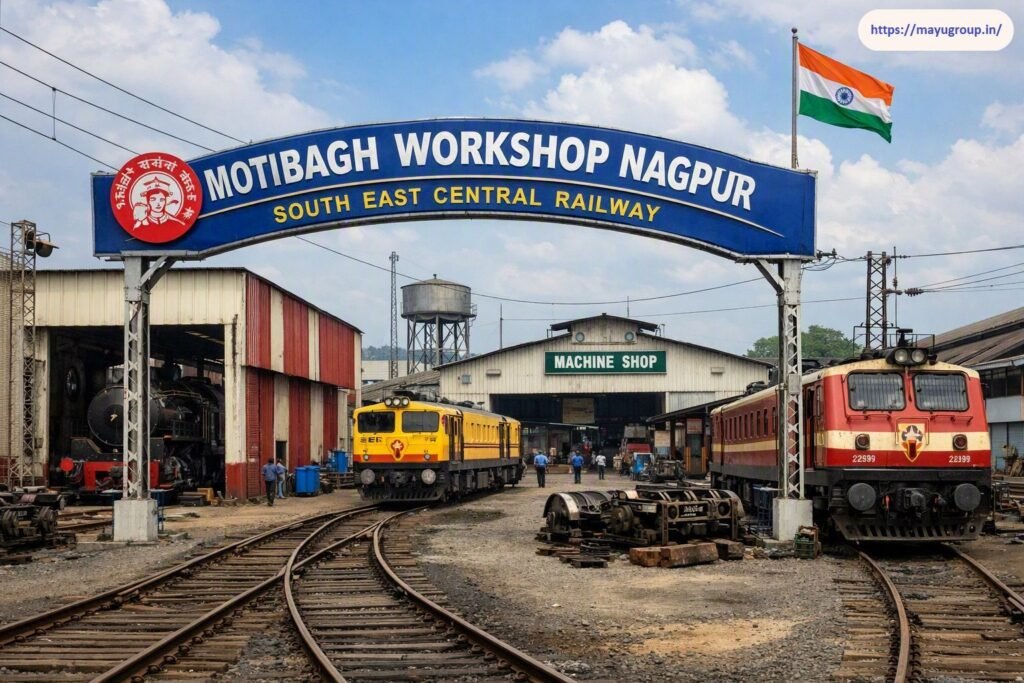
The history of Motibagh Workshop is a story of continuous adaptation. Established in 1879 to support metre-gauge railway operations in the Nagpur region, the workshop developed at a time when railway technology, infrastructure and operating practices were very different from those of today. Over the decades, however, Indian Railways underwent enormous transformation. Routes were converted to broad gauge, steam locomotives gradually disappeared, diesel and electric traction became dominant, and passenger coaches and their components became increasingly sophisticated.
For Motibagh Workshop, these changes created both challenges and opportunities. The workshop could not depend indefinitely on its original narrow-gauge responsibilities. Its continued relevance depended upon its ability to develop new technical capabilities and respond to the changing requirements of the railway system.
One of the most important changes was the gradual adoption of broad gauge. The Nagpur region had historically been served by metre-gauge railway routes, and Motibagh developed expertise in maintaining rolling stock associated with that system. However, as Indian Railways moved progressively toward a unified broad-gauge network, the nature of railway maintenance also changed.
Gauge conversion involved much more than replacing railway tracks. It changed the engineering environment throughout the railway organisation. Locomotives, coaches, wagons, bogies, workshop equipment and maintenance procedures had to be adapted. Employees required new knowledge, while workshops needed machinery and infrastructure capable of handling the new equipment.
For Motibagh, this transition represented a major test of institutional resilience.
An organisation with a long history can sometimes become dependent on traditional practices. The strength of Motibagh was that its accumulated experience could be combined with new engineering knowledge. The workshop’s technicians and engineers possessed practical understanding of railway equipment, while changing railway requirements encouraged them to acquire new skills.
This combination allowed the workshop to gradually move toward a new role.
Broad-gauge maintenance became increasingly important. The workshop’s responsibilities came to include activities related to the Periodical Overhauling of Broad Gauge Coaches and Tower Wagons. Periodical Overhauling, commonly referred to as POH, is a systematic maintenance process in which railway vehicles undergo detailed inspection, dismantling, repair, replacement and testing.
The purpose of such work is not merely to repair an obvious defect. A proper overhaul aims to identify deterioration before it becomes a serious operational problem. Components are examined, worn parts are repaired or replaced, and the vehicle is restored according to applicable railway requirements.
This represented a significant evolution from the workshop’s early history.
The same principle applied to bogie maintenance. The bogie is a critical mechanical assembly supporting the coach body and enabling the vehicle to move safely along the track. Motibagh’s scope included the overhaul of ICF and FIAT bogies, reflecting the workshop’s involvement with different generations of Indian railway passenger-coach technology.
Working on such equipment requires trained personnel, appropriate machinery, inspection facilities and disciplined processes. A small error in measurement, assembly or inspection can have consequences beyond the workshop itself. Therefore, the evolution toward modern bogie and coach maintenance also required the development of a stronger quality and safety culture.
Another important dimension of Motibagh’s transformation was the emergence of environmentally oriented railway activities.
Indian Railways began introducing bio-toilets and bio-digester technology as part of efforts to improve sanitation and reduce the environmental impact of conventional toilet systems. Motibagh became associated with the manufacturing of bio-digester tanks and inoculum for railway applications. A CAG performance audit records the establishment of an inoculum-generation facility at Motibagh in March 2014, with an installed capacity of 30,000 litres per month.
The introduction of this responsibility was significant because it demonstrated that the workshop was capable of moving beyond conventional mechanical maintenance into a field connecting engineering with environmental management.
Bio-digester technology requires a combination of fabrication, biological processes, quality control and operational understanding. The production of tanks and inoculum therefore created another area in which the workshop could contribute to the wider objectives of Indian Railways.
The development of these capabilities also changed the perception of what a railway workshop could be.
A traditional workshop might be viewed simply as a place where damaged components are repaired. A modern railway workshop is much more. It is an engineering centre where maintenance, manufacturing, inspection, safety, environmental responsibility, resource management and workforce development come together.
Motibagh’s transformation followed this broader model.
The workshop’s evolution was supported by its human resources. Experienced railway employees carried knowledge of older technologies, while younger generations brought familiarity with newer equipment and processes. Training became increasingly important because modern railway components required greater precision and specialised knowledge.
The transformation also required a change in management thinking. As machinery became more advanced and operations more complex, informal practices alone were no longer sufficient. Documented procedures, preventive maintenance, inspection records, performance monitoring and systematic reviews became increasingly important.
This shift laid the groundwork for the next stage of Motibagh’s development.
By moving from its historical narrow-gauge role toward broad-gauge maintenance, specialised bogie overhaul and bio-digester-related manufacturing, Motibagh demonstrated that heritage and modernisation could exist together. Its old identity was not erased; instead, its historical engineering culture became a foundation upon which new capabilities could be built.
The workshop’s journey also reflected a larger transformation taking place throughout Indian Railways. As railway operations expanded, expectations regarding safety, reliability, productivity and environmental performance increased. Workshops had to produce dependable results while using resources more efficiently.
Energy became one of those critical resources.
Coach overhaul, bogie maintenance, fabrication, welding, machining, lighting, testing and other industrial activities all require energy. As the scale and sophistication of workshop operations increased, controlling energy consumption became increasingly important.
The next major stage in Motibagh’s story would therefore involve not only what the workshop produced or repaired, but also how efficiently it used the resources required to perform that work.
This transition from traditional maintenance toward systematic resource management would eventually lead to the significance of ISO 50001:2011 certification in 2019, marking another important chapter in Motibagh Workshop’s continuing journey of modernisation and improvement.
#IndianRailways
Chapter 3 – Broad Gauge Maintenance and Engineering Excellence

The transformation of Motibagh Workshop from its historic narrow-gauge role into a modern railway maintenance facility represents one of the most important stages in its development. As Indian Railways progressively expanded the use of broad gauge and introduced newer generations of passenger rolling stock, workshops had to change their equipment, skills, procedures and management practices. Motibagh responded to this changing environment by developing capabilities for the maintenance and overhaul of broad-gauge coaches, tower wagons and important bogie assemblies.
The modern railway system depends upon maintenance facilities that can deliver reliable results consistently. Every passenger coach, maintenance vehicle and mechanical assembly that enters a workshop represents a responsibility. The vehicle must eventually return to service in a condition that supports safe and dependable railway operations. Consequently, workshop activities require engineering discipline, trained manpower, suitable machinery and effective inspection systems.
At Motibagh, Periodical Overhauling of Broad Gauge Coaches and Tower Wagons became an important part of its technical scope. Periodical Overhauling is a comprehensive maintenance activity rather than a simple repair operation. During an overhaul, a railway vehicle can undergo detailed examination of its mechanical, structural and service-related components. Defects are identified, components are repaired or replaced, and assemblies are checked before the vehicle is released for further service.
The process begins with planning and preparation. The vehicle must be received, documented and scheduled for appropriate work. Maintenance personnel review its condition and identify the activities required. The coach may then be systematically dismantled so that individual components can be inspected.
Cleaning is an important part of this process because accumulated dirt, grease, corrosion and deposits can conceal defects. Once components are accessible, technicians can examine them for wear, damage, cracks, distortion and other abnormalities.
Measurement and inspection are equally important. Railway components are manufactured within specified dimensions and tolerances. During service, repeated loading, vibration, friction and environmental exposure can gradually change their condition. Technicians therefore need to compare actual measurements with prescribed requirements and determine whether a component can continue in service, requires repair or must be replaced.
The bogie is one of the most critical areas of passenger-coach maintenance.
A bogie supports the coach body and incorporates wheels, axles, suspension elements, braking components and other mechanical assemblies. Its condition directly affects the running characteristics of the vehicle. Motibagh’s scope included the overhauling of ICF and FIAT bogies, giving the workshop responsibility for important passenger-coach running gear.
The ICF and FIAT bogie designs represent different stages in the development of Indian passenger rolling stock. Their maintenance requires familiarity with their construction, operating characteristics and specified maintenance requirements.
Bogie overhaul involves systematic dismantling, cleaning, inspection, measurement, repair and reassembly. Components that have reached unacceptable levels of wear or deterioration need appropriate action. After assembly, inspection and testing provide additional assurance that the bogie is fit for service.
This work demonstrates why a railway workshop must operate as an integrated system. A component cannot be considered in isolation. The condition of one assembly may influence another, and the final performance of the coach depends upon the correct interaction of numerous components.
Quality therefore becomes inseparable from maintenance.
The workshop’s technical activities also involve tower wagons, specialised railway vehicles used for maintenance and inspection-related activities associated with railway infrastructure. Their reliability is important because maintenance teams depend upon such equipment while carrying out work on the railway system.
The maintenance of tower wagons requires attention to both their mechanical condition and specialised equipment. Their role means that reliability cannot be treated as an optional feature. A properly maintained tower wagon contributes to the ability of railway personnel to undertake infrastructure-related activities effectively.
As Motibagh expanded its technical responsibilities, the importance of standardised work practices increased. Large-scale workshop activities involve many employees, machines and processes. Without standardisation, the quality of work can vary. Documented procedures help establish consistency and provide a basis for inspection and improvement.
Another major requirement is coordination.
Coach overhaul involves different stages that must occur in the correct sequence. Materials must be available when required. Components must move between workstations efficiently. Inspection must take place at appropriate points. Repair and fabrication activities must be coordinated with assembly. Delays at one stage can affect the entire maintenance cycle.
Effective planning therefore contributes directly to productivity.
The workshop’s development also required attention to machinery and infrastructure. Modern railway maintenance involves machining, welding, fabrication, lifting, testing, cleaning and other activities. Each process requires suitable equipment and appropriate operating practices.
This industrial environment also consumes significant amounts of energy. Electrical power is required for machine tools, welding equipment, lighting, compressors, material-handling systems and other workshop services. As the workshop developed more advanced capabilities, the need to manage energy consumption became increasingly relevant.
Energy management could not be separated from maintenance management. Equipment that is poorly maintained may consume more energy. Inefficient operating practices can increase consumption. Unnecessary idling of machinery can waste resources. Compressed-air leaks, inefficient lighting or inappropriate operating schedules can also contribute to energy losses.
Consequently, improving workshop efficiency meant looking beyond the immediate repair task.
The concept of engineering excellence gradually expanded to include resource efficiency. A successful workshop needed to produce quality work safely and within planned schedules while also controlling material, manpower and energy resources.
This broader perspective prepared Motibagh for an important management-system development: the adoption of ISO 50001:2011.
The certification, issued in 2019 according to the information provided for this case study, gave formal recognition to an energy-management approach. It complemented the workshop’s technical capabilities by encouraging systematic attention to energy performance.
The journey toward certification was therefore not an isolated event. It emerged naturally from the workshop’s long transformation.
A facility that had evolved from metre-gauge maintenance to broad-gauge coach overhaul, bogie overhaul and specialised manufacturing had already demonstrated its ability to change. ISO 50001 added another dimension to that evolution by focusing attention on how efficiently energy was used in support of those activities.
In this sense, Motibagh’s engineering excellence can be understood through three connected ideas: reliability of railway equipment, discipline of maintenance processes and responsible use of resources.
Together, these principles formed the foundation for the workshop’s next stage of development, in which energy management would become an organised part of its operational philosophy.
#SECRailway
Chapter 4 – The Environmental Mission of Motibagh Workshop
The transformation of Motibagh Workshop was not limited to the maintenance of railway coaches, tower wagons and bogies. Another important chapter in its development was its association with environmental and sanitation initiatives of Indian Railways. The manufacturing of bio-digester tanks and inoculum added a new dimension to the workshop’s technical responsibilities and demonstrated how railway engineering could contribute to environmental improvement.
For many years, railway sanitation presented a significant challenge. Conventional railway toilets discharged human waste directly onto the track. This practice created sanitation concerns, affected railway stations and surrounding areas, and contributed to corrosion and deterioration of railway infrastructure. As Indian Railways sought cleaner and more sustainable solutions, the development and installation of bio-toilet systems became an important initiative.
The concept of the bio-digester was based on biological treatment. Instead of allowing waste to fall directly onto the track, the system used a tank containing specially selected bacteria to break down human waste. The process could significantly reduce the environmental impact associated with conventional railway toilets when properly designed, installed and maintained.
Motibagh Workshop became involved in this important programme through the manufacturing of bio-digester tanks and inoculum for Indian Railways.
This was a significant development in the workshop’s history because it demonstrated the expansion of its capabilities beyond conventional mechanical maintenance. Manufacturing bio-digester equipment required fabrication expertise, material management, inspection, testing and process control. At the same time, the preparation of inoculum involved a biological component that was different from traditional railway engineering activities.
The involvement of Motibagh in inoculum generation is particularly noteworthy. A performance audit by the Comptroller and Auditor General of India recorded that an inoculum-generation facility was created at Motibagh in March 2014 with an installed capacity of 30,000 litres per month.
The facility represented an important investment in the environmental objectives of Indian Railways. It also demonstrated the railway organisation’s effort to use its existing workshops and technical institutions to support new programmes.
For Motibagh, the project required a different way of thinking.
Traditional workshop activities are generally based on mechanical processes. Components are fabricated, machined, repaired, assembled and tested. Bio-digester technology, by contrast, combines mechanical equipment with biological treatment. The tank provides the physical environment while the inoculum supplies the microorganisms required for the biological process.
This meant that quality and consistency were essential.
The bio-digester tank had to be manufactured appropriately so that it could withstand its intended railway application. Dimensions, fabrication quality, connections and other characteristics needed to meet the applicable requirements. Similarly, inoculum had to be generated and handled according to suitable procedures.
The project also illustrated the relationship between engineering and environmental responsibility.
A railway workshop traditionally exists to maintain railway equipment. But Indian Railways increasingly required its workshops to contribute to broader objectives such as cleanliness, sustainability and resource conservation. Motibagh’s bio-digester-related activities were part of this wider transition.
The initiative also had a direct connection with the cleanliness objectives that became increasingly visible across Indian Railways. Bio-toilets were intended to reduce direct discharge of human waste onto railway tracks. The technology therefore addressed not only sanitation but also the working environment around railway facilities.
For railway employees, cleaner working surroundings can contribute to improved workplace conditions. For passengers and communities located near railway routes, reducing waste discharge can support a cleaner environment.
However, technology alone cannot solve an environmental problem. Proper installation, maintenance, inspection and user awareness are also important. Bio-digesters require appropriate operation and maintenance to perform effectively. This again placed the responsibility of workshops like Motibagh within a larger system rather than a single manufacturing activity.
The bio-digester programme also demonstrated the value of institutional knowledge.
Motibagh already possessed experience in fabrication, mechanical maintenance and railway production processes. These capabilities could be redirected toward an emerging environmental requirement. In this way, the workshop did not need to start from zero. Its historical engineering foundation provided a platform for innovation.
The project also encouraged employees to think about the railway system from a broader perspective. A coach is not simply a vehicle that carries passengers. It includes sanitation systems, water systems, electrical equipment, mechanical components and numerous other facilities that influence passenger experience and environmental performance.
Therefore, improving a coach can mean improving more than its mechanical reliability.
The development of bio-digester tanks and inoculum also fitted naturally with the workshop’s later emphasis on resource management. Environmental performance and energy efficiency are different areas, but they share a common management philosophy: resources should be used responsibly, processes should be monitored, waste should be reduced and opportunities for improvement should be identified.
This philosophy became increasingly important as Motibagh modernised.
The workshop’s environmental role also helped demonstrate that industrial organisations can contribute to sustainability without abandoning their primary operational responsibilities. Coach overhaul, bogie maintenance, tower-wagon work and bio-digester manufacturing could exist within the same institutional framework because all supported the larger mission of Indian Railways.
The environmental mission therefore became another expression of Motibagh’s ability to adapt.
Its history began with the maintenance of railway rolling stock more than a century ago. Over time, its responsibilities expanded in response to technological and social needs. Bio-digester technology represented a response to one of the railway system’s environmental challenges.
The significance of this development extends beyond the equipment itself. It represents a change in organisational thinking—from simply maintaining railway assets to considering the environmental consequences of railway operations.
By participating in bio-digester tank and inoculum manufacturing, Motibagh became part of an important effort to make railway sanitation more sustainable. The initiative added environmental responsibility to the workshop’s established strengths in engineering and maintenance.
This experience also provided an important foundation for the next phase of Motibagh’s development. As the workshop expanded its technical activities and environmental responsibilities, the efficient use of energy became increasingly important.
The question was no longer only how to maintain railway equipment effectively, but also how to perform increasingly complex industrial work while using energy and other resources efficiently.
That question would become central to the workshop’s journey toward ISO 50001:2011 certification in 2019, which introduced a more structured approach to energy performance and continual improvement.
#RailwayWorkshop
Chapter 5 – The Need for Energy Management
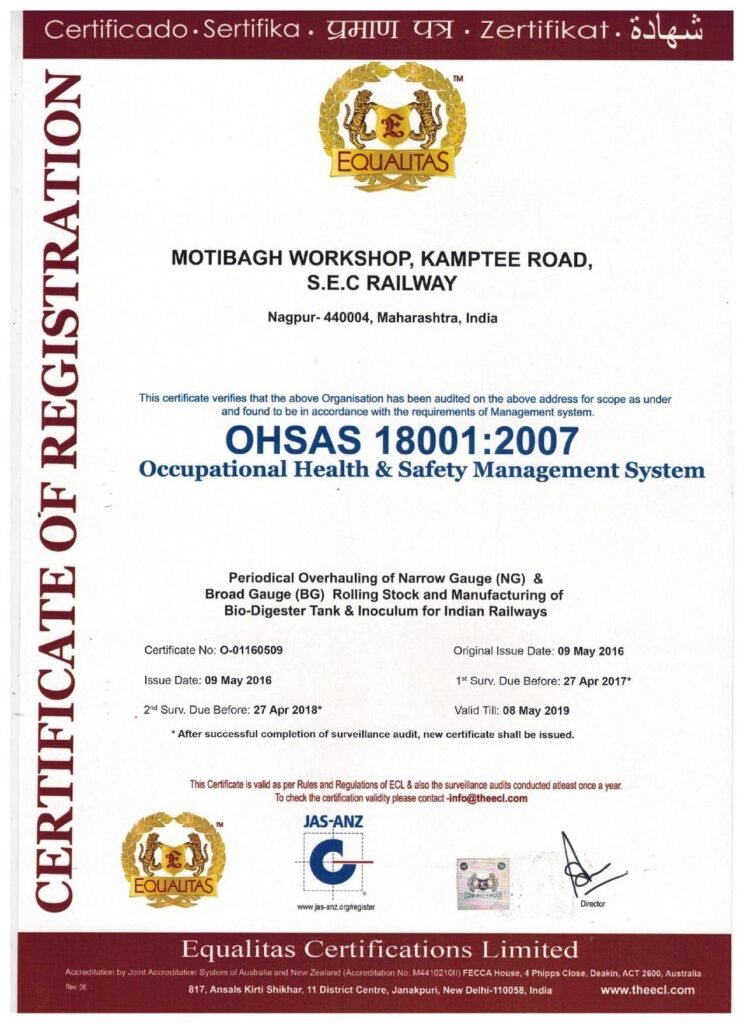
As Motibagh Workshop expanded its technical responsibilities, the importance of energy management became increasingly clear. A modern railway workshop is an energy-intensive industrial environment. Its activities involve machinery, welding, machining, lifting equipment, compressors, lighting, ventilation, testing facilities and numerous auxiliary systems. Every stage of coach overhaul, bogie maintenance, tower-wagon repair and manufacturing requires resources, and energy is one of the most important.
For an organisation with a long industrial history such as Motibagh, energy management represented more than an attempt to reduce electricity consumption. It was part of a broader transition toward systematic operational efficiency. The objective was to understand where energy was being consumed, why it was being consumed and how performance could be improved without compromising safety, quality or productivity.
The development of modern railway maintenance facilities had increased the importance of this issue. Earlier workshop operations relied heavily on manual skills and relatively simple mechanical equipment. Over time, however, machinery became more sophisticated. Electrical equipment became an essential part of production and maintenance. Welding machines, machine tools, cranes, compressors, pumps, lighting systems and other equipment all contributed to the workshop’s energy demand.
With increasing technical capability came increasing responsibility.
Energy that is unnecessarily consumed represents a cost and, more broadly, an inefficient use of resources. An idle machine that remains switched on, compressed air escaping through a leak, inefficient lighting, poorly maintained equipment or inappropriate operating schedules can all result in avoidable consumption.
Therefore, energy efficiency begins with awareness.
Employees who understand the importance of energy can make practical decisions during daily operations. Machines can be switched off when not required. Maintenance teams can identify equipment operating outside normal conditions. Supervisors can monitor consumption patterns. Engineers can evaluate opportunities for improvement. Management can establish objectives and review performance.
These activities become much more effective when they are organised through a formal management system.
This was the importance of ISO 50001:2011 in the context of Motibagh Workshop. ISO 50001 is an international standard for establishing, implementing, maintaining and improving an Energy Management System. Its fundamental purpose is to help organisations develop a systematic approach to improving energy performance.
For Motibagh, adopting such a system was consistent with its continuing history of modernisation.
The workshop had already learned to manage complex maintenance activities through planned procedures. The same discipline could be applied to energy. Instead of treating energy consumption as a fixed overhead, it could be treated as a measurable operational parameter.
The first requirement in such an approach is understanding energy use.
A workshop cannot improve what it does not measure or understand. Different areas may have different consumption patterns. Heavy machinery may consume significant amounts of electricity during certain operations, while lighting and auxiliary services may contribute continuously. By examining these patterns, an organisation can identify significant energy uses and determine where improvement efforts are likely to produce the greatest benefits.
This approach encourages prioritisation.
Not every piece of equipment requires the same level of attention. Energy-intensive machinery deserves closer monitoring, while smaller loads may be managed through simpler practices. Such prioritisation allows resources to be directed toward areas with meaningful potential for improvement.
Maintenance also plays an important role.
Efficient energy management and equipment maintenance are closely connected. A machine operating under abnormal conditions may require more energy to perform the same task. Motors, compressors, pumps and other equipment can lose efficiency when poorly maintained. Regular inspection and preventive maintenance can therefore contribute to both reliability and energy performance.
This is especially relevant in a railway workshop, where equipment reliability is essential.
A failed machine can delay maintenance work and create additional operational demands. Effective preventive maintenance reduces the likelihood of unexpected failures while supporting efficient operation.
Employee training is another important element.
An energy management system cannot succeed as a management-office exercise alone. The people operating machinery every day are often the first to notice abnormal conditions. A technician may identify a compressor running unnecessarily, a machine remaining idle, a lighting area that does not require continuous illumination or another source of avoidable consumption.
Creating channels through which such observations can be reported encourages participation.
Energy management can therefore become part of workplace culture.
The certification information supplied for this case study indicates that Motibagh Workshop achieved ISO 50001:2011 certification in 2019, with validity through 2022. This milestone can be viewed as formal recognition of the workshop’s structured approach toward energy management during that period.
Certification itself, however, should not be regarded as the final objective. An effective management system depends on continual improvement. Energy performance needs to be monitored, objectives reviewed and corrective actions taken when results do not meet expectations.
This philosophy is particularly relevant to a workshop because operational conditions can change. New machinery may be installed. Production requirements may increase or decrease. Maintenance schedules may change. Older equipment may be replaced. New technologies may become available.
An energy management system therefore needs to remain dynamic.
The value of ISO 50001 also lies in connecting energy objectives with everyday operational decision-making. When purchasing equipment, energy performance can be considered. When planning maintenance, efficiency can be included alongside reliability. When reviewing production processes, energy consumption can become one of the performance indicators.
This integrated approach can produce benefits beyond energy savings.
Efficient operation may reduce operating costs. Better maintenance may increase equipment life. Improved monitoring may identify faults earlier. Employee awareness may strengthen workplace discipline. Reduced energy consumption can also support environmental objectives.
For Motibagh, this was particularly meaningful because the workshop had already developed an environmental dimension through its involvement in bio-digester tanks and inoculum. Energy management provided another mechanism through which the workshop could contribute to more responsible railway operations.
The movement toward energy management therefore represented a natural continuation of Motibagh’s long transformation.
The workshop had evolved technologically, expanded its maintenance responsibilities and participated in environmental initiatives. The next logical step was to manage the resources supporting these activities more systematically.
The 2019 ISO 50001:2011 certification became an important milestone in that journey. It reflected an organisational commitment to measuring energy performance, improving efficiency and developing a culture in which every employee could contribute to responsible resource use.
#ISO50001
Chapter 6 – The 2019 Certification Turning Point
The year 2019 represented an important stage in the continuing development of Motibagh Workshop. After decades of technological change, expansion of maintenance responsibilities and participation in environmental initiatives, the workshop entered a new phase in its management journey through the adoption of ISO 50001:2011 for energy management, according to the certification details supplied for this case study.
For an institution with a long industrial history, certification is significant because it introduces a structured framework around activities that may previously have been managed through individual procedures and established practices. The purpose is not simply to obtain a certificate. The deeper objective is to create a system through which energy performance can be understood, monitored and continually improved.
Motibagh’s certification journey can therefore be viewed as part of its larger transformation from a traditional railway workshop into a modern engineering organisation.
The workshop’s operations required substantial energy. Periodical Overhauling of Broad Gauge Coaches and Tower Wagons involved numerous stages, including inspection, cleaning, repair, fabrication, machining, welding, testing and assembly. ICF and FIAT bogie overhaul similarly required machinery and inspection facilities. Bio-digester tank manufacturing involved fabrication and associated industrial processes.
Each of these activities consumed energy.
Before a management system can improve energy performance, an organisation must first understand how energy is used. This involves identifying significant energy-consuming activities and examining operating patterns. In a workshop environment, different machines may have dramatically different energy requirements. Some equipment may operate for long periods, while other machinery may be used only for specific maintenance activities.
This understanding helps management establish priorities.
The certification process also encourages an organisation to establish energy objectives and targets. Instead of considering energy efficiency as a general aspiration, specific areas can be identified for improvement. Progress can then be monitored and reviewed.
This creates accountability.
When responsibilities are clearly assigned, energy management becomes part of the organisation’s operational structure rather than an occasional campaign. Engineers, supervisors, technicians and support personnel can each have roles in maintaining the system.
At Motibagh, this approach could be particularly valuable because workshop operations involve a large number of interconnected activities. Energy consumed at one stage may influence the efficiency of another. For example, poorly maintained equipment may consume more energy and simultaneously create production delays. An inefficient compressor may affect pneumatic tools. Inadequate lighting management may result in unnecessary consumption without contributing to productivity.
Systematic monitoring can help reveal these issues.
The certification process also supports the principle of continual improvement. A workshop does not become energy-efficient simply because it receives a certificate. Conditions change continuously. Equipment ages, production requirements vary, new machinery is introduced and technology improves.
Consequently, energy performance must be reviewed repeatedly.
This is where the management cycle becomes important. The organisation can establish objectives, implement operational controls, monitor performance, evaluate results and take corrective or improvement actions. The cycle then begins again.
Such a process fits naturally with railway maintenance culture.
Railway workshops already depend upon inspection, preventive maintenance, defect identification and corrective action. Energy management applies a similar discipline to the use of energy resources.
For employees, certification can also create greater awareness.
A technician who understands the energy implications of operating machinery may become more careful about unnecessary idling. A supervisor may pay closer attention to operating schedules. Maintenance staff may consider energy performance when inspecting equipment. Engineers may evaluate efficiency when proposing improvements.
Small actions can become meaningful when repeated across a large organisation.
Another important feature of energy management is the relationship between energy efficiency and maintenance.
Equipment in a railway workshop must be maintained not only to prevent breakdowns but also to ensure efficient operation. Motors, compressors, pumps, machine tools and electrical systems can lose efficiency if they are neglected. Preventive maintenance can therefore contribute simultaneously to equipment reliability, productivity and energy performance.
The 2019 certification also had an important symbolic value.
Motibagh had a history stretching back to the nineteenth century. Obtaining recognition under a modern international management standard demonstrated that historical institutions can adopt contemporary systems without losing their identity. Instead, modern management practices can strengthen the institution’s ability to fulfil its traditional mission.
The certification was therefore not a rejection of Motibagh’s heritage. It was an extension of that heritage.
The workshop had already survived major changes in railway technology. It had moved from metre-gauge activities toward broad-gauge work and developed expertise in modern coach and bogie maintenance. It had also taken on environmental responsibilities through bio-digester-related manufacturing. ISO 50001 added energy performance to this continuing process of adaptation.
The period between 2019 and 2022 can consequently be understood as an important phase in the development of a more structured energy-management culture, based on the validity information supplied.
However, the real test of certification is what happens after the certificate is issued.
A management system becomes meaningful only when it changes everyday behaviour and decision-making. Energy objectives must be translated into practical actions. Monitoring must produce useful information. Findings must lead to corrective measures. Employees must remain engaged.
For a railway workshop, these principles can have a wide impact.
Improved energy efficiency can reduce unnecessary operating expenditure. Better equipment performance can support productivity. Reduced energy consumption can contribute to environmental objectives. More systematic maintenance can increase reliability. Employee awareness can improve operational discipline.
Thus, the potential benefits of ISO 50001 extend beyond the electricity bill.
Certification can encourage a culture in which efficiency becomes part of engineering thinking. When a new machine is considered, its energy performance can be evaluated. When an existing machine is maintained, its operating efficiency can be considered. When a production process is redesigned, energy use can become one of the criteria for evaluating the new arrangement.
This approach is particularly valuable for an organisation such as Motibagh, where technical decisions have long-term consequences.
The 2019 certification therefore represents more than a date in the workshop’s history. It represents a change in emphasis—from managing energy informally to managing it through a structured system.
The workshop’s journey illustrates an important lesson for industrial organisations: growth is not measured only by the number of machines, the quantity of work or the expansion of facilities. True organisational growth also includes improved systems, stronger awareness, better resource management and the ability to deliver reliable results with greater efficiency.
Motibagh’s ISO 50001:2011 milestone reflected this broader concept of growth.
It connected the workshop’s historic engineering capabilities with the modern principles of energy efficiency and continual improvement. It also prepared the organisation for a future in which railway workshops would increasingly be expected to balance quality, safety, productivity, environmental responsibility and efficient resource utilisation.
The next stage of the story is therefore the people who made this transformation possible. Behind every certificate, machine and management system are engineers, supervisors, technicians and workers whose daily decisions determine whether improvement becomes a permanent part of organisational culture.
#EnergyManagement
Chapter 7 – The People Behind the Transformation

Every successful railway workshop is ultimately built by people. Machines, buildings, management systems and certificates provide essential support, but it is the workforce that converts these resources into dependable engineering performance. The transformation of Motibagh Workshop from its historical narrow-gauge role into a modern facility involved generations of railway employees whose knowledge, discipline and willingness to adapt became central to its development.
The workshop’s history began in the nineteenth century, when railway maintenance depended heavily on practical craftsmanship. Mechanics, fitters, machinists, welders, inspectors and supervisors learned their trades through experience and close association with railway equipment. Their knowledge was often practical and highly specialised. Understanding the sound of a machine, recognising unusual wear or identifying a developing mechanical problem could be as important as following a written procedure.
As railway technology changed, this practical knowledge had to evolve.
The movement from metre-gauge operations toward broad-gauge maintenance required employees to understand new equipment and new maintenance requirements. Later, the introduction of more advanced passenger coaches and bogie designs brought additional technical challenges.
Motibagh’s workforce therefore had to become a workforce of continuous learners.
The modern railway environment demands a combination of experience and formal technical knowledge. Employees need to understand equipment specifications, inspection requirements, safety procedures, maintenance schedules and quality controls. At the same time, practical experience remains valuable because railway equipment operates in real-world conditions that cannot always be understood through theory alone.
The combination of these two forms of knowledge became one of the workshop’s important strengths.
For Periodical Overhauling of Broad Gauge Coaches, employees are involved in numerous stages of work. Technicians may inspect components, dismantle assemblies, carry out repairs, assist in fabrication and participate in reassembly. Inspectors verify conditions and measurements. Supervisors coordinate activities and ensure that work progresses according to planned requirements.
Each employee contributes to the final result.
Bogie overhaul provides another example. ICF and FIAT bogies contain numerous components that must function together correctly. Employees handling these assemblies require attention to detail because inspection, measurement and assembly quality are essential to reliable operation.
The same principle applies to tower wagons. These specialised railway vehicles support operational and maintenance activities, making their reliability important to the wider railway system.
As Motibagh’s responsibilities expanded into bio-digester tank and inoculum-related work, employees encountered an additional area of technical activity. The manufacturing of bio-digester tanks required fabrication and engineering skills, while inoculum generation involved processes different from conventional mechanical workshop work.
Such diversification required organisational flexibility.
Employees had to understand that their work was connected to broader railway objectives. A coach overhaul contributes to passenger service reliability. Bogie maintenance supports safe vehicle operation. Tower-wagon maintenance supports railway infrastructure activities. Bio-digester work contributes to sanitation and environmental objectives.
This broader understanding can strengthen employee motivation.
The introduction of ISO 50001:2011 added another responsibility: energy awareness.
Energy management cannot be successful if it remains confined to senior management. Employees operating machines every day are directly involved in energy consumption. Their behaviour can influence whether energy is used efficiently.
Consider a typical workshop environment. A machine may be required for a particular job for several hours, but there may also be periods when it remains idle. Lighting may be needed in one work area while another area is temporarily unused. Compressed-air equipment may operate continuously even when demand is low. Equipment may develop faults that increase energy consumption.
Employees who are trained to recognise such situations can become an important part of the energy-management system.
This is why awareness and training are fundamental to certification.
An effective Energy Management System should encourage employees to understand the organisation’s energy objectives and their individual responsibilities. Training can explain why unnecessary consumption matters, how equipment should be operated and what types of abnormal conditions should be reported.
The result is a culture in which energy efficiency becomes part of normal work rather than an additional task.
The workforce also plays an important role in continual improvement.
Employees working directly with equipment often understand practical problems better than anyone else. They may know that a particular machine requires excessive warm-up time, that a compressor frequently runs without load, that a lighting arrangement is inefficient or that a process could be reorganised.
Management systems can provide mechanisms through which such observations become improvement opportunities.
This approach can create a positive cycle. Employees identify an opportunity. Supervisors evaluate it. Engineers develop a solution. Management provides resources. The change is implemented and monitored. If performance improves, the new practice can become part of the standard operating system.
Such cycles gradually strengthen the organisation.
Leadership is equally important. Managers and senior engineers establish priorities, allocate resources and communicate expectations. If management treats energy efficiency as important, employees are more likely to take it seriously. If management integrates energy objectives into planning and reviews performance regularly, the system gains credibility.
The success of certification therefore depends upon leadership and workforce participation together.
Another important factor is safety.
Railway workshop activities involve heavy machinery, lifting operations, welding, electrical systems and complex mechanical equipment. Employees must balance efficiency with safe working practices. Energy-saving measures must never compromise safety or the quality of railway maintenance.
This is why a mature management system considers multiple objectives simultaneously.
The workforce at Motibagh also represents continuity. Employees may retire, new employees may join and technology may change, but institutional knowledge can be preserved through training, documentation and mentoring. Experienced workers can transfer practical knowledge to younger employees, while younger employees can introduce familiarity with newer technologies.
This exchange helps an old institution remain modern.
The story of Motibagh’s development is therefore inseparable from its people. Its historic survival cannot be explained only by infrastructure or machinery. It survived because railway employees repeatedly adapted to new circumstances.
The 2019 ISO 50001:2011 certification should be understood in the same way. The certificate represented a formal management achievement, but its practical success depended upon people implementing the system every day.
Engineers planned. Supervisors coordinated. Technicians operated and maintained equipment. Inspectors verified results. Managers reviewed performance. Support staff helped maintain the organisational framework.
Together, they transformed energy management from a concept into a working practice.
The greatest lesson is that technology and certification can provide a framework, but people create lasting improvement. Motibagh’s future therefore depends not only on modern machines and standards, but also on continued investment in skills, awareness, teamwork and innovation.
As the workshop moves forward, its most valuable resource remains the same resource that supported it from its earliest years: its people.
#SustainableRailways
Chapter 8 – Growth Through Diversification and Modernisation
The growth of Motibagh Workshop can best be understood as a process of continuous diversification. Its development did not occur through one dramatic change. Instead, the workshop gradually expanded its responsibilities, technical capabilities and management systems in response to the changing needs of Indian Railways.
From its origins in the nineteenth century as a workshop associated with metre-gauge railway operations, Motibagh developed into a facility undertaking broad-gauge coach and tower-wagon overhaul, ICF and FIAT bogie overhaul, and the manufacturing of bio-digester tanks and inoculum. The adoption of an ISO 50001:2011 Energy Management System in 2019 added another dimension to this development.
This transformation illustrates how a historic railway institution can remain relevant by continually developing new capabilities.
The first major stage of diversification came with the changing railway gauge system. As broad gauge became increasingly dominant, workshops associated with older railway technologies faced the possibility of declining relevance. Motibagh responded by adapting its capabilities to the new railway environment.
Broad-gauge coach maintenance became an important part of its operational role. This required new knowledge, equipment and processes. The workshop had to understand the characteristics of broad-gauge rolling stock and develop the capability to perform detailed maintenance and overhaul.
Periodical Overhauling became a major technical activity. Unlike minor repair work, an overhaul requires systematic examination of a vehicle and its components. This creates opportunities to identify deterioration before it becomes an operational problem.
The same principle applies to bogie overhaul.
ICF and FIAT bogies represent significant elements of passenger rolling stock. Their maintenance requires precision, appropriate inspection facilities and trained employees. By developing capabilities in this field, Motibagh expanded its role in supporting the reliability of passenger coaches.
Tower-wagon maintenance added another specialised responsibility. These vehicles support railway infrastructure and maintenance operations. Their availability and reliability can influence the ability of railway teams to undertake important work.
Diversification into these activities strengthened the workshop’s technical base.
The next major development was its involvement in bio-digester technology. The manufacturing of bio-digester tanks and inoculum represented a move beyond traditional mechanical railway maintenance. It connected the workshop with Indian Railways’ efforts to improve sanitation and reduce environmental impact.
A CAG report records that an inoculum-generation facility was established at Motibagh in March 2014 with an installed capacity of 30,000 litres per month.
This activity was significant because it demonstrated that railway workshops could contribute to environmental programmes using their existing engineering and manufacturing capabilities.
Diversification also creates organisational benefits.
When an institution develops expertise in multiple related areas, employees gain exposure to different technologies and processes. Engineering knowledge can move between activities. Fabrication skills developed in one area may support another. Inspection and quality-control practices can be applied across different products.
Such knowledge sharing can strengthen the organisation as a whole.
However, diversification also creates management challenges. More activities mean more equipment, more materials, more schedules and more coordination. Without effective management, complexity can reduce productivity.
This is where modern management systems become important.
The development of an Energy Management System under ISO 50001:2011 provided a framework for managing one of the resources common to all workshop activities: energy.
Whether the workshop was repairing a bogie, overhauling a coach, maintaining a tower wagon or manufacturing a bio-digester tank, energy was required at different stages. By managing energy systematically, the organisation could seek improvements across multiple operational areas.
This created a connection between diversification and energy efficiency.
A larger range of activities does not automatically mean greater efficiency. In fact, additional activities can increase energy demand. The challenge is to ensure that growth is accompanied by better resource management.
For example, modern equipment can sometimes perform work faster and more efficiently than older machinery. Preventive maintenance can keep equipment operating near its intended efficiency. Better scheduling can reduce unnecessary machine operation. Improved awareness can reduce avoidable energy use.
These improvements can support productivity while also contributing to environmental goals.
The 2019 certification therefore formed part of a larger pattern of modernisation.
Modernisation is often associated with new machines, but it is equally about new ways of managing existing resources. A workshop can purchase advanced equipment and still operate inefficiently if processes are poorly planned. Conversely, systematic management can produce significant improvements even without major infrastructure changes.
Motibagh’s history illustrates both sides.
Its technical evolution required new equipment and new skills. Its management evolution required new procedures, measurement and performance review.
Another aspect of growth is the ability to support changing railway technology. Indian Railways has progressively introduced newer generations of passenger coaches and maintenance systems. Workshops must therefore remain adaptable.
The development of LHB coach maintenance capabilities, reported in connection with Motibagh’s later transformation, provides an example of this continuing technological adaptation. Contemporary reporting described the workshop being transformed into an LHB coach maintenance facility.
This demonstrates that Motibagh’s development did not stop with the responsibilities listed in its earlier phases. The workshop continued to respond to new rolling-stock requirements.
Growth therefore became a continuous process rather than a single achievement.
There is also an important institutional dimension to this story. Motibagh’s long history means that it contains a valuable legacy of railway engineering knowledge. Modernisation does not require abandoning that history. Instead, historical knowledge can be combined with contemporary technology and management systems.
This combination can create a strong organisational identity.
The workshop’s story also demonstrates that diversification can support resilience. When railway requirements change, an organisation with broader capabilities may be better positioned to respond. Skills in coach maintenance, bogie overhaul, fabrication, specialised vehicles and environmental equipment create a wider technical foundation.
But diversification must always remain connected to quality and safety.
Every new activity brings responsibility. Railway equipment must meet applicable requirements. Manufacturing must be controlled. Inspection must be effective. Employees must be trained. Processes must be documented and reviewed.
Thus, growth should never mean simply doing more work. It should mean doing more work with greater capability, discipline and responsibility.
The ISO 50001 approach reinforced this philosophy by adding energy performance to the workshop’s broader operational considerations. Energy management encouraged the organisation to think about efficiency not as an isolated environmental issue but as an integral part of engineering management.
The journey of Motibagh therefore provides an example of institutional growth through adaptation.
Its development can be represented as a sequence: historical railway maintenance, transition to new gauge and rolling-stock requirements, expansion into specialised overhaul, participation in environmental manufacturing, development of modern management systems and continued technological adaptation.
Each stage built upon the previous one.
The workshop’s greatest achievement is consequently not one particular machine, product or certificate. It is the ability to remain useful while the railway system around it changes.
By 2019, Motibagh had reached a stage where engineering capability and resource management could be brought together through ISO 50001:2011. The certification became one more milestone in a much longer story of growth.
The next chapter examines the deeper significance of certification—not simply as formal recognition, but as a culture of continual improvement capable of influencing quality, productivity, environmental responsibility and long-term organisational performance.
#GreenRailways
Chapter 9 – Certification as a Culture of Continual Improvement
Certification is often viewed as a formal achievement, represented by a document issued after an organisation demonstrates conformity with a recognised standard. For Motibagh Workshop, however, the importance of ISO 50001:2011 certification can be understood more deeply. The certification represented an opportunity to strengthen a culture of systematic energy management, operational discipline and continual improvement.
According to the certification information supplied for this case study, Motibagh Workshop received ISO 50001:2011 certification in 2019, with validity through 2022. The significance of this milestone becomes clearer when it is placed within the workshop’s long history of technological and organisational transformation.
Motibagh had already demonstrated its ability to change. Its origins were connected with metre-gauge railway operations, while its later responsibilities included broad-gauge coach and tower-wagon overhaul, ICF and FIAT bogie overhaul, and manufacturing activities related to bio-digesters and inoculum. The Energy Management System therefore represented another step in an established pattern of adaptation.
The fundamental principle behind continual improvement is simple: an organisation should never assume that its present performance is the best possible performance.
Even when a process works satisfactorily, there may be opportunities to make it safer, faster, more reliable, more economical or more environmentally responsible. Improvement begins by identifying the present condition and then asking how it can be made better.
In an industrial workshop, this philosophy can be applied to almost every activity.
A machine may be operating correctly but consuming more energy than necessary. A maintenance process may produce acceptable results but require excessive time. A material-handling arrangement may work but involve unnecessary movement. A lighting system may provide adequate illumination but operate when areas are unoccupied.
Each observation can become an improvement opportunity.
ISO 50001 provides a structured approach to identifying and managing such opportunities in relation to energy performance. Instead of relying only on individual initiative, an organisation can establish responsibilities, objectives, monitoring processes and review mechanisms.
This structure creates consistency.
One important element is measurement. Energy consumption must be understood through appropriate monitoring and evaluation. Measurements can help management identify changes in performance and determine whether improvement actions are producing the expected results.
For Motibagh, this could be particularly valuable because workshop operations are varied. Different departments may have different energy requirements, operating schedules and equipment. A systematic approach allows energy performance to be considered at the level where useful decisions can be made.
Another important principle is the identification of significant energy uses.
Not every activity contributes equally to total energy consumption. Large machinery and continuous-load systems may have much greater significance than small intermittent equipment. Identifying major consumers helps management focus attention where improvement can have the greatest effect.
This is an important lesson in resource management: improvement does not necessarily require changing everything. It requires identifying the areas that matter most.
Operational control is equally important.
Once improvement opportunities have been identified, appropriate procedures and practices need to be established. Employees must understand how equipment should be operated and maintained. Supervisors must monitor compliance. Management must review results.
The system becomes effective when these activities work together.
Employee participation is especially important. Energy management cannot succeed solely through technical departments or senior management. The people who operate machines and manage daily activities have direct influence over energy performance.
An employee may notice that a machine is being left running unnecessarily. A maintenance technician may identify an inefficient motor. An engineer may recognise that a process can be redesigned. A supervisor may improve scheduling so that equipment is not operating without productive work.
These individual actions can accumulate into substantial organisational improvement.
Certification can help create an environment in which such observations are valued.
Another benefit is improved accountability. When energy objectives are formally established, responsibilities can be assigned and progress can be reviewed. This creates a clear connection between management decisions and operational results.
The approach can also strengthen financial awareness.
Energy is an operating resource, and reducing unnecessary consumption can contribute to cost efficiency. However, the objective should not be to reduce energy use blindly. A railway workshop must maintain safety and quality. If energy reduction compromises the required engineering process, the result is not genuine improvement.
The goal is therefore efficient energy use, not simply lower consumption.
For example, replacing inefficient equipment may reduce energy consumption while improving productivity. Preventive maintenance may reduce energy losses while increasing reliability. Better scheduling may reduce idle operation without reducing output.
This demonstrates why energy management should be integrated with engineering management.
The environmental dimension is also important.
Reduced energy consumption can contribute to lower environmental impact, particularly when energy is generated from sources associated with greenhouse-gas emissions. For a workshop already involved in bio-digester-related environmental initiatives, systematic energy management could strengthen its broader sustainability philosophy.
Certification can therefore create connections between different organisational objectives.
Quality, safety, productivity, environmental responsibility and energy performance do not necessarily have to be treated as separate subjects. In a mature organisation, they can reinforce each other.
A well-maintained machine is often safer and more energy-efficient. A well-planned process can improve productivity while reducing unnecessary energy use. A trained workforce can improve quality while also recognising waste and inefficiency.
This integrated perspective is particularly valuable for Motibagh because of its diverse responsibilities.
Coach overhaul requires quality and reliability. Bogie overhaul requires precision and safety. Tower-wagon maintenance requires dependable specialised equipment. Bio-digester manufacturing requires environmental awareness. Energy management provides a common framework for improving resource efficiency across these activities.
The 2019 certification thus represents more than compliance.
Compliance demonstrates that a management system meets defined requirements at a particular point in time. Continual improvement means maintaining that discipline afterward.
The period of certification validity through 2022, as supplied for this case study, can therefore be understood as a period in which the system provided a structured basis for monitoring and improving energy performance.
The long-term value of such a system depends on organisational commitment. Standards can provide the framework, but leadership and employees determine whether the framework becomes part of daily practice.
Motibagh’s historical experience makes this particularly meaningful. An organisation that has survived for generations understands that improvement is not a one-time project. Railway technology changes, equipment changes, regulations change and operational requirements change. The ability to adapt must therefore become part of the institution itself.
This is the deeper meaning of certification.
The certificate may have a defined issue date and validity period, but the culture it encourages can continue beyond those dates. Energy awareness can remain part of employee behaviour. Monitoring practices can remain useful. Maintenance improvements can continue. Lessons learned can influence future investments.
Motibagh’s journey demonstrates that a management system is most valuable when it becomes embedded in organisational thinking.
The workshop’s growth after certification should therefore not be measured only by immediate energy savings or by the presence of a certificate. Its wider significance lies in developing a mindset of measure, understand, improve and review.
That mindset connects Motibagh’s nineteenth-century heritage with the requirements of modern railway engineering.
As the workshop continues to evolve, continual improvement can remain one of its strongest foundations. New technologies can be evaluated, processes can be refined, employees can be trained and resources can be managed more effectively.
In this way, ISO 50001:2011 becomes part of a much larger story—a story in which Motibagh Workshop continually renews itself while remaining faithful to its fundamental purpose of supporting safe, reliable and efficient railway operations.
#RailwayEngineering
Chapter 10 – The Road Ahead: Legacy, Sustainability and Future Growth
The story of Motibagh Workshop, Nagpur, is ultimately a story of transformation. From its establishment in 1879 to its role in modern railway maintenance and manufacturing, the workshop has experienced more than a century of technological, operational and organisational change. Its journey demonstrates how a historic institution can remain relevant by adapting to new requirements while preserving the knowledge and experience accumulated over generations.
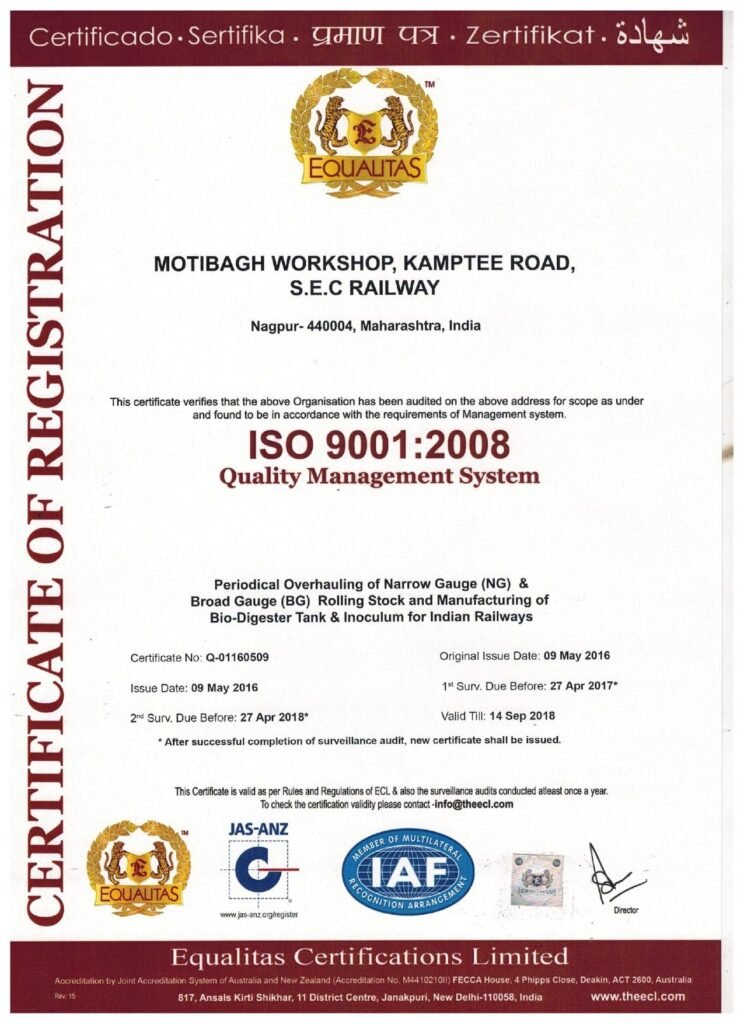
The information supplied for this case study identifies ISO 50001:2011 as an important milestone, with certification issued in 2019 and validity through 2022. The significance of this certification lies not simply in the achievement of a recognised standard, but in what an Energy Management System can contribute to the workshop’s continuing development.
Motibagh’s future is closely connected with the future of Indian Railways. Railway technology continues to evolve. Passenger coaches become more advanced, maintenance methods become more sophisticated and expectations concerning safety, reliability, environmental responsibility and efficiency continue to increase.
A modern railway workshop must therefore be prepared for continuous change.
One of the most important foundations for future growth is technological capability. Coach and bogie maintenance will continue to require trained personnel, accurate inspection systems, modern machinery and effective testing facilities. As new rolling-stock technologies are introduced, workshops must develop the knowledge necessary to maintain them.
For Motibagh, this means that its historical engineering expertise must continue to evolve.
The workshop’s experience in Periodical Overhauling of Broad Gauge Coaches and Tower Wagons and in ICF and FIAT bogie overhaul provides a strong foundation. At the same time, newer generations of passenger coaches and railway equipment require continuous learning.
Training will therefore remain essential.
Future railway maintenance will increasingly depend upon a combination of practical engineering knowledge, digital systems, advanced inspection techniques and data-based decision-making. Employees will need opportunities to understand new technologies while retaining the practical skills that have historically supported railway maintenance.
Another major opportunity lies in energy efficiency.
The ISO 50001 approach provides a framework for considering energy as a managed resource rather than simply an unavoidable operating expense. Future improvements could involve more efficient machinery, better maintenance, improved lighting systems, optimised operating schedules, reduction of idle running and greater awareness of energy performance.
Energy management can also influence future procurement decisions.
When new equipment is considered, its purchase price is only one factor. Its energy consumption, maintenance requirements, expected service life and overall operating cost can also be evaluated. A machine that costs more initially but operates efficiently and reliably may provide greater long-term value.
Such thinking represents the maturity of an energy-management culture.
Digitalisation may further strengthen this process. Modern monitoring systems can provide information about energy consumption and equipment performance. Data can help identify unusual patterns and highlight opportunities for improvement.
For a large workshop, reliable information can support better decisions.
Instead of relying entirely on assumptions, management can analyse actual performance and determine where attention is required. This can make energy management more precise and help evaluate whether improvement projects have achieved their intended results.
The environmental dimension of Motibagh’s future is equally important.
The workshop’s involvement in the manufacturing of bio-digester tanks and inoculum demonstrates its connection with railway sanitation and environmental initiatives. Such experience provides a valuable foundation for continued participation in sustainable railway programmes.
Environmental responsibility is increasingly becoming part of the definition of good industrial performance. A successful workshop should not only maintain equipment effectively but should also consider waste, energy, resource use and environmental impact.
This does not mean compromising productivity. On the contrary, environmental improvement can often support operational efficiency.
Reducing waste can reduce material costs. Improving equipment efficiency can reduce energy costs. Preventive maintenance can extend equipment life. Better process planning can reduce unnecessary movement and consumption.
The future therefore offers opportunities to integrate environmental performance with engineering excellence.
Another important factor is the preservation of institutional knowledge.
Motibagh’s long history is one of its greatest assets. Generations of railway employees have developed practical knowledge that cannot always be captured completely in manuals. As experienced employees retire, mechanisms for transferring this knowledge to younger personnel become increasingly important.
Mentoring, structured training, documented procedures and practical learning can help preserve this heritage.
In this way, modernisation does not mean abandoning the past. It means carrying the best knowledge of the past into the future.
Leadership will also determine the success of future transformation.
Management must establish clear priorities and ensure that safety, quality, productivity and sustainability remain connected. Certification can provide a framework, but leadership provides direction. Employees must understand not only what they are expected to do but also why those activities matter.
A strong organisational culture can turn individual improvements into long-term institutional performance.
Motibagh’s story also demonstrates that growth should not be defined purely in financial terms. A railway workshop may not operate like a conventional commercial company. Its contribution can instead be measured through reliability, technical capability, productivity, service quality, environmental performance and the value it provides to the railway network.
When a coach is returned to service safely and efficiently, the workshop contributes to passenger transportation. When a bogie is properly overhauled, it supports rolling-stock reliability. When a tower wagon is maintained effectively, it supports railway infrastructure activities. When environmental equipment is produced, it contributes to cleaner railway operations.
These are important forms of organisational growth.
The 2019 ISO 50001:2011 certification therefore fits naturally within this broader definition of progress. It represents one milestone in the continuing evolution of Motibagh Workshop.
The workshop’s heritage began in the nineteenth century, but its purpose remains relevant today: supporting the railway system through engineering skill, maintenance expertise and responsible resource management.
Looking ahead, the strongest path for Motibagh is one based on continuous improvement.
New technologies should be evaluated carefully. Energy performance should continue to be monitored. Employees should receive regular training. Maintenance processes should be reviewed. Environmental responsibilities should remain part of operational thinking. Lessons learned should be converted into better practices.
The workshop should continue to ask the fundamental questions that drive improvement: Can this process be made safer? Can it be made more reliable? Can it be completed more efficiently? Can energy be used more responsibly? Can employees be better trained? Can technology improve the result?
These questions have no final answer because railway engineering itself never stops evolving.
Motibagh’s history provides confidence that it can continue to adapt. It has already survived changes in gauge, traction, rolling stock, maintenance technology and organisational requirements. Its participation in environmental initiatives and its adoption of ISO 50001 demonstrate its willingness to address modern challenges.
The real legacy of Motibagh is therefore not simply its age.
Its legacy is adaptability.
An institution founded in 1879 continues to serve a railway system that is vastly different from the one for which it was originally established. That achievement has been possible because each generation has added something new while building upon what came before.
The journey from traditional railway maintenance to modern energy management is consequently not the end of Motibagh’s story. It is another chapter in a continuing process.
The certificate issued in 2019 marked a significant point in that journey. The period through 2022 represented a defined phase of certification, but the principles of energy efficiency, responsible resource use and continual improvement can remain relevant far beyond the certificate’s validity period.
Motibagh Workshop stands as an example of how heritage and modernisation can work together. Its past provides identity, its technical capabilities provide strength, its workforce provides knowledge, and its management systems provide a framework for improvement.
The road ahead will undoubtedly bring new challenges. Yet the history of Motibagh suggests that change itself can become an opportunity.
From the metre-gauge railway era to broad-gauge coach maintenance, from conventional workshop activities to bio-digester manufacturing, and from traditional resource management to ISO 50001-based energy management, Motibagh has repeatedly demonstrated its ability to evolve.
Its future growth will depend on maintaining that spirit.
The story of Motibagh Workshop is therefore not only a story of railway maintenance. It is a story of people, engineering, sustainability, certification, adaptation and continuous improvement—a story that began more than a century ago and continues toward the future of Indian Railways.
#ContinuousImprovement
#MotibaghWorkshop #RailwayMaintenance #NagpurRailway #SECRailway #RailwaySustainability
Take the Next Step Today
Don’t wait to enhance your business’s quality and efficiency. Partner with Mayu Group India and experience the transformation that comes with expert consultancy and training. Contact us today to learn more about how we can help you achieve your business goals. Reach out via phone at +91-9322728183, visit our website at www.mayugroup.in, or email us at investor@mayugroup.in Let us be your guide on the journey to excellence and innovation.